WEATHER DISTURBANCES
PREPARED BY:       HURRICANE, TROPICAL CYCLONE, TYPHOON,
     AARON LOPEZ                         TORNADO, CYCLONE, STORM
What is a weather disturbance?
   A weather disturbance is a general term that
    describes any pulse of energy moving through the
    atmosphere. They are important in that they can act
    as focusing mechanisms for storm formation, or even
    to intensify low pressure systems.
   They are typically mid or upper atmospheric
    troughs of low pressure that are embedded in the
    general wind flow of the atmosphere.
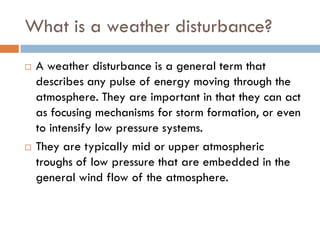
3. Cyclone

 1. Tropical Cyclone


                                      Summary


2. Tornado             4. Storm
Tropical Cyclone/Hurricane/Typhoon

   An Intense circular storm that originates over warm
    tropical oceans and is characterized by low
    atmospheric pressure, high winds and heavy rains.
   A Tropical Cyclone draws energy from the sea
    surface and maintaining its strength as long as it
    remains over warm water.
   A Tropical Cyclone is accompanied by torrential
    rains.
Tornado
   Tornado is a small-diameter column of violently
    rotating air developed within a convective cloud
    and in contact with the ground.
   Tornadoes that hit a populated area causes
    fantastic destruction and great loss of life, mainly
    from flying debris and collapsing structures.
   This strong winds occur in all continents except
    Antarctica.
Cyclone
   Cyclone is any large system of winds that circulates
    about a centre of low atmospheric pressure in a
    counter clockwise direction north of the Equator and
    in a clockwise direction to the south.
   This winds are generally associated with rain or
    snow.
   If there are two cyclones that are near and
    interacting with each other, they cause the Fujiwhara
    Effect.
Storm
   Violent atmospheric disturbance, characterized by
    low barometric pressure, cloud cover, precipitation,
    strong winds, and possibly lightning and thunder.
   In meteorology, storm is restricted to a cyclone with
    a strong low pressure center, strong winds,
    accompanied by heavy precipitation, lightning and
    thunder.
   This generally forms from Low-Pressure Area (LPA)
Summary
   Weather disturbance is a pulse of energy moving
    through the atmosphere. They are embedded in the
    general wind flow of the atmosphere.
   Tropical Cyclone is an intense circular storm that
    originates over warm tropical oceans and is
    characterized by low atmospheric pressure, high
    winds and heavy rains.
   Tornado is a small-diameter column of violent air
    within a convective cloud in contact with the ground.
Summary(cont.)
   Cyclone is a general term for any large system of
    winds that circulates about a center of low
    atmospheric pressure accompanied by rain or snow.
   Storm is a violent atmospheric disturbance,
    characterized by low barometric pressure, cloud
    cover, precipitation, strong winds, and possibly
    lightning and thunder.
   Storm generally forms from LPA
End


      Repeat Report? Click here.

Weather disturbances

  • 1.
    WEATHER DISTURBANCES PREPARED BY: HURRICANE, TROPICAL CYCLONE, TYPHOON, AARON LOPEZ TORNADO, CYCLONE, STORM
  • 2.
    What is aweather disturbance?  A weather disturbance is a general term that describes any pulse of energy moving through the atmosphere. They are important in that they can act as focusing mechanisms for storm formation, or even to intensify low pressure systems.  They are typically mid or upper atmospheric troughs of low pressure that are embedded in the general wind flow of the atmosphere.
  • 3.
    3. Cyclone 1.Tropical Cyclone Summary 2. Tornado 4. Storm
  • 4.
    Tropical Cyclone/Hurricane/Typhoon  An Intense circular storm that originates over warm tropical oceans and is characterized by low atmospheric pressure, high winds and heavy rains.  A Tropical Cyclone draws energy from the sea surface and maintaining its strength as long as it remains over warm water.  A Tropical Cyclone is accompanied by torrential rains.
  • 5.
    Tornado  Tornado is a small-diameter column of violently rotating air developed within a convective cloud and in contact with the ground.  Tornadoes that hit a populated area causes fantastic destruction and great loss of life, mainly from flying debris and collapsing structures.  This strong winds occur in all continents except Antarctica.
  • 6.
    Cyclone  Cyclone is any large system of winds that circulates about a centre of low atmospheric pressure in a counter clockwise direction north of the Equator and in a clockwise direction to the south.  This winds are generally associated with rain or snow.  If there are two cyclones that are near and interacting with each other, they cause the Fujiwhara Effect.
  • 7.
    Storm  Violent atmospheric disturbance, characterized by low barometric pressure, cloud cover, precipitation, strong winds, and possibly lightning and thunder.  In meteorology, storm is restricted to a cyclone with a strong low pressure center, strong winds, accompanied by heavy precipitation, lightning and thunder.  This generally forms from Low-Pressure Area (LPA)
  • 8.
    Summary  Weather disturbance is a pulse of energy moving through the atmosphere. They are embedded in the general wind flow of the atmosphere.  Tropical Cyclone is an intense circular storm that originates over warm tropical oceans and is characterized by low atmospheric pressure, high winds and heavy rains.  Tornado is a small-diameter column of violent air within a convective cloud in contact with the ground.
  • 9.
    Summary(cont.)  Cyclone is a general term for any large system of winds that circulates about a center of low atmospheric pressure accompanied by rain or snow.  Storm is a violent atmospheric disturbance, characterized by low barometric pressure, cloud cover, precipitation, strong winds, and possibly lightning and thunder.  Storm generally forms from LPA
  • 10.
    End Repeat Report? Click here.