Bitcoin: A Peer-to-Peer Electronic Cash
System
PARAS JAIN
TE CMPN-A-46
Satoshi Nakamoto
October 21, 2008
(Anonymous Programmers)
OUTLINE FOR THE SEMINAR
1.What Is Bitcoin
2.Abstract
3.Problem Definition
4.Literature Survey
5.Getting Started With Bitcoin
6.What Is Bitcoin Mining
7.How Bitcoin Works
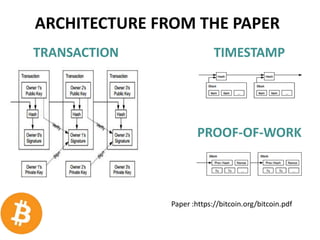
8.Architecture From The Paper
9.Implementation
10.Conclusion
11.References
WHAT IS BITCOIN
• First Decentralized Digital Currency
• No Bank, Very Less Fee
• P2p(no Third Party Involved)
• No Prerequisite And Limit
• Can Be Used Anywhere Across The World
• Transaction Are High Speed, Low Cost, Secured
ABSTRACT
• A purely peer-to-peer version of electronic cash
would allow online payments to be sent directly from
one party to another without going through a
financial institution.
• Digital signatures provide part of the solution, but
the main benefits are lost if a trusted third party is
still required to prevent double-spending.
• The network timestamps transactions by hashing
them into an ongoing chain of hash-based proof-of-
work, forming a record that cannot be changed
without redoing the proof-of-work.
PROBLEM DEFENITION
• Commerce on the Internet has come to rely almost
exclusively on financial institutions serving as trusted
third parties to process electronic payments.
• Completely non-reversible transactions are not really
possible, since financial institutions cannot avoid
mediating disputes.
• What is needed is an electronic payment system
based on cryptographic proof instead of
trust, allowing any two willing parties to transact
directly with each other without the need for a
trusted third party
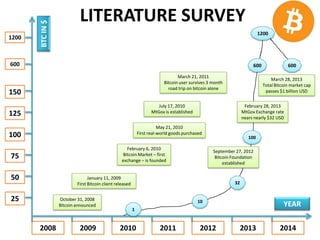
LITERATURE SURVEY
2008 2009 2010 2011 2012 2013 2014
BTCIN$
25
50
75
100
125
150
1200
600
October 31, 2008
Bitcoin announced
January 11, 2009
First Bitcoin client released
February 6, 2010
Bitcoin Market – first
exchange – is founded
May 21, 2010
First real-world goods purchased
July 17, 2010
MtGox is established
March 21, 2011
Bitcoin user survives 3 month
road trip on bitcoin alone
YEAR
March 28, 2013
Total Bitcoin market cap
passes $1 billion USD
600 600
32
100
10
1
1200
February 28, 2013
MtGox Exchange rate
nears nearly $32 USD
September 27, 2012
Bitcoin Foundation
established
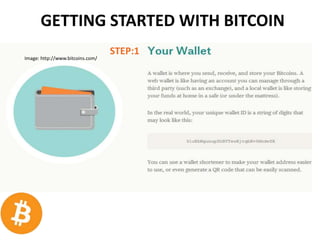
GETTING STARTED WITH BITCOIN
STEP:1
Image: http://www.bitcoins.com/
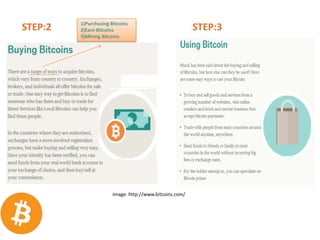
STEP:2 STEP:31)Purchasing Bitcoins
2)Earn Bitcoins
3)Mining Bitcoins
Image: http://www.bitcoins.com/
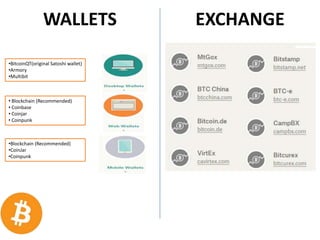
WALLETS EXCHANGE
• Blockchain (Recommended)
• Coinbase
• Coinjar
• Coinpunk
•BitcoinQT(original Satoshi wallet)
•Armory
•Multibit
•Blockchain (Recommended)
•CoinJar
•Coinpunk
WHAT IS BITCOIN MINNING
• Bitcoin Is A P2P Network ,No Centralized
Government
• Bitcoin Has Miners
• To Process The Transaction The Miners
Solve The Math Problem
• After The Transaction Is Approved, Miners
Are Given Rewards(i.e. Bitcoin)
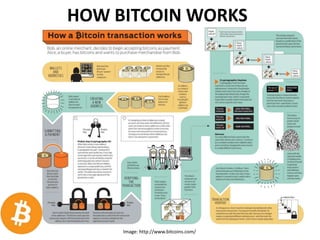
HOW BITCOIN WORKS
Image: http://www.bitcoins.com/
TECHNICAL BACKGROUND
• During mining, your computer runs a cryptographic hashing function (two
rounds of SHA256) on what is called a block header.
• For each new hash, the mining software will use a different number as the
random element of the block header, this number is called the nonce.
• Depending on the nonce and what else is in the block the hashing function will
yield a hash which looks like this:
93ef6f358fbb998c60802496863052290d4c63735b7fe5bdaac821de96a53a9a
• Now to make mining difficult, there is what's called a difficulty target.
• To create a valid block your miner has to find a hash that is below the difficulty
target. So if for example the difficulty target is
1000000000000000000000000000000000000000000000000000000000000000
,any number that starts with a zero would be below the target, e.g.:
0787a6fd6e0782f7f8058fbef45f5c17fe89086ad4e78a1520d06505acb4522f
TECHNICAL BACKGROUND CONT…
• Because the target is such an unwieldy number with tons of digits, people
generally use a simpler number to express the current target. This number is
called the mining difficulty. The mining difficulty expresses how much harder
the current block is to generate compared to the first block. So a difficulty of
70000 means to generate the current block you have to do 70000 times more
work than Satoshi had to do generating the first block. Though be fair
though, back then mining was a lot slower and less optimized.
• The difficulty changes every 2016 blocks. The network tries to change it such
that 2016 blocks at the current global network processing power take about 14
days. That's why, when the network power rises, the difficulty rises as well.
ARCHITECTURE FROM THE PAPER
TRANSACTION TIMESTAMP
PROOF-OF-WORK
Paper :https://bitcoin.org/bitcoin.pdf
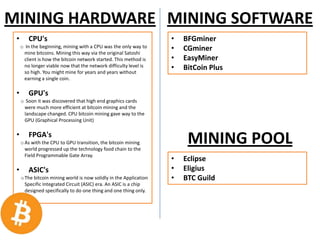
MINING HARDWARE MINING SOFTWARE
• CPU's
o In the beginning, mining with a CPU was the only way to
mine bitcoins. Mining this way via the original Satoshi
client is how the bitcoin network started. This method is
no longer viable now that the network difficulty level is
so high. You might mine for years and years without
earning a single coin.
• GPU's
o Soon it was discovered that high end graphics cards
were much more efficient at bitcoin mining and the
landscape changed. CPU bitcoin mining gave way to the
GPU (Graphical Processing Unit)
• FPGA's
o As with the CPU to GPU transition, the bitcoin mining
world progressed up the technology food chain to the
Field Programmable Gate Array.
• ASIC's
oThe bitcoin mining world is now solidly in the Application
Specific Integrated Circuit (ASIC) era. An ASIC is a chip
designed specifically to do one thing and one thing only.
• BFGminer
• CGminer
• EasyMiner
• BitCoin Plus
MINING POOL
• Eclipse
• Eligius
• BTC Guild
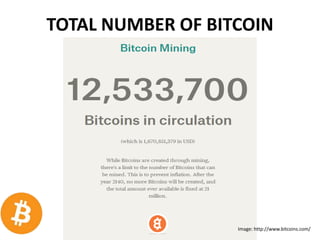
TOTAL NUMBER OF BITCOIN
Image: http://www.bitcoins.com/
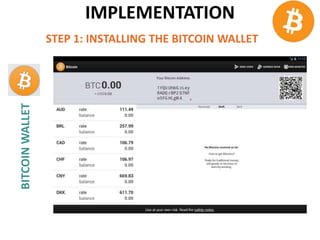
IMPLEMENTATION
STEP 1: INSTALLING THE BITCOIN WALLET
BITCOINWALLET
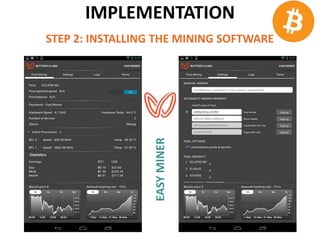
IMPLEMENTATION
STEP 2: INSTALLING THE MINING SOFTWARE
EASYMINER
CONCLUSION
• We have proposed a system for electronic transactions
without relying on trust.
• We started with the usual framework of coins made from
digital signatures, which provides strong control of
ownership, but is incomplete without a way to prevent
double-spending.
• To solve this, we proposed a peer-to-peer network using
proof-of-work to record a public history of transactions
that quickly becomes computationally impractical for an
attacker to change if honest nodes control a majority of
CPU power.
REFRENCES
• [1] W. Dai, "b-money," http://www.weidai.com/bmoney.txt, 1998.
• [2] H. Massias, X.S. Avila, and J.-J. Quisquater, "Design of a secure timestamping service with minimal trust requirements," In 20th
Symposium on Information Theory in the Benelux, May 1999.
• [3] S. Haber, W.S. Stornetta, "How to time-stamp a digital document," In Journal of Cryptology, vol 3, no 2, pages 99-111, 1991.
• [4] D. Bayer, S. Haber, W.S. Stornetta, "Improving the efficiency and reliability of digital time-stamping," In Sequences II: Methods
in Communication, Security and Computer Science, pages 329-334, 1993.
• [5] S. Haber, W.S. Stornetta, "Secure names for bit-strings," In Proceedings of the 4th ACM Conference on Computer and
Communications Security, pages 28-35, April 1997.
• [6] A. Back, "Hashcash - a denial of service counter-measure,“ http://www.hashcash.org/papers/hashcash.pdf, 2002.
• [7] R.C. Merkle, "Protocols for public key cryptosystems," In Proc. 1980 Symposium on Security and Privacy, IEEE Computer
Society, pages 122-133, April 1980.
• [8] W. Feller, "An introduction to probability theory and its applications," 1957

Bitcoin: A Peer-to-Peer Electronic Cash System

  • 1.
    Bitcoin: A Peer-to-PeerElectronic Cash System PARAS JAIN TE CMPN-A-46 Satoshi Nakamoto October 21, 2008 (Anonymous Programmers)
  • 2.
    OUTLINE FOR THESEMINAR 1.What Is Bitcoin 2.Abstract 3.Problem Definition 4.Literature Survey 5.Getting Started With Bitcoin 6.What Is Bitcoin Mining 7.How Bitcoin Works 8.Architecture From The Paper 9.Implementation 10.Conclusion 11.References
  • 3.
    WHAT IS BITCOIN •First Decentralized Digital Currency • No Bank, Very Less Fee • P2p(no Third Party Involved) • No Prerequisite And Limit • Can Be Used Anywhere Across The World • Transaction Are High Speed, Low Cost, Secured
  • 4.
    ABSTRACT • A purelypeer-to-peer version of electronic cash would allow online payments to be sent directly from one party to another without going through a financial institution. • Digital signatures provide part of the solution, but the main benefits are lost if a trusted third party is still required to prevent double-spending. • The network timestamps transactions by hashing them into an ongoing chain of hash-based proof-of- work, forming a record that cannot be changed without redoing the proof-of-work.
  • 5.
    PROBLEM DEFENITION • Commerceon the Internet has come to rely almost exclusively on financial institutions serving as trusted third parties to process electronic payments. • Completely non-reversible transactions are not really possible, since financial institutions cannot avoid mediating disputes. • What is needed is an electronic payment system based on cryptographic proof instead of trust, allowing any two willing parties to transact directly with each other without the need for a trusted third party
  • 6.
    LITERATURE SURVEY 2008 20092010 2011 2012 2013 2014 BTCIN$ 25 50 75 100 125 150 1200 600 October 31, 2008 Bitcoin announced January 11, 2009 First Bitcoin client released February 6, 2010 Bitcoin Market – first exchange – is founded May 21, 2010 First real-world goods purchased July 17, 2010 MtGox is established March 21, 2011 Bitcoin user survives 3 month road trip on bitcoin alone YEAR March 28, 2013 Total Bitcoin market cap passes $1 billion USD 600 600 32 100 10 1 1200 February 28, 2013 MtGox Exchange rate nears nearly $32 USD September 27, 2012 Bitcoin Foundation established
  • 7.
    GETTING STARTED WITHBITCOIN STEP:1 Image: http://www.bitcoins.com/
  • 8.
    STEP:2 STEP:31)Purchasing Bitcoins 2)EarnBitcoins 3)Mining Bitcoins Image: http://www.bitcoins.com/
  • 9.
    WALLETS EXCHANGE • Blockchain(Recommended) • Coinbase • Coinjar • Coinpunk •BitcoinQT(original Satoshi wallet) •Armory •Multibit •Blockchain (Recommended) •CoinJar •Coinpunk
  • 10.
    WHAT IS BITCOINMINNING • Bitcoin Is A P2P Network ,No Centralized Government • Bitcoin Has Miners • To Process The Transaction The Miners Solve The Math Problem • After The Transaction Is Approved, Miners Are Given Rewards(i.e. Bitcoin)
  • 11.
    HOW BITCOIN WORKS Image:http://www.bitcoins.com/
  • 12.
    TECHNICAL BACKGROUND • Duringmining, your computer runs a cryptographic hashing function (two rounds of SHA256) on what is called a block header. • For each new hash, the mining software will use a different number as the random element of the block header, this number is called the nonce. • Depending on the nonce and what else is in the block the hashing function will yield a hash which looks like this: 93ef6f358fbb998c60802496863052290d4c63735b7fe5bdaac821de96a53a9a • Now to make mining difficult, there is what's called a difficulty target. • To create a valid block your miner has to find a hash that is below the difficulty target. So if for example the difficulty target is 1000000000000000000000000000000000000000000000000000000000000000 ,any number that starts with a zero would be below the target, e.g.: 0787a6fd6e0782f7f8058fbef45f5c17fe89086ad4e78a1520d06505acb4522f
  • 13.
    TECHNICAL BACKGROUND CONT… •Because the target is such an unwieldy number with tons of digits, people generally use a simpler number to express the current target. This number is called the mining difficulty. The mining difficulty expresses how much harder the current block is to generate compared to the first block. So a difficulty of 70000 means to generate the current block you have to do 70000 times more work than Satoshi had to do generating the first block. Though be fair though, back then mining was a lot slower and less optimized. • The difficulty changes every 2016 blocks. The network tries to change it such that 2016 blocks at the current global network processing power take about 14 days. That's why, when the network power rises, the difficulty rises as well.
  • 14.
    ARCHITECTURE FROM THEPAPER TRANSACTION TIMESTAMP PROOF-OF-WORK Paper :https://bitcoin.org/bitcoin.pdf
  • 15.
    MINING HARDWARE MININGSOFTWARE • CPU's o In the beginning, mining with a CPU was the only way to mine bitcoins. Mining this way via the original Satoshi client is how the bitcoin network started. This method is no longer viable now that the network difficulty level is so high. You might mine for years and years without earning a single coin. • GPU's o Soon it was discovered that high end graphics cards were much more efficient at bitcoin mining and the landscape changed. CPU bitcoin mining gave way to the GPU (Graphical Processing Unit) • FPGA's o As with the CPU to GPU transition, the bitcoin mining world progressed up the technology food chain to the Field Programmable Gate Array. • ASIC's oThe bitcoin mining world is now solidly in the Application Specific Integrated Circuit (ASIC) era. An ASIC is a chip designed specifically to do one thing and one thing only. • BFGminer • CGminer • EasyMiner • BitCoin Plus MINING POOL • Eclipse • Eligius • BTC Guild
  • 16.
    TOTAL NUMBER OFBITCOIN Image: http://www.bitcoins.com/
  • 17.
    IMPLEMENTATION STEP 1: INSTALLINGTHE BITCOIN WALLET BITCOINWALLET
  • 18.
    IMPLEMENTATION STEP 2: INSTALLINGTHE MINING SOFTWARE EASYMINER
  • 19.
    CONCLUSION • We haveproposed a system for electronic transactions without relying on trust. • We started with the usual framework of coins made from digital signatures, which provides strong control of ownership, but is incomplete without a way to prevent double-spending. • To solve this, we proposed a peer-to-peer network using proof-of-work to record a public history of transactions that quickly becomes computationally impractical for an attacker to change if honest nodes control a majority of CPU power.
  • 20.
    REFRENCES • [1] W.Dai, "b-money," http://www.weidai.com/bmoney.txt, 1998. • [2] H. Massias, X.S. Avila, and J.-J. Quisquater, "Design of a secure timestamping service with minimal trust requirements," In 20th Symposium on Information Theory in the Benelux, May 1999. • [3] S. Haber, W.S. Stornetta, "How to time-stamp a digital document," In Journal of Cryptology, vol 3, no 2, pages 99-111, 1991. • [4] D. Bayer, S. Haber, W.S. Stornetta, "Improving the efficiency and reliability of digital time-stamping," In Sequences II: Methods in Communication, Security and Computer Science, pages 329-334, 1993. • [5] S. Haber, W.S. Stornetta, "Secure names for bit-strings," In Proceedings of the 4th ACM Conference on Computer and Communications Security, pages 28-35, April 1997. • [6] A. Back, "Hashcash - a denial of service counter-measure,“ http://www.hashcash.org/papers/hashcash.pdf, 2002. • [7] R.C. Merkle, "Protocols for public key cryptosystems," In Proc. 1980 Symposium on Security and Privacy, IEEE Computer Society, pages 122-133, April 1980. • [8] W. Feller, "An introduction to probability theory and its applications," 1957