Independent
Record Labels
https://www.youtube.com/watch?v=u7vInHz79goBit of an Intro:
What are the benefits of being an Indie Label?
An indie label is a record label that is independently funded and
not connected to or owned by one of the Big 3 major labels.
Indie labels range from home based hobby labels to highly
profitable, large businesses.
In the 1990s, the line between indie labels and major labels began
to blur somewhat, and now some large indie labels are actually
distributed by the Big 3 major labels.
Independent Labels – How are they Different?
• There are several thousand independents in the UK
alone.
• Independents rarely include publishing or
manufacturing.
• They occasionally run distribution.
• They frequently have new media operations.
• Some indies specialize in licensing existing
recordings.
• Most deal with their own content and artists.
• The bigger indies can major label distribution.
• Majors sometimes own shares in or invest in indies
Independent Labels – How are they Different?
Independent Labels
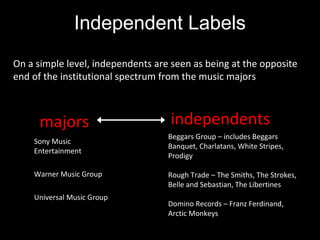
On a simple level, independents are seen as being at the opposite
end of the institutional spectrum from the music majors
majors independents
Sony Music
Entertainment
Warner Music Group
Universal Music Group
Beggars Group – includes Beggars
Banquet, Charlatans, White Stripes,
Prodigy
Rough Trade – The Smiths, The Strokes,
Belle and Sebastian, The Libertines
Domino Records – Franz Ferdinand,
Arctic Monkeys
Independent Labels
Indie labels often face an uphill battle trying to get their music
heard, as they typically have far fewer financial resources to
promote their music than major labels do.
Despite the struggle, many labels have survived, and thrived, for
years, and many other indie labels may not have lasted forever but
had a tremendous impact on music both creatively and in terms of
business.
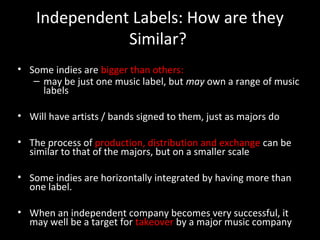
Independent Labels: How are they
Similar?
• Some indies are bigger than others:
– may be just one music label, but may own a range of music
labels
• Will have artists / bands signed to them, just as majors do
• The process of production, distribution and exchange can be
similar to that of the majors, but on a smaller scale
• Some indies are horizontally integrated by having more than
one label.
• When an independent company becomes very successful, it
may well be a target for takeover by a major music company
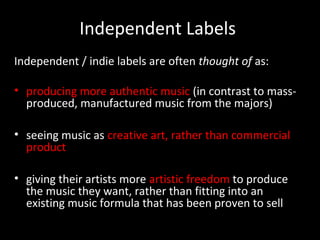
Independent Labels
Independent / indie labels are often thought of as:
• producing more authentic music (in contrast to mass-
produced, manufactured music from the majors)
• seeing music as creative art, rather than commercial
product
• giving their artists more artistic freedom to produce
the music they want, rather than fitting into an
existing music formula that has been proven to sell
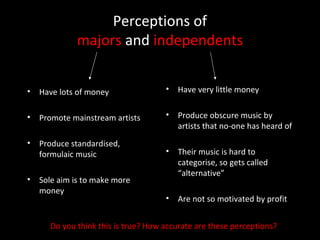
Perceptions of
majors and independents
• Have lots of money
• Promote mainstream artists
• Produce standardised,
formulaic music
• Sole aim is to make more
money
• Have very little money
• Produce obscure music by
artists that no-one has heard of
• Their music is hard to
categorise, so gets called
“alternative”
• Are not so motivated by profit
Do you think this is true? How accurate are these perceptions?
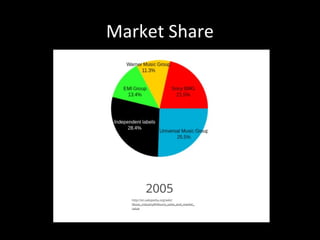
Market Share
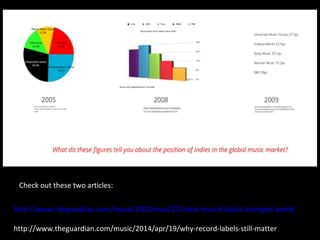
http://www.theguardian.com/music/2012/mar/22/indie-record-labels-changed-world
http://www.theguardian.com/music/2014/apr/19/why-record-labels-still-matter
Check out these two articles:
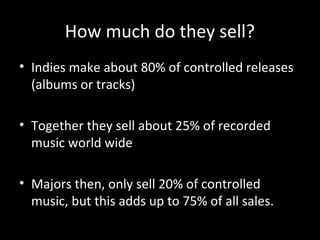
How much do they sell?
• Indies make about 80% of controlled releases
(albums or tracks)
• Together they sell about 25% of recorded
music world wide
• Majors then, only sell 20% of controlled
music, but this adds up to 75% of all sales.
Majors v Indies
MYTHS
• MYTH: Artists on indie labels produce
“alternative” (non-mainstream) music that will
not sell…
But
• Arctic Monkeys - Arctic Monkeys - straight into charts at No. 1 for album
and single in 2006. Fastest selling album up to 2006.
• Franz Ferdinand
• The Strokes
• Oasis - signed to Creation, an indie label, but biggest stadium act of the 90s
• MYTH: Artists on indie labels are all “breaking
new ground”
But
• It can be argued that the most successful
artists are just recycling past musical styles
and images
Majors v Indies
MYTHS
• MYTH: The output of the Big 3 majors is all standardized,
formulaic material.
But
• All of the following have an indie image, but are
contracted to the majors:
– Radiohead - Parlophone – Capitol Records (Universal)
– Sonic Youth - Geffen - Universal
– Green Day, My Chemical Romance, Funeral for a Friend - labels
owned by Warner Music Group
– The Kaiser Chiefs - Universal (after indie start)
Majors v Indies
MYTHS
• MYTH: The majors do not allow “alternative” artists
creative control, and do not really support them
But
• It can be argued that the majors can allow more risk-
taking, because they can cover any losses through
their more profitable mainstream artists.
• “Alternative” artists can draw on the strength of a
major music company to market and distribute their
music
Majors v Indies
MYTHS
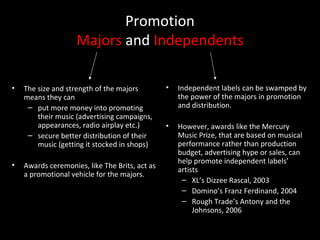
Promotion
Majors and Independents
• The size and strength of the majors
means they can
– put more money into promoting
their music (advertising campaigns,
appearances, radio airplay etc.)
– secure better distribution of their
music (getting it stocked in shops)
• Awards ceremonies, like The Brits, act as
a promotional vehicle for the majors.
• Independent labels can be swamped by
the power of the majors in promotion
and distribution.
• However, awards like the Mercury
Music Prize, that are based on musical
performance rather than production
budget, advertising hype or sales, can
help promote independent labels’
artists
– XL’s Dizzee Rascal, 2003
– Domino’s Franz Ferdinand, 2004
– Rough Trade’s Antony and the
Johnsons, 2006
Where: Main offices located in London, UK, with a satellite office in Brooklyn, USA.
Label Founders: Laurence Bell and Jacqui Rice
Founded: 1993
http://www.dominorecordco.com/
• The band that officially landed Domino in the indie big leagues was Franz
Ferdinand.
• Their self titled first album was an indie favorite, but their 2005 album It
Could Have Been So Much Better earned Domino its first UK number one
album.
• They followed up with the wildly successful I Bet You Look Good on the
Dancefloor, a single by Artic Monkeys, which also was a number one hit in the UK.
• Although these achievements are huge enough for an indie label, Domino was
able to hold on to these bands for the UK market in the wake of their success, a
major coup for an indie label.
• In addition to the less commercial releases that are on the main Domino label,
they founded a subsidiary label, Geographic Records.
• Geographic Records releases music that falls outside of the typical indie
rock/pop of Domino, such as world music, jazz music and other more
experimental music.
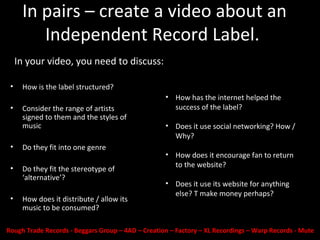
In pairs – create a video about an
Independent Record Label.
• How is the label structured?
• Consider the range of artists
signed to them and the styles of
music
• Do they fit into one genre
• Do they fit the stereotype of
‘alternative’?
• How does it distribute / allow its
music to be consumed?
• How has the internet helped the
success of the label?
• Does it use social networking? How /
Why?
• How does it encourage fan to return
to the website?
• Does it use its website for anything
else? T make money perhaps?
Rough Trade Records - Beggars Group – 4AD – Creation – Factory – XL Recordings – Warp Records - Mute
In your video, you need to discuss:

Independent Music Labels

  • 1.
  • 2.
    What are thebenefits of being an Indie Label? An indie label is a record label that is independently funded and not connected to or owned by one of the Big 3 major labels. Indie labels range from home based hobby labels to highly profitable, large businesses. In the 1990s, the line between indie labels and major labels began to blur somewhat, and now some large indie labels are actually distributed by the Big 3 major labels. Independent Labels – How are they Different?
  • 3.
    • There areseveral thousand independents in the UK alone. • Independents rarely include publishing or manufacturing. • They occasionally run distribution. • They frequently have new media operations. • Some indies specialize in licensing existing recordings. • Most deal with their own content and artists. • The bigger indies can major label distribution. • Majors sometimes own shares in or invest in indies Independent Labels – How are they Different?
  • 4.
    Independent Labels On asimple level, independents are seen as being at the opposite end of the institutional spectrum from the music majors majors independents Sony Music Entertainment Warner Music Group Universal Music Group Beggars Group – includes Beggars Banquet, Charlatans, White Stripes, Prodigy Rough Trade – The Smiths, The Strokes, Belle and Sebastian, The Libertines Domino Records – Franz Ferdinand, Arctic Monkeys
  • 5.
    Independent Labels Indie labelsoften face an uphill battle trying to get their music heard, as they typically have far fewer financial resources to promote their music than major labels do. Despite the struggle, many labels have survived, and thrived, for years, and many other indie labels may not have lasted forever but had a tremendous impact on music both creatively and in terms of business.
  • 6.
    Independent Labels: Howare they Similar? • Some indies are bigger than others: – may be just one music label, but may own a range of music labels • Will have artists / bands signed to them, just as majors do • The process of production, distribution and exchange can be similar to that of the majors, but on a smaller scale • Some indies are horizontally integrated by having more than one label. • When an independent company becomes very successful, it may well be a target for takeover by a major music company
  • 7.
    Independent Labels Independent /indie labels are often thought of as: • producing more authentic music (in contrast to mass- produced, manufactured music from the majors) • seeing music as creative art, rather than commercial product • giving their artists more artistic freedom to produce the music they want, rather than fitting into an existing music formula that has been proven to sell
  • 8.
    Perceptions of majors andindependents • Have lots of money • Promote mainstream artists • Produce standardised, formulaic music • Sole aim is to make more money • Have very little money • Produce obscure music by artists that no-one has heard of • Their music is hard to categorise, so gets called “alternative” • Are not so motivated by profit Do you think this is true? How accurate are these perceptions?
  • 9.
  • 12.
  • 13.
    How much dothey sell? • Indies make about 80% of controlled releases (albums or tracks) • Together they sell about 25% of recorded music world wide • Majors then, only sell 20% of controlled music, but this adds up to 75% of all sales.
  • 14.
    Majors v Indies MYTHS •MYTH: Artists on indie labels produce “alternative” (non-mainstream) music that will not sell… But • Arctic Monkeys - Arctic Monkeys - straight into charts at No. 1 for album and single in 2006. Fastest selling album up to 2006. • Franz Ferdinand • The Strokes • Oasis - signed to Creation, an indie label, but biggest stadium act of the 90s
  • 15.
    • MYTH: Artistson indie labels are all “breaking new ground” But • It can be argued that the most successful artists are just recycling past musical styles and images Majors v Indies MYTHS
  • 16.
    • MYTH: Theoutput of the Big 3 majors is all standardized, formulaic material. But • All of the following have an indie image, but are contracted to the majors: – Radiohead - Parlophone – Capitol Records (Universal) – Sonic Youth - Geffen - Universal – Green Day, My Chemical Romance, Funeral for a Friend - labels owned by Warner Music Group – The Kaiser Chiefs - Universal (after indie start) Majors v Indies MYTHS
  • 17.
    • MYTH: Themajors do not allow “alternative” artists creative control, and do not really support them But • It can be argued that the majors can allow more risk- taking, because they can cover any losses through their more profitable mainstream artists. • “Alternative” artists can draw on the strength of a major music company to market and distribute their music Majors v Indies MYTHS
  • 18.
    Promotion Majors and Independents •The size and strength of the majors means they can – put more money into promoting their music (advertising campaigns, appearances, radio airplay etc.) – secure better distribution of their music (getting it stocked in shops) • Awards ceremonies, like The Brits, act as a promotional vehicle for the majors. • Independent labels can be swamped by the power of the majors in promotion and distribution. • However, awards like the Mercury Music Prize, that are based on musical performance rather than production budget, advertising hype or sales, can help promote independent labels’ artists – XL’s Dizzee Rascal, 2003 – Domino’s Franz Ferdinand, 2004 – Rough Trade’s Antony and the Johnsons, 2006
  • 19.
    Where: Main officeslocated in London, UK, with a satellite office in Brooklyn, USA. Label Founders: Laurence Bell and Jacqui Rice Founded: 1993 http://www.dominorecordco.com/
  • 20.
    • The bandthat officially landed Domino in the indie big leagues was Franz Ferdinand. • Their self titled first album was an indie favorite, but their 2005 album It Could Have Been So Much Better earned Domino its first UK number one album. • They followed up with the wildly successful I Bet You Look Good on the Dancefloor, a single by Artic Monkeys, which also was a number one hit in the UK. • Although these achievements are huge enough for an indie label, Domino was able to hold on to these bands for the UK market in the wake of their success, a major coup for an indie label. • In addition to the less commercial releases that are on the main Domino label, they founded a subsidiary label, Geographic Records. • Geographic Records releases music that falls outside of the typical indie rock/pop of Domino, such as world music, jazz music and other more experimental music.
  • 21.
    In pairs –create a video about an Independent Record Label. • How is the label structured? • Consider the range of artists signed to them and the styles of music • Do they fit into one genre • Do they fit the stereotype of ‘alternative’? • How does it distribute / allow its music to be consumed? • How has the internet helped the success of the label? • Does it use social networking? How / Why? • How does it encourage fan to return to the website? • Does it use its website for anything else? T make money perhaps? Rough Trade Records - Beggars Group – 4AD – Creation – Factory – XL Recordings – Warp Records - Mute In your video, you need to discuss:

Editor's Notes

  • #15 Arctic Monkeys - straight into charts at No. 1 for album and single in 2006. Fastest selling album up to 2006. Franz Ferdinand & The Strokes - big hits Oasis - signed to Creation, an indie label, but biggest stadium act of the 90s Indies need money to stay afloat jus like any other business. Mainstream successes like these bring much needed financial security
  • #16 Any examples to be discussed?