Aziz Art Jun
2015
M
oh
se
n
va
zir
i
m
og
ha
da
m
Bahman Mohassess
G
u
st
a
v
K
li
m
t
Stella Dunkley
Aziz Anzabi
Jen
nif
er
M
orr
iso
n
Forough Farrokhzad
Iran
C
o
m
p
e
ti
ti
o
n
Director: Aziz Anzabi
Editor and translator :
Asra Yaghoubi
Research: Zohreh Nazari
Contents:
1-Mohsen Vaziri-Moghaddam
7-Gustav Klimt
12-Competition
13-Stella Dunkley
15-Bahman Mohassess
17-Jennifer Morrison
18-Competition
19-Forough Farrokhzad
22-Aziz Anzabi
http://www.aziz-anzabi.com
Oh sky,
if I want one day to fly from this silent
prison,
what shall I say to the weeping child's
eyes:
forget about me, for I am captive bird?
I am that candle which illuminates a
ruins with the burning of her heart.
If I want to choose silent darkness,
I will bring a nest to ruin.
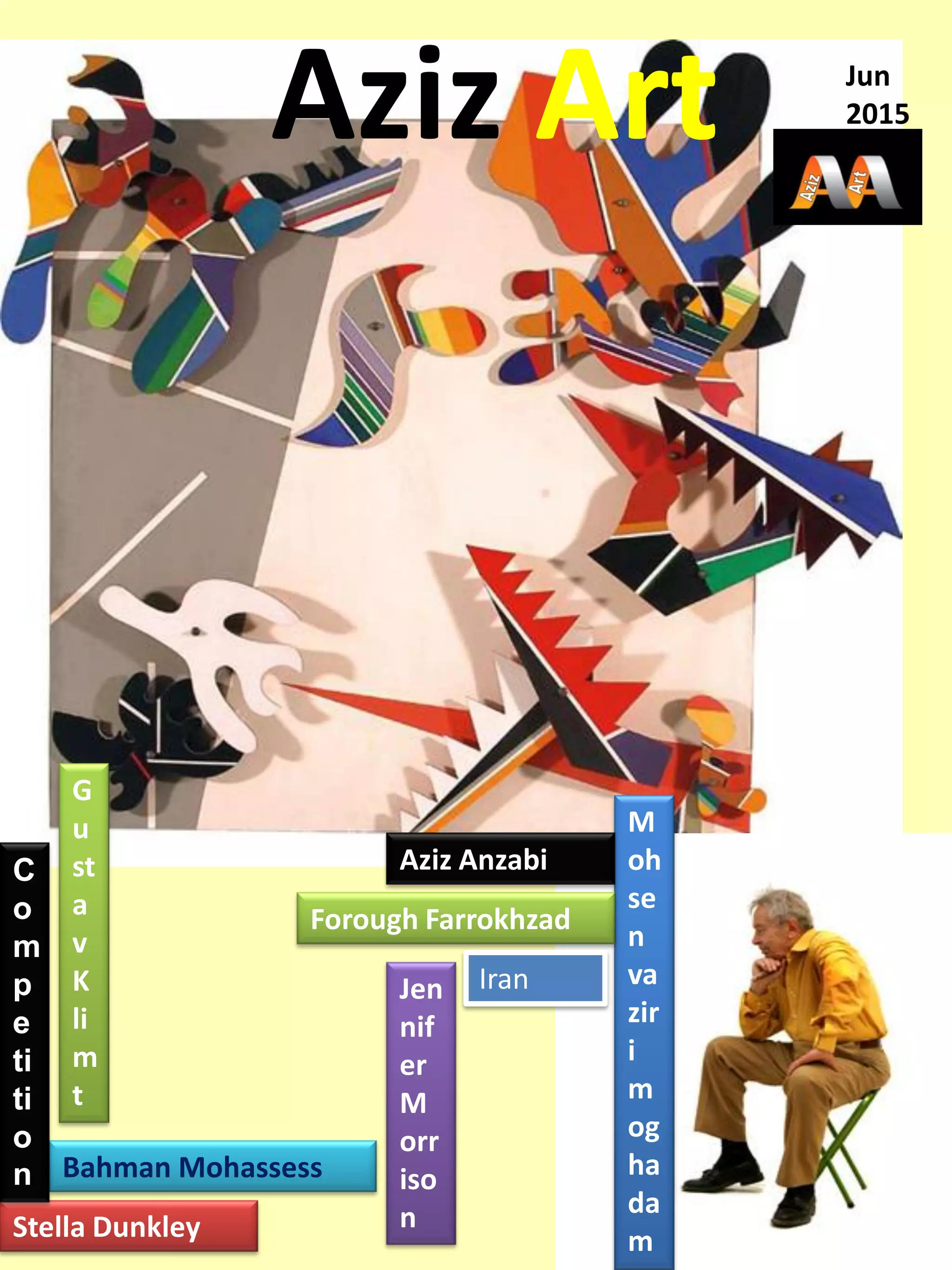
Mohsen Vaziri-Moghaddam
Education
In 1943, after obtaining his diploma
at the Agricultural Institute, he
applies to the Faculty of Fine Arts
in Tehran and attends for three
years. During this period, as the
artist himself will say later on, “I
learned how to nurture my drawing
skills from Heidarian [his painting
teacher] and I did the rest myself; I
painted portraits and landscapes
that didn’t go beyond study
patterns”. During his years at the
Academy, he feels the influence of
Impressionism and Post-
Impressionism, especially Van
Gogh, in both subject matters and
expressive forms.
In 1952, his first solo exhibition is
held at the Iran-America Society in
Teheran.
In 1955 Vaziri leaves for Rome
where he studies at the Academy of
Fine Arts until 1958. During these
years, coinciding with the
establishment of the European In
formalism and the American action
painting, after “studying and
analysing new modern art
movements”, Vaziri reaches the
conclusion that “painting is not a
reconstruction of objective reality,
but the artist has to create
something that never existed
before”.
1
Career
In the April of 1956 Vaziri opens his
first Italian exhibition, displaying his
figurative paintings at the
Portonovo Art Gallery in Rome. In
the same year, he exhibits in
Düsseldorf and Munich, in
Germany.
In 1957, a landmark year and
turning point in his artistic career,
he attends Toti Scialoja’s classes at
the Academy for six months and he
starts experimenting with abstract
art. Vaziri will later confess that this
is when he learned “how to
conceive abstract painting and how
to create visual spaces”. His first
abstract works date back to 1958-
1959 and they fit in perfectly with
the search for materials and
brushstrokes happening in
contemporary movements.
Between 1959 and 1960 he
develops a vision of abstract art
through experiments that are
highly focused on materials. This
will lead to the creation of some of
his most powerful works: the sand
paintings. These paintings were
conceived in a playful moment in
the spring of 1959 and Vaziri will
keep trying his hand at them for
the following 3 years, until 1963.
Different types of sand are applied
to the canvas in their natural state,
or mixed with colour. This original
concept grabs the attention of
some of the most prominent Italian
art critics of the time, such as Giulio
Carlo Argan and Palma Bucarelli.
In 1964 Vaziri is at the peak of his
artistic career that coincides with
the purchase of one of his paintings
by the Modern Art Museum
(MoMA) in New York. He is away
from Italy for a long time and
returns to Iran where he will teach
for several years (until 1975), at the
Faculty of Decorative Arts (the
current University of Art) and the
Faculty of Fine Arts in Tehran. In
those years, he starts writing some
art methodology textbooks and in
1981, he publishes Drawing
method and Painting guide.
His textbooks are still amongst the
most studied by Iranian art
students today. His return to Iran
and heavy teaching commitments
keep Vaziri away from painting for
almost three years.
2
Between 1967 and 1968 he starts
working on a series of reliefs made
of aluminium and iron sheets and is
still anchored to a mono-
dimensional approach. Shortly
after, from 1969, the reliefs will
lead him to the creation of tri-
dimensional works, i.e. wood
sculptures. From 1970, the next
step in the evolution of still works
will be a series of articulated,
mobile sculptures whose wood
pieces are joined together by nuts
and bolts “so that – in Vaziri’s own
words – they would open and
close just like human joints”.
During the 1970s, these sculptures
will in turn inspire a series of
paintings that mark a return to the
well-defined shapes (both pointed
and rounded) of his tri-dimensional
works and develop them further.
Alberto Moravia and Pierre
Restany are amongst the eminent
figures that will write about his
work.
In his chosen field, whether
directed to painting or sculpture, a
constant and essential theme is
that of space, which has brought
him results much appreciated by
critics (Argan, Moravia, Bevilacqua,
Menna, Pensabene) and
recognition by the City of Rome
(1958) and from Prime Minister
Segni (International Art
Competition, Ravenna 1959) and
the Senate Gold Medal
(Sassoferrato 1962).
His works have been shown in
numerous solo exhibitions in Italy
(Rome, Milan, Florence), Germany
(Dusseldorf, Munich), and Iran, at
the Venice Biennial (1958, 1960,
1962, 1964), at the Tehran Biennial
(1960, 1962 ), at the Rome
Quadriennale (1960), at the Sao
Paulo Biennial in Brazil (1962), at
the Museum of Modern Art, New
York (1964) and at the Shiraz Art
Festival, Iran (1969).
3
In 1985 Vaziri moves to Italy
permanently, with his wife and
two children.
In the 1990s the artist works on
Persian calligraphy shapes, trying
to point out the minimalism of its
lines. He also continues to test
himself with abstract compositions
that are all different from each
other and characterised by either
highly defined shapes and intense
colours or vague silhouettes and
soft pastel colours.
In 1999 his translation of The
Mind and Work of Paul Klee by
W. Hahtmann is published.
In 2000 he resumes contact with
Iranian universities and holds
several lectures.
In 2003 Vaziri is affected by an eye
disease, that will considerably
reduce his eyesight, but it doesn’t
let this dampen his spirit. On the
contrary, he invents a new way of
expressing himself: this is how
some new acrylic paintings are
born in which large splashes of
colour reflect his way of seeing
reality.
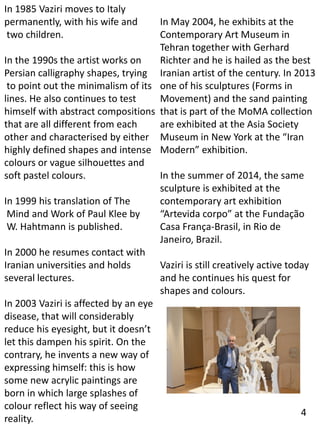
In May 2004, he exhibits at the
Contemporary Art Museum in
Tehran together with Gerhard
Richter and he is hailed as the best
Iranian artist of the century. In 2013
one of his sculptures (Forms in
Movement) and the sand painting
that is part of the MoMA collection
are exhibited at the Asia Society
Museum in New York at the “Iran
Modern” exhibition.
In the summer of 2014, the same
sculpture is exhibited at the
contemporary art exhibition
“Artevida corpo” at the Fundação
Casa França-Brasil, in Rio de
Janeiro, Brazil.
Vaziri is still creatively active today
and he continues his quest for
shapes and colours.
4
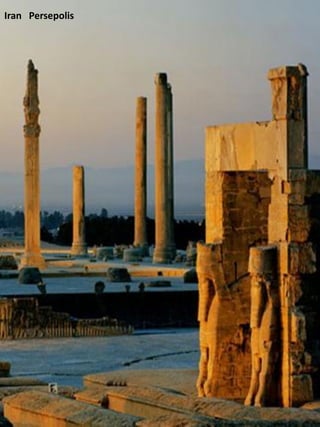
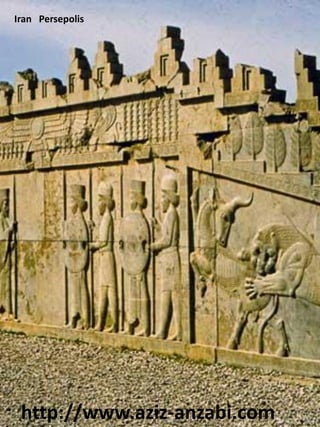
Iran Persepolis
Judith and the
Head of
Holofernes,
1901. Österreichi
sche Galerie
Belvedere,
Vienna
Gustav Klimt
(July 14, 1862 – February 6, 1918)
was an Austrian symbolist painter
and one of the most prominent
members of the Vienna Secession
movement. Klimt is noted for his
paintings, murals, sketches, and
other objets d'art. Klimt's primary
subject was the female body, and
his works are marked by a frank
eroticism. In addition to his
figurative works, which include
allegories and portraits, he painted
landscapes. Among the artists of
the Vienna Secession, Klimt was the
most influenced by Japanese art
and its methods.
Early in his artistic career, he was a
successful painter of architectural
decorations in a conventional
manner. As he developed a more
personal style, his work was the
subject of controversy that
culminated when the paintings he
completed around 1900 for the
ceiling of the Great Hall of the
University of Vienna were criticized
as pornographic. He subsequently
accepted no more public
commissions, but achieved a new
success with the paintings of his
"golden phase," many of which
include gold leaf. Klimt's work was
an important influence on his
younger contemporary Egon
Schiele.
7
Early life and education
Klimt in a light Blue Smock by Egon
Schiele, 1913
Gustav Klimt was born in
Baumgarten, near Vienna in
Austria-Hungary, the second of
seven children—three boys and
four girls. His mother, Anna Klimt ,
had an unrealized ambition to be a
musical performer. His father,
Ernst Klimt the Elder, formerly
from Bohemia, was a gold
engraver. All three of their sons
displayed artistic talent early on.
Klimt's younger brothers were
Ernst Klimt and Georg Klimt.
Klimt lived in poverty while
attending the Vienna School
of Arts and Crafts
(Kunstgewerbeschule), where he
studied architectural painting until
1883. He revered Vienna's
foremost history painter of the
time, Hans Makart. Klimt readily
accepted the principles of a
conservative training; his early
work may be classified as
academic. In 1877 his brother,
Ernst, who, like his father, would
become an engraver, also enrolled
in the school. The two brothers and
their friend, Franz Matsch, began
working together and by 1880 they
had received numerous
commissions as a team that they
called the "Company of Artists".
They also helped their teacher in
painting murals in the
Kunsthistorisches Museum in
Vienna. Klimt began his
professional career painting interior
murals and ceilings in large public
buildings on the Ringstraße,
including a successful series of
"Allegories and Emblems".
In 1888 Klimt received the Golden
Order of Merit from Emperor Franz
Josef I of Austria for his
contributions to murals painted in
the Burgtheater in Vienna. He also
became an honorary member of
the University of Munich and the
University of Vienna. In 1892
Klimt's father and brother Ernst
both died, and he had to assume
financial responsibility for his
father's and brother's families. The
tragedies also affected his artistic
vision and soon he would move
towards a new personal style.
8
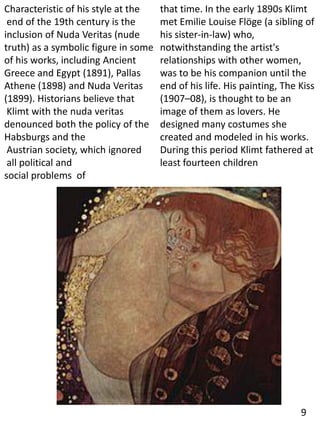
Characteristic of his style at the
end of the 19th century is the
inclusion of Nuda Veritas (nude
truth) as a symbolic figure in some
of his works, including Ancient
Greece and Egypt (1891), Pallas
Athene (1898) and Nuda Veritas
(1899). Historians believe that
Klimt with the nuda veritas
denounced both the policy of the
Habsburgs and the
Austrian society, which ignored
all political and
social problems of
that time. In the early 1890s Klimt
met Emilie Louise Flöge (a sibling of
his sister-in-law) who,
notwithstanding the artist's
relationships with other women,
was to be his companion until the
end of his life. His painting, The Kiss
(1907–08), is thought to be an
image of them as lovers. He
designed many costumes she
created and modeled in his works.
During this period Klimt fathered at
least fourteen children
9
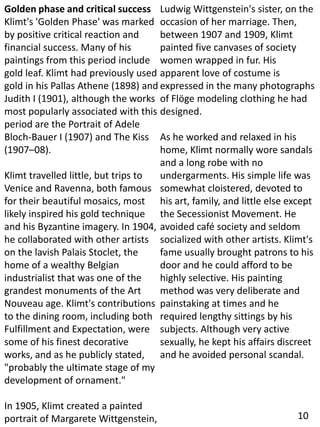
Golden phase and critical success
Klimt's 'Golden Phase' was marked
by positive critical reaction and
financial success. Many of his
paintings from this period include
gold leaf. Klimt had previously used
gold in his Pallas Athene (1898) and
Judith I (1901), although the works
most popularly associated with this
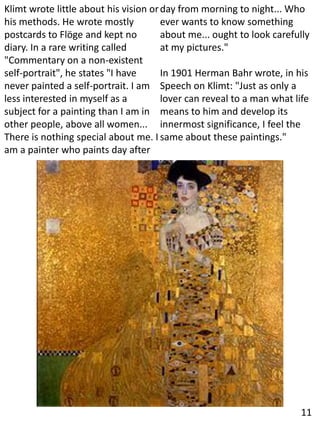
period are the Portrait of Adele
Bloch-Bauer I (1907) and The Kiss
(1907–08).
Klimt travelled little, but trips to
Venice and Ravenna, both famous
for their beautiful mosaics, most
likely inspired his gold technique
and his Byzantine imagery. In 1904,
he collaborated with other artists
on the lavish Palais Stoclet, the
home of a wealthy Belgian
industrialist that was one of the
grandest monuments of the Art
Nouveau age. Klimt's contributions
to the dining room, including both
Fulfillment and Expectation, were
some of his finest decorative
works, and as he publicly stated,
"probably the ultimate stage of my
development of ornament."
In 1905, Klimt created a painted
portrait of Margarete Wittgenstein,
Ludwig Wittgenstein's sister, on the
occasion of her marriage. Then,
between 1907 and 1909, Klimt
painted five canvases of society
women wrapped in fur. His
apparent love of costume is
expressed in the many photographs
of Flöge modeling clothing he had
designed.
As he worked and relaxed in his
home, Klimt normally wore sandals
and a long robe with no
undergarments. His simple life was
somewhat cloistered, devoted to
his art, family, and little else except
the Secessionist Movement. He
avoided café society and seldom
socialized with other artists. Klimt's
fame usually brought patrons to his
door and he could afford to be
highly selective. His painting
method was very deliberate and
painstaking at times and he
required lengthy sittings by his
subjects. Although very active
sexually, he kept his affairs discreet
and he avoided personal scandal.
10
Klimt wrote little about his vision or
his methods. He wrote mostly
postcards to Flöge and kept no
diary. In a rare writing called
"Commentary on a non-existent
self-portrait", he states "I have
never painted a self-portrait. I am
less interested in myself as a
subject for a painting than I am in
other people, above all women...
There is nothing special about me. I
am a painter who paints day after
day from morning to night... Who
ever wants to know something
about me... ought to look carefully
at my pictures."
In 1901 Herman Bahr wrote, in his
Speech on Klimt: "Just as only a
lover can reveal to a man what life
means to him and develop its
innermost significance, I feel the
same about these paintings."
11
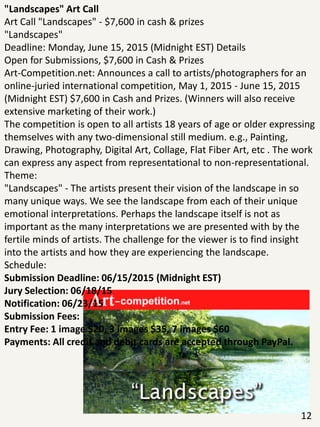
"Landscapes" Art Call
Art Call "Landscapes" - $7,600 in cash & prizes
"Landscapes"
Deadline: Monday, June 15, 2015 (Midnight EST) Details
Open for Submissions, $7,600 in Cash & Prizes
Art-Competition.net: Announces a call to artists/photographers for an
online-juried international competition, May 1, 2015 - June 15, 2015
(Midnight EST) $7,600 in Cash and Prizes. (Winners will also receive
extensive marketing of their work.)
The competition is open to all artists 18 years of age or older expressing
themselves with any two-dimensional still medium. e.g., Painting,
Drawing, Photography, Digital Art, Collage, Flat Fiber Art, etc . The work
can express any aspect from representational to non-representational.
Theme:
"Landscapes" - The artists present their vision of the landscape in so
many unique ways. We see the landscape from each of their unique
emotional interpretations. Perhaps the landscape itself is not as
important as the many interpretations we are presented with by the
fertile minds of artists. The challenge for the viewer is to find insight
into the artists and how they are experiencing the landscape.
Schedule:
Submission Deadline: 06/15/2015 (Midnight EST)
Jury Selection: 06/18/15
Notification: 06/23/15
Submission Fees:
Entry Fee: 1 image $20, 3 images $35, 7 images $60
Payments: All credit and debit cards are accepted through PayPal.
12
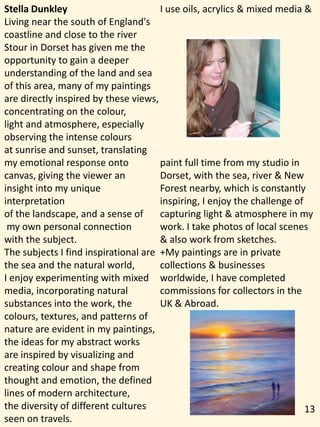
Stella Dunkley
Living near the south of England's
coastline and close to the river
Stour in Dorset has given me the
opportunity to gain a deeper
understanding of the land and sea
of this area, many of my paintings
are directly inspired by these views,
concentrating on the colour,
light and atmosphere, especially
observing the intense colours
at sunrise and sunset, translating
my emotional response onto
canvas, giving the viewer an
insight into my unique
interpretation
of the landscape, and a sense of
my own personal connection
with the subject.
The subjects I find inspirational are
the sea and the natural world,
I enjoy experimenting with mixed
media, incorporating natural
substances into the work, the
colours, textures, and patterns of
nature are evident in my paintings,
the ideas for my abstract works
are inspired by visualizing and
creating colour and shape from
thought and emotion, the defined
lines of modern architecture,
the diversity of different cultures
seen on travels.
I use oils, acrylics & mixed media &
paint full time from my studio in
Dorset, with the sea, river & New
Forest nearby, which is constantly
inspiring, I enjoy the challenge of
capturing light & atmosphere in my
work. I take photos of local scenes
& also work from sketches.
+My paintings are in private
collections & businesses
worldwide, I have completed
commissions for collectors in the
UK & Abroad.
13
Bahman
Mohassess
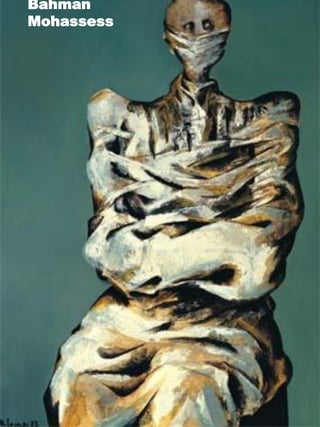
Bahman Mohassess
March 1931 Rasht, Iran-28 July
2010 Rome, Italy,
dubbed by some as the "Persian
Picasso", was an Iranian painter,
sculptor, translator, and theatre
director. His oeuvre comprises
paintings, sculptures and collages.
He was also a celebrated translator
of literary works.
Early life
In his youth he learned painting
from Habib Mohammadi
(who had studied in Moscow
Academy of Arts) and moved with
his family from Rasht to Tehran,
where he attended Tehran's
Faculty of Fine Arts. During the
same period he joined the
"Cockfight" art and culture society
(Anjoman-e Khoros Jangi),
established by Jalil Ziapour, and
was, for some time, the editor of
the literary and art weekly "Panjeh
Khoros" (Rooster Foot). Through
this society he was part of an
avant-garde artistic movement,
which included his good friend
Nima Yooshij, the father of modern
Persian poetry and Sohrab Sepehri,
Houshang Irani and Gholamhossein
Gharib, all progressive artists of
their time. In 1954 he moved to
Italy to study in the Fine Art
Academy of Rome.
Activities
He returned to Iran in 1964 and
participated in Venice, Sao Paolo
and Tehran Biennales. Mohasses
directed plays, including
Pirandello's Henry IV at Goethe
Institute and Ghandriz Hall in
Tehran. He also translated books of
a number of authors, including
Eugène Ionesco, Malaparte and
Pirandello.
He stayed in Iran until 1968, before
returning to Rome, where he
received commissions for statutes
to be placed in Tehran. Some of his
public works in Iran were destroyed
or damaged after the Islamic
Revolution, with the artist
subsequently destroying all his
remaining works in Iran. He
occasionally travelled to Iran and
died in self-imposed seclusion in
Rome in 2010.
15
Artistic legacy
"Irreverent and uncompromising,
a gay man in a hostile world,
Mohassess had a conflicted
relationship with his homeland—
revered by elites in the art scene
and praised as a national icon, only
to be censored later by an
oppressive regime. Known for his
iconoclastic art as well as his
scathing declarations, Mohasses
abandoned the country over 30
years ago for a simple, secluded life
in Italy." Mohasses, unlike many of
his contemporaries, did not make
references to Persian artistic
traditions and had a modern
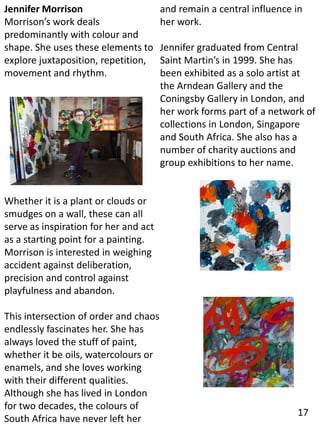
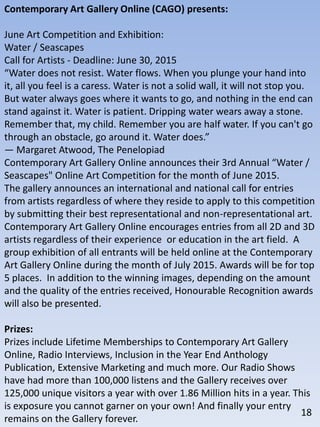
outlook. His paintings and
sculptures depicted mythical
Minotaurs and creatures out of
nightmares in vast deserts of
hopelessness.
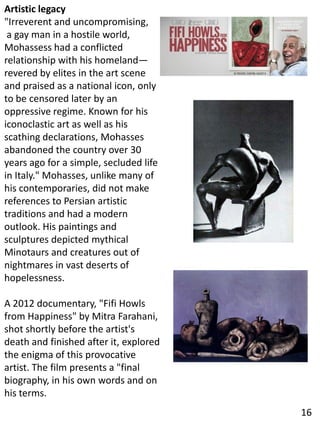
A 2012 documentary, "Fifi Howls
from Happiness" by Mitra Farahani,
shot shortly before the artist's
death and finished after it, explored
the enigma of this provocative
artist. The film presents a "final
biography, in his own words and on
his terms.
16
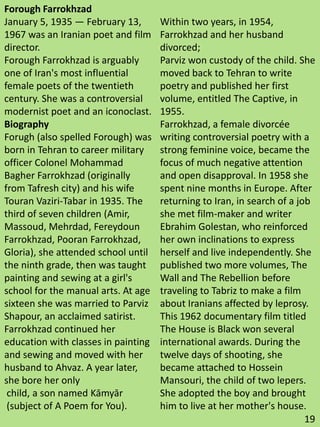
Jennifer Morrison
Morrison’s work deals
predominantly with colour and
shape. She uses these elements to
explore juxtaposition, repetition,
movement and rhythm.
Whether it is a plant or clouds or
smudges on a wall, these can all
serve as inspiration for her and act
as a starting point for a painting.
Morrison is interested in weighing
accident against deliberation,
precision and control against
playfulness and abandon.
This intersection of order and chaos
endlessly fascinates her. She has
always loved the stuff of paint,
whether it be oils, watercolours or
enamels, and she loves working
with their different qualities.
Although she has lived in London
for two decades, the colours of
South Africa have never left her
and remain a central influence in
her work.
Jennifer graduated from Central
Saint Martin’s in 1999. She has
been exhibited as a solo artist at
the Arndean Gallery and the
Coningsby Gallery in London, and
her work forms part of a network of
collections in London, Singapore
and South Africa. She also has a
number of charity auctions and
group exhibitions to her name.
17
Contemporary Art Gallery Online (CAGO) presents:
June Art Competition and Exhibition:
Water / Seascapes
Call for Artists - Deadline: June 30, 2015
“Water does not resist. Water flows. When you plunge your hand into
it, all you feel is a caress. Water is not a solid wall, it will not stop you.
But water always goes where it wants to go, and nothing in the end can
stand against it. Water is patient. Dripping water wears away a stone.
Remember that, my child. Remember you are half water. If you can't go
through an obstacle, go around it. Water does.”
― Margaret Atwood, The Penelopiad
Contemporary Art Gallery Online announces their 3rd Annual “Water /
Seascapes" Online Art Competition for the month of June 2015.
The gallery announces an international and national call for entries
from artists regardless of where they reside to apply to this competition
by submitting their best representational and non-representational art.
Contemporary Art Gallery Online encourages entries from all 2D and 3D
artists regardless of their experience or education in the art field. A
group exhibition of all entrants will be held online at the Contemporary
Art Gallery Online during the month of July 2015. Awards will be for top
5 places. In addition to the winning images, depending on the amount
and the quality of the entries received, Honourable Recognition awards
will also be presented.
Prizes:
Prizes include Lifetime Memberships to Contemporary Art Gallery
Online, Radio Interviews, Inclusion in the Year End Anthology
Publication, Extensive Marketing and much more. Our Radio Shows
have had more than 100,000 listens and the Gallery receives over
125,000 unique visitors a year with over 1.86 Million hits in a year. This
is exposure you cannot garner on your own! And finally your entry
remains on the Gallery forever.
18
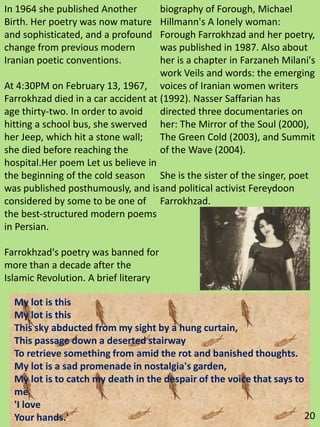
Forough Farrokhzad
January 5, 1935 — February 13,
1967 was an Iranian poet and film
director.
Forough Farrokhzad is arguably
one of Iran's most influential
female poets of the twentieth
century. She was a controversial
modernist poet and an iconoclast.
Biography
Forugh (also spelled Forough) was
born in Tehran to career military
officer Colonel Mohammad
Bagher Farrokhzad (originally
from Tafresh city) and his wife
Touran Vaziri-Tabar in 1935. The
third of seven children (Amir,
Massoud, Mehrdad, Fereydoun
Farrokhzad, Pooran Farrokhzad,
Gloria), she attended school until
the ninth grade, then was taught
painting and sewing at a girl's
school for the manual arts. At age
sixteen she was married to Parviz
Shapour, an acclaimed satirist.
Farrokhzad continued her
education with classes in painting
and sewing and moved with her
husband to Ahvaz. A year later,
she bore her only
child, a son named Kāmyār
(subject of A Poem for You).
Within two years, in 1954,
Farrokhzad and her husband
divorced;
Parviz won custody of the child. She
moved back to Tehran to write
poetry and published her first
volume, entitled The Captive, in
1955.
Farrokhzad, a female divorcée
writing controversial poetry with a
strong feminine voice, became the
focus of much negative attention
and open disapproval. In 1958 she
spent nine months in Europe. After
returning to Iran, in search of a job
she met film-maker and writer
Ebrahim Golestan, who reinforced
her own inclinations to express
herself and live independently. She
published two more volumes, The
Wall and The Rebellion before
traveling to Tabriz to make a film
about Iranians affected by leprosy.
This 1962 documentary film titled
The House is Black won several
international awards. During the
twelve days of shooting, she
became attached to Hossein
Mansouri, the child of two lepers.
She adopted the boy and brought
him to live at her mother's house.
19
In 1964 she published Another
Birth. Her poetry was now mature
and sophisticated, and a profound
change from previous modern
Iranian poetic conventions.
At 4:30PM on February 13, 1967,
Farrokhzad died in a car accident at
age thirty-two. In order to avoid
hitting a school bus, she swerved
her Jeep, which hit a stone wall;
she died before reaching the
hospital.Her poem Let us believe in
the beginning of the cold season
was published posthumously, and is
considered by some to be one of
the best-structured modern poems
in Persian.
Farrokhzad's poetry was banned for
more than a decade after the
Islamic Revolution. A brief literary
biography of Forough, Michael
Hillmann's A lonely woman:
Forough Farrokhzad and her poetry,
was published in 1987. Also about
her is a chapter in Farzaneh Milani's
work Veils and words: the emerging
voices of Iranian women writers
(1992). Nasser Saffarian has
directed three documentaries on
her: The Mirror of the Soul (2000),
The Green Cold (2003), and Summit
of the Wave (2004).
She is the sister of the singer, poet
and political activist Fereydoon
Farrokhzad.
My lot is this
My lot is this
This sky abducted from my sight by a hung curtain,
This passage down a deserted stairway
To retrieve something from amid the rot and banished thoughts.
My lot is a sad promenade in nostalgia's garden,
My lot is to catch my death in the despair of the voice that says to
me
'I love
Your hands.' 20
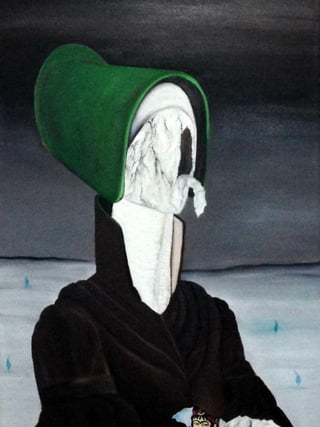
Don't judge her by her cover
By Aziz Anzabi
This painting is miraculously
alluring to the eyes. Created in
2015 by Aziz Anzabi yet one of his
bests. Aziz has painted his sketch
on a 102cmx66cmx4cm canvas
with the technique of oil on canvas
to create this imaginative work.
The featureless lady in the middle
is eccentric and haunts your eyes
every time you stare at it. It is
obvious that Aziz has tried to
indicate/ open up a passage to the
thoughts of the audience through
his engraved symbol: below the
women's chest. Aziz has passed
down Persian symbols for a long
time on his obscuring ,detailed
paintings, which to me now
thinking about it feels like he is not
just trying to create a new style of
his own but again trying to open
the eye's of the audience to the art
world with his paintings full of
clandestine tales. However what
really interests me is that the
woman's face is simply not bland
but filled with many little veins to
create a marble effect. On the left
side of her face there is a colossal
peel, almost like paper etched on
the lavish marble, akin like a scar .
The diamond shaped emerald
shapes fading back in the
background look like scant dancing
trees moving with the emollient
tune of the wind. The woman/girl is
fascinating through her abnormal
body shape and yet awful and
ghoulish every time you glare at it.
The painting absorbs you whole
with great force whenever you
beam at it. Overall I think that this
work is very bewitching and
pleasant every now and again to
see, sometimes even assuring. I'm
grateful for Aziz to have created
such a unique work.
Review by: Asra Y
22
Every time
Every where
http://www.aziz-anzabi.com
Iran Persepolis

Aziz art june2015

  • 1.
    Aziz Art Jun 2015 M oh se n va zir i m og ha da m BahmanMohassess G u st a v K li m t Stella Dunkley Aziz Anzabi Jen nif er M orr iso n Forough Farrokhzad Iran C o m p e ti ti o n
  • 2.
    Director: Aziz Anzabi Editorand translator : Asra Yaghoubi Research: Zohreh Nazari Contents: 1-Mohsen Vaziri-Moghaddam 7-Gustav Klimt 12-Competition 13-Stella Dunkley 15-Bahman Mohassess 17-Jennifer Morrison 18-Competition 19-Forough Farrokhzad 22-Aziz Anzabi http://www.aziz-anzabi.com Oh sky, if I want one day to fly from this silent prison, what shall I say to the weeping child's eyes: forget about me, for I am captive bird? I am that candle which illuminates a ruins with the burning of her heart. If I want to choose silent darkness, I will bring a nest to ruin.
  • 3.
    Mohsen Vaziri-Moghaddam Education In 1943,after obtaining his diploma at the Agricultural Institute, he applies to the Faculty of Fine Arts in Tehran and attends for three years. During this period, as the artist himself will say later on, “I learned how to nurture my drawing skills from Heidarian [his painting teacher] and I did the rest myself; I painted portraits and landscapes that didn’t go beyond study patterns”. During his years at the Academy, he feels the influence of Impressionism and Post- Impressionism, especially Van Gogh, in both subject matters and expressive forms. In 1952, his first solo exhibition is held at the Iran-America Society in Teheran. In 1955 Vaziri leaves for Rome where he studies at the Academy of Fine Arts until 1958. During these years, coinciding with the establishment of the European In formalism and the American action painting, after “studying and analysing new modern art movements”, Vaziri reaches the conclusion that “painting is not a reconstruction of objective reality, but the artist has to create something that never existed before”. 1
  • 4.
    Career In the Aprilof 1956 Vaziri opens his first Italian exhibition, displaying his figurative paintings at the Portonovo Art Gallery in Rome. In the same year, he exhibits in Düsseldorf and Munich, in Germany. In 1957, a landmark year and turning point in his artistic career, he attends Toti Scialoja’s classes at the Academy for six months and he starts experimenting with abstract art. Vaziri will later confess that this is when he learned “how to conceive abstract painting and how to create visual spaces”. His first abstract works date back to 1958- 1959 and they fit in perfectly with the search for materials and brushstrokes happening in contemporary movements. Between 1959 and 1960 he develops a vision of abstract art through experiments that are highly focused on materials. This will lead to the creation of some of his most powerful works: the sand paintings. These paintings were conceived in a playful moment in the spring of 1959 and Vaziri will keep trying his hand at them for the following 3 years, until 1963. Different types of sand are applied to the canvas in their natural state, or mixed with colour. This original concept grabs the attention of some of the most prominent Italian art critics of the time, such as Giulio Carlo Argan and Palma Bucarelli. In 1964 Vaziri is at the peak of his artistic career that coincides with the purchase of one of his paintings by the Modern Art Museum (MoMA) in New York. He is away from Italy for a long time and returns to Iran where he will teach for several years (until 1975), at the Faculty of Decorative Arts (the current University of Art) and the Faculty of Fine Arts in Tehran. In those years, he starts writing some art methodology textbooks and in 1981, he publishes Drawing method and Painting guide. His textbooks are still amongst the most studied by Iranian art students today. His return to Iran and heavy teaching commitments keep Vaziri away from painting for almost three years. 2
  • 5.
    Between 1967 and1968 he starts working on a series of reliefs made of aluminium and iron sheets and is still anchored to a mono- dimensional approach. Shortly after, from 1969, the reliefs will lead him to the creation of tri- dimensional works, i.e. wood sculptures. From 1970, the next step in the evolution of still works will be a series of articulated, mobile sculptures whose wood pieces are joined together by nuts and bolts “so that – in Vaziri’s own words – they would open and close just like human joints”. During the 1970s, these sculptures will in turn inspire a series of paintings that mark a return to the well-defined shapes (both pointed and rounded) of his tri-dimensional works and develop them further. Alberto Moravia and Pierre Restany are amongst the eminent figures that will write about his work. In his chosen field, whether directed to painting or sculpture, a constant and essential theme is that of space, which has brought him results much appreciated by critics (Argan, Moravia, Bevilacqua, Menna, Pensabene) and recognition by the City of Rome (1958) and from Prime Minister Segni (International Art Competition, Ravenna 1959) and the Senate Gold Medal (Sassoferrato 1962). His works have been shown in numerous solo exhibitions in Italy (Rome, Milan, Florence), Germany (Dusseldorf, Munich), and Iran, at the Venice Biennial (1958, 1960, 1962, 1964), at the Tehran Biennial (1960, 1962 ), at the Rome Quadriennale (1960), at the Sao Paulo Biennial in Brazil (1962), at the Museum of Modern Art, New York (1964) and at the Shiraz Art Festival, Iran (1969). 3
  • 6.
    In 1985 Vazirimoves to Italy permanently, with his wife and two children. In the 1990s the artist works on Persian calligraphy shapes, trying to point out the minimalism of its lines. He also continues to test himself with abstract compositions that are all different from each other and characterised by either highly defined shapes and intense colours or vague silhouettes and soft pastel colours. In 1999 his translation of The Mind and Work of Paul Klee by W. Hahtmann is published. In 2000 he resumes contact with Iranian universities and holds several lectures. In 2003 Vaziri is affected by an eye disease, that will considerably reduce his eyesight, but it doesn’t let this dampen his spirit. On the contrary, he invents a new way of expressing himself: this is how some new acrylic paintings are born in which large splashes of colour reflect his way of seeing reality. In May 2004, he exhibits at the Contemporary Art Museum in Tehran together with Gerhard Richter and he is hailed as the best Iranian artist of the century. In 2013 one of his sculptures (Forms in Movement) and the sand painting that is part of the MoMA collection are exhibited at the Asia Society Museum in New York at the “Iran Modern” exhibition. In the summer of 2014, the same sculpture is exhibited at the contemporary art exhibition “Artevida corpo” at the Fundação Casa França-Brasil, in Rio de Janeiro, Brazil. Vaziri is still creatively active today and he continues his quest for shapes and colours. 4
  • 7.
  • 8.
    Judith and the Headof Holofernes, 1901. Österreichi sche Galerie Belvedere, Vienna
  • 9.
    Gustav Klimt (July 14,1862 – February 6, 1918) was an Austrian symbolist painter and one of the most prominent members of the Vienna Secession movement. Klimt is noted for his paintings, murals, sketches, and other objets d'art. Klimt's primary subject was the female body, and his works are marked by a frank eroticism. In addition to his figurative works, which include allegories and portraits, he painted landscapes. Among the artists of the Vienna Secession, Klimt was the most influenced by Japanese art and its methods. Early in his artistic career, he was a successful painter of architectural decorations in a conventional manner. As he developed a more personal style, his work was the subject of controversy that culminated when the paintings he completed around 1900 for the ceiling of the Great Hall of the University of Vienna were criticized as pornographic. He subsequently accepted no more public commissions, but achieved a new success with the paintings of his "golden phase," many of which include gold leaf. Klimt's work was an important influence on his younger contemporary Egon Schiele. 7
  • 10.
    Early life andeducation Klimt in a light Blue Smock by Egon Schiele, 1913 Gustav Klimt was born in Baumgarten, near Vienna in Austria-Hungary, the second of seven children—three boys and four girls. His mother, Anna Klimt , had an unrealized ambition to be a musical performer. His father, Ernst Klimt the Elder, formerly from Bohemia, was a gold engraver. All three of their sons displayed artistic talent early on. Klimt's younger brothers were Ernst Klimt and Georg Klimt. Klimt lived in poverty while attending the Vienna School of Arts and Crafts (Kunstgewerbeschule), where he studied architectural painting until 1883. He revered Vienna's foremost history painter of the time, Hans Makart. Klimt readily accepted the principles of a conservative training; his early work may be classified as academic. In 1877 his brother, Ernst, who, like his father, would become an engraver, also enrolled in the school. The two brothers and their friend, Franz Matsch, began working together and by 1880 they had received numerous commissions as a team that they called the "Company of Artists". They also helped their teacher in painting murals in the Kunsthistorisches Museum in Vienna. Klimt began his professional career painting interior murals and ceilings in large public buildings on the Ringstraße, including a successful series of "Allegories and Emblems". In 1888 Klimt received the Golden Order of Merit from Emperor Franz Josef I of Austria for his contributions to murals painted in the Burgtheater in Vienna. He also became an honorary member of the University of Munich and the University of Vienna. In 1892 Klimt's father and brother Ernst both died, and he had to assume financial responsibility for his father's and brother's families. The tragedies also affected his artistic vision and soon he would move towards a new personal style. 8
  • 11.
    Characteristic of hisstyle at the end of the 19th century is the inclusion of Nuda Veritas (nude truth) as a symbolic figure in some of his works, including Ancient Greece and Egypt (1891), Pallas Athene (1898) and Nuda Veritas (1899). Historians believe that Klimt with the nuda veritas denounced both the policy of the Habsburgs and the Austrian society, which ignored all political and social problems of that time. In the early 1890s Klimt met Emilie Louise Flöge (a sibling of his sister-in-law) who, notwithstanding the artist's relationships with other women, was to be his companion until the end of his life. His painting, The Kiss (1907–08), is thought to be an image of them as lovers. He designed many costumes she created and modeled in his works. During this period Klimt fathered at least fourteen children 9
  • 12.
    Golden phase andcritical success Klimt's 'Golden Phase' was marked by positive critical reaction and financial success. Many of his paintings from this period include gold leaf. Klimt had previously used gold in his Pallas Athene (1898) and Judith I (1901), although the works most popularly associated with this period are the Portrait of Adele Bloch-Bauer I (1907) and The Kiss (1907–08). Klimt travelled little, but trips to Venice and Ravenna, both famous for their beautiful mosaics, most likely inspired his gold technique and his Byzantine imagery. In 1904, he collaborated with other artists on the lavish Palais Stoclet, the home of a wealthy Belgian industrialist that was one of the grandest monuments of the Art Nouveau age. Klimt's contributions to the dining room, including both Fulfillment and Expectation, were some of his finest decorative works, and as he publicly stated, "probably the ultimate stage of my development of ornament." In 1905, Klimt created a painted portrait of Margarete Wittgenstein, Ludwig Wittgenstein's sister, on the occasion of her marriage. Then, between 1907 and 1909, Klimt painted five canvases of society women wrapped in fur. His apparent love of costume is expressed in the many photographs of Flöge modeling clothing he had designed. As he worked and relaxed in his home, Klimt normally wore sandals and a long robe with no undergarments. His simple life was somewhat cloistered, devoted to his art, family, and little else except the Secessionist Movement. He avoided café society and seldom socialized with other artists. Klimt's fame usually brought patrons to his door and he could afford to be highly selective. His painting method was very deliberate and painstaking at times and he required lengthy sittings by his subjects. Although very active sexually, he kept his affairs discreet and he avoided personal scandal. 10
  • 13.
    Klimt wrote littleabout his vision or his methods. He wrote mostly postcards to Flöge and kept no diary. In a rare writing called "Commentary on a non-existent self-portrait", he states "I have never painted a self-portrait. I am less interested in myself as a subject for a painting than I am in other people, above all women... There is nothing special about me. I am a painter who paints day after day from morning to night... Who ever wants to know something about me... ought to look carefully at my pictures." In 1901 Herman Bahr wrote, in his Speech on Klimt: "Just as only a lover can reveal to a man what life means to him and develop its innermost significance, I feel the same about these paintings." 11
  • 14.
    "Landscapes" Art Call ArtCall "Landscapes" - $7,600 in cash & prizes "Landscapes" Deadline: Monday, June 15, 2015 (Midnight EST) Details Open for Submissions, $7,600 in Cash & Prizes Art-Competition.net: Announces a call to artists/photographers for an online-juried international competition, May 1, 2015 - June 15, 2015 (Midnight EST) $7,600 in Cash and Prizes. (Winners will also receive extensive marketing of their work.) The competition is open to all artists 18 years of age or older expressing themselves with any two-dimensional still medium. e.g., Painting, Drawing, Photography, Digital Art, Collage, Flat Fiber Art, etc . The work can express any aspect from representational to non-representational. Theme: "Landscapes" - The artists present their vision of the landscape in so many unique ways. We see the landscape from each of their unique emotional interpretations. Perhaps the landscape itself is not as important as the many interpretations we are presented with by the fertile minds of artists. The challenge for the viewer is to find insight into the artists and how they are experiencing the landscape. Schedule: Submission Deadline: 06/15/2015 (Midnight EST) Jury Selection: 06/18/15 Notification: 06/23/15 Submission Fees: Entry Fee: 1 image $20, 3 images $35, 7 images $60 Payments: All credit and debit cards are accepted through PayPal. 12
  • 15.
    Stella Dunkley Living nearthe south of England's coastline and close to the river Stour in Dorset has given me the opportunity to gain a deeper understanding of the land and sea of this area, many of my paintings are directly inspired by these views, concentrating on the colour, light and atmosphere, especially observing the intense colours at sunrise and sunset, translating my emotional response onto canvas, giving the viewer an insight into my unique interpretation of the landscape, and a sense of my own personal connection with the subject. The subjects I find inspirational are the sea and the natural world, I enjoy experimenting with mixed media, incorporating natural substances into the work, the colours, textures, and patterns of nature are evident in my paintings, the ideas for my abstract works are inspired by visualizing and creating colour and shape from thought and emotion, the defined lines of modern architecture, the diversity of different cultures seen on travels. I use oils, acrylics & mixed media & paint full time from my studio in Dorset, with the sea, river & New Forest nearby, which is constantly inspiring, I enjoy the challenge of capturing light & atmosphere in my work. I take photos of local scenes & also work from sketches. +My paintings are in private collections & businesses worldwide, I have completed commissions for collectors in the UK & Abroad. 13
  • 16.
  • 17.
    Bahman Mohassess March 1931Rasht, Iran-28 July 2010 Rome, Italy, dubbed by some as the "Persian Picasso", was an Iranian painter, sculptor, translator, and theatre director. His oeuvre comprises paintings, sculptures and collages. He was also a celebrated translator of literary works. Early life In his youth he learned painting from Habib Mohammadi (who had studied in Moscow Academy of Arts) and moved with his family from Rasht to Tehran, where he attended Tehran's Faculty of Fine Arts. During the same period he joined the "Cockfight" art and culture society (Anjoman-e Khoros Jangi), established by Jalil Ziapour, and was, for some time, the editor of the literary and art weekly "Panjeh Khoros" (Rooster Foot). Through this society he was part of an avant-garde artistic movement, which included his good friend Nima Yooshij, the father of modern Persian poetry and Sohrab Sepehri, Houshang Irani and Gholamhossein Gharib, all progressive artists of their time. In 1954 he moved to Italy to study in the Fine Art Academy of Rome. Activities He returned to Iran in 1964 and participated in Venice, Sao Paolo and Tehran Biennales. Mohasses directed plays, including Pirandello's Henry IV at Goethe Institute and Ghandriz Hall in Tehran. He also translated books of a number of authors, including Eugène Ionesco, Malaparte and Pirandello. He stayed in Iran until 1968, before returning to Rome, where he received commissions for statutes to be placed in Tehran. Some of his public works in Iran were destroyed or damaged after the Islamic Revolution, with the artist subsequently destroying all his remaining works in Iran. He occasionally travelled to Iran and died in self-imposed seclusion in Rome in 2010. 15
  • 18.
    Artistic legacy "Irreverent anduncompromising, a gay man in a hostile world, Mohassess had a conflicted relationship with his homeland— revered by elites in the art scene and praised as a national icon, only to be censored later by an oppressive regime. Known for his iconoclastic art as well as his scathing declarations, Mohasses abandoned the country over 30 years ago for a simple, secluded life in Italy." Mohasses, unlike many of his contemporaries, did not make references to Persian artistic traditions and had a modern outlook. His paintings and sculptures depicted mythical Minotaurs and creatures out of nightmares in vast deserts of hopelessness. A 2012 documentary, "Fifi Howls from Happiness" by Mitra Farahani, shot shortly before the artist's death and finished after it, explored the enigma of this provocative artist. The film presents a "final biography, in his own words and on his terms. 16
  • 19.
    Jennifer Morrison Morrison’s workdeals predominantly with colour and shape. She uses these elements to explore juxtaposition, repetition, movement and rhythm. Whether it is a plant or clouds or smudges on a wall, these can all serve as inspiration for her and act as a starting point for a painting. Morrison is interested in weighing accident against deliberation, precision and control against playfulness and abandon. This intersection of order and chaos endlessly fascinates her. She has always loved the stuff of paint, whether it be oils, watercolours or enamels, and she loves working with their different qualities. Although she has lived in London for two decades, the colours of South Africa have never left her and remain a central influence in her work. Jennifer graduated from Central Saint Martin’s in 1999. She has been exhibited as a solo artist at the Arndean Gallery and the Coningsby Gallery in London, and her work forms part of a network of collections in London, Singapore and South Africa. She also has a number of charity auctions and group exhibitions to her name. 17
  • 20.
    Contemporary Art GalleryOnline (CAGO) presents: June Art Competition and Exhibition: Water / Seascapes Call for Artists - Deadline: June 30, 2015 “Water does not resist. Water flows. When you plunge your hand into it, all you feel is a caress. Water is not a solid wall, it will not stop you. But water always goes where it wants to go, and nothing in the end can stand against it. Water is patient. Dripping water wears away a stone. Remember that, my child. Remember you are half water. If you can't go through an obstacle, go around it. Water does.” ― Margaret Atwood, The Penelopiad Contemporary Art Gallery Online announces their 3rd Annual “Water / Seascapes" Online Art Competition for the month of June 2015. The gallery announces an international and national call for entries from artists regardless of where they reside to apply to this competition by submitting their best representational and non-representational art. Contemporary Art Gallery Online encourages entries from all 2D and 3D artists regardless of their experience or education in the art field. A group exhibition of all entrants will be held online at the Contemporary Art Gallery Online during the month of July 2015. Awards will be for top 5 places. In addition to the winning images, depending on the amount and the quality of the entries received, Honourable Recognition awards will also be presented. Prizes: Prizes include Lifetime Memberships to Contemporary Art Gallery Online, Radio Interviews, Inclusion in the Year End Anthology Publication, Extensive Marketing and much more. Our Radio Shows have had more than 100,000 listens and the Gallery receives over 125,000 unique visitors a year with over 1.86 Million hits in a year. This is exposure you cannot garner on your own! And finally your entry remains on the Gallery forever. 18
  • 21.
    Forough Farrokhzad January 5,1935 — February 13, 1967 was an Iranian poet and film director. Forough Farrokhzad is arguably one of Iran's most influential female poets of the twentieth century. She was a controversial modernist poet and an iconoclast. Biography Forugh (also spelled Forough) was born in Tehran to career military officer Colonel Mohammad Bagher Farrokhzad (originally from Tafresh city) and his wife Touran Vaziri-Tabar in 1935. The third of seven children (Amir, Massoud, Mehrdad, Fereydoun Farrokhzad, Pooran Farrokhzad, Gloria), she attended school until the ninth grade, then was taught painting and sewing at a girl's school for the manual arts. At age sixteen she was married to Parviz Shapour, an acclaimed satirist. Farrokhzad continued her education with classes in painting and sewing and moved with her husband to Ahvaz. A year later, she bore her only child, a son named Kāmyār (subject of A Poem for You). Within two years, in 1954, Farrokhzad and her husband divorced; Parviz won custody of the child. She moved back to Tehran to write poetry and published her first volume, entitled The Captive, in 1955. Farrokhzad, a female divorcée writing controversial poetry with a strong feminine voice, became the focus of much negative attention and open disapproval. In 1958 she spent nine months in Europe. After returning to Iran, in search of a job she met film-maker and writer Ebrahim Golestan, who reinforced her own inclinations to express herself and live independently. She published two more volumes, The Wall and The Rebellion before traveling to Tabriz to make a film about Iranians affected by leprosy. This 1962 documentary film titled The House is Black won several international awards. During the twelve days of shooting, she became attached to Hossein Mansouri, the child of two lepers. She adopted the boy and brought him to live at her mother's house. 19
  • 22.
    In 1964 shepublished Another Birth. Her poetry was now mature and sophisticated, and a profound change from previous modern Iranian poetic conventions. At 4:30PM on February 13, 1967, Farrokhzad died in a car accident at age thirty-two. In order to avoid hitting a school bus, she swerved her Jeep, which hit a stone wall; she died before reaching the hospital.Her poem Let us believe in the beginning of the cold season was published posthumously, and is considered by some to be one of the best-structured modern poems in Persian. Farrokhzad's poetry was banned for more than a decade after the Islamic Revolution. A brief literary biography of Forough, Michael Hillmann's A lonely woman: Forough Farrokhzad and her poetry, was published in 1987. Also about her is a chapter in Farzaneh Milani's work Veils and words: the emerging voices of Iranian women writers (1992). Nasser Saffarian has directed three documentaries on her: The Mirror of the Soul (2000), The Green Cold (2003), and Summit of the Wave (2004). She is the sister of the singer, poet and political activist Fereydoon Farrokhzad. My lot is this My lot is this This sky abducted from my sight by a hung curtain, This passage down a deserted stairway To retrieve something from amid the rot and banished thoughts. My lot is a sad promenade in nostalgia's garden, My lot is to catch my death in the despair of the voice that says to me 'I love Your hands.' 20
  • 24.
    Don't judge herby her cover By Aziz Anzabi This painting is miraculously alluring to the eyes. Created in 2015 by Aziz Anzabi yet one of his bests. Aziz has painted his sketch on a 102cmx66cmx4cm canvas with the technique of oil on canvas to create this imaginative work. The featureless lady in the middle is eccentric and haunts your eyes every time you stare at it. It is obvious that Aziz has tried to indicate/ open up a passage to the thoughts of the audience through his engraved symbol: below the women's chest. Aziz has passed down Persian symbols for a long time on his obscuring ,detailed paintings, which to me now thinking about it feels like he is not just trying to create a new style of his own but again trying to open the eye's of the audience to the art world with his paintings full of clandestine tales. However what really interests me is that the woman's face is simply not bland but filled with many little veins to create a marble effect. On the left side of her face there is a colossal peel, almost like paper etched on the lavish marble, akin like a scar . The diamond shaped emerald shapes fading back in the background look like scant dancing trees moving with the emollient tune of the wind. The woman/girl is fascinating through her abnormal body shape and yet awful and ghoulish every time you glare at it. The painting absorbs you whole with great force whenever you beam at it. Overall I think that this work is very bewitching and pleasant every now and again to see, sometimes even assuring. I'm grateful for Aziz to have created such a unique work. Review by: Asra Y 22
  • 25.
  • 26.