The ARIADNE interoperability framework, component architecture and registry service 
Costis Dallas1,2,3 and Dimitris Gavrilis1 
1 Digital Curation Unit-IMIS, Athena Research Centre 2 Department of Communication, Media and Culture, Panteion University 3 Faculty of Information, University of Toronto 
{c.dallas,d.gavrilis}@dcu.gr 
1
ARIADNE 
Advanced Research Infrastructure for 
Archaeological Dataset Networking in Europe 
•48 months 
•24 partners 
•17 work packages 
•8.464.000 Euros 
2
What is ARIADNE about 
•Very large number of digital datasets 
–Various domains, periods, places 
•Vast number of corpus available 
•Bring together and integrate the existing archaeological research data infrastructures 
–Compare 
–Re-use 
–Integrate into current research 
3
Objectives 
•Community building 
•Overcome fragmentation and provide interoperability 
–Overcome linguistic barriers 
–Address dataset interoperability 
•Unified and homogeneous interfaces 
–Provide a one-stop access point to Archaeological datasets 
–Provide innovative tools for enriching content / visualizing content (2D/3D) 
•Long-term preservation 
–Also include “grey literature” primary data 
•Development of innovative tools and services 
–Multilingual searching 
–Improved Conceptual Reference Model 
•Creating a new generation of researchers 
4
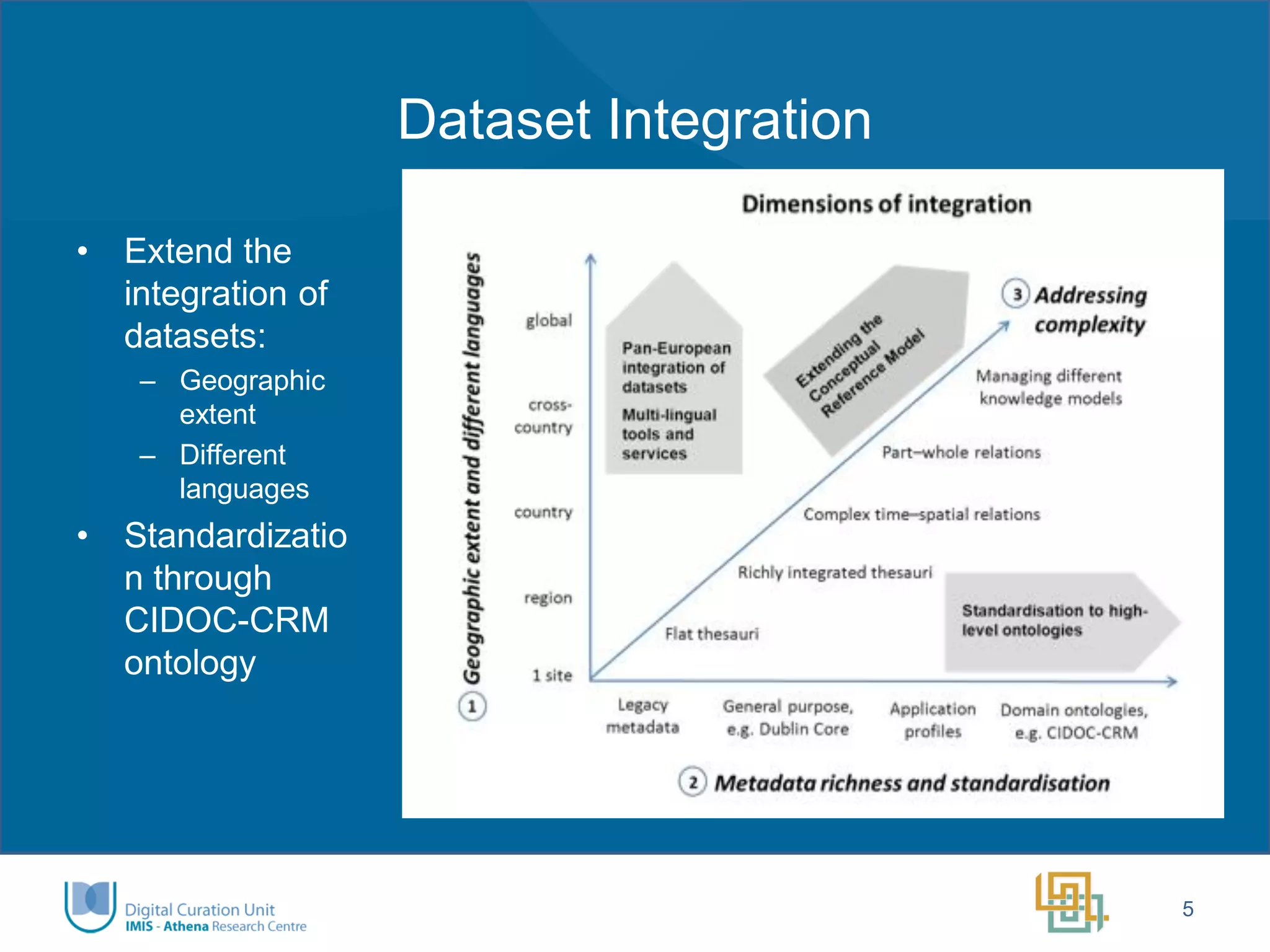
Dataset Integration 
•Extend the integration of datasets: 
–Geographic extent 
–Different languages 
•Standardization through CIDOC-CRM ontology 
5
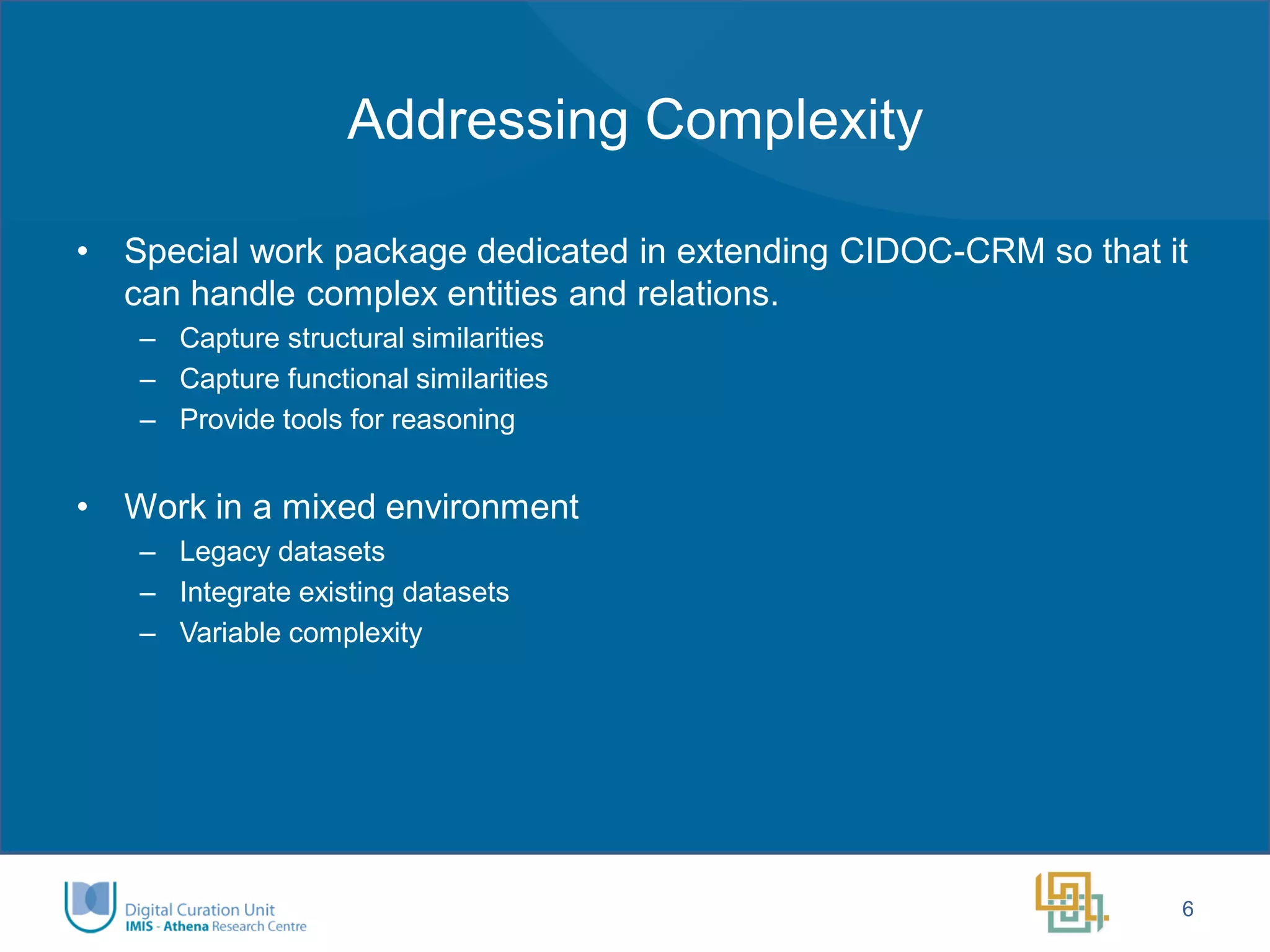
Addressing Complexity 
•Special work package dedicated in extending CIDOC-CRM so that it can handle complex entities and relations. 
–Capture structural similarities 
–Capture functional similarities 
–Provide tools for reasoning 
•Work in a mixed environment 
–Legacy datasets 
–Integrate existing datasets 
–Variable complexity 
6
Bibliography 
•Bring-in existing bibliography 
–Grey literature 
•NLP services 
–Mine texts (e.g. grey literature) 
–Information extraction 
–Automatic classification 
7
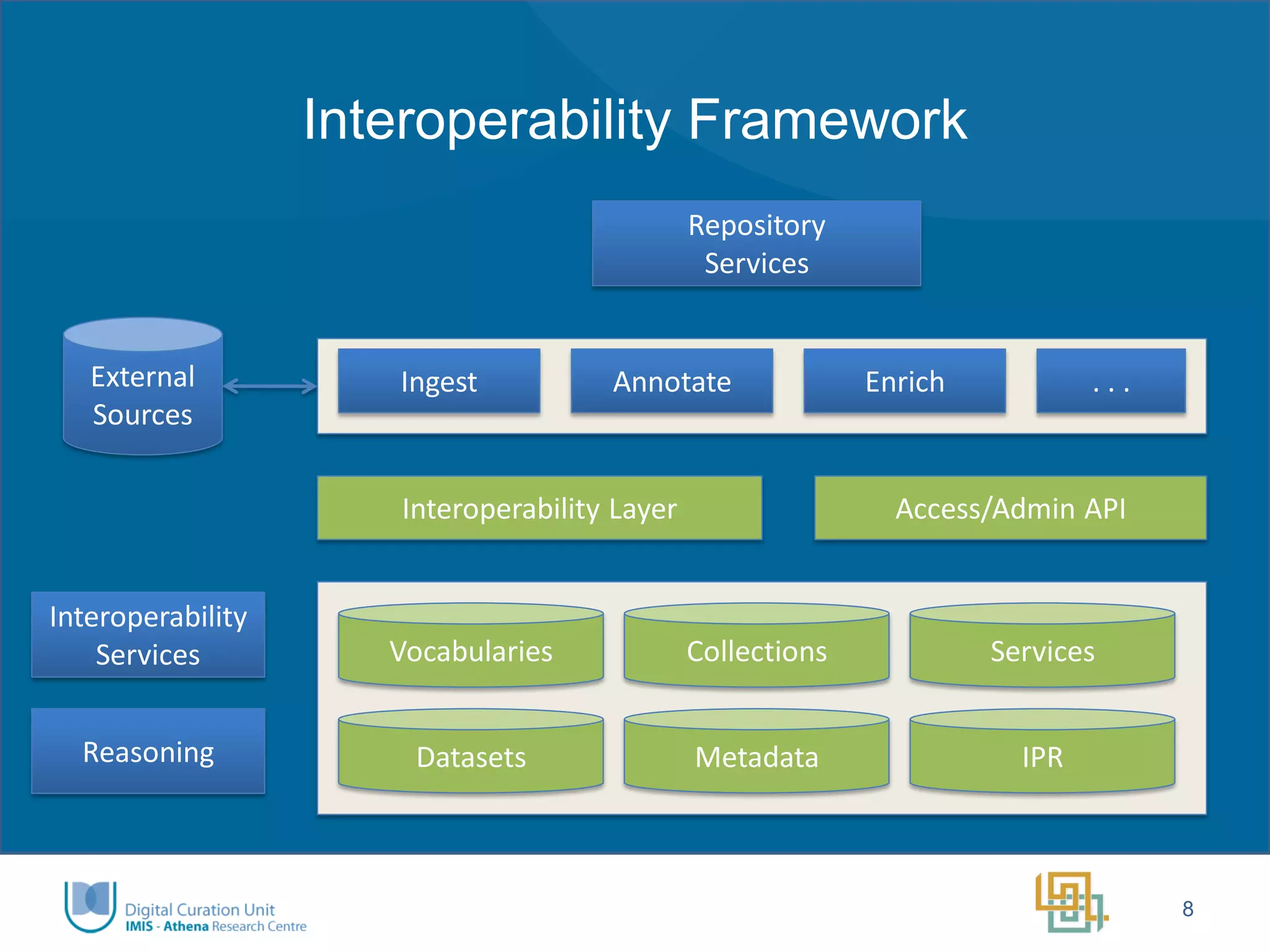
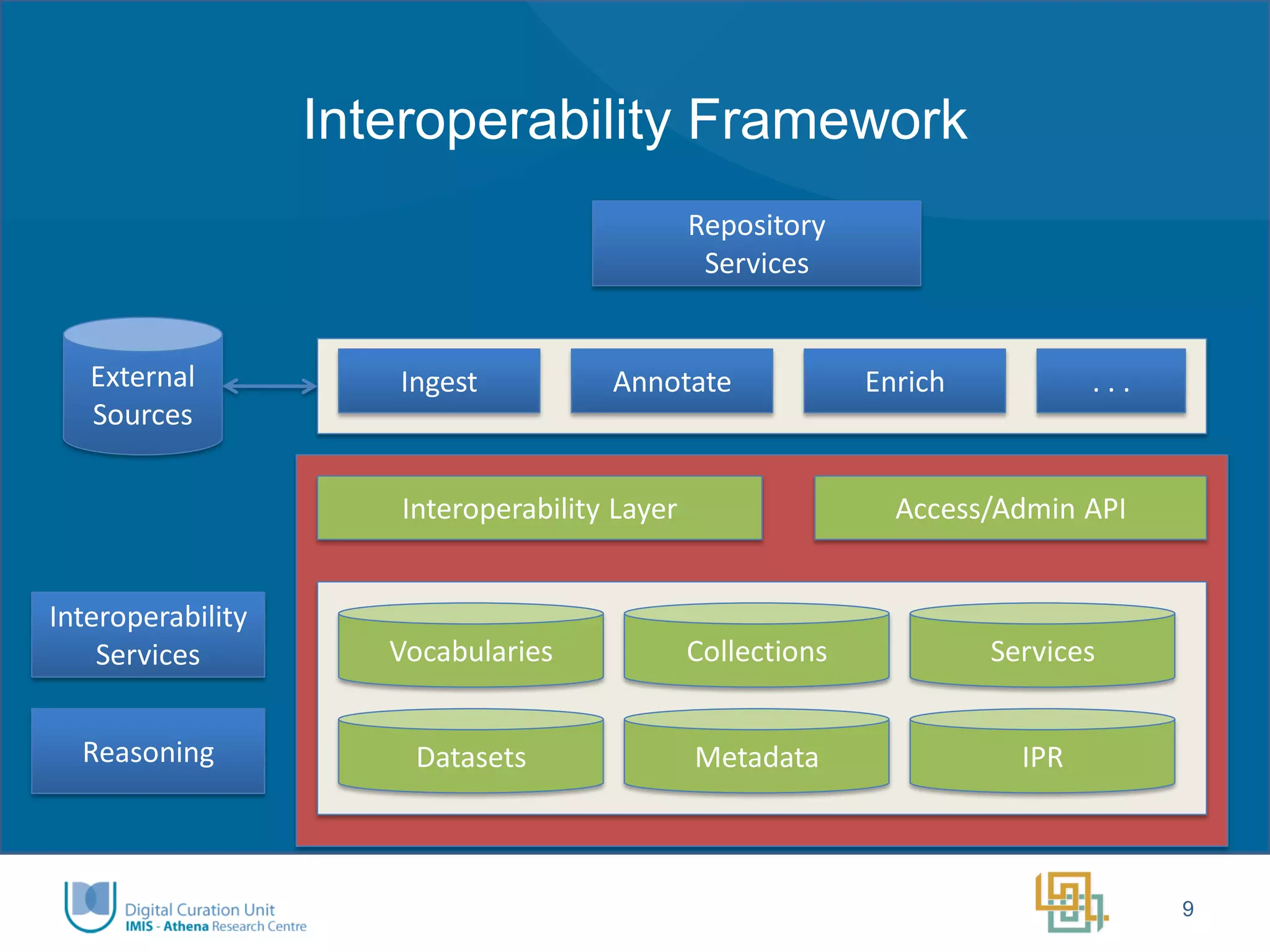
Interoperability Framework 
8 
Interoperability Layer 
Datasets 
Vocabularies 
Metadata 
Collections 
IPR 
Services 
Access/Admin API 
Ingest 
Annotate 
Enrich 
. . . 
External Sources 
Interoperability Services 
Repository Services 
Reasoning
Interoperability Framework 
9 
Interoperability Layer 
Datasets 
Vocabularies 
Metadata 
Collections 
IPR 
Services 
Access/Admin API 
Ingest 
Annotate 
Enrich 
. . . 
External Sources 
Repository Services 
Interoperability Services 
Reasoning
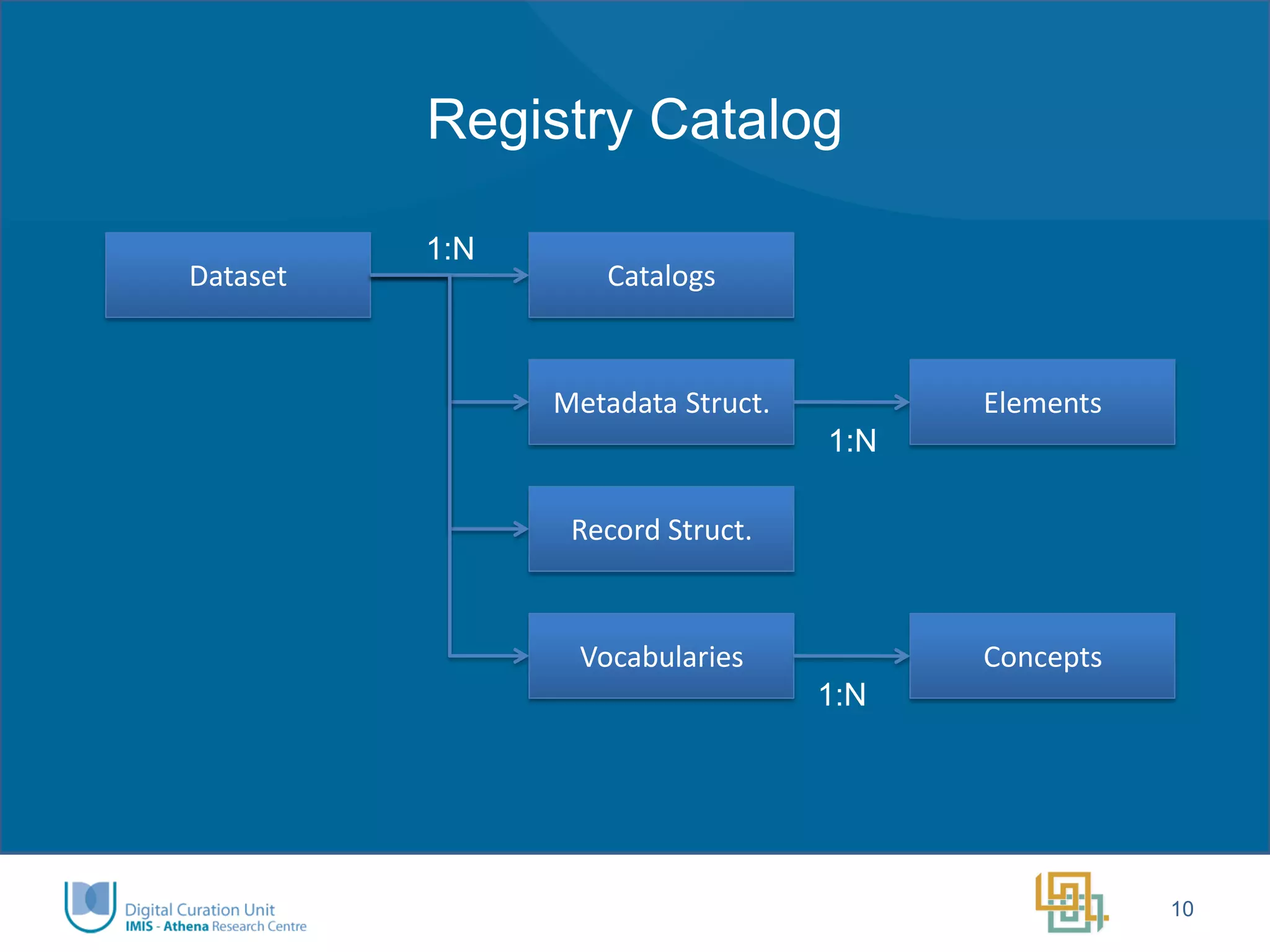
Registry Catalog 
10 
Dataset 
Catalogs 
1:N 
Metadata Struct. 
Record Struct. 
Vocabularies 
Concepts 
1:N 
Elements 
1:N
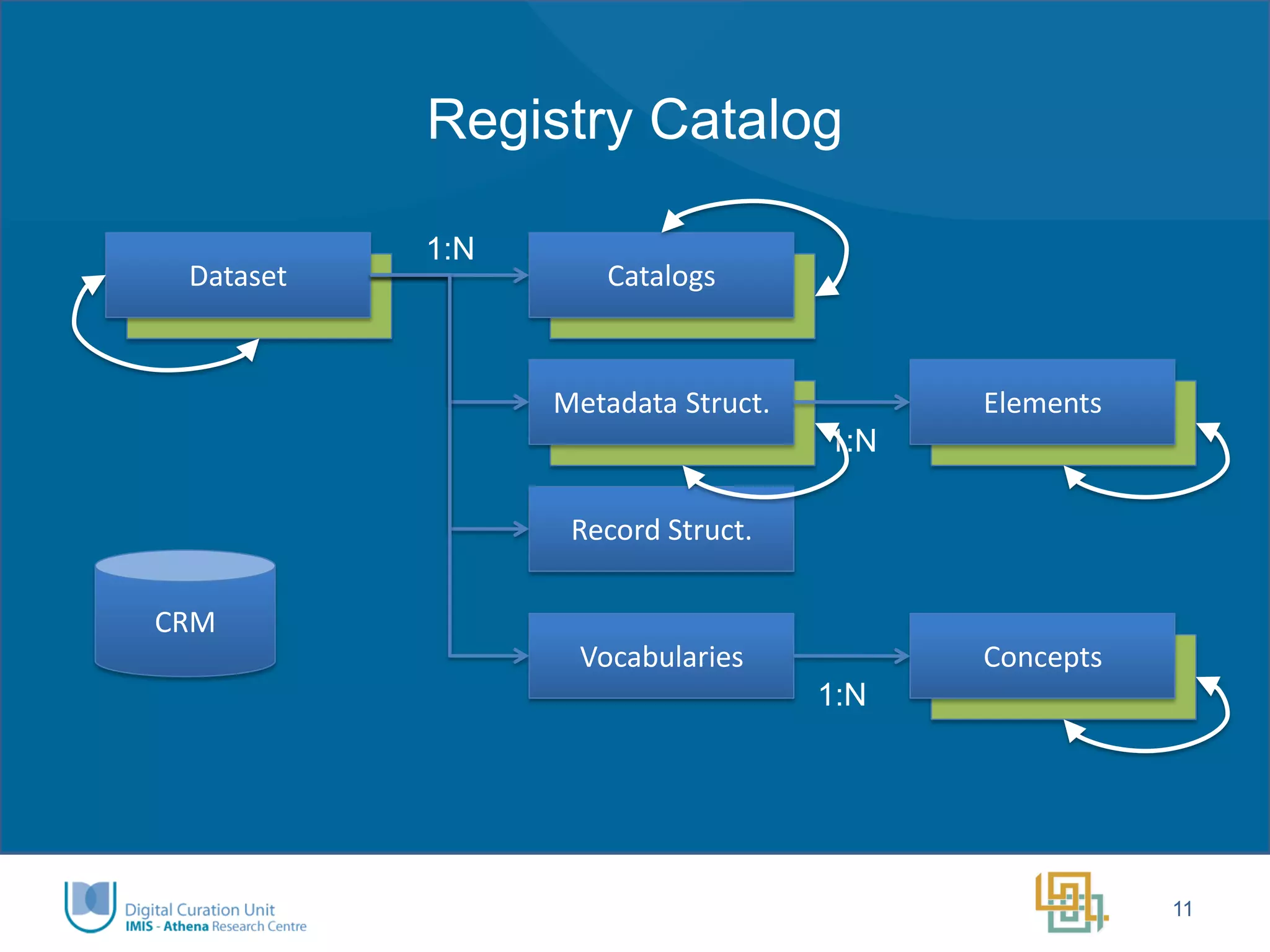
Registry Catalog 
11 
Dataset 
Catalogs 
1:N 
Metadata Struct. 
Record Struct. 
Vocabularies 
Concepts 
1:N 
Elements 
1:N 
CRM
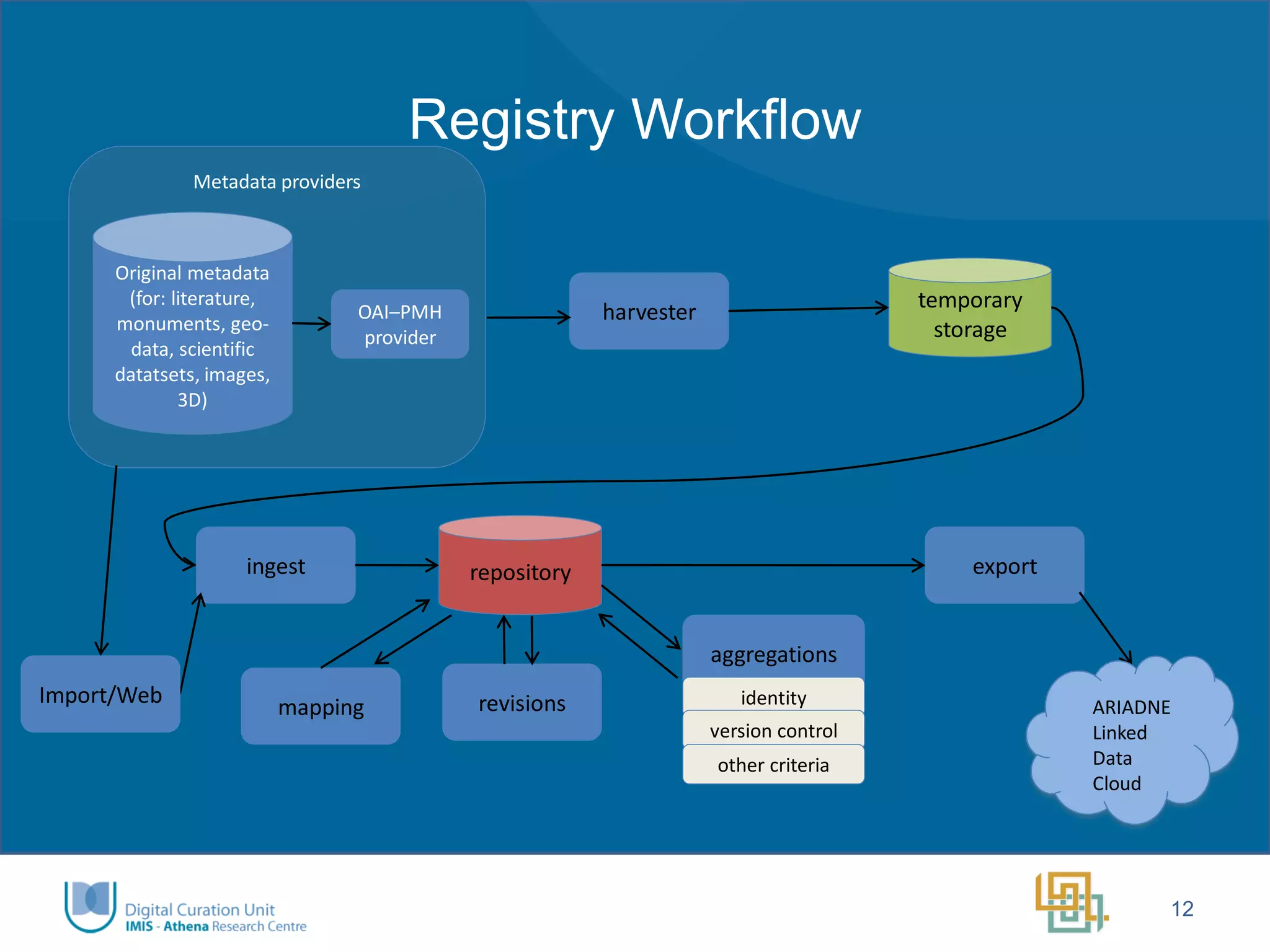
Registry Workflow 
12 
mapping 
temporary storage 
ingest 
repository 
revisions 
aggregations 
identity 
version control 
other criteria 
export 
harvester 
ARIADNE Linked Data Cloud 
Metadata providers 
Original metadata 
(for: literature, monuments, geo- data, scientific datatsets, images, 3D) 
OAI–PMH provider 
Import/Web
Services 
•Authentication / authorization 
•Ingestion 
•Indexing / retrieval 
•Resource discovery 
•Semantic annotation and linking 
•Visualization (3D/VR) 
•Repository services 
•Long-term preservation services 
13
Networking 
•ARIADNE gives special focus on Transnational Access and Training. 
–Enable users to co-work with experts 
–Allow effective use of the research infrastructure 
–Support innovative investigations 
14
15 
ARIADNE is a project funded by the European Commission under the Community’s Seventh Framework Programme, contract no. FP7-INFRASTRUCTURES-2012-1-313193. 
The views and opinions expressed in this presentation are the sole responsibility of the authors and do not necessarily reflect the views of the European Commission.

The ARIADNE interoperability framework, component architecture and registry service

  • 1.
    The ARIADNE interoperabilityframework, component architecture and registry service Costis Dallas1,2,3 and Dimitris Gavrilis1 1 Digital Curation Unit-IMIS, Athena Research Centre 2 Department of Communication, Media and Culture, Panteion University 3 Faculty of Information, University of Toronto {c.dallas,d.gavrilis}@dcu.gr 1
  • 2.
    ARIADNE Advanced ResearchInfrastructure for Archaeological Dataset Networking in Europe •48 months •24 partners •17 work packages •8.464.000 Euros 2
  • 3.
    What is ARIADNEabout •Very large number of digital datasets –Various domains, periods, places •Vast number of corpus available •Bring together and integrate the existing archaeological research data infrastructures –Compare –Re-use –Integrate into current research 3
  • 4.
    Objectives •Community building •Overcome fragmentation and provide interoperability –Overcome linguistic barriers –Address dataset interoperability •Unified and homogeneous interfaces –Provide a one-stop access point to Archaeological datasets –Provide innovative tools for enriching content / visualizing content (2D/3D) •Long-term preservation –Also include “grey literature” primary data •Development of innovative tools and services –Multilingual searching –Improved Conceptual Reference Model •Creating a new generation of researchers 4
  • 5.
    Dataset Integration •Extendthe integration of datasets: –Geographic extent –Different languages •Standardization through CIDOC-CRM ontology 5
  • 6.
    Addressing Complexity •Specialwork package dedicated in extending CIDOC-CRM so that it can handle complex entities and relations. –Capture structural similarities –Capture functional similarities –Provide tools for reasoning •Work in a mixed environment –Legacy datasets –Integrate existing datasets –Variable complexity 6
  • 7.
    Bibliography •Bring-in existingbibliography –Grey literature •NLP services –Mine texts (e.g. grey literature) –Information extraction –Automatic classification 7
  • 8.
    Interoperability Framework 8 Interoperability Layer Datasets Vocabularies Metadata Collections IPR Services Access/Admin API Ingest Annotate Enrich . . . External Sources Interoperability Services Repository Services Reasoning
  • 9.
    Interoperability Framework 9 Interoperability Layer Datasets Vocabularies Metadata Collections IPR Services Access/Admin API Ingest Annotate Enrich . . . External Sources Repository Services Interoperability Services Reasoning
  • 10.
    Registry Catalog 10 Dataset Catalogs 1:N Metadata Struct. Record Struct. Vocabularies Concepts 1:N Elements 1:N
  • 11.
    Registry Catalog 11 Dataset Catalogs 1:N Metadata Struct. Record Struct. Vocabularies Concepts 1:N Elements 1:N CRM
  • 12.
    Registry Workflow 12 mapping temporary storage ingest repository revisions aggregations identity version control other criteria export harvester ARIADNE Linked Data Cloud Metadata providers Original metadata (for: literature, monuments, geo- data, scientific datatsets, images, 3D) OAI–PMH provider Import/Web
  • 13.
    Services •Authentication /authorization •Ingestion •Indexing / retrieval •Resource discovery •Semantic annotation and linking •Visualization (3D/VR) •Repository services •Long-term preservation services 13
  • 14.
    Networking •ARIADNE givesspecial focus on Transnational Access and Training. –Enable users to co-work with experts –Allow effective use of the research infrastructure –Support innovative investigations 14
  • 15.
    15 ARIADNE isa project funded by the European Commission under the Community’s Seventh Framework Programme, contract no. FP7-INFRASTRUCTURES-2012-1-313193. The views and opinions expressed in this presentation are the sole responsibility of the authors and do not necessarily reflect the views of the European Commission.