A strategic approach to
Reproductive, Maternal, Newborn,
Child and Adolescent health in India
8/13/2018
1
RMNCH+A
Dr. Aparna Sen Chaudhary
Background
• In June 2012,
• GOI, Ethiopia, USA and The UNICEF –
 “Global Child Survival Call for Action : A promise to Keep”
• In February 2013, India launched –
 “ A Strategic Approach to Reproductive, Maternal, New-born
Child and Adolescent Health (RMNCH + A)”
8/13/2018
2
Background
8/13/2018
3
+
Five pillars in the Strategy
Reproductive Maternal Neonatal Child Adolescent
8/13/2018
4
“Plus” within the strategy
• Including adolescence
• Linking maternal health to reproductive health, FP, adolescent
health, HIV, gender, preconception and prenatal diagnostic
techniques
• Linking home and community based services to facility based
care
• Ensuring linkages, referrals and counter referrals
8/13/2018
5
Aim
Reach the maximum number of people in the remotest corners
of the country through
▸Continuum of services
▸Constant Innovations
▸Routine monitoring
8/13/2018
6
Goals
For 12th Five Year Plan
⋆ Reduction of Infant Mortality Rate to 25/1000 live births by 2017.
⋆ Reduction in Maternal Mortality Ratio to 100/100000 live births by 2017
⋆ Reduction in Total Fertility Rate to 2.1 by 2017
8/13/2018
7
Coverage Targets
8/13/2018
8
Aspects to be covered From baseline Annual increase rate
Facilities equipped for perinatal care by 100%
Institutional deliveries 61%(SRS 2010) 5.6%
ANC’s 53% (CES 2009) 6%
Postnatal care 45% (CES 2009) 7.5%
Deliveries by skilled birth attendants 76% (CES 2009) 2%
Exclusive breast feeding rates 35% (CES 2009) 9.6%
Reduce prevalence of under-five children with
underweight
45% (NFHS -3) 5.5%
Reduce Unmet need for family planning method 21% (DHLS 3) 8.8%
Increase met need for family planning 47% (DLHS-3) 4.5%
Reduce Anaemia in adolescent girls and boys 56%(G); 30% (B) 6%
Total fertility contributed by adolescents (15-19y) 16% (NFHS -3) 3.8%
Raise child sex ratio (0-6 years) 914 (Census 2011) 0.6%
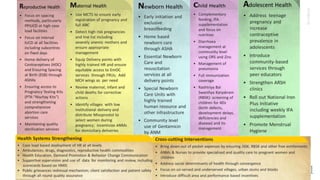
RMNCH+A strategy
▸ Focuses on high priority districts
• To address inter- state and inter- district variation
• Tailored programs to meet the needs of the underserved
• Includes adolescents, urban poor, tribal population
▸Management tools and job aids
• 5x5 matrix –five thematic areas – important tool which explains
strategy
• Minimum essential commodities
8/13/2018
9
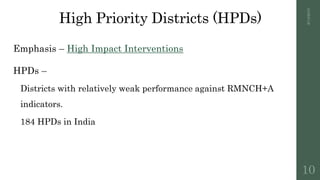
High Priority Districts (HPDs)
Emphasis – High Impact Interventions
HPDs –
Districts with relatively weak performance against RMNCH+A
indicators.
184 HPDs in India
8/13/2018
10
8/13/2018
11
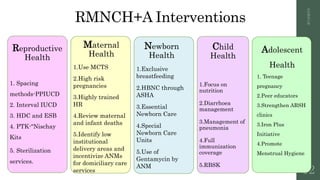
RMNCH+A Interventions
8/13/2018
12
Maternal
Health
1.Use MCTS
2.High risk
pregnancies
3.Highly trained
HR
4.Review maternal
and infant deaths
5.Identify low
institutional
delivery areas and
incentivize ANMs
for domiciliary care
services
Reproductive
Health
1. Spacing
methods-PPIUCD
2. Interval IUCD
3. HDC and ESB
4. PTK-"Nischay
Kits
5. Sterilization
services.
Newborn
Health
1.Exclusive
breastfeeding
2.HBNC through
ASHA
3.Essential
Newborn Care
4.Special
Newborn Care
Units
5.Use of
Gentamycin by
ANM
Child
Health
1.Focus on
nutrition
2.Diarrhoea
management
3.Management of
pneumonia
4.Full
immunization
coverage
5.RBSK
Adolescent
Health
1. Teenage
pregnancy
2.Peer educators
3.Strengthen ARSH
clinics
3.Iron Plus
Initiative
4.Promote
Menstrual Hygiene
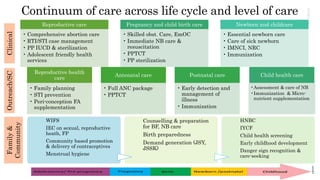
Implementation strategies
• Key intervention
 “Continuum of Care”
 Reducing mortality and improving survival
8/13/2018
13
Continuum of care across life cycle and level of care
8/13/2018
14
Reproductive care
• Comprehensive abortion care
• RTI/STI case management
• PP IUCD & sterilization
• Adolescent friendly health
services
Pregnancy and child birth care
• Skilled obst. Care, EmOC
• Immediate NB care &
resuscitation
• PPTCT
• PP sterilization
Newborn and childcare
• Essential newborn care
• Care of sick newborn
• IMNCI, NRC
• Immunization
Reproductive health
care
• Family planning
• STI prevention
• Peri-conception FA
supplementation
Antenatal care
• Full ANC package
• PPTCT
Postnatal care
• Early detection and
management of
illness
• Immunization
Child health care
•Assessment & care of NB
•Immunization & Micro-
nutrient supplementation
WIFS
IEC on sexual, reproductive
heath, FP
Community based promotion
& delivery of contraceptives
Menstrual hygiene
Counselling & preparation
for BF, NB care
Birth preparedness
Demand generation (JSY,
JSSK)
HNBC
IYCF
Child health screening
Early childhood development
Danger sign recognition &
care-seeking
ClinicalOutreach/SCFamily&
Community
Adolescent Health Programme
Priority interventions
• Adolescent nutrition; iron and folic acid supplementation
• Facility-based adolescent reproductive and sexual health services (Adolescent health
clinics)
• Information and counselling on adolescent sexual reproductive health and other health
issues
• Menstrual hygiene
• Preventive health check-ups
8/13/2018
15
A. Adolescent Reproductive and Sexual health
programme (ARSH)
• Routine check-up at primary, secondary and tertiary levels on
fixed days
• Promotive, Preventive, Curative and Counselling Management
of menstrual problems
• Approaches
 Facility based health services
 Counselling (ARSH and ICTC)
 Community based interventions
8/13/2018
16
ARSH…
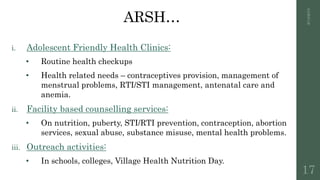
i. Adolescent Friendly Health Clinics:
• Routine health checkups
• Health related needs – contraceptives provision, management of
menstrual problems, RTI/STI management, antenatal care and
anemia.
ii. Facility based counselling services:
• On nutrition, puberty, STI/RTI prevention, contraception, abortion
services, sexual abuse, substance misuse, mental health problems.
iii. Outreach activities:
• In schools, colleges, Village Health Nutrition Day.
8/13/2018
17
B. Weekly Iron and Folic acid Supplementation
(WIFS)
• Reduce incidence of anemia amongst adolescent girls and boys.
• Goal – to break intergenerational cycle of anemia
• Interventions
a) Supervised weekly Fe-FA supplements – 100mg Fe & 500 𝜇g FA.
b) Screening of the target groups
c) Biannual de-worming
d) Information and counselling
8/13/2018
18
C. Menstrual hygiene scheme
• Promotion of menstrual hygiene among adolescent girls (10-19 yrs.)
in rural areas.
• Activities
 Community based health education and outreach
 Ensuring regular availability of sanitary napkins
 Storage and distribution of sanitary napkins
 Training of ASHA and nodal teachers in menstrual health
 Safe disposal of sanitary napkins
8/13/2018
19
Other Interventions
• Care during pregnancy and child birth
• Newborn and child care
• Care through reproductive years
8/13/2018
20
Other Interventions
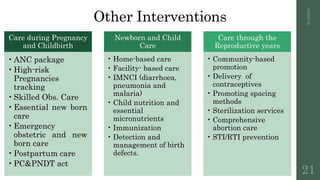
Care during Pregnancy
and Childbirth
•ANC package
•High-risk
Pregnancies
tracking
•Skilled Obs. Care
•Essential new born
care
•Emergency
obstetric and new
born care
•Postpartum care
•PC&PNDT act
Newborn and Child
Care
• Home-based care
• Facility- based care
• IMNCI (diarrhoea,
pneumonia and
malaria)
• Child nutrition and
essential
micronutrients
• Immunization
• Detection and
management of birth
defects.
Care through the
Reproductive years
• Community-based
promotion
• Delivery of
contraceptives
• Promoting spacing
methods
• Sterilization services
• Comprehensive
abortion care
• STI/RTI prevention
8/13/2018
21
Delivery points
Designated based on provision of services for delivery care
8/13/2018
22
• Conducts minimum three normal deliveries
per monthL1
• Conducts minimum ten deliveries per month,
including management of complicationsL2
• Conducts minimum 20 - 50 deliveries per
month including C-sectionL3
Delivery points
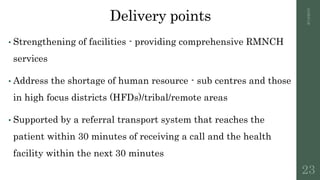
• Strengthening of facilities - providing comprehensive RMNCH
services
• Address the shortage of human resource - sub centres and those
in high focus districts (HFDs)/tribal/remote areas
• Supported by a referral transport system that reaches the
patient within 30 minutes of receiving a call and the health
facility within the next 30 minutes
8/13/2018
23
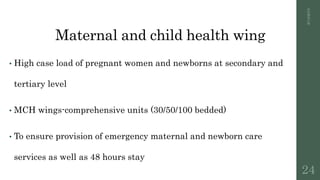
Maternal and child health wing
• High case load of pregnant women and newborns at secondary and
tertiary level
• MCH wings-comprehensive units (30/50/100 bedded)
• To ensure provision of emergency maternal and newborn care
services as well as 48 hours stay
8/13/2018
24
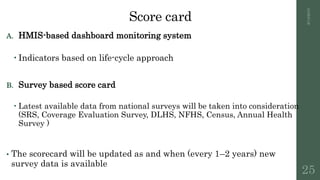
Score card
A. HMIS-based dashboard monitoring system
 Indicators based on life-cycle approach
B. Survey based score card
 Latest available data from national surveys will be taken into consideration
(SRS, Coverage Evaluation Survey, DLHS, NFHS, Census, Annual Health
Survey )
• The scorecard will be updated as and when (every 1–2 years) new
survey data is available
8/13/2018
25
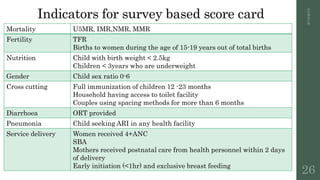
Indicators for survey based score card
Mortality U5MR, IMR,NMR, MMR
Fertility TFR
Births to women during the age of 15-19 years out of total births
Nutrition Child with birth weight < 2.5kg
Children < 3years who are underweight
Gender Child sex ratio 0-6
Cross cutting Full immunization of children 12 -23 months
Household having access to toilet facility
Couples using spacing methods for more than 6 months
Diarrhoea ORT provided
Pneumonia Child seeking ARI in any health facility
Service delivery Women received 4+ANC
SBA
Mothers received postnatal care from health personnel within 2 days
of delivery
Early initiation (<1hr) and exclusive breast feeding
8/13/2018
26
Thank you
8/13/2018
27

Rmnch+a

  • 1.
    A strategic approachto Reproductive, Maternal, Newborn, Child and Adolescent health in India 8/13/2018 1 RMNCH+A Dr. Aparna Sen Chaudhary
  • 2.
    Background • In June2012, • GOI, Ethiopia, USA and The UNICEF –  “Global Child Survival Call for Action : A promise to Keep” • In February 2013, India launched –  “ A Strategic Approach to Reproductive, Maternal, New-born Child and Adolescent Health (RMNCH + A)” 8/13/2018 2
  • 3.
  • 4.
    Five pillars inthe Strategy Reproductive Maternal Neonatal Child Adolescent 8/13/2018 4
  • 5.
    “Plus” within thestrategy • Including adolescence • Linking maternal health to reproductive health, FP, adolescent health, HIV, gender, preconception and prenatal diagnostic techniques • Linking home and community based services to facility based care • Ensuring linkages, referrals and counter referrals 8/13/2018 5
  • 6.
    Aim Reach the maximumnumber of people in the remotest corners of the country through ▸Continuum of services ▸Constant Innovations ▸Routine monitoring 8/13/2018 6
  • 7.
    Goals For 12th FiveYear Plan ⋆ Reduction of Infant Mortality Rate to 25/1000 live births by 2017. ⋆ Reduction in Maternal Mortality Ratio to 100/100000 live births by 2017 ⋆ Reduction in Total Fertility Rate to 2.1 by 2017 8/13/2018 7
  • 8.
    Coverage Targets 8/13/2018 8 Aspects tobe covered From baseline Annual increase rate Facilities equipped for perinatal care by 100% Institutional deliveries 61%(SRS 2010) 5.6% ANC’s 53% (CES 2009) 6% Postnatal care 45% (CES 2009) 7.5% Deliveries by skilled birth attendants 76% (CES 2009) 2% Exclusive breast feeding rates 35% (CES 2009) 9.6% Reduce prevalence of under-five children with underweight 45% (NFHS -3) 5.5% Reduce Unmet need for family planning method 21% (DHLS 3) 8.8% Increase met need for family planning 47% (DLHS-3) 4.5% Reduce Anaemia in adolescent girls and boys 56%(G); 30% (B) 6% Total fertility contributed by adolescents (15-19y) 16% (NFHS -3) 3.8% Raise child sex ratio (0-6 years) 914 (Census 2011) 0.6%
  • 9.
    RMNCH+A strategy ▸ Focuseson high priority districts • To address inter- state and inter- district variation • Tailored programs to meet the needs of the underserved • Includes adolescents, urban poor, tribal population ▸Management tools and job aids • 5x5 matrix –five thematic areas – important tool which explains strategy • Minimum essential commodities 8/13/2018 9
  • 10.
    High Priority Districts(HPDs) Emphasis – High Impact Interventions HPDs – Districts with relatively weak performance against RMNCH+A indicators. 184 HPDs in India 8/13/2018 10
  • 11.
  • 12.
    RMNCH+A Interventions 8/13/2018 12 Maternal Health 1.Use MCTS 2.Highrisk pregnancies 3.Highly trained HR 4.Review maternal and infant deaths 5.Identify low institutional delivery areas and incentivize ANMs for domiciliary care services Reproductive Health 1. Spacing methods-PPIUCD 2. Interval IUCD 3. HDC and ESB 4. PTK-"Nischay Kits 5. Sterilization services. Newborn Health 1.Exclusive breastfeeding 2.HBNC through ASHA 3.Essential Newborn Care 4.Special Newborn Care Units 5.Use of Gentamycin by ANM Child Health 1.Focus on nutrition 2.Diarrhoea management 3.Management of pneumonia 4.Full immunization coverage 5.RBSK Adolescent Health 1. Teenage pregnancy 2.Peer educators 3.Strengthen ARSH clinics 3.Iron Plus Initiative 4.Promote Menstrual Hygiene
  • 13.
    Implementation strategies • Keyintervention  “Continuum of Care”  Reducing mortality and improving survival 8/13/2018 13
  • 14.
    Continuum of careacross life cycle and level of care 8/13/2018 14 Reproductive care • Comprehensive abortion care • RTI/STI case management • PP IUCD & sterilization • Adolescent friendly health services Pregnancy and child birth care • Skilled obst. Care, EmOC • Immediate NB care & resuscitation • PPTCT • PP sterilization Newborn and childcare • Essential newborn care • Care of sick newborn • IMNCI, NRC • Immunization Reproductive health care • Family planning • STI prevention • Peri-conception FA supplementation Antenatal care • Full ANC package • PPTCT Postnatal care • Early detection and management of illness • Immunization Child health care •Assessment & care of NB •Immunization & Micro- nutrient supplementation WIFS IEC on sexual, reproductive heath, FP Community based promotion & delivery of contraceptives Menstrual hygiene Counselling & preparation for BF, NB care Birth preparedness Demand generation (JSY, JSSK) HNBC IYCF Child health screening Early childhood development Danger sign recognition & care-seeking ClinicalOutreach/SCFamily& Community
  • 15.
    Adolescent Health Programme Priorityinterventions • Adolescent nutrition; iron and folic acid supplementation • Facility-based adolescent reproductive and sexual health services (Adolescent health clinics) • Information and counselling on adolescent sexual reproductive health and other health issues • Menstrual hygiene • Preventive health check-ups 8/13/2018 15
  • 16.
    A. Adolescent Reproductiveand Sexual health programme (ARSH) • Routine check-up at primary, secondary and tertiary levels on fixed days • Promotive, Preventive, Curative and Counselling Management of menstrual problems • Approaches  Facility based health services  Counselling (ARSH and ICTC)  Community based interventions 8/13/2018 16
  • 17.
    ARSH… i. Adolescent FriendlyHealth Clinics: • Routine health checkups • Health related needs – contraceptives provision, management of menstrual problems, RTI/STI management, antenatal care and anemia. ii. Facility based counselling services: • On nutrition, puberty, STI/RTI prevention, contraception, abortion services, sexual abuse, substance misuse, mental health problems. iii. Outreach activities: • In schools, colleges, Village Health Nutrition Day. 8/13/2018 17
  • 18.
    B. Weekly Ironand Folic acid Supplementation (WIFS) • Reduce incidence of anemia amongst adolescent girls and boys. • Goal – to break intergenerational cycle of anemia • Interventions a) Supervised weekly Fe-FA supplements – 100mg Fe & 500 𝜇g FA. b) Screening of the target groups c) Biannual de-worming d) Information and counselling 8/13/2018 18
  • 19.
    C. Menstrual hygienescheme • Promotion of menstrual hygiene among adolescent girls (10-19 yrs.) in rural areas. • Activities  Community based health education and outreach  Ensuring regular availability of sanitary napkins  Storage and distribution of sanitary napkins  Training of ASHA and nodal teachers in menstrual health  Safe disposal of sanitary napkins 8/13/2018 19
  • 20.
    Other Interventions • Careduring pregnancy and child birth • Newborn and child care • Care through reproductive years 8/13/2018 20
  • 21.
    Other Interventions Care duringPregnancy and Childbirth •ANC package •High-risk Pregnancies tracking •Skilled Obs. Care •Essential new born care •Emergency obstetric and new born care •Postpartum care •PC&PNDT act Newborn and Child Care • Home-based care • Facility- based care • IMNCI (diarrhoea, pneumonia and malaria) • Child nutrition and essential micronutrients • Immunization • Detection and management of birth defects. Care through the Reproductive years • Community-based promotion • Delivery of contraceptives • Promoting spacing methods • Sterilization services • Comprehensive abortion care • STI/RTI prevention 8/13/2018 21
  • 22.
    Delivery points Designated basedon provision of services for delivery care 8/13/2018 22 • Conducts minimum three normal deliveries per monthL1 • Conducts minimum ten deliveries per month, including management of complicationsL2 • Conducts minimum 20 - 50 deliveries per month including C-sectionL3
  • 23.
    Delivery points • Strengtheningof facilities - providing comprehensive RMNCH services • Address the shortage of human resource - sub centres and those in high focus districts (HFDs)/tribal/remote areas • Supported by a referral transport system that reaches the patient within 30 minutes of receiving a call and the health facility within the next 30 minutes 8/13/2018 23
  • 24.
    Maternal and childhealth wing • High case load of pregnant women and newborns at secondary and tertiary level • MCH wings-comprehensive units (30/50/100 bedded) • To ensure provision of emergency maternal and newborn care services as well as 48 hours stay 8/13/2018 24
  • 25.
    Score card A. HMIS-baseddashboard monitoring system  Indicators based on life-cycle approach B. Survey based score card  Latest available data from national surveys will be taken into consideration (SRS, Coverage Evaluation Survey, DLHS, NFHS, Census, Annual Health Survey ) • The scorecard will be updated as and when (every 1–2 years) new survey data is available 8/13/2018 25
  • 26.
    Indicators for surveybased score card Mortality U5MR, IMR,NMR, MMR Fertility TFR Births to women during the age of 15-19 years out of total births Nutrition Child with birth weight < 2.5kg Children < 3years who are underweight Gender Child sex ratio 0-6 Cross cutting Full immunization of children 12 -23 months Household having access to toilet facility Couples using spacing methods for more than 6 months Diarrhoea ORT provided Pneumonia Child seeking ARI in any health facility Service delivery Women received 4+ANC SBA Mothers received postnatal care from health personnel within 2 days of delivery Early initiation (<1hr) and exclusive breast feeding 8/13/2018 26
  • 27.