MEDICINMANField Force Excellence
TM
May 2015 | www.medicinman.net
Since 2011
“A
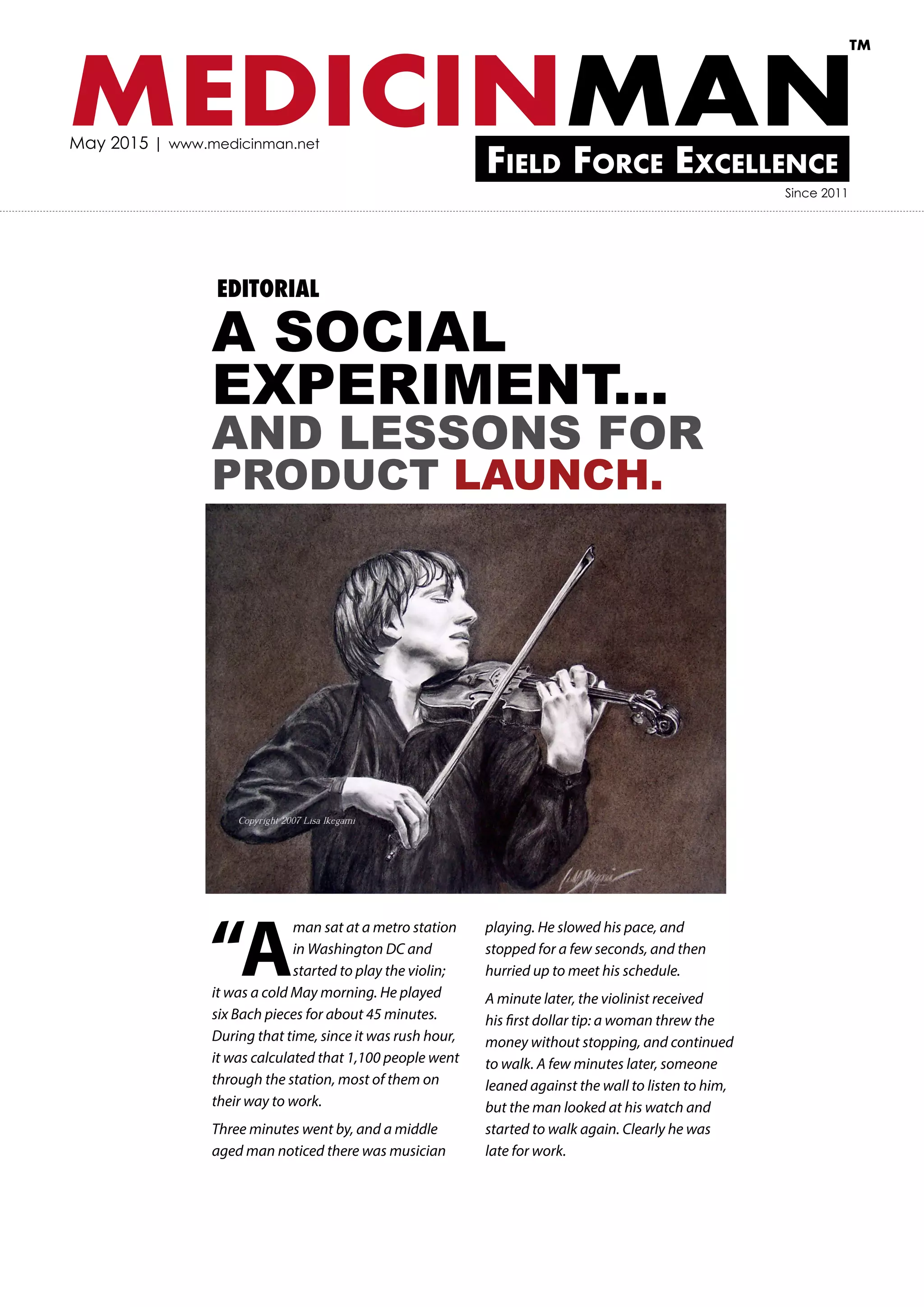
man sat at a metro station
in Washington DC and
started to play the violin;
it was a cold May morning. He played
six Bach pieces for about 45 minutes.
During that time, since it was rush hour,
it was calculated that 1,100 people went
through the station, most of them on
their way to work.
Three minutes went by, and a middle
aged man noticed there was musician
playing. He slowed his pace, and
stopped for a few seconds, and then
hurried up to meet his schedule.
A minute later, the violinist received
his first dollar tip: a woman threw the
money without stopping, and continued
to walk. A few minutes later, someone
leaned against the wall to listen to him,
but the man looked at his watch and
started to walk again. Clearly he was
late for work.
EDITORIAL
A SOCIAL
EXPERIMENT...
AND LESSONS FOR
PRODUCT LAUNCH.
Editorial
Connect with Anup Soans on LinkedIn | Facebook | Twitter
Anup Soans is an Author, Facilitator and the
Editor of MedicinMan.
Write in to him: anupsoans@medicinman.net
Meet the Editor
The one who paid the most attention was a 3 year
old boy. His mother tagged him along, hurried, but
the kid stopped to look at the violinist. Finally, the
mother pushed hard, and the child continued to walk,
turning his head all the time. This action was repeated
by several other children. All the parents, without
exception, forced them to move on.
In the 45 minutes the musician played, only 6 people
stopped and stayed for a while. About 20 gave him
money, but continued to walk their normal pace. He
collected $32. When he finished playing and silence
took over, no one noticed it. No one applauded, nor
was there any recognition.
No one knew this, but the violinist was Joshua Bell,
one of the most talented musicians in the world. He
had just played one of the most intricate pieces ever
written, on a violin worth $3.5 million dollars. Two days
before playing in the subway, Joshua Bell sold out full-
house at a theatre in Boston where the seats averaged
$100.
This is a true story. Joshua Bell playing incognito in the
metro station was organized by the Washington Post
as part of a social experiment about perception, taste,
and priorities of people.”
- The Washington Post
Lessons for Pharma: In today’s attention deficit
economy, you can have the best product and a
great story on the latest digital device in the hands
of a well trained field force, but if your don’t create
the right expectation in the minds of busy doctors
through a well thought out multi channel marketing
strategy that creates a pre launch expectation, your
product launch is likely to meet the fate of Joshua
Bell in the Washington DC metro station. -MM
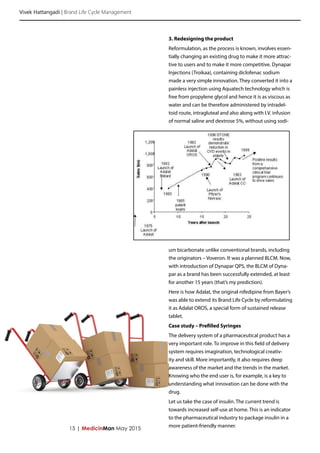
Joshua Bell’s performance in a Boston subway was
mostly ignored by passersby
BRAND
LIFE CYCLE
MANAGEMENT
Vivek Hattangadi
1. Doctor Profiling for Sales Success.....................4
A Doctor Profile enables the Medical Rep to tailor-
make his detailing approach to each Doctor,
ensuring sales success.
RB Balakrishna
2. Using Gamification to Achieve a State of Flow
while Learning..........................................................7
By turning learning into a game, learners enter into
a ‘state of flow’ - a condition where the ‘high’ of the
game makes learning a habit.
Rajiv Jayaraman
3. The 3 ‘E’s of Sales Leadership: Engage,
Empower & Enable...............................................10
How to move from being mere sales ‘managers’ to
being sales ‘leaders’.
K. Hariram
4. Focus Feature: Brand Life Cycle Management
.................................................................................12
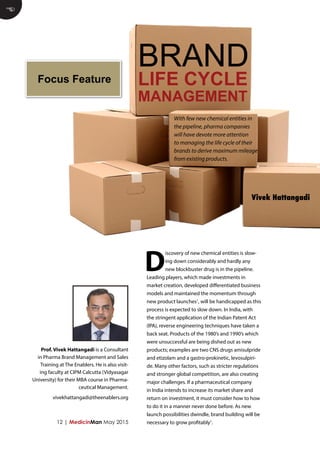
With few new chemical entities in the pipeline,
pharma companies will have devote more attention
to managing the life cycle of their brands to derive
maximum mileage from existing products.
Vivek Hattangadi
5. Lost Patients......................................................17
By ignoring the pharmacist, pharma companies
are losing out on meeting the health needs of many
patients.
(Click to navigate)
CONTENTS
MedicinMan Volume 5 Issue 5 | April 2015
Editor and Publisher
Anup Soans
CEO
Chhaya Sankath
Chief Mentor
K. Hariram
Editorial Board
Salil Kallianpur; Prof. Vivek Hattangadi; Shashin
Bodawala; Hanno Wolfram; Renie McClay
Executive Editor
Joshua Soans
Letters to the Editor: anupsoans@medicinman.net
Focus Feature
PAGE 12
4 | MedicinMan May 2015
T
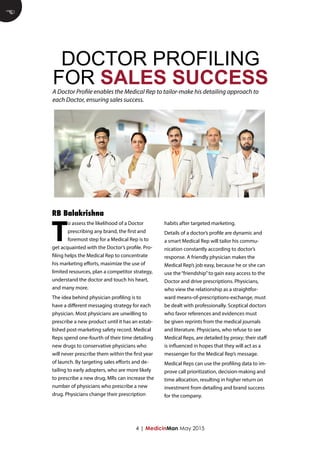
o assess the likelihood of a Doctor
prescribing any brand, the first and
foremost step for a Medical Rep is to
get acquainted with the Doctor’s profile. Pro-
filing helps the Medical Rep to concentrate
his marketing efforts, maximize the use of
limited resources, plan a competitor strategy,
understand the doctor and touch his heart,
and many more.
The idea behind physician profiling is to
have a different messaging strategy for each
physician. Most physicians are unwilling to
prescribe a new product until it has an estab-
lished post-marketing safety record. Medical
Reps spend one-fourth of their time detailing
new drugs to conservative physicians who
will never prescribe them within the first year
of launch. By targeting sales efforts and de-
tailing to early adopters, who are more likely
to prescribe a new drug, MRs can increase the
number of physicians who prescribe a new
drug. Physicians change their prescription
habits after targeted marketing.
Details of a doctor’s profile are dynamic and
a smart Medical Rep will tailor his commu-
nication constantly according to doctor’s
response. A friendly physician makes the
Medical Rep’s job easy, because he or she can
use the“friendship”to gain easy access to the
Doctor and drive prescriptions. Physicians,
who view the relationship as a straightfor-
ward means-of-prescriptions-exchange, must
be dealt with professionally. Sceptical doctors
who favor references and evidences must
be given reprints from the medical journals
and literature. Physicians, who refuse to see
Medical Reps, are detailed by proxy; their staff
is influenced in hopes that they will act as a
messenger for the Medical Rep’s message.
Medical Reps can use the profiling data to im-
prove call prioritization, decision-making and
time allocation, resulting in higher return on
investment from detailing and brand success
for the company.
RB Balakrishna
E
DOCTOR PROFILING
FOR SALES SUCCESSA Doctor Profile enables the Medical Rep to tailor-make his detailing approach to
each Doctor, ensuring sales success.
5 | MedicinMan May 2015
Prescribing data can be a tool used both to identify
high-prescribers and to track the effects of promo-
tions. Ensuring that physicians targeted for detailing
are both high prescribers and early adopters, im-
proves the probability of prescriptions. This cumu-
latively increases the total number of prescriptions
written for a drug, simply by identifying the right
physicians to detail. The benefits of profiling can be
translated directly into profit and growth. Meaning,
this growth is attained without additional investment
in the given territory.
Prescribing data can also be used to see how many of
a physician’s patients receive specific drugs, how many
prescriptions the physician writes for targeted and
competing drugs, and how a physician’s prescribing
habits change over time.
Even for a standard-detailing-visit promoting a mature
product, MRs must identify and document:
1.	 Which products the physician prefer to use and
when.
2.	 What their prescribing rate for different diseases
is and how quickly they adopt the use of new
products.
When a product launch approaches, Medical Reps
can consolidate the information recorded of specific
physicians to build a prescriber profile of the key phy-
sicians in their area.
Consider a Medical Rep who doesn’t know the profile
of the doctor whom he is about to meet. He or she
doesn’t know the preferences of the doctor and will
not be able to make an effective call. On the other
hand, a Medical Rep who knows the profile of the
doctor can even manage the time of visit and spend
more time in a given call and build relationship. The
probability of doctor prescribing the requested brand
increases significantly if the required specifics are
mentioned in the detailing.
Conclusion
Doctor’s profiling information improves:
ØØ The possibility of seeing the doctor,
ØØ The probability of doctor prescribing the brand
after detailing,
ØØ Number of prescriptions the doctor is likely to
write and thus
ØØ Number of new prescriptions gained through
detailing alone. -RB
RB Balakrishna | Doctor Profiling for Sales Success
RB Balakrishna is an Area Manager with a
reputed pharmaceutical company
”
Medical Reps can use the
profiling data to improve call
prioritization, decision-making
and time allocation, resulting
in higher return on investment
from detailing and brand
success for the company.
CAREERPROGRESSIONRESOURCES
NOWAVAILABLEON
(click on the books to purchase on
flipkart)
SuperVision for the SuperWiser Front-line Manager
is a tool to help pharma professionals transition from
super salesmen to great front-line managers and
leaders. The book will equip front-line managers to
Manage, Coach, Motivate and Lead their teams to
deliver outstanding performance. An engaging read,
filled with examples and illustrations, SuperVision for
the SuperWiser Front-line Manager has been used by
thousands of managers across the industry.
HardKnocks for the GreenHorn is a specially crafted
training manual to enable Medical Representatives
to gain the Knowledge, Skills and Attitude needed
to succeed in the competitive arena of pharma field
sales. Medical Representatives joining the field are
often not aware about the key success factors of their
job and as a result they get discouraged when things
don’t go as planned. HardKnocks for the GreenHorn
is a powerful learning and motivational tool for field
sales managers to build their sales teams.
GET YOUR PHARMA CAREER OFF TO A FLYING START!
7 | MedicinMan May 2015
H
ave you ever had an experience where you
lost your sense of self while immersing your-
self in an activity? Have you experienced a
high due to single-minded focus on something inter-
esting? Have you lost track of time while pursuing an
activity that you are passionate about? If the answer
to any of these questions is“Yes”, then you have
experienced the‘state of flow’. Did any of these ex-
periences happen to you while you were learning in
school, college or at work? I guess not. Most learners
unfortunately tend to look at learning as a laborious
chore. This isn’t how it was meant to be. So how do
we change this situation? How do we make learning
a joy? This article aims to present various ways in
which learning and development professionals can
learn from games and gamification to facilitate the
state of flow for learners.
In his groundbreaking classic work, psychologist
Mihaly Csikszentmihalyi reveals that what makes an
experience genuinely satisfying is a state of con-
sciousness called‘flow’. During flow, people typically
experience total focus, deep enjoyment, creativity,
and complete involvement with whatever activity
they pursue, in fact with life itself. He demonstrates
various ways in which this positive state of mind can
be controlled and not just left to chance.
Flow is understood to comprise of nine dimensions:
Challenge-skill balance, clear goals, control, immedi-
ate feedback, autotelic experience, loss of self-con-
sciousness, time transformation, concentration and
merging action-awareness. Games and gamification
create a conducive environment for many of these
dimensions to manifest in the learning process.
E
By turning learning into a game, learners enter into a ‘state of flow’ - a
condition where the ‘high’ of the game makes learning a habit.
USING GAMIFICATION
TO ACHIEVE A STATE OF
FLOW WHILE LEARNING
Rajiv Jayaraman
”
8 | MedicinMan May 2015
CHALLENGE-SKILL BALANCE
Games have a concept of levels embedded in the
structure of the game. This enables players to start at a
simple level and keep progressing to higher levels till
they feel that they cannot proceed anymore. This con-
stant pursuit of mastery is what brings them back to
the game every day. Applying this concept to learning,
companies can construct a learning environment that
provides the learner the opportunity to make progress
by expanding their skill one step at a time.
CLEAR GOALS
Every game has a clear objective and a set of guiding
rules. Without goals, the player does not get a clear
sense of direction. The same principle applies to
learners. Every learning intervention needs to clearly
outline the goals. It is best if the goals are challeng-
ing yet seem achievable. Getting this balance right
is immensely important for the learner to have the
confidence to start and the right amount of challenges
to keep going.
CONTROL
Games give individuals the power to choose from var-
ious possibilities and alter the course of action within
the game. This gives gamers the sense of control that
is needed to stay engaged in the activity. Research
shows that adult learners learn best when they are
given the autonomy to test their hypothesis and see
the results for themselves.
IMMEDIATE FEEDBACK
Malcolm Gladwell, in his book Outliers, talks about
how assisted practice over a long period of time im-
proves the chances of mastery in a domain. The short
cause and effect feedback loop in games makes the
gamer learn the rules of the game faster. The feedback
also helps to condition the behaviour of gamers within
and outside the game. Case in point, the current COO
of Symantec, Stephen Gillette, is one of the youngest
executives sitting in the board of a large organization.
He is an avid gamer who attributes his leadership skills
to the World of Warcraft game. Real world behaviours
can be shaped by games and simulation through
immediate feedback.
AUTOTELIC EXPERIENCE
Any activity that has a purpose in and not apart from
itself is described as Autotelic. In other words, autotelic
experience is one where the individual does the activi-
ty for its own sake without any inducement of external
rewards. While points, badges and leader boards mo-
tivate the learner to perform well, in most successful
games, it is the activity itself that is the reward.
Every learning
intervention needs to
clearly outline the goals.
It is best if the goals are
challenging yet seem
achievable. Getting this
balance right is immensely
important for the learner
to have the confidence to
start and the right amount
of challenges to keep going.
Rajiv Jayaraman | Using Gamification to Achieve a State of Flow while Learning
9 | MedicinMan May 2015
By making the context of the learning environment
real-world like and by giving the learner the feedback
that he / she is gaining in skill, we can facilitate autotel-
ic experiences for the learner.
LOSS OF SELF-CONSCIOUSNESS
Games have the ability to draw us into an alternative
world and make us lose our sense of self. Quite inter-
estingly, after the experience, individuals come out
with a stronger sense of self, one that is integrated and
sophisticated. By introducing games and simulations
in the learning process, we can achieve the same result
for our learners.
TIME TRANSFORMATION
Most gamers report that they lose the sense of time
when they immerse themselves in a game. They are at
it for hours on end. By using gaming principles in the
learning process, we can create a craving for learning
and engage learners in productive skill enhancing
exercises.
CONCENTRATION
The most enjoyable experiences happen to us when
we devote our complete attention to the activity at
hand. The power of concentration frees up our mind
from distractions and enables us to enjoy the quality of
the experience. By using gaming and simulations, we
can enable learners to completely devote themselves
to the learning task at hand. As a result, learning be-
comes enjoyable and sheer joy. The high the learners
experience becomes the hook for making learning a
habit.
MERGING ACTION-AWARENESS
Today, most learning interventions tend to focus
on the cognitive aspects of learning, with very little
attention paid to the motivation of the learner and
the application of learning. By encouraging learners to
apply learning in a safe learning environment, we can
enable them to exercise their muscle-memory, which
comes in handy later when they face real situations.
Combination of action and reflection is vital for learn-
ers to internalize their experience.
CONCLUSION
To sum up, the current learning design doesn’t facil-
itate the state of flow for learners. We need to think
about ways in which learners can escape from the mo-
notony and truly enjoy the bliss of learning something
new. By wisely using some of the gaming and gamifi-
cation principles, we can facilitate the state of flow in
learners. Perhaps then, learning will become a joy and
learners will get into the habit of learning daily just like
millions of candy crush and fishville players around the
world can’t live without their favorite game. -RJ
Rajiv Jayaraman | Using Gamification to Achieve a State of Flow while Learning
”
By using gaming and
simulations, we can enable
learners to completely
devote themselves to the
learning task at hand. As
a result, learning becomes
enjoyable and sheer joy.
The high the learners
experience becomes the
hook for making learning a
habit.
Rajiv Jayaraman is Founder-CEO, KNOLSKAPE
10 | MedicinMan May 2015
I
s there a difference between the Head of Sales/Sales
Manager (SM) and the Front Line Manager (FLM)?
I know this controversial question will raise many eye-
brows. However, I am very clear and what I am refering
to is the mindset and approach to business and people.
More often than not, we are all ready to criticise the
FLMs, their quality, role, responsibilities, and behaviours.
However, when I meet many sales managers leading a
team of sales people and line managers at various levels,
I often wonder the thin line of difference in terms of
their quality, behaviours and managing people.
So, the unasked question is – do you want Head of Sales
to be Sales Leaders (or Leaders of the sales team) or mere
Sales Managers (managing sales)?
What is the difference? Almost always, sales managers
are managing their sales force, allocating geographical
territories, controlling the efforts area, pushing people
to perform, hitting the sales numbers by hook or crook
by the month end and various tasks that come under
the title umbrella.
Leading the sales team takes on a whole different
meaning and with added dimensions. Apart from what
is mentioned above it involves mentoring people, on/off
the job, coaching, influencing/inspiring people, support-
ing and helping them and being a constant cheer leader
for them every day.
E
THE 3 ‘E’s OF
SALES LEADERSHIP:
ENGAGE,
EMPOWER &
ENABLEHow to move from being mere sales
‘managers’ to being sales ‘leaders’
K. Hariram
K. Hariram is the former MD (retd.) at
Galderma India.
He is Chief Mentor at MedicinMan and a
regular contributor. khariram25@yahoo.com
11 | MedicinMan May 2015
In short, it is practicing 3‘E’s – Engaging, Empow-
ering and Enabling the sales team day in and day
out.
How often have you looked at a Sales Manager and
said,“He took his people from GOOD to GREAT”, as
Jim Collins said?
Having been a Sales Head in my career journey,
I know for sure that sales management is not an
easy business and it is not for the weak-hearted.
The responsibility involves acting as a cushion
between organisational revenue objectives and
the sales people who are out on the road, braving
the vagaries of weather and the constant rejec-
tions/objections they face from customers. As their
leader and the Head of Sales you make sure that
they keep going, despite the odds and maximise
their success through performance.
It is time that the sales managers change their
mindset and come out of their intimidating and
negative reinforcement behaviours. These will
not work in the long run and will only add to the
misery of increasing sales force attrition. Equally
important is the need to invest in self-learning and
development through books and attending learn-
ing & development programs besides developing
through work.
As a sales manager, you are not just‘managing’
them but LEADING them to WIN in a highly com-
petitive environment. In short, you are a SALES
LEADER. -KH
K. Hariram | The 3 ‘E’s of Sales Leadership: Engage, Empower & Enable
”
Leading the sales team ...
involves mentoring people,
on/off the job, coaching,
influencing/inspiring
people, supporting and
helping them and being a
constant cheer leader for
them every day.
12 | MedicinMan May 2015
D
iscovery of new chemical entities is slow-
ing down considerably and hardly any
new blockbuster drug is in the pipeline.
Leading players, which made investments in
market creation, developed differentiated business
models and maintained the momentum through
new product launches1
, will be handicapped as this
process is expected to slow down. In India, with
the stringent application of the Indian Patent Act
(IPA), reverse engineering techniques have taken a
back seat. Products of the 1980’s and 1990’s which
were unsuccessful are being dished out as new
products; examples are two CNS drugs amisulpride
and etizolam and a gastro-prokinetic, levosulpiri-
de. Many other factors, such as stricter regulations
and stronger global competition, are also creating
major challenges. If a pharmaceutical company
in India intends to increase its market share and
return on investment, it must consider how to how
to do it in a manner never done before. As new
launch possibilities dwindle, brand building will be
necessary to grow profitably1
.
E
BRAND
LIFE CYCLE
MANAGEMENT
Vivek Hattangadi
With few new chemical entities in
the pipeline, pharma companies
will have devote more attention
to managing the life cycle of their
brands to derive maximum mileage
from existing products.
Prof. Vivek Hattangadi is a Consultant
in Pharma Brand Management and Sales
Training at The Enablers. He is also visit-
ing faculty at CIPM Calcutta (Vidyasagar
University) for their MBA course in Pharma-
ceutical Management.
vivekhattangadi@theenablers.org
Focus Feature
Vivek Hattangadi | Brand Life Cycle Management
13 | MedicinMan May 2015
Brand building via Brand Life Cycle Management (BLCM)
is an excellent option in this regard.
There are several methods for approaching BLCM effec-
tively. What is crucial, however, is to plan for it very early,
preferably even before the product is actually launched
in the marketplace.
The key to successful BLCM is to create and evolve a
proactive strategy for the brand throughout its life cycle,
from launch to long-term growth and acceptance in the
market.
BLCM is an essential part of the success of any brand. But
in the Indian Pharmaceutical Market (IPM), it will now
have a very special place.
Rather than build their existing brands, many companies
have until now relied on their ability to keep the pipeline
filled with new products. But the number of new chemi-
cal entities (NCEs) has been dwindling, while formulation
and development costs for new products are soaring.
Except for a product here or a product there, no truly
Indian NCE has been developed. More than ever, Indian
pharmaceutical companies need to turn to BLCM in order
to differentiate their products.
This also means that getting a product on the market
is no longer enough: keeping it there and managing its
success is crucial. This is where BLCM comes in.
Basically, there are two kinds of markets, each demand-
ing a certain approach.
1.	 A first-in-class product entering a non-competitive
market – i.e. without any other similar molecule – will
need to be launched quickly and effectively (like
Lipaglyn of Zydus).
2.	 A simpler form of administration can be chosen, thus
speeding up time to market and keeping costs down.
Once the novelty of first-time launch wears off, or
when more drugs enter the market and becomes
competitive, the real challenge commences. In that
case, the brand will have to have certain qualities
unique to it, like a special form of administration (like
Dynapar QPS).
MAINTAINING A SUCCESSFUL COURSE
Brand managers in IPM hardly invest any time on BLCM.
Once the product is in the market and earning healthy
returns on investment, it is forgotten.
The preferred approach in IPM is to simply focus on the
launch and then turn attention to the next new product
in the pipeline. Companies launch, or rather churn out,
six to eight products every year.
”
...the number of new
chemical entities (NCEs)
has been dwindling,
while formulation and
development costs for
new products are soaring.
Except for a product
here or a product there,
no truly Indian NCE
has been developed.
More than ever, Indian
pharmaceutical companies
need to turn to BLCM in
order to differentiate their
products.
Vivek Hattangadi | Brand Life Cycle Management
14 | MedicinMan May 2015
But times will change as fewer NCEs are coming in the
market. Moreover, product development costs have
increased. Hence a pharma company has to draw the
most out of the existing brands it already has in the
market. This means a carefully designed strategy needs
to be elaborated well ahead of time, to extend a drug’s
lifecycle.
The report‘Vision to Reality - From Market to Discov-
ery and Back’by Capegemini published in 2006 says
that 90% of pharmaceutical industry brand managers
believed that BLCM is significant for the bottom-line.
60% predicted its importance would grow consider-
ably by the end of the decade. Most of those inter-
viewed for the report had a prime rule: it is crucial to
have a clear concept early on if a company wants to be
successful and maintain a larger piece of the market.
BLCM must also be deeply integrated into the entire
process, which can save a great deal of money. The
authors concluded that using legal loopholes or other
measures to prevent competitors from entering the
market is counterproductive. It is far more costly and
the outcome is doubtful2
.
So how early is early enough? Some pharma compa-
nies may well consider planning their brand lifecycle
management in the introductory phase. In other cases,
relatively sudden changes on the market can force a
quick rethinking of a drug’s design.
BLCM OPTIONS
There are several approaches to BLCM that can be
applied depending on need.
1. Developing new markets
If a brand is being released to a limited market, extend-
ing it to other markets is the next logical step. This may
require passing regulatory barriers or forming alliances
with other companies. A case in point is Kusum Health-
care, a Rs. 3000 million New Delhi based company.
They are leaders in Ukraine, Uzbekistan and some other
CIS countries. They are now set to make a formidable
presence in IPM through their brands which are leaders
in CIS countries.
2. Looking for new applications
Sometimes a particular drug will have more than one
indication allowing it to be targeted at a completely
new market. Aspirin, for example, began as treatment
musculoskeletal pain, and was later used to reduce
the risk of death following cardiac events. Clonotril
(Torrent) was launched as an add-on drug in refractory
epilepsy. It is now being very strongly promoted in
anxiety disorders as a‘rediscovered benzodiazepine’.
”
BLCM must also be deeply
integrated into the entire
process, which can save
a great deal of money.
... using legal loopholes
or other measures to
prevent competitors from
entering the market is
counterproductive. It is
far more costly and the
outcome is doubtful
Vivek Hattangadi | Brand Life Cycle Management
15 | MedicinMan May 2015
3. Redesigning the product
Reformulation, as the process is known, involves essen-
tially changing an existing drug to make it more attrac-
tive to users and to make it more competitive. Dynapar
Injections (Troikaa), containing diclofenac sodium
made a very simple innovation. They converted it into a
painless injection using Aquatech technology which is
free from propylene glycol and hence it is as viscous as
water and can be therefore administered by intradel-
toid route, intragluteal and also along with I.V. infusion
of normal saline and dextrose 5%, without using sodi-
um bicarbonate unlike conventional brands, including
the originators – Voveron. It was a planned BLCM. Now,
with introduction of Dynapar QPS, the BLCM of Dyna-
par as a brand has been successfully extended, at least
for another 15 years (that’s my prediction).
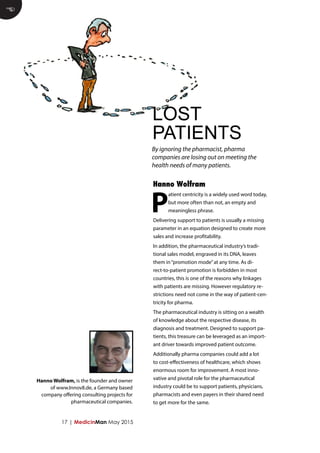
Here is how Adalat, the original nifedipine from Bayer’s
was able to extend its Brand Life Cycle by reformulating
it as Adalat OROS, a special form of sustained release
tablet.
Case study – Prefilled Syringes
The delivery system of a pharmaceutical product has a
very important role. To improve in this field of delivery
system requires imagination, technological creativ-
ity and skill. More importantly, it also requires deep
awareness of the market and the trends in the market.
Knowing who the end user is, for example, is a key to
understanding what innovation can be done with the
drug.
Let us take the case of insulin. The current trend is
towards increased self-use at home. This is an indicator
to the pharmaceutical industry to package insulin in a
more patient-friendly manner.
Vivek Hattangadi | Brand Life Cycle Management
16 | MedicinMan May 2015
Insulin inhalable (The greatest flop-show of the world-
wide pharma industry, Exubera from Pfizer) is a case
study by itself.
With tablets and other delivery forms, the options are
fairly simple. In the case of injectables, however, the
situation is a little more complex.
A company might launch a drug in a vial/diluent
system. It can then switchover to an innovative
end-user-friendly application system such as prefilled
syringes, or cartridge/pen or dual-chamber system (for
lyophilized drugs).
With the dual-chamber syringes – ideal for sensitive
formulations, a drug can be lyophilized and packaged
with its diluents, permitting the end user to reconsti-
tute and administer the drug. The system is highly con-
venient and allows for far greater precision in dosing.
Added to this is the advantage of increased yield
exploitation due to reduced overfill. USFDA permits
overfill with ampoules and vials to compensate for the
loss of the active ingredient sticking to the container
system or the habit of some care givers to expel some
liquid to remove the air bubble3
. Vials are overfilled by
up to 25%, especially if the desired dose is very small,
to ensure that the user may withdraw the desired
dose4
. With a prefilled syringe, overfill is hardly 2%
resulting in marked savings of the cost of the active
pharmaceutical ingredient. Prefilled syringes therefore
result in a clear value addition. A drug that is estab-
lished in the market as vials can be repackaged in this
modern and user friendly system.
A company which decides to switch-over their amika-
cin into a prefilled syringe will not only have a marked
edge over competition but will also be able to extent
the brands life cycle. This is an opportunity for the
brand leader in amikacin, Mikacin, (from Aristo).
In the final analysis, BLCM must be made an integral
part of any drug’s development. BLCM should therefore
begin very early on in the process during the formula-
tion and development stage with the possibilities to in-
crease the drug’s competitiveness. With a robust BLCM
concept and schedule, pharmaceutical companies can
look to the future with optimism. -VH
Bibliography
1) Mckinsey report - India Pharma 2020 Propelling
access and acceptance, realizing true potential
2) Jessica S. Blumstein, Omar Chane, et al. Global
research report;Vision & Reality: 6th Edition, Capegem-
ini.2007
3) Guidance for Industry Allowable ExcessVolume and
LabeledVial Fill Size in Injectable Drug and Biological
Products (March 2015) in www.raps.org/regulatoryD-
etail
4)http://www.troikaa.com/pfs.html
What the Pharma CEO
Wants from the Brand
Manager
A Book by Prof. Vivek Hattangadi
Available on Flipkart
(click to purchase)
17 | MedicinMan May 2015
P
atient centricity is a widely used word today,
but more often than not, an empty and
meaningless phrase.
Delivering support to patients is usually a missing
parameter in an equation designed to create more
sales and increase profitability.
In addition, the pharmaceutical industry’s tradi-
tional sales model, engraved in its DNA, leaves
them in“promotion mode”at any time. As di-
rect-to-patient promotion is forbidden in most
countries, this is one of the reasons why linkages
with patients are missing. However regulatory re-
strictions need not come in the way of patient-cen-
tricity for pharma.
The pharmaceutical industry is sitting on a wealth
of knowledge about the respective disease, its
diagnosis and treatment. Designed to support pa-
tients, this treasure can be leveraged as an import-
ant driver towards improved patient outcome.
Additionally pharma companies could add a lot
to cost-effectiveness of healthcare, which shows
enormous room for improvement. A most inno-
vative and pivotal role for the pharmaceutical
industry could be to support patients, physicians,
pharmacists and even payers in their shared need
to get more for the same.
E
LOST
PATIENTS
Hanno Wolfram
By ignoring the pharmacist, pharma
companies are losing out on meeting the
health needs of many patients.
Hanno Wolfram, is the founder and owner
of www.Innov8.de, a Germany based
company offering consulting projects for
pharmaceutical companies.
Hanno Wolfram | Lost Patients
18 | MedicinMan May 2015
It is hardly possible to educate the vast majority of pa-
tients to fully understand all the details around a spe-
cific condition – patients regularly get lost between
tests, lab, x-rays, diagnoses, the prescription of a drug
and other recommendations to considerably change
habits. Receiving a diagnosis for a chronic condition
must be acknowledged as a life-changing event. Be it
an allergy, diabetes, rheumatism, hypertension, COPD
or asthma: any of those diagnosis, even at the earliest
possible stage, changes you from a“normal”human
being to a patient from now on.
After the diagnosis is clear, any physician can only
be successful if the patient adheres to therapy. Only
if and when patients adhere to therapy, payers will
get what they paid for. Adherent patients will usually
turn happy, since the burden of disease is alleviated
or taken away. Pharmacists are happy, when patients
adhere to treatment, since patients will refill their
prescriptions. Politicians are happy, because the mon-
ey invested into the health of their people is paying
back.
There are a number of causes in the fragment-
ed healthcare system or business, preventing
health-care-providers from attaining common objec-
tives.
A root cause for losing out on the patient is structural
in nature. Traditionally, decades ago, pharma separat-
ed their distribution channels. This started long ago
with an inside out-perspective:“Our drugs vary by Rx
vs. non-Rx.”
The subsequent split of channels, activities, depart-
ments or business units almost was unavoidable:
1.	 Sales channel 1: Physicians, deciding about Rx
2.	 Sales channel 2: Pharmacists, making recommen-
dations for non-Rx
Both assumptions from those early days do no longer
apply in the 21st century:
1.	 Rx-decisions today are made by political bodies,
tenders, contracts, guidelines etc.
2.	 Most purchasing decisions around OTC drugs, are
made by the buyer, driven by TV-ads and other
means, channels and ways of promotion.
In the 21st century the patient journey includes steps
far away from those antiquated structures still prevail-
ing in the industry. How can pharma deliver improved
patient outcome, when they miss the chance to
follow the patient along the patient journey?
”
The pharmaceutical
industry is sitting on a
wealth of knowledge about
the respective disease, its
diagnosis and treatment.
Designed to support
patients, this treasure
can be leveraged as an
important driver towards
improved patient outcome.
Hanno Wolfram | Lost Patients
19 | MedicinMan May 2015
Very often the starting point for health advice is the
pharmacist - the most approachable person in the
healthcare chain. A patient will ask the pharmacists
for an OTC drug or request the pharmacist’s advice
on his problem. Being a member of the highly valued
health-care-provider guild, the pharmacist plays a most
trusted role for patients. Once a patient perceives his
situation serious enough or has been advised by his
pharmacist to do so, he will see a physician.
The key purpose of a physician is to detect and estab-
lish a diagnosis. Consequently therapy will be started,
following guidelines, evidence or availability of a
therapeutic solution. In the vast majority of cases, ther-
apy will include the prescription of a drug. Again, the
patient will go back to his“low-threshold service point”
pharmacist, asking him to fill the prescription.
Pharmacists are proven to be a central anchor-point to
therapy adherence. Daily-life proves this research, tell-
ing us that pharmacists are actively asked for advice, are
requested to consult, have most regular (low-threshold)
contact and are a most trusted source for patient’s
information.
Given the traditional sales-model and the currently
prevailing structures of the pharmaceutical industry,
pharmacists are outside of the endeavors to improve
patient’s lives.
Usually you will find high and mostly insurmountable
walls between the Rx and OTC business, between phy-
sicians as major targets for Rx and pharmacists for the
OTC business.
This is why it appears normal that 76% of German
pharmacists (n=18,000 pharmacies, Feb, 2015) claim
they are not sufficiently informed by the pharmaceuti-
cal industry about a newly launched antidiabetic drug.
Only 7% said they are well informed.
84% of pharmacists ask for more support from pharma
to better allow them to improve therapy adherence in
patients. Do these results appear astonishing or new to
you?
Pharma’s sales-model is designed to generate revenue
from drugs. By far, most companies employ sales forces
of reasonable size, dedicated to sell drugs to physicians.
These selling attempts supposedly lead to prescrip-
tions, which are filled by patients in their pharmacy. In
this traditional model and paradigm there is no room
for pharmacists and subsequently patients are lost and
patient centricity remains a slogan, usually empty and
meaningless phrase. -HW
”
Very often the starting
point for health advice is
the pharmacist - the most
approachable person in
the healthcare chain...
Being a member of the
highly valued health-
care-provider guild, the
pharmacist plays a most
trusted role for patients.
KAMinPharma3.0
Available on Amazon
(click to purchase)
by Hanno Wolfram
The must-read book on Key Account
Management in Pharma

Pharma Brand Life Cycle Management

  • 1.
    MEDICINMANField Force Excellence TM May2015 | www.medicinman.net Since 2011 “A man sat at a metro station in Washington DC and started to play the violin; it was a cold May morning. He played six Bach pieces for about 45 minutes. During that time, since it was rush hour, it was calculated that 1,100 people went through the station, most of them on their way to work. Three minutes went by, and a middle aged man noticed there was musician playing. He slowed his pace, and stopped for a few seconds, and then hurried up to meet his schedule. A minute later, the violinist received his first dollar tip: a woman threw the money without stopping, and continued to walk. A few minutes later, someone leaned against the wall to listen to him, but the man looked at his watch and started to walk again. Clearly he was late for work. EDITORIAL A SOCIAL EXPERIMENT... AND LESSONS FOR PRODUCT LAUNCH.
  • 2.
    Editorial Connect with AnupSoans on LinkedIn | Facebook | Twitter Anup Soans is an Author, Facilitator and the Editor of MedicinMan. Write in to him: anupsoans@medicinman.net Meet the Editor The one who paid the most attention was a 3 year old boy. His mother tagged him along, hurried, but the kid stopped to look at the violinist. Finally, the mother pushed hard, and the child continued to walk, turning his head all the time. This action was repeated by several other children. All the parents, without exception, forced them to move on. In the 45 minutes the musician played, only 6 people stopped and stayed for a while. About 20 gave him money, but continued to walk their normal pace. He collected $32. When he finished playing and silence took over, no one noticed it. No one applauded, nor was there any recognition. No one knew this, but the violinist was Joshua Bell, one of the most talented musicians in the world. He had just played one of the most intricate pieces ever written, on a violin worth $3.5 million dollars. Two days before playing in the subway, Joshua Bell sold out full- house at a theatre in Boston where the seats averaged $100. This is a true story. Joshua Bell playing incognito in the metro station was organized by the Washington Post as part of a social experiment about perception, taste, and priorities of people.” - The Washington Post Lessons for Pharma: In today’s attention deficit economy, you can have the best product and a great story on the latest digital device in the hands of a well trained field force, but if your don’t create the right expectation in the minds of busy doctors through a well thought out multi channel marketing strategy that creates a pre launch expectation, your product launch is likely to meet the fate of Joshua Bell in the Washington DC metro station. -MM Joshua Bell’s performance in a Boston subway was mostly ignored by passersby
  • 3.
    BRAND LIFE CYCLE MANAGEMENT Vivek Hattangadi 1.Doctor Profiling for Sales Success.....................4 A Doctor Profile enables the Medical Rep to tailor- make his detailing approach to each Doctor, ensuring sales success. RB Balakrishna 2. Using Gamification to Achieve a State of Flow while Learning..........................................................7 By turning learning into a game, learners enter into a ‘state of flow’ - a condition where the ‘high’ of the game makes learning a habit. Rajiv Jayaraman 3. The 3 ‘E’s of Sales Leadership: Engage, Empower & Enable...............................................10 How to move from being mere sales ‘managers’ to being sales ‘leaders’. K. Hariram 4. Focus Feature: Brand Life Cycle Management .................................................................................12 With few new chemical entities in the pipeline, pharma companies will have devote more attention to managing the life cycle of their brands to derive maximum mileage from existing products. Vivek Hattangadi 5. Lost Patients......................................................17 By ignoring the pharmacist, pharma companies are losing out on meeting the health needs of many patients. (Click to navigate) CONTENTS MedicinMan Volume 5 Issue 5 | April 2015 Editor and Publisher Anup Soans CEO Chhaya Sankath Chief Mentor K. Hariram Editorial Board Salil Kallianpur; Prof. Vivek Hattangadi; Shashin Bodawala; Hanno Wolfram; Renie McClay Executive Editor Joshua Soans Letters to the Editor: anupsoans@medicinman.net Focus Feature PAGE 12
  • 4.
    4 | MedicinManMay 2015 T o assess the likelihood of a Doctor prescribing any brand, the first and foremost step for a Medical Rep is to get acquainted with the Doctor’s profile. Pro- filing helps the Medical Rep to concentrate his marketing efforts, maximize the use of limited resources, plan a competitor strategy, understand the doctor and touch his heart, and many more. The idea behind physician profiling is to have a different messaging strategy for each physician. Most physicians are unwilling to prescribe a new product until it has an estab- lished post-marketing safety record. Medical Reps spend one-fourth of their time detailing new drugs to conservative physicians who will never prescribe them within the first year of launch. By targeting sales efforts and de- tailing to early adopters, who are more likely to prescribe a new drug, MRs can increase the number of physicians who prescribe a new drug. Physicians change their prescription habits after targeted marketing. Details of a doctor’s profile are dynamic and a smart Medical Rep will tailor his commu- nication constantly according to doctor’s response. A friendly physician makes the Medical Rep’s job easy, because he or she can use the“friendship”to gain easy access to the Doctor and drive prescriptions. Physicians, who view the relationship as a straightfor- ward means-of-prescriptions-exchange, must be dealt with professionally. Sceptical doctors who favor references and evidences must be given reprints from the medical journals and literature. Physicians, who refuse to see Medical Reps, are detailed by proxy; their staff is influenced in hopes that they will act as a messenger for the Medical Rep’s message. Medical Reps can use the profiling data to im- prove call prioritization, decision-making and time allocation, resulting in higher return on investment from detailing and brand success for the company. RB Balakrishna E DOCTOR PROFILING FOR SALES SUCCESSA Doctor Profile enables the Medical Rep to tailor-make his detailing approach to each Doctor, ensuring sales success.
  • 5.
    5 | MedicinManMay 2015 Prescribing data can be a tool used both to identify high-prescribers and to track the effects of promo- tions. Ensuring that physicians targeted for detailing are both high prescribers and early adopters, im- proves the probability of prescriptions. This cumu- latively increases the total number of prescriptions written for a drug, simply by identifying the right physicians to detail. The benefits of profiling can be translated directly into profit and growth. Meaning, this growth is attained without additional investment in the given territory. Prescribing data can also be used to see how many of a physician’s patients receive specific drugs, how many prescriptions the physician writes for targeted and competing drugs, and how a physician’s prescribing habits change over time. Even for a standard-detailing-visit promoting a mature product, MRs must identify and document: 1. Which products the physician prefer to use and when. 2. What their prescribing rate for different diseases is and how quickly they adopt the use of new products. When a product launch approaches, Medical Reps can consolidate the information recorded of specific physicians to build a prescriber profile of the key phy- sicians in their area. Consider a Medical Rep who doesn’t know the profile of the doctor whom he is about to meet. He or she doesn’t know the preferences of the doctor and will not be able to make an effective call. On the other hand, a Medical Rep who knows the profile of the doctor can even manage the time of visit and spend more time in a given call and build relationship. The probability of doctor prescribing the requested brand increases significantly if the required specifics are mentioned in the detailing. Conclusion Doctor’s profiling information improves: ØØ The possibility of seeing the doctor, ØØ The probability of doctor prescribing the brand after detailing, ØØ Number of prescriptions the doctor is likely to write and thus ØØ Number of new prescriptions gained through detailing alone. -RB RB Balakrishna | Doctor Profiling for Sales Success RB Balakrishna is an Area Manager with a reputed pharmaceutical company ” Medical Reps can use the profiling data to improve call prioritization, decision-making and time allocation, resulting in higher return on investment from detailing and brand success for the company.
  • 6.
    CAREERPROGRESSIONRESOURCES NOWAVAILABLEON (click on thebooks to purchase on flipkart) SuperVision for the SuperWiser Front-line Manager is a tool to help pharma professionals transition from super salesmen to great front-line managers and leaders. The book will equip front-line managers to Manage, Coach, Motivate and Lead their teams to deliver outstanding performance. An engaging read, filled with examples and illustrations, SuperVision for the SuperWiser Front-line Manager has been used by thousands of managers across the industry. HardKnocks for the GreenHorn is a specially crafted training manual to enable Medical Representatives to gain the Knowledge, Skills and Attitude needed to succeed in the competitive arena of pharma field sales. Medical Representatives joining the field are often not aware about the key success factors of their job and as a result they get discouraged when things don’t go as planned. HardKnocks for the GreenHorn is a powerful learning and motivational tool for field sales managers to build their sales teams. GET YOUR PHARMA CAREER OFF TO A FLYING START!
  • 7.
    7 | MedicinManMay 2015 H ave you ever had an experience where you lost your sense of self while immersing your- self in an activity? Have you experienced a high due to single-minded focus on something inter- esting? Have you lost track of time while pursuing an activity that you are passionate about? If the answer to any of these questions is“Yes”, then you have experienced the‘state of flow’. Did any of these ex- periences happen to you while you were learning in school, college or at work? I guess not. Most learners unfortunately tend to look at learning as a laborious chore. This isn’t how it was meant to be. So how do we change this situation? How do we make learning a joy? This article aims to present various ways in which learning and development professionals can learn from games and gamification to facilitate the state of flow for learners. In his groundbreaking classic work, psychologist Mihaly Csikszentmihalyi reveals that what makes an experience genuinely satisfying is a state of con- sciousness called‘flow’. During flow, people typically experience total focus, deep enjoyment, creativity, and complete involvement with whatever activity they pursue, in fact with life itself. He demonstrates various ways in which this positive state of mind can be controlled and not just left to chance. Flow is understood to comprise of nine dimensions: Challenge-skill balance, clear goals, control, immedi- ate feedback, autotelic experience, loss of self-con- sciousness, time transformation, concentration and merging action-awareness. Games and gamification create a conducive environment for many of these dimensions to manifest in the learning process. E By turning learning into a game, learners enter into a ‘state of flow’ - a condition where the ‘high’ of the game makes learning a habit. USING GAMIFICATION TO ACHIEVE A STATE OF FLOW WHILE LEARNING Rajiv Jayaraman
  • 8.
    ” 8 | MedicinManMay 2015 CHALLENGE-SKILL BALANCE Games have a concept of levels embedded in the structure of the game. This enables players to start at a simple level and keep progressing to higher levels till they feel that they cannot proceed anymore. This con- stant pursuit of mastery is what brings them back to the game every day. Applying this concept to learning, companies can construct a learning environment that provides the learner the opportunity to make progress by expanding their skill one step at a time. CLEAR GOALS Every game has a clear objective and a set of guiding rules. Without goals, the player does not get a clear sense of direction. The same principle applies to learners. Every learning intervention needs to clearly outline the goals. It is best if the goals are challeng- ing yet seem achievable. Getting this balance right is immensely important for the learner to have the confidence to start and the right amount of challenges to keep going. CONTROL Games give individuals the power to choose from var- ious possibilities and alter the course of action within the game. This gives gamers the sense of control that is needed to stay engaged in the activity. Research shows that adult learners learn best when they are given the autonomy to test their hypothesis and see the results for themselves. IMMEDIATE FEEDBACK Malcolm Gladwell, in his book Outliers, talks about how assisted practice over a long period of time im- proves the chances of mastery in a domain. The short cause and effect feedback loop in games makes the gamer learn the rules of the game faster. The feedback also helps to condition the behaviour of gamers within and outside the game. Case in point, the current COO of Symantec, Stephen Gillette, is one of the youngest executives sitting in the board of a large organization. He is an avid gamer who attributes his leadership skills to the World of Warcraft game. Real world behaviours can be shaped by games and simulation through immediate feedback. AUTOTELIC EXPERIENCE Any activity that has a purpose in and not apart from itself is described as Autotelic. In other words, autotelic experience is one where the individual does the activi- ty for its own sake without any inducement of external rewards. While points, badges and leader boards mo- tivate the learner to perform well, in most successful games, it is the activity itself that is the reward. Every learning intervention needs to clearly outline the goals. It is best if the goals are challenging yet seem achievable. Getting this balance right is immensely important for the learner to have the confidence to start and the right amount of challenges to keep going. Rajiv Jayaraman | Using Gamification to Achieve a State of Flow while Learning
  • 9.
    9 | MedicinManMay 2015 By making the context of the learning environment real-world like and by giving the learner the feedback that he / she is gaining in skill, we can facilitate autotel- ic experiences for the learner. LOSS OF SELF-CONSCIOUSNESS Games have the ability to draw us into an alternative world and make us lose our sense of self. Quite inter- estingly, after the experience, individuals come out with a stronger sense of self, one that is integrated and sophisticated. By introducing games and simulations in the learning process, we can achieve the same result for our learners. TIME TRANSFORMATION Most gamers report that they lose the sense of time when they immerse themselves in a game. They are at it for hours on end. By using gaming principles in the learning process, we can create a craving for learning and engage learners in productive skill enhancing exercises. CONCENTRATION The most enjoyable experiences happen to us when we devote our complete attention to the activity at hand. The power of concentration frees up our mind from distractions and enables us to enjoy the quality of the experience. By using gaming and simulations, we can enable learners to completely devote themselves to the learning task at hand. As a result, learning be- comes enjoyable and sheer joy. The high the learners experience becomes the hook for making learning a habit. MERGING ACTION-AWARENESS Today, most learning interventions tend to focus on the cognitive aspects of learning, with very little attention paid to the motivation of the learner and the application of learning. By encouraging learners to apply learning in a safe learning environment, we can enable them to exercise their muscle-memory, which comes in handy later when they face real situations. Combination of action and reflection is vital for learn- ers to internalize their experience. CONCLUSION To sum up, the current learning design doesn’t facil- itate the state of flow for learners. We need to think about ways in which learners can escape from the mo- notony and truly enjoy the bliss of learning something new. By wisely using some of the gaming and gamifi- cation principles, we can facilitate the state of flow in learners. Perhaps then, learning will become a joy and learners will get into the habit of learning daily just like millions of candy crush and fishville players around the world can’t live without their favorite game. -RJ Rajiv Jayaraman | Using Gamification to Achieve a State of Flow while Learning ” By using gaming and simulations, we can enable learners to completely devote themselves to the learning task at hand. As a result, learning becomes enjoyable and sheer joy. The high the learners experience becomes the hook for making learning a habit. Rajiv Jayaraman is Founder-CEO, KNOLSKAPE
  • 10.
    10 | MedicinManMay 2015 I s there a difference between the Head of Sales/Sales Manager (SM) and the Front Line Manager (FLM)? I know this controversial question will raise many eye- brows. However, I am very clear and what I am refering to is the mindset and approach to business and people. More often than not, we are all ready to criticise the FLMs, their quality, role, responsibilities, and behaviours. However, when I meet many sales managers leading a team of sales people and line managers at various levels, I often wonder the thin line of difference in terms of their quality, behaviours and managing people. So, the unasked question is – do you want Head of Sales to be Sales Leaders (or Leaders of the sales team) or mere Sales Managers (managing sales)? What is the difference? Almost always, sales managers are managing their sales force, allocating geographical territories, controlling the efforts area, pushing people to perform, hitting the sales numbers by hook or crook by the month end and various tasks that come under the title umbrella. Leading the sales team takes on a whole different meaning and with added dimensions. Apart from what is mentioned above it involves mentoring people, on/off the job, coaching, influencing/inspiring people, support- ing and helping them and being a constant cheer leader for them every day. E THE 3 ‘E’s OF SALES LEADERSHIP: ENGAGE, EMPOWER & ENABLEHow to move from being mere sales ‘managers’ to being sales ‘leaders’ K. Hariram K. Hariram is the former MD (retd.) at Galderma India. He is Chief Mentor at MedicinMan and a regular contributor. khariram25@yahoo.com
  • 11.
    11 | MedicinManMay 2015 In short, it is practicing 3‘E’s – Engaging, Empow- ering and Enabling the sales team day in and day out. How often have you looked at a Sales Manager and said,“He took his people from GOOD to GREAT”, as Jim Collins said? Having been a Sales Head in my career journey, I know for sure that sales management is not an easy business and it is not for the weak-hearted. The responsibility involves acting as a cushion between organisational revenue objectives and the sales people who are out on the road, braving the vagaries of weather and the constant rejec- tions/objections they face from customers. As their leader and the Head of Sales you make sure that they keep going, despite the odds and maximise their success through performance. It is time that the sales managers change their mindset and come out of their intimidating and negative reinforcement behaviours. These will not work in the long run and will only add to the misery of increasing sales force attrition. Equally important is the need to invest in self-learning and development through books and attending learn- ing & development programs besides developing through work. As a sales manager, you are not just‘managing’ them but LEADING them to WIN in a highly com- petitive environment. In short, you are a SALES LEADER. -KH K. Hariram | The 3 ‘E’s of Sales Leadership: Engage, Empower & Enable ” Leading the sales team ... involves mentoring people, on/off the job, coaching, influencing/inspiring people, supporting and helping them and being a constant cheer leader for them every day.
  • 12.
    12 | MedicinManMay 2015 D iscovery of new chemical entities is slow- ing down considerably and hardly any new blockbuster drug is in the pipeline. Leading players, which made investments in market creation, developed differentiated business models and maintained the momentum through new product launches1 , will be handicapped as this process is expected to slow down. In India, with the stringent application of the Indian Patent Act (IPA), reverse engineering techniques have taken a back seat. Products of the 1980’s and 1990’s which were unsuccessful are being dished out as new products; examples are two CNS drugs amisulpride and etizolam and a gastro-prokinetic, levosulpiri- de. Many other factors, such as stricter regulations and stronger global competition, are also creating major challenges. If a pharmaceutical company in India intends to increase its market share and return on investment, it must consider how to how to do it in a manner never done before. As new launch possibilities dwindle, brand building will be necessary to grow profitably1 . E BRAND LIFE CYCLE MANAGEMENT Vivek Hattangadi With few new chemical entities in the pipeline, pharma companies will have devote more attention to managing the life cycle of their brands to derive maximum mileage from existing products. Prof. Vivek Hattangadi is a Consultant in Pharma Brand Management and Sales Training at The Enablers. He is also visit- ing faculty at CIPM Calcutta (Vidyasagar University) for their MBA course in Pharma- ceutical Management. vivekhattangadi@theenablers.org Focus Feature
  • 13.
    Vivek Hattangadi |Brand Life Cycle Management 13 | MedicinMan May 2015 Brand building via Brand Life Cycle Management (BLCM) is an excellent option in this regard. There are several methods for approaching BLCM effec- tively. What is crucial, however, is to plan for it very early, preferably even before the product is actually launched in the marketplace. The key to successful BLCM is to create and evolve a proactive strategy for the brand throughout its life cycle, from launch to long-term growth and acceptance in the market. BLCM is an essential part of the success of any brand. But in the Indian Pharmaceutical Market (IPM), it will now have a very special place. Rather than build their existing brands, many companies have until now relied on their ability to keep the pipeline filled with new products. But the number of new chemi- cal entities (NCEs) has been dwindling, while formulation and development costs for new products are soaring. Except for a product here or a product there, no truly Indian NCE has been developed. More than ever, Indian pharmaceutical companies need to turn to BLCM in order to differentiate their products. This also means that getting a product on the market is no longer enough: keeping it there and managing its success is crucial. This is where BLCM comes in. Basically, there are two kinds of markets, each demand- ing a certain approach. 1. A first-in-class product entering a non-competitive market – i.e. without any other similar molecule – will need to be launched quickly and effectively (like Lipaglyn of Zydus). 2. A simpler form of administration can be chosen, thus speeding up time to market and keeping costs down. Once the novelty of first-time launch wears off, or when more drugs enter the market and becomes competitive, the real challenge commences. In that case, the brand will have to have certain qualities unique to it, like a special form of administration (like Dynapar QPS). MAINTAINING A SUCCESSFUL COURSE Brand managers in IPM hardly invest any time on BLCM. Once the product is in the market and earning healthy returns on investment, it is forgotten. The preferred approach in IPM is to simply focus on the launch and then turn attention to the next new product in the pipeline. Companies launch, or rather churn out, six to eight products every year. ” ...the number of new chemical entities (NCEs) has been dwindling, while formulation and development costs for new products are soaring. Except for a product here or a product there, no truly Indian NCE has been developed. More than ever, Indian pharmaceutical companies need to turn to BLCM in order to differentiate their products.
  • 14.
    Vivek Hattangadi |Brand Life Cycle Management 14 | MedicinMan May 2015 But times will change as fewer NCEs are coming in the market. Moreover, product development costs have increased. Hence a pharma company has to draw the most out of the existing brands it already has in the market. This means a carefully designed strategy needs to be elaborated well ahead of time, to extend a drug’s lifecycle. The report‘Vision to Reality - From Market to Discov- ery and Back’by Capegemini published in 2006 says that 90% of pharmaceutical industry brand managers believed that BLCM is significant for the bottom-line. 60% predicted its importance would grow consider- ably by the end of the decade. Most of those inter- viewed for the report had a prime rule: it is crucial to have a clear concept early on if a company wants to be successful and maintain a larger piece of the market. BLCM must also be deeply integrated into the entire process, which can save a great deal of money. The authors concluded that using legal loopholes or other measures to prevent competitors from entering the market is counterproductive. It is far more costly and the outcome is doubtful2 . So how early is early enough? Some pharma compa- nies may well consider planning their brand lifecycle management in the introductory phase. In other cases, relatively sudden changes on the market can force a quick rethinking of a drug’s design. BLCM OPTIONS There are several approaches to BLCM that can be applied depending on need. 1. Developing new markets If a brand is being released to a limited market, extend- ing it to other markets is the next logical step. This may require passing regulatory barriers or forming alliances with other companies. A case in point is Kusum Health- care, a Rs. 3000 million New Delhi based company. They are leaders in Ukraine, Uzbekistan and some other CIS countries. They are now set to make a formidable presence in IPM through their brands which are leaders in CIS countries. 2. Looking for new applications Sometimes a particular drug will have more than one indication allowing it to be targeted at a completely new market. Aspirin, for example, began as treatment musculoskeletal pain, and was later used to reduce the risk of death following cardiac events. Clonotril (Torrent) was launched as an add-on drug in refractory epilepsy. It is now being very strongly promoted in anxiety disorders as a‘rediscovered benzodiazepine’. ” BLCM must also be deeply integrated into the entire process, which can save a great deal of money. ... using legal loopholes or other measures to prevent competitors from entering the market is counterproductive. It is far more costly and the outcome is doubtful
  • 15.
    Vivek Hattangadi |Brand Life Cycle Management 15 | MedicinMan May 2015 3. Redesigning the product Reformulation, as the process is known, involves essen- tially changing an existing drug to make it more attrac- tive to users and to make it more competitive. Dynapar Injections (Troikaa), containing diclofenac sodium made a very simple innovation. They converted it into a painless injection using Aquatech technology which is free from propylene glycol and hence it is as viscous as water and can be therefore administered by intradel- toid route, intragluteal and also along with I.V. infusion of normal saline and dextrose 5%, without using sodi- um bicarbonate unlike conventional brands, including the originators – Voveron. It was a planned BLCM. Now, with introduction of Dynapar QPS, the BLCM of Dyna- par as a brand has been successfully extended, at least for another 15 years (that’s my prediction). Here is how Adalat, the original nifedipine from Bayer’s was able to extend its Brand Life Cycle by reformulating it as Adalat OROS, a special form of sustained release tablet. Case study – Prefilled Syringes The delivery system of a pharmaceutical product has a very important role. To improve in this field of delivery system requires imagination, technological creativ- ity and skill. More importantly, it also requires deep awareness of the market and the trends in the market. Knowing who the end user is, for example, is a key to understanding what innovation can be done with the drug. Let us take the case of insulin. The current trend is towards increased self-use at home. This is an indicator to the pharmaceutical industry to package insulin in a more patient-friendly manner.
  • 16.
    Vivek Hattangadi |Brand Life Cycle Management 16 | MedicinMan May 2015 Insulin inhalable (The greatest flop-show of the world- wide pharma industry, Exubera from Pfizer) is a case study by itself. With tablets and other delivery forms, the options are fairly simple. In the case of injectables, however, the situation is a little more complex. A company might launch a drug in a vial/diluent system. It can then switchover to an innovative end-user-friendly application system such as prefilled syringes, or cartridge/pen or dual-chamber system (for lyophilized drugs). With the dual-chamber syringes – ideal for sensitive formulations, a drug can be lyophilized and packaged with its diluents, permitting the end user to reconsti- tute and administer the drug. The system is highly con- venient and allows for far greater precision in dosing. Added to this is the advantage of increased yield exploitation due to reduced overfill. USFDA permits overfill with ampoules and vials to compensate for the loss of the active ingredient sticking to the container system or the habit of some care givers to expel some liquid to remove the air bubble3 . Vials are overfilled by up to 25%, especially if the desired dose is very small, to ensure that the user may withdraw the desired dose4 . With a prefilled syringe, overfill is hardly 2% resulting in marked savings of the cost of the active pharmaceutical ingredient. Prefilled syringes therefore result in a clear value addition. A drug that is estab- lished in the market as vials can be repackaged in this modern and user friendly system. A company which decides to switch-over their amika- cin into a prefilled syringe will not only have a marked edge over competition but will also be able to extent the brands life cycle. This is an opportunity for the brand leader in amikacin, Mikacin, (from Aristo). In the final analysis, BLCM must be made an integral part of any drug’s development. BLCM should therefore begin very early on in the process during the formula- tion and development stage with the possibilities to in- crease the drug’s competitiveness. With a robust BLCM concept and schedule, pharmaceutical companies can look to the future with optimism. -VH Bibliography 1) Mckinsey report - India Pharma 2020 Propelling access and acceptance, realizing true potential 2) Jessica S. Blumstein, Omar Chane, et al. Global research report;Vision & Reality: 6th Edition, Capegem- ini.2007 3) Guidance for Industry Allowable ExcessVolume and LabeledVial Fill Size in Injectable Drug and Biological Products (March 2015) in www.raps.org/regulatoryD- etail 4)http://www.troikaa.com/pfs.html What the Pharma CEO Wants from the Brand Manager A Book by Prof. Vivek Hattangadi Available on Flipkart (click to purchase)
  • 17.
    17 | MedicinManMay 2015 P atient centricity is a widely used word today, but more often than not, an empty and meaningless phrase. Delivering support to patients is usually a missing parameter in an equation designed to create more sales and increase profitability. In addition, the pharmaceutical industry’s tradi- tional sales model, engraved in its DNA, leaves them in“promotion mode”at any time. As di- rect-to-patient promotion is forbidden in most countries, this is one of the reasons why linkages with patients are missing. However regulatory re- strictions need not come in the way of patient-cen- tricity for pharma. The pharmaceutical industry is sitting on a wealth of knowledge about the respective disease, its diagnosis and treatment. Designed to support pa- tients, this treasure can be leveraged as an import- ant driver towards improved patient outcome. Additionally pharma companies could add a lot to cost-effectiveness of healthcare, which shows enormous room for improvement. A most inno- vative and pivotal role for the pharmaceutical industry could be to support patients, physicians, pharmacists and even payers in their shared need to get more for the same. E LOST PATIENTS Hanno Wolfram By ignoring the pharmacist, pharma companies are losing out on meeting the health needs of many patients. Hanno Wolfram, is the founder and owner of www.Innov8.de, a Germany based company offering consulting projects for pharmaceutical companies.
  • 18.
    Hanno Wolfram |Lost Patients 18 | MedicinMan May 2015 It is hardly possible to educate the vast majority of pa- tients to fully understand all the details around a spe- cific condition – patients regularly get lost between tests, lab, x-rays, diagnoses, the prescription of a drug and other recommendations to considerably change habits. Receiving a diagnosis for a chronic condition must be acknowledged as a life-changing event. Be it an allergy, diabetes, rheumatism, hypertension, COPD or asthma: any of those diagnosis, even at the earliest possible stage, changes you from a“normal”human being to a patient from now on. After the diagnosis is clear, any physician can only be successful if the patient adheres to therapy. Only if and when patients adhere to therapy, payers will get what they paid for. Adherent patients will usually turn happy, since the burden of disease is alleviated or taken away. Pharmacists are happy, when patients adhere to treatment, since patients will refill their prescriptions. Politicians are happy, because the mon- ey invested into the health of their people is paying back. There are a number of causes in the fragment- ed healthcare system or business, preventing health-care-providers from attaining common objec- tives. A root cause for losing out on the patient is structural in nature. Traditionally, decades ago, pharma separat- ed their distribution channels. This started long ago with an inside out-perspective:“Our drugs vary by Rx vs. non-Rx.” The subsequent split of channels, activities, depart- ments or business units almost was unavoidable: 1. Sales channel 1: Physicians, deciding about Rx 2. Sales channel 2: Pharmacists, making recommen- dations for non-Rx Both assumptions from those early days do no longer apply in the 21st century: 1. Rx-decisions today are made by political bodies, tenders, contracts, guidelines etc. 2. Most purchasing decisions around OTC drugs, are made by the buyer, driven by TV-ads and other means, channels and ways of promotion. In the 21st century the patient journey includes steps far away from those antiquated structures still prevail- ing in the industry. How can pharma deliver improved patient outcome, when they miss the chance to follow the patient along the patient journey? ” The pharmaceutical industry is sitting on a wealth of knowledge about the respective disease, its diagnosis and treatment. Designed to support patients, this treasure can be leveraged as an important driver towards improved patient outcome.
  • 19.
    Hanno Wolfram |Lost Patients 19 | MedicinMan May 2015 Very often the starting point for health advice is the pharmacist - the most approachable person in the healthcare chain. A patient will ask the pharmacists for an OTC drug or request the pharmacist’s advice on his problem. Being a member of the highly valued health-care-provider guild, the pharmacist plays a most trusted role for patients. Once a patient perceives his situation serious enough or has been advised by his pharmacist to do so, he will see a physician. The key purpose of a physician is to detect and estab- lish a diagnosis. Consequently therapy will be started, following guidelines, evidence or availability of a therapeutic solution. In the vast majority of cases, ther- apy will include the prescription of a drug. Again, the patient will go back to his“low-threshold service point” pharmacist, asking him to fill the prescription. Pharmacists are proven to be a central anchor-point to therapy adherence. Daily-life proves this research, tell- ing us that pharmacists are actively asked for advice, are requested to consult, have most regular (low-threshold) contact and are a most trusted source for patient’s information. Given the traditional sales-model and the currently prevailing structures of the pharmaceutical industry, pharmacists are outside of the endeavors to improve patient’s lives. Usually you will find high and mostly insurmountable walls between the Rx and OTC business, between phy- sicians as major targets for Rx and pharmacists for the OTC business. This is why it appears normal that 76% of German pharmacists (n=18,000 pharmacies, Feb, 2015) claim they are not sufficiently informed by the pharmaceuti- cal industry about a newly launched antidiabetic drug. Only 7% said they are well informed. 84% of pharmacists ask for more support from pharma to better allow them to improve therapy adherence in patients. Do these results appear astonishing or new to you? Pharma’s sales-model is designed to generate revenue from drugs. By far, most companies employ sales forces of reasonable size, dedicated to sell drugs to physicians. These selling attempts supposedly lead to prescrip- tions, which are filled by patients in their pharmacy. In this traditional model and paradigm there is no room for pharmacists and subsequently patients are lost and patient centricity remains a slogan, usually empty and meaningless phrase. -HW ” Very often the starting point for health advice is the pharmacist - the most approachable person in the healthcare chain... Being a member of the highly valued health- care-provider guild, the pharmacist plays a most trusted role for patients. KAMinPharma3.0 Available on Amazon (click to purchase) by Hanno Wolfram The must-read book on Key Account Management in Pharma