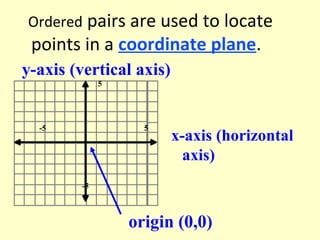
Ordered pairs are used to locate
points in a coordinate plane.
x-axis (horizontal
axis)
origin (0,0)
y-axis (vertical axis)
5
5
-5
-5
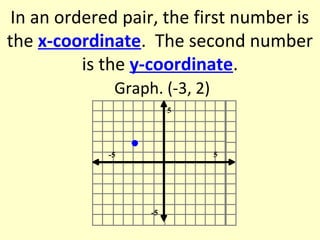
In an ordered pair, the first number is
the x-coordinate. The second number
is the y-coordinate.
Graph. (-3, 2)
•
5
5
-5
-5
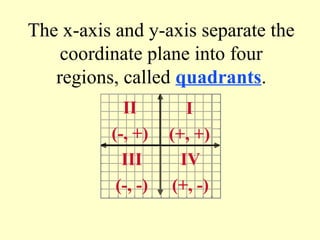
The x-axis and y-axis separate the
coordinate plane into four
regions, called quadrants.
II
(-, +)
I
(+, +)
IV
(+, -)
III
(-, -)
Origin (0,0)
(3,-2)
(-4,0)
Quandrant IV
(+, - )
Quandrant III
(-, - )
Quandrant II
(-, + )
Quandrant I
(+, + )
Origin (0,0)
(3,-2)
(-4,0)
Quandrant IV
(+, - )
Quandrant III
(-, - )
Quandrant II
(-, + )
Quandrant I
(+, + )
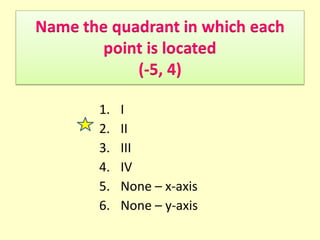
1. I
2. II
3. III
4. IV
5. None – x-axis
6. None – y-axis
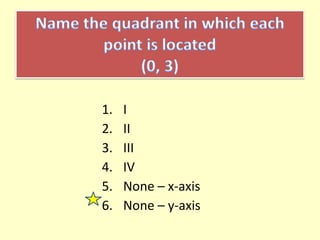
1. I
2. II
3. III
4. IV
5. None – x-axis
6. None – y-axis
1. I
2. II
3. III
4. IV
5. None – x-axis
6. None – y-axis
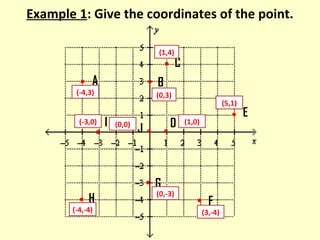
Example 1: Give the coordinates of the point.
J
I
H
G
F
E
D
C
BA
(-4,3) (0,3)
(1,4)
(1,0)
(5,1)
(3,-4)
(0,-3)
(-4,-4)
(-3,0) (0,0)
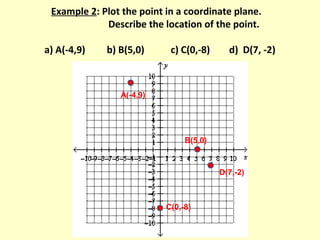
Example 2: Plot the point in a coordinate plane.
Describe the location of the point.
a) A(-4,9) b) B(5,0) c) C(0,-8) d) D(7, -2)
A(-4,9)
B(5,0)
C(0,-8)
D(7,-2)
x y = ½x + 1 y
-4 y = ½(-4) + 1
-2 y = ½(-2) + 1
0 y = ½(0) + 1
2 y = ½(2) + 1
4 y = ½(4) + 1
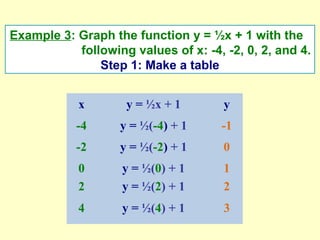
Example 3: Graph the function y = ½x + 1 with the
following values of x: -4, -2, 0, 2, and 4.
Step 1: Make a table
x y = ½x + 1 y
-4 y = ½(-4) + 1
-2 y = ½(-2) + 1
0 y = ½(0) + 1
2 y = ½(2) + 1
4 y = ½(4) + 1
x y = ½x + 1 y
-4 y = ½(-4) + 1 -1
-2 y = ½(-2) + 1 0
0 y = ½(0) + 1 1
2 y = ½(2) + 1 2
4 y = ½(4) + 1 3
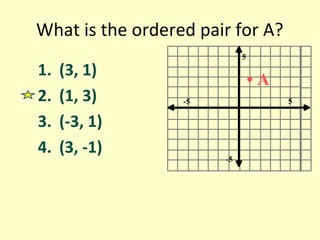
What is the ordered pair for A?
1. (3, 1)
2. (1, 3)
3. (-3, 1)
4. (3, -1)
5
5
-5
-5
• A
What is the ordered pair for C?
1. (0, -4)
2. (-4, 0)
3. (0, 4)
4. (4, 0)
5
5
-5
-5
• C

Plotting points in rectangular coordinate system

  • 2.
    Ordered pairs areused to locate points in a coordinate plane. x-axis (horizontal axis) origin (0,0) y-axis (vertical axis) 5 5 -5 -5
  • 3.
    In an orderedpair, the first number is the x-coordinate. The second number is the y-coordinate. Graph. (-3, 2) • 5 5 -5 -5
  • 4.
    The x-axis andy-axis separate the coordinate plane into four regions, called quadrants. II (-, +) I (+, +) IV (+, -) III (-, -)
  • 5.
    Origin (0,0) (3,-2) (-4,0) Quandrant IV (+,- ) Quandrant III (-, - ) Quandrant II (-, + ) Quandrant I (+, + ) Origin (0,0) (3,-2) (-4,0) Quandrant IV (+, - ) Quandrant III (-, - ) Quandrant II (-, + ) Quandrant I (+, + )
  • 6.
    1. I 2. II 3.III 4. IV 5. None – x-axis 6. None – y-axis
  • 7.
    1. I 2. II 3.III 4. IV 5. None – x-axis 6. None – y-axis
  • 8.
    1. I 2. II 3.III 4. IV 5. None – x-axis 6. None – y-axis
  • 9.
    Example 1: Givethe coordinates of the point. J I H G F E D C BA (-4,3) (0,3) (1,4) (1,0) (5,1) (3,-4) (0,-3) (-4,-4) (-3,0) (0,0)
  • 10.
    Example 2: Plotthe point in a coordinate plane. Describe the location of the point. a) A(-4,9) b) B(5,0) c) C(0,-8) d) D(7, -2) A(-4,9) B(5,0) C(0,-8) D(7,-2)
  • 11.
    x y =½x + 1 y -4 y = ½(-4) + 1 -2 y = ½(-2) + 1 0 y = ½(0) + 1 2 y = ½(2) + 1 4 y = ½(4) + 1 Example 3: Graph the function y = ½x + 1 with the following values of x: -4, -2, 0, 2, and 4. Step 1: Make a table x y = ½x + 1 y -4 y = ½(-4) + 1 -2 y = ½(-2) + 1 0 y = ½(0) + 1 2 y = ½(2) + 1 4 y = ½(4) + 1 x y = ½x + 1 y -4 y = ½(-4) + 1 -1 -2 y = ½(-2) + 1 0 0 y = ½(0) + 1 1 2 y = ½(2) + 1 2 4 y = ½(4) + 1 3
  • 13.
    What is theordered pair for A? 1. (3, 1) 2. (1, 3) 3. (-3, 1) 4. (3, -1) 5 5 -5 -5 • A
  • 14.
    What is theordered pair for C? 1. (0, -4) 2. (-4, 0) 3. (0, 4) 4. (4, 0) 5 5 -5 -5 • C