The Effect of the Business Cycle on the PERFormance OF SOCIALLY RESPONSIBLE INVESTMENTSDissertation Proposal DefenseAndrea RoofeMay 5, 2010
What is ‘Socially Responsible Investing’?Socially responsible investing (SRI) “…integrates environmental, social and governance factors into investment decisions" (Social Investment Forum, 2010a)www.socialinvest.org
Outline of the presentationBackgroundResearch Questions and relevance of the studyTheoretical perspectivesMethodsPreliminary findings
BACKGROUND
SRI movement: Historical Backgroundneed to express personal value system through investing:religious and secular values.slave trade and war (17th - 19th century)alcohol, tobacco, firearms and gambling activities  (1920s)civil rights, the Vietnam War, apartheid, and consumer issues (1960s-80s)corporate governance and sustainability  issues (1990s and early 21st century)
RESEARCH QUESTIONS AND RELEVANCE OF THE STUDY
Research QuestionsDoes socially responsible investing deliver financial value?  Does the SP-FP relationship vary across phases of the business cycle?To what extent are net excess returns attributable to fund-SRI index differences, and index-benchmark differences?What is the nature of the FP-SP link on religious and vice funds?  How do they compare to secular SRI funds and conventional funds?
Relevance of the studyPublic concern with issues in corporate governance  (ENRON, 2008 crisis in the financial markets).Size of SRI market: 70 inst investors  representing US$4 trillion.260  mutual funds (AUM>$200b) in 2007.55 funds (AUM~$12 billion) in 1995.Paucity of research into the performance of SRI equity mutual funds during a severe economic downturn.Performance of SRI mutual funds (AMANA Growth Fund , Ave Maria Catholic Values Growth Fund, Calvert Long term Income Fund A-Lipper ratings 2009 and 2010)
Theoretical Perspectives
Review of the literatureStakeholder Theory and CSR-the basis for SRI The social performance-financial performance (SP-FP) connection	 The SRI Investment Process	 Business Cycles and SRI	 Recent trends in SRI
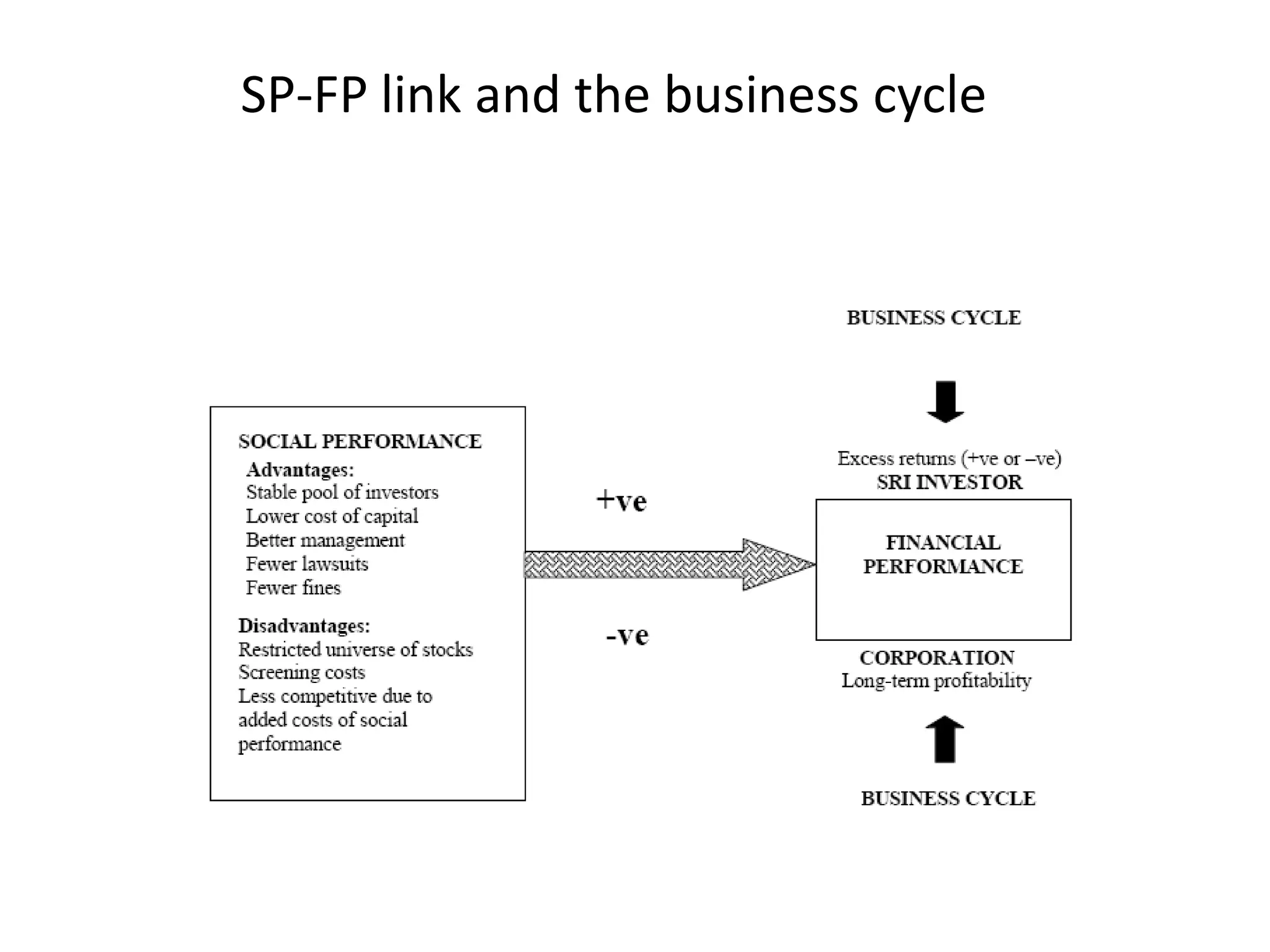
DefinitionsSocial performance-rating assigned to a company based on investor perception of a company’s social responsibility.Financial performance-the long-term profitability of the corporation or the excess returns delivered by the SRI fund. SP-FP link takes place at 2 levels:CSR->FP by the firmCSR-> high SP rating -> SRI investment
-Stakeholder theory-the rationale and foundation of SPStakeholders include all entities in the society whose interests or welfare are affected by the company’s actions (Freeman, 1984)Stakeholder interest is financial only (Friedman, 1970)Hybrid approach-corporations attempt to achieve long term profit maximization by engaging with diverse entities to minimize conflict and maintain long term competitiveness ”enlightened self-interest” (Porter, 2006;  Jensen, 2001)
SRI and the parallel SP and FP linkSP-FP (corporate): SP-> FP through competitive advantageSRI (investor): financial returns and utility (satisfaction) of social investing
SRI investor attitude toward riskAdaptation of Tobin’s Liquidity Preference Theory as behavior toward risk (1958).Risk lover-gives up financial returns in exchange for more risk.Risk averter (diversifier)–balances risk, return-at higher levels of risk, more returns needed in exchange for the same amount of riskRisk averter (plunger)-higher returns in exchange for more risk-accepts more risk in exchange for the same amount of return.
Social Criteria Preference as Behavior toward RiskSRI investor tradeoff among risk-return-social performance (Beal et al., 2005; M. Moskowitz, 1972; M. Moskowitz, 1997).  Ethical financial-investor is risk averse on both financial and social criteria.Ethical consumer-investor and investment-investor either risk averse (plunger) or a risk lover on the social performance criteria. May be risk averse on financial  criteria.
Relevance of the Social Criteria constructThis attempt to define a new construct in the SRI-financial literature should help in defining the implications of behaviors identified by the hypotheses.In spite of the focus on financial returns, SRI is a behavioral phenomenon.
SP-FP link and the business cycle
SP-FP theoretical perspectivesLinked to perspectives on stakeholder theory:Companies engaged in social performance  deliver superior financial performance.The benefits  of SRI outweigh the cost of screening the investment.SRI is consistent with Prudent Investor Rule (fiduciary duty to consider well being of the trust)
SP-FP theoretical perspectivesSocial performance has an adverse effect on financial performance-inefficient use of resources.
SRI limits the trustee’s universe of stocks  (financial stakeholder view-Prudent Man considers financial returns)
Added cost of SRI screening detracts from the excess return on the fund.  Vice vs. Religious vs. Traditional SRIVice funds  Recession resistant ? Less risky? More consistent returns?More risky?  Higher returns?Religious funds a smaller universe of stocks-more risky?Stock portfolio subject to less industry risk-more consistent returns?
SP-FP empirical findingsMixed mostly positive empirical results of relationship between SP and FPSome neutral or inconclusive    (UNPRI, 2007; Orlitzky, Schmidt &Rynes, 2003; Margolis and Walsh, 2001).
Business Cycles and SRIWeak economy – risk of loss-high expected return (Fama & French, 1989)Fund manager skill required (Siegel, 2009a)Strong economy – less risk of loss-lower expected return.Does the inclusion of SRI screens add value to the investment process?Do religious or vice funds perform better during good/bad times?
Trends in SRISpecialized funds-environmental, religious, vice, international, country /regional-there is a  fund for every need!UNPRI –SRI acceptance by financial community.B Lab/B Corporation certification-development of formal standards and audit procedures for SP.SEC addition of climate risk to list of disclosures.
METHOD
MethodHypothesesMeasures	 Proposed Sample	  Approach
HypothesesHypothesis 1(a) There is no difference between the performance of SRI indices and their conventional benchmarks during periods of economic expansion.Hypothesis 1(b) There is no difference between the performance of SRI indices and their conventional benchmarks during periods of economic contraction.
Hypotheses continuedHypothesis 2  SRI delivers positive net  excess returns (after expenses).  Hypothesis 3a  Religious funds have greater excess returns than vice funds, and their conventional benchmarks.  Hypothesis 3b The Vice Fund delivers greater excess returns than traditional SRI funds, and religious funds.
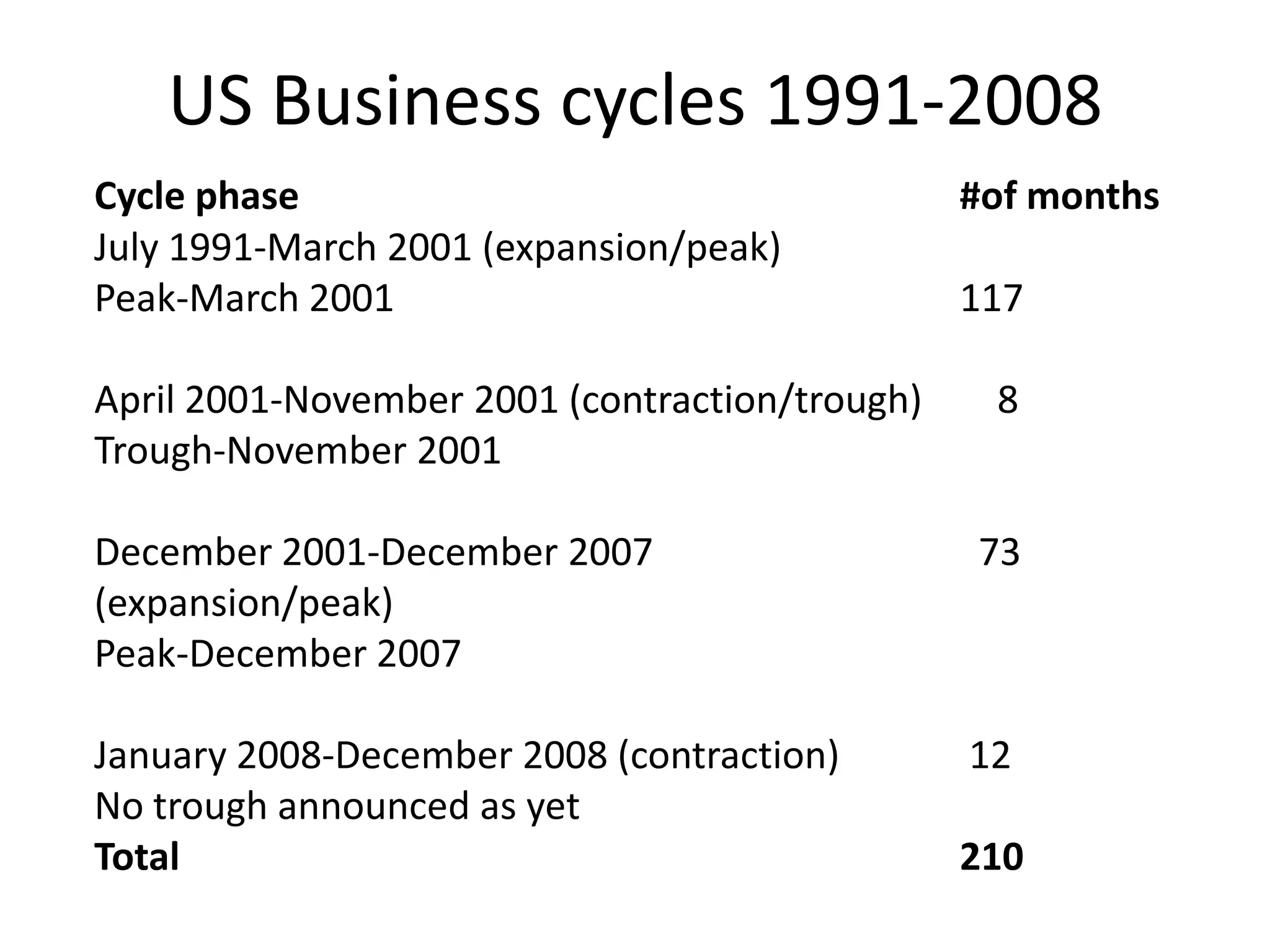
US Business cycles 1991-2008
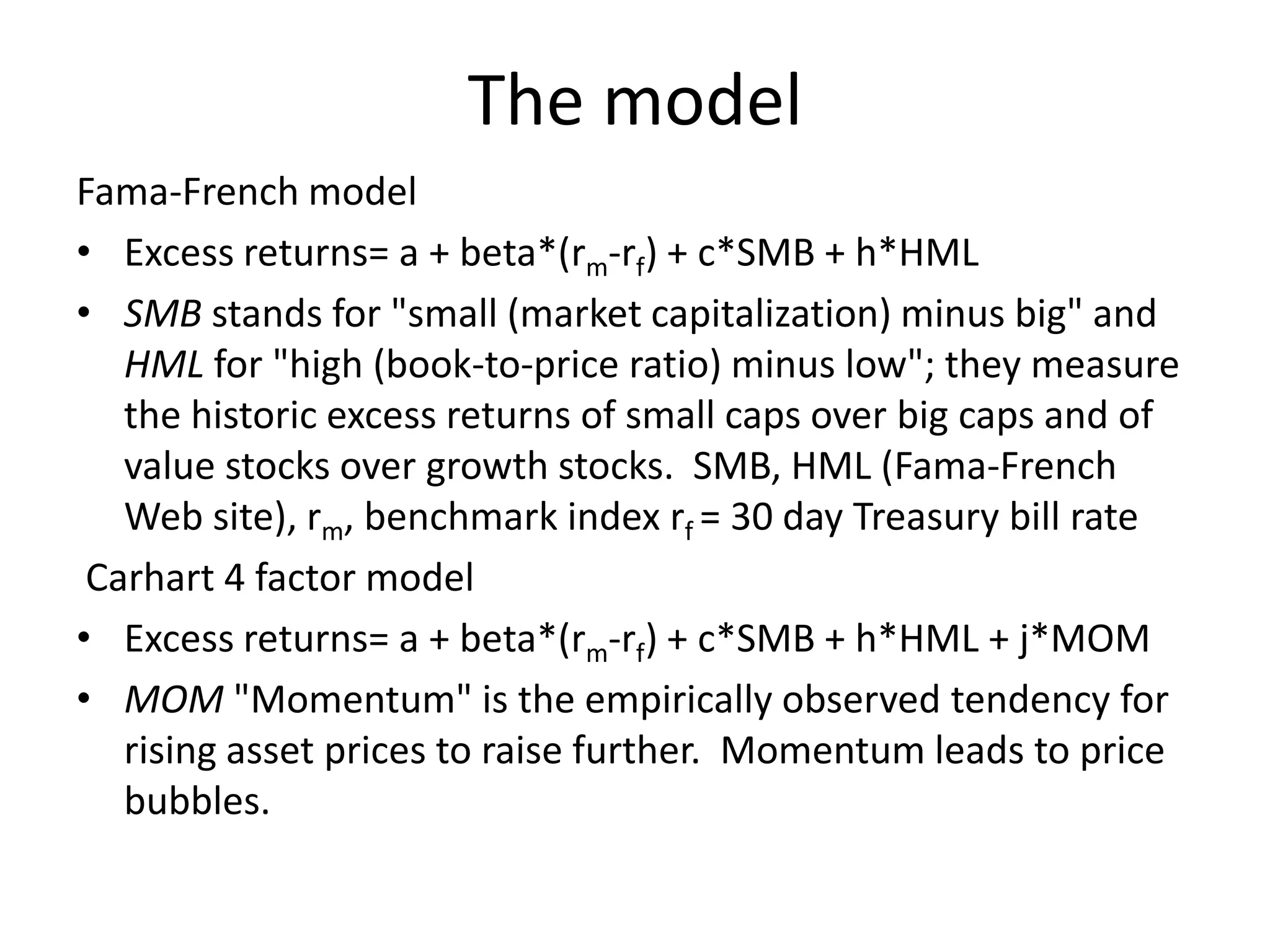
The modelFama-French modelExcess returns= a + beta*(rm-rf) + c*SMB + h*HML  SMB stands for "small (market capitalization) minus big" and HML for "high (book-to-price ratio) minus low"; they measure the historic excess returns of small caps over big caps and of value stocks over growth stocks.  SMB, HML (Fama-French Web site), rm, benchmark index rf= 30 day Treasury bill rateCarhart 4 factor modelExcess returns= a + beta*(rm-rf) + c*SMB + h*HML + j*MOMMOM "Momentum" is the empirically observed tendency for rising asset prices to raise further.  Momentum leads to price bubbles.
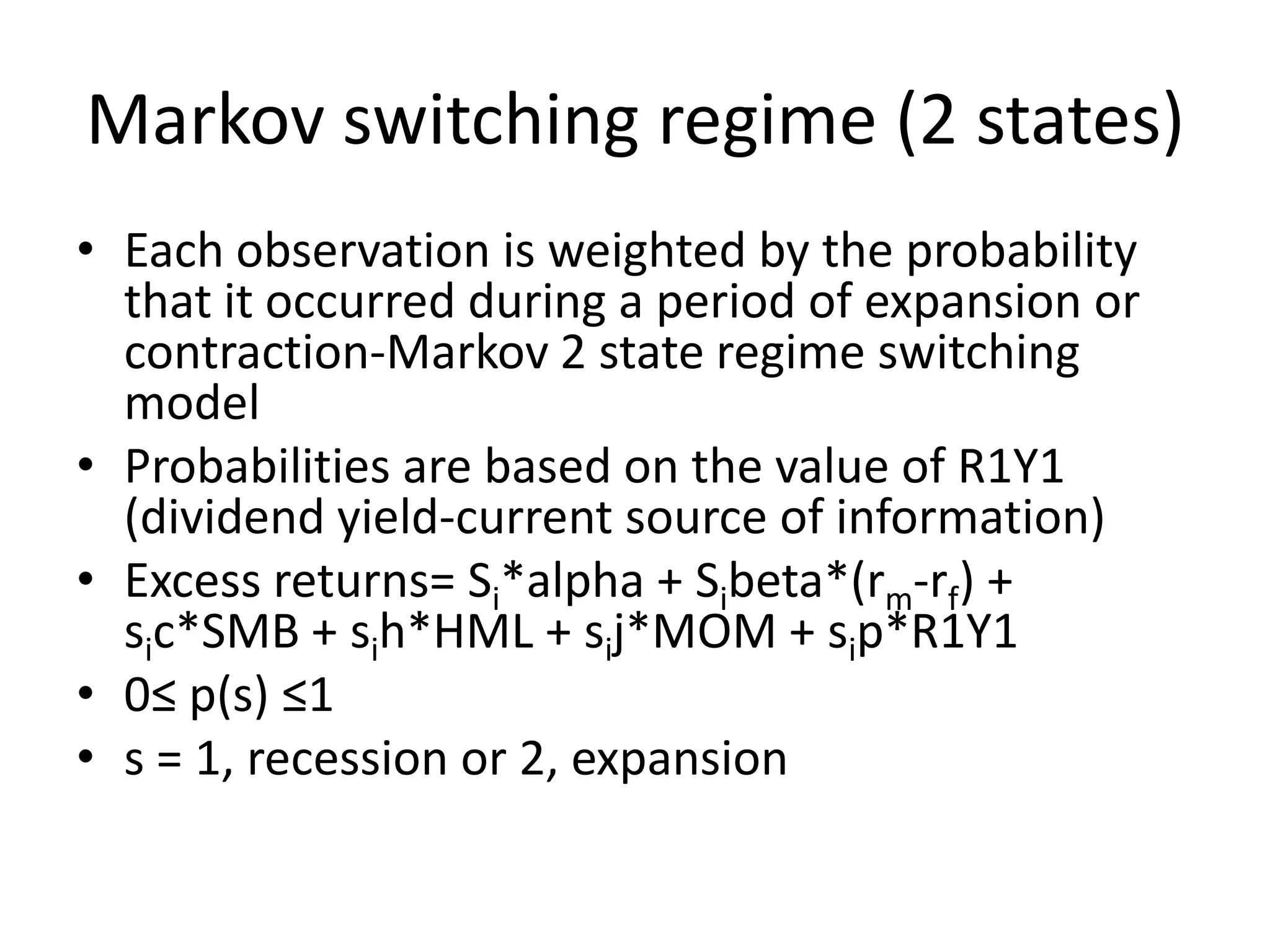
Markov switching regime (2 states)Each observation is weighted by the probability that it occurred during a period of expansion or contraction-Markov 2 state regime switching modelProbabilities are based on the value of R1Y1 (dividend yield-current source of information)Excess returns= Si*alpha + Sibeta*(rm-rf) + sic*SMB + sih*HML + sij*MOM + sip*R1Y1  0≤ p(s) ≤1  s = 1, recession or 2, expansion
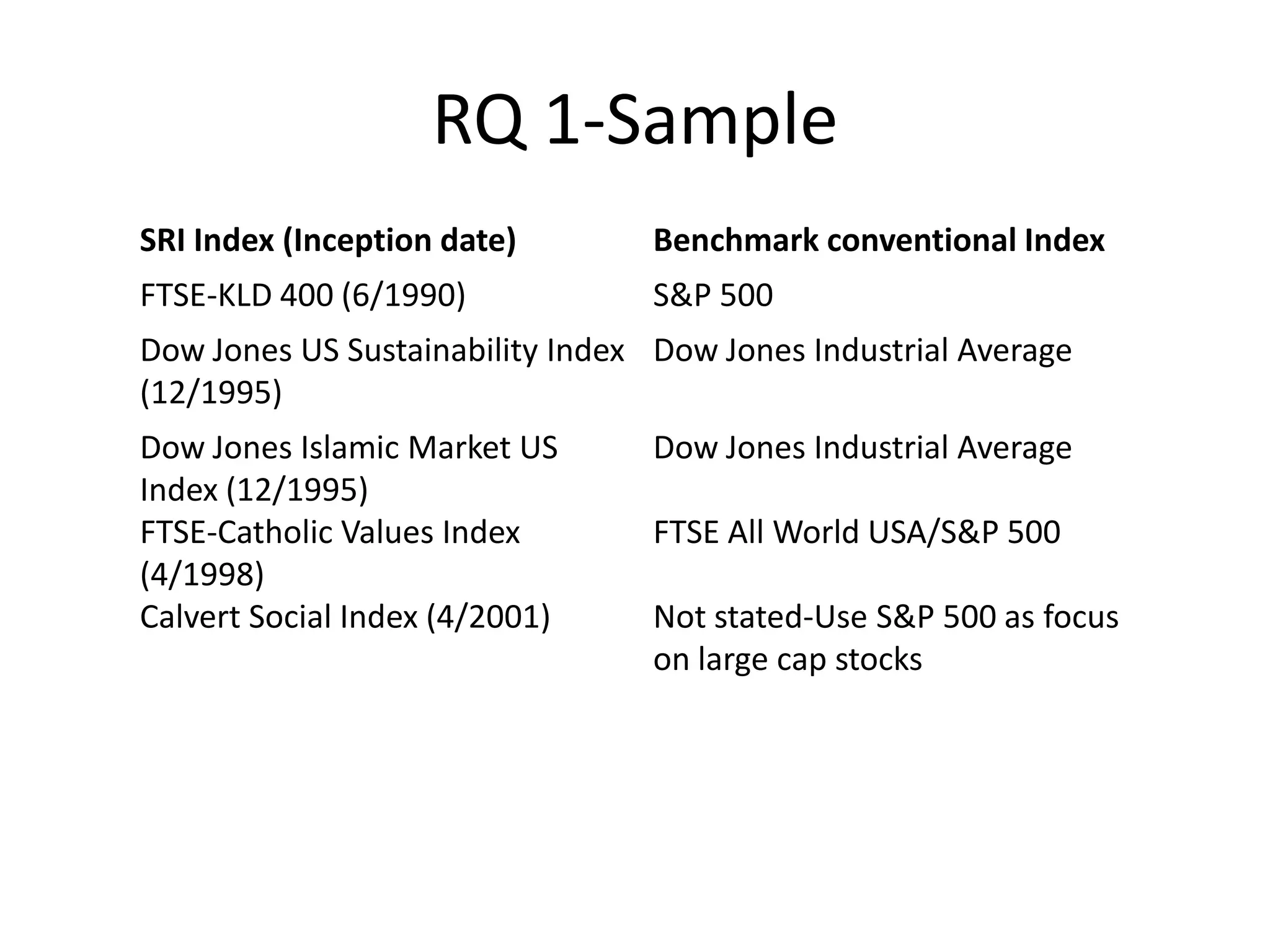
RQ 1-Sample
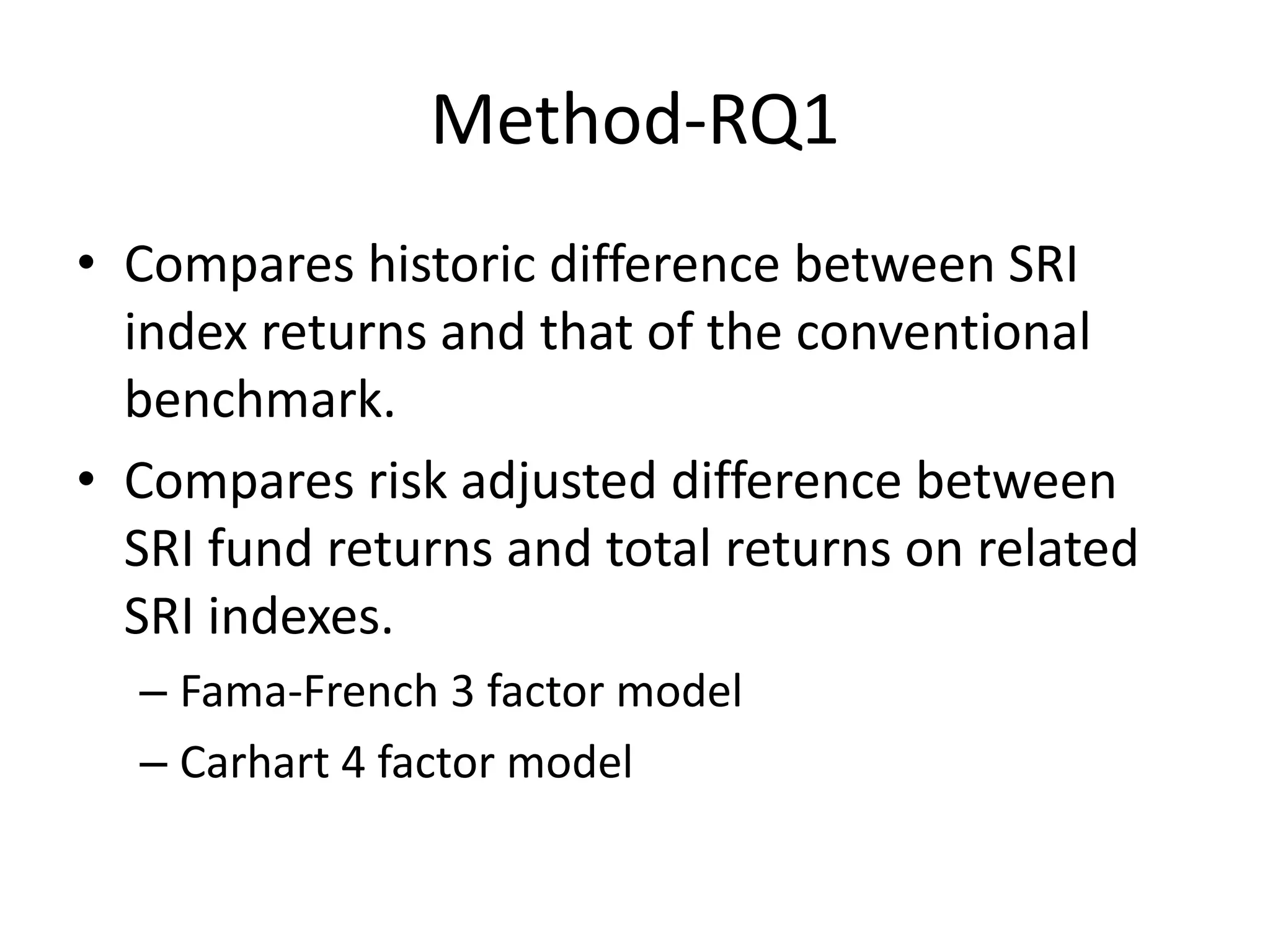
Method-RQ1Compares historic difference between SRI index returns and that of the conventional benchmark.Compares risk adjusted difference between SRI fund returns and total returns on related SRI indexes.Fama-French 3 factor modelCarhart 4 factor model
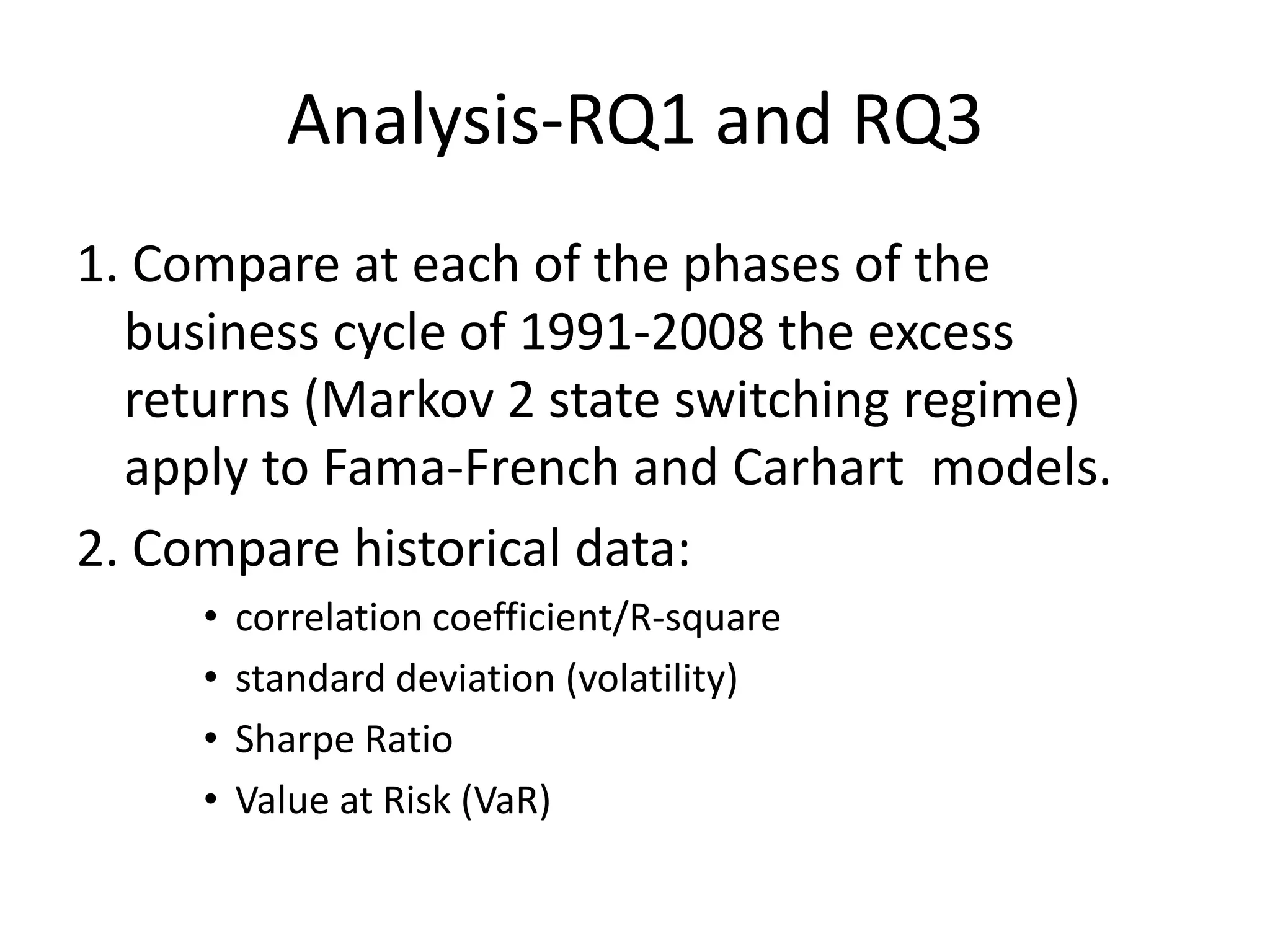
Analysis-RQ1 and RQ3  1. Compare at each of the phases of the business cycle of 1991-2008 the excess returns (Markov 2 state switching regime) apply to Fama-French and Carhart  models.2. Compare historical data:correlation coefficient/R-squarestandard deviation (volatility)Sharpe Ratio Value at Risk (VaR)
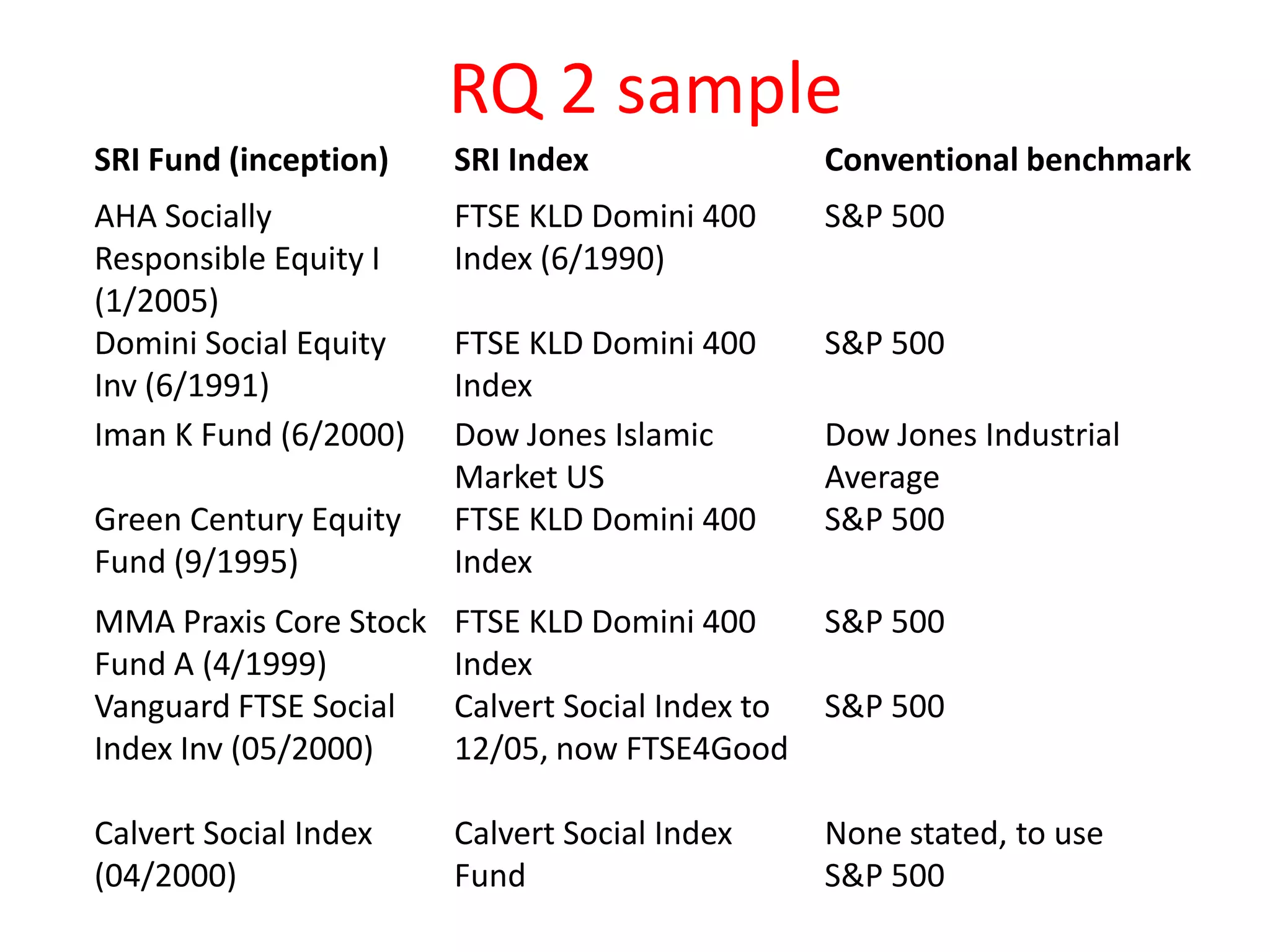
RQ 2 sample
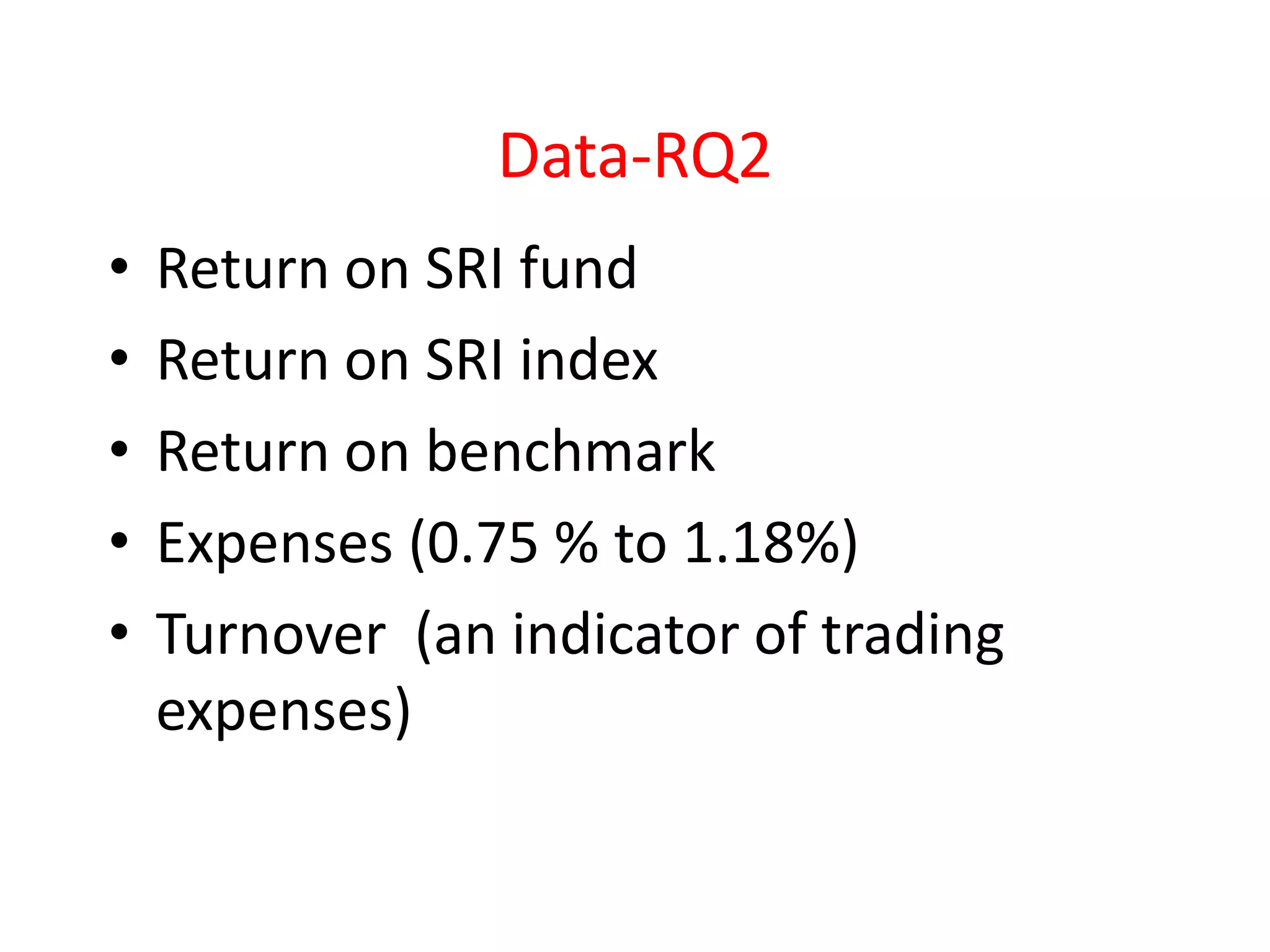
Data-RQ2Return on SRI fundReturn on SRI indexReturn on benchmarkExpenses (0.75 % to 1.18%)Turnover  (an indicator of trading expenses)
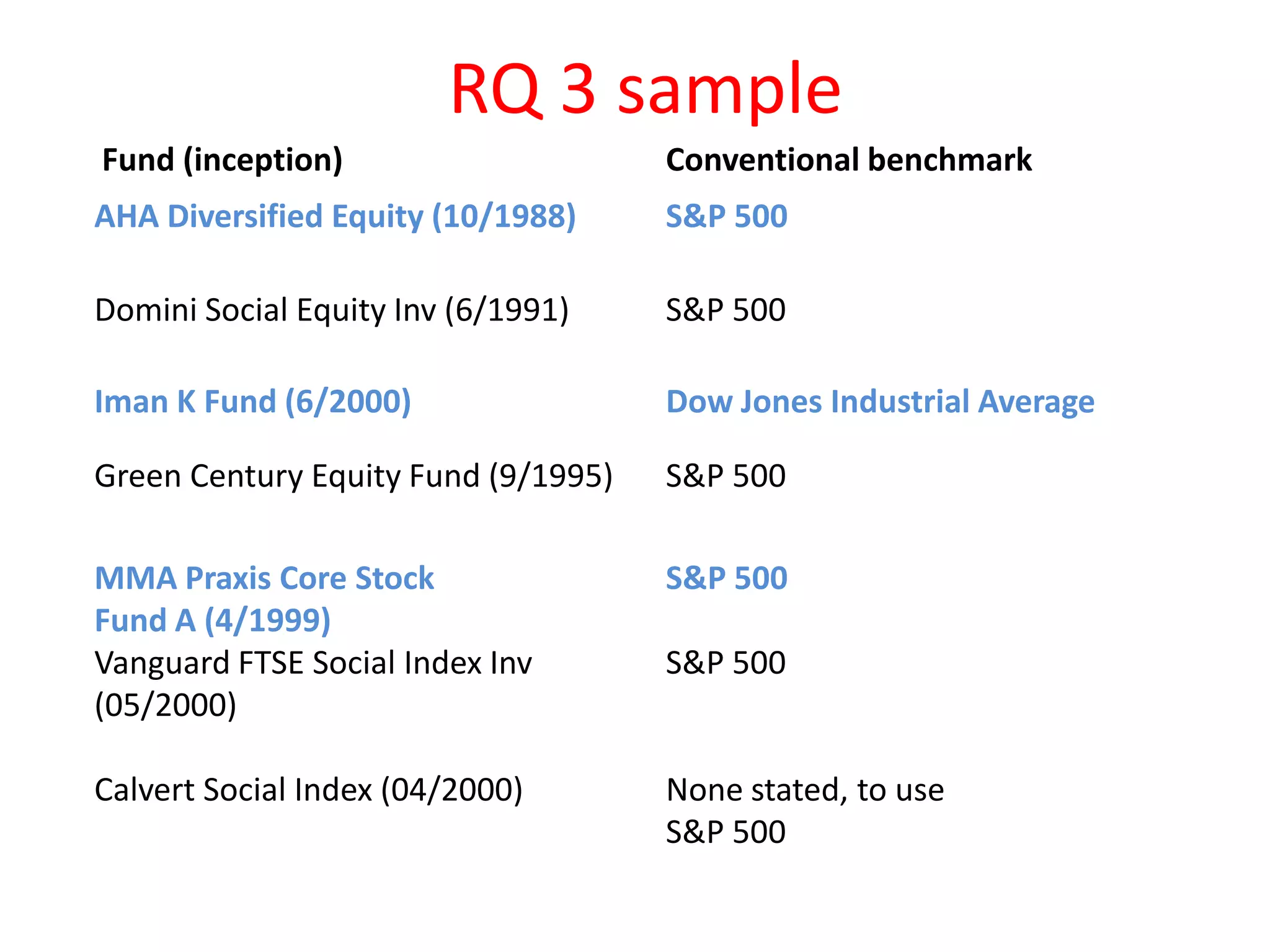
RQ 3 sample
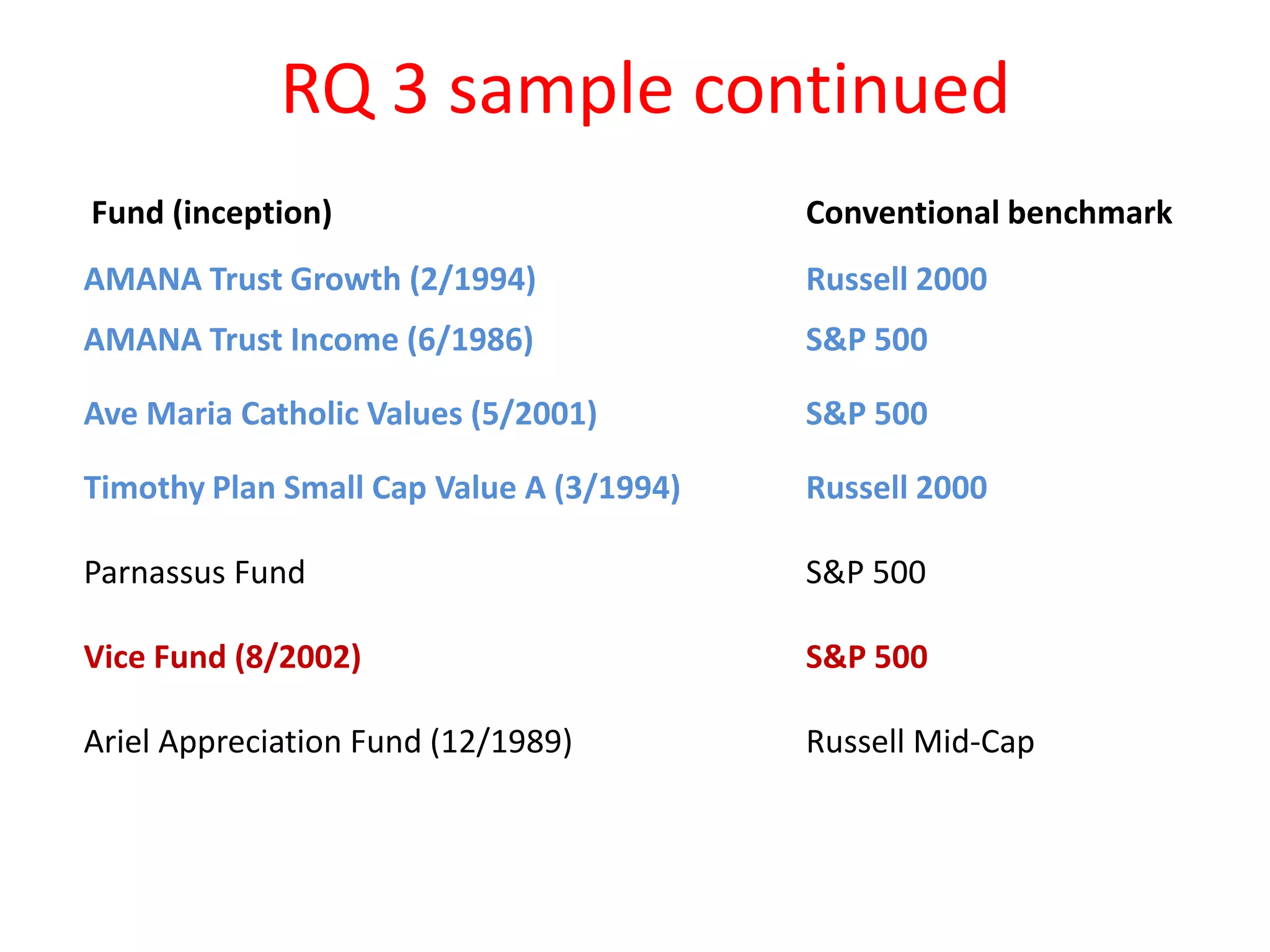
RQ 3 sample continued
Preliminary observationsHypothesis 1
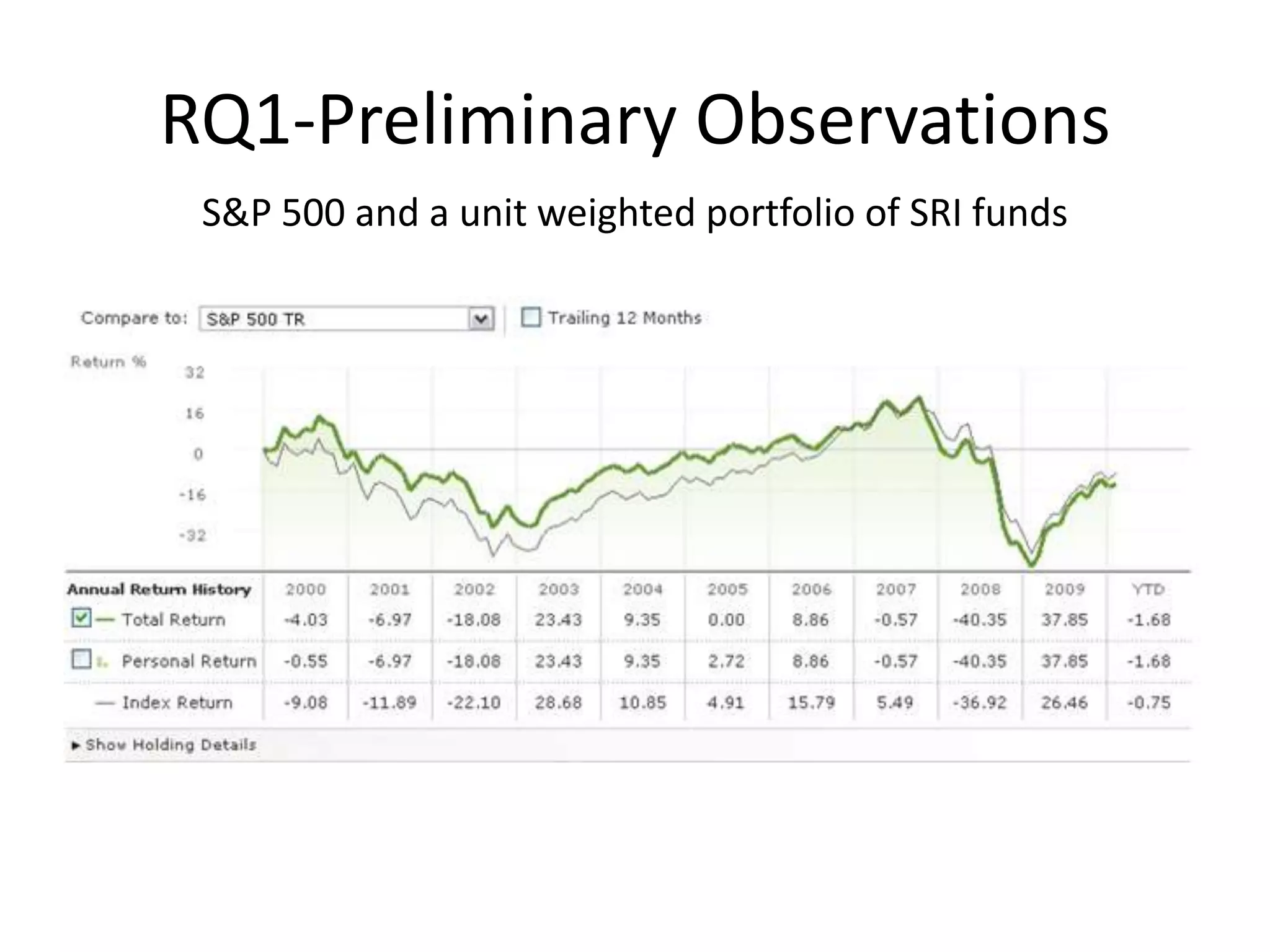
RQ1-Preliminary ObservationsS&P 500 and a unit weighted portfolio of SRI funds
S&P500 index returns-coincident index and KLD Social Equity Index excess returns  (1991-2008)
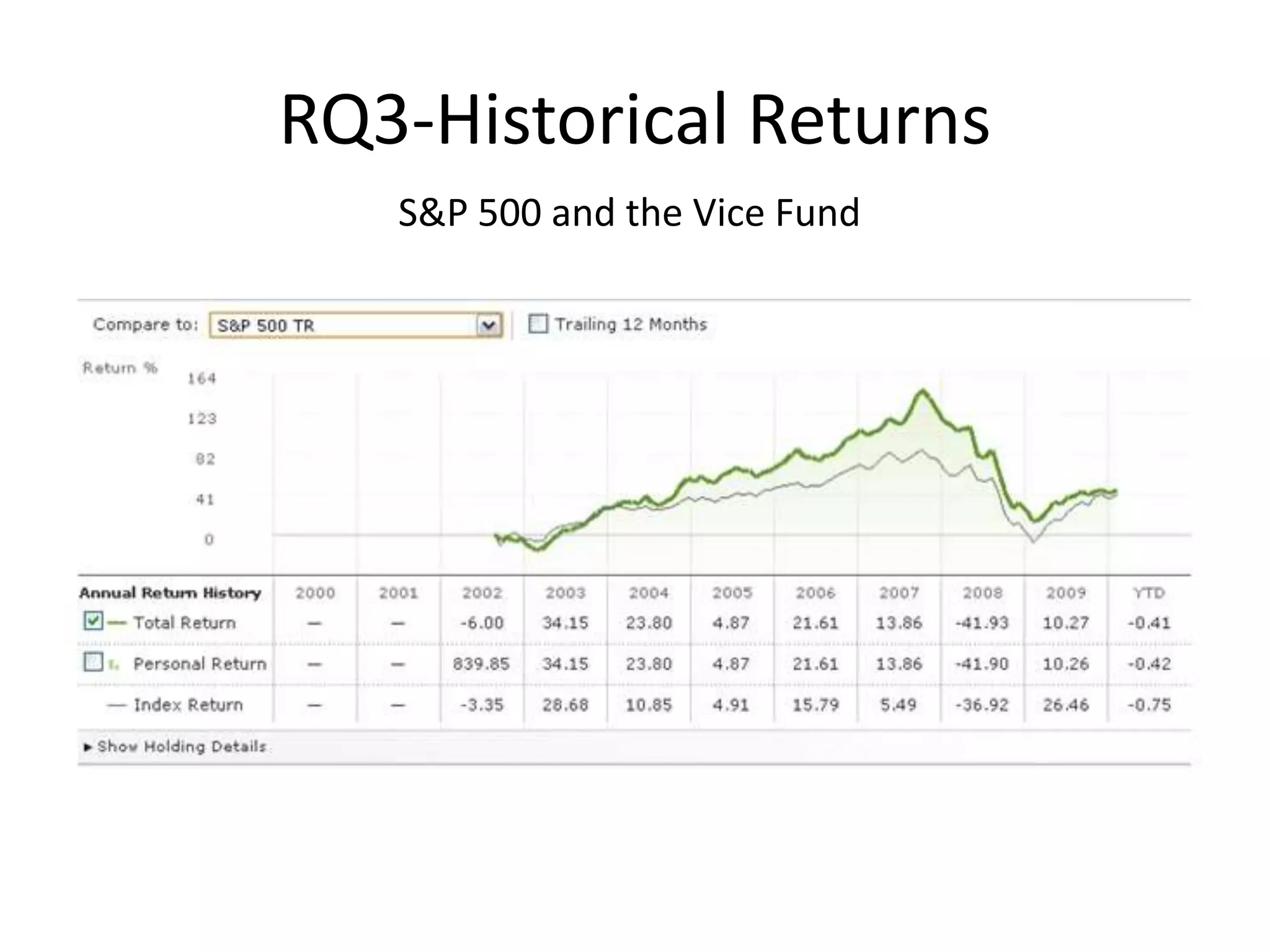
RQ3-Historical ReturnsS&P 500 and the Vice Fund

Presentation for Dissertation Proposal Defense

  • 1.
    The Effect ofthe Business Cycle on the PERFormance OF SOCIALLY RESPONSIBLE INVESTMENTSDissertation Proposal DefenseAndrea RoofeMay 5, 2010
  • 2.
    What is ‘SociallyResponsible Investing’?Socially responsible investing (SRI) “…integrates environmental, social and governance factors into investment decisions" (Social Investment Forum, 2010a)www.socialinvest.org
  • 3.
    Outline of thepresentationBackgroundResearch Questions and relevance of the studyTheoretical perspectivesMethodsPreliminary findings
  • 4.
  • 5.
    SRI movement: HistoricalBackgroundneed to express personal value system through investing:religious and secular values.slave trade and war (17th - 19th century)alcohol, tobacco, firearms and gambling activities (1920s)civil rights, the Vietnam War, apartheid, and consumer issues (1960s-80s)corporate governance and sustainability issues (1990s and early 21st century)
  • 6.
    RESEARCH QUESTIONS ANDRELEVANCE OF THE STUDY
  • 7.
    Research QuestionsDoes sociallyresponsible investing deliver financial value? Does the SP-FP relationship vary across phases of the business cycle?To what extent are net excess returns attributable to fund-SRI index differences, and index-benchmark differences?What is the nature of the FP-SP link on religious and vice funds? How do they compare to secular SRI funds and conventional funds?
  • 8.
    Relevance of thestudyPublic concern with issues in corporate governance (ENRON, 2008 crisis in the financial markets).Size of SRI market: 70 inst investors representing US$4 trillion.260 mutual funds (AUM>$200b) in 2007.55 funds (AUM~$12 billion) in 1995.Paucity of research into the performance of SRI equity mutual funds during a severe economic downturn.Performance of SRI mutual funds (AMANA Growth Fund , Ave Maria Catholic Values Growth Fund, Calvert Long term Income Fund A-Lipper ratings 2009 and 2010)
  • 9.
  • 10.
    Review of theliteratureStakeholder Theory and CSR-the basis for SRI The social performance-financial performance (SP-FP) connection The SRI Investment Process Business Cycles and SRI Recent trends in SRI
  • 11.
    DefinitionsSocial performance-rating assignedto a company based on investor perception of a company’s social responsibility.Financial performance-the long-term profitability of the corporation or the excess returns delivered by the SRI fund. SP-FP link takes place at 2 levels:CSR->FP by the firmCSR-> high SP rating -> SRI investment
  • 12.
    -Stakeholder theory-the rationaleand foundation of SPStakeholders include all entities in the society whose interests or welfare are affected by the company’s actions (Freeman, 1984)Stakeholder interest is financial only (Friedman, 1970)Hybrid approach-corporations attempt to achieve long term profit maximization by engaging with diverse entities to minimize conflict and maintain long term competitiveness ”enlightened self-interest” (Porter, 2006; Jensen, 2001)
  • 13.
    SRI and theparallel SP and FP linkSP-FP (corporate): SP-> FP through competitive advantageSRI (investor): financial returns and utility (satisfaction) of social investing
  • 14.
    SRI investor attitudetoward riskAdaptation of Tobin’s Liquidity Preference Theory as behavior toward risk (1958).Risk lover-gives up financial returns in exchange for more risk.Risk averter (diversifier)–balances risk, return-at higher levels of risk, more returns needed in exchange for the same amount of riskRisk averter (plunger)-higher returns in exchange for more risk-accepts more risk in exchange for the same amount of return.
  • 15.
    Social Criteria Preferenceas Behavior toward RiskSRI investor tradeoff among risk-return-social performance (Beal et al., 2005; M. Moskowitz, 1972; M. Moskowitz, 1997). Ethical financial-investor is risk averse on both financial and social criteria.Ethical consumer-investor and investment-investor either risk averse (plunger) or a risk lover on the social performance criteria. May be risk averse on financial criteria.
  • 16.
    Relevance of theSocial Criteria constructThis attempt to define a new construct in the SRI-financial literature should help in defining the implications of behaviors identified by the hypotheses.In spite of the focus on financial returns, SRI is a behavioral phenomenon.
  • 17.
    SP-FP link andthe business cycle
  • 18.
    SP-FP theoretical perspectivesLinkedto perspectives on stakeholder theory:Companies engaged in social performance deliver superior financial performance.The benefits of SRI outweigh the cost of screening the investment.SRI is consistent with Prudent Investor Rule (fiduciary duty to consider well being of the trust)
  • 19.
    SP-FP theoretical perspectivesSocialperformance has an adverse effect on financial performance-inefficient use of resources.
  • 20.
    SRI limits thetrustee’s universe of stocks (financial stakeholder view-Prudent Man considers financial returns)
  • 21.
    Added cost ofSRI screening detracts from the excess return on the fund. Vice vs. Religious vs. Traditional SRIVice funds Recession resistant ? Less risky? More consistent returns?More risky? Higher returns?Religious funds a smaller universe of stocks-more risky?Stock portfolio subject to less industry risk-more consistent returns?
  • 22.
    SP-FP empirical findingsMixedmostly positive empirical results of relationship between SP and FPSome neutral or inconclusive (UNPRI, 2007; Orlitzky, Schmidt &Rynes, 2003; Margolis and Walsh, 2001).
  • 23.
    Business Cycles andSRIWeak economy – risk of loss-high expected return (Fama & French, 1989)Fund manager skill required (Siegel, 2009a)Strong economy – less risk of loss-lower expected return.Does the inclusion of SRI screens add value to the investment process?Do religious or vice funds perform better during good/bad times?
  • 24.
    Trends in SRISpecializedfunds-environmental, religious, vice, international, country /regional-there is a fund for every need!UNPRI –SRI acceptance by financial community.B Lab/B Corporation certification-development of formal standards and audit procedures for SP.SEC addition of climate risk to list of disclosures.
  • 25.
  • 26.
  • 27.
    HypothesesHypothesis 1(a) Thereis no difference between the performance of SRI indices and their conventional benchmarks during periods of economic expansion.Hypothesis 1(b) There is no difference between the performance of SRI indices and their conventional benchmarks during periods of economic contraction.
  • 28.
    Hypotheses continuedHypothesis 2 SRI delivers positive net excess returns (after expenses). Hypothesis 3a Religious funds have greater excess returns than vice funds, and their conventional benchmarks. Hypothesis 3b The Vice Fund delivers greater excess returns than traditional SRI funds, and religious funds.
  • 29.
  • 30.
    The modelFama-French modelExcessreturns= a + beta*(rm-rf) + c*SMB + h*HML SMB stands for "small (market capitalization) minus big" and HML for "high (book-to-price ratio) minus low"; they measure the historic excess returns of small caps over big caps and of value stocks over growth stocks. SMB, HML (Fama-French Web site), rm, benchmark index rf= 30 day Treasury bill rateCarhart 4 factor modelExcess returns= a + beta*(rm-rf) + c*SMB + h*HML + j*MOMMOM "Momentum" is the empirically observed tendency for rising asset prices to raise further. Momentum leads to price bubbles.
  • 31.
    Markov switching regime(2 states)Each observation is weighted by the probability that it occurred during a period of expansion or contraction-Markov 2 state regime switching modelProbabilities are based on the value of R1Y1 (dividend yield-current source of information)Excess returns= Si*alpha + Sibeta*(rm-rf) + sic*SMB + sih*HML + sij*MOM + sip*R1Y1 0≤ p(s) ≤1 s = 1, recession or 2, expansion
  • 32.
  • 33.
    Method-RQ1Compares historic differencebetween SRI index returns and that of the conventional benchmark.Compares risk adjusted difference between SRI fund returns and total returns on related SRI indexes.Fama-French 3 factor modelCarhart 4 factor model
  • 34.
    Analysis-RQ1 and RQ3 1. Compare at each of the phases of the business cycle of 1991-2008 the excess returns (Markov 2 state switching regime) apply to Fama-French and Carhart models.2. Compare historical data:correlation coefficient/R-squarestandard deviation (volatility)Sharpe Ratio Value at Risk (VaR)
  • 35.
  • 36.
    Data-RQ2Return on SRIfundReturn on SRI indexReturn on benchmarkExpenses (0.75 % to 1.18%)Turnover (an indicator of trading expenses)
  • 37.
  • 38.
    RQ 3 samplecontinued
  • 39.
  • 40.
    RQ1-Preliminary ObservationsS&P 500and a unit weighted portfolio of SRI funds
  • 41.
    S&P500 index returns-coincidentindex and KLD Social Equity Index excess returns (1991-2008)
  • 42.
  • 43.