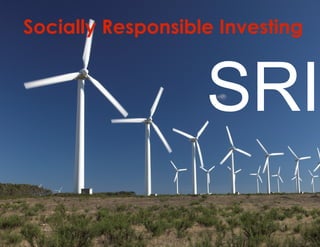
Socially Responsible Investing SRI
What Is It? Socially Responsible Investing  (SRI) is an investment process that considers social and environmental consequences of investments, both positive and negative, within the context of rigorous financial analysis. Source: Social Investment Forum
The Lingo aka: Principals of Responsible Investment (PRI) Environmental, Social, and Governance (ESG) Issues Corporate Social Responsibility (CSR) Ethical Investing Values Based Investing
How Does It Work? Screening Companies are rated by research firms such as KLD. Positive Screening: Invest more in the best companies. Negative Screening: Invest less, or none, in the worst companies. Your values = Your screens Advocacy Shareholders have voting rights. Vote your proxies, participate in resolutions. Community The bottom up approach: investing in people, places, and small business
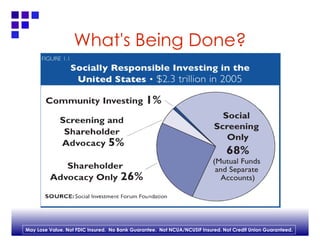
What's Being Done?
Dirty
Clean
Cleaner
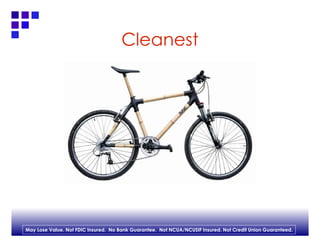
Cleanest
What Screens?
 
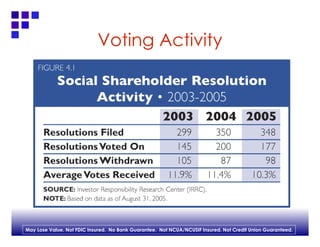
Voting Activity
Voting Issues
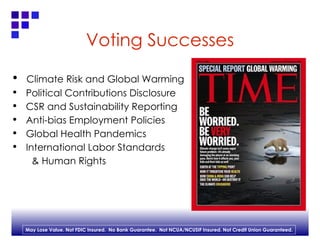
Voting Successes Climate Risk and Global Warming Political Contributions Disclosure CSR and Sustainability Reporting Anti-bias Employment Policies Global Health Pandemics International Labor Standards  & Human Rights
Hot Issues Climate Risk Improved Shareholder Proxy Access Excessive Executive Compensation Board Diversity, Composition, and Independence Social and Environmental Risk Management
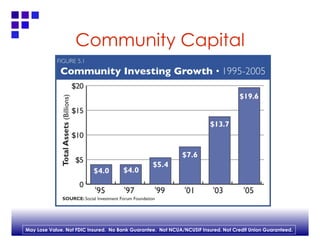
Community Capital
Calvert Foundation Wins 2006 Fast Company Social Capitalist Award
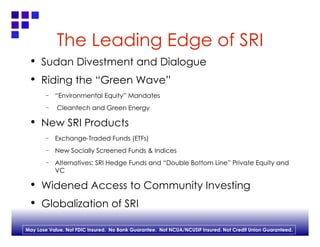
The Leading Edge of SRI Sudan Divestment and Dialogue Riding the “Green Wave” “ Environmental Equity” Mandates Cleantech and Green Energy New SRI Products Exchange-Traded Funds (ETFs) New Socially Screened Funds & Indices Alternatives: SRI Hedge Funds and “Double Bottom Line” Private Equity and VC Widened Access to Community Investing Globalization of SRI
Major Players AltruShare Securities Calvert Christian Brothers Investment Services, Inc. Citizens Funds Co-op America Domini Social Investments, LLC The Dreyfus Corporation First Affirmative Financial Network, LLC Institutional Shareholder Services, Inc. KLD Research & Analytics, Inc. Light Green Advisors, LLC Neuberger Berman, LLC, A Lehman Brothers Co. Opportunity Finance Network Pax World Funds Trillium Asset Management Corporation United Methodist Church General Board of Pension and Health Benefits Walden Asset Management, a Division of Boston Trust & Investment Management
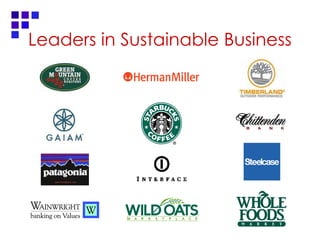
Leaders in Sustainable Business
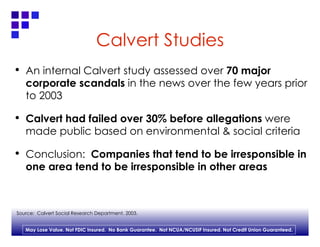
Calvert Studies An internal Calvert study assessed over  70 major corporate scandals  in the news over the few years prior to 2003 Calvert had failed over 30% before allegations  were made public based on environmental & social criteria  Conclusion:  Companies that tend to be irresponsible in one area tend to be irresponsible in other areas  Source:  Calvert Social Research Department, 2003.
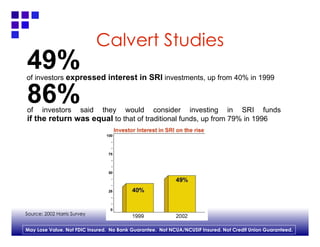
Calvert Studies of investors  expressed interest in SRI  investments, up from 40% in 1999 Source: 2002 Harris Survey 49% 86% of investors said they would consider investing in SRI funds if the return was equal  to that of traditional funds, up from 79% in 1996
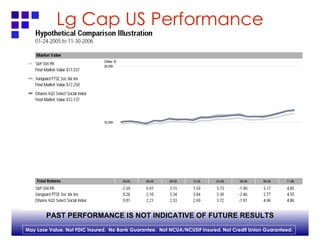
Lg Cap US Performance PAST PERFORMANCE IS NOT INDICATIVE OF FUTURE RESULTS
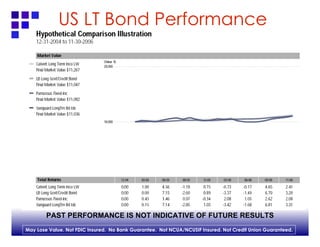
US LT Bond Performance PAST PERFORMANCE IS NOT INDICATIVE OF FUTURE RESULTS
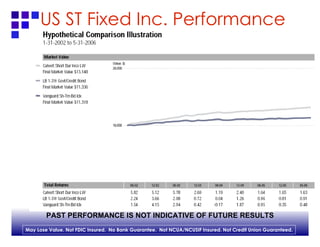
US ST Fixed Inc. Performance PAST PERFORMANCE IS NOT INDICATIVE OF FUTURE RESULTS
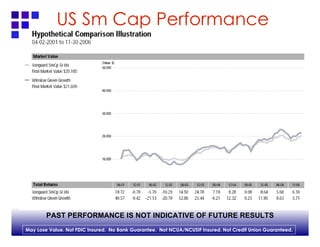
US Sm Cap Performance PAST PERFORMANCE IS NOT INDICATIVE OF FUTURE RESULTS
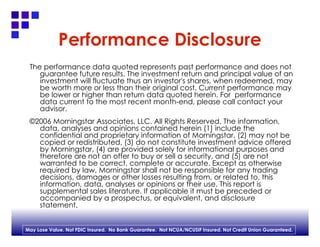
Performance Disclosure The performance data quoted represents past performance and does not guarantee future results. The investment return and principal value of an investment will fluctuate thus an investor's shares, when redeemed, may be worth more or less than their original cost. Current performance may be lower or higher than return data quoted herein. For  performance data current to the most recent month-end, please call contact your advisor. ©2006 Morningstar Associates, LLC. All Rights Reserved. The information, data, analyses and opinions contained herein (1) include the confidential and proprietary information of Morningstar, (2) may not be copied or redistributed, (3) do not constitute investment advice offered by Morningstar, (4) are provided solely for informational purposes and therefore are not an offer to buy or sell a security, and (5) are not warranted to be correct, complete or accurate. Except as otherwise required by law, Morningstar shall not be responsible for any trading decisions, damages or other losses resulting from, or related to, this information, data, analyses or opinions or their use. This report is supplemental sales literature. If applicable it must be preceded or accompanied by a prospectus, or equivalent, and disclosure statement.
Notes Several of the numbers identifying the charts in this presentation pertain to the chart numbers in the complete “ 2005 Report of Socially Responsible Investing Trends in the United States .” The report is available at  www.socialinvest.org .
Notes The performance data quoted represents past performance, which does not guarantee future results. The investment return and principal value of an investment will fluctuate so that an investor’s shares, when redeemed, may be worth more or less than their original cost.  Current performance may be higher or lower than the performance data quoted.
Socially Responsible Investing SRI
SRI History 1700's - Social investing has long historical roots in the U.S., dating back to the late 1700s when religious investors decided that they would refuse to invest in companies engaging in alcohol, gambling and tobacco. 1928 - Pioneer Group creates a “sin” screen that is later used to screen out certain investments when practicing socially responsible investing (SRI). 1960's - SRI movement is reborn during the Vietnam War by people who did not want their investments supporting the war. Students begin to pressure universities to divest from companies that have South African operations. 1970's - Significant events impacting SRI growth: Love Canal Firestone’s rubber explosion of 500 radial tires Sources: Social Investment Forum 1997 Trends Report., Goodmoney.com,
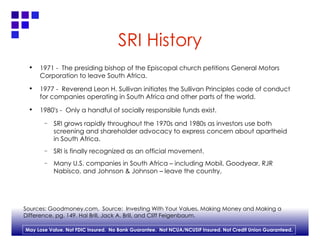
SRI History 1971 -  The presiding bishop of the Episcopal church petitions General Motors Corporation to leave South Africa. 1977 -  Reverend Leon H. Sullivan initiates the Sullivan Principles code of conduct for companies operating in South Africa and other parts of the world. 1980's -  Only a handful of socially responsible funds exist. SRI grows rapidly throughout the 1970s and 1980s as investors use both screening and shareholder advocacy to express concern about apartheid in South Africa.  SRI is finally recognized as an official movement. Many U.S. companies in South Africa – including Mobil, Goodyear, RJR Nabisco, and Johnson & Johnson – leave the country. Sources: Goodmoney.com,  Source:  Investing With Your Values, Making Money and Making a  Difference, pg. 149. Hal Brill, Jack A. Brill, and Cliff Feigenbaum.
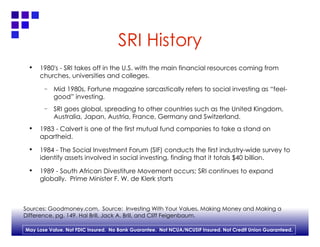
SRI History 1980's - SRI takes off in the U.S. with the main financial resources coming from churches, universities and colleges.  Mid 1980s, Fortune magazine sarcastically refers to social investing as “feel-good” investing. SRI goes global, spreading to other countries such as the United Kingdom, Australia, Japan, Austria, France, Germany and Switzerland. 1983 - Calvert is one of the first mutual fund companies to take a stand on apartheid. 1984 - The Social Investment Forum (SIF) conducts the first industry-wide survey to identify assets involved in social investing, finding that it totals $40 billion. 1989 - South African Divestiture Movement occurs; SRI continues to expand globally.  Prime Minister F. W. de Klerk starts Sources: Goodmoney.com,  Source:  Investing With Your Values, Making Money and Making a  Difference, pg. 149. Hal Brill, Jack A. Brill, and Cliff Feigenbaum.
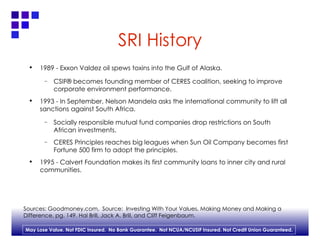
SRI History 1989 - Exxon Valdez oil spews toxins into the Gulf of Alaska. CSIF® becomes founding member of CERES coalition, seeking to improve corporate environment performance. 1993 - In September, Nelson Mandela asks the international community to lift all sanctions against South Africa. Socially responsible mutual fund companies drop restrictions on South African investments. CERES Principles reaches big leagues when Sun Oil Company becomes first Fortune 500 firm to adopt the principles. 1995 - Calvert Foundation makes its first community loans to inner city and rural communities. Sources: Goodmoney.com,  Source:  Investing With Your Values, Making Money and Making a  Difference, pg. 149. Hal Brill, Jack A. Brill, and Cliff Feigenbaum.
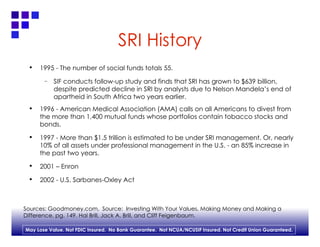
SRI History 1995 - The number of social funds totals 55. SIF conducts follow-up study and finds that SRI has grown to $639 billion, despite predicted decline in SRI by analysts due to Nelson Mandela’s end of apartheid in South Africa two years earlier. 1996 - American Medical Association (AMA) calls on all Americans to divest from the more than 1,400 mutual funds whose portfolios contain tobacco stocks and bonds. 1997 - More than $1.5 trillion is estimated to be under SRI management. Or, nearly 10% of all assets under professional management in the U.S. - an 85% increase in the past two years. 2001 – Enron 2002 - U.S. Sarbanes-Oxley Act Sources: Goodmoney.com,  Source:  Investing With Your Values, Making Money and Making a  Difference, pg. 149. Hal Brill, Jack A. Brill, and Cliff Feigenbaum.
SRI History 2003 - $2.14 trillion assets in socially screened portfolios an increase from $40 billion 20 years ago 200 socially responsible mutual funds an increase from 139 in 1997  Sources: Goodmoney.com,  Source:  Investing With Your Values, Making Money and Making a  Difference, pg. 149. Hal Brill, Jack A. Brill, and Cliff Feigenbaum.

Socially Responsible Investing

  • 1.
  • 2.
    What Is It?Socially Responsible Investing (SRI) is an investment process that considers social and environmental consequences of investments, both positive and negative, within the context of rigorous financial analysis. Source: Social Investment Forum
  • 3.
    The Lingo aka:Principals of Responsible Investment (PRI) Environmental, Social, and Governance (ESG) Issues Corporate Social Responsibility (CSR) Ethical Investing Values Based Investing
  • 4.
    How Does ItWork? Screening Companies are rated by research firms such as KLD. Positive Screening: Invest more in the best companies. Negative Screening: Invest less, or none, in the worst companies. Your values = Your screens Advocacy Shareholders have voting rights. Vote your proxies, participate in resolutions. Community The bottom up approach: investing in people, places, and small business
  • 5.
  • 6.
  • 7.
  • 8.
  • 9.
  • 10.
  • 11.
  • 12.
  • 13.
  • 14.
    Voting Successes ClimateRisk and Global Warming Political Contributions Disclosure CSR and Sustainability Reporting Anti-bias Employment Policies Global Health Pandemics International Labor Standards & Human Rights
  • 15.
    Hot Issues ClimateRisk Improved Shareholder Proxy Access Excessive Executive Compensation Board Diversity, Composition, and Independence Social and Environmental Risk Management
  • 16.
  • 17.
    Calvert Foundation Wins2006 Fast Company Social Capitalist Award
  • 18.
    The Leading Edgeof SRI Sudan Divestment and Dialogue Riding the “Green Wave” “ Environmental Equity” Mandates Cleantech and Green Energy New SRI Products Exchange-Traded Funds (ETFs) New Socially Screened Funds & Indices Alternatives: SRI Hedge Funds and “Double Bottom Line” Private Equity and VC Widened Access to Community Investing Globalization of SRI
  • 19.
    Major Players AltruShareSecurities Calvert Christian Brothers Investment Services, Inc. Citizens Funds Co-op America Domini Social Investments, LLC The Dreyfus Corporation First Affirmative Financial Network, LLC Institutional Shareholder Services, Inc. KLD Research & Analytics, Inc. Light Green Advisors, LLC Neuberger Berman, LLC, A Lehman Brothers Co. Opportunity Finance Network Pax World Funds Trillium Asset Management Corporation United Methodist Church General Board of Pension and Health Benefits Walden Asset Management, a Division of Boston Trust & Investment Management
  • 20.
  • 21.
    Calvert Studies Aninternal Calvert study assessed over 70 major corporate scandals in the news over the few years prior to 2003 Calvert had failed over 30% before allegations were made public based on environmental & social criteria Conclusion: Companies that tend to be irresponsible in one area tend to be irresponsible in other areas Source: Calvert Social Research Department, 2003.
  • 22.
    Calvert Studies ofinvestors expressed interest in SRI investments, up from 40% in 1999 Source: 2002 Harris Survey 49% 86% of investors said they would consider investing in SRI funds if the return was equal to that of traditional funds, up from 79% in 1996
  • 23.
    Lg Cap USPerformance PAST PERFORMANCE IS NOT INDICATIVE OF FUTURE RESULTS
  • 24.
    US LT BondPerformance PAST PERFORMANCE IS NOT INDICATIVE OF FUTURE RESULTS
  • 25.
    US ST FixedInc. Performance PAST PERFORMANCE IS NOT INDICATIVE OF FUTURE RESULTS
  • 26.
    US Sm CapPerformance PAST PERFORMANCE IS NOT INDICATIVE OF FUTURE RESULTS
  • 27.
    Performance Disclosure Theperformance data quoted represents past performance and does not guarantee future results. The investment return and principal value of an investment will fluctuate thus an investor's shares, when redeemed, may be worth more or less than their original cost. Current performance may be lower or higher than return data quoted herein. For performance data current to the most recent month-end, please call contact your advisor. ©2006 Morningstar Associates, LLC. All Rights Reserved. The information, data, analyses and opinions contained herein (1) include the confidential and proprietary information of Morningstar, (2) may not be copied or redistributed, (3) do not constitute investment advice offered by Morningstar, (4) are provided solely for informational purposes and therefore are not an offer to buy or sell a security, and (5) are not warranted to be correct, complete or accurate. Except as otherwise required by law, Morningstar shall not be responsible for any trading decisions, damages or other losses resulting from, or related to, this information, data, analyses or opinions or their use. This report is supplemental sales literature. If applicable it must be preceded or accompanied by a prospectus, or equivalent, and disclosure statement.
  • 28.
    Notes Several ofthe numbers identifying the charts in this presentation pertain to the chart numbers in the complete “ 2005 Report of Socially Responsible Investing Trends in the United States .” The report is available at www.socialinvest.org .
  • 29.
    Notes The performancedata quoted represents past performance, which does not guarantee future results. The investment return and principal value of an investment will fluctuate so that an investor’s shares, when redeemed, may be worth more or less than their original cost. Current performance may be higher or lower than the performance data quoted.
  • 30.
  • 31.
    SRI History 1700's- Social investing has long historical roots in the U.S., dating back to the late 1700s when religious investors decided that they would refuse to invest in companies engaging in alcohol, gambling and tobacco. 1928 - Pioneer Group creates a “sin” screen that is later used to screen out certain investments when practicing socially responsible investing (SRI). 1960's - SRI movement is reborn during the Vietnam War by people who did not want their investments supporting the war. Students begin to pressure universities to divest from companies that have South African operations. 1970's - Significant events impacting SRI growth: Love Canal Firestone’s rubber explosion of 500 radial tires Sources: Social Investment Forum 1997 Trends Report., Goodmoney.com,
  • 32.
    SRI History 1971- The presiding bishop of the Episcopal church petitions General Motors Corporation to leave South Africa. 1977 - Reverend Leon H. Sullivan initiates the Sullivan Principles code of conduct for companies operating in South Africa and other parts of the world. 1980's - Only a handful of socially responsible funds exist. SRI grows rapidly throughout the 1970s and 1980s as investors use both screening and shareholder advocacy to express concern about apartheid in South Africa. SRI is finally recognized as an official movement. Many U.S. companies in South Africa – including Mobil, Goodyear, RJR Nabisco, and Johnson & Johnson – leave the country. Sources: Goodmoney.com, Source: Investing With Your Values, Making Money and Making a Difference, pg. 149. Hal Brill, Jack A. Brill, and Cliff Feigenbaum.
  • 33.
    SRI History 1980's- SRI takes off in the U.S. with the main financial resources coming from churches, universities and colleges. Mid 1980s, Fortune magazine sarcastically refers to social investing as “feel-good” investing. SRI goes global, spreading to other countries such as the United Kingdom, Australia, Japan, Austria, France, Germany and Switzerland. 1983 - Calvert is one of the first mutual fund companies to take a stand on apartheid. 1984 - The Social Investment Forum (SIF) conducts the first industry-wide survey to identify assets involved in social investing, finding that it totals $40 billion. 1989 - South African Divestiture Movement occurs; SRI continues to expand globally. Prime Minister F. W. de Klerk starts Sources: Goodmoney.com, Source: Investing With Your Values, Making Money and Making a Difference, pg. 149. Hal Brill, Jack A. Brill, and Cliff Feigenbaum.
  • 34.
    SRI History 1989- Exxon Valdez oil spews toxins into the Gulf of Alaska. CSIF® becomes founding member of CERES coalition, seeking to improve corporate environment performance. 1993 - In September, Nelson Mandela asks the international community to lift all sanctions against South Africa. Socially responsible mutual fund companies drop restrictions on South African investments. CERES Principles reaches big leagues when Sun Oil Company becomes first Fortune 500 firm to adopt the principles. 1995 - Calvert Foundation makes its first community loans to inner city and rural communities. Sources: Goodmoney.com, Source: Investing With Your Values, Making Money and Making a Difference, pg. 149. Hal Brill, Jack A. Brill, and Cliff Feigenbaum.
  • 35.
    SRI History 1995- The number of social funds totals 55. SIF conducts follow-up study and finds that SRI has grown to $639 billion, despite predicted decline in SRI by analysts due to Nelson Mandela’s end of apartheid in South Africa two years earlier. 1996 - American Medical Association (AMA) calls on all Americans to divest from the more than 1,400 mutual funds whose portfolios contain tobacco stocks and bonds. 1997 - More than $1.5 trillion is estimated to be under SRI management. Or, nearly 10% of all assets under professional management in the U.S. - an 85% increase in the past two years. 2001 – Enron 2002 - U.S. Sarbanes-Oxley Act Sources: Goodmoney.com, Source: Investing With Your Values, Making Money and Making a Difference, pg. 149. Hal Brill, Jack A. Brill, and Cliff Feigenbaum.
  • 36.
    SRI History 1995- The number of social funds totals 55. SIF conducts follow-up study and finds that SRI has grown to $639 billion, despite predicted decline in SRI by analysts due to Nelson Mandela’s end of apartheid in South Africa two years earlier. 1996 - American Medical Association (AMA) calls on all Americans to divest from the more than 1,400 mutual funds whose portfolios contain tobacco stocks and bonds. 1997 - More than $1.5 trillion is estimated to be under SRI management. Or, nearly 10% of all assets under professional management in the U.S. - an 85% increase in the past two years. 2001 – Enron 2002 - U.S. Sarbanes-Oxley Act Sources: Goodmoney.com, Source: Investing With Your Values, Making Money and Making a Difference, pg. 149. Hal Brill, Jack A. Brill, and Cliff Feigenbaum.
  • 37.
    SRI History 2003- $2.14 trillion assets in socially screened portfolios an increase from $40 billion 20 years ago 200 socially responsible mutual funds an increase from 139 in 1997 Sources: Goodmoney.com, Source: Investing With Your Values, Making Money and Making a Difference, pg. 149. Hal Brill, Jack A. Brill, and Cliff Feigenbaum.