THE PYTHON ECOSYSTEM FOR DATA
SCIENCE - LANDSCAPE OVERVIEW
Ananth Krishnamoorthy, Ph.D.
Outline Slides for Talk at Fifth Elephant 2017
25-Apr-2017
Summary
• In their day-to-day jobs, data science teams and data scientists face challenges in
many overlapping yet distinct areas such as Reporting, Data Processing &
Storage, Scientific Computing, ML Modelling, Application Development. To
succeed, Data science teams, especially small ones, need a deep appreciation of
these dependencies on their success.
• Python ecosystem for data science has a number of tools and libraries for various
aspects of data science, including Machine Learning, Cluster Computing,
Scientific Computing, etc.
• The idea of this talk is to understand what the Python data science ecosystem
offers (so that you don't reinvent it), what are some common gaps (so that you
don't go blue looking for answers).
• In this talk, we describe how different tools/libraries fit in the machine learning
model development and deployment workflow . This talk is about how these
different tools work (and don’t work) together with each other. It is intended as a
landscape survey of the python data science ecosystem, along with a mention of
some common gaps that practitioners may notice as they put together a stack
and/or an application for their company.
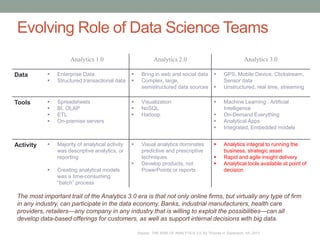
The most important trait of the Analytics 3.0 era is that not only online firms, but virtually any type of firm
in any industry, can participate in the data economy. Banks, industrial manufacturers, health care
providers, retailers—any company in any industry that is willing to exploit the possibilities—can all
develop data-based offerings for customers, as well as support internal decisions with big data.
Analytics 1.0 Analytics 2.0 Analytics 3.0
Data  Enterprise Data
 Structured transactional data
 Bring in web and social data
 Complex, large,
semistructured data sources
 GPS, Mobile Device, Clickstream,
Sensor data
 Unstructured, real time, streaming
Tools  Spreadsheets
 BI, OLAP
 ETL
 On-premise servers
 Visualization
 NoSQL
 Hadoop
 Machine Learning , Artificial
Intelligence
 On-Demand Everything
 Analytical Apps
 Integrated, Embedded models
Activity  Majority of analytical activity
was descriptive analytics, or
reporting
 Creating analytical models
was a time-consuming
“batch” process
 Visual analytics dominates
predictive and prescriptive
techniques
 Develop products, not
PowerPoints or reports
 Analytics integral to running the
business, strategic asset
 Rapid and agile insight delivery
 Analytical tools available at point of
decision
Source: THE RISE OF ANALYTICS 3.0, By Thomas H. Davenport, IIA, 2013
Evolving Role of Data Science Teams
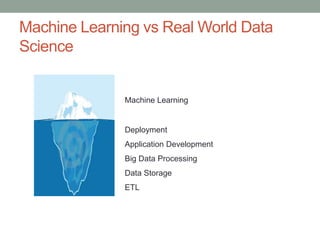
Machine Learning vs Real World Data
Science
Machine Learning
Deployment
Application Development
Big Data Processing
Data Storage
ETL
Challenges faced by Data Science Teams
• Requires many more competencies than can be reasonably expected
from one person
• Challenges are greater for smaller teams and smaller companies, e.g.
startups
• Challenges create dependencies on other teams e.g. Development
• Dependencies slow down execution and benefits realization
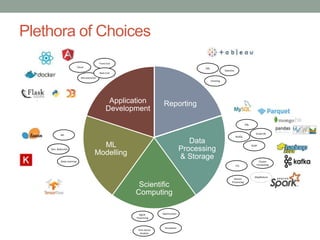
Plethora of Choices
Reporting
Data
Processing
& Storage
Scientific
Computing
ML
Modelling
Application
Development
SQL
NoSQL
Graphdb
OLAP
ETL
Cluster
Computing
Stream
Processing
SQL
Charting
Statistics
Cloud
Front End
Microservices
Back End
ML
Deep Learning
Dim. Reduction
Signal
Processing
Optimization
Time Series
Analysis
Simulation
MapReduce
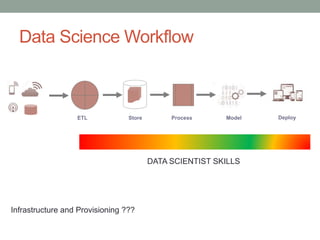
Data Science Workflow
ETL Process ModelStore Deploy
DATA SCIENTIST SKILLS
Infrastructure and Provisioning ???
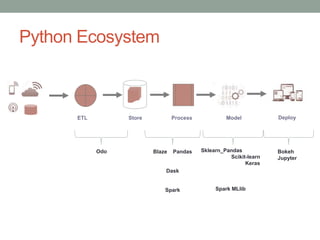
Python Ecosystem
ETL Process ModelStore Deploy
Odo Blaze Pandas
Dask
Spark
Sklearn_Pandas
Scikit-learn
Keras
Spark MLlib
Bokeh
Jupyter
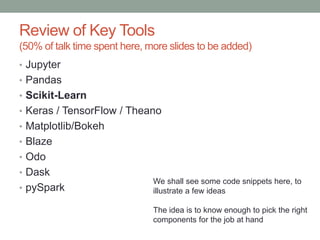
Review of Key Tools
(50% of talk time spent here, more slides to be added)
• Jupyter
• Pandas
• Scikit-Learn
• Keras / TensorFlow / Theano
• Matplotlib/Bokeh
• Blaze
• Odo
• Dask
• pySpark
We shall see some code snippets here, to
illustrate a few ideas
The idea is to know enough to pick the right
components for the job at hand
Use Case 1: Small Data
This use case will illustrate case of Small
Data i.e. Desktop / In-memory processing
Use Case 2: ‘Medium’ Data
This use case will illustrate case of Medium
Data with Out-of-core processing
Use Case 3: Big Data
This use case will illustrate case of Big Data
i.e cluster computing
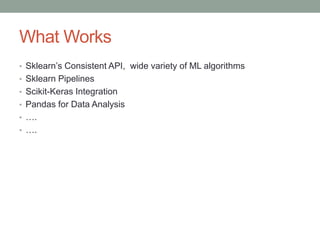
What Works
• Sklearn’s Consistent API, wide variety of ML algorithms
• Sklearn Pipelines
• Scikit-Keras Integration
• Pandas for Data Analysis
• ….
• ….
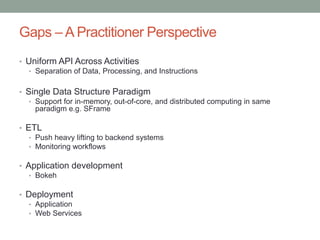
Gaps – A Practitioner Perspective
• Uniform API Across Activities
• Separation of Data, Processing, and Instructions
• Single Data Structure Paradigm
• Support for in-memory, out-of-core, and distributed computing in same
paradigm e.g. SFrame
• ETL
• Push heavy lifting to backend systems
• Monitoring workflows
• Application development
• Bokeh
• Deployment
• Application
• Web Services

The Python ecosystem for data science - Landscape Overview

  • 1.
    THE PYTHON ECOSYSTEMFOR DATA SCIENCE - LANDSCAPE OVERVIEW Ananth Krishnamoorthy, Ph.D. Outline Slides for Talk at Fifth Elephant 2017 25-Apr-2017
  • 2.
    Summary • In theirday-to-day jobs, data science teams and data scientists face challenges in many overlapping yet distinct areas such as Reporting, Data Processing & Storage, Scientific Computing, ML Modelling, Application Development. To succeed, Data science teams, especially small ones, need a deep appreciation of these dependencies on their success. • Python ecosystem for data science has a number of tools and libraries for various aspects of data science, including Machine Learning, Cluster Computing, Scientific Computing, etc. • The idea of this talk is to understand what the Python data science ecosystem offers (so that you don't reinvent it), what are some common gaps (so that you don't go blue looking for answers). • In this talk, we describe how different tools/libraries fit in the machine learning model development and deployment workflow . This talk is about how these different tools work (and don’t work) together with each other. It is intended as a landscape survey of the python data science ecosystem, along with a mention of some common gaps that practitioners may notice as they put together a stack and/or an application for their company.
  • 3.
    The most importanttrait of the Analytics 3.0 era is that not only online firms, but virtually any type of firm in any industry, can participate in the data economy. Banks, industrial manufacturers, health care providers, retailers—any company in any industry that is willing to exploit the possibilities—can all develop data-based offerings for customers, as well as support internal decisions with big data. Analytics 1.0 Analytics 2.0 Analytics 3.0 Data  Enterprise Data  Structured transactional data  Bring in web and social data  Complex, large, semistructured data sources  GPS, Mobile Device, Clickstream, Sensor data  Unstructured, real time, streaming Tools  Spreadsheets  BI, OLAP  ETL  On-premise servers  Visualization  NoSQL  Hadoop  Machine Learning , Artificial Intelligence  On-Demand Everything  Analytical Apps  Integrated, Embedded models Activity  Majority of analytical activity was descriptive analytics, or reporting  Creating analytical models was a time-consuming “batch” process  Visual analytics dominates predictive and prescriptive techniques  Develop products, not PowerPoints or reports  Analytics integral to running the business, strategic asset  Rapid and agile insight delivery  Analytical tools available at point of decision Source: THE RISE OF ANALYTICS 3.0, By Thomas H. Davenport, IIA, 2013 Evolving Role of Data Science Teams
  • 4.
    Machine Learning vsReal World Data Science Machine Learning Deployment Application Development Big Data Processing Data Storage ETL
  • 5.
    Challenges faced byData Science Teams • Requires many more competencies than can be reasonably expected from one person • Challenges are greater for smaller teams and smaller companies, e.g. startups • Challenges create dependencies on other teams e.g. Development • Dependencies slow down execution and benefits realization
  • 6.
    Plethora of Choices Reporting Data Processing &Storage Scientific Computing ML Modelling Application Development SQL NoSQL Graphdb OLAP ETL Cluster Computing Stream Processing SQL Charting Statistics Cloud Front End Microservices Back End ML Deep Learning Dim. Reduction Signal Processing Optimization Time Series Analysis Simulation MapReduce
  • 7.
    Data Science Workflow ETLProcess ModelStore Deploy DATA SCIENTIST SKILLS Infrastructure and Provisioning ???
  • 8.
    Python Ecosystem ETL ProcessModelStore Deploy Odo Blaze Pandas Dask Spark Sklearn_Pandas Scikit-learn Keras Spark MLlib Bokeh Jupyter
  • 9.
    Review of KeyTools (50% of talk time spent here, more slides to be added) • Jupyter • Pandas • Scikit-Learn • Keras / TensorFlow / Theano • Matplotlib/Bokeh • Blaze • Odo • Dask • pySpark We shall see some code snippets here, to illustrate a few ideas The idea is to know enough to pick the right components for the job at hand
  • 10.
    Use Case 1:Small Data This use case will illustrate case of Small Data i.e. Desktop / In-memory processing
  • 11.
    Use Case 2:‘Medium’ Data This use case will illustrate case of Medium Data with Out-of-core processing
  • 12.
    Use Case 3:Big Data This use case will illustrate case of Big Data i.e cluster computing
  • 13.
    What Works • Sklearn’sConsistent API, wide variety of ML algorithms • Sklearn Pipelines • Scikit-Keras Integration • Pandas for Data Analysis • …. • ….
  • 14.
    Gaps – APractitioner Perspective • Uniform API Across Activities • Separation of Data, Processing, and Instructions • Single Data Structure Paradigm • Support for in-memory, out-of-core, and distributed computing in same paradigm e.g. SFrame • ETL • Push heavy lifting to backend systems • Monitoring workflows • Application development • Bokeh • Deployment • Application • Web Services

Editor's Notes

  • #7 Slide needs improvement 