preencoded.png
Shri Ramswaroop Memorial University
Lucknow – Deva Road, Barabanki (UP)
Department of Computer Science & Information Systems
UCS3002
C++ Programming
BCA(DS+AI)-3B
Submitted To: Submitted By:
Name:- Anand Singh
Roll no: 202410101360090
Mr. Ashok Masih Sir
preencoded.png
What is Data Science?
Data Science is the art and science of extracting meaningful insights
from raw data. It’s an interdisciplinary field that blends scientific
methods, processes, algorithms, and systems to extract knowledge and
insights from structured and unstructured data.
• It combines statistics, machine learning, artificial intelligence (AI),
and domain knowledge.
• It enables data-driven decision-making across various industries,
transforming how businesses operate and innovate.
preencoded.png
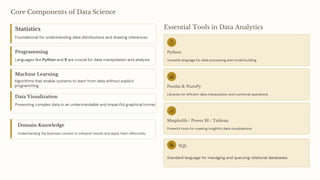
Core Components of Data Science
Statistics
Foundational for understanding data distributions and drawing inferences.
Programming
Languages like Python and R are crucial for data manipulation and analysis.
Machine Learning
Algorithms that enable systems to learn from data without explicit
programming.
Data Visualization
Presenting complex data in an understandable and impactful graphical format.
Domain Knowledge
Understanding the business context to interpret results and apply them effectively.
Essential Tools in Data Analytics
Python
Versatile language for data processing and model building.
Pandas & NumPy
Libraries for efficient data manipulation and numerical operations.
Matplotlib / Power BI / Tableau
Powerful tools for creating insightful data visualisations.
SQL
Standard language for managing and querying relational databases.
preencoded.png
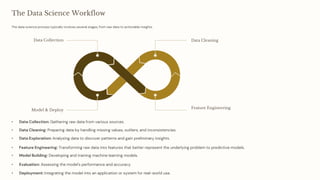
The Data Science Workflow
The data science process typically involves several stages, from raw data to actionable insights.
Data Collection Data Cleaning
Feature Engineering
Model & Deploy
• Data Collection: Gathering raw data from various sources.
• Data Cleaning: Preparing data by handling missing values, outliers, and inconsistencies.
• Data Exploration: Analysing data to discover patterns and gain preliminary insights.
• Feature Engineering: Transforming raw data into features that better represent the underlying problem to predictive models.
• Model Building: Developing and training machine learning models.
• Evaluation: Assessing the model's performance and accuracy.
• Deployment: Integrating the model into an application or system for real-world use.
preencoded.png
Data Analytics in Data Science: Unlocking Insights
Data analytics is a fundamental discipline within the broader field of data science, focused on the systematic examination of raw data to discover meaningful trends, patterns, and actionable
insights. It's the process of transforming complex datasets into understandable and strategic information, driving informed decision-making across various sectors.
The Four Pillars of Data Analytics
Descriptive Analytics
What happened? Summarizes past events through reports, dashboards, and
visualizations to understand historical performance and current status.
Diagnostic Analytics
Why did it happen? Explores data to uncover the root causes of past events and
anomalies, providing deeper understanding.
Predictive Analytics
What will happen? Uses historical data and statistical models to forecast future
outcomes, trends, and probabilities.
Prescriptive Analytics
What should we do? Recommends specific actions to achieve desired outcomes or
prevent future problems, guiding optimal decision-making.
The Importance of Actionable Insights
At its core, data analytics empowers organizations to move beyond mere data collection to strategic action. By transforming raw data into clear, actionable insights, it enables businesses to
optimize operations, improve customer experiences, identify new opportunities, and mitigate risks, ultimately driving growth and innovation.
preencoded.png
Understanding Data & Its Collection
Types of Data
Data comes in various forms, each requiring different handling and analysis
techniques:
• Structured Data: Highly organised, typically found in relational databases
(e.g., customer records, financial transactions).
• Unstructured Data: Lacks a predefined format, often text-heavy (e.g.,
emails, social media posts, images, videos).
• Semi-structured Data: Contains tags or markers to organise elements but
doesn't conform to a rigid relational model (e.g., XML, JSON files).
Common Data Collection Methods
Collecting relevant data is the first crucial step in any data science project.
Databases
Retrieving information from SQL and NoSQL databases.
APIs (Application Programming Interfaces)
Accessing data from external services like social media platforms or
public datasets.
Files (CSV, Excel)
Importing data from flat files, commonly used for smaller datasets.
Web Scraping
Automated extraction of data from websites, adhering to ethical
guidelines and terms of service.
preencoded.png
Data Cleaning and Exploratory Data Analysis (EDA)
Data Cleaning: Refining Raw Data
Before analysis, data must be cleaned to ensure accuracy and
consistency. This involves:
Handling Missing Data
Imputing values or removing records to maintain data integrity.
Removing Duplicates
Eliminating redundant entries to prevent biased analysis.
Fixing Inconsistent Formats
Standardising data types, units, and spellings.
Outlier Detection
Identifying and addressing extreme values that could skew results (e.g., a
single very high salary in an employee dataset).
EDA: Uncovering Insights
EDA is the process of analysing data sets to summarise their main characteristics, often with
visual methods.
• Summary Statistics: Calculating mean, median, mode, standard deviation
to understand data distribution.
• Visualisations: Using histograms, bar charts, and scatter plots to identify
trends, outliers, and patterns.
• Finding Patterns & Insights: Discovering relationships between variables
and forming hypotheses for further analysis.
preencoded.png
Impact of Data Science: Real-Life Applications
Data Science is revolutionising numerous sectors, driving innovation and efficiency.
Healthcare
Machine learning models predict
diseases & AI analyzes MRI, X-ray, and
CT scan images faster than humans.
Finance
ML models detect unusual transactions
(location, time, amount) and block
fraud.
Banks decide loan eligibility using analytics.
E-commerce
Products recommended based on your
browsing, buying history, and similar
users
Weather Forecasting
More accurate predictions for
agriculture, disaster management, and
daily life.
Social Media Analytics
Reels, videos, posts are recommended using ML.
Ads are shown based on interests, age,
location, behavior.
preencoded.png
The Future of Data Science
The field of Data Science is constantly evolving, with new trends and technologies shaping its trajectory.
1
AI Automation
Increasing automation of data processes, from collection to model deployment, making data science more
accessible and efficient.
2
Big Data Growth
Continued exponential growth of data volumes, demanding more sophisticated tools and techniques for processing
and analysis.
3
Enhanced Data-Driven Decision Making
Organisations increasingly relying on data science for strategic planning, operational efficiency, and competitive
advantage.
preencoded.png
Big Data and Its Role in Data Science
What is Big Data?
Big Data refers to extremely large and complex datasets that cannot be easily processed or analysed
using traditional data processing applications. It is characterised by the "5 Vs":
• Volume: The immense amount of data generated.
• Velocity: The speed at which data is generated and needs to be processed.
• Variety: The diverse types of data (structured, unstructured, semi-structured).
• Veracity: The quality and accuracy of the data.
• Value: The potential for extracting meaningful insights from the data.
Examples & Tools
Big Data plays a crucial role in enabling deeper insights and handling
real-time information flow.
• Examples: Social media feeds, Internet of Things (IoT) sensor data,
transaction records, web logs.
• Role in Data Science: Provides the raw material for advanced analytics,
machine learning, and AI applications, allowing for predictions and pattern
discovery on an unprecedented scale.
• Tools: Platforms like Hadoop, Spark, and cloud-based solutions are essential
for storing, processing, and analysing Big Data.
How Hadoop & Sparks Works ?
Hadoop handles big data by storing huge files
across many machines and processing them in
parallel using MapReduce.
Spark works with big data by loading it into
memory and executing tasks across clusters,
allowing fast, distributed processing and real-
time analytics.
preencoded.png
Machine Learning and AI in Data Science
Machine Learning (ML) and Artificial Intelligence (AI) are integral to modern data science,
powering advanced analytical capabilities.
AI: The Broader Field
AI enables machines to mimic
human intelligence, automate tasks,
analyze data, and make smart
decisions to improve efficiency and
accuracy.
ML: A Subset of AI
Machine Learning is a method within AI
that allows systems to learn from data
without explicit programming. It focuses
on developing algorithms that can
recognise patterns and make predictions.
How They Intersect with Data Science
Data scientists use ML algorithms to build predictive models, automate tasks, and extract
complex patterns from large datasets. AI provides the overarching framework for
intelligent systems, leveraging the insights gained from data science.
preencoded.png
Case Study : Delhi AQI Analysis (2021 – 2024) :
• Analysed Delhi AQI data from 2021–2024.
• Performed data cleaning and preprocessing using Python
(Pandas).
• Fixed missing values, duplicates, and inconsistent data
• Imported cleaned dataset into MySQL for structured storage
• Applied date column engineering for time-series insights.
• Connected MySQL to Power BI to build an interactive dashboard
• Dashboard highlights yearly trends, seasonal patterns, and pollution
spikes.
• Demonstrates skills in Python, SQL, and Data Visualization
Workflow :
preencoded.png
Conclusion: The Indispensable
Role of Data Science
Summary
Data Science integrates statistics, programming, ML, and domain
knowledge to transform raw data into actionable insights, driving
innovation across diverse industries.
Today's Importance
In an increasingly data-rich world, data science is crucial for making
informed decisions, optimising operations, and staying competitive.
It's the engine behind personalised experiences and groundbreaking
discoveries.
Embrace Data Science to unlock the full potential of your data and shape
the future.

Data Science: Concepts, Workflow & Applications PPT

  • 1.
    preencoded.png Shri Ramswaroop MemorialUniversity Lucknow – Deva Road, Barabanki (UP) Department of Computer Science & Information Systems UCS3002 C++ Programming BCA(DS+AI)-3B Submitted To: Submitted By: Name:- Anand Singh Roll no: 202410101360090 Mr. Ashok Masih Sir
  • 2.
    preencoded.png What is DataScience? Data Science is the art and science of extracting meaningful insights from raw data. It’s an interdisciplinary field that blends scientific methods, processes, algorithms, and systems to extract knowledge and insights from structured and unstructured data. • It combines statistics, machine learning, artificial intelligence (AI), and domain knowledge. • It enables data-driven decision-making across various industries, transforming how businesses operate and innovate.
  • 3.
    preencoded.png Core Components ofData Science Statistics Foundational for understanding data distributions and drawing inferences. Programming Languages like Python and R are crucial for data manipulation and analysis. Machine Learning Algorithms that enable systems to learn from data without explicit programming. Data Visualization Presenting complex data in an understandable and impactful graphical format. Domain Knowledge Understanding the business context to interpret results and apply them effectively. Essential Tools in Data Analytics Python Versatile language for data processing and model building. Pandas & NumPy Libraries for efficient data manipulation and numerical operations. Matplotlib / Power BI / Tableau Powerful tools for creating insightful data visualisations. SQL Standard language for managing and querying relational databases.
  • 4.
    preencoded.png The Data ScienceWorkflow The data science process typically involves several stages, from raw data to actionable insights. Data Collection Data Cleaning Feature Engineering Model & Deploy • Data Collection: Gathering raw data from various sources. • Data Cleaning: Preparing data by handling missing values, outliers, and inconsistencies. • Data Exploration: Analysing data to discover patterns and gain preliminary insights. • Feature Engineering: Transforming raw data into features that better represent the underlying problem to predictive models. • Model Building: Developing and training machine learning models. • Evaluation: Assessing the model's performance and accuracy. • Deployment: Integrating the model into an application or system for real-world use.
  • 5.
    preencoded.png Data Analytics inData Science: Unlocking Insights Data analytics is a fundamental discipline within the broader field of data science, focused on the systematic examination of raw data to discover meaningful trends, patterns, and actionable insights. It's the process of transforming complex datasets into understandable and strategic information, driving informed decision-making across various sectors. The Four Pillars of Data Analytics Descriptive Analytics What happened? Summarizes past events through reports, dashboards, and visualizations to understand historical performance and current status. Diagnostic Analytics Why did it happen? Explores data to uncover the root causes of past events and anomalies, providing deeper understanding. Predictive Analytics What will happen? Uses historical data and statistical models to forecast future outcomes, trends, and probabilities. Prescriptive Analytics What should we do? Recommends specific actions to achieve desired outcomes or prevent future problems, guiding optimal decision-making. The Importance of Actionable Insights At its core, data analytics empowers organizations to move beyond mere data collection to strategic action. By transforming raw data into clear, actionable insights, it enables businesses to optimize operations, improve customer experiences, identify new opportunities, and mitigate risks, ultimately driving growth and innovation.
  • 6.
    preencoded.png Understanding Data &Its Collection Types of Data Data comes in various forms, each requiring different handling and analysis techniques: • Structured Data: Highly organised, typically found in relational databases (e.g., customer records, financial transactions). • Unstructured Data: Lacks a predefined format, often text-heavy (e.g., emails, social media posts, images, videos). • Semi-structured Data: Contains tags or markers to organise elements but doesn't conform to a rigid relational model (e.g., XML, JSON files). Common Data Collection Methods Collecting relevant data is the first crucial step in any data science project. Databases Retrieving information from SQL and NoSQL databases. APIs (Application Programming Interfaces) Accessing data from external services like social media platforms or public datasets. Files (CSV, Excel) Importing data from flat files, commonly used for smaller datasets. Web Scraping Automated extraction of data from websites, adhering to ethical guidelines and terms of service.
  • 7.
    preencoded.png Data Cleaning andExploratory Data Analysis (EDA) Data Cleaning: Refining Raw Data Before analysis, data must be cleaned to ensure accuracy and consistency. This involves: Handling Missing Data Imputing values or removing records to maintain data integrity. Removing Duplicates Eliminating redundant entries to prevent biased analysis. Fixing Inconsistent Formats Standardising data types, units, and spellings. Outlier Detection Identifying and addressing extreme values that could skew results (e.g., a single very high salary in an employee dataset). EDA: Uncovering Insights EDA is the process of analysing data sets to summarise their main characteristics, often with visual methods. • Summary Statistics: Calculating mean, median, mode, standard deviation to understand data distribution. • Visualisations: Using histograms, bar charts, and scatter plots to identify trends, outliers, and patterns. • Finding Patterns & Insights: Discovering relationships between variables and forming hypotheses for further analysis.
  • 8.
    preencoded.png Impact of DataScience: Real-Life Applications Data Science is revolutionising numerous sectors, driving innovation and efficiency. Healthcare Machine learning models predict diseases & AI analyzes MRI, X-ray, and CT scan images faster than humans. Finance ML models detect unusual transactions (location, time, amount) and block fraud. Banks decide loan eligibility using analytics. E-commerce Products recommended based on your browsing, buying history, and similar users Weather Forecasting More accurate predictions for agriculture, disaster management, and daily life. Social Media Analytics Reels, videos, posts are recommended using ML. Ads are shown based on interests, age, location, behavior.
  • 9.
    preencoded.png The Future ofData Science The field of Data Science is constantly evolving, with new trends and technologies shaping its trajectory. 1 AI Automation Increasing automation of data processes, from collection to model deployment, making data science more accessible and efficient. 2 Big Data Growth Continued exponential growth of data volumes, demanding more sophisticated tools and techniques for processing and analysis. 3 Enhanced Data-Driven Decision Making Organisations increasingly relying on data science for strategic planning, operational efficiency, and competitive advantage.
  • 10.
    preencoded.png Big Data andIts Role in Data Science What is Big Data? Big Data refers to extremely large and complex datasets that cannot be easily processed or analysed using traditional data processing applications. It is characterised by the "5 Vs": • Volume: The immense amount of data generated. • Velocity: The speed at which data is generated and needs to be processed. • Variety: The diverse types of data (structured, unstructured, semi-structured). • Veracity: The quality and accuracy of the data. • Value: The potential for extracting meaningful insights from the data. Examples & Tools Big Data plays a crucial role in enabling deeper insights and handling real-time information flow. • Examples: Social media feeds, Internet of Things (IoT) sensor data, transaction records, web logs. • Role in Data Science: Provides the raw material for advanced analytics, machine learning, and AI applications, allowing for predictions and pattern discovery on an unprecedented scale. • Tools: Platforms like Hadoop, Spark, and cloud-based solutions are essential for storing, processing, and analysing Big Data. How Hadoop & Sparks Works ? Hadoop handles big data by storing huge files across many machines and processing them in parallel using MapReduce. Spark works with big data by loading it into memory and executing tasks across clusters, allowing fast, distributed processing and real- time analytics.
  • 11.
    preencoded.png Machine Learning andAI in Data Science Machine Learning (ML) and Artificial Intelligence (AI) are integral to modern data science, powering advanced analytical capabilities. AI: The Broader Field AI enables machines to mimic human intelligence, automate tasks, analyze data, and make smart decisions to improve efficiency and accuracy. ML: A Subset of AI Machine Learning is a method within AI that allows systems to learn from data without explicit programming. It focuses on developing algorithms that can recognise patterns and make predictions. How They Intersect with Data Science Data scientists use ML algorithms to build predictive models, automate tasks, and extract complex patterns from large datasets. AI provides the overarching framework for intelligent systems, leveraging the insights gained from data science.
  • 12.
    preencoded.png Case Study :Delhi AQI Analysis (2021 – 2024) : • Analysed Delhi AQI data from 2021–2024. • Performed data cleaning and preprocessing using Python (Pandas). • Fixed missing values, duplicates, and inconsistent data • Imported cleaned dataset into MySQL for structured storage • Applied date column engineering for time-series insights. • Connected MySQL to Power BI to build an interactive dashboard • Dashboard highlights yearly trends, seasonal patterns, and pollution spikes. • Demonstrates skills in Python, SQL, and Data Visualization Workflow :
  • 13.
    preencoded.png Conclusion: The Indispensable Roleof Data Science Summary Data Science integrates statistics, programming, ML, and domain knowledge to transform raw data into actionable insights, driving innovation across diverse industries. Today's Importance In an increasingly data-rich world, data science is crucial for making informed decisions, optimising operations, and staying competitive. It's the engine behind personalised experiences and groundbreaking discoveries. Embrace Data Science to unlock the full potential of your data and shape the future.