Feedback
In the Sporting Environment


                              Ashlee Turner
d


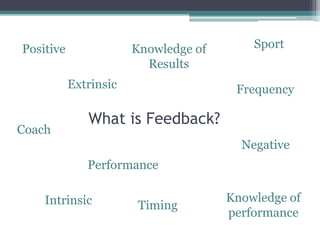
Positive               Knowledge of       Sport
                         Results
           Extrinsic                   Frequency

              What is Feedback?
Coach
                         d              Negative
              Performance

      Intrinsic                       Knowledge of
                        Timing
                                      performance
   d
What is Feedback?


   A process where the effect of an action is
    ‘fed back’ to enable modifications to be
            made to the next action


                                          (Weeks & Kordus, 1998)
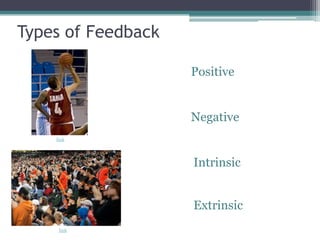
Types of Feedback

                    Positive


                    Negative
    link


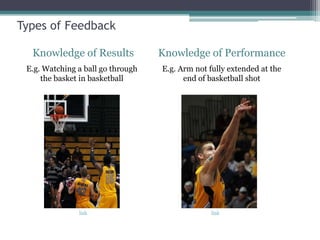
                    Intrinsic


                    Extrinsic
     link
Types of Feedback

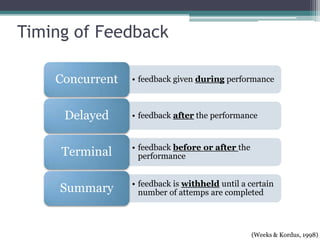
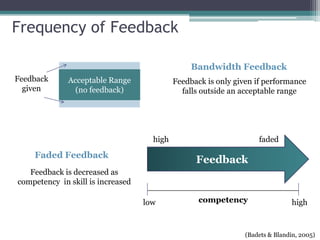
  Knowledge of Results             Knowledge of Performance
 E.g. Watching a ball go through   E.g. Arm not fully extended at the
     the basket in basketball            end of basketball shot


               link                              link
Timing of Feedback

    Concurrent   • feedback given during performance


     Delayed     • feedback after the performance


                 • feedback before or after the
     Terminal      performance


                 • feedback is withheld until a certain
     Summary       number of attemps are completed


                                                  (Weeks & Kordus, 1998)
Frequency of Feedback

                                                 Bandwidth Feedback
Feedback      Acceptable Range              Feedback is only given if performance
  given         (no feedback)                 falls outside an acceptable range


                                     high                           faded
    Faded Feedback
                                                  Feedback
   Feedback is decreased as
competency in skill is increased

                                   low             competency                   high


                                                                (Badets & Blandin, 2005)
What is the use of feedback?

                      Motivation
    • Positive feedback is a source of motivation
    • Provides a sense of capability
    • Helps achieve goals
    • Increases enjoyment and willingness to train
    • Poor feedback can cause demotivation

        Positive feedback = increased motivation
         Poor feedback= decreased motivation

                                            (Mouratidis et al., 2008)
What is the use of feedback?

                   Reinforcement
   Feedback reinforces the athlete to perform
               in a specific way

    • Positive reinforcement facilitates beneficial
    changes and consistency
    • Negative reinforcement removes an aspect but
    still improves performance


                                         (Schmidt & Wrisberg, 2008)
What is the use of feedback?

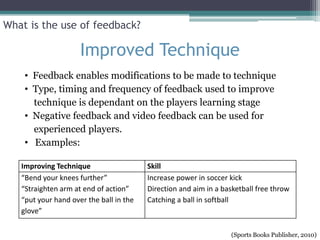
                     Improved Technique
    • Feedback enables modifications to be made to technique
    • Type, timing and frequency of feedback used to improve
      technique is dependant on the players learning stage
    • Negative feedback and video feedback can be used for
      experienced players.
    • Examples:

   Improving Technique                   Skill
   “Bend your knees further”             Increase power in soccer kick
   “Straighten arm at end of action”     Direction and aim in a basketball free throw
   “put your hand over the ball in the   Catching a ball in softball
   glove”

                                                                  (Sports Books Publisher, 2010)
Feedback in Teaching & Coaching
              What is good feedback?


                        clear
                      direct
                     limited
                                       (Schmidt & Wrisberg, 2008)
Feedback in Teaching & Coaching

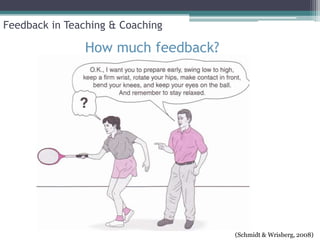
               How much feedback?


                                    (Schmidt & Wrisberg, 2008)
Feedback in Teaching & Coaching

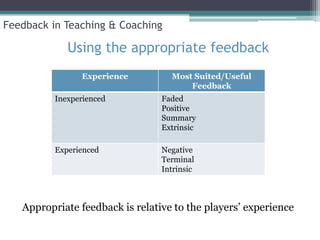
             Using the appropriate feedback
                Experience         Most Suited/Useful
                                       Feedback
          Inexperienced          Faded
                                 Positive
                                 Summary
                                 Extrinsic

          Experienced            Negative
                                 Terminal
                                 Intrinsic


   Appropriate feedback is relative to the players’ experience
Feedback in Teaching & Coaching

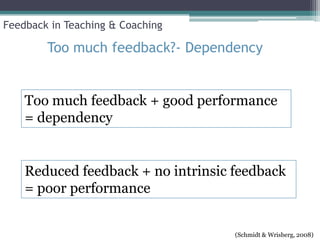
        Too much feedback?- Dependency


    Too much feedback + good performance
    = dependency


    Reduced feedback + no intrinsic feedback
    = poor performance


                                    (Schmidt & Wrisberg, 2008)
Feedback in Teaching & Coaching
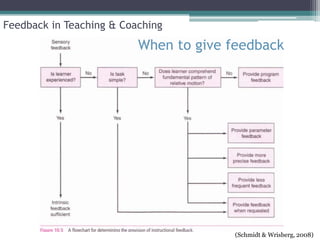
                          When to give feedback


                                       (Schmidt & Wrisberg, 2008)
Feedback in Teaching & Coaching

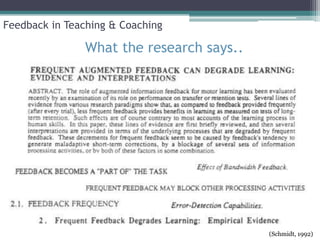
               What the research says..


                                          (Schmidt, 1992)
Conclusions
Conclusions

      Why is it important to study feedback?
    How to effectively use feedback to enhance
    performance
    -What types are effective for different learners
    - When and how to use feedback
    - Effect for coach and on players

    Issues with feedback
    -Degrade learning
    -Dependency

    What else could be studied about feedback?
Conclusions
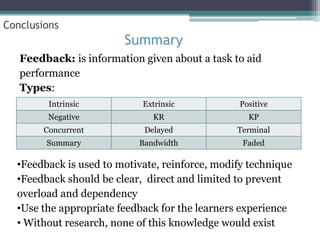
                        Summary
   Feedback: is information given about a task to aid
   performance
   Types:
         Intrinsic          Extrinsic           Positive
         Negative             KR                  KP
        Concurrent          Delayed             Terminal
        Summary            Bandwidth             Faded

  •Feedback is used to motivate, reinforce, modify technique
  •Feedback should be clear, direct and limited to prevent
  overload and dependency
  •Use the appropriate feedback for the learners experience
  • Without research, none of this knowledge would exist
References
Creative Common Images- (In order of slides)

http://www.flickr.com/photos/markop/893721540/
http://www.flickr.com/photos/nikoosphotos/7058859589/
http://www.flickr.com/photos/kysaant/8253209327/
http://www.flickr.com/photos/kysaant/8253210919/

Information Resources

Badets, A., & Blandin, Y. (2005). Observational learning: Effects of bandwidth knowledge of results. Journal of Motor Behaviour,
37(3), 211-216.

Mouratidis, A., Vansteenkiste, M., Lens, W., & Sideridis, G. (2008). The motivating role of positive feedback in sport and physical
education: Evidence for a motivational model. Journal of Sport & Exercise Psychology, 30(2), 240-268.

Nicaise, V., Cogerino, G., Bois, J., & Amorose, A. J. (2006). Students' perceptions of teacher feedback and physical competence in
physical education classes: Gender effects. Journal of Teaching in Physical Education, 25(1), 36-57.

Schmidt, R.A., (1992). Tutorials in motor neuroscience. In Stelmach & Requin (Ed.), Frequent Augmented Feedback Can Degrade
Learning: Evidence and Interpretations (pp. 59-75). Dordrecht: Kluwer Academic Publishers

Schmidt, R. A., & Wrisberg, C. A. (2008). Providing feedback during the learning experience. In Motor learning and performance:
A situation-based learning approach (4th ed., pp. 283-319). Champaign, IL: Human Kinetics.

Sports Books Publisher. (2010, October 25). Motor skills: Learning and acquisition processes- Chapter 18. [Video file]. Retrieved
from http://www.docstoc.com/docs/58352191/Motor-Skills-Learning-and-Acquisition-Processes

Weeks, D. L., & Kordus, R. N. (1998). Relative frequency of knowledge of performance and motor skill learning. Research
Quarterly for Exercise and Sport, 69(3), 224-230.

Feedback

  • 1.
    Feedback In the SportingEnvironment Ashlee Turner
  • 2.
    d Positive Knowledge of Sport Results Extrinsic Frequency What is Feedback? Coach d Negative Performance Intrinsic Knowledge of Timing performance d
  • 3.
    What is Feedback? A process where the effect of an action is ‘fed back’ to enable modifications to be made to the next action (Weeks & Kordus, 1998)
  • 4.
    Types of Feedback Positive Negative link Intrinsic Extrinsic link
  • 5.
    Types of Feedback Knowledge of Results Knowledge of Performance E.g. Watching a ball go through E.g. Arm not fully extended at the the basket in basketball end of basketball shot link link
  • 6.
    Timing of Feedback Concurrent • feedback given during performance Delayed • feedback after the performance • feedback before or after the Terminal performance • feedback is withheld until a certain Summary number of attemps are completed (Weeks & Kordus, 1998)
  • 7.
    Frequency of Feedback Bandwidth Feedback Feedback Acceptable Range Feedback is only given if performance given (no feedback) falls outside an acceptable range high faded Faded Feedback Feedback Feedback is decreased as competency in skill is increased low competency high (Badets & Blandin, 2005)
  • 8.
    What is theuse of feedback?
  • 9.
    What is theuse of feedback? Motivation • Positive feedback is a source of motivation • Provides a sense of capability • Helps achieve goals • Increases enjoyment and willingness to train • Poor feedback can cause demotivation Positive feedback = increased motivation Poor feedback= decreased motivation (Mouratidis et al., 2008)
  • 10.
    What is theuse of feedback? Reinforcement Feedback reinforces the athlete to perform in a specific way • Positive reinforcement facilitates beneficial changes and consistency • Negative reinforcement removes an aspect but still improves performance (Schmidt & Wrisberg, 2008)
  • 11.
    What is theuse of feedback? Improved Technique • Feedback enables modifications to be made to technique • Type, timing and frequency of feedback used to improve technique is dependant on the players learning stage • Negative feedback and video feedback can be used for experienced players. • Examples: Improving Technique Skill “Bend your knees further” Increase power in soccer kick “Straighten arm at end of action” Direction and aim in a basketball free throw “put your hand over the ball in the Catching a ball in softball glove” (Sports Books Publisher, 2010)
  • 12.
  • 13.
    Feedback in Teaching& Coaching What is good feedback? clear direct limited (Schmidt & Wrisberg, 2008)
  • 14.
    Feedback in Teaching& Coaching How much feedback? (Schmidt & Wrisberg, 2008)
  • 15.
    Feedback in Teaching& Coaching Using the appropriate feedback Experience Most Suited/Useful Feedback Inexperienced Faded Positive Summary Extrinsic Experienced Negative Terminal Intrinsic Appropriate feedback is relative to the players’ experience
  • 16.
    Feedback in Teaching& Coaching Too much feedback?- Dependency Too much feedback + good performance = dependency Reduced feedback + no intrinsic feedback = poor performance (Schmidt & Wrisberg, 2008)
  • 17.
    Feedback in Teaching& Coaching When to give feedback (Schmidt & Wrisberg, 2008)
  • 18.
    Feedback in Teaching& Coaching What the research says.. (Schmidt, 1992)
  • 19.
  • 20.
    Conclusions Why is it important to study feedback? How to effectively use feedback to enhance performance -What types are effective for different learners - When and how to use feedback - Effect for coach and on players Issues with feedback -Degrade learning -Dependency What else could be studied about feedback?
  • 21.
    Conclusions Summary Feedback: is information given about a task to aid performance Types: Intrinsic Extrinsic Positive Negative KR KP Concurrent Delayed Terminal Summary Bandwidth Faded •Feedback is used to motivate, reinforce, modify technique •Feedback should be clear, direct and limited to prevent overload and dependency •Use the appropriate feedback for the learners experience • Without research, none of this knowledge would exist
  • 22.
    References Creative Common Images-(In order of slides) http://www.flickr.com/photos/markop/893721540/ http://www.flickr.com/photos/nikoosphotos/7058859589/ http://www.flickr.com/photos/kysaant/8253209327/ http://www.flickr.com/photos/kysaant/8253210919/ Information Resources Badets, A., & Blandin, Y. (2005). Observational learning: Effects of bandwidth knowledge of results. Journal of Motor Behaviour, 37(3), 211-216. Mouratidis, A., Vansteenkiste, M., Lens, W., & Sideridis, G. (2008). The motivating role of positive feedback in sport and physical education: Evidence for a motivational model. Journal of Sport & Exercise Psychology, 30(2), 240-268. Nicaise, V., Cogerino, G., Bois, J., & Amorose, A. J. (2006). Students' perceptions of teacher feedback and physical competence in physical education classes: Gender effects. Journal of Teaching in Physical Education, 25(1), 36-57. Schmidt, R.A., (1992). Tutorials in motor neuroscience. In Stelmach & Requin (Ed.), Frequent Augmented Feedback Can Degrade Learning: Evidence and Interpretations (pp. 59-75). Dordrecht: Kluwer Academic Publishers Schmidt, R. A., & Wrisberg, C. A. (2008). Providing feedback during the learning experience. In Motor learning and performance: A situation-based learning approach (4th ed., pp. 283-319). Champaign, IL: Human Kinetics. Sports Books Publisher. (2010, October 25). Motor skills: Learning and acquisition processes- Chapter 18. [Video file]. Retrieved from http://www.docstoc.com/docs/58352191/Motor-Skills-Learning-and-Acquisition-Processes Weeks, D. L., & Kordus, R. N. (1998). Relative frequency of knowledge of performance and motor skill learning. Research Quarterly for Exercise and Sport, 69(3), 224-230.