CE453 Sanitary Engineering 
Laboratory 
(1.5-2:1) 
Description: This Lab course is intended to practice basic water quality analyses. Gravimetric, volumetric and 
spectrophotometeric analytical methods are used to determine quality parameters of raw water, finished water 
and wastewater. Parameters tested include alkalinity, hardness, salinity and solids, BOD and COD among others 
. 
Pre-requisite: Sanitary Engineering CE 451 
Student Assessment and Grading: Lab Reports (30%), Quizzes (5%), 1 Midterm Exam (25%), Final Exam 
(40%) 
Learning outcomes, delivery and assessment methods- Cross Reference Table: 
Student Learning Outcome Method of 
Delivery 
Assessment 
Methods 
Program objectives 
1. Basic orientation on safety measures in 
the sanitary engineering LAB 
Lecturing on 
theory and Lab 
Practice 
Report submission, 
quizzes and exams 
a, f, g, h, i, j 
2. Appreciation of QA/QC protocols in water 
quality LAB including the significance 
of reference samples and controls 
Lecturing on 
theory and Lab 
Practice 
Report submission, 
quizzes and exams 
a, f, g, h, i, j 
3. Solids determination and gravimetric 
analysis 
Lecturing on 
theory and Lab 
Practice 
Report submission, 
quizzes and exams 
a, b, d, f, g, h, i, j, and k 
4. Beer’s law and spectrophotometric 
analysis as applied to the determination 
of p-Nitro Phenol in waters 
Lecturing on 
theory and Lab 
Practice 
Report submission, 
quizzes and exams 
a, b, d, f, g, h, i, j, and k 
5. Titration skills and acid / base chemical 
analyses 
Lecturing on 
theory and Lab 
Practice 
Report submission, 
quizzes and exams 
a, b, d, f, g, h, i, j, and k 
6. Determination of water alkalinity 
Lecturing on 
theory and Lab 
Practice 
Report submission, 
quizzes and exams 
a, b, d, f, g, h, i, j, and k 
7. Determination of water hardness 
Lecturing on 
theory and Lab 
Practice 
Report submission, 
quizzes and exams 
a, b, d, f, g, h, i, j, and k 
8. Turbidity of surface waters, Jar Test and 
Modeling of the coagulation-flocculation 
process 
Lecturing on 
theory and Lab 
Practice 
Report submission, 
quizzes and exams 
a, b, d, f, g, h, i, j, and k 
9. Determination of EC, TDS, and Chlorine 
residual in drinking and irrigation 
waters 
Lecturing on 
theory and Lab 
Practice 
Report submission, 
quizzes and exams 
a, b, d, f, g, h, i, j, and k 
10. Determination of 5-day BOD in influent 
and effluent of wastewater treatment 
plants 
Lecturing on 
theory and Lab 
Practice 
Report submission, 
quizzes and exams 
a, b, d, f, g, h, i, j, and k 
11. Determination of COD in wastewater Lecturing on Report submission, a, b, d, f, g, h, i, j, and k
theory and Lab 
Practice 
quizzes and exams 
12. Application of membrane filter technique 
(MFT) to measure total and fecal 
coliforms in water 
Lecturing on 
theory and Lab 
Practice 
Report submission, 
quizzes and exams 
a, b, d, f, g, h, i, j, and k 
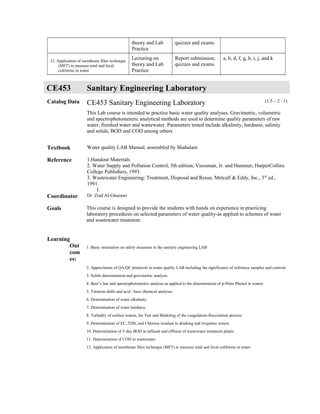
CE453 Sanitary Engineering Laboratory 
Catalog Data CE453 Sanitary Engineering Laboratory (1.5 – 2 : 1) 
This Lab course is intended to practice basic water quality analyses. Gravimetric, volumetric 
and spectrophotometeric analytical methods are used to determine quality parameters of raw 
water, finished water and wastewater. Parameters tested include alkalinity, hardness, salinity 
and solids, BOD and COD among others 
Textbook Water quality LAB Manual, assembled by Shahalam 
Reference 1.Handout Materials 
2. Water Supply and Pollution Control, 5th edition, Viessman, Jr. and Hammer, HarperCollins 
College Publishers, 1993. 
3. Wastewater Engineering: Treatment, Disposal and Reuse, Metcalf & Eddy, Inc., 3rd ed., 
1991. 
1. 
Coordinator Dr. Ziad Al-Ghazawi 
Goals This course is designed to provide the students with hands on experience in practicing 
laboratory procedures on selected parameters of water quality-as applied to schemes of water 
and wastewater treatment. 
Learning 
Out 
com 
es: 
1. Basic orientation on safety measures in the sanitary engineering LAB 
2. Appreciation of QA/QC protocols in water quality LAB including the significance of reference samples and controls 
3. Solids determination and gravimetric analysis 
4. Beer’s law and spectrophotometric analysis as applied to the determination of p-Nitro Phenol in waters 
5. Titration skills and acid / base chemical analyses 
6. Determination of water alkalinity 
7. Determination of water hardness 
8. Turbidity of surface waters, Jar Test and Modeling of the coagulation-flocculation process 
9. Determination of EC, TDS, and Chlorine residual in drinking and irrigation waters 
10. Determination of 5-day BOD in influent and effluent of wastewater treatment plants 
11. Determination of COD in wastewater 
12. Application of membrane filter technique (MFT) to measure total and fecal coliforms in water
Pre-Requisites Contents of the CE 451 Sanitary Engineering 
course 
by Topic 
Topics 1. Basic orientation on safety measures in the sanitary engineering LAB 2 Lecture and Lab Session 
2. Appreciation of QA/QC protocols in water quality LAB including the 
significance of reference samples and controls 
1 Lecture and Lab Session 
3. Solids determination and gravimetric analysis 1 Lecture and Lab Session 
4. Beer’s law and spectrophotometric analysis as applied to the determination 
of p-Nitro Phenol in waters 
1 Lecture and Lab Session 
5. Titration skills and acid / base chemical analyses 1 Lecture and Lab Session 
6. Determination of water alkalinity 1 Lecture and Lab Session 
7. Determination of water hardness 1 Lecture and Lab Session 
8. Turbidity of surface waters, Jar Test and Modeling of the coagulation-flocculation 
process 
1 Lecture and Lab Session 
9. Determination of EC, TDS, and Chlorine residual in drinking and 
irrigation waters 
1 Lecture and Lab Session 
10. Determination of 5-day BOD in influent and effluent of wastewater 
treatment plants 
1 Lecture and Lab Session 
11. Determination of COD in wastewater 1 Lecture and Lab Session 
12. Application of membrane filter technique (MFT) to measure total and 
fecal coliforms in water 
1 Lecture and Lab Session 
Computer 
Usa 
ge 
Spread Sheet programming is used to calculate chemical and biochemical kinetics 
Assessment 
and 
Gra 
ding 
Reports.……………. 30% 
Quizzes…..………… 5% 
1 MT exam ………… ………… 25% 
Final Exam ……………………. 40% 
Estimated 
Content 
Engineering Science 0.5 Credit 
Engineering Lab 1.0 Credit 
Prepared by Dr. Ziad Al-Ghazawi Date: March 2007

Ce453 (2)cdscdscsdcds

  • 1.
    CE453 Sanitary Engineering Laboratory (1.5-2:1) Description: This Lab course is intended to practice basic water quality analyses. Gravimetric, volumetric and spectrophotometeric analytical methods are used to determine quality parameters of raw water, finished water and wastewater. Parameters tested include alkalinity, hardness, salinity and solids, BOD and COD among others . Pre-requisite: Sanitary Engineering CE 451 Student Assessment and Grading: Lab Reports (30%), Quizzes (5%), 1 Midterm Exam (25%), Final Exam (40%) Learning outcomes, delivery and assessment methods- Cross Reference Table: Student Learning Outcome Method of Delivery Assessment Methods Program objectives 1. Basic orientation on safety measures in the sanitary engineering LAB Lecturing on theory and Lab Practice Report submission, quizzes and exams a, f, g, h, i, j 2. Appreciation of QA/QC protocols in water quality LAB including the significance of reference samples and controls Lecturing on theory and Lab Practice Report submission, quizzes and exams a, f, g, h, i, j 3. Solids determination and gravimetric analysis Lecturing on theory and Lab Practice Report submission, quizzes and exams a, b, d, f, g, h, i, j, and k 4. Beer’s law and spectrophotometric analysis as applied to the determination of p-Nitro Phenol in waters Lecturing on theory and Lab Practice Report submission, quizzes and exams a, b, d, f, g, h, i, j, and k 5. Titration skills and acid / base chemical analyses Lecturing on theory and Lab Practice Report submission, quizzes and exams a, b, d, f, g, h, i, j, and k 6. Determination of water alkalinity Lecturing on theory and Lab Practice Report submission, quizzes and exams a, b, d, f, g, h, i, j, and k 7. Determination of water hardness Lecturing on theory and Lab Practice Report submission, quizzes and exams a, b, d, f, g, h, i, j, and k 8. Turbidity of surface waters, Jar Test and Modeling of the coagulation-flocculation process Lecturing on theory and Lab Practice Report submission, quizzes and exams a, b, d, f, g, h, i, j, and k 9. Determination of EC, TDS, and Chlorine residual in drinking and irrigation waters Lecturing on theory and Lab Practice Report submission, quizzes and exams a, b, d, f, g, h, i, j, and k 10. Determination of 5-day BOD in influent and effluent of wastewater treatment plants Lecturing on theory and Lab Practice Report submission, quizzes and exams a, b, d, f, g, h, i, j, and k 11. Determination of COD in wastewater Lecturing on Report submission, a, b, d, f, g, h, i, j, and k
  • 2.
    theory and Lab Practice quizzes and exams 12. Application of membrane filter technique (MFT) to measure total and fecal coliforms in water Lecturing on theory and Lab Practice Report submission, quizzes and exams a, b, d, f, g, h, i, j, and k CE453 Sanitary Engineering Laboratory Catalog Data CE453 Sanitary Engineering Laboratory (1.5 – 2 : 1) This Lab course is intended to practice basic water quality analyses. Gravimetric, volumetric and spectrophotometeric analytical methods are used to determine quality parameters of raw water, finished water and wastewater. Parameters tested include alkalinity, hardness, salinity and solids, BOD and COD among others Textbook Water quality LAB Manual, assembled by Shahalam Reference 1.Handout Materials 2. Water Supply and Pollution Control, 5th edition, Viessman, Jr. and Hammer, HarperCollins College Publishers, 1993. 3. Wastewater Engineering: Treatment, Disposal and Reuse, Metcalf & Eddy, Inc., 3rd ed., 1991. 1. Coordinator Dr. Ziad Al-Ghazawi Goals This course is designed to provide the students with hands on experience in practicing laboratory procedures on selected parameters of water quality-as applied to schemes of water and wastewater treatment. Learning Out com es: 1. Basic orientation on safety measures in the sanitary engineering LAB 2. Appreciation of QA/QC protocols in water quality LAB including the significance of reference samples and controls 3. Solids determination and gravimetric analysis 4. Beer’s law and spectrophotometric analysis as applied to the determination of p-Nitro Phenol in waters 5. Titration skills and acid / base chemical analyses 6. Determination of water alkalinity 7. Determination of water hardness 8. Turbidity of surface waters, Jar Test and Modeling of the coagulation-flocculation process 9. Determination of EC, TDS, and Chlorine residual in drinking and irrigation waters 10. Determination of 5-day BOD in influent and effluent of wastewater treatment plants 11. Determination of COD in wastewater 12. Application of membrane filter technique (MFT) to measure total and fecal coliforms in water
  • 3.
    Pre-Requisites Contents ofthe CE 451 Sanitary Engineering course by Topic Topics 1. Basic orientation on safety measures in the sanitary engineering LAB 2 Lecture and Lab Session 2. Appreciation of QA/QC protocols in water quality LAB including the significance of reference samples and controls 1 Lecture and Lab Session 3. Solids determination and gravimetric analysis 1 Lecture and Lab Session 4. Beer’s law and spectrophotometric analysis as applied to the determination of p-Nitro Phenol in waters 1 Lecture and Lab Session 5. Titration skills and acid / base chemical analyses 1 Lecture and Lab Session 6. Determination of water alkalinity 1 Lecture and Lab Session 7. Determination of water hardness 1 Lecture and Lab Session 8. Turbidity of surface waters, Jar Test and Modeling of the coagulation-flocculation process 1 Lecture and Lab Session 9. Determination of EC, TDS, and Chlorine residual in drinking and irrigation waters 1 Lecture and Lab Session 10. Determination of 5-day BOD in influent and effluent of wastewater treatment plants 1 Lecture and Lab Session 11. Determination of COD in wastewater 1 Lecture and Lab Session 12. Application of membrane filter technique (MFT) to measure total and fecal coliforms in water 1 Lecture and Lab Session Computer Usa ge Spread Sheet programming is used to calculate chemical and biochemical kinetics Assessment and Gra ding Reports.……………. 30% Quizzes…..………… 5% 1 MT exam ………… ………… 25% Final Exam ……………………. 40% Estimated Content Engineering Science 0.5 Credit Engineering Lab 1.0 Credit Prepared by Dr. Ziad Al-Ghazawi Date: March 2007