Page 1 of 2 
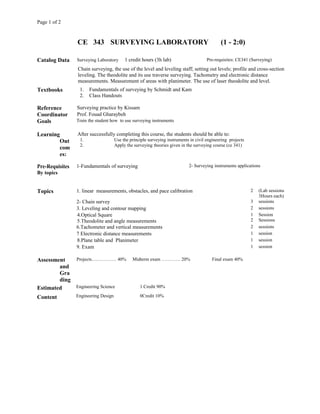
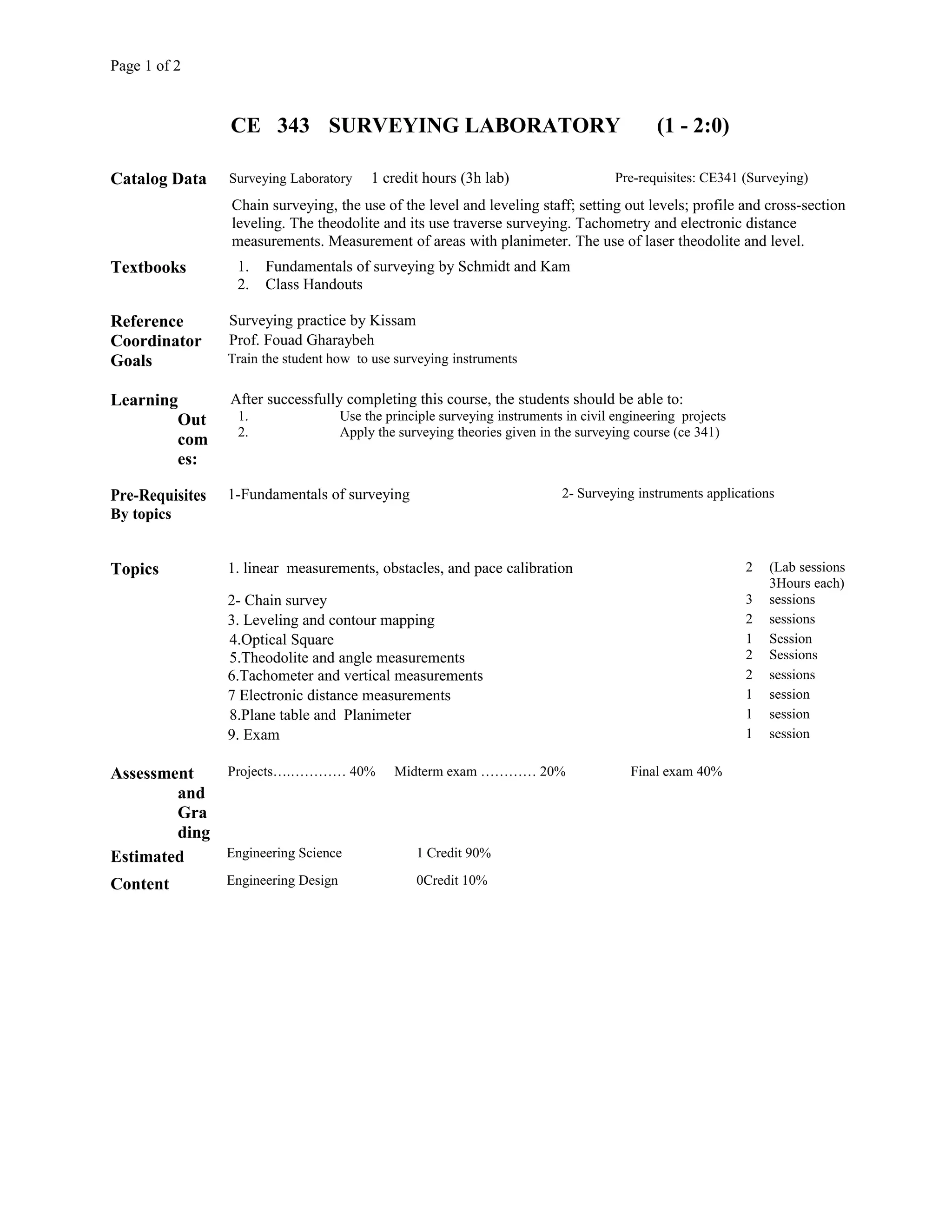
CE 343 SURVEYING LABORATORY (1 - 2:0) 
Catalog Data Surveying Laboratory 1 credit hours (3h lab) Pre-requisites: CE341 (Surveying) 
Chain surveying, the use of the level and leveling staff; setting out levels; profile and cross-section 
leveling. The theodolite and its use traverse surveying. Tachometry and electronic distance 
measurements. Measurement of areas with planimeter. The use of laser theodolite and level. 
Textbooks 1. Fundamentals of surveying by Schmidt and Kam 
2. Class Handouts 
Reference Surveying practice by Kissam 
Coordinator Prof. Fouad Gharaybeh 
Goals Train the student how to use surveying instruments 
Learning 
Out 
com 
es: 
After successfully completing this course, the students should be able to: 
1. Use the principle surveying instruments in civil engineering projects 
2. Apply the surveying theories given in the surveying course (ce 341) 
Pre-Requisites 
By topics 
1-Fundamentals of surveying 2- Surveying instruments applications 
Topics 1. linear measurements, obstacles, and pace calibration 2 (Lab sessions 
3Hours each) 
2- Chain survey 3 sessions 
3. Leveling and contour mapping 2 sessions 
4.Optical Square 
5.Theodolite and angle measurements 
12 
Session 
Sessions 
6.Tachometer and vertical measurements 2 sessions 
7 Electronic distance measurements 1 session 
8.Plane table and Planimeter 1 session 
9. Exam 1 session 
Assessment 
and 
Gra 
ding 
Projects….………… 40% Midterm exam ………… 20% Final exam 40% 
Estimated 
Content 
Engineering Science 1 Credit 90% 
Engineering Design 0Credit 10%
Page 2 of 2 
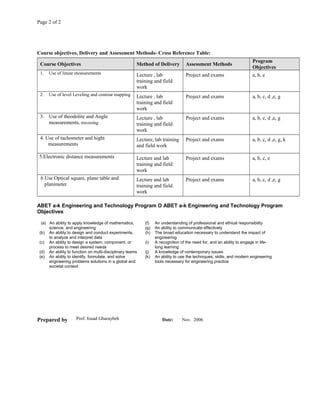
Course objectives, Delivery and Assessment Methods- Cross Reference Table: 
Course Objectives Method of Delivery Assessment Methods Program 
Objectives 
1. Use of linear measurements Lecture , lab 
training and field 
work 
Project and exams a, b, e 
2. Use of level Leveling and contour mapping Lecture , lab 
training and field 
work 
Project and exams a, b, c, d ,e, g 
3. Use of theodolite and Angle 
measurements, travesing 
Lecture , lab 
training and field 
work 
Project and exams a, b, c, d ,e, g 
4. Use of tachometer and hight 
measurements 
Lecture, lab training 
and field work 
Project and exams a, b, c, d ,e, g, k 
5.Electronic distance measurements Lecture and lab 
training and field 
work 
Project and exams a, b, c, e 
6 Use Optical square, plane table and 
planimeter 
Lecture and lab 
training and field 
work 
Project and exams a, b, c, d ,e, g 
ABET a-k Engineering and Technology Program O ABET a-k Engineering and Technology Program 
Objectives 
(a) An ability to apply knowledge of mathematics, 
science, and engineering 
(b) An ability to design and conduct experiments, 
to analyze and interpret data 
(c) An ability to design a system, component, or 
process to meet desired needs 
(d) An ability to function on multi-disciplinary teams 
(e) An ability to identify, formulate, and solve 
engineering problems solutions in a global and 
societal context 
(f) An understanding of professional and ethical responsibility 
(g) An ability to communicate effectively 
(h) The broad education necessary to understand the impact of 
engineering 
(i) A recognition of the need for, and an ability to engage in life-long 
learning 
(j) A knowledge of contemporary issues 
(k) An ability to use the techniques, skills, and modern engineering 
tools necessary for engineering practice 
Prepared by Prof. fouad Gharaybeh Date: Nov. 2006

Ce343scsdcdsc

  • 1.
    Page 1 of2 CE 343 SURVEYING LABORATORY (1 - 2:0) Catalog Data Surveying Laboratory 1 credit hours (3h lab) Pre-requisites: CE341 (Surveying) Chain surveying, the use of the level and leveling staff; setting out levels; profile and cross-section leveling. The theodolite and its use traverse surveying. Tachometry and electronic distance measurements. Measurement of areas with planimeter. The use of laser theodolite and level. Textbooks 1. Fundamentals of surveying by Schmidt and Kam 2. Class Handouts Reference Surveying practice by Kissam Coordinator Prof. Fouad Gharaybeh Goals Train the student how to use surveying instruments Learning Out com es: After successfully completing this course, the students should be able to: 1. Use the principle surveying instruments in civil engineering projects 2. Apply the surveying theories given in the surveying course (ce 341) Pre-Requisites By topics 1-Fundamentals of surveying 2- Surveying instruments applications Topics 1. linear measurements, obstacles, and pace calibration 2 (Lab sessions 3Hours each) 2- Chain survey 3 sessions 3. Leveling and contour mapping 2 sessions 4.Optical Square 5.Theodolite and angle measurements 12 Session Sessions 6.Tachometer and vertical measurements 2 sessions 7 Electronic distance measurements 1 session 8.Plane table and Planimeter 1 session 9. Exam 1 session Assessment and Gra ding Projects….………… 40% Midterm exam ………… 20% Final exam 40% Estimated Content Engineering Science 1 Credit 90% Engineering Design 0Credit 10%
  • 2.
    Page 2 of2 Course objectives, Delivery and Assessment Methods- Cross Reference Table: Course Objectives Method of Delivery Assessment Methods Program Objectives 1. Use of linear measurements Lecture , lab training and field work Project and exams a, b, e 2. Use of level Leveling and contour mapping Lecture , lab training and field work Project and exams a, b, c, d ,e, g 3. Use of theodolite and Angle measurements, travesing Lecture , lab training and field work Project and exams a, b, c, d ,e, g 4. Use of tachometer and hight measurements Lecture, lab training and field work Project and exams a, b, c, d ,e, g, k 5.Electronic distance measurements Lecture and lab training and field work Project and exams a, b, c, e 6 Use Optical square, plane table and planimeter Lecture and lab training and field work Project and exams a, b, c, d ,e, g ABET a-k Engineering and Technology Program O ABET a-k Engineering and Technology Program Objectives (a) An ability to apply knowledge of mathematics, science, and engineering (b) An ability to design and conduct experiments, to analyze and interpret data (c) An ability to design a system, component, or process to meet desired needs (d) An ability to function on multi-disciplinary teams (e) An ability to identify, formulate, and solve engineering problems solutions in a global and societal context (f) An understanding of professional and ethical responsibility (g) An ability to communicate effectively (h) The broad education necessary to understand the impact of engineering (i) A recognition of the need for, and an ability to engage in life-long learning (j) A knowledge of contemporary issues (k) An ability to use the techniques, skills, and modern engineering tools necessary for engineering practice Prepared by Prof. fouad Gharaybeh Date: Nov. 2006