DEFINITIONS
• Overload Principle- Placing a load on a
body system that is greater than what it
is used to causing overcompensation
• Body System- A group of organs or
tissues that have a common function.
(Skeletal, muscular, immune, nervous,
etc.)
Aerobic and Anaerobic
• Aerobic: long in duration and
moderate in intensity
• Anaerobic: short in duration and
high in intensity
• What are some examples of each
kind of activity?
UTILIZING THE
OVERLOAD PRINCIPLE
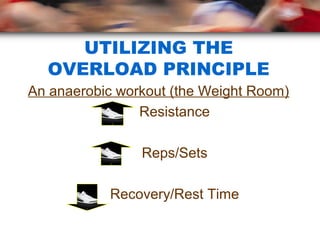
An anaerobic workout (the Weight Room)
Resistance
Reps/Sets
Recovery/Rest Time
UTILIZING THE
OVERLOAD PRINCIPLE
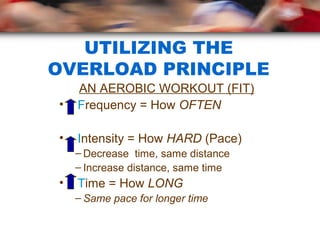
AN AEROBIC WORKOUT (FIT)
• Frequency = How OFTEN
• Intensity = How HARD (Pace)
– Decrease time, same distance
– Increase distance, same time
• Time = How LONG
– Same pace for longer time
THE OVERLOAD
PRINCIPLE
USE IT OR LOSE IT
ATROPHY- Decrease in muscle mass/size
HYPERTROPHY- Increase in muscle
mass/size
5 COMPONENTS OF
PHYSICAL FITNESS
• CARDIOVASCULAR FITNESS - how
well the heart and lungs work over an
extended period of time
• MUSCULAR STRENGTH - the force a
muscle can exert
• FLEXIBILITY - the ability to take a joint
through a full range of motion
5 COMPONENTS OF
PHYSICAL FITNESS
• MUSCLE ENDURANCE - the ability to
produce force over an extended period
of time
• BODY COMPOSITION - the ratio of
lean body mass/body fat
Which is most critical to health?

Overload principle

  • 1.
    DEFINITIONS • Overload Principle-Placing a load on a body system that is greater than what it is used to causing overcompensation • Body System- A group of organs or tissues that have a common function. (Skeletal, muscular, immune, nervous, etc.)
  • 2.
    Aerobic and Anaerobic •Aerobic: long in duration and moderate in intensity • Anaerobic: short in duration and high in intensity • What are some examples of each kind of activity?
  • 3.
    UTILIZING THE OVERLOAD PRINCIPLE Ananaerobic workout (the Weight Room) Resistance Reps/Sets Recovery/Rest Time
  • 4.
    UTILIZING THE OVERLOAD PRINCIPLE ANAEROBIC WORKOUT (FIT) • Frequency = How OFTEN • Intensity = How HARD (Pace) – Decrease time, same distance – Increase distance, same time • Time = How LONG – Same pace for longer time
  • 5.
    THE OVERLOAD PRINCIPLE USE ITOR LOSE IT ATROPHY- Decrease in muscle mass/size HYPERTROPHY- Increase in muscle mass/size
  • 6.
    5 COMPONENTS OF PHYSICALFITNESS • CARDIOVASCULAR FITNESS - how well the heart and lungs work over an extended period of time • MUSCULAR STRENGTH - the force a muscle can exert • FLEXIBILITY - the ability to take a joint through a full range of motion
  • 7.
    5 COMPONENTS OF PHYSICALFITNESS • MUSCLE ENDURANCE - the ability to produce force over an extended period of time • BODY COMPOSITION - the ratio of lean body mass/body fat Which is most critical to health?