Turner Construction Company
Arrigo Gaetano
Rinaldi Alessandro
Organizational Design
Turner Construction Company
In 1983, turner led building contractors in the value of
contracts booked
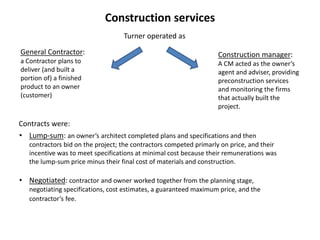
Construction services
Turner operated as
General Contractor:
a Contractor plans to
deliver (and built a
portion of) a finished
product to an owner
(customer)
Construction manager:
A CM acted as the owner’s
agent and adviser, providing
preconstruction services
and monitoring the firms
that actually built the
project.
Contracts were:
• Lump-sum: an owner’s architect completed plans and specifications and then
contractors bid on the project; the contractors competed primarly on price, and their
incentive was to meet specifications at minimal cost because their remunerations was
the lump-sum price minus their final cost of materials and construction.
• Negotiated: contractor and owner worked together from the planning stage,
negotiating specifications, cost estimates, a guaranteed maximum price, and the
contractor’s fee.
Construction services
Turner perfomed most of its work through negotiated fee contracts where it
acted as both General Contractor and Construction Manager
• Planned and scheduled the project;
• Procured materials;
• Marshaled the different personnel required;
• Awared and supervised subcontracts;
• Assumed responsability for on-time completion at a guaranteed
maximum price;
‘’Our business is a combination of consulting and underwriting: we buy risk and sell
predictability’’
‘’ We manage all the project’s details for the owner and, because we’re involved early,
we can guarantee a price earlier than the lump-sum bidder. Thus, the owner can
begin arranging financing earlier and construction (and occupancy) can begin sooner.
TIME IS MONEY IN CONSTRUCTION’’
Turner’s senior
vice president
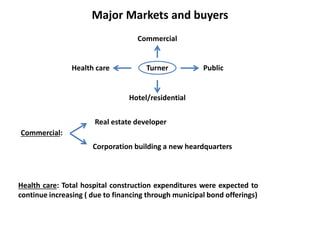
Major Markets and buyers
Commercial
Turner Public
Hotel/residential
Health care
Commercial:
Real estate developer
Corporation building a new heardquarters
Health care: Total hospital construction expenditures were expected to
continue increasing ( due to financing through municipal bond offerings)
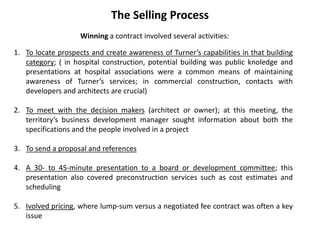
The Selling Process
Winning a contract involved several activities:
1. To locate prospects and create awareness of Turner’s capabilities in that building
category; ( in hospital construction, potential building was public knoledge and
presentations at hospital associations were a common means of maintaining
awareness of Turner’s services; in commercial construction, contacts with
developers and architects are crucial)
2. To meet with the decision makers (architect or owner); at this meeting, the
territory’s business development manager sought information about both the
specifications and the people involved in a project
3. To send a proposal and references
4. A 30- to 45-minute presentation to a board or development committee; this
presentation also covered preconstruction services such as cost estimates and
scheduling
5. Ivolved pricing, where lump-sum versus a negotiated fee contract was often a key
issue
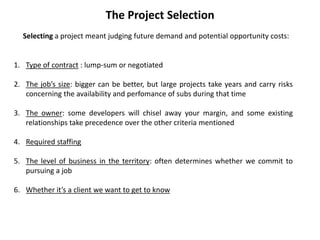
The Project Selection
Selecting a project meant judging future demand and potential opportunity costs:
1. Type of contract : lump-sum or negotiated
2. The job’s size: bigger can be better, but large projects take years and carry risks
concerning the availability and perfomance of subs during that time
3. The owner: some developers will chisel away your margin, and some existing
relationships take precedence over the other criteria mentioned
4. Required staffing
5. The level of business in the territory: often determines whether we commit to
pursuing a job
6. Whether it’s a client we want to get to know
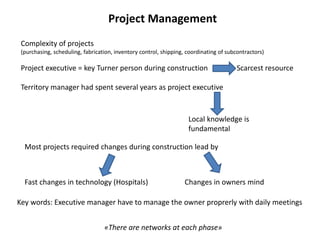
Project Management
Complexity of projects
(purchasing, scheduling, fabrication, inventory control, shipping, coordinating of subcontractors)
Project executive = key Turner person during construction Scarcest resource
Territory manager had spent several years as project executive
Local knowledge is
fundamental
Most projects required changes during construction lead by
Fast changes in technology (Hospitals) Changes in owners mind
Key words: Executive manager have to manage the owner proprerly with daily meetings
«There are networks at each phase»
Organization
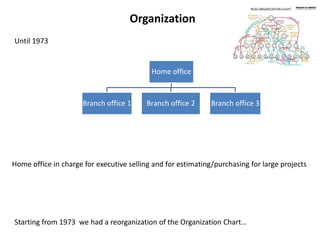
Until 1973
Home office
Branch office 1 Branch office 2 Branch office 3
Home office in charge for executive selling and for estimating/purchasing for large projects
Starting from 1973 we had a reorganization of the Organization Chart…
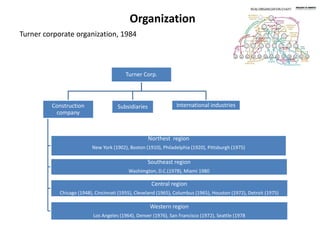
Turner Corp.
Construction
company
Northest region
New York (1902), Boston (1910), Philadelphia (1920), Pittsburgh (1975)
Southeast region
Washimgton, D.C.(1978), Miami 1980
Central region
Chicago (1948), Cincinnati (1955), Cleveland (1965), Columbus (1965), Houston (1972), Detroit (1975)
Western region
Los Angeles (1964), Denver (1976), San Francisco (1972), Seattle (1978
Subsidiaries International industries
Organization
Turner corporate organization, 1984
Organization
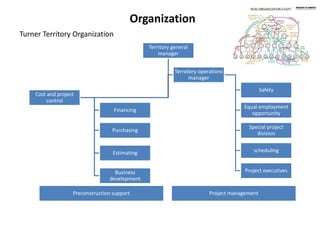
Cost and project
control
Terrotory operations
manager
Safety
Equal employment
opportunity
Special project
division
scheduling
Project executives
Financing
Purchasing
Estimating
Business
development
Territory general
manager
Project managementPreconstruction support
Turner Territory Organization
Organization
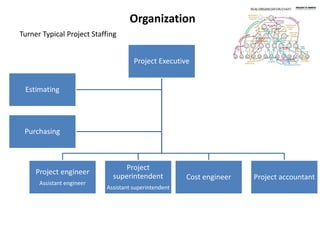
Turner Typical Project Staffing
Project Executive
Project engineer
Assistant engineer
Project
superintendent
Assistant superintendent
Project accountantCost engineer
Estimating
Purchasing
Organization
Organization
Territory GMs had been with Turner for 20 to 25 years with experience in estimating,
purchasing and project management
GMs reported to regional VPs who reported to Kupfer
GMs and VPs were measured on annual sales and earning goals
Recent developments
Kupfer became executive VP in May 1983, previously he held the position of
International Industries’ president and senior VP for eastern region.
He was responsible for corporate marketing and sale, contract administration, and
strategic planning
Two long-term development setted by him:
 Product specialization
 National accounts
Product specialization
Hospital market:
Turner had lost share in recent years to a new company (Park).
Park is considered a «hospital construction specialist», it operate from corporate offices
Ability to bring national resources to a hospital project
«The core of precostruction service’s Parks is software that provides a fancy checklist of
cost and design estimates»
Park’s presentations are very professional
Product specialization
Similar competition in correctional and high-tech industrial market
In response to this competition Turner established in 1983 a «Management Consulting
Service, M.C.S.» to standardize service among territories
Some GMs welcomed these groups, wile others considered their involment redundant.
What do you thing about this new function at the corporate level of Turner?
National accounts
Various factors had increased the national scope of construction work
Nationwide expansion of large regional developers and major architectural firms
National insurance companies beginning to assume development as well as financing
tasks in JV with developers
Large retailers and manufacturers had expanded into national companies.
IN 1978, Turner estabilished a National Account Program (N.A.P.)
Objectives: develop a network for early detection of new business opportunities
In 1984, corporate management was disappointed with this program
National firms are not pursued aggressively or proactively
In your mind, why the N.A.P. is not working well?
National accounts
Recommendations concerning N.A.P.
•Granting a territory some percentage of the operating fee if it performed “work of
substance” in generating a project for another territory
•Placing one or two senior managers as full-time NAP rappresentative at the
corporate level
•Developing Turner’s product-specific capabilities beyond the MCS stage by
establishing national groups for hospitals and correctional facilities.
Today’s Decisions
Commercial building project in territory A
Turner had not previously worked with this owner but it had worked with DA
(Design Associates) for 30 years.
All key staff available in territory…
(not really it the three previous proposal were successful)
Project’s starting date suggested a tight schedule
Hospital Facility Group
Turner had not built an hospital in territory A in the last decade and had not worked
with HFG
Kupfer believed the hospital market would be increasingly important and that the
commercial-building market, while currently strong, was vulnerable to overcapacity
in the near future.
Today’s Decisions
Call from business development manager of Territory B
He reported a possible contract of renovation ($50 million) for Goodnight Hotels
national chain
A senior VP of Goodnight Hotels request a uniform standard of service and fees
through the United States
Turner construction

Turner construction

  • 1.
    Turner Construction Company ArrigoGaetano Rinaldi Alessandro Organizational Design
  • 2.
    Turner Construction Company In1983, turner led building contractors in the value of contracts booked
  • 3.
    Construction services Turner operatedas General Contractor: a Contractor plans to deliver (and built a portion of) a finished product to an owner (customer) Construction manager: A CM acted as the owner’s agent and adviser, providing preconstruction services and monitoring the firms that actually built the project. Contracts were: • Lump-sum: an owner’s architect completed plans and specifications and then contractors bid on the project; the contractors competed primarly on price, and their incentive was to meet specifications at minimal cost because their remunerations was the lump-sum price minus their final cost of materials and construction. • Negotiated: contractor and owner worked together from the planning stage, negotiating specifications, cost estimates, a guaranteed maximum price, and the contractor’s fee.
  • 4.
    Construction services Turner perfomedmost of its work through negotiated fee contracts where it acted as both General Contractor and Construction Manager • Planned and scheduled the project; • Procured materials; • Marshaled the different personnel required; • Awared and supervised subcontracts; • Assumed responsability for on-time completion at a guaranteed maximum price; ‘’Our business is a combination of consulting and underwriting: we buy risk and sell predictability’’ ‘’ We manage all the project’s details for the owner and, because we’re involved early, we can guarantee a price earlier than the lump-sum bidder. Thus, the owner can begin arranging financing earlier and construction (and occupancy) can begin sooner. TIME IS MONEY IN CONSTRUCTION’’ Turner’s senior vice president
  • 5.
    Major Markets andbuyers Commercial Turner Public Hotel/residential Health care Commercial: Real estate developer Corporation building a new heardquarters Health care: Total hospital construction expenditures were expected to continue increasing ( due to financing through municipal bond offerings)
  • 6.
    The Selling Process Winninga contract involved several activities: 1. To locate prospects and create awareness of Turner’s capabilities in that building category; ( in hospital construction, potential building was public knoledge and presentations at hospital associations were a common means of maintaining awareness of Turner’s services; in commercial construction, contacts with developers and architects are crucial) 2. To meet with the decision makers (architect or owner); at this meeting, the territory’s business development manager sought information about both the specifications and the people involved in a project 3. To send a proposal and references 4. A 30- to 45-minute presentation to a board or development committee; this presentation also covered preconstruction services such as cost estimates and scheduling 5. Ivolved pricing, where lump-sum versus a negotiated fee contract was often a key issue
  • 7.
    The Project Selection Selectinga project meant judging future demand and potential opportunity costs: 1. Type of contract : lump-sum or negotiated 2. The job’s size: bigger can be better, but large projects take years and carry risks concerning the availability and perfomance of subs during that time 3. The owner: some developers will chisel away your margin, and some existing relationships take precedence over the other criteria mentioned 4. Required staffing 5. The level of business in the territory: often determines whether we commit to pursuing a job 6. Whether it’s a client we want to get to know
  • 8.
    Project Management Complexity ofprojects (purchasing, scheduling, fabrication, inventory control, shipping, coordinating of subcontractors) Project executive = key Turner person during construction Scarcest resource Territory manager had spent several years as project executive Local knowledge is fundamental Most projects required changes during construction lead by Fast changes in technology (Hospitals) Changes in owners mind Key words: Executive manager have to manage the owner proprerly with daily meetings «There are networks at each phase»
  • 9.
    Organization Until 1973 Home office Branchoffice 1 Branch office 2 Branch office 3 Home office in charge for executive selling and for estimating/purchasing for large projects Starting from 1973 we had a reorganization of the Organization Chart…
  • 10.
    Turner Corp. Construction company Northest region NewYork (1902), Boston (1910), Philadelphia (1920), Pittsburgh (1975) Southeast region Washimgton, D.C.(1978), Miami 1980 Central region Chicago (1948), Cincinnati (1955), Cleveland (1965), Columbus (1965), Houston (1972), Detroit (1975) Western region Los Angeles (1964), Denver (1976), San Francisco (1972), Seattle (1978 Subsidiaries International industries Organization Turner corporate organization, 1984
  • 11.
    Organization Cost and project control Terrotoryoperations manager Safety Equal employment opportunity Special project division scheduling Project executives Financing Purchasing Estimating Business development Territory general manager Project managementPreconstruction support Turner Territory Organization
  • 12.
    Organization Turner Typical ProjectStaffing Project Executive Project engineer Assistant engineer Project superintendent Assistant superintendent Project accountantCost engineer Estimating Purchasing
  • 13.
  • 14.
    Organization Territory GMs hadbeen with Turner for 20 to 25 years with experience in estimating, purchasing and project management GMs reported to regional VPs who reported to Kupfer GMs and VPs were measured on annual sales and earning goals
  • 15.
    Recent developments Kupfer becameexecutive VP in May 1983, previously he held the position of International Industries’ president and senior VP for eastern region. He was responsible for corporate marketing and sale, contract administration, and strategic planning Two long-term development setted by him:  Product specialization  National accounts
  • 16.
    Product specialization Hospital market: Turnerhad lost share in recent years to a new company (Park). Park is considered a «hospital construction specialist», it operate from corporate offices Ability to bring national resources to a hospital project «The core of precostruction service’s Parks is software that provides a fancy checklist of cost and design estimates» Park’s presentations are very professional
  • 17.
    Product specialization Similar competitionin correctional and high-tech industrial market In response to this competition Turner established in 1983 a «Management Consulting Service, M.C.S.» to standardize service among territories Some GMs welcomed these groups, wile others considered their involment redundant. What do you thing about this new function at the corporate level of Turner?
  • 18.
    National accounts Various factorshad increased the national scope of construction work Nationwide expansion of large regional developers and major architectural firms National insurance companies beginning to assume development as well as financing tasks in JV with developers Large retailers and manufacturers had expanded into national companies. IN 1978, Turner estabilished a National Account Program (N.A.P.) Objectives: develop a network for early detection of new business opportunities In 1984, corporate management was disappointed with this program National firms are not pursued aggressively or proactively In your mind, why the N.A.P. is not working well?
  • 19.
    National accounts Recommendations concerningN.A.P. •Granting a territory some percentage of the operating fee if it performed “work of substance” in generating a project for another territory •Placing one or two senior managers as full-time NAP rappresentative at the corporate level •Developing Turner’s product-specific capabilities beyond the MCS stage by establishing national groups for hospitals and correctional facilities.
  • 20.
    Today’s Decisions Commercial buildingproject in territory A Turner had not previously worked with this owner but it had worked with DA (Design Associates) for 30 years. All key staff available in territory… (not really it the three previous proposal were successful) Project’s starting date suggested a tight schedule Hospital Facility Group Turner had not built an hospital in territory A in the last decade and had not worked with HFG Kupfer believed the hospital market would be increasingly important and that the commercial-building market, while currently strong, was vulnerable to overcapacity in the near future.
  • 21.
    Today’s Decisions Call frombusiness development manager of Territory B He reported a possible contract of renovation ($50 million) for Goodnight Hotels national chain A senior VP of Goodnight Hotels request a uniform standard of service and fees through the United States