Presented By: Akshay Virkar
Table of Contents
Sources
Conclusion
Investment Risk
Investor Risk
Classification of Risk
Regulatory Body
Corporate Governance
Compliance
Introduction
“Insurance is a social device whereby the uncertain
risk of individuals may be combined in a group and
thus made more certain, small periodical
contribution by individual providing a fund out of
which those who suffer losses may be reimbursed”.
Meaning of insurance
The Essentials of valid insurance contract are
Offer and Acceptance
Consideration
Capacity to contract
Free consent
Legality of purpose
Compliance in Insurance
Investments.
Anti - Money laundering.
Standard Formats.
Fraud Risk Management Systems.
Unfair or Misleading Advertisement.
Type of Investment Life
Insurance
General
Insurance
Government Securities (Not less than ) 25%, 20%
State Government Securities or other
approved securities (Not less than )
30%, 30%
Approved Investments as specified in Schedule I (not exceeding)
Infrastructure and Social Sector 15% 20%
Others to be governed by Exposure. 20% 10%
Other than in Approved Investments to be
governed by Exposure
10% 20%
Investments
Source : IRDA.GOV.IN
Fraud Risk Management Systems
Internal Fraud.
Policyholder Fraud and Claims Fraud.
Intermediary fraud.
In order to adequately protect itself from the financial
and reputational risks posed by insurance frauds,
every insurance company shall have in place
appropriate framework to detect, monitor and
mitigate occurrence of such insurance frauds within its
company.
Unfair or Misleading Advertisement
Makes claims beyond the ability
Makes unfair or incomplete comparisons with
products which are not comparable or criticizes
competitors
Uses words or phrases in a way which hides or
minimizes the costs of the hazard insured against or
the risks inherent in the policy
Omits to disclose or discloses insufficiently,
important exclusions, limitations and conditions of
the contract
Corporate Governance in insurance
• Corporate governance defines organizational
roles and responsibilities of an enterprise.
• It generally encompasses five areas:
corporate culture and environment, corporate
structure, governing policies, controls and
procedures and decision making.
Guidelines on Corporate Governance in insurance
company (LIC)
• Well developed risk culture and risk management and internal control
systems, supported by effective and independent control functions.
• A high level of financial expertise among board members and within
senior management.
• Policies and procedures that ensure proper treatment of customers and
policyholders.
• The insurance sector, the regulatory responsibility to protect the interests
of the policyholders demands that the insurers have in place, good
governance practices for maintenance of solvency, and assumption of
underwriting risks on a prudential basis.
Regulatory Body of Insurance Sector
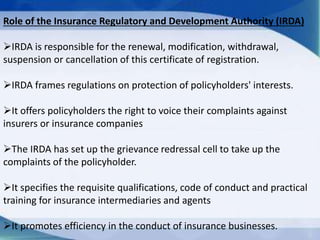
Role of the Insurance Regulatory and Development Authority (IRDA)
IRDA is responsible for the renewal, modification, withdrawal,
suspension or cancellation of this certificate of registration.
IRDA frames regulations on protection of policyholders' interests.
It offers policyholders the right to voice their complaints against
insurers or insurance companies
The IRDA has set up the grievance redressal cell to take up the
complaints of the policyholder.
It specifies the requisite qualifications, code of conduct and practical
training for insurance intermediaries and agents
It promotes efficiency in the conduct of insurance businesses.
It levies fees and other charges to carry out the purposes of the IRDA
Act.
It can call for information from, undertake the inspection of, conduct
enquiries and investigations including the auditing of insurers,
intermediaries, insurance intermediaries and other organisations
connected with the business of Insurance.
It regulates the investment of funds by insurance companies.
It regulates the maintenance of margins of solvency.
It adjudicates disputes between insurers and intermediaries or
insurance intermediaries.
It specifies the percentage of life insurance business to be undertaken
by an insurer in the rural or social sector.
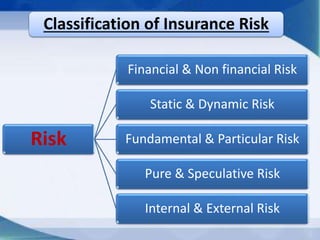
Classification of Insurance Risk
Risk
Financial & Non financial Risk
Static & Dynamic Risk
Fundamental & Particular Risk
Pure & Speculative Risk
Internal & External Risk
Investor Risk
Undisclosed Information
Exchange Rate
Rising Premium
Language of Premium
Closedown of policy
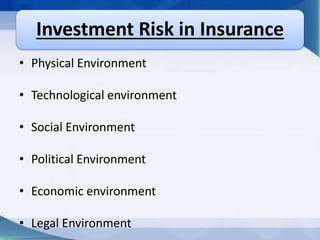
Investment Risk in Insurance
• Physical Environment
• Technological environment
• Social Environment
• Political Environment
• Economic environment
• Legal Environment
Conclusion
Sources
• www.irda.gov.in
• Insurance Management by Aarthi Kalyankaram &
Shraddha Bhome
• www.wealth.economictimes.com
• http://www.business-standard.com
• www.prokerala.com/banking/articles/insurance-
investment-option.php
• www.incomeprotectionadvisors.com
• Strategic Business Risk by Ernst & Young
Insurance risk

Insurance risk

  • 1.
  • 2.
    Table of Contents Sources Conclusion InvestmentRisk Investor Risk Classification of Risk Regulatory Body Corporate Governance Compliance Introduction
  • 3.
    “Insurance is asocial device whereby the uncertain risk of individuals may be combined in a group and thus made more certain, small periodical contribution by individual providing a fund out of which those who suffer losses may be reimbursed”. Meaning of insurance The Essentials of valid insurance contract are Offer and Acceptance Consideration Capacity to contract Free consent Legality of purpose
  • 4.
    Compliance in Insurance Investments. Anti- Money laundering. Standard Formats. Fraud Risk Management Systems. Unfair or Misleading Advertisement.
  • 5.
    Type of InvestmentLife Insurance General Insurance Government Securities (Not less than ) 25%, 20% State Government Securities or other approved securities (Not less than ) 30%, 30% Approved Investments as specified in Schedule I (not exceeding) Infrastructure and Social Sector 15% 20% Others to be governed by Exposure. 20% 10% Other than in Approved Investments to be governed by Exposure 10% 20% Investments Source : IRDA.GOV.IN
  • 6.
    Fraud Risk ManagementSystems Internal Fraud. Policyholder Fraud and Claims Fraud. Intermediary fraud. In order to adequately protect itself from the financial and reputational risks posed by insurance frauds, every insurance company shall have in place appropriate framework to detect, monitor and mitigate occurrence of such insurance frauds within its company.
  • 7.
    Unfair or MisleadingAdvertisement Makes claims beyond the ability Makes unfair or incomplete comparisons with products which are not comparable or criticizes competitors Uses words or phrases in a way which hides or minimizes the costs of the hazard insured against or the risks inherent in the policy Omits to disclose or discloses insufficiently, important exclusions, limitations and conditions of the contract
  • 8.
    Corporate Governance ininsurance • Corporate governance defines organizational roles and responsibilities of an enterprise. • It generally encompasses five areas: corporate culture and environment, corporate structure, governing policies, controls and procedures and decision making.
  • 9.
    Guidelines on CorporateGovernance in insurance company (LIC) • Well developed risk culture and risk management and internal control systems, supported by effective and independent control functions. • A high level of financial expertise among board members and within senior management. • Policies and procedures that ensure proper treatment of customers and policyholders. • The insurance sector, the regulatory responsibility to protect the interests of the policyholders demands that the insurers have in place, good governance practices for maintenance of solvency, and assumption of underwriting risks on a prudential basis.
  • 10.
    Regulatory Body ofInsurance Sector
  • 11.
    Role of theInsurance Regulatory and Development Authority (IRDA) IRDA is responsible for the renewal, modification, withdrawal, suspension or cancellation of this certificate of registration. IRDA frames regulations on protection of policyholders' interests. It offers policyholders the right to voice their complaints against insurers or insurance companies The IRDA has set up the grievance redressal cell to take up the complaints of the policyholder. It specifies the requisite qualifications, code of conduct and practical training for insurance intermediaries and agents It promotes efficiency in the conduct of insurance businesses.
  • 12.
    It levies feesand other charges to carry out the purposes of the IRDA Act. It can call for information from, undertake the inspection of, conduct enquiries and investigations including the auditing of insurers, intermediaries, insurance intermediaries and other organisations connected with the business of Insurance. It regulates the investment of funds by insurance companies. It regulates the maintenance of margins of solvency. It adjudicates disputes between insurers and intermediaries or insurance intermediaries. It specifies the percentage of life insurance business to be undertaken by an insurer in the rural or social sector.
  • 13.
    Classification of InsuranceRisk Risk Financial & Non financial Risk Static & Dynamic Risk Fundamental & Particular Risk Pure & Speculative Risk Internal & External Risk
  • 14.
    Investor Risk Undisclosed Information ExchangeRate Rising Premium Language of Premium Closedown of policy
  • 15.
    Investment Risk inInsurance • Physical Environment • Technological environment • Social Environment • Political Environment • Economic environment • Legal Environment
  • 16.
  • 17.
    Sources • www.irda.gov.in • InsuranceManagement by Aarthi Kalyankaram & Shraddha Bhome • www.wealth.economictimes.com • http://www.business-standard.com • www.prokerala.com/banking/articles/insurance- investment-option.php • www.incomeprotectionadvisors.com • Strategic Business Risk by Ernst & Young