ENDODONTIC
 SURGERY
What is Endodontic Surgery ?

   Endodontic surgery is a
 surgical procedure performed
   to remove or correct the
  causative agents of radicular
 and periradicular disease and
    to restore these tissues to
        functional health.
Endodontic Surgery

It is often the last hope for retention of a
tooth and therefore requires the greatest
skill.
INDICATION FOR ENDO.
          SURGERY
- Inability to Eliminate Pathology by
   Conventional RCT.
   e.g : calcified canal , perforation .
- Inability to Clean and Fill the Entire
   Root Canal by Conventional Method .
   e.g : severe dilaceration , post & core .
- Iatrogenic Problems .
  e.g : broken instrument , perforation .
CONTRAINDICATIONS FOR
           ENDO. SURGERY
1. Pathology Resolved by Conventional
   RCT.
2. Health Contraindications
   e.g: severly debilitated patients or taking
   anticoagulants
3. Anatomic Considerations ???
   e.g: proximity to great palatine foramen.
4. Periodontal Considerations.
PRESURGICAL PREPARATION

 1.   Referral Data
 2.   Record Review
 3.   Medical History Review
 4.   Preoperative Radiographs
 5.   Diagnosis
 6.   Case Presentation to The Patient
 7.   Post Surgical Complication
 8.   Preoperative Patient Preparation
 9.   Surgical Preparation
FLAP DESIGN
Rules For Flap Design
- The base is wider than the free margin.
- Incision must not be placed over any bony
   defect.
- Incisions that traverse a bony eminence
   should be avoided .
- Sharp points at the corners of the flap
   should be avoided .
FLAP DESIGN
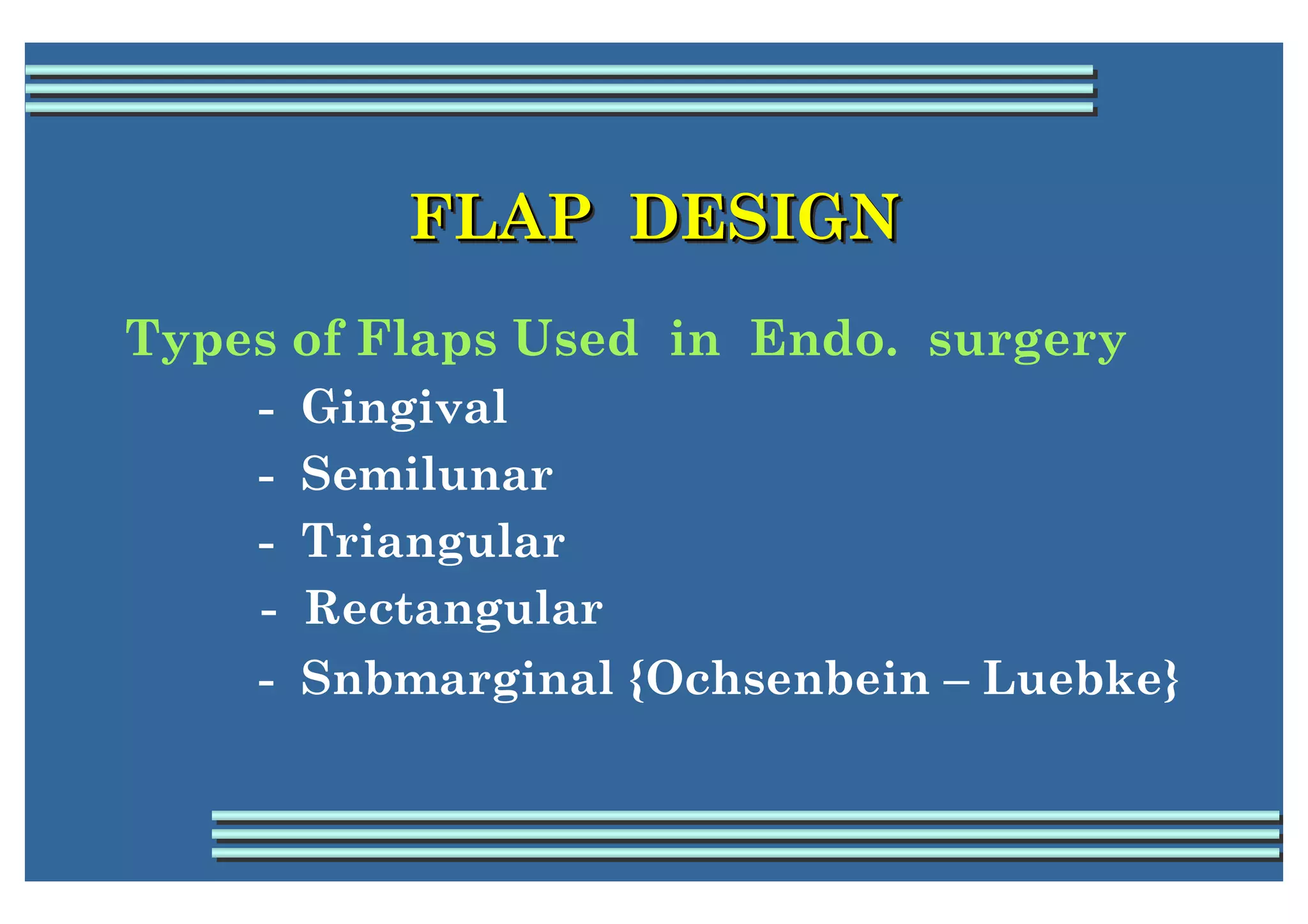
Types of Flaps Used in Endo. surgery
    -   Gingival
    -   Semilunar
    -   Triangular
    -   Rectangular
    - Snbmarginal {Ochsenbein – Luebke}
GINGIVAL (envelope)
1. Intrasulcular horizontal
   incision without vertical
   release

2. Not used for apical
   surgery

3. Used for root resects, root
   amps, hemisections,
   repair of cervical perfs.
   or resorptive defects
Gingival (envelope):

ADVANTAGES                DISADVANTAGES
 1. Good for perio         1. Limited endo use
    surgery                2. Not for apical
 2. Can convert to            surgery
    rectangular flap if    3. No releasing incisions
    needed
SEMILUNAR FLAP
1. Full-thickness flap in
   alveolar mucosa at
   level of tooth apex
2. Indication for long
   tooth only (maxillary
   canine)
3. Seldom used due to
   poor access & scarring
4. Hemostasis may be
   problem
Semilunar
ADVANTAGES                    DISADVANTAGES

 1. Fast & easy to reflect;    1. Poor access (least),
    no exposure of crestal        excessive scarring & flap
    bone                          shrinkage
 2. Unaltered soft tissue      2. Blood supply
    attachment level              interruption to adjacent
                                  tissues
 3. No involvement of
    marginal &                 3. Limited use in mandible
    interdental gingiva        4. Unable to extend; may
                                  cross bony cavity
TRIANGULAR (Intrasulcular)
              (Intrasulcular)

1. Most commonly used
   Endo SX flap
2. One vertical releasing
   incision; can extend to
   rectangular flap
3. Full-thickness flap
4. Keep 2 teeth away from
   pathosis
Triangular (Intrasulcular):
               (Intrasulcular):
ADVANTAGES                DISADVANTAGES
1. Excellent wound        1. More difficult to
   healing potential         incise & reflect
2. Minimal disruption     2. May be limited
   of vascular supply        access due to single
3. Excellent visibility      releasing incision
   & access to defects    3. Possible slight
4. Good flap                 gingival recession
   reapproximation
5. Easy to suture
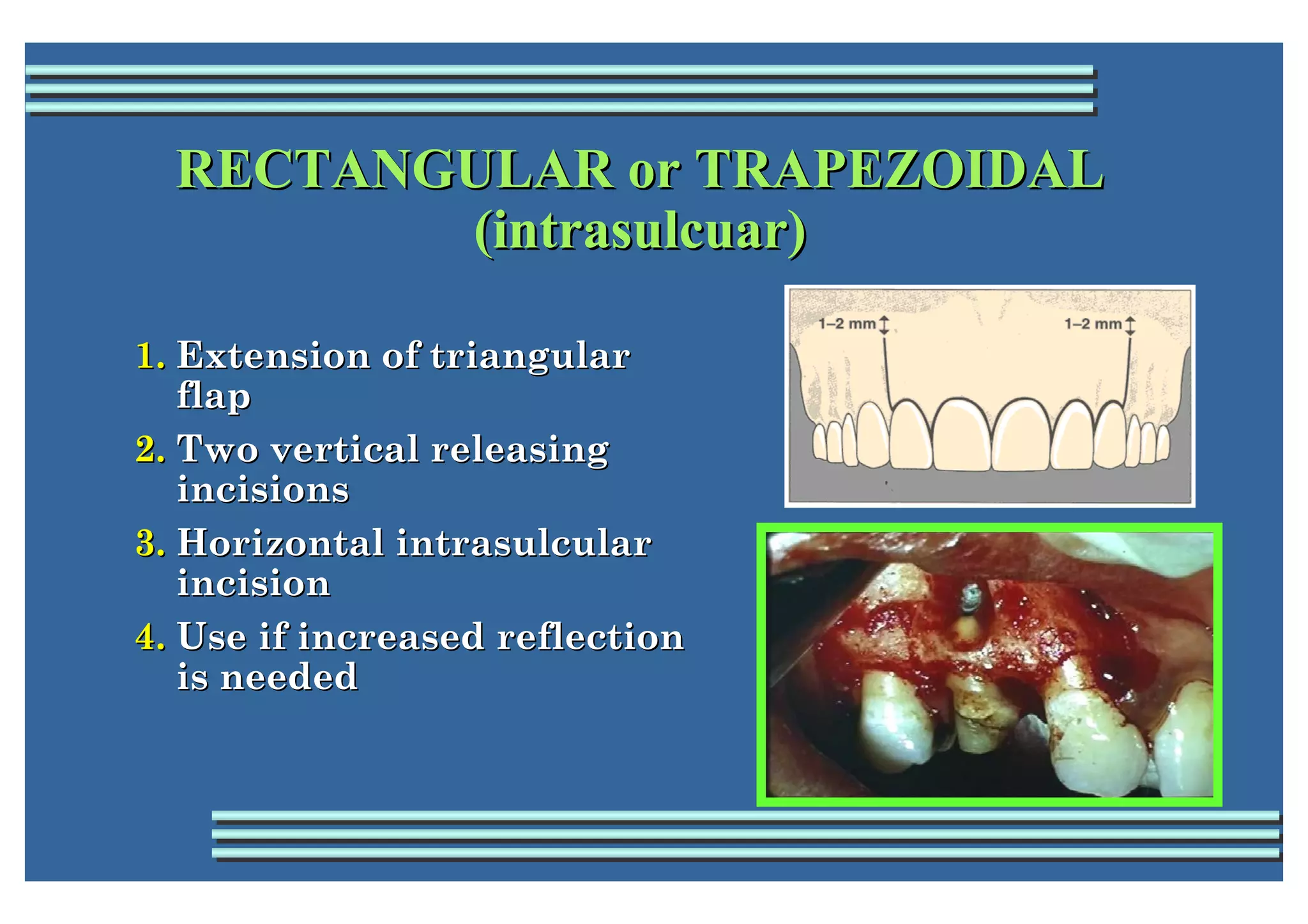
RECTANGULAR or TRAPEZOIDAL
         (intrasulcuar)

1. Extension of triangular
   flap
2. Two vertical releasing
   incisions
3. Horizontal intrasulcular
   incision
4. Use if increased reflection
   is needed
Rectangular or Trapezoidal
ADVANTAGES                 DISADVANTAGES
 1. Enhanced surgical      1. More difficult to incise
    access                    & reflect
 2. Excellent visibility   2. Possible gingival
                              recession
 3. Excellent wound
    healing potential      3. More difficult wound
 4. Minimal disruption        closure than triangular
    of vascular supply        flap
 5. Good to view
    dehiscenses &
    fenestrations
SUBMARGINAL (Ochsenbein-Luebke)

1. Scalloped horizontal
   incision in attached
   gingiva & two vertical
   releasing incisions

2. Must be adequate
   attached gingiva (3-5mm)

3. Best for epithelial wound
   closure
SUBMARGINAL (Ochsenbein-Luebke)

ADVANTAGES                     DISADVANTAGES
1. Does not involve            1. Unable to extend flap if
   marginal or interdental        needed
   gingiva nor expose          2. Disruption of blood
   crestal bone                   supplty to marginal
2. Minimizes crestal bone         tissues; must rely on
   loss & gingival recession      collateral *
   (esthetics)                 3. Limited mandibular use
3. Easy flap                   4. Possible flap shrinkage
   reapproximation                & scarring
                               5. Limited visibility for
                                  root & crestal bone
SUTURING
- To approximate the tissue
- Provide strength to the wound
- Eliminate tissue spaces within the wound

Types:
1. Absorbable gut = catgut “ plain gut “
   manufactured from collagen obtained from
   the small intestine of cheep or cattle
2. Silk - made from the protein-rich spun by
   silkworm larvae.
TYPES OF ENDODONTIC SURGERY
1. Incision for drainage - soft tissue
2. Trephination - I & D through the bone
3. Periaradicular surgery:
        - apical curettage
        - apicoectomy
        - apicoectomy with retrograde filling
4. Repair of perforation
5. Hemi-section and root amputation
6. Intentional replantation
INCISION
    FOR DRAINAGE
Designed to
1. Release accumulated byproducts of tissue
   breakdown
2. Collect samples for bacteriologic analysis
3. Provide a more favorable gradient and
   pathway for drainage

                       RELIEF OF ACUTE
   ER TX ONLY
                       SYMPTOMS
TREPHINATION
    A surgical technique used to
 alleviate acute pain caused by an
accumulation of purulent material
 when drainage through the root
        canal is impossible.
Trephination is usually
performed as an emergency
procedure in the absence of
    soft tissue swelling
PERIRADICULAR
   SURGERY
REPAIRE OF
PERFORATION
HEMI-SECTION
HEMI-SECTION
ROOT
AMPUTATION
INTENTIONAL
REPLANTATION
INTENTIONAL REPLANTATION
         50 / 50 Success at best


 Indication :

  1. lateral perforation that can not be
     treated surgically.
 2. Anatomy make surgery risky e.g:
         mental foramen , maxillary sinus
INTENTIONAL REPLANTATION
       INTENTIONAL REPLANTATION
REMMEMBER :

1.   Do orthograde fill if possible
2.   Do not touch the root
3.   Work fast “ less than 30 min. “
4.   Stabilize if necessary
5.   Reduce occlusion before extraction
6.   Extraction should be non-traumatic.
POSTSURGICAL
 INSTRUCTION
POSTSURGICAL COMPLICATIONS
 1.    Pain
 2.    Swelling
 3.    Infection
 4.    Bleeding
 5.    Hematoma
 6.    Tissue trauma
 7.    Incomplete root resection
 8.    Malalignment of retrograde filling
 9.    Foreign debris in the surgical site
 10.   Parasthesia
FOLLOW UP
“A minimum of 2 years was
 considered to be sufficient to
 evaluate the success or
 failure of the treatment.”

                    Rud et al 1972
                    Rud et al 1972
“The type of endodontic surgical treatment
 seemed not to influence the prognosis of
 endodontic surgery.

 The success rate is higher with the use of
 retrofill in periapical surgery.”


                      Molven & Hals 1991
                      Molven & Hals 1991
“ Prognosis is decreased to about
      30-40% in cases where
 endodontic surgical retreatment
      has been performed. ”

                 Block et al 1979
                 Block et al 1979
http://faculty.ksu.edu.sa/alnazhan/default.aspx

Endodontic surgery

  • 1.
  • 2.
    What is EndodonticSurgery ? Endodontic surgery is a surgical procedure performed to remove or correct the causative agents of radicular and periradicular disease and to restore these tissues to functional health.
  • 3.
    Endodontic Surgery It isoften the last hope for retention of a tooth and therefore requires the greatest skill.
  • 4.
    INDICATION FOR ENDO. SURGERY - Inability to Eliminate Pathology by Conventional RCT. e.g : calcified canal , perforation . - Inability to Clean and Fill the Entire Root Canal by Conventional Method . e.g : severe dilaceration , post & core . - Iatrogenic Problems . e.g : broken instrument , perforation .
  • 5.
    CONTRAINDICATIONS FOR ENDO. SURGERY 1. Pathology Resolved by Conventional RCT. 2. Health Contraindications e.g: severly debilitated patients or taking anticoagulants 3. Anatomic Considerations ??? e.g: proximity to great palatine foramen. 4. Periodontal Considerations.
  • 6.
    PRESURGICAL PREPARATION 1. Referral Data 2. Record Review 3. Medical History Review 4. Preoperative Radiographs 5. Diagnosis 6. Case Presentation to The Patient 7. Post Surgical Complication 8. Preoperative Patient Preparation 9. Surgical Preparation
  • 7.
  • 8.
    Rules For FlapDesign - The base is wider than the free margin. - Incision must not be placed over any bony defect. - Incisions that traverse a bony eminence should be avoided . - Sharp points at the corners of the flap should be avoided .
  • 9.
    FLAP DESIGN Types ofFlaps Used in Endo. surgery - Gingival - Semilunar - Triangular - Rectangular - Snbmarginal {Ochsenbein – Luebke}
  • 10.
    GINGIVAL (envelope) 1. Intrasulcularhorizontal incision without vertical release 2. Not used for apical surgery 3. Used for root resects, root amps, hemisections, repair of cervical perfs. or resorptive defects
  • 11.
    Gingival (envelope): ADVANTAGES DISADVANTAGES 1. Good for perio 1. Limited endo use surgery 2. Not for apical 2. Can convert to surgery rectangular flap if 3. No releasing incisions needed
  • 12.
    SEMILUNAR FLAP 1. Full-thicknessflap in alveolar mucosa at level of tooth apex 2. Indication for long tooth only (maxillary canine) 3. Seldom used due to poor access & scarring 4. Hemostasis may be problem
  • 13.
    Semilunar ADVANTAGES DISADVANTAGES 1. Fast & easy to reflect; 1. Poor access (least), no exposure of crestal excessive scarring & flap bone shrinkage 2. Unaltered soft tissue 2. Blood supply attachment level interruption to adjacent tissues 3. No involvement of marginal & 3. Limited use in mandible interdental gingiva 4. Unable to extend; may cross bony cavity
  • 14.
    TRIANGULAR (Intrasulcular) (Intrasulcular) 1. Most commonly used Endo SX flap 2. One vertical releasing incision; can extend to rectangular flap 3. Full-thickness flap 4. Keep 2 teeth away from pathosis
  • 15.
    Triangular (Intrasulcular): (Intrasulcular): ADVANTAGES DISADVANTAGES 1. Excellent wound 1. More difficult to healing potential incise & reflect 2. Minimal disruption 2. May be limited of vascular supply access due to single 3. Excellent visibility releasing incision & access to defects 3. Possible slight 4. Good flap gingival recession reapproximation 5. Easy to suture
  • 16.
    RECTANGULAR or TRAPEZOIDAL (intrasulcuar) 1. Extension of triangular flap 2. Two vertical releasing incisions 3. Horizontal intrasulcular incision 4. Use if increased reflection is needed
  • 17.
    Rectangular or Trapezoidal ADVANTAGES DISADVANTAGES 1. Enhanced surgical 1. More difficult to incise access & reflect 2. Excellent visibility 2. Possible gingival recession 3. Excellent wound healing potential 3. More difficult wound 4. Minimal disruption closure than triangular of vascular supply flap 5. Good to view dehiscenses & fenestrations
  • 18.
    SUBMARGINAL (Ochsenbein-Luebke) 1. Scallopedhorizontal incision in attached gingiva & two vertical releasing incisions 2. Must be adequate attached gingiva (3-5mm) 3. Best for epithelial wound closure
  • 19.
    SUBMARGINAL (Ochsenbein-Luebke) ADVANTAGES DISADVANTAGES 1. Does not involve 1. Unable to extend flap if marginal or interdental needed gingiva nor expose 2. Disruption of blood crestal bone supplty to marginal 2. Minimizes crestal bone tissues; must rely on loss & gingival recession collateral * (esthetics) 3. Limited mandibular use 3. Easy flap 4. Possible flap shrinkage reapproximation & scarring 5. Limited visibility for root & crestal bone
  • 20.
    SUTURING - To approximatethe tissue - Provide strength to the wound - Eliminate tissue spaces within the wound Types: 1. Absorbable gut = catgut “ plain gut “ manufactured from collagen obtained from the small intestine of cheep or cattle 2. Silk - made from the protein-rich spun by silkworm larvae.
  • 21.
    TYPES OF ENDODONTICSURGERY 1. Incision for drainage - soft tissue 2. Trephination - I & D through the bone 3. Periaradicular surgery: - apical curettage - apicoectomy - apicoectomy with retrograde filling 4. Repair of perforation 5. Hemi-section and root amputation 6. Intentional replantation
  • 22.
    INCISION FOR DRAINAGE Designed to 1. Release accumulated byproducts of tissue breakdown 2. Collect samples for bacteriologic analysis 3. Provide a more favorable gradient and pathway for drainage RELIEF OF ACUTE ER TX ONLY SYMPTOMS
  • 23.
    TREPHINATION A surgical technique used to alleviate acute pain caused by an accumulation of purulent material when drainage through the root canal is impossible.
  • 24.
    Trephination is usually performedas an emergency procedure in the absence of soft tissue swelling
  • 25.
  • 26.
  • 27.
  • 28.
  • 29.
  • 30.
    INTENTIONAL REPLANTATION 50 / 50 Success at best Indication : 1. lateral perforation that can not be treated surgically. 2. Anatomy make surgery risky e.g: mental foramen , maxillary sinus
  • 31.
    INTENTIONAL REPLANTATION INTENTIONAL REPLANTATION REMMEMBER : 1. Do orthograde fill if possible 2. Do not touch the root 3. Work fast “ less than 30 min. “ 4. Stabilize if necessary 5. Reduce occlusion before extraction 6. Extraction should be non-traumatic.
  • 32.
  • 33.
    POSTSURGICAL COMPLICATIONS 1. Pain 2. Swelling 3. Infection 4. Bleeding 5. Hematoma 6. Tissue trauma 7. Incomplete root resection 8. Malalignment of retrograde filling 9. Foreign debris in the surgical site 10. Parasthesia
  • 34.
  • 35.
    “A minimum of2 years was considered to be sufficient to evaluate the success or failure of the treatment.” Rud et al 1972 Rud et al 1972
  • 36.
    “The type ofendodontic surgical treatment seemed not to influence the prognosis of endodontic surgery. The success rate is higher with the use of retrofill in periapical surgery.” Molven & Hals 1991 Molven & Hals 1991
  • 37.
    “ Prognosis isdecreased to about 30-40% in cases where endodontic surgical retreatment has been performed. ” Block et al 1979 Block et al 1979
  • 38.