BY-
DR. AKANKSHA NARELA
PG 1ST YEAR
Maxillary Anatomical landmarks
Contents -
 Introduction
 Intraoral landmarks
 Maxillary Arch
i. Histology
ii. Supporting areas
iii. Peripheral/limiting areas
 Conclusion
 References
INTRODUCTION
M.M Devan Dictum “Aim of a prosthodontist is not only
the meticulous replacement of what is missing, but also
perpetual preservation of what is present”
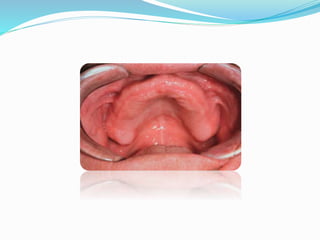
A prosthesis must function in harmony with the tissues
that support them and those that surround them.
Hence the dentist must understand the macroscopic as
well as microscopic anatomy of the supporting and limiting
structures of the denture.
This knowledge aids in determining -
i. The selective placement of forces by the denture
bases upon the supporting tissues.
ii. The form of the denture borders that will be
harmonious with the normal function of the limiting
structures that surround them.
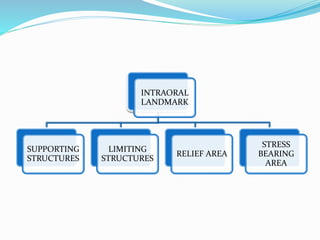
INTRAORAL LANDMARKS
INTRAORAL
LANDMARK
SUPPORTING
STRUCTURES
LIMITING
STRUCTURES
RELIEF AREA
STRESS
BEARING
AREA
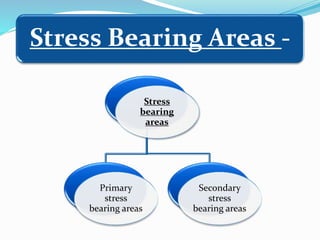
Stress
bearing
areas
Primary
stress
bearing areas
Secondary
stress
bearing areas
Stress Bearing Areas -
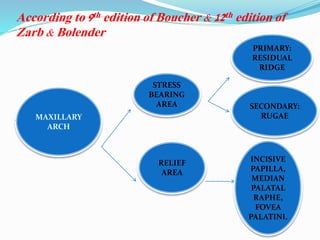
According to 9th edition of Boucher & 12th edition of
Zarb & Bolender
MAXILLARY
ARCH
STRESS
BEARING
AREA
RELIEF
AREA
PRIMARY:
RESIDUAL
RIDGE
SECONDARY:
RUGAE
INCISIVE
PAPILLA,
MEDIAN
PALATAL
RAPHE,
FOVEA
PALATINI.
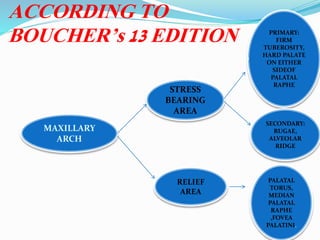
ACCORDING TO
BOUCHER’s 13 EDITION
MAXILLARY
ARCH
STRESS
BEARING
AREA
RELIEF
AREA
PRIMARY:
FIRM
TUBEROSITY,
HARD PALATE
ON EITHER
SIDEOF
PALATAL
RAPHE
SECONDARY:
RUGAE,
ALVEOLAR
RIDGE
PALATAL
TORUS,
MEDIAN
PALATAL
RAPHE
,FOVEA
PALATINI.
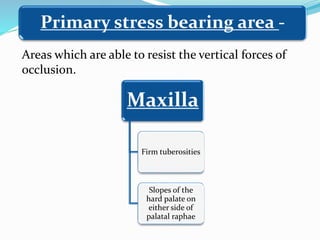
Maxilla
Firm tuberosities
Slopes of the
hard palate on
either side of
palatal raphae
Primary stress bearing area -
Areas which are able to resist the vertical forces of
occlusion.
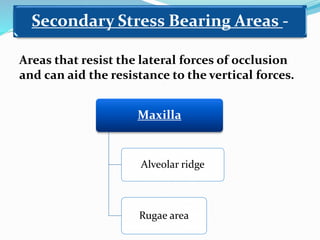
Maxilla
Alveolar ridge
Rugae area
Secondary Stress Bearing Areas -
Areas that resist the lateral forces of occlusion
and can aid the resistance to the vertical forces.
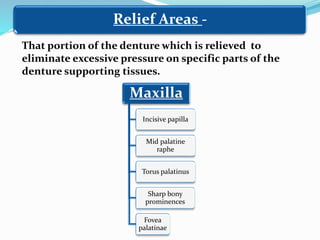
Relief Areas -
That portion of the denture which is relieved to
eliminate excessive pressure on specific parts of the
denture supporting tissues.
Maxilla
Incisive papilla
Mid palatine
raphe
Torus palatinus
Sharp bony
prominences
Fovea
palatinae
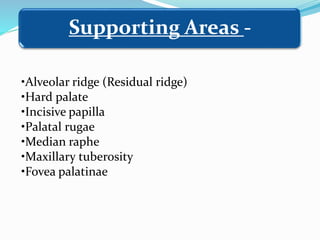
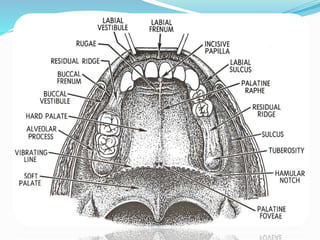
•Alveolar ridge (Residual ridge)
•Hard palate
•Incisive papilla
•Palatal rugae
•Median raphe
•Maxillary tuberosity
•Fovea palatinae
Supporting Areas -
•Labial frenum
•Labial sulcus
•Buccal frenum
•Buccal sulcus
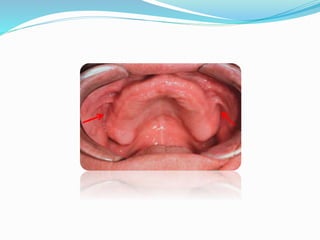
•Distobuccal space
•Hamular notch
•Posterior palatal seal area
Peripheral / Limiting Areas -
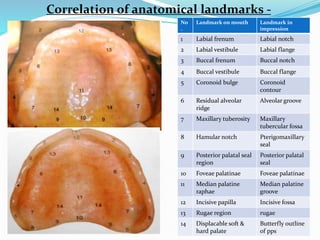
Correlation of anatomical landmarks -
No
.
Landmark on mouth Landmark in
impression
1 Labial frenum Labial notch
2 Labial vestibule Labial flange
3 Buccal frenum Buccal notch
4 Buccal vestibule Buccal flange
5 Coronoid bulge Coronoid
contour
6 Residual alveolar
ridge
Alveolar groove
7 Maxillary tuberosity Maxillary
tubercular fossa
8 Hamular notch Pterigomaxillary
seal
9 Posterior palatal seal
region
Posterior palatal
seal
10 Foveae palatinae Foveae palatinae
11 Median palatine
raphae
Median palatine
groove
12 Incisive papilla Incisive fossa
13 Rugae region rugae
14 Displacable soft &
hard palate
Butterfly outline
of pps
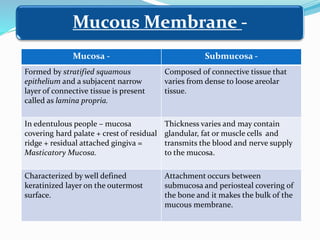
Mucous Membrane -
Mucosa - Submucosa -
Formed by stratified squamous
epithelium and a subjacent narrow
layer of connective tissue is present
called as lamina propria.
Composed of connective tissue that
varies from dense to loose areolar
tissue.
In edentulous people – mucosa
covering hard palate + crest of residual
ridge + residual attached gingiva =
Masticatory Mucosa.
Thickness varies and may contain
glandular, fat or muscle cells and
transmits the blood and nerve supply
to the mucosa.
Characterized by well defined
keratinized layer on the outermost
surface.
Attachment occurs between
submucosa and periosteal covering of
the bone and it makes the bulk of the
mucous membrane.
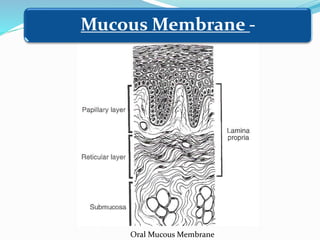
Oral Mucous Membrane
Mucous Membrane -
The residual ridge is the remnant of the alveolar
process which originally contained sockets for
natural teeth.
After natural teeth are extracted, the alveolar ridge
can be expected to get smaller (resorb).
The rate of resorption varies considerably from
person to person.
Alveolar Ridge (Residual Ridge) -
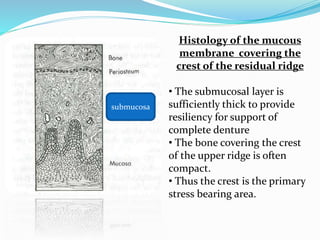
Histology of the mucous
membrane covering the
crest of the residual ridge
• The submucosal layer is
sufficiently thick to provide
resiliency for support of
complete denture
• The bone covering the crest
of the upper ridge is often
compact.
• Thus the crest is the primary
stress bearing area.
submucosa
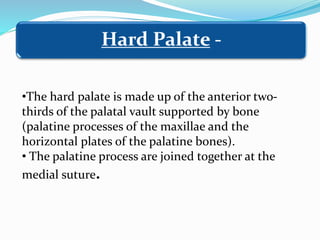
Hard Palate -
•The hard palate is made up of the anterior two-
thirds of the palatal vault supported by bone
(palatine processes of the maxillae and the
horizontal plates of the palatine bones).
• The palatine process are joined together at the
medial suture.
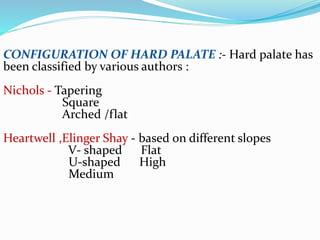
CONFIGURATION OF HARD PALATE :- Hard palate has
been classified by various authors :
Nichols - Tapering
Square
Arched /flat
Heartwell ,Elinger Shay - based on different slopes
V- shaped Flat
U-shaped High
Medium
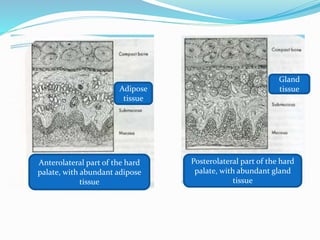
Gland
tissueAdipose
tissue
Anterolateral part of the hard
palate, with abundant adipose
tissue
Posterolateral part of the hard
palate, with abundant gland
tissue
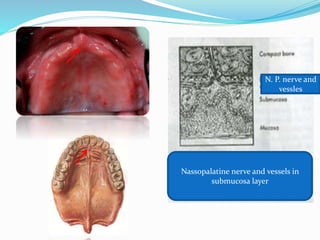
•It is a pad of fibrous connective tissue overlying
the orifice of the nasopalatine canal.
Significance :
1. Stable landmark and gives its relation to
incisive foramen through which the
neurovascular bundle emerge and lie on the
surface of bone.
Incisive Papillae -
2. It is a biometric guide giving information on
positional relation to central incisors which are
about 8-10 mm anterior to incisive papilla.
3. Biometric guide which gives us
information about location of maxillary canines
(A perpendicular drawn posterior to the centre of
incisive papilla to sagittal plane passes through
canines).
Clinical Consideration : During final
impression procedure, care should be taken not
to compress the papilla. Hence the incisive
papilla should be relieved with a spacer.
Reason :
a. Compression of blood vessels obliteration
of the lumen  deprive nutrition to tissues 
breakdown of tissues.
b. Pressure on nerve causes parasthesia in the
region of upper lip.
N. P. nerve and
vessles
Nassopalatine nerve and vessels in
submucosa layer
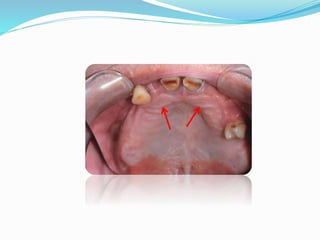
• They are raised areas of dense connective tissue
radiating from the median suture in the anterior
1/3rd of the palate.
•It is seconadary stress bearing area.
Significance :
1.Said to be concerned with phonetics.
2.Increase the surface area of the foundation
and thus supplement the values of retention.
3.It is the denture stabilizing area in the
maxillary foundation.
Palatal Rugae -
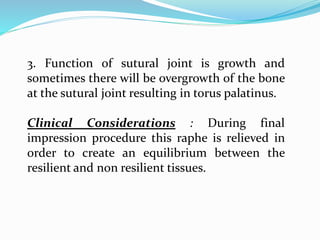
•It is the area extending from the incisive papilla to
the distal end of the hard palate.
Significance :
1.Area of sutural joint and covered with firmly
adherent mucous membrane to the underlying
bone with little submucosal tissue.
2.This sutural joint is formed by the median
fusion of two maxillary processes and two
horizontal plates of palatine bone.
Mid palatine suture -
3. Function of sutural joint is growth and
sometimes there will be overgrowth of the bone
at the sutural joint resulting in torus palatinus.
Clinical Considerations : During final
impression procedure this raphe is relieved in
order to create an equilibrium between the
resilient and non resilient tissues.
Thin
submucosa
h/p of mid palatal suture showing
thin submucosal layer
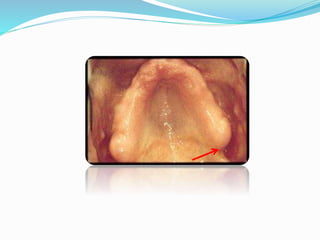
•It is a narrow cleft of loose areolar tissue which is
approximately 2mm in extent antero-posteriorly.
•It is situated between the distal surface of the
tuberosity and the hamulus of medial pterygoid plate.
•Located by using T-burnisher.
Significance :
•Constitutes the lateral boundary of posterior
palatal seal area in maxillary foundation.
•The pterygomandibular raphe attaches to hamulus.
Hamular Notch -
Clinical Consideration :
1.Denture should not extend beyond the
hamular notch, failure of which will result in :
a.Restricted pterygomandibular raphe
movement.
b.When mouth is wide open the denture
dislodges.
•It is the distal most part of the residual alveolar
ridge and presents the hard tissue landmarks.
•They are primary stress bearing area.
Significance : The last posterior tooth should not
be placed on the tuberosity.
Clinical Significance :
•Often there is lateral and vertical growth of
tuberosity and the area assumes importance when
maxillary antrum extends laterally with undercuts at
the tuberosity region.
Maxillary Tuberosity -
•It is important to prevent oro-antral fistula so
it is important to have radiograph before
resection of the tuberosity.
•It can be used for the retention of the denture.
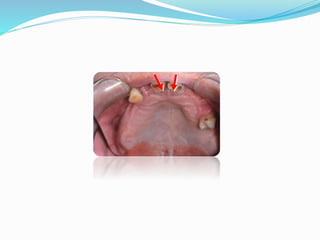
•They are the remnants of ducts of coalescence.
•Usually two in number on either side of the midline.
•They indicate the vicinity of posterior palatine seal
area.
• Its position also influences the position of the
posterior border of the denture.
•Denture can extend 1-2 mm across it.
•In patients with thick saliva, the fovea palatine
should be left uncovered or else thick saliva flows
between the tissue and increase the hydrostatic
pressure and hence lead to denture displacement.
Fovea Palatine -
Peripheral
/ Limiting
areas
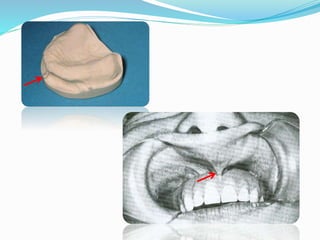
•It appears as a fold of mucous membrane
extending from the mucous lining of the lip to
the crest of residual ridge on the labial surface.
•It may be single .
•It may be narrow / broad.
•It contains no muscle fibers of significance.
•It starts superiorly as a fan shape and converges
as it descends to its terminal attachment on the
labial side of the ridge.
Labial Frenum -
Clinical Consideration :
1.Sufficient relief should be given during final
impression procedure and in completed
prosthesis because overriding of function of
frenum will cause pain and dislodgement of
denture.
2.During impression procedure the lip should be
stretched horizontal outwards for the proper
recording of frenum.
3.If frenum is attached close to the crest
frenectomy is done, failure of which will lead to
the denture border being placed on the bone
tissue which will cause decreased border seal.
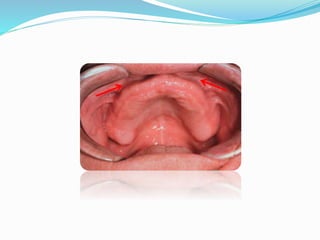
•It extends on both sides of the midline from labial
frenum anteriorly to the buccal frenum posteriorly.
•It is bounded laterally by the labial mucosa,
medially by maxillary residual alveolar ridge.
•It is lined by linig mucosa.
•Reflection of the mucous membrane superiorly
reflects the height. The area of mucous membrane
reflection has no muscle.
Clinical Consideration :
For effective border contact between denture and
tissue, vestibule should be completely filled with
impression material.
Labial Vestibule -
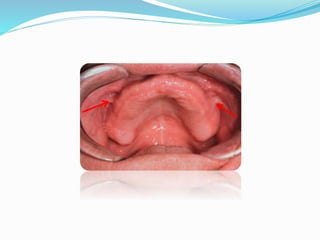
•Fold or folds of mucous membrane extending from
mucous membrane reflection area to the slope or
crest of residual alveolar ridge.
•It forms the dividing line between the labial and the
buccal vestibule.
Significance :
•LEVATOR ANGULIORIS (CANINUS MUSCLE) lies
beneath it and affect position of frenum.
•ORBICULARIS ORIS muscle pulls frenum forward.
•BUCCINATOR MUSCLE pulls frenum backword.
Buccal Frenum -
Clinical Consideration:
1.During final impression procedure and in
final prosthesis sufficient relief should be
given for the movement of frenum because
over-riding of function of frenum will cause
pain and dislodgement of denture.
2.During impression procedure the cheek
should be reflected laterally and posteriorly.
3.If frenum is attached close to the crest of
alveolar ridge, frenectomy is called for.
Boundaries :
• It is bounded anteriorly by the buccal frenum,
laterally by the buccal mucosa and medially by
residual alveolar ridge.
•Size of vestibule varies with contraction of
BUCCINATOR MUSCLE, POSITION OF
MANDIBLE , AND AMOUNT OF BONE LOSS
FROM MAXILLA.
Buccal Vestibule -
Clinical Consideration :
1.During impression procedure the vestibule
should be completely filled with impression
material for proper border contact between
denture and tissues.
2.When the vestibular space that is distal and
lateral to the alveolar tubercles is properly filled
with denture flange the stability and retention of
the maxillary denture is greatly enhanced.
3.The buccal flange borders depend upon
movement of ramus of mandible at the distal end
of buccal vestibule and hence the patient should
move the mandible laterally and protrusively to
make sure the mandible does not interfere with
these functions.
4.To effectively record the maxillary buccal sulcus
the mouth should be half way closed because wide
opening of the mouth narrows the space and does
not allow proper contouring of sulcus because the
coronoid process of mandible comes closer to the
sulcus.
N. S. Arbree, D.D.S.,* A. A. Yurkstas, D.M.D., M.S.,** and J. H. Kronman, D.D.S., Ph.D.***
Tufts University, School of Dental Medicine, Boston, Mass
Also known as
 Buccal space or vestibule,
 Buccal pocket,
 Tuberosity sulcus,
 Distobuccal angle of the buccal vestibule,
 Buccal sulcus
 Buccal pouch,
 Buccal mucous membrane reflection region
 Postmalar area
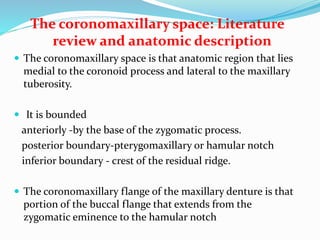
The coronomaxillary space: Literature
review and anatomic description
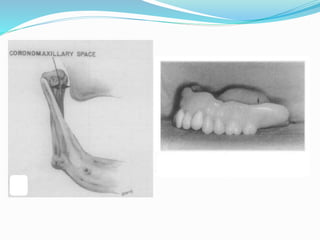
 The coronomaxillary space is that anatomic region that lies
medial to the coronoid process and lateral to the maxillary
tuberosity.
 It is bounded
anteriorly -by the base of the zygomatic process.
posterior boundary-pterygomaxillary or hamular notch
inferior boundary - crest of the residual ridge.
 The coronomaxillary flange of the maxillary denture is that
portion of the buccal flange that extends from the
zygomatic eminence to the hamular notch
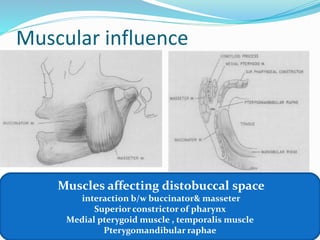
Muscular influence
Muscles affecting distobuccal space
interaction b/w buccinator& masseter
Superior constrictor of pharynx
Medial pterygoid muscle , temporalis muscle
Pterygomandibular raphae
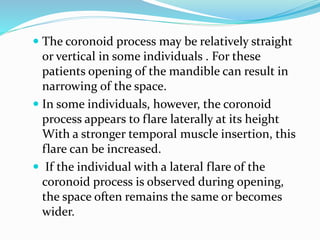
 The coronoid process may be relatively straight
or vertical in some individuals . For these
patients opening of the mandible can result in
narrowing of the space.
 In some individuals, however, the coronoid
process appears to flare laterally at its height
With a stronger temporal muscle insertion, this
flare can be increased.
 If the individual with a lateral flare of the
coronoid process is observed during opening,
the space often remains the same or becomes
wider.
 Various studies demonstrates alteration in
coronomaxillary space on wide opening of mouth, and
some says no change in opening.
 If the coronomaxillary space broadens or remains the
same size on opening , the functional filling of this
space with the denture flange becomes important.”
 If the space is not completely filled or even slightly
overfilled,‘,’ maximum retention may be lost.
 In this instance it is advisable not to have the patient
open wide, protrude, or move laterally during border
molding or impression procedures.“,’
 A gentle molding of the region by pulling the cheek
out, down, and in will be more successful
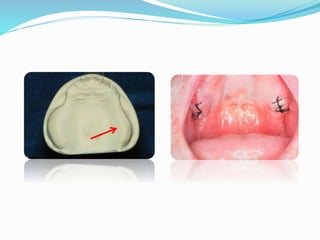
Posterior Palatal Seal Area -
•It is also called as Post dam, Post palatal seal .
•Defined as – The soft tissue area at or beyond the junction
of the hard and soft palates on which pressure, within
physiologic limits, can be applied by a denture to aid in its
retention. (GPT -7)
•Hardy and Kapur stated that retention and stability that
is achieved from adhesion ,cohesion and interfacial surface
tension are able to resist those dislodging forces that are
perpendicular to the denture base.
Horizontal and lateral torquing of the maxillary denture
can be resisted only by adequate border seal.
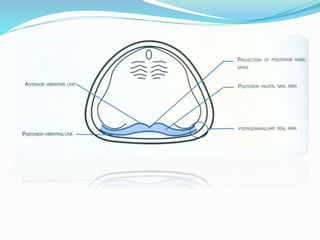
• Boundaries of posterior palatal seal area –
i. Anteriorly – Anterior vibrating line
ii. Posteriorly - Posterior vibrating line
iii.Laterally – Pterygomaxillary notch
Anterior Vibrating line –
• An imaginary line located at the junction of the
attached tissues overlying the hard palate and the movable
tissues of the immediately adjacent hard palate.
•Shape – bow shaped anteriorly, sometimes referred to as
“Cupid’s Bow”.
•Located by –
a) Valsalva Maneuver - Both the nostrils are held firmly
while the patient blows gently through the nose. This
positions the soft palate downwards at its junction with
the hard palate.
b) Patient is asked to say “ah” with short vigorous bursts.
.
Posterior vibrating line –
• An imaginary line at the junction of the
aponeurosis of the tensor veli palatini and the
muscular portion of the soft palate.
• Located by - it can be visualised when the
patient says “ah” in a normal un exaggerated
fashion
Significance :
1) It maintains contact of denture with soft tissue during
functional movements of stomatognathic system
(mastication, deglutition and phonation etc.)
2) Decreases gag reflex.
3) Decreases food accumulation with adequate tissue
compressibility.
4) Decrease patient discomfort of tongue with posterior
part of denture
5) Compensation of volumetric shrinkage that occurs
during the polymerization of PMMA.
6) Permits normal movement of muscles and
ligaments.
7) Increases retention and stability by creating a
partial vacuum.
8) Increased strength of maxillary denture base.
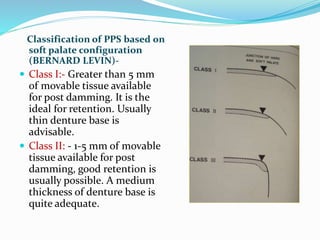
Classification of PPS based on
soft palate configuration
(BERNARD LEVIN)-
 Class I:- Greater than 5 mm
of movable tissue available
for post damming. It is the
ideal for retention. Usually
thin denture base is
advisable.
 Class II: - 1-5 mm of movable
tissue available for post
damming, good retention is
usually possible. A medium
thickness of denture base is
quite adequate.
FACTORS INFLUENCING PPS
The accuracy of PPS reproduction in complete
denture depends on various factors :-
 Configuration of hard palate.
 Investing medium
 Factors involved in processing of acrylic resin.
 Denture base thickness.
 Head position
 PPS determination methods can be broadly categorized
based on stage of denture construction as follows:
 PPS determination in final impression stage.
 PPS determination or designing on master cast.
 Recording PPS in Secondary Impression
Appointment Stage
Methods to record pps
 Determining PPS on Master Cast
1. Boucher's Technique
2. Bernard Levin's Technique
3. Swenson's Technique
4. Calomeni, Feldman,Kuebker's Technique
5. Pound's Technique
6. Apple Baum
7. Winkler's Technique
8. Silverman's Technique
9. Hardy and Kapur Technique
•The basic goal of a successful complete denture therapy is
reaching the patients expectations in fulfillment of better
masticatory ability, unaltered speech and a better esthetics.
•Extensions of the borders to get a good seal facilitates the
clinician to obtain the compromised treatment approach.
The clinician should have the anatomical knowledge to
fabricate prosthesis which inturn aids in proper
maintenance of stomatognathic system.
Conclusion -
•The knowledge of oral anatomy, microscopic as well as
macroscopic better equips us as prosthodontists to -
i. Decide how to make the impression.
ii. What material to use?
iii. How to plan the treatment?
•All this will result in a successful prosthetic treatment
1. Zarb,Bolender,Carlson – Boucher’s prosthodontic treatment for
edentulous patients,12th edition
2. Sharry J.J. – Complete denture prosthodontics;ed.3.New York,
1974
3.Heartwell Charles – syllabus for complete dentures Ed.4,Philadelphia
4 .Sheldon Winkler – Essentials of complete denture Prosthodontics,ed.2
5. O Boucher – Swenson’s complete denture Prosthodontics,ed.6
11.Benard Lynn,Detriot,Mich – Significance of anatomic landmarks in
complete denture service,JPD,1964,14:456-459
12.H.R.Kolb-Variable denture limiting structures of the
edentulous mouth,Part 1 ,maxillary border areas,JPD 1966,16:194-204
13.Colie H Millsap-The posterior palatal seal area for complete denture.
DCNA,Nov.1964,663
14’.Nallaswamy-Textbook of prosthodontics,ed. 1
15.Inderbir Singh-Textbook of human histology with colour atlas,ed.3
17.Orban-Oral histology & embryology,ed.10
16.Elinger-synopsis of complete denture prosthodontics,ed.1
18.N. S. Arbree, D.D.S.,* A. A. Yurkstas, D.M.D., M.S.,** and J. H. Kronman, D.D.S.,
Ph.D.***Tufts University, School of Dental Medicine, Boston, Mass

maxillary anatomical landmarks

  • 1.
    BY- DR. AKANKSHA NARELA PG1ST YEAR Maxillary Anatomical landmarks
  • 2.
    Contents -  Introduction Intraoral landmarks  Maxillary Arch i. Histology ii. Supporting areas iii. Peripheral/limiting areas  Conclusion  References
  • 3.
    INTRODUCTION M.M Devan Dictum“Aim of a prosthodontist is not only the meticulous replacement of what is missing, but also perpetual preservation of what is present” A prosthesis must function in harmony with the tissues that support them and those that surround them. Hence the dentist must understand the macroscopic as well as microscopic anatomy of the supporting and limiting structures of the denture.
  • 4.
    This knowledge aidsin determining - i. The selective placement of forces by the denture bases upon the supporting tissues. ii. The form of the denture borders that will be harmonious with the normal function of the limiting structures that surround them.
  • 5.
  • 6.
  • 7.
  • 8.
    According to 9thedition of Boucher & 12th edition of Zarb & Bolender MAXILLARY ARCH STRESS BEARING AREA RELIEF AREA PRIMARY: RESIDUAL RIDGE SECONDARY: RUGAE INCISIVE PAPILLA, MEDIAN PALATAL RAPHE, FOVEA PALATINI.
  • 9.
    ACCORDING TO BOUCHER’s 13EDITION MAXILLARY ARCH STRESS BEARING AREA RELIEF AREA PRIMARY: FIRM TUBEROSITY, HARD PALATE ON EITHER SIDEOF PALATAL RAPHE SECONDARY: RUGAE, ALVEOLAR RIDGE PALATAL TORUS, MEDIAN PALATAL RAPHE ,FOVEA PALATINI.
  • 10.
    Maxilla Firm tuberosities Slopes ofthe hard palate on either side of palatal raphae Primary stress bearing area - Areas which are able to resist the vertical forces of occlusion.
  • 11.
    Maxilla Alveolar ridge Rugae area SecondaryStress Bearing Areas - Areas that resist the lateral forces of occlusion and can aid the resistance to the vertical forces.
  • 12.
    Relief Areas - Thatportion of the denture which is relieved to eliminate excessive pressure on specific parts of the denture supporting tissues. Maxilla Incisive papilla Mid palatine raphe Torus palatinus Sharp bony prominences Fovea palatinae
  • 13.
    •Alveolar ridge (Residualridge) •Hard palate •Incisive papilla •Palatal rugae •Median raphe •Maxillary tuberosity •Fovea palatinae Supporting Areas -
  • 14.
    •Labial frenum •Labial sulcus •Buccalfrenum •Buccal sulcus •Distobuccal space •Hamular notch •Posterior palatal seal area Peripheral / Limiting Areas -
  • 16.
    Correlation of anatomicallandmarks - No . Landmark on mouth Landmark in impression 1 Labial frenum Labial notch 2 Labial vestibule Labial flange 3 Buccal frenum Buccal notch 4 Buccal vestibule Buccal flange 5 Coronoid bulge Coronoid contour 6 Residual alveolar ridge Alveolar groove 7 Maxillary tuberosity Maxillary tubercular fossa 8 Hamular notch Pterigomaxillary seal 9 Posterior palatal seal region Posterior palatal seal 10 Foveae palatinae Foveae palatinae 11 Median palatine raphae Median palatine groove 12 Incisive papilla Incisive fossa 13 Rugae region rugae 14 Displacable soft & hard palate Butterfly outline of pps
  • 17.
    Mucous Membrane - Mucosa- Submucosa - Formed by stratified squamous epithelium and a subjacent narrow layer of connective tissue is present called as lamina propria. Composed of connective tissue that varies from dense to loose areolar tissue. In edentulous people – mucosa covering hard palate + crest of residual ridge + residual attached gingiva = Masticatory Mucosa. Thickness varies and may contain glandular, fat or muscle cells and transmits the blood and nerve supply to the mucosa. Characterized by well defined keratinized layer on the outermost surface. Attachment occurs between submucosa and periosteal covering of the bone and it makes the bulk of the mucous membrane.
  • 18.
  • 19.
    The residual ridgeis the remnant of the alveolar process which originally contained sockets for natural teeth. After natural teeth are extracted, the alveolar ridge can be expected to get smaller (resorb). The rate of resorption varies considerably from person to person. Alveolar Ridge (Residual Ridge) -
  • 21.
    Histology of themucous membrane covering the crest of the residual ridge • The submucosal layer is sufficiently thick to provide resiliency for support of complete denture • The bone covering the crest of the upper ridge is often compact. • Thus the crest is the primary stress bearing area. submucosa
  • 22.
    Hard Palate - •Thehard palate is made up of the anterior two- thirds of the palatal vault supported by bone (palatine processes of the maxillae and the horizontal plates of the palatine bones). • The palatine process are joined together at the medial suture.
  • 23.
    CONFIGURATION OF HARDPALATE :- Hard palate has been classified by various authors : Nichols - Tapering Square Arched /flat Heartwell ,Elinger Shay - based on different slopes V- shaped Flat U-shaped High Medium
  • 24.
    Gland tissueAdipose tissue Anterolateral part ofthe hard palate, with abundant adipose tissue Posterolateral part of the hard palate, with abundant gland tissue
  • 25.
    •It is apad of fibrous connective tissue overlying the orifice of the nasopalatine canal. Significance : 1. Stable landmark and gives its relation to incisive foramen through which the neurovascular bundle emerge and lie on the surface of bone. Incisive Papillae -
  • 26.
    2. It isa biometric guide giving information on positional relation to central incisors which are about 8-10 mm anterior to incisive papilla. 3. Biometric guide which gives us information about location of maxillary canines (A perpendicular drawn posterior to the centre of incisive papilla to sagittal plane passes through canines).
  • 27.
    Clinical Consideration :During final impression procedure, care should be taken not to compress the papilla. Hence the incisive papilla should be relieved with a spacer. Reason : a. Compression of blood vessels obliteration of the lumen  deprive nutrition to tissues  breakdown of tissues. b. Pressure on nerve causes parasthesia in the region of upper lip.
  • 28.
    N. P. nerveand vessles Nassopalatine nerve and vessels in submucosa layer
  • 29.
    • They areraised areas of dense connective tissue radiating from the median suture in the anterior 1/3rd of the palate. •It is seconadary stress bearing area. Significance : 1.Said to be concerned with phonetics. 2.Increase the surface area of the foundation and thus supplement the values of retention. 3.It is the denture stabilizing area in the maxillary foundation. Palatal Rugae -
  • 31.
    •It is thearea extending from the incisive papilla to the distal end of the hard palate. Significance : 1.Area of sutural joint and covered with firmly adherent mucous membrane to the underlying bone with little submucosal tissue. 2.This sutural joint is formed by the median fusion of two maxillary processes and two horizontal plates of palatine bone. Mid palatine suture -
  • 32.
    3. Function ofsutural joint is growth and sometimes there will be overgrowth of the bone at the sutural joint resulting in torus palatinus. Clinical Considerations : During final impression procedure this raphe is relieved in order to create an equilibrium between the resilient and non resilient tissues.
  • 33.
    Thin submucosa h/p of midpalatal suture showing thin submucosal layer
  • 34.
    •It is anarrow cleft of loose areolar tissue which is approximately 2mm in extent antero-posteriorly. •It is situated between the distal surface of the tuberosity and the hamulus of medial pterygoid plate. •Located by using T-burnisher. Significance : •Constitutes the lateral boundary of posterior palatal seal area in maxillary foundation. •The pterygomandibular raphe attaches to hamulus. Hamular Notch -
  • 35.
    Clinical Consideration : 1.Dentureshould not extend beyond the hamular notch, failure of which will result in : a.Restricted pterygomandibular raphe movement. b.When mouth is wide open the denture dislodges.
  • 37.
    •It is thedistal most part of the residual alveolar ridge and presents the hard tissue landmarks. •They are primary stress bearing area. Significance : The last posterior tooth should not be placed on the tuberosity. Clinical Significance : •Often there is lateral and vertical growth of tuberosity and the area assumes importance when maxillary antrum extends laterally with undercuts at the tuberosity region. Maxillary Tuberosity -
  • 38.
    •It is importantto prevent oro-antral fistula so it is important to have radiograph before resection of the tuberosity. •It can be used for the retention of the denture.
  • 40.
    •They are theremnants of ducts of coalescence. •Usually two in number on either side of the midline. •They indicate the vicinity of posterior palatine seal area. • Its position also influences the position of the posterior border of the denture. •Denture can extend 1-2 mm across it. •In patients with thick saliva, the fovea palatine should be left uncovered or else thick saliva flows between the tissue and increase the hydrostatic pressure and hence lead to denture displacement. Fovea Palatine -
  • 42.
  • 43.
    •It appears asa fold of mucous membrane extending from the mucous lining of the lip to the crest of residual ridge on the labial surface. •It may be single . •It may be narrow / broad. •It contains no muscle fibers of significance. •It starts superiorly as a fan shape and converges as it descends to its terminal attachment on the labial side of the ridge. Labial Frenum -
  • 44.
    Clinical Consideration : 1.Sufficientrelief should be given during final impression procedure and in completed prosthesis because overriding of function of frenum will cause pain and dislodgement of denture. 2.During impression procedure the lip should be stretched horizontal outwards for the proper recording of frenum. 3.If frenum is attached close to the crest frenectomy is done, failure of which will lead to the denture border being placed on the bone tissue which will cause decreased border seal.
  • 46.
    •It extends onboth sides of the midline from labial frenum anteriorly to the buccal frenum posteriorly. •It is bounded laterally by the labial mucosa, medially by maxillary residual alveolar ridge. •It is lined by linig mucosa. •Reflection of the mucous membrane superiorly reflects the height. The area of mucous membrane reflection has no muscle. Clinical Consideration : For effective border contact between denture and tissue, vestibule should be completely filled with impression material. Labial Vestibule -
  • 48.
    •Fold or foldsof mucous membrane extending from mucous membrane reflection area to the slope or crest of residual alveolar ridge. •It forms the dividing line between the labial and the buccal vestibule. Significance : •LEVATOR ANGULIORIS (CANINUS MUSCLE) lies beneath it and affect position of frenum. •ORBICULARIS ORIS muscle pulls frenum forward. •BUCCINATOR MUSCLE pulls frenum backword. Buccal Frenum -
  • 49.
    Clinical Consideration: 1.During finalimpression procedure and in final prosthesis sufficient relief should be given for the movement of frenum because over-riding of function of frenum will cause pain and dislodgement of denture. 2.During impression procedure the cheek should be reflected laterally and posteriorly. 3.If frenum is attached close to the crest of alveolar ridge, frenectomy is called for.
  • 51.
    Boundaries : • Itis bounded anteriorly by the buccal frenum, laterally by the buccal mucosa and medially by residual alveolar ridge. •Size of vestibule varies with contraction of BUCCINATOR MUSCLE, POSITION OF MANDIBLE , AND AMOUNT OF BONE LOSS FROM MAXILLA. Buccal Vestibule -
  • 52.
    Clinical Consideration : 1.Duringimpression procedure the vestibule should be completely filled with impression material for proper border contact between denture and tissues. 2.When the vestibular space that is distal and lateral to the alveolar tubercles is properly filled with denture flange the stability and retention of the maxillary denture is greatly enhanced.
  • 53.
    3.The buccal flangeborders depend upon movement of ramus of mandible at the distal end of buccal vestibule and hence the patient should move the mandible laterally and protrusively to make sure the mandible does not interfere with these functions. 4.To effectively record the maxillary buccal sulcus the mouth should be half way closed because wide opening of the mouth narrows the space and does not allow proper contouring of sulcus because the coronoid process of mandible comes closer to the sulcus.
  • 55.
    N. S. Arbree,D.D.S.,* A. A. Yurkstas, D.M.D., M.S.,** and J. H. Kronman, D.D.S., Ph.D.*** Tufts University, School of Dental Medicine, Boston, Mass Also known as  Buccal space or vestibule,  Buccal pocket,  Tuberosity sulcus,  Distobuccal angle of the buccal vestibule,  Buccal sulcus  Buccal pouch,  Buccal mucous membrane reflection region  Postmalar area
  • 56.
    The coronomaxillary space:Literature review and anatomic description  The coronomaxillary space is that anatomic region that lies medial to the coronoid process and lateral to the maxillary tuberosity.  It is bounded anteriorly -by the base of the zygomatic process. posterior boundary-pterygomaxillary or hamular notch inferior boundary - crest of the residual ridge.  The coronomaxillary flange of the maxillary denture is that portion of the buccal flange that extends from the zygomatic eminence to the hamular notch
  • 58.
    Muscular influence Muscles affectingdistobuccal space interaction b/w buccinator& masseter Superior constrictor of pharynx Medial pterygoid muscle , temporalis muscle Pterygomandibular raphae
  • 59.
     The coronoidprocess may be relatively straight or vertical in some individuals . For these patients opening of the mandible can result in narrowing of the space.  In some individuals, however, the coronoid process appears to flare laterally at its height With a stronger temporal muscle insertion, this flare can be increased.  If the individual with a lateral flare of the coronoid process is observed during opening, the space often remains the same or becomes wider.
  • 60.
     Various studiesdemonstrates alteration in coronomaxillary space on wide opening of mouth, and some says no change in opening.  If the coronomaxillary space broadens or remains the same size on opening , the functional filling of this space with the denture flange becomes important.”  If the space is not completely filled or even slightly overfilled,‘,’ maximum retention may be lost.  In this instance it is advisable not to have the patient open wide, protrude, or move laterally during border molding or impression procedures.“,’  A gentle molding of the region by pulling the cheek out, down, and in will be more successful
  • 61.
    Posterior Palatal SealArea - •It is also called as Post dam, Post palatal seal . •Defined as – The soft tissue area at or beyond the junction of the hard and soft palates on which pressure, within physiologic limits, can be applied by a denture to aid in its retention. (GPT -7) •Hardy and Kapur stated that retention and stability that is achieved from adhesion ,cohesion and interfacial surface tension are able to resist those dislodging forces that are perpendicular to the denture base. Horizontal and lateral torquing of the maxillary denture can be resisted only by adequate border seal.
  • 62.
    • Boundaries ofposterior palatal seal area – i. Anteriorly – Anterior vibrating line ii. Posteriorly - Posterior vibrating line iii.Laterally – Pterygomaxillary notch
  • 63.
    Anterior Vibrating line– • An imaginary line located at the junction of the attached tissues overlying the hard palate and the movable tissues of the immediately adjacent hard palate. •Shape – bow shaped anteriorly, sometimes referred to as “Cupid’s Bow”. •Located by – a) Valsalva Maneuver - Both the nostrils are held firmly while the patient blows gently through the nose. This positions the soft palate downwards at its junction with the hard palate. b) Patient is asked to say “ah” with short vigorous bursts. .
  • 64.
    Posterior vibrating line– • An imaginary line at the junction of the aponeurosis of the tensor veli palatini and the muscular portion of the soft palate. • Located by - it can be visualised when the patient says “ah” in a normal un exaggerated fashion
  • 66.
    Significance : 1) Itmaintains contact of denture with soft tissue during functional movements of stomatognathic system (mastication, deglutition and phonation etc.) 2) Decreases gag reflex. 3) Decreases food accumulation with adequate tissue compressibility. 4) Decrease patient discomfort of tongue with posterior part of denture
  • 67.
    5) Compensation ofvolumetric shrinkage that occurs during the polymerization of PMMA. 6) Permits normal movement of muscles and ligaments. 7) Increases retention and stability by creating a partial vacuum. 8) Increased strength of maxillary denture base.
  • 68.
    Classification of PPSbased on soft palate configuration (BERNARD LEVIN)-  Class I:- Greater than 5 mm of movable tissue available for post damming. It is the ideal for retention. Usually thin denture base is advisable.  Class II: - 1-5 mm of movable tissue available for post damming, good retention is usually possible. A medium thickness of denture base is quite adequate.
  • 69.
    FACTORS INFLUENCING PPS Theaccuracy of PPS reproduction in complete denture depends on various factors :-  Configuration of hard palate.  Investing medium  Factors involved in processing of acrylic resin.  Denture base thickness.  Head position
  • 70.
     PPS determinationmethods can be broadly categorized based on stage of denture construction as follows:  PPS determination in final impression stage.  PPS determination or designing on master cast.  Recording PPS in Secondary Impression Appointment Stage Methods to record pps
  • 71.
     Determining PPSon Master Cast 1. Boucher's Technique 2. Bernard Levin's Technique 3. Swenson's Technique 4. Calomeni, Feldman,Kuebker's Technique 5. Pound's Technique 6. Apple Baum 7. Winkler's Technique 8. Silverman's Technique 9. Hardy and Kapur Technique
  • 72.
    •The basic goalof a successful complete denture therapy is reaching the patients expectations in fulfillment of better masticatory ability, unaltered speech and a better esthetics. •Extensions of the borders to get a good seal facilitates the clinician to obtain the compromised treatment approach. The clinician should have the anatomical knowledge to fabricate prosthesis which inturn aids in proper maintenance of stomatognathic system. Conclusion -
  • 73.
    •The knowledge oforal anatomy, microscopic as well as macroscopic better equips us as prosthodontists to - i. Decide how to make the impression. ii. What material to use? iii. How to plan the treatment? •All this will result in a successful prosthetic treatment
  • 74.
    1. Zarb,Bolender,Carlson –Boucher’s prosthodontic treatment for edentulous patients,12th edition 2. Sharry J.J. – Complete denture prosthodontics;ed.3.New York, 1974 3.Heartwell Charles – syllabus for complete dentures Ed.4,Philadelphia 4 .Sheldon Winkler – Essentials of complete denture Prosthodontics,ed.2 5. O Boucher – Swenson’s complete denture Prosthodontics,ed.6
  • 75.
    11.Benard Lynn,Detriot,Mich –Significance of anatomic landmarks in complete denture service,JPD,1964,14:456-459 12.H.R.Kolb-Variable denture limiting structures of the edentulous mouth,Part 1 ,maxillary border areas,JPD 1966,16:194-204 13.Colie H Millsap-The posterior palatal seal area for complete denture. DCNA,Nov.1964,663 14’.Nallaswamy-Textbook of prosthodontics,ed. 1 15.Inderbir Singh-Textbook of human histology with colour atlas,ed.3 17.Orban-Oral histology & embryology,ed.10 16.Elinger-synopsis of complete denture prosthodontics,ed.1 18.N. S. Arbree, D.D.S.,* A. A. Yurkstas, D.M.D., M.S.,** and J. H. Kronman, D.D.S., Ph.D.***Tufts University, School of Dental Medicine, Boston, Mass