ITIL- Incident Management For Beginners   Abhishek Agnihotry If any query mail me at  [email_address]
Contents Incident Management objective Incident Management Activities Incident management input and Output Benefits Roadblocks Key Performance indicators Roles and responsibilities Relationships Tool Requirements Summary
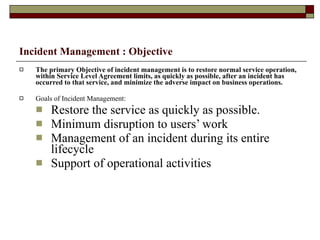
Incident Management : Objective The primary Objective of incident management is to restore normal service operation, within Service Level Agreement limits, as quickly as possible, after an incident has occurred to that service, and minimize the adverse impact on business operations. Goals of Incident Management: Restore the service as quickly as possible. Minimum disruption to users’ work Management of an incident during its entire lifecycle Support of operational activities
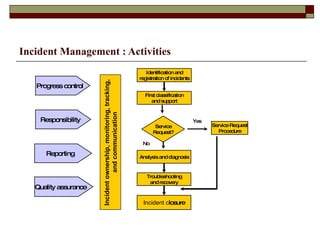
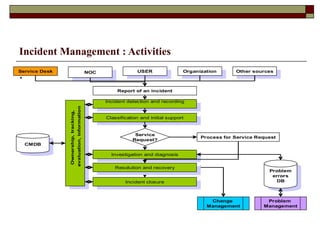
Incident Management : Activities
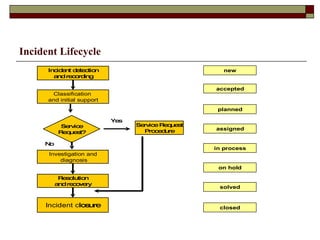
Incident Lifecycle
. Incident Management : Activities
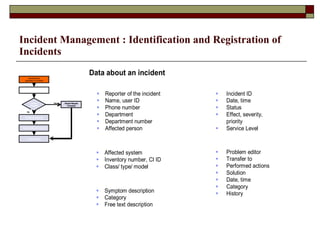
Incident Management : Identification and Registration of Incidents
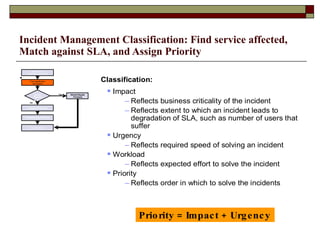
Incident Management Classification: Find service affected, Match against SLA, and Assign Priority .
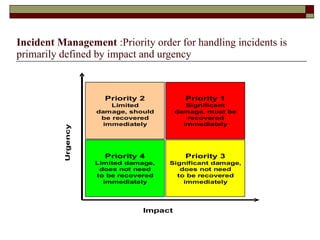
Incident Management  :Priority order for handling incidents is primarily defined by impact and urgency
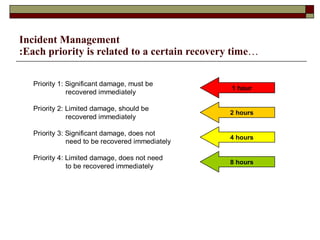
Incident Management :Each priority is related to a certain recovery time …
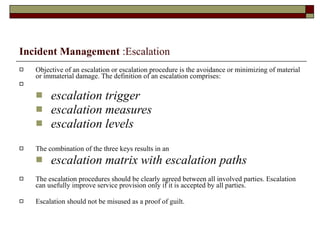
Incident Management  :Escalation Objective of an escalation or escalation procedure is the avoidance or minimizing of material or immaterial damage. The definition of an escalation comprises: escalation trigger escalation measures escalation levels The combination of the three keys results in an escalation matrix with escalation paths The escalation procedures should be clearly agreed between all involved parties. Escalation can usefully improve service provision only if it is accepted by all parties. Escalation should not be misused as a proof of guilt.
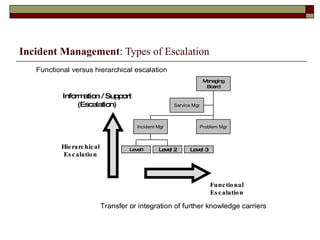
Incident Management : Types of Escalation
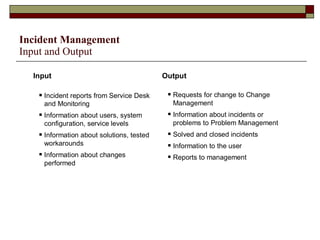
Incident Management Input and Output
Incident Management :Benefits Reduced business impact of incidents by timely resolution Proactive identification of possible enhancements Management information related to business-focused SLA Improved monitoring Improved management information related to aspects of service Better staff utilization: no more interruption-based handling of incidents Elimination of lost incidents and service requests Better and accurate CMDB information Better user/customer satisfaction
Incident Management   Roadblocks: No management/staff commitment, hence no resources Lack of clarity of business needs Badly-defined service goals Working practices not reviewed or changed No service levels defined with customer Lack of knowledge on resolving incidents The quality of the Configuration Database No integration with other processes Resistance to using process
Key Performance indicators Total number of Incidents Average time to restore service from point of first call Percentage of incidents Handled within agreed response time Number of Incidents broken down by Priority and category Number of Incidents escalated by service desk Number of incidents re-opened Number of Incidents by Passing service desk Number of Incidents Incorrectly escalated
Incident management Roles and Responsibilities Incident Manager -  driving the efficiency and effectiveness of the  Incident Management  process  -producing management information  -managing the work of Incident support staff (first-and second-line)  - monitoring the effectiveness of Incident Management and making recommendations for improvement  - developing and maintaining the Incident Management systems.  Incident Analyst (first Line) -  Incident registration -routing service requests to support groups when Incidents are not closed  -initial support and classification  -ownership, monitoring, tracking and communication  -resolution and recovery of Incidents not assigned to second-line support  -closure of Incidents
Incident management Roles and Responsibilities Incident Analyst (second line) - Handling service requests  -monitoring Incident details, including the Configuration Items affected  -Incident investigation and diagnosis (including resolution where possible)  -detection of possible Problems and the assignment of them to the Problem -Management team for them to raise Problem records  - the resolution and recovery of assigned Incidents.  Subject Matter expert - Analyzes incidents to identify service restoration actions to be taken -Takes Incident resolution actions to restore services to customers -Assists incident management staff with identifying the impact of the incidents
Key Relationships Problem Management Configuration Management Change Management Service level Management Availability Management Capacity Management
Tool requirements Tool for  incident logging and recording Automatic Escalation Facilities Automatic extraction of Configuration data from CMDB ACD systems for automatically registering names and phone Numbers of  users
Incident Management Summary: The goal of incident management is to restore normal service operation, within Service Level Agreement limits, as quickly as possible, after an incident has occurred to that service, and to minimize the adverse impact on business operations. Incident Management process Activities Incident detection and recording Classification and initial support Investigation and diagnosis Resolution and recovery Incident closure Prioritization primarily determined by impact on business and urgency with which a resolution or workaround is needed; correct prioritization enables optimum staffing and use of other resources to customer satisfaction.  Escalation (functional and hierarchical)

Incident Management

  • 1.
    ITIL- Incident ManagementFor Beginners  Abhishek Agnihotry If any query mail me at [email_address]
  • 2.
    Contents Incident Managementobjective Incident Management Activities Incident management input and Output Benefits Roadblocks Key Performance indicators Roles and responsibilities Relationships Tool Requirements Summary
  • 3.
    Incident Management :Objective The primary Objective of incident management is to restore normal service operation, within Service Level Agreement limits, as quickly as possible, after an incident has occurred to that service, and minimize the adverse impact on business operations. Goals of Incident Management: Restore the service as quickly as possible. Minimum disruption to users’ work Management of an incident during its entire lifecycle Support of operational activities
  • 4.
  • 5.
  • 6.
  • 7.
    Incident Management :Identification and Registration of Incidents
  • 8.
    Incident Management Classification:Find service affected, Match against SLA, and Assign Priority .
  • 9.
    Incident Management :Priority order for handling incidents is primarily defined by impact and urgency
  • 10.
    Incident Management :Eachpriority is related to a certain recovery time …
  • 11.
    Incident Management :Escalation Objective of an escalation or escalation procedure is the avoidance or minimizing of material or immaterial damage. The definition of an escalation comprises: escalation trigger escalation measures escalation levels The combination of the three keys results in an escalation matrix with escalation paths The escalation procedures should be clearly agreed between all involved parties. Escalation can usefully improve service provision only if it is accepted by all parties. Escalation should not be misused as a proof of guilt.
  • 12.
    Incident Management :Types of Escalation
  • 13.
  • 14.
    Incident Management :BenefitsReduced business impact of incidents by timely resolution Proactive identification of possible enhancements Management information related to business-focused SLA Improved monitoring Improved management information related to aspects of service Better staff utilization: no more interruption-based handling of incidents Elimination of lost incidents and service requests Better and accurate CMDB information Better user/customer satisfaction
  • 15.
    Incident Management Roadblocks: No management/staff commitment, hence no resources Lack of clarity of business needs Badly-defined service goals Working practices not reviewed or changed No service levels defined with customer Lack of knowledge on resolving incidents The quality of the Configuration Database No integration with other processes Resistance to using process
  • 16.
    Key Performance indicatorsTotal number of Incidents Average time to restore service from point of first call Percentage of incidents Handled within agreed response time Number of Incidents broken down by Priority and category Number of Incidents escalated by service desk Number of incidents re-opened Number of Incidents by Passing service desk Number of Incidents Incorrectly escalated
  • 17.
    Incident management Rolesand Responsibilities Incident Manager - driving the efficiency and effectiveness of the Incident Management process -producing management information -managing the work of Incident support staff (first-and second-line) - monitoring the effectiveness of Incident Management and making recommendations for improvement - developing and maintaining the Incident Management systems. Incident Analyst (first Line) - Incident registration -routing service requests to support groups when Incidents are not closed -initial support and classification -ownership, monitoring, tracking and communication -resolution and recovery of Incidents not assigned to second-line support -closure of Incidents
  • 18.
    Incident management Rolesand Responsibilities Incident Analyst (second line) - Handling service requests -monitoring Incident details, including the Configuration Items affected -Incident investigation and diagnosis (including resolution where possible) -detection of possible Problems and the assignment of them to the Problem -Management team for them to raise Problem records - the resolution and recovery of assigned Incidents. Subject Matter expert - Analyzes incidents to identify service restoration actions to be taken -Takes Incident resolution actions to restore services to customers -Assists incident management staff with identifying the impact of the incidents
  • 19.
    Key Relationships ProblemManagement Configuration Management Change Management Service level Management Availability Management Capacity Management
  • 20.
    Tool requirements Toolfor incident logging and recording Automatic Escalation Facilities Automatic extraction of Configuration data from CMDB ACD systems for automatically registering names and phone Numbers of users
  • 21.
    Incident Management Summary:The goal of incident management is to restore normal service operation, within Service Level Agreement limits, as quickly as possible, after an incident has occurred to that service, and to minimize the adverse impact on business operations. Incident Management process Activities Incident detection and recording Classification and initial support Investigation and diagnosis Resolution and recovery Incident closure Prioritization primarily determined by impact on business and urgency with which a resolution or workaround is needed; correct prioritization enables optimum staffing and use of other resources to customer satisfaction. Escalation (functional and hierarchical)