Figurative
Language
What is figurative language?
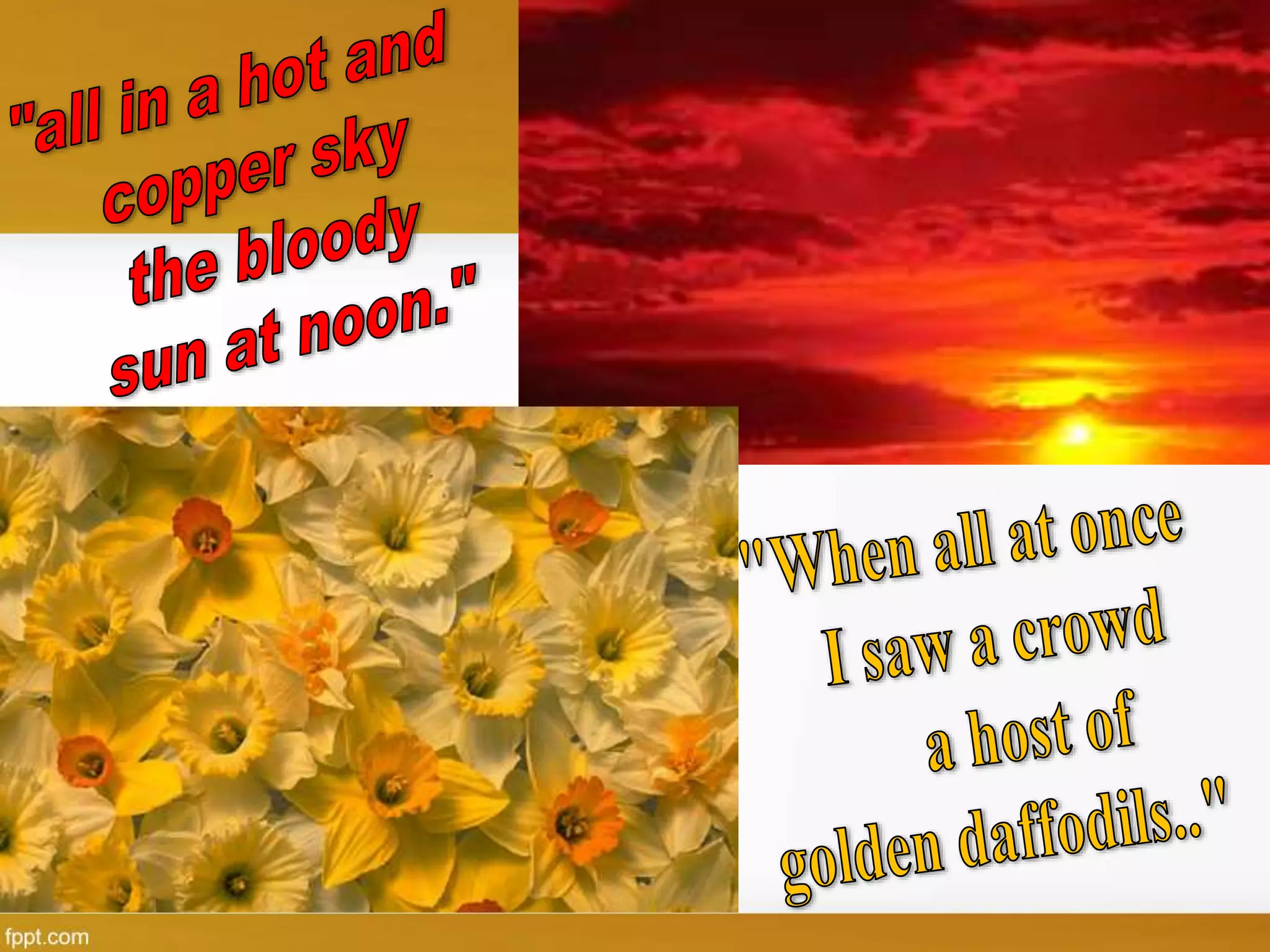
Whenever you describe something by
comparing it with something else,
you are using figurative language.
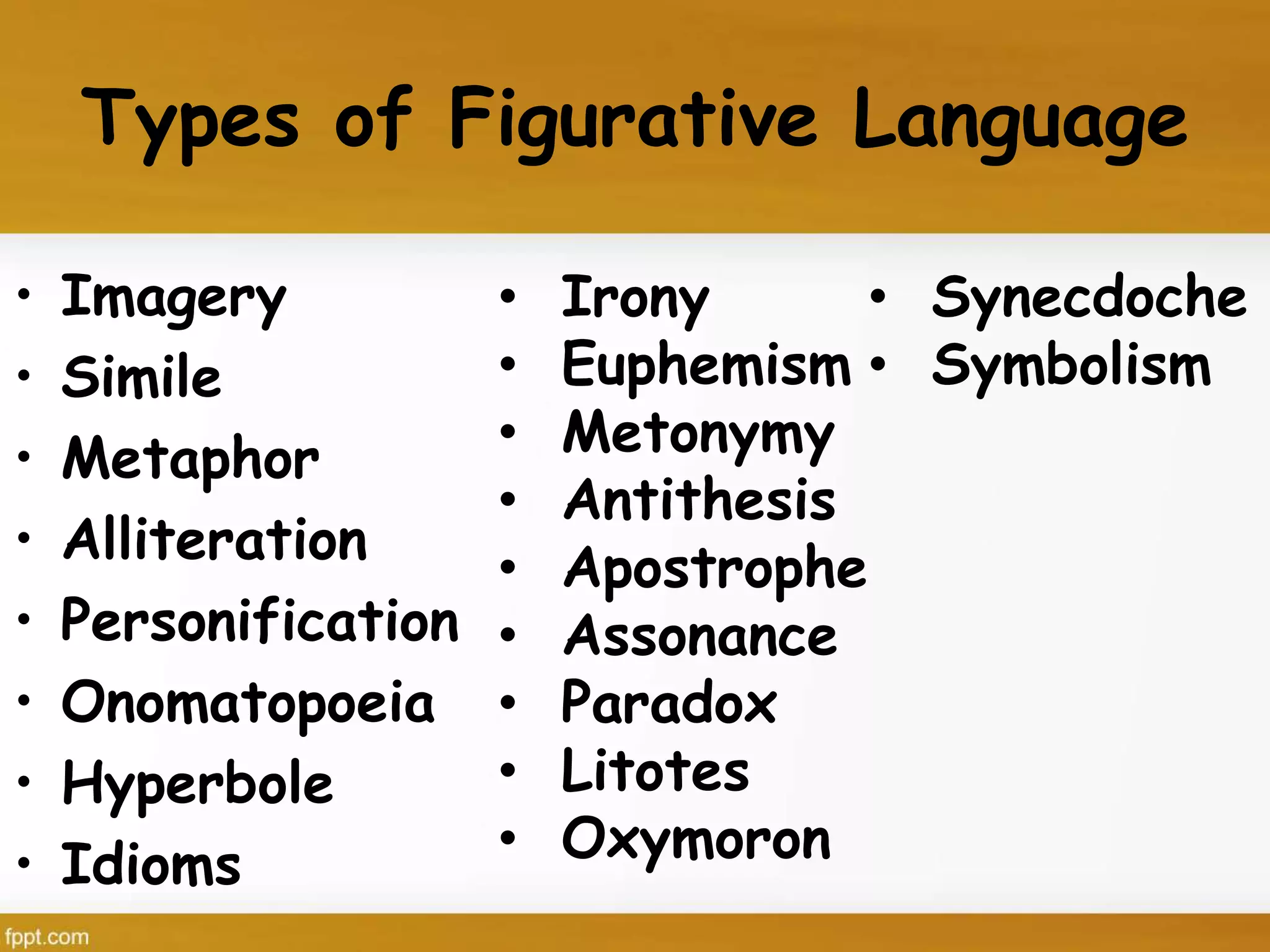
Types of Figurative Language
• Imagery
• Simile
• Metaphor
• Alliteration
• Personification
• Onomatopoeia
• Hyperbole
• Idioms
• Irony
• Euphemism
• Metonymy
• Antithesis
• Apostrophe
• Assonance
• Paradox
• Litotes
• Oxymoron
• Synecdoche
• Symbolism
Imagery
• Sight
• Hearing
• Touch
• Taste
• Smell
Language that appeals to the senses.
Descriptions of people or objects
stated in terms of our senses.
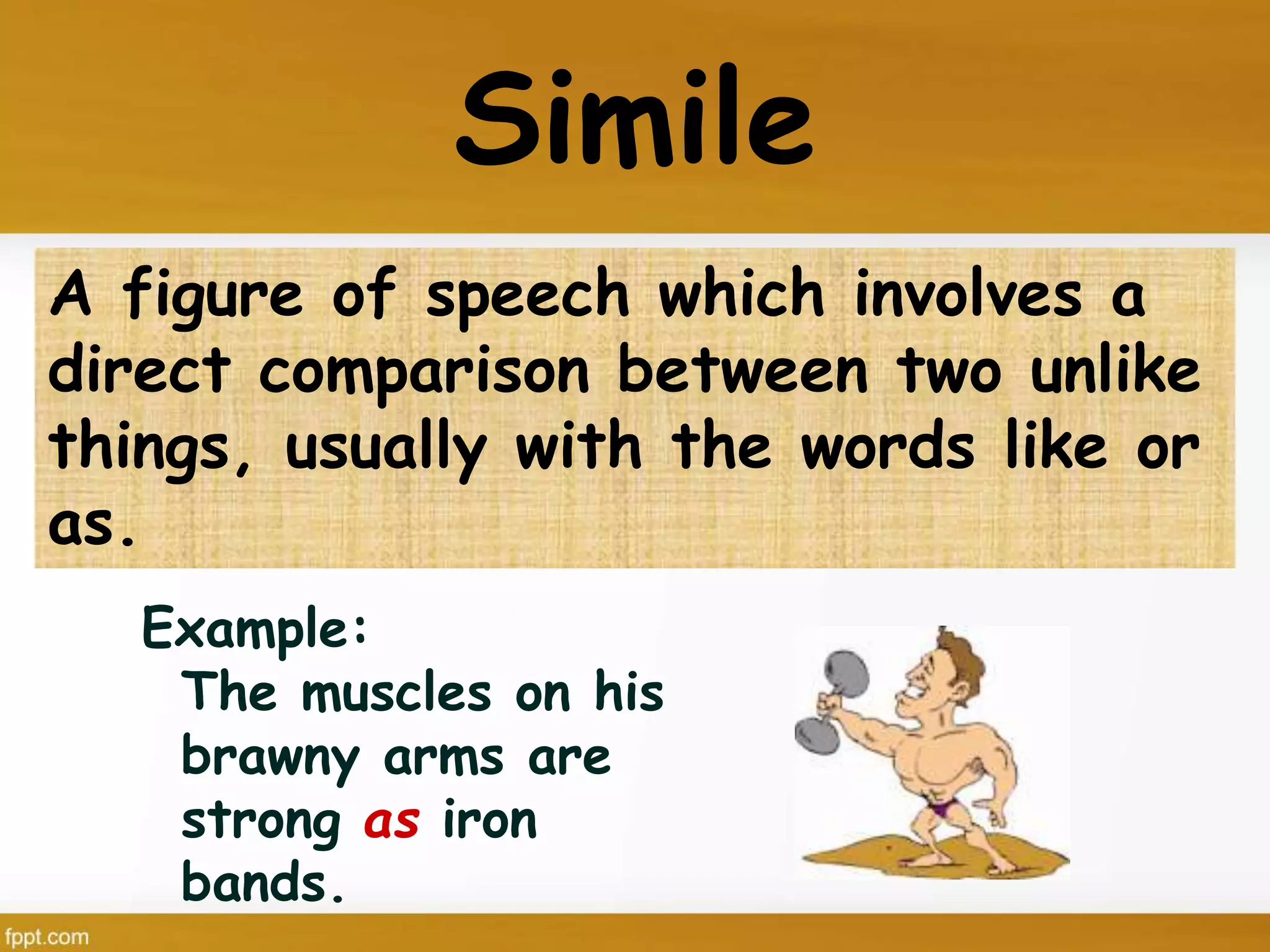
Simile
Example:
The muscles on his
brawny arms are
strong as iron
bands.
A figure of speech which involves a
direct comparison between two unlike
things, usually with the words like or
as.
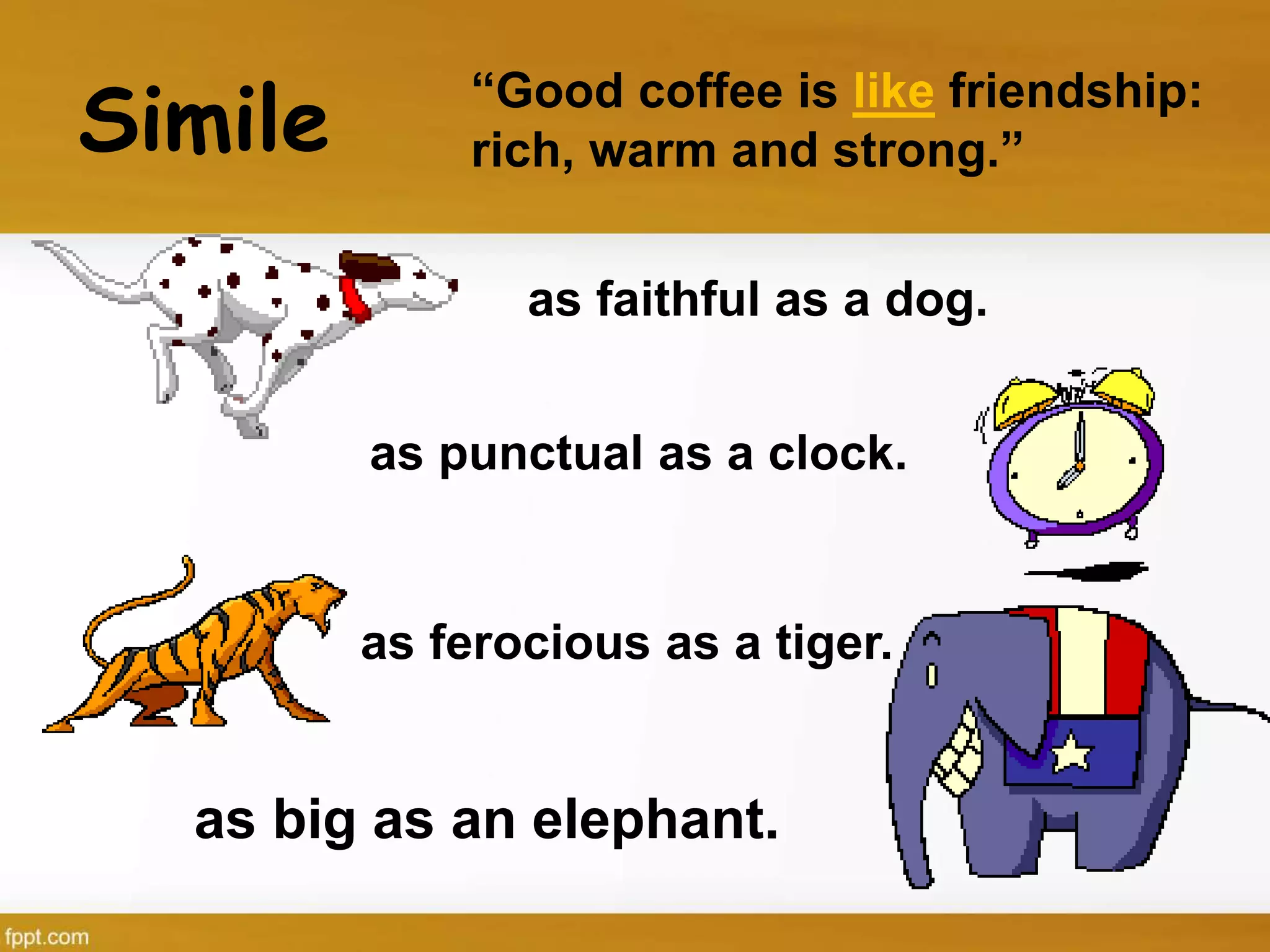
Simile
as faithful as a dog.
as punctual as a clock.
as ferocious as a tiger.
as big as an elephant.
“Good coffee is like friendship:
rich, warm and strong.”
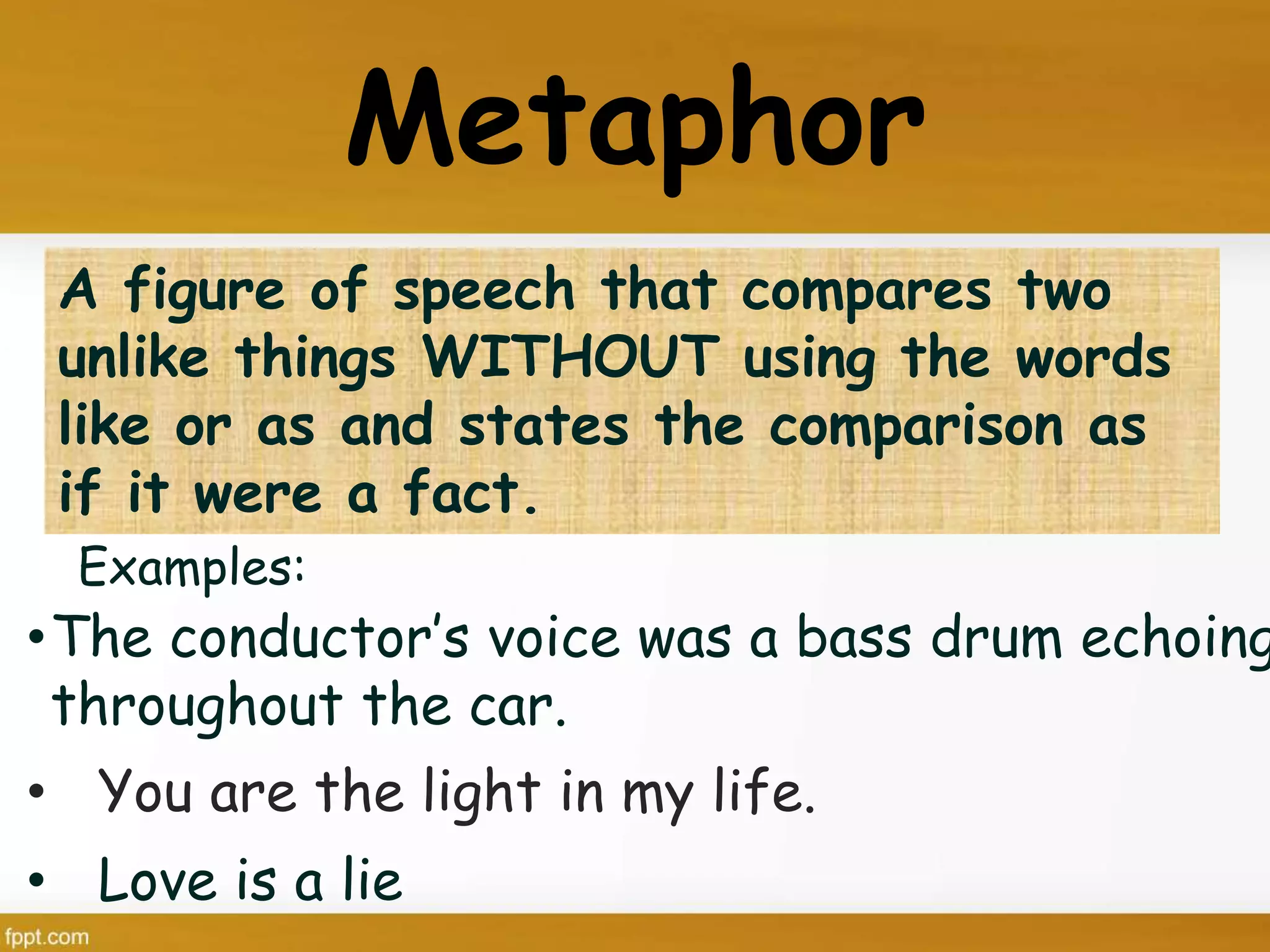
Metaphor
A figure of speech that compares two
unlike things WITHOUT using the words
like or as and states the comparison as
if it were a fact.
•The conductor’s voice was a bass drum echoing
throughout the car.
• You are the light in my life.
• Love is a lie
Examples:
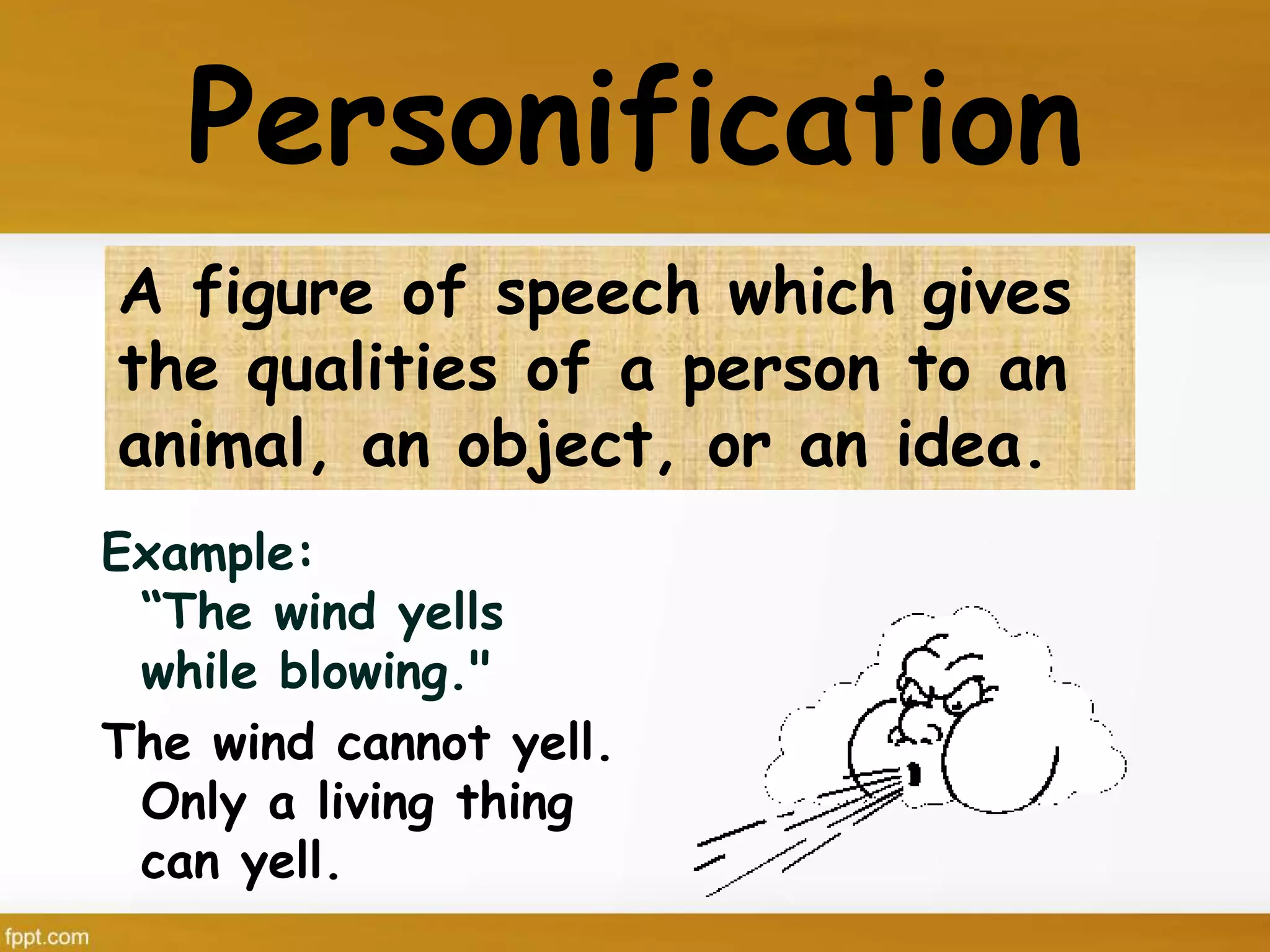
Personification
Example:
“The wind yells
while blowing."
The wind cannot yell.
Only a living thing
can yell.
A figure of speech which gives
the qualities of a person to an
animal, an object, or an idea.
Personification examples…
• The wind whistled against my cheeks.
• The sun greeted me this morning.
• The flowers begged for water.
• The wind screamed as it raced around the
house.
• Lightning danced across the sky.
• Trees bowed to the ground.
• The carved pumpkin smiled at me.
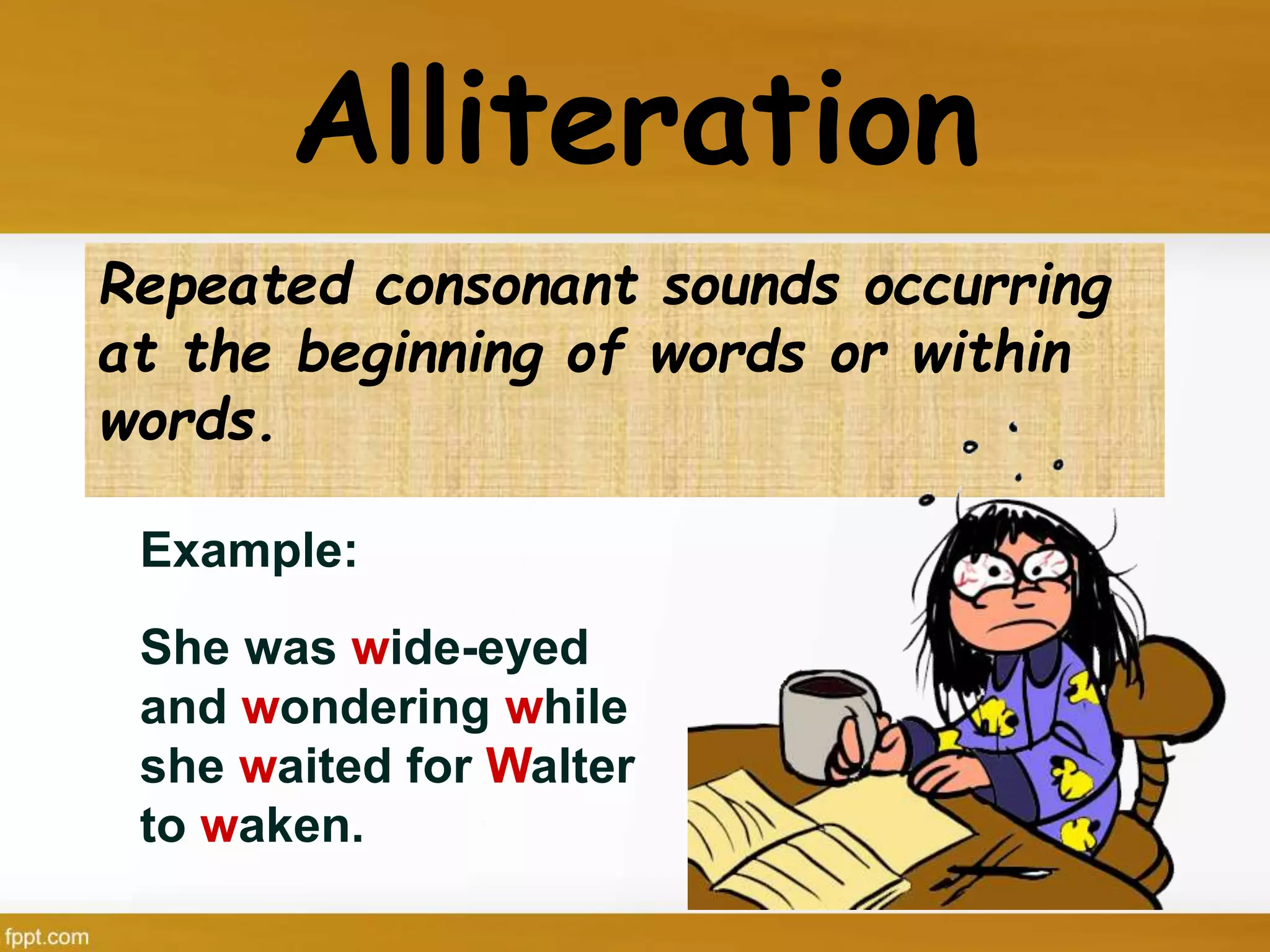
Alliteration
Repeated consonant sounds occurring
at the beginning of words or within
words.
Example:
She was wide-eyed
and wondering while
she waited for Walter
to waken.
Alliteration examples…
• Carries cat clawed her couch, creating chaos.
• Dan’s dog dove deep in the dam, drinking dirty
water as he dove.
• Eric’s eagle eats eggs, enjoying each episode
of eating.
• Fred’s friends fried Fritos for Friday’s food.
• Hannah’s home has heat hopefully.
• Alice’s aunt ate apples and acorns around
August.
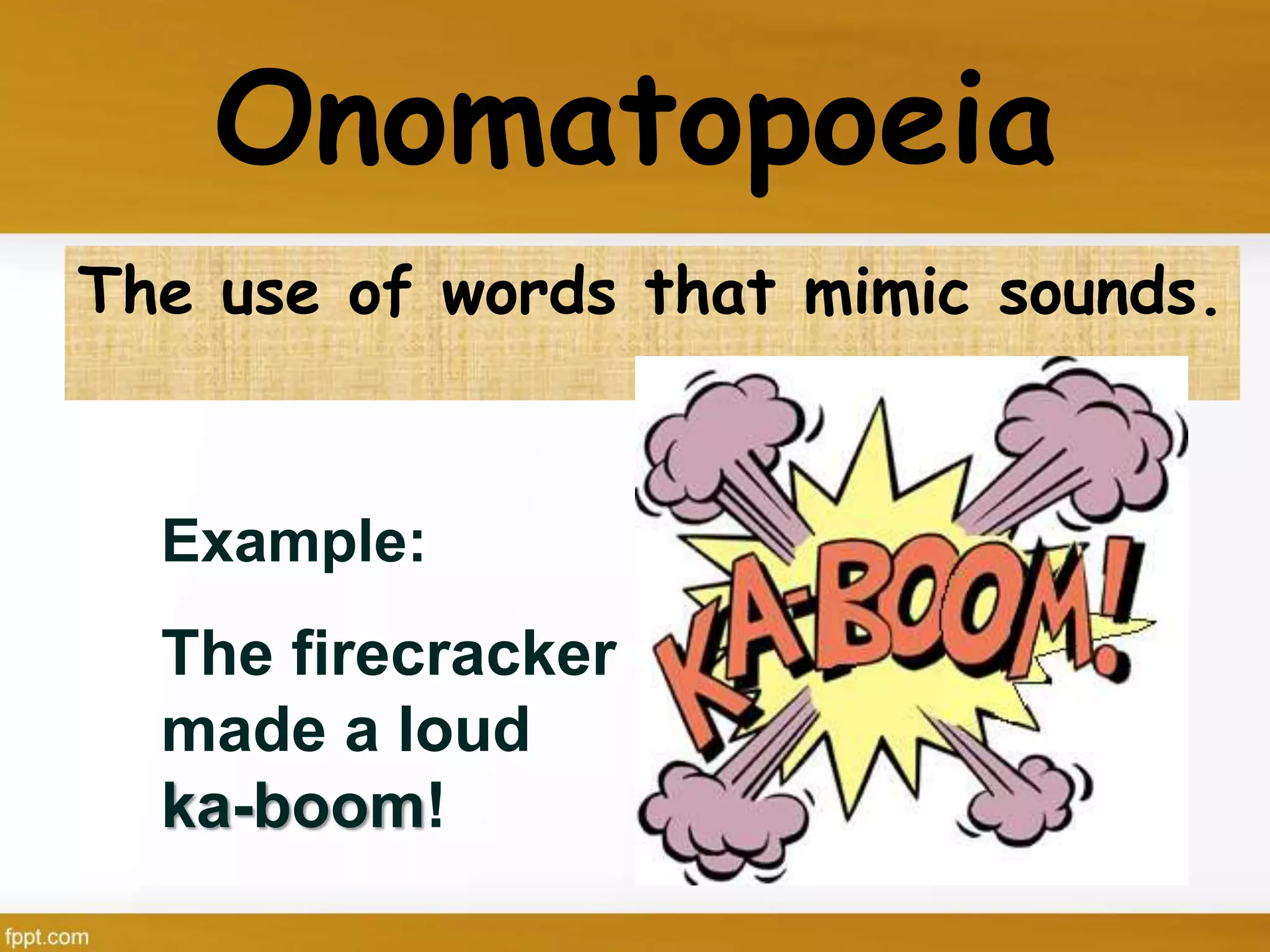
Onomatopoeia
The use of words that mimic sounds.
Example:
The firecracker
made a loud
ka-boom!
Hyperbole
Hyperbole is an
outrageous
exaggeration that
emphasizes a point, and
can be ridiculous or
funny.
Hyperbole examples…
• The lottery winner's grin stretched
from New York City to Los Angeles.
• You snore louder than a freight train.
• I have died everyday waiting for you
• It was so cold, I saw polar bears
wearing jackets.
• I am so hungry that I can eat a horse.
• I had a ton of homework
Idioms
An idiom or idiomatic
expression refers to a
construction or expression
in one language that cannot
be matched or directly
translated word-for-word
in another language.
Idioms
Example:
You should keep your eye
out for him.
To keep an eye out for
someone means to watch
out for them.
Irony
Example:
Irony is the use of words that
mean the opposite of what you
really think especially in order to
be funny.
• “This is my brilliant son who failed
out of college.”
• She’s a great singer who sings like a crow.
Euphemism
Example:
• Passed away – died
• I’m busy – Leave me the alone
• Your being let go – Your Fired
The substitution of an agreeable or
inoffensive expression for one that may
offend or suggest something unpleasant
Examples :
METONYMY
In Metonymy an object is
designated by the name of the
something which is generally
associated with it.
The crown, for kings.
Red-coats, for British soldiers.
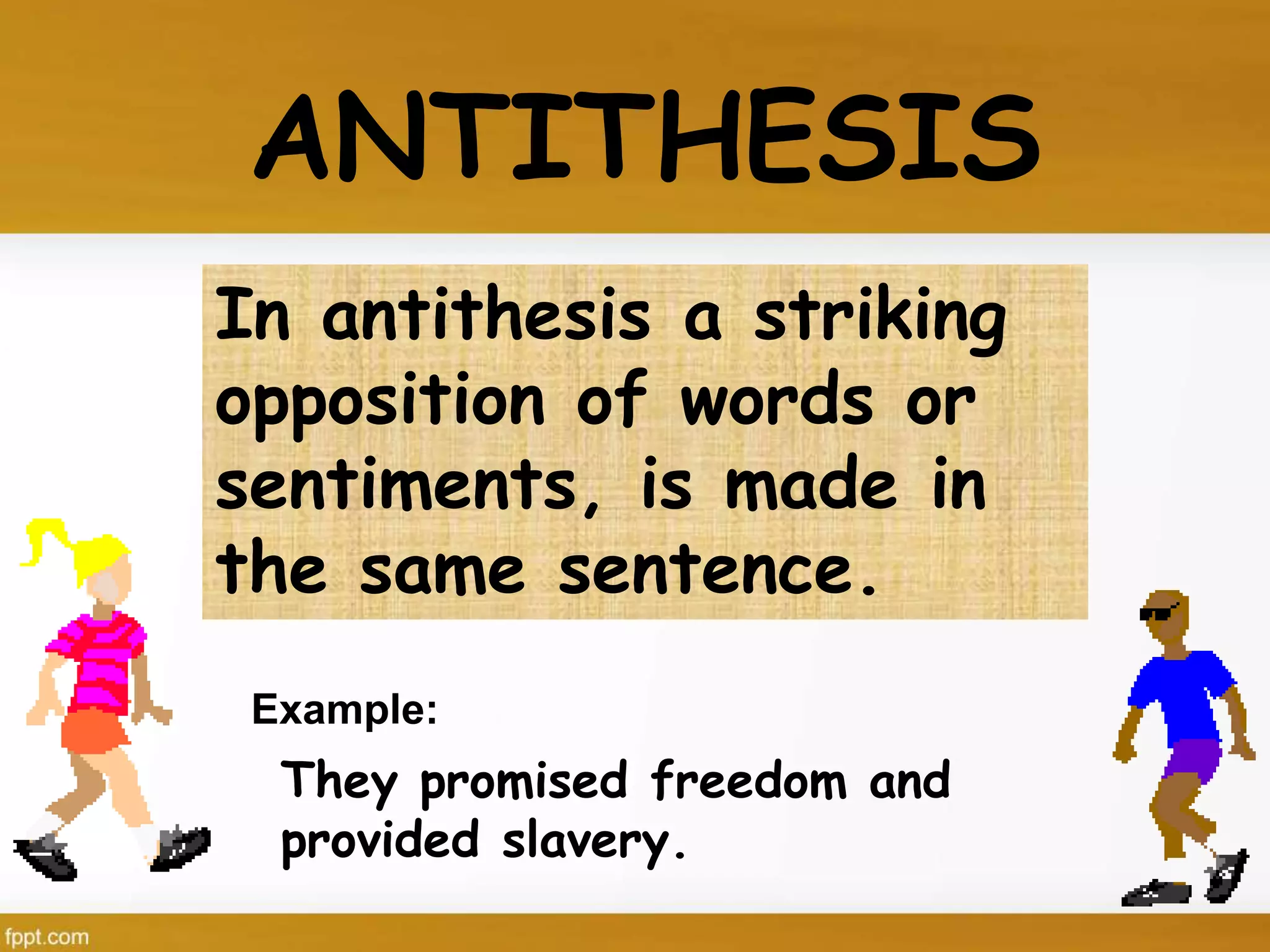
In antithesis a striking
opposition of words or
sentiments, is made in
the same sentence.
ANTITHESIS
They promised freedom and
provided slavery.
Example:
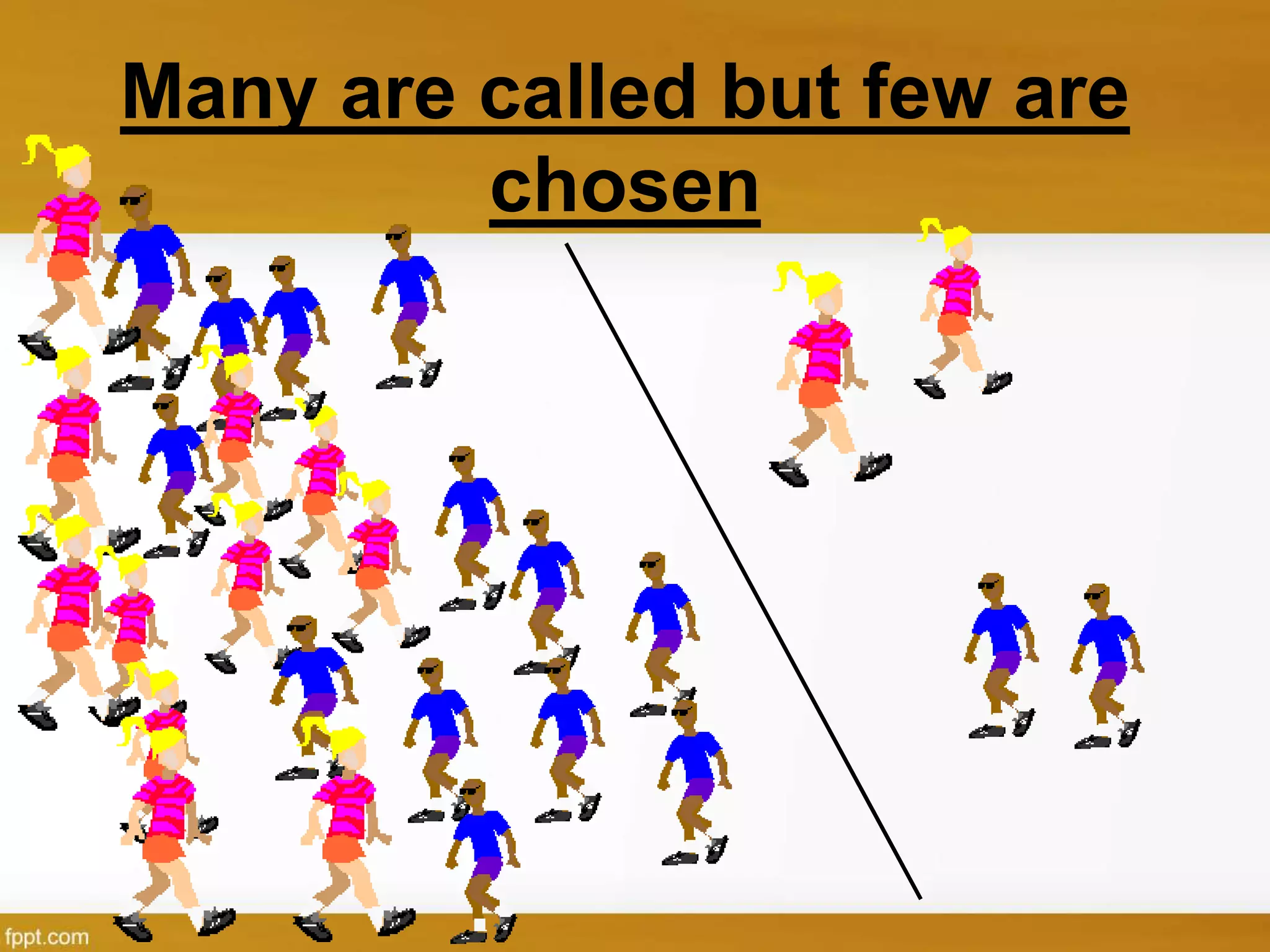
Many are called but few are
chosen
The addressing od usually absent
people or a usually personified
thing rhetorically.
Apostrophe
Carlye’s “O Liberty, what
things are done in thy name.
Example:
LITOTES
In Litotes an affirmative is conveyed by
negation of the opposite, the effect being
to suggest a strong expression by means
of a weaker. It is the opposite of
Hyperbole.
Not unhappy
Not a bad singer
Examples :
Not unlike
The use of words that have the
same or very similar vowel
sounds near one another.
Assonance
• Example:
• Summer fun
• Rise high in the bright sky.
In which a statement appears to
contradict itself
Paradox
• Example:
• “War is Peace.”
• “Freedom is slavery.”
• “Ignorance is strength.”
• My weakness is my strength.
Oxymoron
Example:
• Great Depression
• Criminal Justice
• Hell’s Angels
Contradictory terms appear side
by side. Known as a compressed
paradox.
Examples:
SYNECDOCHE
In Synecdoche a part is used to
designate the whole or the whole to
designate a part.
• Give us this day our daily bread (for food)
• He has many mouths to feed.
• A ten sail (for ten ships)
• As a creature (for a man)
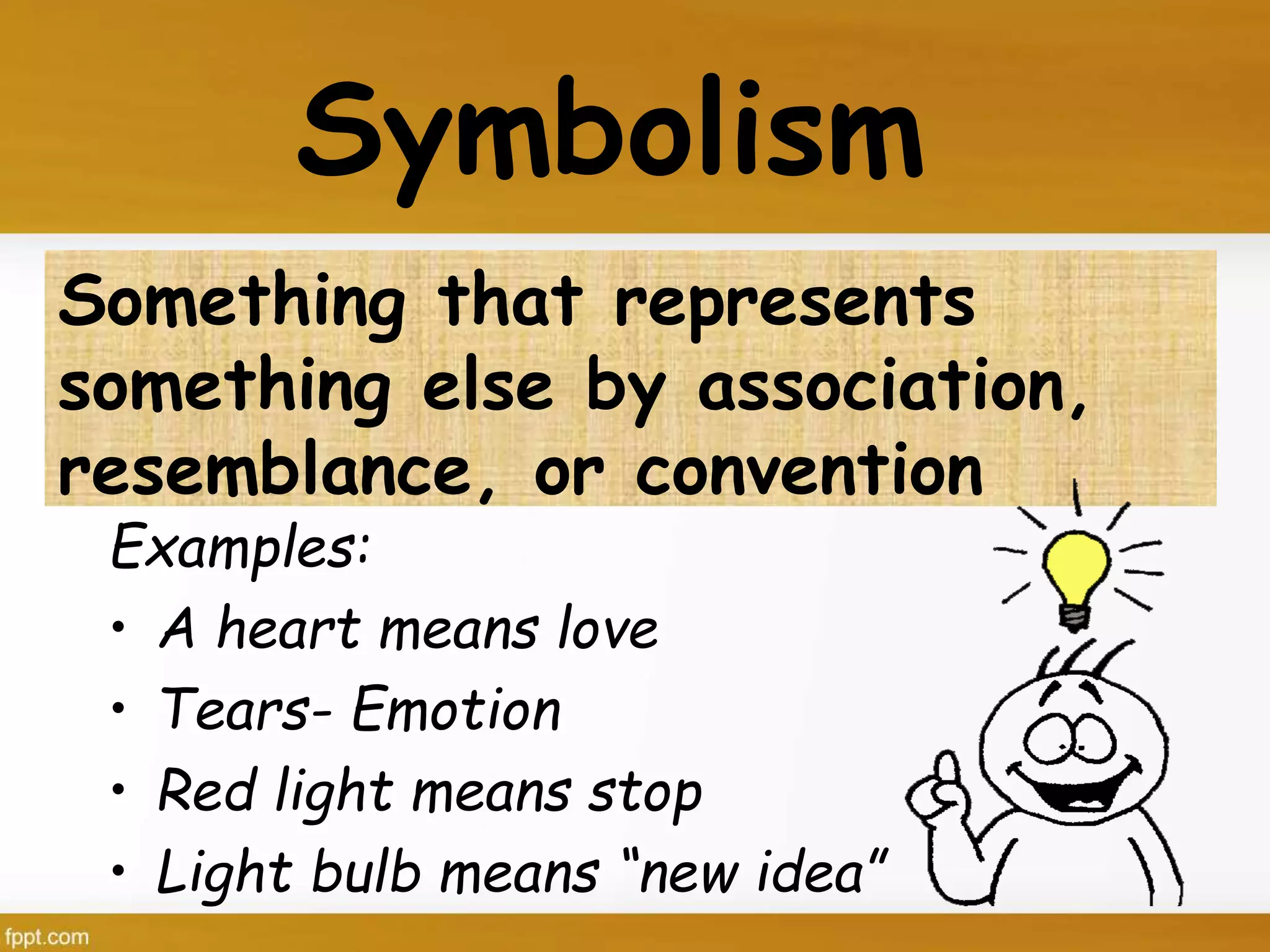
Symbolism
Examples:
• A heart means love
• Tears- Emotion
• Red light means stop
• Light bulb means “new idea”
Something that represents
something else by association,
resemblance, or convention
Figurative Language

Figurative Language

  • 1.
  • 2.
    What is figurativelanguage? Whenever you describe something by comparing it with something else, you are using figurative language.
  • 3.
    Types of FigurativeLanguage • Imagery • Simile • Metaphor • Alliteration • Personification • Onomatopoeia • Hyperbole • Idioms • Irony • Euphemism • Metonymy • Antithesis • Apostrophe • Assonance • Paradox • Litotes • Oxymoron • Synecdoche • Symbolism
  • 4.
    Imagery • Sight • Hearing •Touch • Taste • Smell Language that appeals to the senses. Descriptions of people or objects stated in terms of our senses.
  • 6.
    Simile Example: The muscles onhis brawny arms are strong as iron bands. A figure of speech which involves a direct comparison between two unlike things, usually with the words like or as.
  • 7.
    Simile as faithful asa dog. as punctual as a clock. as ferocious as a tiger. as big as an elephant. “Good coffee is like friendship: rich, warm and strong.”
  • 8.
    Metaphor A figure ofspeech that compares two unlike things WITHOUT using the words like or as and states the comparison as if it were a fact. •The conductor’s voice was a bass drum echoing throughout the car. • You are the light in my life. • Love is a lie Examples:
  • 9.
    Personification Example: “The wind yells whileblowing." The wind cannot yell. Only a living thing can yell. A figure of speech which gives the qualities of a person to an animal, an object, or an idea.
  • 10.
    Personification examples… • Thewind whistled against my cheeks. • The sun greeted me this morning. • The flowers begged for water. • The wind screamed as it raced around the house. • Lightning danced across the sky. • Trees bowed to the ground. • The carved pumpkin smiled at me.
  • 11.
    Alliteration Repeated consonant soundsoccurring at the beginning of words or within words. Example: She was wide-eyed and wondering while she waited for Walter to waken.
  • 12.
    Alliteration examples… • Carriescat clawed her couch, creating chaos. • Dan’s dog dove deep in the dam, drinking dirty water as he dove. • Eric’s eagle eats eggs, enjoying each episode of eating. • Fred’s friends fried Fritos for Friday’s food. • Hannah’s home has heat hopefully. • Alice’s aunt ate apples and acorns around August.
  • 13.
    Onomatopoeia The use ofwords that mimic sounds. Example: The firecracker made a loud ka-boom!
  • 14.
    Hyperbole Hyperbole is an outrageous exaggerationthat emphasizes a point, and can be ridiculous or funny.
  • 15.
    Hyperbole examples… • Thelottery winner's grin stretched from New York City to Los Angeles. • You snore louder than a freight train. • I have died everyday waiting for you • It was so cold, I saw polar bears wearing jackets. • I am so hungry that I can eat a horse. • I had a ton of homework
  • 16.
    Idioms An idiom oridiomatic expression refers to a construction or expression in one language that cannot be matched or directly translated word-for-word in another language.
  • 17.
    Idioms Example: You should keepyour eye out for him. To keep an eye out for someone means to watch out for them.
  • 18.
    Irony Example: Irony is theuse of words that mean the opposite of what you really think especially in order to be funny. • “This is my brilliant son who failed out of college.” • She’s a great singer who sings like a crow.
  • 19.
    Euphemism Example: • Passed away– died • I’m busy – Leave me the alone • Your being let go – Your Fired The substitution of an agreeable or inoffensive expression for one that may offend or suggest something unpleasant
  • 20.
    Examples : METONYMY In Metonymyan object is designated by the name of the something which is generally associated with it. The crown, for kings. Red-coats, for British soldiers.
  • 21.
    In antithesis astriking opposition of words or sentiments, is made in the same sentence. ANTITHESIS They promised freedom and provided slavery. Example:
  • 22.
    Many are calledbut few are chosen
  • 23.
    The addressing odusually absent people or a usually personified thing rhetorically. Apostrophe Carlye’s “O Liberty, what things are done in thy name. Example:
  • 24.
    LITOTES In Litotes anaffirmative is conveyed by negation of the opposite, the effect being to suggest a strong expression by means of a weaker. It is the opposite of Hyperbole. Not unhappy Not a bad singer Examples : Not unlike
  • 25.
    The use ofwords that have the same or very similar vowel sounds near one another. Assonance • Example: • Summer fun • Rise high in the bright sky.
  • 26.
    In which astatement appears to contradict itself Paradox • Example: • “War is Peace.” • “Freedom is slavery.” • “Ignorance is strength.” • My weakness is my strength.
  • 27.
    Oxymoron Example: • Great Depression •Criminal Justice • Hell’s Angels Contradictory terms appear side by side. Known as a compressed paradox.
  • 28.
    Examples: SYNECDOCHE In Synecdoche apart is used to designate the whole or the whole to designate a part. • Give us this day our daily bread (for food) • He has many mouths to feed. • A ten sail (for ten ships) • As a creature (for a man)
  • 29.
    Symbolism Examples: • A heartmeans love • Tears- Emotion • Red light means stop • Light bulb means “new idea” Something that represents something else by association, resemblance, or convention

Editor's Notes

  • #2 Jesica Prudenciano
  • #4 Irony Euphemism Metonymy Antithesis Apostophe Paradox Assosance Litotes Oxymoron Synecdoche Symbolism
  • #19 She’s a great singer who sings like a crow
  • #22 Example:
  • #24 Example: