







Things I wish I'd known...
AtoM tips, tricks, and gotchas
https://pixabay.com/en/dumbbells-weights-weight-lifting-1634750/
https://pixabay.com/en/clocks-clock-time-watch-date-1098080//
User inactivity logout time limit
https://pixabay.com/en/clocks-clock-time-watch-date-1098080//
Did you know? By default, AtoM will automatically log you out of the
application after 30 minutes of inactivity. This is a security measure in case you
accidentally leave a logged in browser session open.
However, it also means that if you spend too long working on a single record
without pausing to save, your data will be lost! When you try to save, AtoM
will direct you to the login page.
Be sure to save your work periodically to prevent this from happening!
User inactivity logout time limit
https://pixabay.com/en/clocks-clock-time-watch-date-1098080//
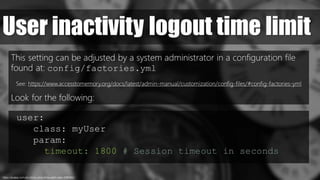
This setting can be adjusted by a system administrator in a configuration file
found at: config/factories.yml
See: https://www.accesstomemory.org/docs/latest/admin-manual/customization/config-files/#config-factories-yml
Look for the following:
user:
class: myUser
param:
timeout: 1800 # Session timeout in seconds
User inactivity logout time limit
https://pixabay.com/en/clocks-clock-time-watch-date-1098080//
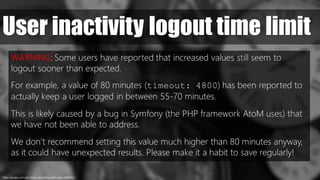
WARNING: Some users have reported that increased values still seem to
logout sooner than expected.
For example, a value of 80 minutes (timeout: 4800) has been reported to
actually keep a user logged in between 55-70 minutes.
This is likely caused by a bug in Symfony (the PHP framework AtoM uses) that
we have not been able to address.
We don’t recommend setting this value much higher than 80 minutes anyway,
as it could have unexpected results. Please make it a habit to save regularly!
User inactivity logout time limit
https://pixabay.com/en/clocks-clock-time-watch-date-1098080//
BONUS TIP: Many browsers have free extensions or add-ons that can
automatically save web form data (like AtoM’s edit templates) as you work, and
recover it if it is lost.
Search the web store for your preferred browser to find options.
NOTE: We have NOT tested the use of these ourselves, and cannot
recommend a specific extension. If you find one you like, why not share with
the community in the AtoM User Forum?
https://pxhere.com/en/photo/1064969
Creator and repository inheritance
https://pxhere.com/en/photo/1064969
Creator and repository inheritance
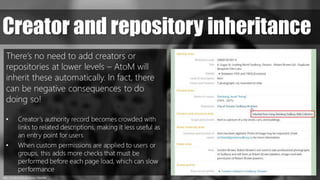
There’s no need to add creators or
repositories at lower levels – AtoM will
inherit these automatically. In fact, there
can be negative consequences to do
doing so!
• Creator’s authority record becomes crowded with
links to related descriptions, making it less useful as
an entry point for users
• When custom permissions are applied to users or
groups, this adds more checks that must be
performed before each page load, which can slow
performance
https://commons.wikimedia.org/wiki/File:Toyogeki-Movie_Toyooka002.jpg
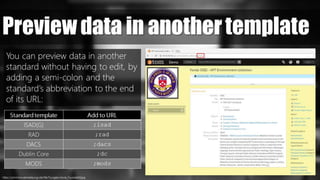
Preview data in another template
You can preview data in another
standard without having to edit, by
adding a semi-colon and the
standard’s abbreviation to the end
of its URL:
Standard template Add to URL
ISAD(G) ;isad
RAD ;rad
DACS ;dacs
Dublin Core ;dc
MODS ;mods
https://commons.wikimedia.org/wiki/File:Toyogeki-Movie_Toyooka002.jpg
https://pxhere.com/en/photo/872686/
ASCIIbetical not Alphabetical sort
https://pxhere.com/en/photo/872686/
ASCIIbetical not Alphabetical sort
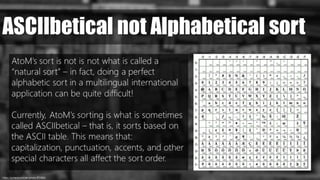
AtoM’s sort is not is not what is called a
“natural sort” – in fact, doing a perfect
alphabetic sort in a multilingual international
application can be quite difficult!
Currently, AtoM’s sorting is what is sometimes
called ASCIIbetical – that is, it sorts based on
the ASCII table. This means that:
capitalization, punctuation, accents, and other
special characters all affect the sort order.
https://pxhere.com/en/photo/872686/
ASCIIbetical not Alphabetical sort
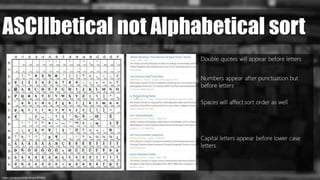
Double quotes will appear before letters
Numbers appear after punctuation but
before letters
Spaces will affect sort order as well
Capital letters appear before lower case
letters
https://pxhere.com/en/photo/872686/
ASCIIbetical not Alphabetical sort
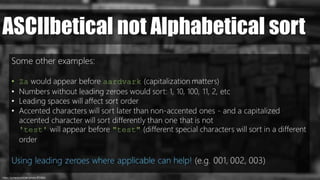
Some other examples:
• Za would appear before aardvark (capitalization matters)
• Numbers without leading zeroes would sort: 1, 10, 100, 11, 2, etc
• Leading spaces will affect sort order
• Accented characters will sort later than non-accented ones - and a capitalized
accented character will sort differently than one that is not
'test' will appear before "test" (different special characters will sort in a different
order
Using leading zeroes where applicable can help! (e.g. 001, 002, 003)
https://www.pexels.com/photo/coffee-countryside-close-up-view-macro-69976/
Filter search and browse pages
https://www.pexels.com/photo/coffee-countryside-close-up-view-macro-69976/
Filter search and browse pages
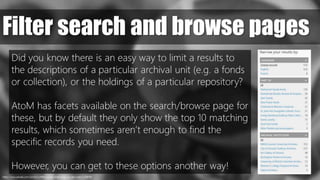
Did you know there is an easy way to limit a results to
the descriptions of a particular archival unit (e.g. a fonds
or collection), or the holdings of a particular repository?
AtoM has facets available on the search/browse page for
these, but by default they only show the top 10 matching
results, which sometimes aren’t enough to find the
specific records you need.
However, you can get to these options another way!
https://www.pexels.com/photo/coffee-countryside-close-up-view-macro-69976/
Filter search and browse pages
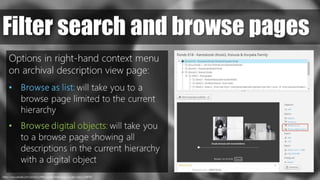
Options in right-hand context menu
on archival description view page:
• Browse as list: will take you to a
browse page limited to the current
hierarchy
• Browse digital objects: will take you
to a browse page showing all
descriptions in the current hierarchy
with a digital object
https://www.pexels.com/photo/coffee-countryside-close-up-view-macro-69976/
Filter search and browse pages
Filter tag indicates
page is limited to
selected hierarchy
Can now use facets
and advanced search
filters to explore
further within this
collection.
https://www.pexels.com/photo/coffee-countryside-close-up-view-macro-69976/
Filter search and browse pages
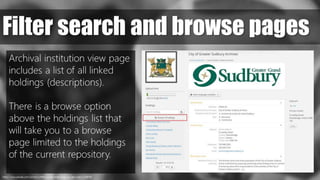
Archival institution view page
includes a list of all linked
holdings (descriptions).
There is a browse option
above the holdings list that
will take you to a browse
page limited to the holdings
of the current repository.
https://www.pexels.com/photo/coffee-countryside-close-up-view-macro-69976/
Filter search and browse pages
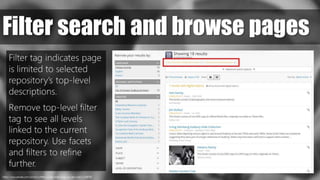
Filter tag indicates page
is limited to selected
repository’s top-level
descriptions.
Remove top-level filter
tag to see all levels
linked to the current
repository. Use facets
and filters to refine
further.
https://www.pexels.com/photo/selective-focus-photography-of-zebra-763925/
Put a zebra in it!
https://www.pexels.com/photo/selective-focus-photography-of-zebra-763925/
Put a zebra in it!
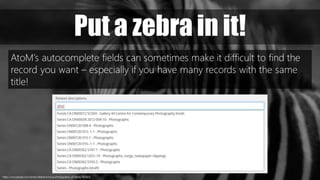
AtoM’s autocomplete fields can sometimes make it difficult to find the
record you want – especially if you have many records with the same
title!
https://www.pexels.com/photo/selective-focus-photography-of-zebra-763925/
Put a zebra in it!
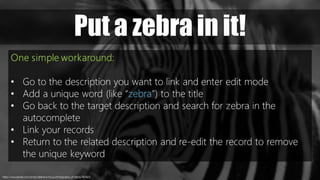
One simple workaround:
• Go to the description you want to link and enter edit mode
• Add a unique word (like “zebra”) to the title
• Go back to the target description and search for zebra in the
autocomplete
• Link your records
• Return to the related description and re-edit the record to remove
the unique keyword
https://en.wikipedia.org/wiki/File:World_Map_1689.JPG
Add dynamic maps to your content
https://en.wikipedia.org/wiki/File:World_Map_1689.JPG
Add dynamic maps to your content
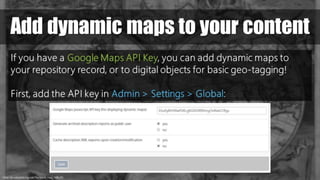
If you have a Google Maps API Key, you can add dynamic maps to
your repository record, or to digital objects for basic geo-tagging!
First, add the API key in Admin > Settings > Global:
https://en.wikipedia.org/wiki/File:World_Map_1689.JPG
Add dynamic maps to your content
For repository records,
just add latitude and
longitude values in the
Contact area.
Pro tip: there is a CLI task
that can attempt to fetch
lats and longs based on
the existing address info!
https://en.wikipedia.org/wiki/File:World_Map_1689.JPG
Add dynamic maps to your content
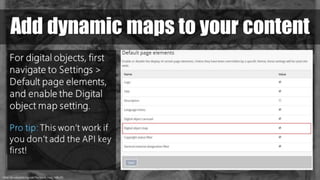
For digital objects, first
navigate to Settings >
Default page elements,
and enable the Digital
object map setting.
Pro tip: This won’t work if
you don’t add the API key
first!
https://en.wikipedia.org/wiki/File:World_Map_1689.JPG
Add dynamic maps to your content
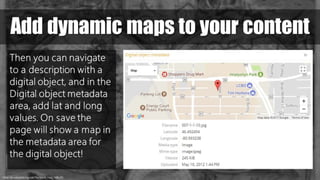
Then you can navigate
to a description with a
digital object, and in the
Digital object metadata
area, add lat and long
values. On save the
page will show a map in
the metadata area for
the digital object!
https://en.wikipedia.org/wiki/File:World_Map_1689.JPG
Warning: 2018 Maps API changes!
As of Sept 2018, you can
no longer use the Maps
API without entering
billing info.
However, users are given
$200/month credit, so
smaller archives can
potentially still use it for
free.
See:
• https://cloud.google.com/maps-platform/user-guide/pricing-changes/
• https://developers.google.com/maps/billing/understanding-cost-of-use
https://www.pexels.com/photo/nature-water-drops-of-water-liquid-40784/
Add a watermark to your digital objects
https://www.pexels.com/photo/nature-water-drops-of-water-liquid-40784/
Add a watermark to your digital objects
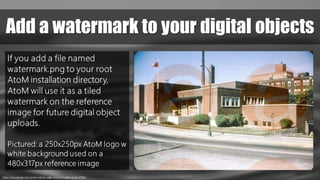
If you add a file named
watermark.png to your root
AtoM installation directory,
AtoM will use it as a tiled
watermark on the reference
image for future digital object
uploads.
Pictured: a 250x250px AtoM logo w
white background used on a
480x317px reference image
https://www.pexels.com/photo/nature-water-drops-of-water-liquid-40784/
Add a watermark to your digital objects
Usage notes:
• Use an image w either a transparent or a white background
• Only reference images will be affected – masters and thumbnails are
unchanged
• Will only affect image derivatives – videos etc. are not affected
• Currently will only tile. This is handled by the imagemagick library – developers
could change the way this is implemented to append a single watermark
• See: https://github.com/artefactual/atom/blob/HEAD/lib/model/QubitDigitalObject.php#L1194-L1204
Brick Laying, from tOrange.biz - https://torange.biz/brick-laying-2880
Add a search box to a static page
Brick Laying, from tOrange.biz - https://torange.biz/brick-laying-2880
Add a search box to a static page
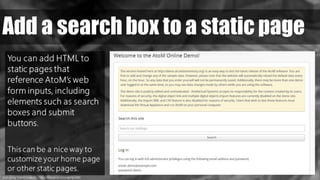
You can add HTML to
static pages that
reference AtoM’s web
form inputs, including
elements such as search
boxes and submit
buttons.
This can be a nice way to
customize your home page
or other static pages.
Brick Laying, from tOrange.biz - https://torange.biz/brick-laying-2880
Add a search box to a static page
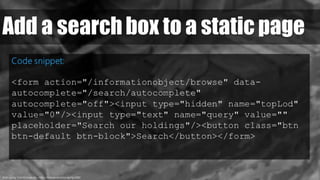
Code snippet:
<form action="/informationobject/browse" data-
autocomplete="/search/autocomplete"
autocomplete="off"><input type="hidden" name="topLod"
value="0"/><input type="text" name="query" value=""
placeholder="Search our holdings"/><button class="btn
btn-default btn-block">Search</button></form>
Brick Laying, from tOrange.biz - https://torange.biz/brick-laying-2880
Add a search box to a static page
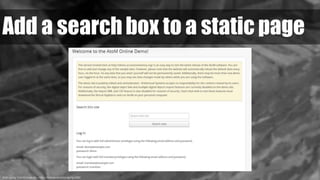
You can also customize it:
<form action="/informationobject/browse" data-
autocomplete="/search/autocomplete" autocomplete="off"
style="width:300px; text-align:center; margin: 0
auto;"><input type="hidden" name="topLod"
value="0"/><input type="text" name="query" value=""
placeholder="Search this site"/><button class="btn
btn-default btn-block">Search now</button></form>
Brick Laying, from tOrange.biz - https://torange.biz/brick-laying-2880
Add a search box to a static page
Brick Laying, from tOrange.biz - https://torange.biz/brick-laying-2880
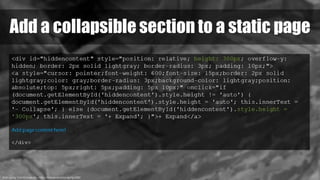
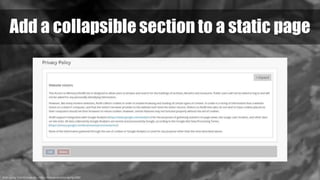
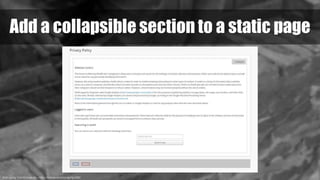
Add a collapsible section to a static page
<div id="hiddencontent" style="position: relative; height: 300px; overflow-y:
hidden; border: 2px solid lightgray; border-radius: 3px; padding: 10px;">
<a style="cursor: pointer;font-weight: 600;font-size: 15px;border: 2px solid
lightgray;color: gray;border-radius: 3px;background-color: lightgray;position:
absolute;top: 5px;right: 5px;padding: 5px 10px;" onclick="if
(document.getElementById('hiddencontent').style.height != 'auto') {
document.getElementById('hiddencontent').style.height = 'auto'; this.innerText =
'- Collapse'; } else {document.getElementById('hiddencontent').style.height =
'300px'; this.innerText = '+ Expand'; }">+ Expand</a>
Add page content here!
</div>
Brick Laying, from tOrange.biz - https://torange.biz/brick-laying-2880
Add a collapsible section to a static page
Brick Laying, from tOrange.biz - https://torange.biz/brick-laying-2880
Add a collapsible section to a static page
records, by Anna. https://www.flickr.com/photos/art_es_anna/1314358266/
Expert searching with Elasticsearch
records, by Anna. https://www.flickr.com/photos/art_es_anna/1314358266/
Expert searching with Elasticsearch
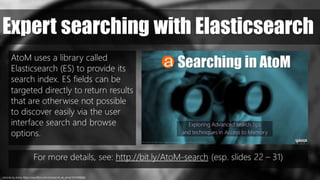
AtoM uses a library called
Elasticsearch (ES) to provide its
search index. ES fields can be
targeted directly to return results
that are otherwise not possible
to discover easily via the user
interface search and browse
options.
For more details, see: http://bit.ly/AtoM-search (esp. slides 22 – 31)
records, by Anna. https://www.flickr.com/photos/art_es_anna/1314358266/
Expert searching with Elasticsearch
EMPTY / MISSING FIELDS
• Syntax:
• !_exists_:field.name
Examples
Search for English descriptions with no scope and
content:
• !_exists_:i18n.en.scopeAndContent
Search for French descriptions with no extent or medium
statement:
• !_exists_:i18n.fr.extentAndMedium
POPULATED FIELDS
• Syntax:
• _exists_:field.name
Examples
Search for English descriptions with a subject access
point:
• _exists_:subjects.i18n.en.name
Search for Spanish descriptions with a statement on
Sources in the Description control area:
• _exists_:i18n.es.sources
records, by Anna. https://www.flickr.com/photos/art_es_anna/1314358266/
Expert searching with Elasticsearch
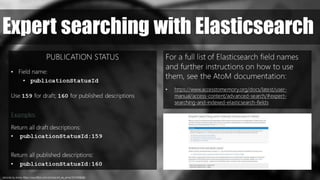
PUBLICATION STATUS
• Field name:
• publicationStatusId
Use 159 for draft; 160 for published descriptions
Examples
Return all draft descriptions:
• publicationStatusId:159
Return all published descriptions:
• publicationStatusId:160
For a full list of Elasticsearch field names
and further instructions on how to use
them, see the AtoM documentation:
• https://www.accesstomemory.org/docs/latest/user-
manual/access-content/advanced-search/#expert-
searching-and-indexed-elasticsearch-fields
Questions?
https://pixabay.com/en/dumbbells-weights-weight-lifting-1634750/
info@artefactual.com

Things I wish I'd known - AtoM tips, tricks, and gotchas

  • 1.
    Things I wishI'd known... AtoM tips, tricks, and gotchas https://pixabay.com/en/dumbbells-weights-weight-lifting-1634750/
  • 2.
  • 3.
    User inactivity logouttime limit https://pixabay.com/en/clocks-clock-time-watch-date-1098080// Did you know? By default, AtoM will automatically log you out of the application after 30 minutes of inactivity. This is a security measure in case you accidentally leave a logged in browser session open. However, it also means that if you spend too long working on a single record without pausing to save, your data will be lost! When you try to save, AtoM will direct you to the login page. Be sure to save your work periodically to prevent this from happening!
  • 4.
    User inactivity logouttime limit https://pixabay.com/en/clocks-clock-time-watch-date-1098080// This setting can be adjusted by a system administrator in a configuration file found at: config/factories.yml See: https://www.accesstomemory.org/docs/latest/admin-manual/customization/config-files/#config-factories-yml Look for the following: user: class: myUser param: timeout: 1800 # Session timeout in seconds
  • 5.
    User inactivity logouttime limit https://pixabay.com/en/clocks-clock-time-watch-date-1098080// WARNING: Some users have reported that increased values still seem to logout sooner than expected. For example, a value of 80 minutes (timeout: 4800) has been reported to actually keep a user logged in between 55-70 minutes. This is likely caused by a bug in Symfony (the PHP framework AtoM uses) that we have not been able to address. We don’t recommend setting this value much higher than 80 minutes anyway, as it could have unexpected results. Please make it a habit to save regularly!
  • 6.
    User inactivity logouttime limit https://pixabay.com/en/clocks-clock-time-watch-date-1098080// BONUS TIP: Many browsers have free extensions or add-ons that can automatically save web form data (like AtoM’s edit templates) as you work, and recover it if it is lost. Search the web store for your preferred browser to find options. NOTE: We have NOT tested the use of these ourselves, and cannot recommend a specific extension. If you find one you like, why not share with the community in the AtoM User Forum?
  • 7.
  • 8.
    https://pxhere.com/en/photo/1064969 Creator and repositoryinheritance There’s no need to add creators or repositories at lower levels – AtoM will inherit these automatically. In fact, there can be negative consequences to do doing so! • Creator’s authority record becomes crowded with links to related descriptions, making it less useful as an entry point for users • When custom permissions are applied to users or groups, this adds more checks that must be performed before each page load, which can slow performance
  • 9.
  • 10.
    Preview data inanother template You can preview data in another standard without having to edit, by adding a semi-colon and the standard’s abbreviation to the end of its URL: Standard template Add to URL ISAD(G) ;isad RAD ;rad DACS ;dacs Dublin Core ;dc MODS ;mods https://commons.wikimedia.org/wiki/File:Toyogeki-Movie_Toyooka002.jpg
  • 11.
  • 12.
    https://pxhere.com/en/photo/872686/ ASCIIbetical not Alphabeticalsort AtoM’s sort is not is not what is called a “natural sort” – in fact, doing a perfect alphabetic sort in a multilingual international application can be quite difficult! Currently, AtoM’s sorting is what is sometimes called ASCIIbetical – that is, it sorts based on the ASCII table. This means that: capitalization, punctuation, accents, and other special characters all affect the sort order.
  • 13.
    https://pxhere.com/en/photo/872686/ ASCIIbetical not Alphabeticalsort Double quotes will appear before letters Numbers appear after punctuation but before letters Spaces will affect sort order as well Capital letters appear before lower case letters
  • 14.
    https://pxhere.com/en/photo/872686/ ASCIIbetical not Alphabeticalsort Some other examples: • Za would appear before aardvark (capitalization matters) • Numbers without leading zeroes would sort: 1, 10, 100, 11, 2, etc • Leading spaces will affect sort order • Accented characters will sort later than non-accented ones - and a capitalized accented character will sort differently than one that is not 'test' will appear before "test" (different special characters will sort in a different order Using leading zeroes where applicable can help! (e.g. 001, 002, 003)
  • 15.
  • 16.
    https://www.pexels.com/photo/coffee-countryside-close-up-view-macro-69976/ Filter search andbrowse pages Did you know there is an easy way to limit a results to the descriptions of a particular archival unit (e.g. a fonds or collection), or the holdings of a particular repository? AtoM has facets available on the search/browse page for these, but by default they only show the top 10 matching results, which sometimes aren’t enough to find the specific records you need. However, you can get to these options another way!
  • 17.
    https://www.pexels.com/photo/coffee-countryside-close-up-view-macro-69976/ Filter search andbrowse pages Options in right-hand context menu on archival description view page: • Browse as list: will take you to a browse page limited to the current hierarchy • Browse digital objects: will take you to a browse page showing all descriptions in the current hierarchy with a digital object
  • 18.
    https://www.pexels.com/photo/coffee-countryside-close-up-view-macro-69976/ Filter search andbrowse pages Filter tag indicates page is limited to selected hierarchy Can now use facets and advanced search filters to explore further within this collection.
  • 19.
    https://www.pexels.com/photo/coffee-countryside-close-up-view-macro-69976/ Filter search andbrowse pages Archival institution view page includes a list of all linked holdings (descriptions). There is a browse option above the holdings list that will take you to a browse page limited to the holdings of the current repository.
  • 20.
    https://www.pexels.com/photo/coffee-countryside-close-up-view-macro-69976/ Filter search andbrowse pages Filter tag indicates page is limited to selected repository’s top-level descriptions. Remove top-level filter tag to see all levels linked to the current repository. Use facets and filters to refine further.
  • 21.
  • 22.
    https://www.pexels.com/photo/selective-focus-photography-of-zebra-763925/ Put a zebrain it! AtoM’s autocomplete fields can sometimes make it difficult to find the record you want – especially if you have many records with the same title!
  • 23.
    https://www.pexels.com/photo/selective-focus-photography-of-zebra-763925/ Put a zebrain it! One simple workaround: • Go to the description you want to link and enter edit mode • Add a unique word (like “zebra”) to the title • Go back to the target description and search for zebra in the autocomplete • Link your records • Return to the related description and re-edit the record to remove the unique keyword
  • 24.
  • 25.
    https://en.wikipedia.org/wiki/File:World_Map_1689.JPG Add dynamic mapsto your content If you have a Google Maps API Key, you can add dynamic maps to your repository record, or to digital objects for basic geo-tagging! First, add the API key in Admin > Settings > Global:
  • 26.
    https://en.wikipedia.org/wiki/File:World_Map_1689.JPG Add dynamic mapsto your content For repository records, just add latitude and longitude values in the Contact area. Pro tip: there is a CLI task that can attempt to fetch lats and longs based on the existing address info!
  • 27.
    https://en.wikipedia.org/wiki/File:World_Map_1689.JPG Add dynamic mapsto your content For digital objects, first navigate to Settings > Default page elements, and enable the Digital object map setting. Pro tip: This won’t work if you don’t add the API key first!
  • 28.
    https://en.wikipedia.org/wiki/File:World_Map_1689.JPG Add dynamic mapsto your content Then you can navigate to a description with a digital object, and in the Digital object metadata area, add lat and long values. On save the page will show a map in the metadata area for the digital object!
  • 29.
    https://en.wikipedia.org/wiki/File:World_Map_1689.JPG Warning: 2018 MapsAPI changes! As of Sept 2018, you can no longer use the Maps API without entering billing info. However, users are given $200/month credit, so smaller archives can potentially still use it for free. See: • https://cloud.google.com/maps-platform/user-guide/pricing-changes/ • https://developers.google.com/maps/billing/understanding-cost-of-use
  • 30.
  • 31.
    https://www.pexels.com/photo/nature-water-drops-of-water-liquid-40784/ Add a watermarkto your digital objects If you add a file named watermark.png to your root AtoM installation directory, AtoM will use it as a tiled watermark on the reference image for future digital object uploads. Pictured: a 250x250px AtoM logo w white background used on a 480x317px reference image
  • 32.
    https://www.pexels.com/photo/nature-water-drops-of-water-liquid-40784/ Add a watermarkto your digital objects Usage notes: • Use an image w either a transparent or a white background • Only reference images will be affected – masters and thumbnails are unchanged • Will only affect image derivatives – videos etc. are not affected • Currently will only tile. This is handled by the imagemagick library – developers could change the way this is implemented to append a single watermark • See: https://github.com/artefactual/atom/blob/HEAD/lib/model/QubitDigitalObject.php#L1194-L1204
  • 33.
    Brick Laying, fromtOrange.biz - https://torange.biz/brick-laying-2880 Add a search box to a static page
  • 34.
    Brick Laying, fromtOrange.biz - https://torange.biz/brick-laying-2880 Add a search box to a static page You can add HTML to static pages that reference AtoM’s web form inputs, including elements such as search boxes and submit buttons. This can be a nice way to customize your home page or other static pages.
  • 35.
    Brick Laying, fromtOrange.biz - https://torange.biz/brick-laying-2880 Add a search box to a static page Code snippet: <form action="/informationobject/browse" data- autocomplete="/search/autocomplete" autocomplete="off"><input type="hidden" name="topLod" value="0"/><input type="text" name="query" value="" placeholder="Search our holdings"/><button class="btn btn-default btn-block">Search</button></form>
  • 36.
    Brick Laying, fromtOrange.biz - https://torange.biz/brick-laying-2880 Add a search box to a static page You can also customize it: <form action="/informationobject/browse" data- autocomplete="/search/autocomplete" autocomplete="off" style="width:300px; text-align:center; margin: 0 auto;"><input type="hidden" name="topLod" value="0"/><input type="text" name="query" value="" placeholder="Search this site"/><button class="btn btn-default btn-block">Search now</button></form>
  • 37.
    Brick Laying, fromtOrange.biz - https://torange.biz/brick-laying-2880 Add a search box to a static page
  • 38.
    Brick Laying, fromtOrange.biz - https://torange.biz/brick-laying-2880 Add a collapsible section to a static page <div id="hiddencontent" style="position: relative; height: 300px; overflow-y: hidden; border: 2px solid lightgray; border-radius: 3px; padding: 10px;"> <a style="cursor: pointer;font-weight: 600;font-size: 15px;border: 2px solid lightgray;color: gray;border-radius: 3px;background-color: lightgray;position: absolute;top: 5px;right: 5px;padding: 5px 10px;" onclick="if (document.getElementById('hiddencontent').style.height != 'auto') { document.getElementById('hiddencontent').style.height = 'auto'; this.innerText = '- Collapse'; } else {document.getElementById('hiddencontent').style.height = '300px'; this.innerText = '+ Expand'; }">+ Expand</a> Add page content here! </div>
  • 39.
    Brick Laying, fromtOrange.biz - https://torange.biz/brick-laying-2880 Add a collapsible section to a static page
  • 40.
    Brick Laying, fromtOrange.biz - https://torange.biz/brick-laying-2880 Add a collapsible section to a static page
  • 41.
    records, by Anna.https://www.flickr.com/photos/art_es_anna/1314358266/ Expert searching with Elasticsearch
  • 42.
    records, by Anna.https://www.flickr.com/photos/art_es_anna/1314358266/ Expert searching with Elasticsearch AtoM uses a library called Elasticsearch (ES) to provide its search index. ES fields can be targeted directly to return results that are otherwise not possible to discover easily via the user interface search and browse options. For more details, see: http://bit.ly/AtoM-search (esp. slides 22 – 31)
  • 43.
    records, by Anna.https://www.flickr.com/photos/art_es_anna/1314358266/ Expert searching with Elasticsearch EMPTY / MISSING FIELDS • Syntax: • !_exists_:field.name Examples Search for English descriptions with no scope and content: • !_exists_:i18n.en.scopeAndContent Search for French descriptions with no extent or medium statement: • !_exists_:i18n.fr.extentAndMedium POPULATED FIELDS • Syntax: • _exists_:field.name Examples Search for English descriptions with a subject access point: • _exists_:subjects.i18n.en.name Search for Spanish descriptions with a statement on Sources in the Description control area: • _exists_:i18n.es.sources
  • 44.
    records, by Anna.https://www.flickr.com/photos/art_es_anna/1314358266/ Expert searching with Elasticsearch PUBLICATION STATUS • Field name: • publicationStatusId Use 159 for draft; 160 for published descriptions Examples Return all draft descriptions: • publicationStatusId:159 Return all published descriptions: • publicationStatusId:160 For a full list of Elasticsearch field names and further instructions on how to use them, see the AtoM documentation: • https://www.accesstomemory.org/docs/latest/user- manual/access-content/advanced-search/#expert- searching-and-indexed-elasticsearch-fields
  • 45.