Sound
Diegetic
• Sound that exists within the fictional world of
the text (the diegesis).
Non-diegetic
• Sound that the audience can hear, but doesn’t
exist within the fictional world of text.
Sound mixing
• When the different parts of sound, music,
video etc, change volume levels.
• Artificially created or enhanced sounds.
Sound effects
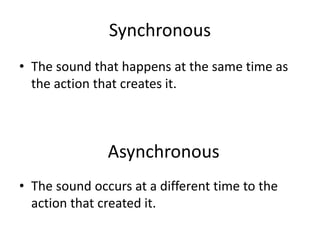
Synchronous
• The sound that happens at the same time as
the action that creates it.
• The sound occurs at a different time to the
action that created it.
Asynchronous
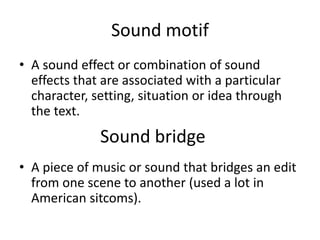
Sound motif
• A sound effect or combination of sound
effects that are associated with a particular
character, setting, situation or idea through
the text.
• A piece of music or sound that bridges an edit
from one scene to another (used a lot in
American sitcoms).
Sound bridge
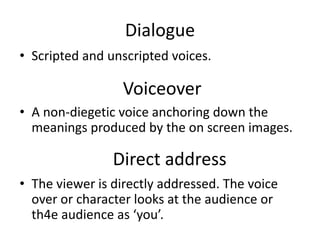
Dialogue
• Scripted and unscripted voices.
• A non-diegetic voice anchoring down the
meanings produced by the on screen images.
• The viewer is directly addressed. The voice
over or character looks at the audience or
th4e audience as ‘you’.
Voiceover
Direct address
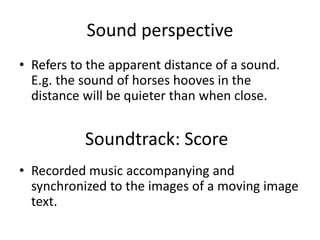
Sound perspective
• Refers to the apparent distance of a sound.
E.g. the sound of horses hooves in the
distance will be quieter than when close.
• Recorded music accompanying and
synchronized to the images of a moving image
text.
Soundtrack: Score
Incidental music
• Often “background” music, and adds atmosphere
to the action. E.g. A single note.
• All sound features may share certain
characteristics – e.g. A particular rhythm.
• The background sounds which are present in a
scene or location. Comon ambient sounds include
wind, water, birds, crowds, office noises and
traffic.
Themes and stings
Ambient

Sound

  • 1.
  • 2.
    Diegetic • Sound thatexists within the fictional world of the text (the diegesis). Non-diegetic • Sound that the audience can hear, but doesn’t exist within the fictional world of text.
  • 3.
    Sound mixing • Whenthe different parts of sound, music, video etc, change volume levels. • Artificially created or enhanced sounds. Sound effects
  • 4.
    Synchronous • The soundthat happens at the same time as the action that creates it. • The sound occurs at a different time to the action that created it. Asynchronous
  • 5.
    Sound motif • Asound effect or combination of sound effects that are associated with a particular character, setting, situation or idea through the text. • A piece of music or sound that bridges an edit from one scene to another (used a lot in American sitcoms). Sound bridge
  • 6.
    Dialogue • Scripted andunscripted voices. • A non-diegetic voice anchoring down the meanings produced by the on screen images. • The viewer is directly addressed. The voice over or character looks at the audience or th4e audience as ‘you’. Voiceover Direct address
  • 7.
    Sound perspective • Refersto the apparent distance of a sound. E.g. the sound of horses hooves in the distance will be quieter than when close. • Recorded music accompanying and synchronized to the images of a moving image text. Soundtrack: Score
  • 8.
    Incidental music • Often“background” music, and adds atmosphere to the action. E.g. A single note. • All sound features may share certain characteristics – e.g. A particular rhythm. • The background sounds which are present in a scene or location. Comon ambient sounds include wind, water, birds, crowds, office noises and traffic. Themes and stings Ambient