NUCLEAR
CHEMISTRY
RADIOACTIVITY – WHAT IS IT?
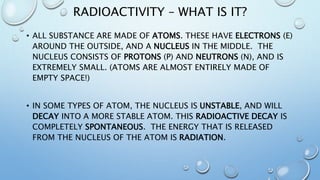
• ALL SUBSTANCE ARE MADE OF ATOMS. THESE HAVE ELECTRONS (E)
AROUND THE OUTSIDE, AND A NUCLEUS IN THE MIDDLE. THE
NUCLEUS CONSISTS OF PROTONS (P) AND NEUTRONS (N), AND IS
EXTREMELY SMALL. (ATOMS ARE ALMOST ENTIRELY MADE OF
EMPTY SPACE!)
• IN SOME TYPES OF ATOM, THE NUCLEUS IS UNSTABLE, AND WILL
DECAY INTO A MORE STABLE ATOM. THIS RADIOACTIVE DECAY IS
COMPLETELY SPONTANEOUS. THE ENERGY THAT IS RELEASED
FROM THE NUCLEUS OF THE ATOM IS RADIATION.
RADIOACTIVITY – WHAT IS IT?
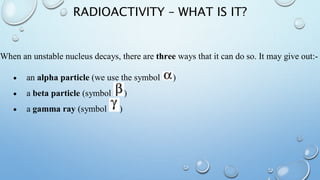
When an unstable nucleus decays, there are three ways that it can do so. It may give out:-
 an alpha particle (we use the symbol )
 a beta particle (symbol )
 a gamma ray (symbol )
RADIOACTIVITY – ALPHA PARTICLES
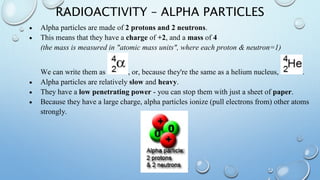
 Alpha particles are made of 2 protons and 2 neutrons.
 This means that they have a charge of +2, and a mass of 4
(the mass is measured in "atomic mass units", where each proton & neutron=1)
We can write them as , or, because they're the same as a helium nucleus, .
 Alpha particles are relatively slow and heavy.
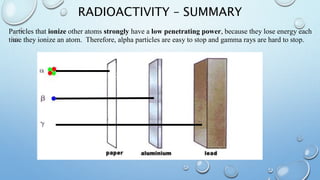
 They have a low penetrating power - you can stop them with just a sheet of paper.
 Because they have a large charge, alpha particles ionize (pull electrons from) other atoms
strongly.
RADIOACTIVITY – BETA PARTICLES
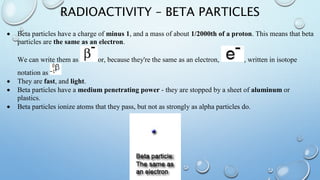
 Beta particles have a charge of minus 1, and a mass of about 1/2000th of a proton. This means that beta
particles are the same as an electron.
We can write them as or, because they're the same as an electron, , written in isotope
notation as
 They are fast, and light.
 Beta particles have a medium penetrating power - they are stopped by a sheet of aluminum or
plastics.
 Beta particles ionize atoms that they pass, but not as strongly as alpha particles do.
RADIOACTIVITY – GAMMA WAVES
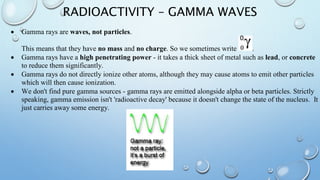
 Gamma rays are waves, not particles.
This means that they have no mass and no charge. So we sometimes write .
 Gamma rays have a high penetrating power - it takes a thick sheet of metal such as lead, or concrete
to reduce them significantly.
 Gamma rays do not directly ionize other atoms, although they may cause atoms to emit other particles
which will then cause ionization.
 We don't find pure gamma sources - gamma rays are emitted alongside alpha or beta particles. Strictly
speaking, gamma emission isn't 'radioactive decay' because it doesn't change the state of the nucleus. It
just carries away some energy.
RADIOACTIVITY – SUMMARY
Particles that ionize other atoms strongly have a low penetrating power, because they lose energy each
time they ionize an atom. Therefore, alpha particles are easy to stop and gamma rays are hard to stop.
ISOTOPE NOTATION
• ISOTOPE NOTATION INCLUDES ADDITIONAL INFORMATION ABOUT AN ISOTOPE.
IN ADDITION TO THE CHEMICAL SYMBOL, THE MASS NUMBER AND THE ATOMIC
NUMBER ARE INCLUDED. THIS ALLOWS INFORMATION ABOUT THE NUCLEUS TO
BE DETERMINED.
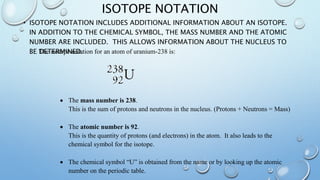
The isotope notation for an atom of uranium-238 is:
 The mass number is 238.
This is the sum of protons and neutrons in the nucleus. (Protons + Neutrons = Mass)
 The atomic number is 92.
This is the quantity of protons (and electrons) in the atom. It also leads to the
chemical symbol for the isotope.
 The chemical symbol “U” is obtained from the name or by looking up the atomic
number on the periodic table.
NUCLEAR DECAY REACTIONS
• SOME ELEMENTS ARE NATURALLY UNSTABLE
• THEY TEND TO UNDERGO ALPHA-DECAY OR BETA-DECAY TO
BECOME MORE STABLE.
• THEY MAY TAKE SEVERAL STEPS IN ORDER TO ACHIEVE THIS,
THUS WE OBSERVE DECAY CHAINS (ALSO KNOWN AS SERIES
DECAY) FOR MOST RADIOACTIVE ELEMENTS.
• FOR EXAMPLE, IT TAKES U-238 14 STEPS OF ALPHA AND
BETA DECAY TO BECOME COMPLETELY STABLE
IDENTIFYING ALPHA AND BETA DECAY
REACTIONS
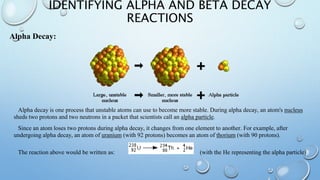
Alpha Decay:
Alpha decay is one process that unstable atoms can use to become more stable. During alpha decay, an atom's nucleus
sheds two protons and two neutrons in a packet that scientists call an alpha particle.
Since an atom loses two protons during alpha decay, it changes from one element to another. For example, after
undergoing alpha decay, an atom of uranium (with 92 protons) becomes an atom of thorium (with 90 protons).
The reaction above would be written as: (with the He representing the alpha particle)
IDENTIFYING ALPHA AND BETA DECAY
REACTIONS
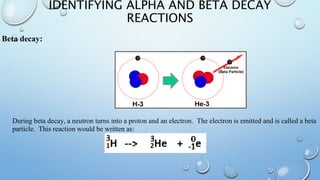
Beta decay:
During beta decay, a neutron turns into a proton and an electron. The electron is emitted and is called a beta
particle. This reaction would be written as:
BALANCING NUCLEAR DECAY REACTIONS
222
86
218
84
228
90
228
91
Examples:
1. Rn  Po + ____ 2. Th  Pa + ____
Decay type __________________ Decay type __________________
DECAY CHAIN OF U-238
• STEP 1: ALPHA DECAY OF URANIUM-238
____________________________________________________
• STEP 2: BETA DECAY REACTION
____________________________________________________
• STEP 3: BETA DECAY REACTION
____________________________________________________
• NOW YOU COMPLETE THE REST ………………………
FISSION AND FUSION
• FISSION: FISSION IS THE PROCESS OF SPLITTING AN ATOM.
• FUSION: NUCLEAR FUSION IS THE PROCESS BY WHICH
MULTIPLE SMALL ATOMIC NUCLEI JOIN TOGETHER TO FORM A
HEAVIER NUCLEUS.
FISSION AND FUSION
236
92
1
0
1
0
92
36
2
1
4
2
Examples:
1. U + n  3 n + Kr + _____ 2. _____ + H  He
Decay type _________________ Decay type _______________
HALF LIFE
• WHEN RADIOACTIVE ISOTOPES DECAY, THEY DO
SO EXPONENTIALLY. THEIR RATE OF DECAY IS
DETERMINED THROUGH AN UNDERSTANDING OF
HALF-LIFE.
• HALF-LIFE IS THE AMOUNT OF TIME IT TAKES FOR
HALF OF THE ATOMS OF AN UNSTABLE ISOTOPE
TO DECAY.
• ATOMS WITH SHORT HALF-LIVES ARE MORE
UNSTABLE THAN THOSE WITH LONG HALF-LIVES.
HALF LIFE
• WHEN RADIOACTIVE ISOTOPES DECAY, THEY DO
SO EXPONENTIALLY. THEIR RATE OF DECAY IS
DETERMINED THROUGH AN UNDERSTANDING OF
HALF-LIFE.
• HALF-LIFE IS THE AMOUNT OF TIME IT TAKES FOR
HALF OF THE ATOMS OF AN UNSTABLE ISOTOPE
TO DECAY.
• ATOMS WITH SHORT HALF-LIVES ARE MORE
UNSTABLE THAN THOSE WITH LONG HALF-LIVES.
HALF LIFE EXAMPLES
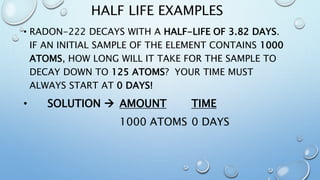
• RADON-222 DECAYS WITH A HALF-LIFE OF 3.82 DAYS.
IF AN INITIAL SAMPLE OF THE ELEMENT CONTAINS 1000
ATOMS, HOW LONG WILL IT TAKE FOR THE SAMPLE TO
DECAY DOWN TO 125 ATOMS? YOUR TIME MUST
ALWAYS START AT 0 DAYS!
• SOLUTION  AMOUNT TIME
1000 ATOMS 0 DAYS
HALF LIFE EXAMPLES
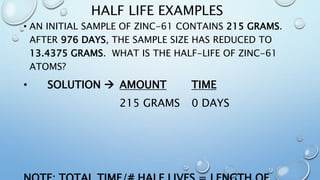
• AN INITIAL SAMPLE OF ZINC-61 CONTAINS 215 GRAMS.
AFTER 976 DAYS, THE SAMPLE SIZE HAS REDUCED TO
13.4375 GRAMS. WHAT IS THE HALF-LIFE OF ZINC-61
ATOMS?
• SOLUTION  AMOUNT TIME
215 GRAMS 0 DAYS
HALF LIFE EXAMPLES
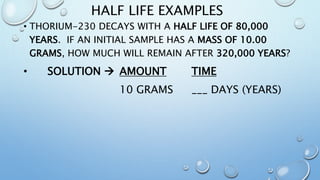
• THORIUM-230 DECAYS WITH A HALF LIFE OF 80,000
YEARS. IF AN INITIAL SAMPLE HAS A MASS OF 10.00
GRAMS, HOW MUCH WILL REMAIN AFTER 320,000 YEARS?
• SOLUTION  AMOUNT TIME
10 GRAMS ___ DAYS (YEARS)

Nuclear Chemistry ppt.pptx

  • 1.
  • 2.
    RADIOACTIVITY – WHATIS IT? • ALL SUBSTANCE ARE MADE OF ATOMS. THESE HAVE ELECTRONS (E) AROUND THE OUTSIDE, AND A NUCLEUS IN THE MIDDLE. THE NUCLEUS CONSISTS OF PROTONS (P) AND NEUTRONS (N), AND IS EXTREMELY SMALL. (ATOMS ARE ALMOST ENTIRELY MADE OF EMPTY SPACE!) • IN SOME TYPES OF ATOM, THE NUCLEUS IS UNSTABLE, AND WILL DECAY INTO A MORE STABLE ATOM. THIS RADIOACTIVE DECAY IS COMPLETELY SPONTANEOUS. THE ENERGY THAT IS RELEASED FROM THE NUCLEUS OF THE ATOM IS RADIATION.
  • 3.
    RADIOACTIVITY – WHATIS IT? When an unstable nucleus decays, there are three ways that it can do so. It may give out:-  an alpha particle (we use the symbol )  a beta particle (symbol )  a gamma ray (symbol )
  • 4.
    RADIOACTIVITY – ALPHAPARTICLES  Alpha particles are made of 2 protons and 2 neutrons.  This means that they have a charge of +2, and a mass of 4 (the mass is measured in "atomic mass units", where each proton & neutron=1) We can write them as , or, because they're the same as a helium nucleus, .  Alpha particles are relatively slow and heavy.  They have a low penetrating power - you can stop them with just a sheet of paper.  Because they have a large charge, alpha particles ionize (pull electrons from) other atoms strongly.
  • 5.
    RADIOACTIVITY – BETAPARTICLES  Beta particles have a charge of minus 1, and a mass of about 1/2000th of a proton. This means that beta particles are the same as an electron. We can write them as or, because they're the same as an electron, , written in isotope notation as  They are fast, and light.  Beta particles have a medium penetrating power - they are stopped by a sheet of aluminum or plastics.  Beta particles ionize atoms that they pass, but not as strongly as alpha particles do.
  • 6.
    RADIOACTIVITY – GAMMAWAVES  Gamma rays are waves, not particles. This means that they have no mass and no charge. So we sometimes write .  Gamma rays have a high penetrating power - it takes a thick sheet of metal such as lead, or concrete to reduce them significantly.  Gamma rays do not directly ionize other atoms, although they may cause atoms to emit other particles which will then cause ionization.  We don't find pure gamma sources - gamma rays are emitted alongside alpha or beta particles. Strictly speaking, gamma emission isn't 'radioactive decay' because it doesn't change the state of the nucleus. It just carries away some energy.
  • 7.
    RADIOACTIVITY – SUMMARY Particlesthat ionize other atoms strongly have a low penetrating power, because they lose energy each time they ionize an atom. Therefore, alpha particles are easy to stop and gamma rays are hard to stop.
  • 8.
    ISOTOPE NOTATION • ISOTOPENOTATION INCLUDES ADDITIONAL INFORMATION ABOUT AN ISOTOPE. IN ADDITION TO THE CHEMICAL SYMBOL, THE MASS NUMBER AND THE ATOMIC NUMBER ARE INCLUDED. THIS ALLOWS INFORMATION ABOUT THE NUCLEUS TO BE DETERMINED. The isotope notation for an atom of uranium-238 is:  The mass number is 238. This is the sum of protons and neutrons in the nucleus. (Protons + Neutrons = Mass)  The atomic number is 92. This is the quantity of protons (and electrons) in the atom. It also leads to the chemical symbol for the isotope.  The chemical symbol “U” is obtained from the name or by looking up the atomic number on the periodic table.
  • 9.
    NUCLEAR DECAY REACTIONS •SOME ELEMENTS ARE NATURALLY UNSTABLE • THEY TEND TO UNDERGO ALPHA-DECAY OR BETA-DECAY TO BECOME MORE STABLE. • THEY MAY TAKE SEVERAL STEPS IN ORDER TO ACHIEVE THIS, THUS WE OBSERVE DECAY CHAINS (ALSO KNOWN AS SERIES DECAY) FOR MOST RADIOACTIVE ELEMENTS. • FOR EXAMPLE, IT TAKES U-238 14 STEPS OF ALPHA AND BETA DECAY TO BECOME COMPLETELY STABLE
  • 10.
    IDENTIFYING ALPHA ANDBETA DECAY REACTIONS Alpha Decay: Alpha decay is one process that unstable atoms can use to become more stable. During alpha decay, an atom's nucleus sheds two protons and two neutrons in a packet that scientists call an alpha particle. Since an atom loses two protons during alpha decay, it changes from one element to another. For example, after undergoing alpha decay, an atom of uranium (with 92 protons) becomes an atom of thorium (with 90 protons). The reaction above would be written as: (with the He representing the alpha particle)
  • 11.
    IDENTIFYING ALPHA ANDBETA DECAY REACTIONS Beta decay: During beta decay, a neutron turns into a proton and an electron. The electron is emitted and is called a beta particle. This reaction would be written as:
  • 12.
    BALANCING NUCLEAR DECAYREACTIONS 222 86 218 84 228 90 228 91 Examples: 1. Rn  Po + ____ 2. Th  Pa + ____ Decay type __________________ Decay type __________________
  • 13.
    DECAY CHAIN OFU-238 • STEP 1: ALPHA DECAY OF URANIUM-238 ____________________________________________________ • STEP 2: BETA DECAY REACTION ____________________________________________________ • STEP 3: BETA DECAY REACTION ____________________________________________________ • NOW YOU COMPLETE THE REST ………………………
  • 14.
    FISSION AND FUSION •FISSION: FISSION IS THE PROCESS OF SPLITTING AN ATOM. • FUSION: NUCLEAR FUSION IS THE PROCESS BY WHICH MULTIPLE SMALL ATOMIC NUCLEI JOIN TOGETHER TO FORM A HEAVIER NUCLEUS.
  • 15.
    FISSION AND FUSION 236 92 1 0 1 0 92 36 2 1 4 2 Examples: 1.U + n  3 n + Kr + _____ 2. _____ + H  He Decay type _________________ Decay type _______________
  • 16.
    HALF LIFE • WHENRADIOACTIVE ISOTOPES DECAY, THEY DO SO EXPONENTIALLY. THEIR RATE OF DECAY IS DETERMINED THROUGH AN UNDERSTANDING OF HALF-LIFE. • HALF-LIFE IS THE AMOUNT OF TIME IT TAKES FOR HALF OF THE ATOMS OF AN UNSTABLE ISOTOPE TO DECAY. • ATOMS WITH SHORT HALF-LIVES ARE MORE UNSTABLE THAN THOSE WITH LONG HALF-LIVES.
  • 17.
    HALF LIFE • WHENRADIOACTIVE ISOTOPES DECAY, THEY DO SO EXPONENTIALLY. THEIR RATE OF DECAY IS DETERMINED THROUGH AN UNDERSTANDING OF HALF-LIFE. • HALF-LIFE IS THE AMOUNT OF TIME IT TAKES FOR HALF OF THE ATOMS OF AN UNSTABLE ISOTOPE TO DECAY. • ATOMS WITH SHORT HALF-LIVES ARE MORE UNSTABLE THAN THOSE WITH LONG HALF-LIVES.
  • 18.
    HALF LIFE EXAMPLES •RADON-222 DECAYS WITH A HALF-LIFE OF 3.82 DAYS. IF AN INITIAL SAMPLE OF THE ELEMENT CONTAINS 1000 ATOMS, HOW LONG WILL IT TAKE FOR THE SAMPLE TO DECAY DOWN TO 125 ATOMS? YOUR TIME MUST ALWAYS START AT 0 DAYS! • SOLUTION  AMOUNT TIME 1000 ATOMS 0 DAYS
  • 19.
    HALF LIFE EXAMPLES •AN INITIAL SAMPLE OF ZINC-61 CONTAINS 215 GRAMS. AFTER 976 DAYS, THE SAMPLE SIZE HAS REDUCED TO 13.4375 GRAMS. WHAT IS THE HALF-LIFE OF ZINC-61 ATOMS? • SOLUTION  AMOUNT TIME 215 GRAMS 0 DAYS
  • 20.
    HALF LIFE EXAMPLES •THORIUM-230 DECAYS WITH A HALF LIFE OF 80,000 YEARS. IF AN INITIAL SAMPLE HAS A MASS OF 10.00 GRAMS, HOW MUCH WILL REMAIN AFTER 320,000 YEARS? • SOLUTION  AMOUNT TIME 10 GRAMS ___ DAYS (YEARS)