By-Yash Raghava
Date-Friday, March 22, 2019
EXPERT SYSTEM
The Expert Systems are the Computer Applications developed to solve complex problems
in a particular domain, at the level of extra-ordinary human intelligence and expertise. In
Simple words, it is a computer system that emulates the decision-making capability of a
human expert. It is mainly developed using Artificial Intelligence concepts, tools and
technologies, and possesses expert knowledge in a particular field, topic or skill and has a
wide variety of Applications.
ARCHITECTURE OF AN EXPERT
SYSTEM
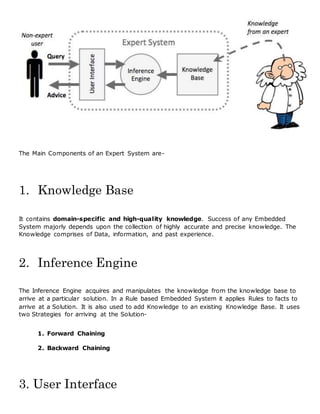
The Main Components of an Expert System are-
1. Knowledge Base
It contains domain-specific and high-quality knowledge. Success of any Embedded
System majorly depends upon the collection of highly accurate and precise knowledge. The
Knowledge comprises of Data, information, and past experience.
2. Inference Engine
The Inference Engine acquires and manipulates the knowledge from the knowledge base to
arrive at a particular solution. In a Rule based Embedded System it applies Rules to facts to
arrive at a Solution. It is also used to add Knowledge to an existing Knowledge Base. It uses
two Strategies for arriving at the Solution-
1. Forward Chaining
2. Backward Chaining
3. User Interface
User interface provides interaction between user of the Expert System and the Expert
System itself. The User who is well versed in the Task Domain uses Natural Language
Processing to interact with the Expert System. The user doesn’t necessarily require to be an
expert in Artificial Intelligence.
SOME POPULAR COMMERCIAL
APPLICATIONS OF AN EXPERT
SYSTEM ARE-
1. Information Management
It can help in any organization in managing, modifying, extracting
large amount of Dynamic Data related to it’s activities and
records.
2. Medical Field
It can help by giving recommendations. For example-It can be
used in an Application dealing with Medical Solutions. It will
Simulate Medical Supervision provided by highly proficient
Doctors. It will also help in detecting diseases and conducting
Medical Operations on Humans.
3. Virus and Malware Detection
It will assist in building smarter security software solutions
and will be more effective in detecting viruses and protecting
Computer Systems.
4. Stock Market Trading
By using Expert analysis it will help in Credible Stock market
forecasting and can be used as a revolutionary tool in the
Economic Sector which will help in reducing the Risk Factor
associated with Investment in Stock Market.
5. Loan Analysis
It will assist in Banking Sector in assessing the Credentials for
approval of Banking Loans. Since the process will be a completely
Digital Process, the results and statistics can be stored for further
analysis and will be easily accessible. This will be help prevent
Scams and Frauds in Banks and will add transparency to the
process.
6. Airline scheduling
I will help in proper scheduling of Air flights.
This will also help in Air Traffic controlling by
providing automated services.
7. Help desks management
This feature can be used in an Organization for handling
Queries and assisting Users. It will reduce Investment in
Human Resources for handling Customer Queries.
LIMITATIONS OF AN EXPERT
SYSTEM
1. Limitations of the Technology
2. Difficult Knowledge Acquisition
3. Expert Systems are difficult to Maintain
4. High Development Costs
EXAMPLES OF EXPERT SYSTEM
1. MYCIN:
One of the earliest expert systems based on backward chaining. It can
identify various bacteria that can cause severe infections and can also
recommend drugs based on the person’s weight.
2. DENDRAL:
It was an artificial intelligence based expert system used for chemical analysis. It used a substance’s
spectrographic data to predict it’s molecular structure.
3. R1/XCON:
It could select specific software to generate a computer system wished by the user.
4. PXDES:
It could easily determine the type and the degree of lung cancer
in a patient based on the data.
5. CaDet:
It is a clinical support system that could identify cancer in its early
stages in patients.
6. DXplain:
It was also a clinical support system that could suggest a variety of diseases based on the findings of
the doctor.

Expert system

  • 1.
    By-Yash Raghava Date-Friday, March22, 2019 EXPERT SYSTEM The Expert Systems are the Computer Applications developed to solve complex problems in a particular domain, at the level of extra-ordinary human intelligence and expertise. In Simple words, it is a computer system that emulates the decision-making capability of a human expert. It is mainly developed using Artificial Intelligence concepts, tools and technologies, and possesses expert knowledge in a particular field, topic or skill and has a wide variety of Applications. ARCHITECTURE OF AN EXPERT SYSTEM
  • 2.
    The Main Componentsof an Expert System are- 1. Knowledge Base It contains domain-specific and high-quality knowledge. Success of any Embedded System majorly depends upon the collection of highly accurate and precise knowledge. The Knowledge comprises of Data, information, and past experience. 2. Inference Engine The Inference Engine acquires and manipulates the knowledge from the knowledge base to arrive at a particular solution. In a Rule based Embedded System it applies Rules to facts to arrive at a Solution. It is also used to add Knowledge to an existing Knowledge Base. It uses two Strategies for arriving at the Solution- 1. Forward Chaining 2. Backward Chaining 3. User Interface
  • 3.
    User interface providesinteraction between user of the Expert System and the Expert System itself. The User who is well versed in the Task Domain uses Natural Language Processing to interact with the Expert System. The user doesn’t necessarily require to be an expert in Artificial Intelligence. SOME POPULAR COMMERCIAL APPLICATIONS OF AN EXPERT SYSTEM ARE- 1. Information Management It can help in any organization in managing, modifying, extracting large amount of Dynamic Data related to it’s activities and records. 2. Medical Field It can help by giving recommendations. For example-It can be used in an Application dealing with Medical Solutions. It will Simulate Medical Supervision provided by highly proficient Doctors. It will also help in detecting diseases and conducting Medical Operations on Humans. 3. Virus and Malware Detection It will assist in building smarter security software solutions and will be more effective in detecting viruses and protecting Computer Systems.
  • 4.
    4. Stock MarketTrading By using Expert analysis it will help in Credible Stock market forecasting and can be used as a revolutionary tool in the Economic Sector which will help in reducing the Risk Factor associated with Investment in Stock Market. 5. Loan Analysis It will assist in Banking Sector in assessing the Credentials for approval of Banking Loans. Since the process will be a completely Digital Process, the results and statistics can be stored for further analysis and will be easily accessible. This will be help prevent Scams and Frauds in Banks and will add transparency to the process. 6. Airline scheduling I will help in proper scheduling of Air flights. This will also help in Air Traffic controlling by providing automated services. 7. Help desks management This feature can be used in an Organization for handling Queries and assisting Users. It will reduce Investment in Human Resources for handling Customer Queries.
  • 5.
    LIMITATIONS OF ANEXPERT SYSTEM 1. Limitations of the Technology 2. Difficult Knowledge Acquisition 3. Expert Systems are difficult to Maintain 4. High Development Costs EXAMPLES OF EXPERT SYSTEM 1. MYCIN: One of the earliest expert systems based on backward chaining. It can identify various bacteria that can cause severe infections and can also recommend drugs based on the person’s weight. 2. DENDRAL: It was an artificial intelligence based expert system used for chemical analysis. It used a substance’s spectrographic data to predict it’s molecular structure.
  • 6.
    3. R1/XCON: It couldselect specific software to generate a computer system wished by the user. 4. PXDES: It could easily determine the type and the degree of lung cancer in a patient based on the data. 5. CaDet: It is a clinical support system that could identify cancer in its early stages in patients. 6. DXplain: It was also a clinical support system that could suggest a variety of diseases based on the findings of the doctor.