Software Delivery in
Hybrid (Cloud)
Environments
Binura Gunasekara
Associate Director/Architect
WSO2
There are two kinds of people:
those who think Hybrid Clouds are a
fantastic idea, and those who have had
to run them in production.
– Me, circa today
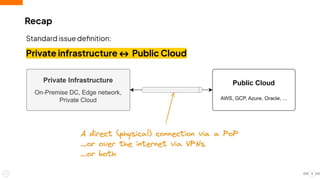
Standard issue definition:
Private infrastructure ↔ Public Cloud
Recap
3
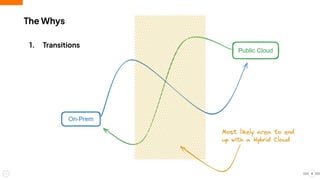
The Whys
4
1. Transitions
The Whys
5
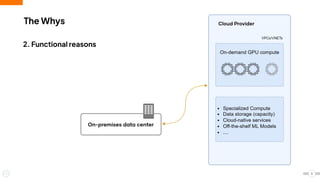
2. Functional reasons
The Whys
6
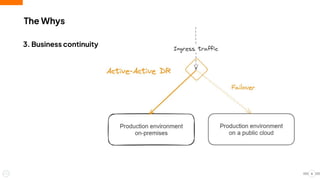
3. Business continuity
Failure Points
1. Design rot
2. Chasing (the illusion of) portability
3. Developer experience adversity
a. Tooling chaos
b. Platform overhead
7
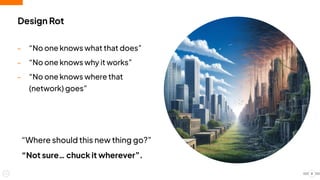
Design Rot
- “No one knows what that does”
- “No one knows why it works”
- “No one knows where that
(network) goes”
8
“Where should this new thing go?”
“Not sure… chuck it wherever”.
“Portability” might only be skin-deep
- It’s (relatively) easy to move containerized applications around.
- Applications front things that are not-so-easy to move around.
- Or moving them around could be costly.
- Eg. Databases, Queues, …so on and so forth.
- Replicated architectures... on hybrid clouds... for high availability and/or
portability – Is your stack really portable?
9
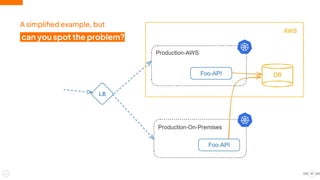
10
can you spot the problem?
A simplified example, but
Developer
Adversity
11
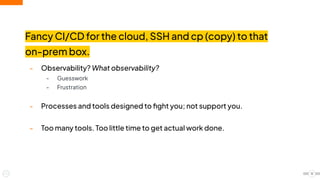
Fancy CI/CD for the cloud, SSH and cp (copy) to that
on-prem box.
- Observability? What observability?
- Guesswork
- Frustration
- Processes and tools designed to fight you; not support you.
- Too many tools. Too little time to get actual work done.
12
Getting it right
● Design to optimize the benefits of a Hybrid Cloud.
○ You can also design to make your life miserable.
● Prefer domain-driven partitioning over replication (if possible)
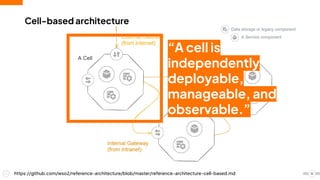
● Cell-based architecture gives you a scalable framework to build,
reason with and visualize your enterprise architecture.
○ A framework to model your enterprise architecture into self-contained
implementation units.
○ Controlled ingress and egress points:
■ Observability
■ Access controls
■ …towards zero-trust
Avoiding design rot.
14
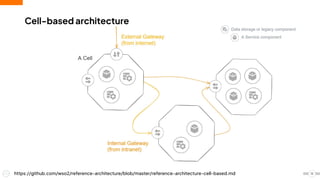
Cell-based architecture
15
https://github.com/wso2/reference-architecture/blob/master/reference-architecture-cell-based.md
Cell-based architecture
16
https://github.com/wso2/reference-architecture/blob/master/reference-architecture-cell-based.md
“A cell is
independently
deployable,
manageable, and
observable.”
17
Source:
github.com/wso2/reference-architecture/blob/
master/reference-architecture-cell-based.md
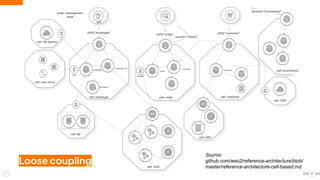
Loose coupling
● You now have self-contained, portable* units of business/functional
capability – loose coupling.
● *Portability can still be restricted by technology choices.
Eg. Being backed by a proprietary database.
● A great read: Google–“Don't get locked up into avoiding lock-in”
⦿ Reference: https://martinfowler.com/articles/oss-lockin.html
Portable units of deployment
18
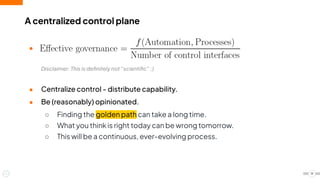
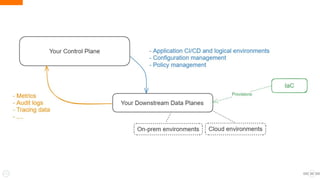
A centralized control plane
19
●
Disclaimer: This is definitely not “scientific” ;)
● Centralize control - distribute capability.
● Be (reasonably) opinionated.
○ Finding the golden path can take a long time.
○ What you think is right today can be wrong tomorrow.
○ This will be a continuous, ever-evolving process.
20
North star: Become Platformless!
...How do you do that?
Build to enable your developers.
21
Thank You!

WSO2Con2024 - Software Delivery in Hybrid Environments