High-Performance
Hibernate
VLAD MIHALCEA
About me
• @Hibernate Developer
• vladmihalcea.com
• @vlad_mihalcea
• vladmihalcea
Agenda
• Performance and Scaling
• Connection providers
• Identifier generators
• Relationships
• Batching
• Fetching
• Caching
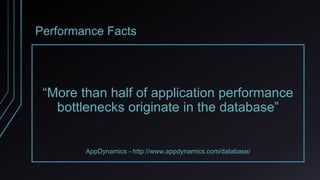
Performance Facts
“More than half of application performance
bottlenecks originate in the database”
AppDynamics - http://www.appdynamics.com/database/
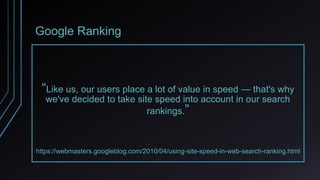
Google Ranking
“Like us, our users place a lot of value in speed — that's why
we've decided to take site speed into account in our search
rankings.”
https://webmasters.googleblog.com/2010/04/using-site-speed-in-web-search-ranking.html
Performance and Revenue
“It has been reported that every 100ms of latency costs
Amazon 1% of profit.”
http://radar.oreilly.com/2008/08/radar-theme-web-ops.html
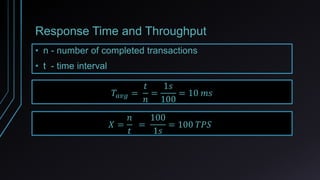
Response Time and Throughput
• n - number of completed transactions
• t - time interval
𝑇𝑎𝑣𝑔 =
𝑡
𝑛
=
1𝑠
100
= 10 𝑚𝑠
𝑋 =
𝑛
𝑡
=
100
1𝑠
= 100 𝑇𝑃𝑆
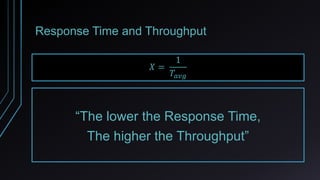
Response Time and Throughput
𝑋 =
1
𝑇𝑎𝑣𝑔
“The lower the Response Time,
The higher the Throughput”
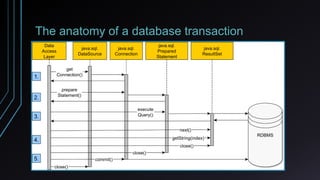
The anatomy of a database transaction
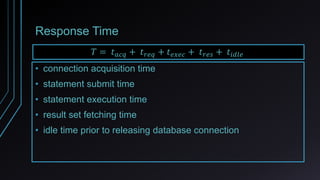
Response Time
• connection acquisition time
• statement submit time
• statement execution time
• result set fetching time
• idle time prior to releasing database connection
𝑇 = 𝑡 𝑎𝑐𝑞 + 𝑡 𝑟𝑒𝑞 + 𝑡 𝑒𝑥𝑒𝑐 + 𝑡 𝑟𝑒𝑠 + 𝑡𝑖𝑑𝑙𝑒
Agenda
• Performance and Scaling
• Connection providers
• Identifier generators
• Relationships
• Batching
• Fetching
• Caching
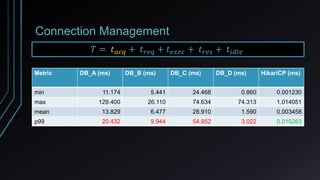
Connection Management
Metric DB_A (ms) DB_B (ms) DB_C (ms) DB_D (ms) HikariCP (ms)
min 11.174 5.441 24.468 0.860 0.001230
max 129.400 26.110 74.634 74.313 1.014051
mean 13.829 6.477 28.910 1.590 0.003458
p99 20.432 9.944 54.952 3.022 0.010263
𝑇 = 𝑡 𝑎𝑐𝑞 + 𝑡 𝑟𝑒𝑞 + 𝑡 𝑒𝑥𝑒𝑐 + 𝑡 𝑟𝑒𝑠 + 𝑡𝑖𝑑𝑙𝑒
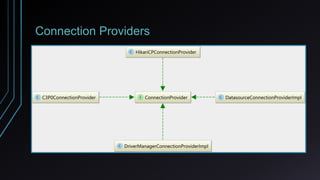
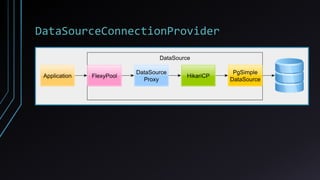
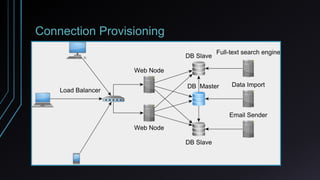
Connection Providers
DataSourceConnectionProvider
Connection Provisioning
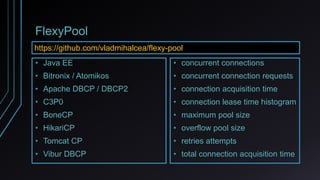
FlexyPool
• concurrent connections
• concurrent connection requests
• connection acquisition time
• connection lease time histogram
• maximum pool size
• overflow pool size
• retries attempts
• total connection acquisition time
• Java EE
• Bitronix / Atomikos
• Apache DBCP / DBCP2
• C3P0
• BoneCP
• HikariCP
• Tomcat CP
• Vibur DBCP
https://github.com/vladmihalcea/flexy-pool
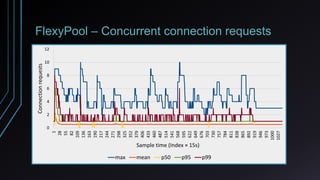
FlexyPool – Concurrent connection requests
1
28
55
82
109
136
163
190
217
244
271
298
325
352
379
406
433
460
487
514
541
568
595
622
649
676
703
730
757
784
811
838
865
892
919
946
973
1000
1027
0
2
4
6
8
10
12
Sample time (Index × 15s)
Connectionrequests
max mean p50 p95 p99
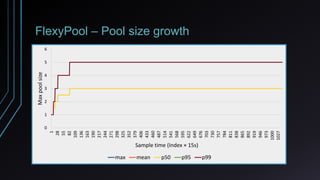
FlexyPool – Pool size growth
1
28
55
82
109
136
163
190
217
244
271
298
325
352
379
406
433
460
487
514
541
568
595
622
649
676
703
730
757
784
811
838
865
892
919
946
973
1000
1027
0
1
2
3
4
5
6
Sample time (Index × 15s)
Maxpoolsize
max mean p50 p95 p99
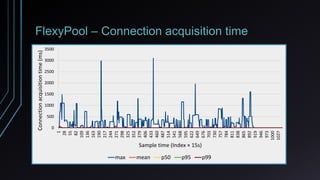
FlexyPool – Connection acquisition time
1
28
55
82
109
136
163
190
217
244
271
298
325
352
379
406
433
460
487
514
541
568
595
622
649
676
703
730
757
784
811
838
865
892
919
946
973
1000
1027
0
500
1000
1500
2000
2500
3000
3500
Sample time (Index × 15s)
Connectionacquisitiontime(ms)
max mean p50 p95 p99
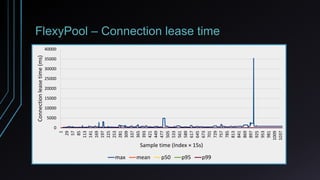
FlexyPool – Connection lease time
1
29
57
85
113
141
169
197
225
253
281
309
337
365
393
421
449
477
505
533
561
589
617
645
673
701
729
757
785
813
841
869
897
925
953
981
1009
1037
0
5000
10000
15000
20000
25000
30000
35000
40000
Sample time (Index × 15s)
Connectionleasetime(ms)
max mean p50 p95 p99
Agenda
• Performance and Scaling
• Connection providers
• Identifier generators
• Relationships
• Batching
• Fetching
• Caching
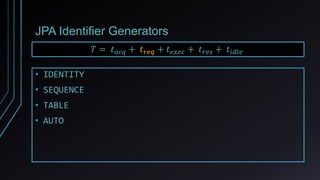
JPA Identifier Generators
𝑇 = 𝑡 𝑎𝑐𝑞 + 𝑡 𝑟𝑒𝑞 + 𝑡 𝑒𝑥𝑒𝑐 + 𝑡 𝑟𝑒𝑠 + 𝑡𝑖𝑑𝑙𝑒
• IDENTITY
• SEQUENCE
• TABLE
• AUTO
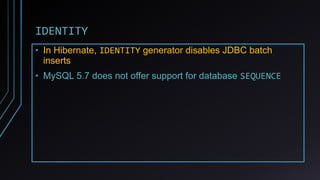
IDENTITY
• In Hibernate, IDENTITY generator disables JDBC batch
inserts
• MySQL 5.7 does not offer support for database SEQUENCE
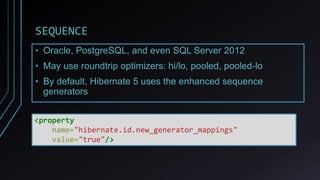
SEQUENCE
• Oracle, PostgreSQL, and even SQL Server 2012
• May use roundtrip optimizers: hi/lo, pooled, pooled-lo
• By default, Hibernate 5 uses the enhanced sequence
generators
<property
name="hibernate.id.new_generator_mappings"
value="true"/>
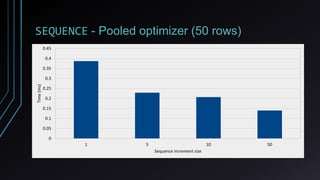
SEQUENCE - Pooled optimizer (50 rows)
1 5 10 50
0
0.05
0.1
0.15
0.2
0.25
0.3
0.35
0.4
0.45
Sequence increment size
Time(ms)
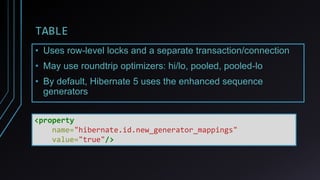
TABLE
• Uses row-level locks and a separate transaction/connection
• May use roundtrip optimizers: hi/lo, pooled, pooled-lo
• By default, Hibernate 5 uses the enhanced sequence
generators
<property
name="hibernate.id.new_generator_mappings"
value="true"/>
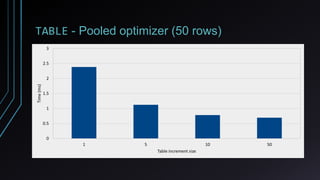
TABLE - Pooled optimizer (50 rows)
1 5 10 50
0
0.5
1
1.5
2
2.5
3
Table increment size
Time(ms)
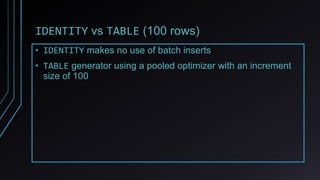
IDENTITY vs TABLE (100 rows)
• IDENTITY makes no use of batch inserts
• TABLE generator using a pooled optimizer with an increment
size of 100
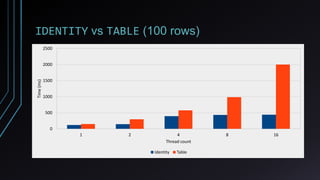
IDENTITY vs TABLE (100 rows)
1 2 4 8 16
0
500
1000
1500
2000
2500
Thread count
Time(ms)
Identity Table
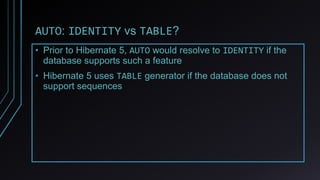
AUTO: IDENTITY vs TABLE?
• Prior to Hibernate 5, AUTO would resolve to IDENTITY if the
database supports such a feature
• Hibernate 5 uses TABLE generator if the database does not
support sequences
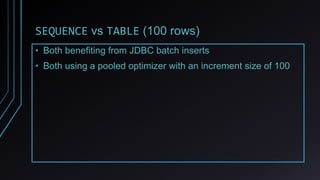
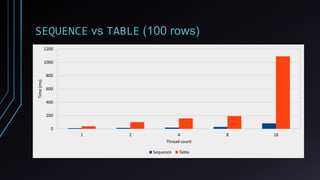
SEQUENCE vs TABLE (100 rows)
• Both benefiting from JDBC batch inserts
• Both using a pooled optimizer with an increment size of 100
SEQUENCE vs TABLE (100 rows)
1 2 4 8 16
0
200
400
600
800
1000
1200
Thread count
Time(ms)
Sequence Table
Agenda
• Performance and Scaling
• Connection providers
• Identifier generators
• Relationships
• Batching
• Fetching
• Caching
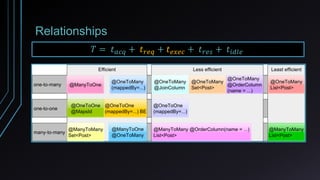
Relationships
𝑇 = 𝑡 𝑎𝑐𝑞 + 𝑡 𝑟𝑒𝑞 + 𝑡 𝑒𝑥𝑒𝑐 + 𝑡 𝑟𝑒𝑠 + 𝑡𝑖𝑑𝑙𝑒
Agenda
• Performance and Scaling
• Connection providers
• Identifier generators
• Relationships
• Batching
• Fetching
• Caching
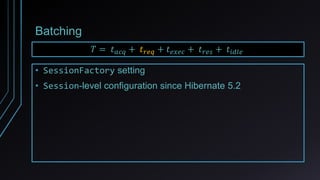
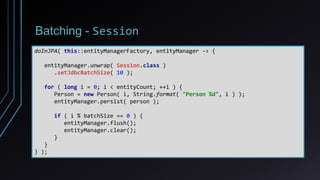
Batching
𝑇 = 𝑡 𝑎𝑐𝑞 + 𝑡 𝑟𝑒𝑞 + 𝑡 𝑒𝑥𝑒𝑐 + 𝑡 𝑟𝑒𝑠 + 𝑡𝑖𝑑𝑙𝑒
• SessionFactory setting
• Session-level configuration since Hibernate 5.2
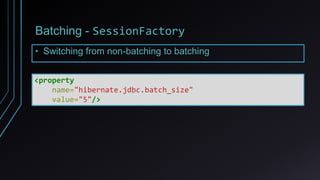
Batching - SessionFactory
<property
name="hibernate.jdbc.batch_size"
value="5"/>
• Switching from non-batching to batching
Batching - Session
doInJPA( this::entityManagerFactory, entityManager -> {
entityManager.unwrap( Session.class )
.setJdbcBatchSize( 10 );
for ( long i = 0; i < entityCount; ++i ) {
Person = new Person( i, String.format( "Person %d", i ) );
entityManager.persist( person );
if ( i % batchSize == 0 ) {
entityManager.flush();
entityManager.clear();
}
}
} );
Batching
DEBUG [main]: n.t.d.l.SLF4JQueryLoggingListener –
Name:DATA_SOURCE_PROXY,
Time:1,
Success:True,
Type:Prepared,
Batch:True,
QuerySize:1,
BatchSize:10,
Query: ["insert into Person (name, id) values (?, ?)"],
Params:[
(Person 1, 1), (Person 2, 2), (Person 3, 3), (Person 4, 4), (Person 5, 5),
(Person 6, 6), (Person 7, 7), (Person 8, 8), (Person 9, 9), (Person 10, 10)
]
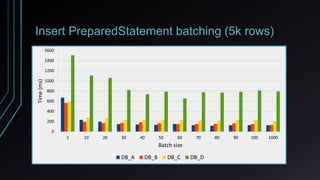
Insert PreparedStatement batching (5k rows)
1 10 20 30 40 50 60 70 80 90 100 1000
0
200
400
600
800
1000
1200
1400
1600
Batch size
Time(ms)
DB_A DB_B DB_C DB_D
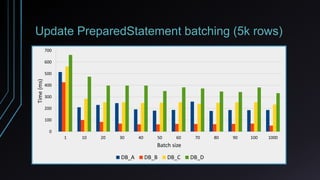
Update PreparedStatement batching (5k rows)
1 10 20 30 40 50 60 70 80 90 100 1000
0
100
200
300
400
500
600
700
Batch size
Time(ms)
DB_A DB_B DB_C DB_D
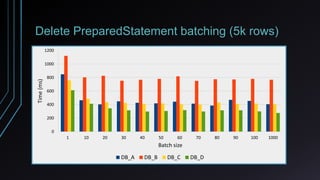
Delete PreparedStatement batching (5k rows)
1 10 20 30 40 50 60 70 80 90 100 1000
0
200
400
600
800
1000
1200
Batch size
Time(ms)
DB_A DB_B DB_C DB_D
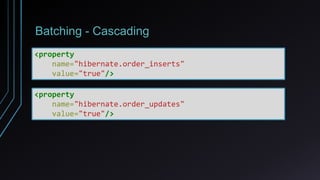
Batching - Cascading
<property
name="hibernate.order_inserts"
value="true"/>
<property
name="hibernate.order_updates"
value="true"/>
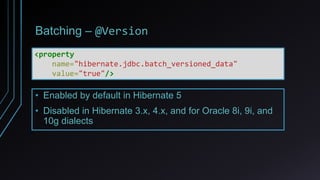
Batching – @Version
<property
name="hibernate.jdbc.batch_versioned_data"
value="true"/>
• Enabled by default in Hibernate 5
• Disabled in Hibernate 3.x, 4.x, and for Oracle 8i, 9i, and
10g dialects
Agenda
• Performance and Scaling
• Connection providers
• Identifier generators
• Relationships
• Batching
• Fetching
• Caching
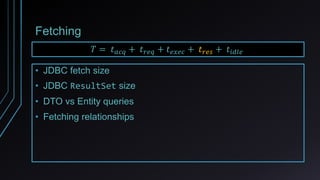
Fetching
𝑇 = 𝑡 𝑎𝑐𝑞 + 𝑡 𝑟𝑒𝑞 + 𝑡 𝑒𝑥𝑒𝑐 + 𝑡 𝑟𝑒𝑠 + 𝑡𝑖𝑑𝑙𝑒
• JDBC fetch size
• JDBC ResultSet size
• DTO vs Entity queries
• Fetching relationships
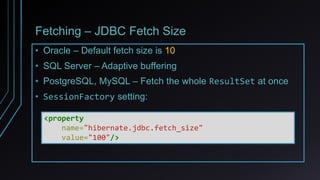
Fetching – JDBC Fetch Size
• Oracle – Default fetch size is 10
• SQL Server – Adaptive buffering
• PostgreSQL, MySQL – Fetch the whole ResultSet at once
• SessionFactory setting:
<property
name="hibernate.jdbc.fetch_size"
value="100"/>
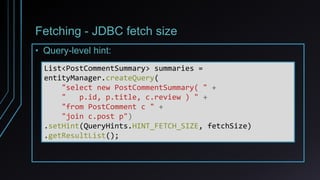
Fetching - JDBC fetch size
• Query-level hint:
List<PostCommentSummary> summaries =
entityManager.createQuery(
"select new PostCommentSummary( " +
" p.id, p.title, c.review ) " +
"from PostComment c " +
"join c.post p")
.setHint(QueryHints.HINT_FETCH_SIZE, fetchSize)
.getResultList();
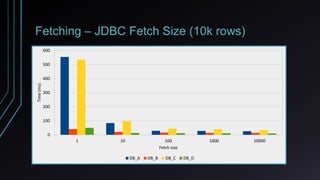
Fetching – JDBC Fetch Size (10k rows)
1 10 100 1000 10000
0
100
200
300
400
500
600
Fetch size
Time(ms)
DB_A DB_B DB_C DB_D
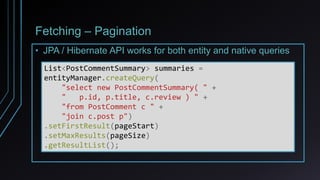
Fetching – Pagination
• JPA / Hibernate API works for both entity and native queries
List<PostCommentSummary> summaries =
entityManager.createQuery(
"select new PostCommentSummary( " +
" p.id, p.title, c.review ) " +
"from PostComment c " +
"join c.post p")
.setFirstResult(pageStart)
.setMaxResults(pageSize)
.getResultList();
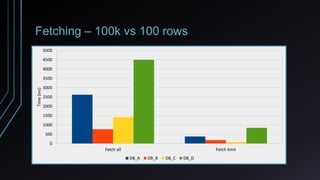
Fetching – 100k vs 100 rows
Fetch all Fetch limit
0
500
1000
1500
2000
2500
3000
3500
4000
4500
5000
Time(ms)
DB_A DB_B DB_C DB_D
Fetching – Pagination
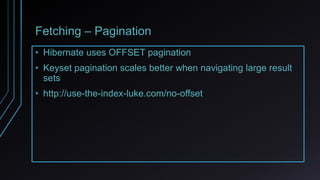
• Hibernate uses OFFSET pagination
• Keyset pagination scales better when navigating large result
sets
• http://use-the-index-luke.com/no-offset
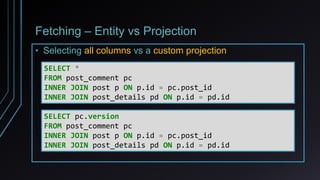
Fetching – Entity vs Projection
• Selecting all columns vs a custom projection
SELECT *
FROM post_comment pc
INNER JOIN post p ON p.id = pc.post_id
INNER JOIN post_details pd ON p.id = pd.id
SELECT pc.version
FROM post_comment pc
INNER JOIN post p ON p.id = pc.post_id
INNER JOIN post_details pd ON p.id = pd.id
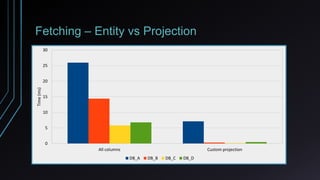
Fetching – Entity vs Projection
All columns Custom projection
0
5
10
15
20
25
30
Time(ms)
DB_A DB_B DB_C DB_D
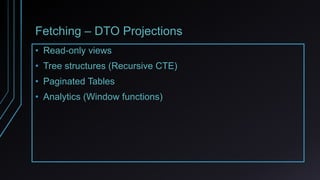
Fetching – DTO Projections
• Read-only views
• Tree structures (Recursive CTE)
• Paginated Tables
• Analytics (Window functions)
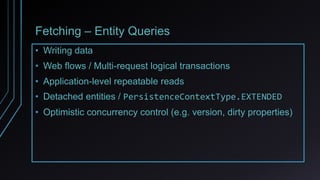
Fetching – Entity Queries
• Writing data
• Web flows / Multi-request logical transactions
• Application-level repeatable reads
• Detached entities / PersistenceContextType.EXTENDED
• Optimistic concurrency control (e.g. version, dirty properties)
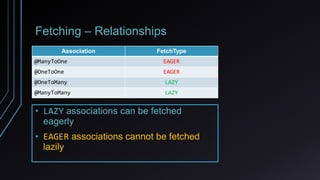
Fetching – Relationships
Association FetchType
@ManyToOne EAGER
@OneToOne EAGER
@OneToMany LAZY
@ManyToMany LAZY
• LAZY associations can be fetched
eagerly
• EAGER associations cannot be fetched
lazily
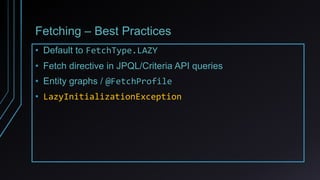
Fetching – Best Practices
• Default to FetchType.LAZY
• Fetch directive in JPQL/Criteria API queries
• Entity graphs / @FetchProfile
• LazyInitializationException
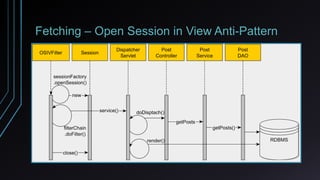
Fetching – Open Session in View Anti-Pattern
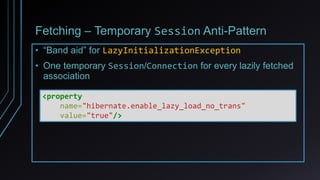
Fetching – Temporary Session Anti-Pattern
• “Band aid” for LazyInitializationException
• One temporary Session/Connection for every lazily fetched
association
<property
name="hibernate.enable_lazy_load_no_trans"
value="true"/>
Agenda
• Performance and Scaling
• Connection providers
• Identifier generators
• Relationships
• Batching
• Fetching
• Caching
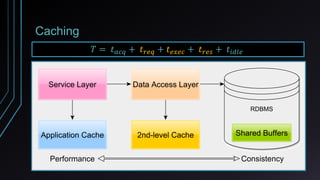
Caching
𝑇 = 𝑡 𝑎𝑐𝑞 + 𝑡 𝑟𝑒𝑞 + 𝑡 𝑒𝑥𝑒𝑐 + 𝑡 𝑟𝑒𝑠 + 𝑡𝑖𝑑𝑙𝑒
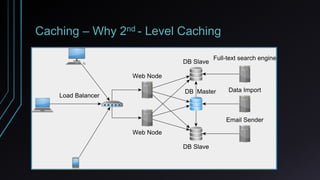
Caching – Why 2nd - Level Caching
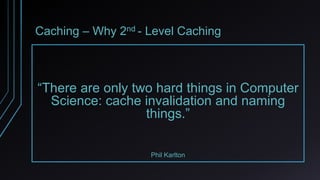
“There are only two hard things in Computer
Science: cache invalidation and naming
things.”
Phil Karlton
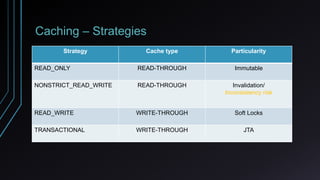
Caching – Strategies
Strategy Cache type Particularity
READ_ONLY READ-THROUGH Immutable
NONSTRICT_READ_WRITE READ-THROUGH Invalidation/
Inconsistency risk
READ_WRITE WRITE-THROUGH Soft Locks
TRANSACTIONAL WRITE-THROUGH JTA
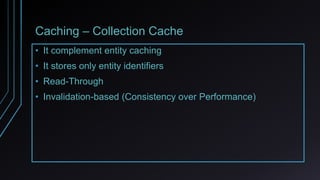
Caching – Collection Cache
• It complement entity caching
• It stores only entity identifiers
• Read-Through
• Invalidation-based (Consistency over Performance)
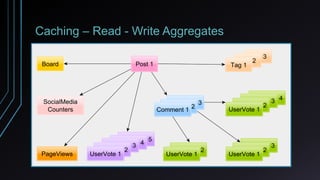
Caching – Read - Write Aggregates
Questions and Answers
https://leanpub.com/high-performance-java-persistence
• Performance and Scaling
• Connection providers
• Identifier generators
• Relationships
• Batching
• Fetching
• Caching

High Performance Hibernate JavaZone 2016

  • 1.
  • 2.
    About me • @HibernateDeveloper • vladmihalcea.com • @vlad_mihalcea • vladmihalcea
  • 3.
    Agenda • Performance andScaling • Connection providers • Identifier generators • Relationships • Batching • Fetching • Caching
  • 4.
    Performance Facts “More thanhalf of application performance bottlenecks originate in the database” AppDynamics - http://www.appdynamics.com/database/
  • 5.
    Google Ranking “Like us,our users place a lot of value in speed — that's why we've decided to take site speed into account in our search rankings.” https://webmasters.googleblog.com/2010/04/using-site-speed-in-web-search-ranking.html
  • 6.
    Performance and Revenue “Ithas been reported that every 100ms of latency costs Amazon 1% of profit.” http://radar.oreilly.com/2008/08/radar-theme-web-ops.html
  • 7.
    Response Time andThroughput • n - number of completed transactions • t - time interval 𝑇𝑎𝑣𝑔 = 𝑡 𝑛 = 1𝑠 100 = 10 𝑚𝑠 𝑋 = 𝑛 𝑡 = 100 1𝑠 = 100 𝑇𝑃𝑆
  • 8.
    Response Time andThroughput 𝑋 = 1 𝑇𝑎𝑣𝑔 “The lower the Response Time, The higher the Throughput”
  • 9.
    The anatomy ofa database transaction
  • 10.
    Response Time • connectionacquisition time • statement submit time • statement execution time • result set fetching time • idle time prior to releasing database connection 𝑇 = 𝑡 𝑎𝑐𝑞 + 𝑡 𝑟𝑒𝑞 + 𝑡 𝑒𝑥𝑒𝑐 + 𝑡 𝑟𝑒𝑠 + 𝑡𝑖𝑑𝑙𝑒
  • 11.
    Agenda • Performance andScaling • Connection providers • Identifier generators • Relationships • Batching • Fetching • Caching
  • 12.
    Connection Management Metric DB_A(ms) DB_B (ms) DB_C (ms) DB_D (ms) HikariCP (ms) min 11.174 5.441 24.468 0.860 0.001230 max 129.400 26.110 74.634 74.313 1.014051 mean 13.829 6.477 28.910 1.590 0.003458 p99 20.432 9.944 54.952 3.022 0.010263 𝑇 = 𝑡 𝑎𝑐𝑞 + 𝑡 𝑟𝑒𝑞 + 𝑡 𝑒𝑥𝑒𝑐 + 𝑡 𝑟𝑒𝑠 + 𝑡𝑖𝑑𝑙𝑒
  • 13.
  • 14.
  • 15.
  • 16.
    FlexyPool • concurrent connections •concurrent connection requests • connection acquisition time • connection lease time histogram • maximum pool size • overflow pool size • retries attempts • total connection acquisition time • Java EE • Bitronix / Atomikos • Apache DBCP / DBCP2 • C3P0 • BoneCP • HikariCP • Tomcat CP • Vibur DBCP https://github.com/vladmihalcea/flexy-pool
  • 17.
    FlexyPool – Concurrentconnection requests 1 28 55 82 109 136 163 190 217 244 271 298 325 352 379 406 433 460 487 514 541 568 595 622 649 676 703 730 757 784 811 838 865 892 919 946 973 1000 1027 0 2 4 6 8 10 12 Sample time (Index × 15s) Connectionrequests max mean p50 p95 p99
  • 18.
    FlexyPool – Poolsize growth 1 28 55 82 109 136 163 190 217 244 271 298 325 352 379 406 433 460 487 514 541 568 595 622 649 676 703 730 757 784 811 838 865 892 919 946 973 1000 1027 0 1 2 3 4 5 6 Sample time (Index × 15s) Maxpoolsize max mean p50 p95 p99
  • 19.
    FlexyPool – Connectionacquisition time 1 28 55 82 109 136 163 190 217 244 271 298 325 352 379 406 433 460 487 514 541 568 595 622 649 676 703 730 757 784 811 838 865 892 919 946 973 1000 1027 0 500 1000 1500 2000 2500 3000 3500 Sample time (Index × 15s) Connectionacquisitiontime(ms) max mean p50 p95 p99
  • 20.
    FlexyPool – Connectionlease time 1 29 57 85 113 141 169 197 225 253 281 309 337 365 393 421 449 477 505 533 561 589 617 645 673 701 729 757 785 813 841 869 897 925 953 981 1009 1037 0 5000 10000 15000 20000 25000 30000 35000 40000 Sample time (Index × 15s) Connectionleasetime(ms) max mean p50 p95 p99
  • 21.
    Agenda • Performance andScaling • Connection providers • Identifier generators • Relationships • Batching • Fetching • Caching
  • 22.
    JPA Identifier Generators 𝑇= 𝑡 𝑎𝑐𝑞 + 𝑡 𝑟𝑒𝑞 + 𝑡 𝑒𝑥𝑒𝑐 + 𝑡 𝑟𝑒𝑠 + 𝑡𝑖𝑑𝑙𝑒 • IDENTITY • SEQUENCE • TABLE • AUTO
  • 23.
    IDENTITY • In Hibernate,IDENTITY generator disables JDBC batch inserts • MySQL 5.7 does not offer support for database SEQUENCE
  • 24.
    SEQUENCE • Oracle, PostgreSQL,and even SQL Server 2012 • May use roundtrip optimizers: hi/lo, pooled, pooled-lo • By default, Hibernate 5 uses the enhanced sequence generators <property name="hibernate.id.new_generator_mappings" value="true"/>
  • 25.
    SEQUENCE - Pooledoptimizer (50 rows) 1 5 10 50 0 0.05 0.1 0.15 0.2 0.25 0.3 0.35 0.4 0.45 Sequence increment size Time(ms)
  • 26.
    TABLE • Uses row-levellocks and a separate transaction/connection • May use roundtrip optimizers: hi/lo, pooled, pooled-lo • By default, Hibernate 5 uses the enhanced sequence generators <property name="hibernate.id.new_generator_mappings" value="true"/>
  • 27.
    TABLE - Pooledoptimizer (50 rows) 1 5 10 50 0 0.5 1 1.5 2 2.5 3 Table increment size Time(ms)
  • 28.
    IDENTITY vs TABLE(100 rows) • IDENTITY makes no use of batch inserts • TABLE generator using a pooled optimizer with an increment size of 100
  • 29.
    IDENTITY vs TABLE(100 rows) 1 2 4 8 16 0 500 1000 1500 2000 2500 Thread count Time(ms) Identity Table
  • 30.
    AUTO: IDENTITY vsTABLE? • Prior to Hibernate 5, AUTO would resolve to IDENTITY if the database supports such a feature • Hibernate 5 uses TABLE generator if the database does not support sequences
  • 31.
    SEQUENCE vs TABLE(100 rows) • Both benefiting from JDBC batch inserts • Both using a pooled optimizer with an increment size of 100
  • 32.
    SEQUENCE vs TABLE(100 rows) 1 2 4 8 16 0 200 400 600 800 1000 1200 Thread count Time(ms) Sequence Table
  • 33.
    Agenda • Performance andScaling • Connection providers • Identifier generators • Relationships • Batching • Fetching • Caching
  • 34.
    Relationships 𝑇 = 𝑡𝑎𝑐𝑞 + 𝑡 𝑟𝑒𝑞 + 𝑡 𝑒𝑥𝑒𝑐 + 𝑡 𝑟𝑒𝑠 + 𝑡𝑖𝑑𝑙𝑒
  • 35.
    Agenda • Performance andScaling • Connection providers • Identifier generators • Relationships • Batching • Fetching • Caching
  • 36.
    Batching 𝑇 = 𝑡𝑎𝑐𝑞 + 𝑡 𝑟𝑒𝑞 + 𝑡 𝑒𝑥𝑒𝑐 + 𝑡 𝑟𝑒𝑠 + 𝑡𝑖𝑑𝑙𝑒 • SessionFactory setting • Session-level configuration since Hibernate 5.2
  • 37.
  • 38.
    Batching - Session doInJPA(this::entityManagerFactory, entityManager -> { entityManager.unwrap( Session.class ) .setJdbcBatchSize( 10 ); for ( long i = 0; i < entityCount; ++i ) { Person = new Person( i, String.format( "Person %d", i ) ); entityManager.persist( person ); if ( i % batchSize == 0 ) { entityManager.flush(); entityManager.clear(); } } } );
  • 39.
    Batching DEBUG [main]: n.t.d.l.SLF4JQueryLoggingListener– Name:DATA_SOURCE_PROXY, Time:1, Success:True, Type:Prepared, Batch:True, QuerySize:1, BatchSize:10, Query: ["insert into Person (name, id) values (?, ?)"], Params:[ (Person 1, 1), (Person 2, 2), (Person 3, 3), (Person 4, 4), (Person 5, 5), (Person 6, 6), (Person 7, 7), (Person 8, 8), (Person 9, 9), (Person 10, 10) ]
  • 40.
    Insert PreparedStatement batching(5k rows) 1 10 20 30 40 50 60 70 80 90 100 1000 0 200 400 600 800 1000 1200 1400 1600 Batch size Time(ms) DB_A DB_B DB_C DB_D
  • 41.
    Update PreparedStatement batching(5k rows) 1 10 20 30 40 50 60 70 80 90 100 1000 0 100 200 300 400 500 600 700 Batch size Time(ms) DB_A DB_B DB_C DB_D
  • 42.
    Delete PreparedStatement batching(5k rows) 1 10 20 30 40 50 60 70 80 90 100 1000 0 200 400 600 800 1000 1200 Batch size Time(ms) DB_A DB_B DB_C DB_D
  • 43.
  • 44.
    Batching – @Version <property name="hibernate.jdbc.batch_versioned_data" value="true"/> •Enabled by default in Hibernate 5 • Disabled in Hibernate 3.x, 4.x, and for Oracle 8i, 9i, and 10g dialects
  • 45.
    Agenda • Performance andScaling • Connection providers • Identifier generators • Relationships • Batching • Fetching • Caching
  • 46.
    Fetching 𝑇 = 𝑡𝑎𝑐𝑞 + 𝑡 𝑟𝑒𝑞 + 𝑡 𝑒𝑥𝑒𝑐 + 𝑡 𝑟𝑒𝑠 + 𝑡𝑖𝑑𝑙𝑒 • JDBC fetch size • JDBC ResultSet size • DTO vs Entity queries • Fetching relationships
  • 47.
    Fetching – JDBCFetch Size • Oracle – Default fetch size is 10 • SQL Server – Adaptive buffering • PostgreSQL, MySQL – Fetch the whole ResultSet at once • SessionFactory setting: <property name="hibernate.jdbc.fetch_size" value="100"/>
  • 48.
    Fetching - JDBCfetch size • Query-level hint: List<PostCommentSummary> summaries = entityManager.createQuery( "select new PostCommentSummary( " + " p.id, p.title, c.review ) " + "from PostComment c " + "join c.post p") .setHint(QueryHints.HINT_FETCH_SIZE, fetchSize) .getResultList();
  • 49.
    Fetching – JDBCFetch Size (10k rows) 1 10 100 1000 10000 0 100 200 300 400 500 600 Fetch size Time(ms) DB_A DB_B DB_C DB_D
  • 50.
    Fetching – Pagination •JPA / Hibernate API works for both entity and native queries List<PostCommentSummary> summaries = entityManager.createQuery( "select new PostCommentSummary( " + " p.id, p.title, c.review ) " + "from PostComment c " + "join c.post p") .setFirstResult(pageStart) .setMaxResults(pageSize) .getResultList();
  • 51.
    Fetching – 100kvs 100 rows Fetch all Fetch limit 0 500 1000 1500 2000 2500 3000 3500 4000 4500 5000 Time(ms) DB_A DB_B DB_C DB_D
  • 52.
    Fetching – Pagination •Hibernate uses OFFSET pagination • Keyset pagination scales better when navigating large result sets • http://use-the-index-luke.com/no-offset
  • 53.
    Fetching – Entityvs Projection • Selecting all columns vs a custom projection SELECT * FROM post_comment pc INNER JOIN post p ON p.id = pc.post_id INNER JOIN post_details pd ON p.id = pd.id SELECT pc.version FROM post_comment pc INNER JOIN post p ON p.id = pc.post_id INNER JOIN post_details pd ON p.id = pd.id
  • 54.
    Fetching – Entityvs Projection All columns Custom projection 0 5 10 15 20 25 30 Time(ms) DB_A DB_B DB_C DB_D
  • 55.
    Fetching – DTOProjections • Read-only views • Tree structures (Recursive CTE) • Paginated Tables • Analytics (Window functions)
  • 56.
    Fetching – EntityQueries • Writing data • Web flows / Multi-request logical transactions • Application-level repeatable reads • Detached entities / PersistenceContextType.EXTENDED • Optimistic concurrency control (e.g. version, dirty properties)
  • 57.
    Fetching – Relationships AssociationFetchType @ManyToOne EAGER @OneToOne EAGER @OneToMany LAZY @ManyToMany LAZY • LAZY associations can be fetched eagerly • EAGER associations cannot be fetched lazily
  • 58.
    Fetching – BestPractices • Default to FetchType.LAZY • Fetch directive in JPQL/Criteria API queries • Entity graphs / @FetchProfile • LazyInitializationException
  • 59.
    Fetching – OpenSession in View Anti-Pattern
  • 60.
    Fetching – TemporarySession Anti-Pattern • “Band aid” for LazyInitializationException • One temporary Session/Connection for every lazily fetched association <property name="hibernate.enable_lazy_load_no_trans" value="true"/>
  • 61.
    Agenda • Performance andScaling • Connection providers • Identifier generators • Relationships • Batching • Fetching • Caching
  • 62.
    Caching 𝑇 = 𝑡𝑎𝑐𝑞 + 𝑡 𝑟𝑒𝑞 + 𝑡 𝑒𝑥𝑒𝑐 + 𝑡 𝑟𝑒𝑠 + 𝑡𝑖𝑑𝑙𝑒
  • 63.
    Caching – Why2nd - Level Caching
  • 64.
    Caching – Why2nd - Level Caching “There are only two hard things in Computer Science: cache invalidation and naming things.” Phil Karlton
  • 65.
    Caching – Strategies StrategyCache type Particularity READ_ONLY READ-THROUGH Immutable NONSTRICT_READ_WRITE READ-THROUGH Invalidation/ Inconsistency risk READ_WRITE WRITE-THROUGH Soft Locks TRANSACTIONAL WRITE-THROUGH JTA
  • 66.
    Caching – CollectionCache • It complement entity caching • It stores only entity identifiers • Read-Through • Invalidation-based (Consistency over Performance)
  • 67.
    Caching – Read- Write Aggregates
  • 68.
    Questions and Answers https://leanpub.com/high-performance-java-persistence •Performance and Scaling • Connection providers • Identifier generators • Relationships • Batching • Fetching • Caching