DECENTRALIZATION,
DEVOLUTION AND
DECONCENTRATION
ABASONTEY VICTORIA
Decentralization
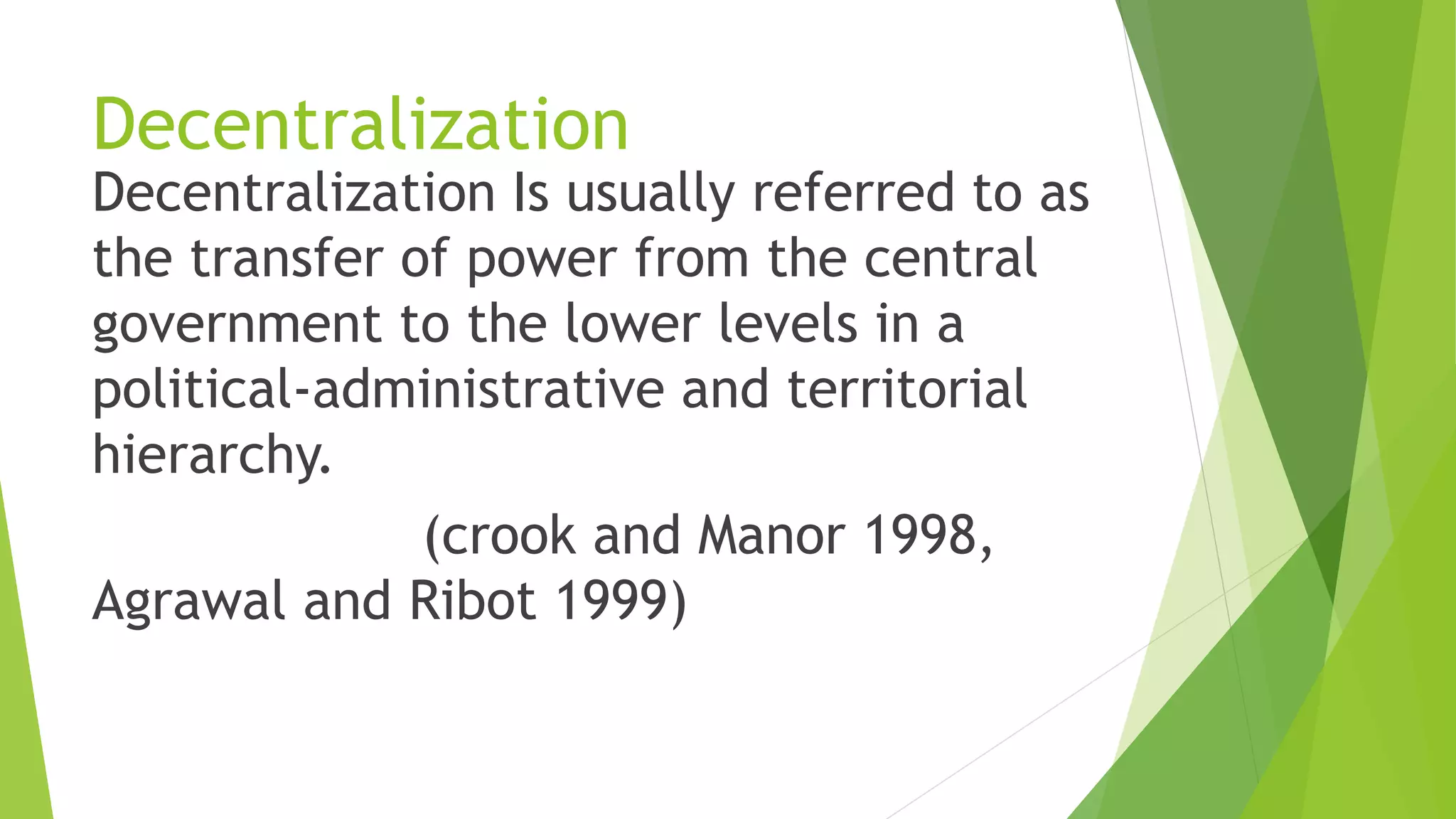
Decentralization Is usually referred to as
the transfer of power from the central
government to the lower levels in a
political-administrative and territorial
hierarchy.
(crook and Manor 1998,
Agrawal and Ribot 1999)
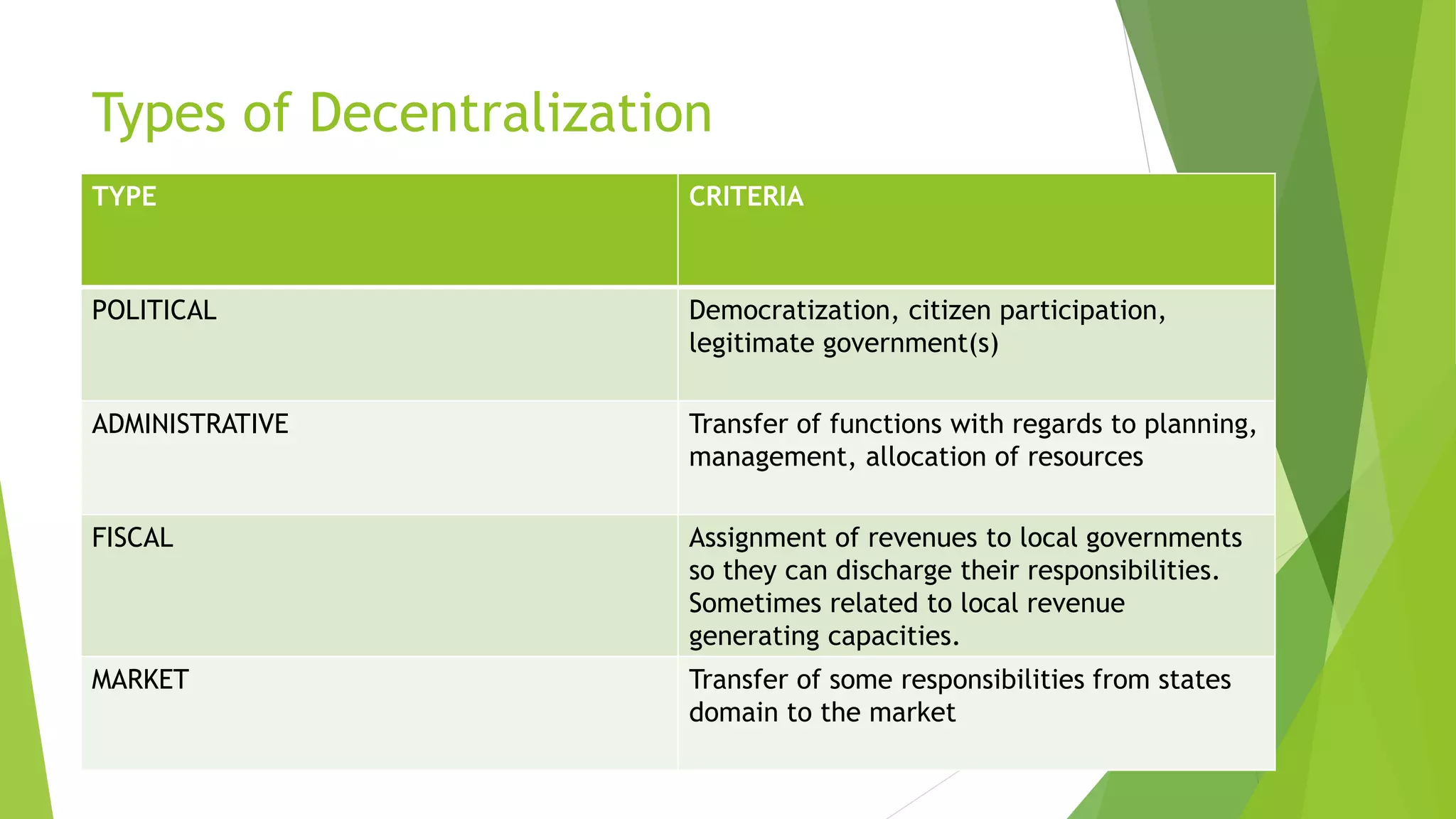
Types of Decentralization
TYPE CRITERIA
POLITICAL Democratization, citizen participation,
legitimate government(s)
ADMINISTRATIVE Transfer of functions with regards to planning,
management, allocation of resources
FISCAL Assignment of revenues to local governments
so they can discharge their responsibilities.
Sometimes related to local revenue
generating capacities.
MARKET Transfer of some responsibilities from states
domain to the market
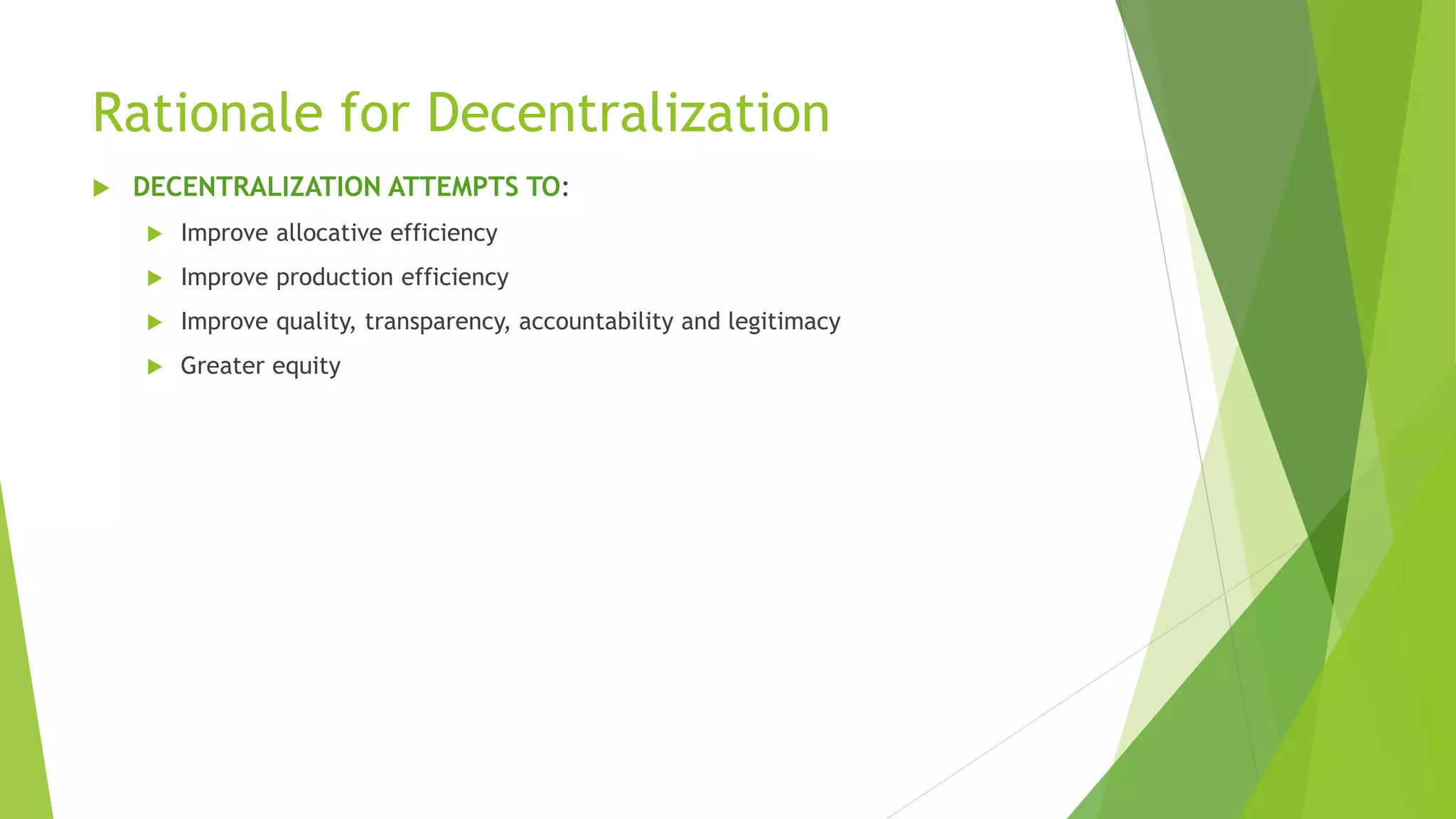
Rationale for Decentralization
 DECENTRALIZATION ATTEMPTS TO:
 Improve allocative efficiency
 Improve production efficiency
 Improve quality, transparency, accountability and legitimacy
 Greater equity
Modes of Decentralization
 Deconcentration
 Delegation
 Devolution
Modes of Decentralization
 DECONCENTRATION
Transfer of functions, powers and resources
The center executes normative functions,
supervision and control
States are responsible for operational activities
& service programs
It is mostly and administrative action and does
not alter the flow of command in the system
Modes of Decentralization
 DELEGATION
Transfer of responsibilities for decision making
& administration to semi-autonomous
organizations not controlled by but accountable
to the central government (IFE in Mexico,
Central Banking, Ombudsman)
Semi-autonomous public enterprises to provide
services more effectively and efficiently than a
central bureaucracy
Modes of Decentralization
 DEVOLUTION
Strengths the relationship among the federal,
state and local governments
Autonomy to sub-national units of government
in some areas (e.g. fiscal and financial powers,
police power, eminent domain, etc. )
 Local governments acquire the necessary
functions to govern and not only to administer
Decentralization and natural resource
management
 NRM is great interest to promoters of
decentralization and local democracy.
 Decentralization is also of interest to
environmentalists too.
 Representation, accountable and equitable
processes depends on which authorities are
being entrusted with NRG.
Pacesetters In decentralization of NRM
 China
 Cambodia
 Nepal
 Tanzania
 Ghana
 etc
Nepal’s participatory forest management
 Progressive legislation and policies in the
decentralization of Forest management.
 Decentralization is linked to emerging issues;
sustainable forest management, forest
governance, policy advocacy, gender, equity,
poverty, etc.
 despite all the positive outcomes, challenges
arose; elite capture, imbalance between social
needs and environmental agenda, persistence of
poor and disadvantaged sectors, etc.
The case of Ghana
 Ghana has well developed policies for forest
decentralization.
 The decentralization process has suffered due to
central governments reluctance to decentralize
key revenue –generating sectors; forestry and
mining.
 Weak participation of CSOs, NGOs, CBOs etc.
Conclusion
 Decentralization is not an end in itself.
 It is a means to deliver the demands of the
environment and also meet the needs of the
people.
End of Presentation
Thank you!

Decentralization, devolution and deconcentration

  • 1.
  • 2.
    Decentralization Decentralization Is usuallyreferred to as the transfer of power from the central government to the lower levels in a political-administrative and territorial hierarchy. (crook and Manor 1998, Agrawal and Ribot 1999)
  • 3.
    Types of Decentralization TYPECRITERIA POLITICAL Democratization, citizen participation, legitimate government(s) ADMINISTRATIVE Transfer of functions with regards to planning, management, allocation of resources FISCAL Assignment of revenues to local governments so they can discharge their responsibilities. Sometimes related to local revenue generating capacities. MARKET Transfer of some responsibilities from states domain to the market
  • 4.
    Rationale for Decentralization DECENTRALIZATION ATTEMPTS TO:  Improve allocative efficiency  Improve production efficiency  Improve quality, transparency, accountability and legitimacy  Greater equity
  • 5.
    Modes of Decentralization Deconcentration  Delegation  Devolution
  • 6.
    Modes of Decentralization DECONCENTRATION Transfer of functions, powers and resources The center executes normative functions, supervision and control States are responsible for operational activities & service programs It is mostly and administrative action and does not alter the flow of command in the system
  • 7.
    Modes of Decentralization DELEGATION Transfer of responsibilities for decision making & administration to semi-autonomous organizations not controlled by but accountable to the central government (IFE in Mexico, Central Banking, Ombudsman) Semi-autonomous public enterprises to provide services more effectively and efficiently than a central bureaucracy
  • 8.
    Modes of Decentralization DEVOLUTION Strengths the relationship among the federal, state and local governments Autonomy to sub-national units of government in some areas (e.g. fiscal and financial powers, police power, eminent domain, etc. )  Local governments acquire the necessary functions to govern and not only to administer
  • 9.
    Decentralization and naturalresource management  NRM is great interest to promoters of decentralization and local democracy.  Decentralization is also of interest to environmentalists too.  Representation, accountable and equitable processes depends on which authorities are being entrusted with NRG.
  • 10.
    Pacesetters In decentralizationof NRM  China  Cambodia  Nepal  Tanzania  Ghana  etc
  • 11.
    Nepal’s participatory forestmanagement  Progressive legislation and policies in the decentralization of Forest management.  Decentralization is linked to emerging issues; sustainable forest management, forest governance, policy advocacy, gender, equity, poverty, etc.  despite all the positive outcomes, challenges arose; elite capture, imbalance between social needs and environmental agenda, persistence of poor and disadvantaged sectors, etc.
  • 12.
    The case ofGhana  Ghana has well developed policies for forest decentralization.  The decentralization process has suffered due to central governments reluctance to decentralize key revenue –generating sectors; forestry and mining.  Weak participation of CSOs, NGOs, CBOs etc.
  • 13.
    Conclusion  Decentralization isnot an end in itself.  It is a means to deliver the demands of the environment and also meet the needs of the people.
  • 14.