Flow of the presentation
 Introduction
 Sensex

& NIFTY
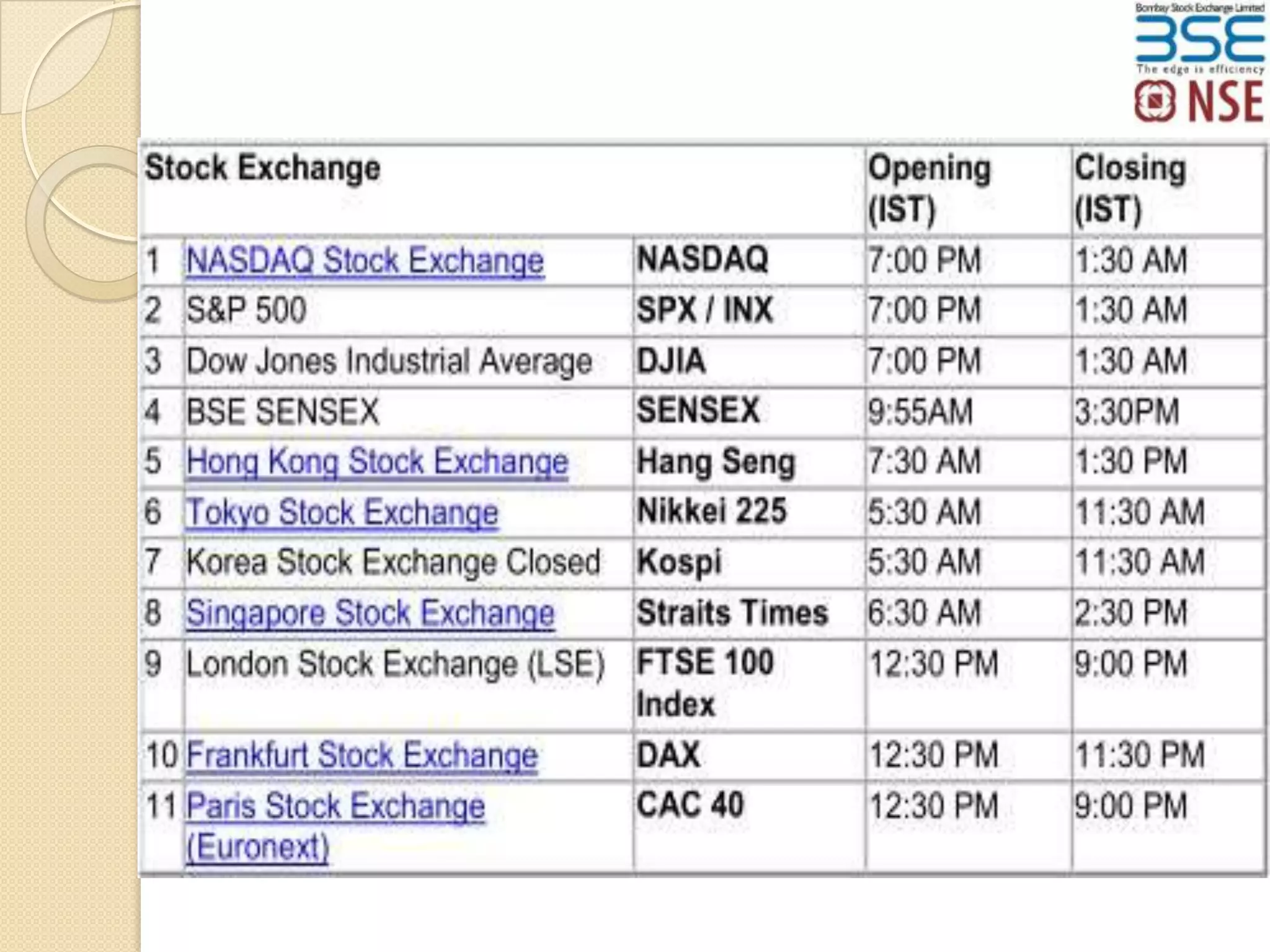
 Stock exchanges around the world
 How Sensex works
 Sectoral Index
 conclusion
Introduction


Bombay Stock Exchange Limited is the oldest stock exchange in
Asia with a rich heritage. Popularly known as "BSE", it was
established as "The Native Share & Stock Brokers Association" in
1875.



It is the first stock exchange in the country to obtain permanent
recognition in 1956 from the Government of India under the
Securities Contracts (Regulation) Act, 1956.The Indian capital
market is widely recognized and its index, SENSEX, is tracked
worldwide.



Earlier an Association of Persons (AOP), the Exchange is now a
demutualised and corporatised entity incorporated under the
provisions of the Companies Act, 1956, pursuant to the BSE
Scheme, 2005 notified by the Securities and Exchange Board of
India (SEBI).


It consists of the 30 largest and most actively
traded stocks, representative of various sectors, on
the Bombay Stock Exchange. These companies
account for majority of the market capitalization of
the BSE.



At irregular intervals, the Bombay Stock Exchange
(BSE) authorities review and modify its
composition to make sure it reflects current market
conditions.

Note:
 “The abbreviated form "Sensex" was coined by
Deepak Mohoni around 1990 while writing market
analysis columns for some of the business
Nifty
Nifty is an index or an indicator of the performance of the
companies listed in national stock exchange situated in
Delhi. Nifty constitutes of 50 companies and the change in
the Nifty index ( Up or down ) indicate the trend in the
majority of the stocks.
 Nifty is a joint holding of National Stock Exchange ( NSE )
and India Index Services and Products Limited ( IISL ) and
Nifty accounts for 70% of total market capitalization.
 NIFTY is an Index computed from performance of top
stocks from different sectors listed on NSE (National stock
exchange). NIFTY consists of 50 companies from 24
different sectors.




NIFTY stands for National Stock Exchange’s Fifty. The
companies which form index of NIFTY may vary from time
to time considered by NSE. NIFTY is for NSE
similarly SENSEX is for BSE
Some mutual funds use NIFTY index as a
benchmark meaning the mutual funds’
performance is compared against the
performance of NIFTY. On NSE there are
futures and options available for trading
with NIFTY as underlying index.
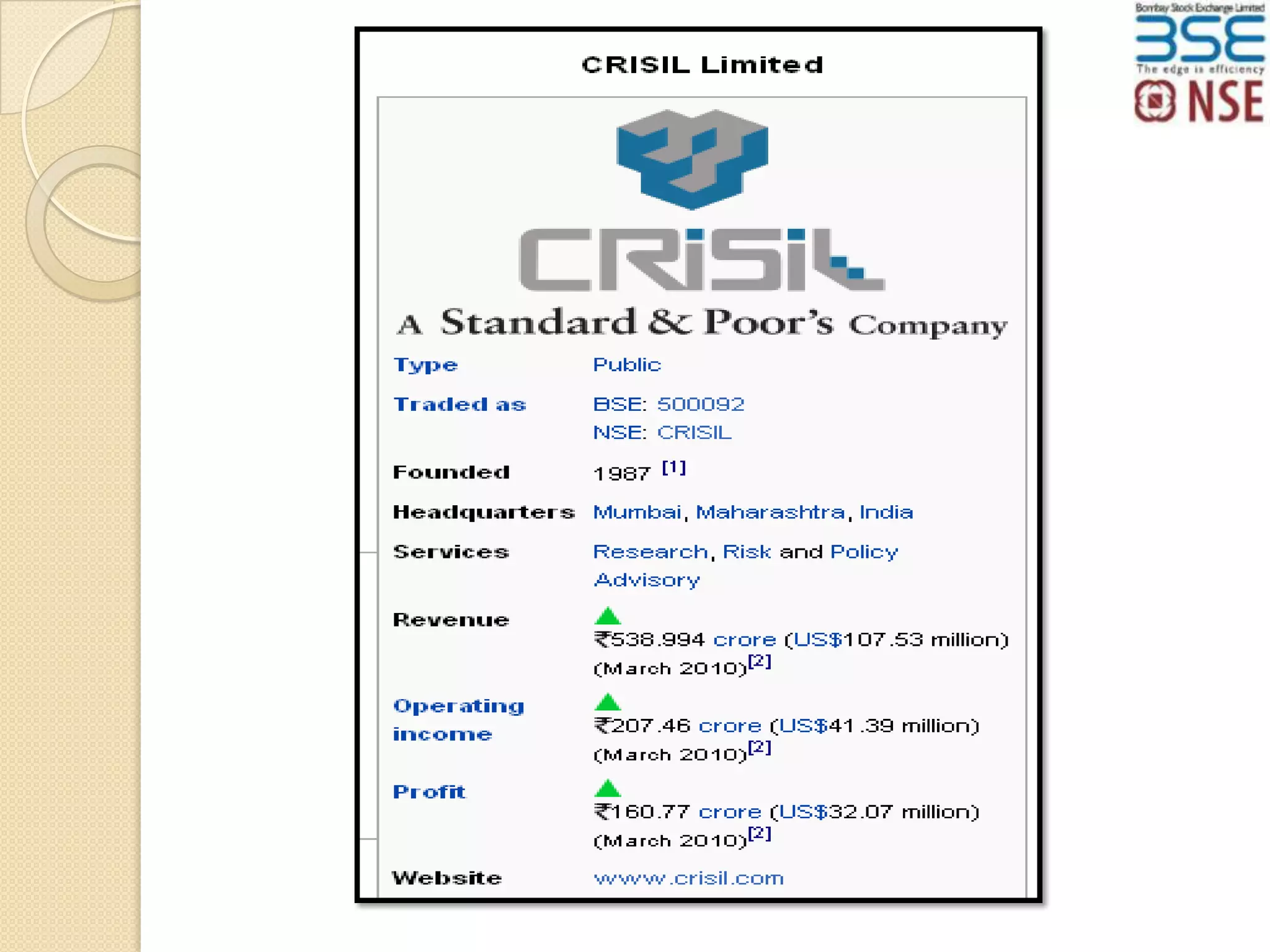
 India Index Services and Products Ltd.
(IISL) owns NIFTY. IISL is a joint venture of
NSE and CRISIL. CRISIL is a subsidiary of
Standard and Poor (S&P). And so NIFTY is
also called as S&P CNX NIFTY.

Market capitalization
Market capitalization refers to the value of a
company's outstanding shares
outstanding shares: number of shares issued by the company
& subscribed by the public


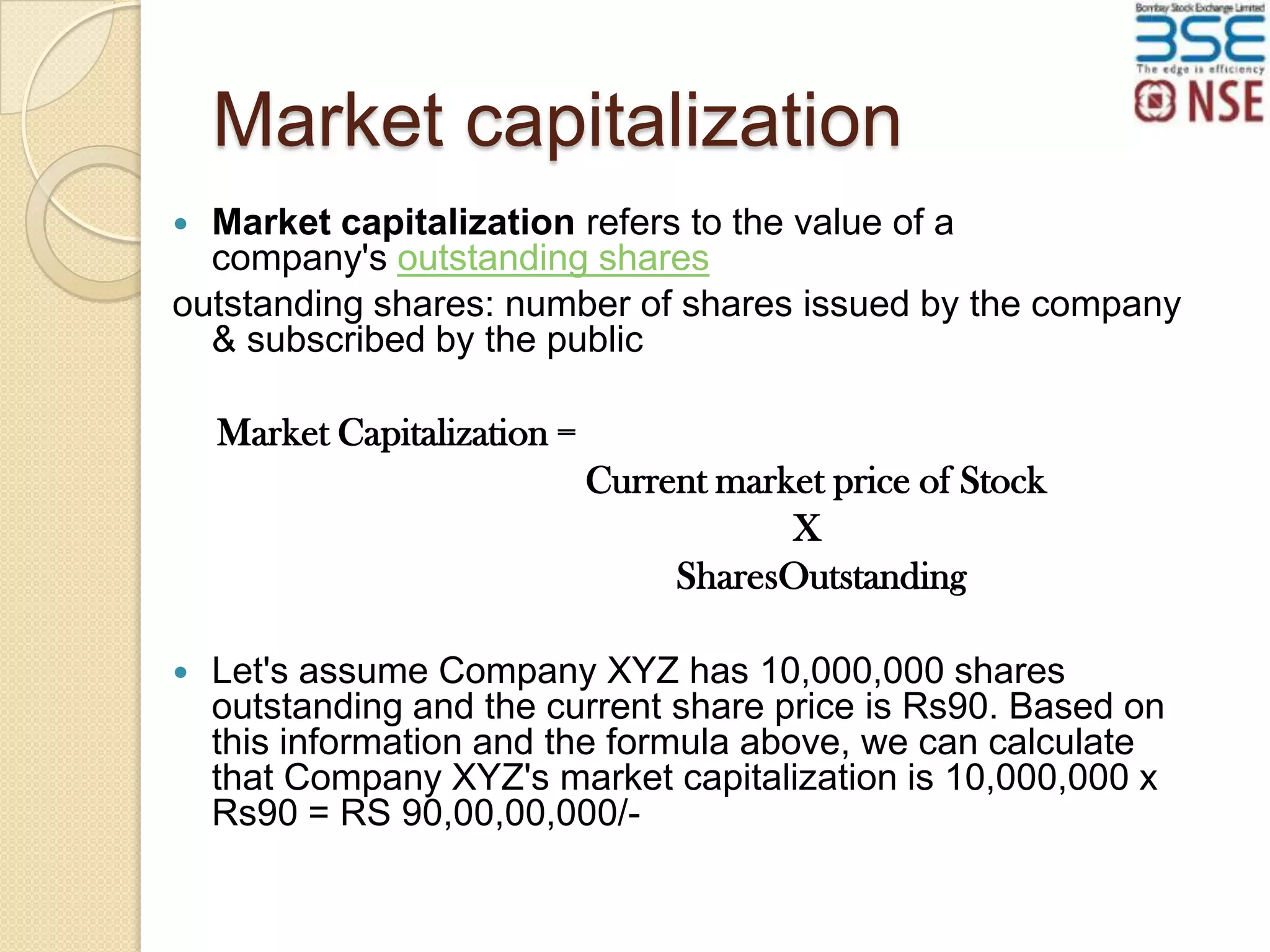
Market Capitalization =
Current market price of Stock
X
SharesOutstanding


Let's assume Company XYZ has 10,000,000 shares
outstanding and the current share price is Rs90. Based on
this information and the formula above, we can calculate
that Company XYZ's market capitalization is 10,000,000 x
Rs90 = RS 90,00,00,000/-
Free float market
capitalization
efinition:
D

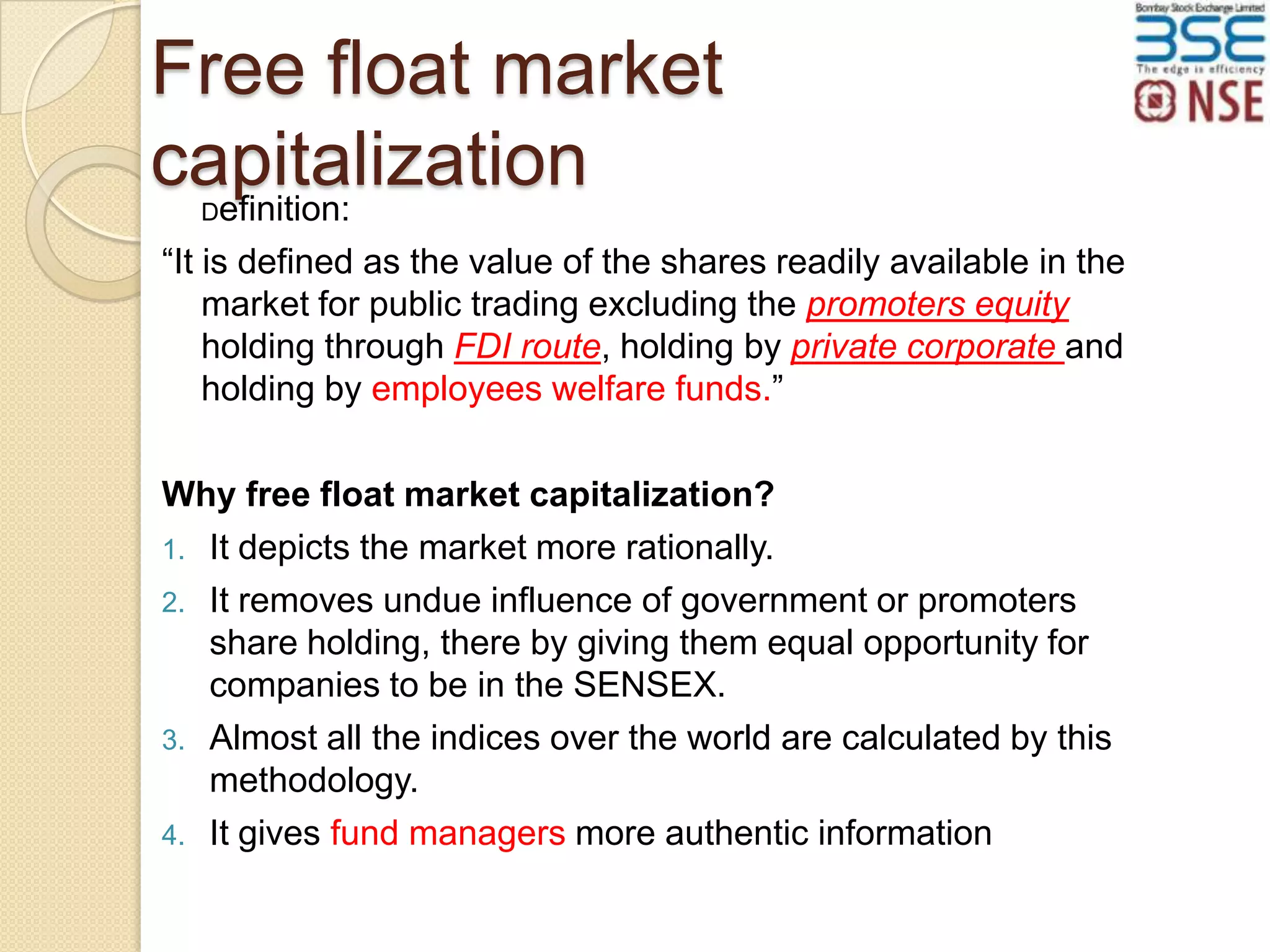
“It is defined as the value of the shares readily available in the
market for public trading excluding the promoters equity
holding through FDI route, holding by private corporate and
holding by employees welfare funds.”
Why free float market capitalization?
1. It depicts the market more rationally.
2. It removes undue influence of government or promoters
share holding, there by giving them equal opportunity for
companies to be in the SENSEX.
3. Almost all the indices over the world are calculated by this
methodology.
4. It gives fund managers more authentic information


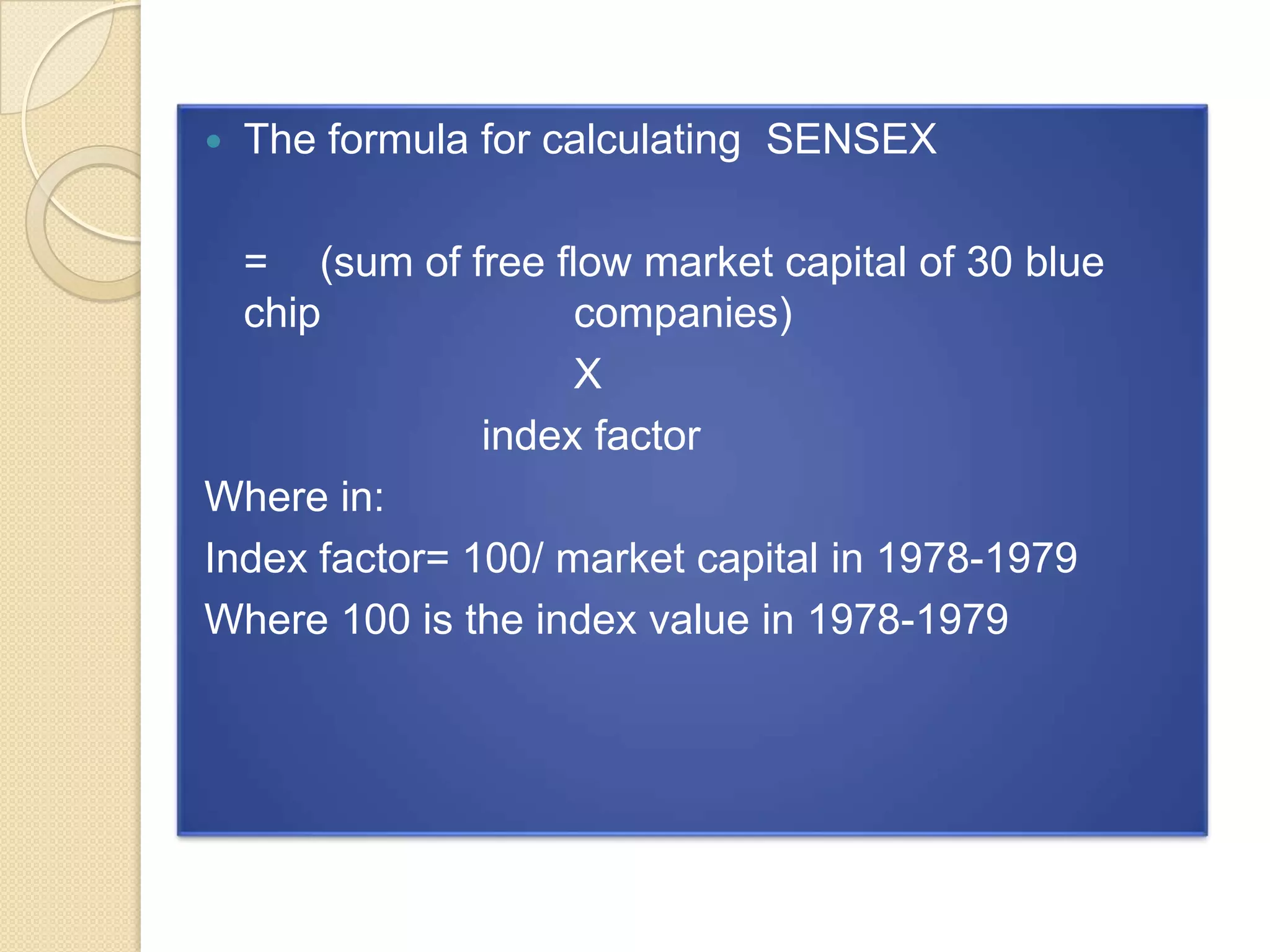
The formula for calculating SENSEX

= (sum of free flow market capital of 30 blue
chip
companies)
X
index factor
Where in:
Index factor= 100/ market capital in 1978-1979
Where 100 is the index value in 1978-1979
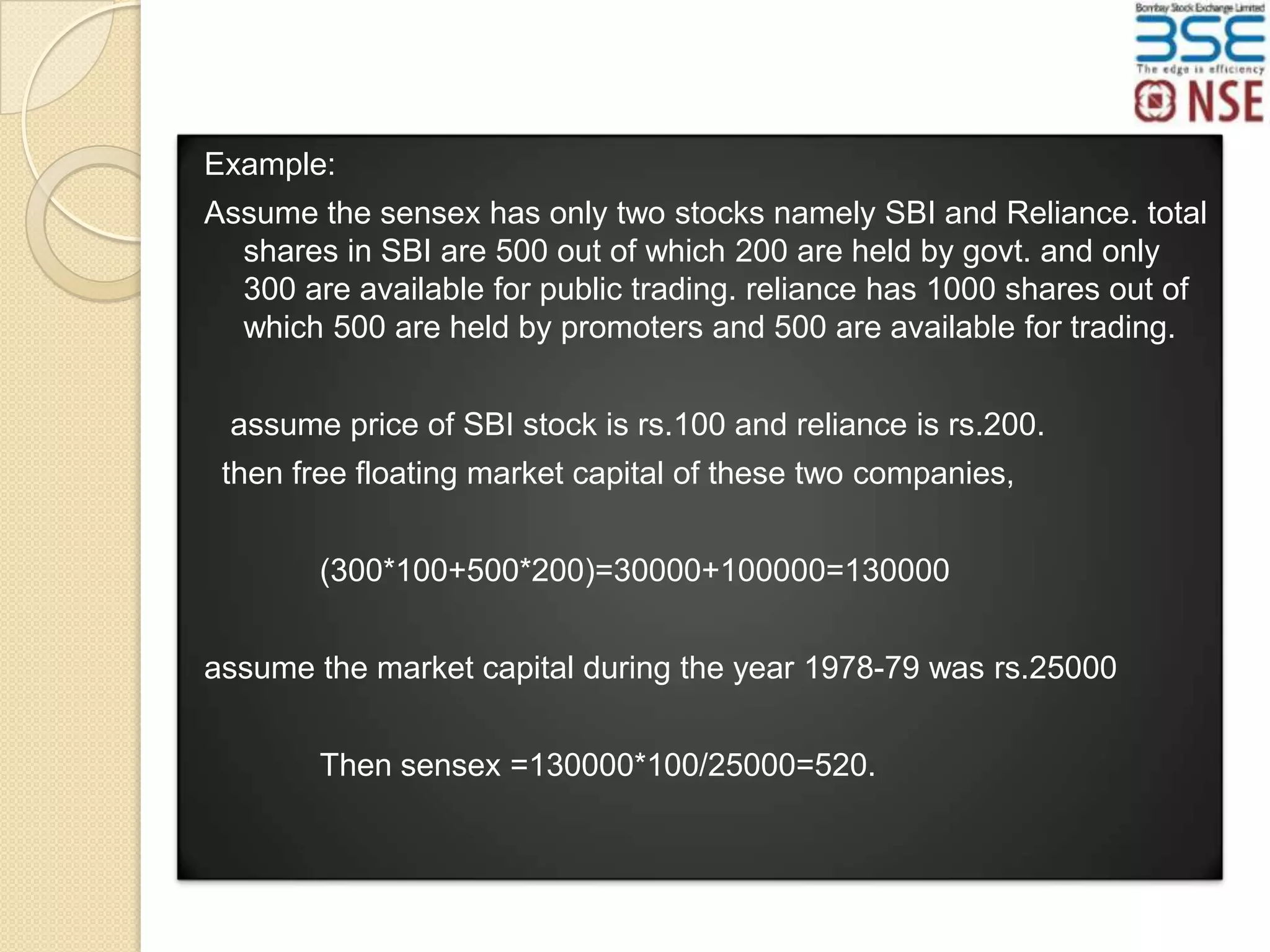
Example:
Assume the sensex has only two stocks namely SBI and Reliance. total
shares in SBI are 500 out of which 200 are held by govt. and only
300 are available for public trading. reliance has 1000 shares out of
which 500 are held by promoters and 500 are available for trading.
assume price of SBI stock is rs.100 and reliance is rs.200.
then free floating market capital of these two companies,
(300*100+500*200)=30000+100000=130000
assume the market capital during the year 1978-79 was rs.25000

Then sensex =130000*100/25000=520.
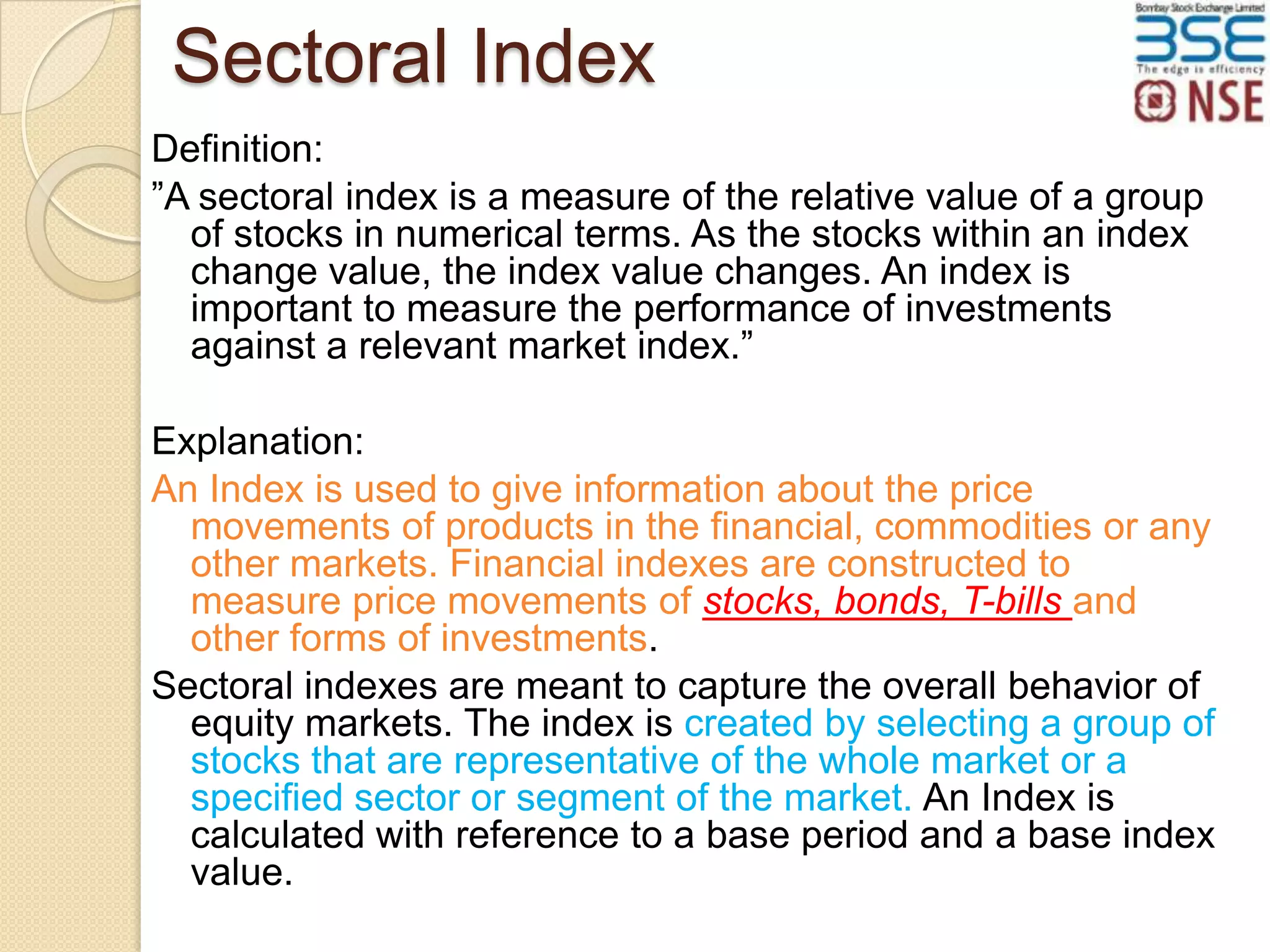
Sectoral Index
Definition:
”A sectoral index is a measure of the relative value of a group
of stocks in numerical terms. As the stocks within an index
change value, the index value changes. An index is
important to measure the performance of investments
against a relevant market index.”
Explanation:
An Index is used to give information about the price
movements of products in the financial, commodities or any
other markets. Financial indexes are constructed to
measure price movements of stocks, bonds, T-bills and
other forms of investments.
Sectoral indexes are meant to capture the overall behavior of
equity markets. The index is created by selecting a group of
stocks that are representative of the whole market or a
specified sector or segment of the market. An Index is
calculated with reference to a base period and a base index
value.
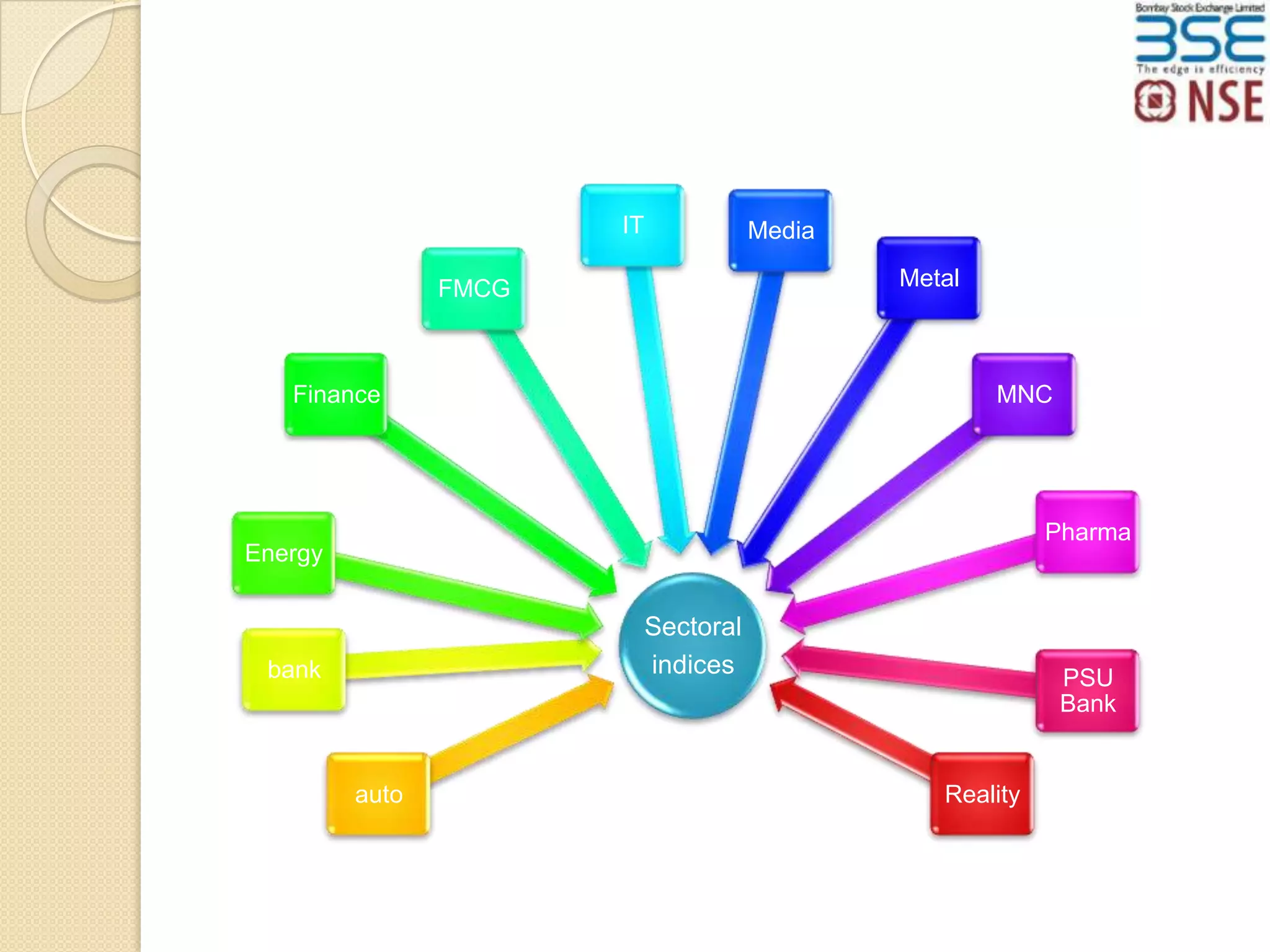
IT

Media
Metal

FMCG

Finance

MNC

Pharma

Energy

Sectoral
indices

bank

auto

PSU
Bank

Reality
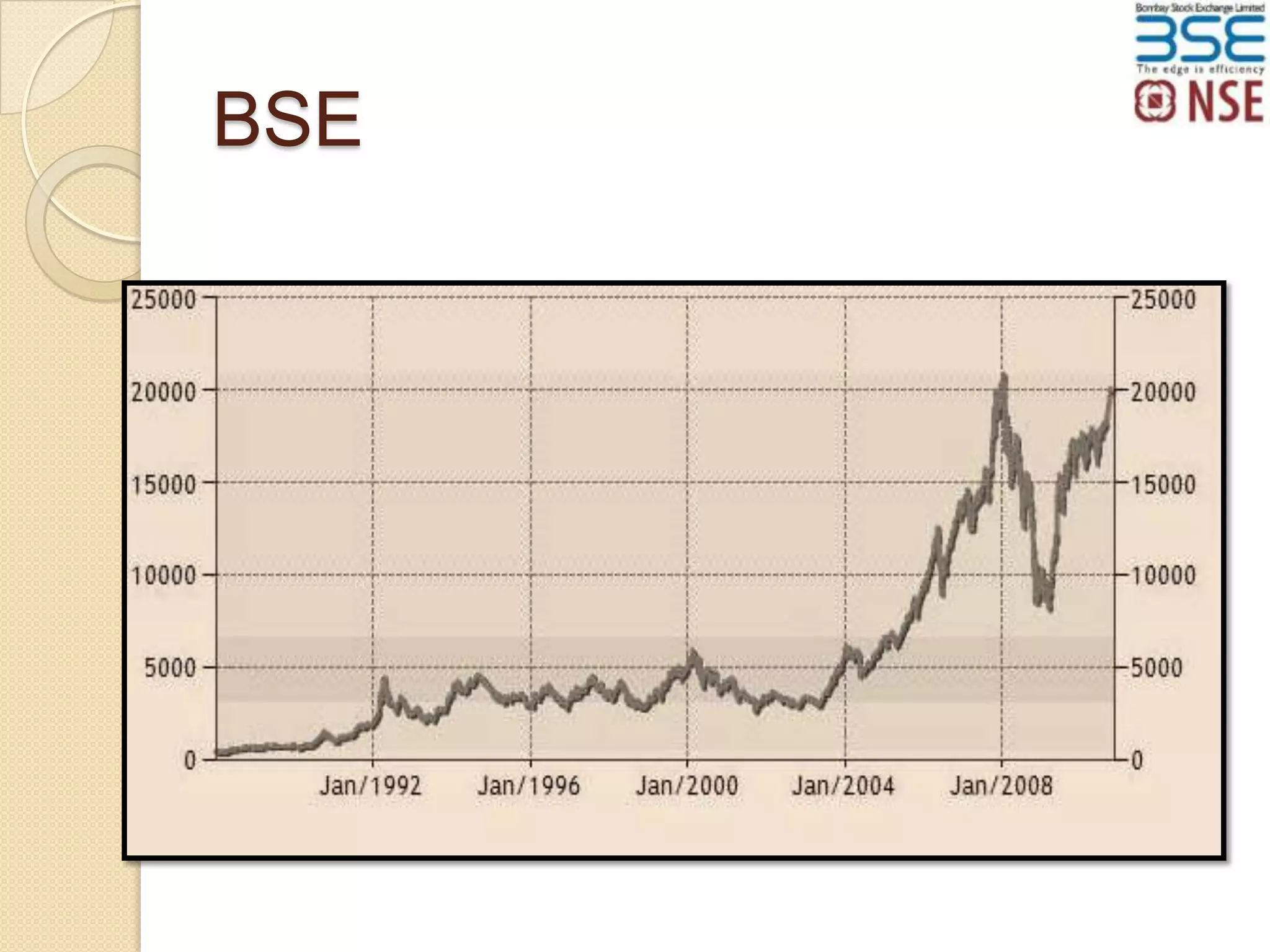
BSE
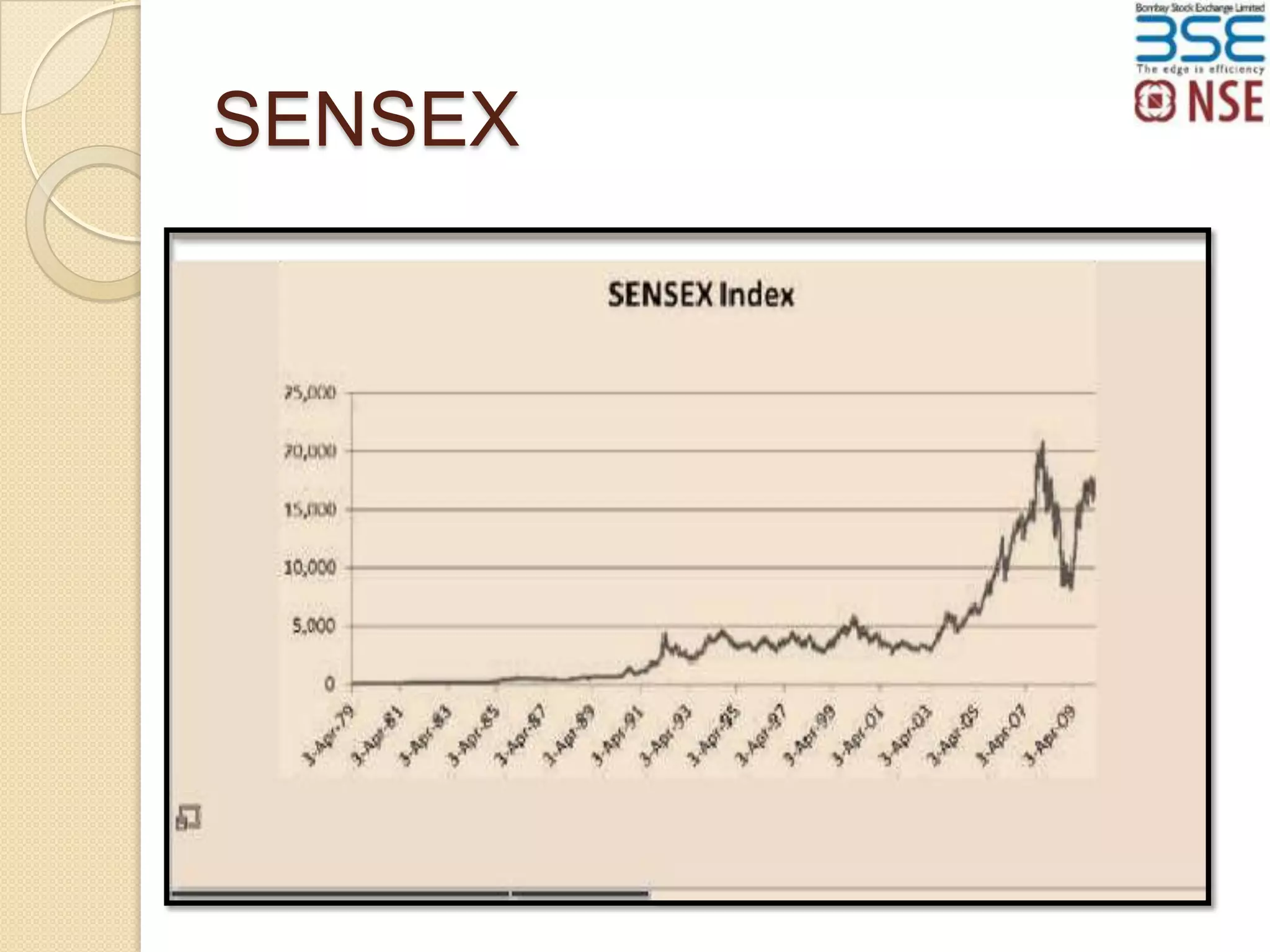
SENSEX
If you liked this presentation
then follow me to get more
updates

Calculation of Sensex & Nifty

  • 2.
    Flow of thepresentation  Introduction  Sensex & NIFTY  Stock exchanges around the world  How Sensex works  Sectoral Index  conclusion
  • 3.
    Introduction  Bombay Stock ExchangeLimited is the oldest stock exchange in Asia with a rich heritage. Popularly known as "BSE", it was established as "The Native Share & Stock Brokers Association" in 1875.  It is the first stock exchange in the country to obtain permanent recognition in 1956 from the Government of India under the Securities Contracts (Regulation) Act, 1956.The Indian capital market is widely recognized and its index, SENSEX, is tracked worldwide.  Earlier an Association of Persons (AOP), the Exchange is now a demutualised and corporatised entity incorporated under the provisions of the Companies Act, 1956, pursuant to the BSE Scheme, 2005 notified by the Securities and Exchange Board of India (SEBI).
  • 4.
     It consists ofthe 30 largest and most actively traded stocks, representative of various sectors, on the Bombay Stock Exchange. These companies account for majority of the market capitalization of the BSE.  At irregular intervals, the Bombay Stock Exchange (BSE) authorities review and modify its composition to make sure it reflects current market conditions. Note:  “The abbreviated form "Sensex" was coined by Deepak Mohoni around 1990 while writing market analysis columns for some of the business
  • 5.
    Nifty Nifty is anindex or an indicator of the performance of the companies listed in national stock exchange situated in Delhi. Nifty constitutes of 50 companies and the change in the Nifty index ( Up or down ) indicate the trend in the majority of the stocks.  Nifty is a joint holding of National Stock Exchange ( NSE ) and India Index Services and Products Limited ( IISL ) and Nifty accounts for 70% of total market capitalization.  NIFTY is an Index computed from performance of top stocks from different sectors listed on NSE (National stock exchange). NIFTY consists of 50 companies from 24 different sectors.   NIFTY stands for National Stock Exchange’s Fifty. The companies which form index of NIFTY may vary from time to time considered by NSE. NIFTY is for NSE similarly SENSEX is for BSE
  • 6.
    Some mutual fundsuse NIFTY index as a benchmark meaning the mutual funds’ performance is compared against the performance of NIFTY. On NSE there are futures and options available for trading with NIFTY as underlying index.  India Index Services and Products Ltd. (IISL) owns NIFTY. IISL is a joint venture of NSE and CRISIL. CRISIL is a subsidiary of Standard and Poor (S&P). And so NIFTY is also called as S&P CNX NIFTY. 
  • 10.
    Market capitalization Market capitalizationrefers to the value of a company's outstanding shares outstanding shares: number of shares issued by the company & subscribed by the public  Market Capitalization = Current market price of Stock X SharesOutstanding  Let's assume Company XYZ has 10,000,000 shares outstanding and the current share price is Rs90. Based on this information and the formula above, we can calculate that Company XYZ's market capitalization is 10,000,000 x Rs90 = RS 90,00,00,000/-
  • 11.
    Free float market capitalization efinition: D “Itis defined as the value of the shares readily available in the market for public trading excluding the promoters equity holding through FDI route, holding by private corporate and holding by employees welfare funds.” Why free float market capitalization? 1. It depicts the market more rationally. 2. It removes undue influence of government or promoters share holding, there by giving them equal opportunity for companies to be in the SENSEX. 3. Almost all the indices over the world are calculated by this methodology. 4. It gives fund managers more authentic information
  • 12.
     The formula forcalculating SENSEX = (sum of free flow market capital of 30 blue chip companies) X index factor Where in: Index factor= 100/ market capital in 1978-1979 Where 100 is the index value in 1978-1979
  • 13.
    Example: Assume the sensexhas only two stocks namely SBI and Reliance. total shares in SBI are 500 out of which 200 are held by govt. and only 300 are available for public trading. reliance has 1000 shares out of which 500 are held by promoters and 500 are available for trading. assume price of SBI stock is rs.100 and reliance is rs.200. then free floating market capital of these two companies, (300*100+500*200)=30000+100000=130000 assume the market capital during the year 1978-79 was rs.25000 Then sensex =130000*100/25000=520.
  • 14.
    Sectoral Index Definition: ”A sectoralindex is a measure of the relative value of a group of stocks in numerical terms. As the stocks within an index change value, the index value changes. An index is important to measure the performance of investments against a relevant market index.” Explanation: An Index is used to give information about the price movements of products in the financial, commodities or any other markets. Financial indexes are constructed to measure price movements of stocks, bonds, T-bills and other forms of investments. Sectoral indexes are meant to capture the overall behavior of equity markets. The index is created by selecting a group of stocks that are representative of the whole market or a specified sector or segment of the market. An Index is calculated with reference to a base period and a base index value.
  • 15.
  • 17.
  • 18.
  • 19.
    If you likedthis presentation then follow me to get more updates