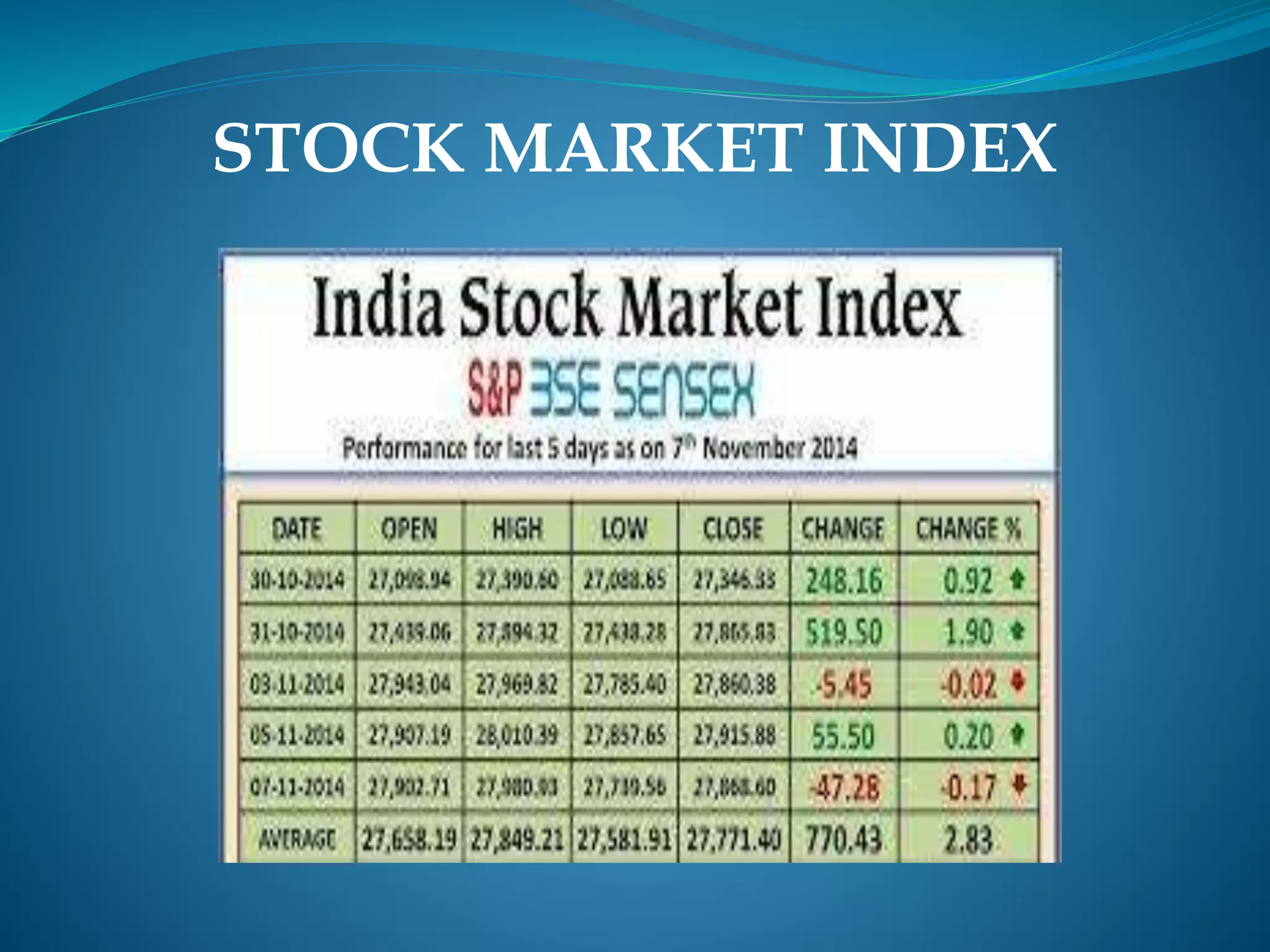
STOCK MARKET INDEX
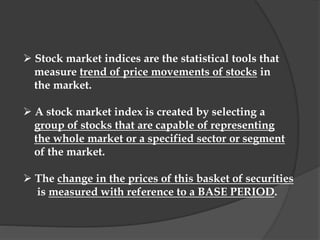
 Stock market indices are the statistical tools that
measure trend of price movements of stocks in
the market.
 A stock market index is created by selecting a
group of stocks that are capable of representing
the whole market or a specified sector or segment
of the market.
 The change in the prices of this basket of securities
is measured with reference to a BASE PERIOD.
 There is usually a provision of giving proper weights
to different stocks on the basis of their importance in
the economy.
 A stock market index acts as an indicator of the
performance of the economy or a sector of the
economy.
USEFULNESS:
 Indices help to recognize broad trends in the market.
 The investor can use the indices to allocate the funds
rationally among the stocks.
 Technical analysts use these indices to predict the
future market.
 Indices function as a status report on the general
economy.
MAJOR STOCK MARKET
INDICES
 DOW JONES
 NASDAQ
 S & P 500
 SENSEX
 NIFTY
 NIKKEI
BOMBAY STOCK EXCHANGE BSE
 Bombay Stock Exchange is the oldest stock
exchange in Asia with a rich heritage of over 140
years of existence.
 BSE is the first stock exchange in the country
which obtained permanent recognition (in 1956)
from the Government of India under the
Securities Contracts (Regulation) Act (SCRA)
1956.
 Over the past 140 years, BSE has facilitated the
growth of the Indian corporate sector by
providing it with cost and time efficient access to
resources.
SENSEX (BSE30)
 The BSE SENSEX, also called the BSE 30 or simply the SENSEX,
is a free-float market capitalization-weighted stock market
index of 30 well-established and financially sound companies
listed on Bombay Stock Exchange.
 The 30 component companies which are some of the largest and
most actively traded stocks, are representative of
various industrial sectors of the Indian economy. Published since
January 1, 1986, the SENSEX is regarded as the pulse of the
domestic stock markets in India.
 The base value of the SENSEX is taken as 100 on April 1, 1979,
and its base year as 1978-79.
 The market capitalization of SENSEX was
about 29,733 billion (US$538billion) (42.34% of
market capitalization of BSE), while its free-float market
capitalization was 15,690 billion (US$284 billion).
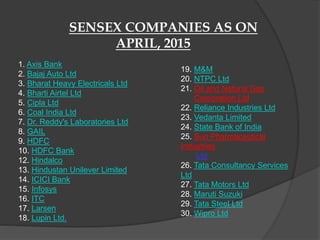
SENSEX COMPANIES AS ON
APRIL, 2015
1. Axis Bank
2. Bajaj Auto Ltd
3. Bharat Heavy Electricals Ltd
4. Bharti Airtel Ltd
5. Cipla Ltd
6. Coal India Ltd
7. Dr. Reddy's Laboratories Ltd
8. GAIL
9. HDFC
10. HDFC Bank
12. Hindalco
13. Hindustan Unilever Limited
14. ICICI Bank
15. Infosys
16. ITC
17. Larsen
18. Lupin Ltd.
19. M&M
20. NTPC Ltd
21. Oil and Natural Gas
Corporation Ltd
22. Reliance Industries Ltd
23. Vedanta Limited
24. State Bank of India
25. Sun Pharmaceutical
Industries
Ltd
26. Tata Consultancy Services
Ltd
27. Tata Motors Ltd
28. Maruti Suzuki
29. Tata Steel Ltd
30. Wipro Ltd
Market Capitalization
Market capitalization is the total worth of all outstanding (issued)
shares of a company. It represents the total worth of a company.
Market capitalization=
No of shares outstanding x market price of share
Free Float Market Capitalization
Free float concept is an index construction methodology which
makes use of free float shares in the market.
Free float market capitalization is the total worth of all shares of a
company which are available for trading in the open market. These
shares are called free float shares and are available for trading by
anyone.
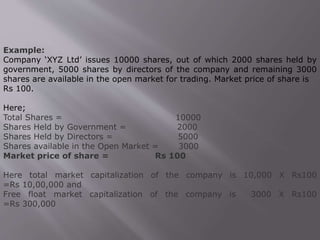
Example:
Company ‘XYZ Ltd’ issues 10000 shares, out of which 2000 shares held by
government, 5000 shares by directors of the company and remaining 3000
shares are available in the open market for trading. Market price of share is
Rs 100.
Here;
Total Shares = 10000
Shares Held by Government = 2000
Shares Held by Directors = 5000
Shares available in the Open Market = 3000
Market price of share = Rs 100
Here total market capitalization of the company is 10,000 X Rs100
=Rs 10,00,000 and
Free float market capitalization of the company is 3000 X Rs100
=Rs 300,000
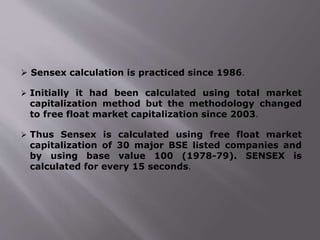
 Sensex calculation is practiced since 1986.
 Initially it had been calculated using total market
capitalization method but the methodology changed
to free float market capitalization since 2003.
 Thus Sensex is calculated using free float market
capitalization of 30 major BSE listed companies and
by using base value 100 (1978-79). SENSEX is
calculated for every 15 seconds.
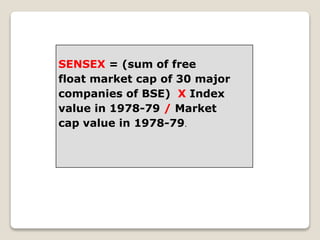
SENSEX = (sum of free
float market cap of 30 major
companies of BSE) X Index
value in 1978-79 / Market
cap value in 1978-79.
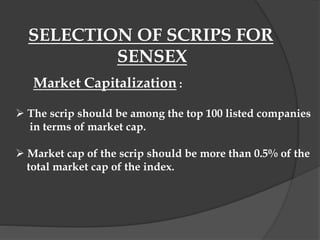
SELECTION OF SCRIPS FOR
SENSEX
Market Capitalization :
 The scrip should be among the top 100 listed companies
in terms of market cap.
 Market cap of the scrip should be more than 0.5% of the
total market cap of the index.
INDUSTRY REPRESENTATION :
 The scrip should be representative of its industry group.
 The companies in the index are leaders in their respective
industries.
REGULARITY OF TRADING :
 The scrip should have been traded on every trading day
for the last six months, except for extreme reasons.
NUMBER OF TRADES :
 The scrip should be among top 150 listed companies
by average number of trades per day for the last six
months.
VOLUME OF TRADE :
 The scrip should be among the top 150 companies
listed by average volume traded per day for the last
six months.
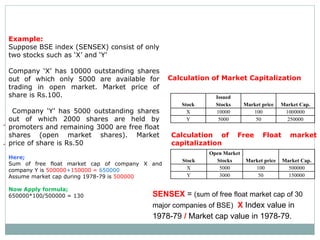
Stock
Issued
Stocks Market price Market Cap.
X 10000 100 1000000
Y 5000 50 250000
Stock
Open Market
Stocks Market price Market Cap.
X 5000 100 500000
Y 3000 50 150000
Example:
Suppose BSE index (SENSEX) consist of only
two stocks such as ‘X’ and ‘Y’
Company ‘X’ has 10000 outstanding shares
out of which only 5000 are available for
trading in open market. Market price of
share is Rs.100.
Company ‘Y’ has 5000 outstanding shares
out of which 2000 shares are held by
promoters and remaining 3000 are free float
shares (open market shares). Market
price of share is Rs.50


Calculation of Market Capitalization
Calculation of Free Float market
capitalization
Here;
Sum of free float market cap of company X and
company Y is 500000+150000 = 650000
Assume market cap during 1978-79 is 500000
Now Apply formula;
650000*100/500000 = 130 SENSEX = (sum of free float market cap of 30
major companies of BSE) X Index value in
1978-79 / Market cap value in 1978-79.
NATIONAL STOCK EXCHANGE
 National stock exchange of India ltd, the leading stock
stock exchange of India was established in 1992.
 Set up by a group of leading Indian financial institutions.
 Incorporated in 1992 as a tax paying company and was
recognized as a stock exchange in 1993 under Securities
Contract(Regulation) Act, 1956.
 The first exchange in the country to provide fully
automated screen based electronic trading system.
 NSE’s flagship index is S & P CNX NIFTY.
 NSE has a market capitalization of more than
US $ 1.6 TRILLION, making it the world’s 12th
largest stock exchange as of 23rd January, 2015.
 NSE offers trading, clearing and settlement services
in Equity, Equity Derivatives, Debt and Currency
Derivatives segments.
S and P CNX Nifty
It is an index calculated with a well diversified
sample of fifty stocks representing 13 sectors of the
economy.
The base period selected for nifty is the close of
prices on November 3,1995.
 The base value of the index has been set at 1000.
 Nifty is managed by India Index Services and
Products Ltd(IISL),which is a joint venture between
NSE and CRISIL.
 The index is known as S and P index because IISL
has consulting and licensing agreement with
Standard and Poor’s(S and P),who are world leaders
in index services.
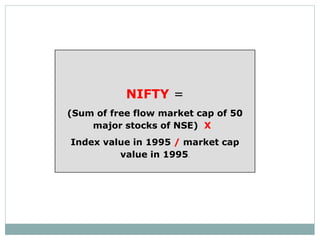
NIFTY =
(Sum of free flow market cap of 50
major stocks of NSE) X
Index value in 1995 / market cap
value in 1995.
USEFULNESS OF NIFTY :
 Helps investors and the common man to judge the mood
of the stock market and the Indian economy.
 Helps in comparing performance of a specific company
with market performance.
 Shareholders can evaluate management of their company.
 Traders and intermediaries can judge the market
sentiments.
 Nifty is used as the benchmark of mutual funds.
IMPORTANCE OF STOCK EXCHANGE
 It is an organized securities market which can provide
sufficient marketability and price continuity for shares.
 It provides a reasonable measure of safety and fair
dealing in the buying and selling of securities.
 Through the interplay of demand for and supply of
securities, stock exchange assists in correct evaluation
of securities in terms of their real worth.
 With proper evaluation of securities, stock exchange
helps in the orderly flow of savings between
different types of competitive investments.

CLASS-XI, CHAPTER-14

  • 1.
  • 4.
     Stock marketindices are the statistical tools that measure trend of price movements of stocks in the market.  A stock market index is created by selecting a group of stocks that are capable of representing the whole market or a specified sector or segment of the market.  The change in the prices of this basket of securities is measured with reference to a BASE PERIOD.
  • 5.
     There isusually a provision of giving proper weights to different stocks on the basis of their importance in the economy.  A stock market index acts as an indicator of the performance of the economy or a sector of the economy.
  • 6.
    USEFULNESS:  Indices helpto recognize broad trends in the market.  The investor can use the indices to allocate the funds rationally among the stocks.  Technical analysts use these indices to predict the future market.  Indices function as a status report on the general economy.
  • 7.
    MAJOR STOCK MARKET INDICES DOW JONES  NASDAQ  S & P 500  SENSEX  NIFTY  NIKKEI
  • 8.
    BOMBAY STOCK EXCHANGEBSE  Bombay Stock Exchange is the oldest stock exchange in Asia with a rich heritage of over 140 years of existence.  BSE is the first stock exchange in the country which obtained permanent recognition (in 1956) from the Government of India under the Securities Contracts (Regulation) Act (SCRA) 1956.  Over the past 140 years, BSE has facilitated the growth of the Indian corporate sector by providing it with cost and time efficient access to resources.
  • 9.
    SENSEX (BSE30)  TheBSE SENSEX, also called the BSE 30 or simply the SENSEX, is a free-float market capitalization-weighted stock market index of 30 well-established and financially sound companies listed on Bombay Stock Exchange.  The 30 component companies which are some of the largest and most actively traded stocks, are representative of various industrial sectors of the Indian economy. Published since January 1, 1986, the SENSEX is regarded as the pulse of the domestic stock markets in India.  The base value of the SENSEX is taken as 100 on April 1, 1979, and its base year as 1978-79.
  • 10.
     The marketcapitalization of SENSEX was about 29,733 billion (US$538billion) (42.34% of market capitalization of BSE), while its free-float market capitalization was 15,690 billion (US$284 billion).
  • 11.
    SENSEX COMPANIES ASON APRIL, 2015 1. Axis Bank 2. Bajaj Auto Ltd 3. Bharat Heavy Electricals Ltd 4. Bharti Airtel Ltd 5. Cipla Ltd 6. Coal India Ltd 7. Dr. Reddy's Laboratories Ltd 8. GAIL 9. HDFC 10. HDFC Bank 12. Hindalco 13. Hindustan Unilever Limited 14. ICICI Bank 15. Infosys 16. ITC 17. Larsen 18. Lupin Ltd. 19. M&M 20. NTPC Ltd 21. Oil and Natural Gas Corporation Ltd 22. Reliance Industries Ltd 23. Vedanta Limited 24. State Bank of India 25. Sun Pharmaceutical Industries Ltd 26. Tata Consultancy Services Ltd 27. Tata Motors Ltd 28. Maruti Suzuki 29. Tata Steel Ltd 30. Wipro Ltd
  • 12.
    Market Capitalization Market capitalizationis the total worth of all outstanding (issued) shares of a company. It represents the total worth of a company. Market capitalization= No of shares outstanding x market price of share Free Float Market Capitalization Free float concept is an index construction methodology which makes use of free float shares in the market. Free float market capitalization is the total worth of all shares of a company which are available for trading in the open market. These shares are called free float shares and are available for trading by anyone.
  • 13.
    Example: Company ‘XYZ Ltd’issues 10000 shares, out of which 2000 shares held by government, 5000 shares by directors of the company and remaining 3000 shares are available in the open market for trading. Market price of share is Rs 100. Here; Total Shares = 10000 Shares Held by Government = 2000 Shares Held by Directors = 5000 Shares available in the Open Market = 3000 Market price of share = Rs 100 Here total market capitalization of the company is 10,000 X Rs100 =Rs 10,00,000 and Free float market capitalization of the company is 3000 X Rs100 =Rs 300,000
  • 14.
     Sensex calculationis practiced since 1986.  Initially it had been calculated using total market capitalization method but the methodology changed to free float market capitalization since 2003.  Thus Sensex is calculated using free float market capitalization of 30 major BSE listed companies and by using base value 100 (1978-79). SENSEX is calculated for every 15 seconds.
  • 15.
    SENSEX = (sumof free float market cap of 30 major companies of BSE) X Index value in 1978-79 / Market cap value in 1978-79.
  • 16.
    SELECTION OF SCRIPSFOR SENSEX Market Capitalization :  The scrip should be among the top 100 listed companies in terms of market cap.  Market cap of the scrip should be more than 0.5% of the total market cap of the index.
  • 17.
    INDUSTRY REPRESENTATION : The scrip should be representative of its industry group.  The companies in the index are leaders in their respective industries.
  • 18.
    REGULARITY OF TRADING:  The scrip should have been traded on every trading day for the last six months, except for extreme reasons. NUMBER OF TRADES :  The scrip should be among top 150 listed companies by average number of trades per day for the last six months.
  • 19.
    VOLUME OF TRADE:  The scrip should be among the top 150 companies listed by average volume traded per day for the last six months.
  • 20.
    Stock Issued Stocks Market priceMarket Cap. X 10000 100 1000000 Y 5000 50 250000 Stock Open Market Stocks Market price Market Cap. X 5000 100 500000 Y 3000 50 150000 Example: Suppose BSE index (SENSEX) consist of only two stocks such as ‘X’ and ‘Y’ Company ‘X’ has 10000 outstanding shares out of which only 5000 are available for trading in open market. Market price of share is Rs.100. Company ‘Y’ has 5000 outstanding shares out of which 2000 shares are held by promoters and remaining 3000 are free float shares (open market shares). Market price of share is Rs.50   Calculation of Market Capitalization Calculation of Free Float market capitalization Here; Sum of free float market cap of company X and company Y is 500000+150000 = 650000 Assume market cap during 1978-79 is 500000 Now Apply formula; 650000*100/500000 = 130 SENSEX = (sum of free float market cap of 30 major companies of BSE) X Index value in 1978-79 / Market cap value in 1978-79.
  • 21.
    NATIONAL STOCK EXCHANGE National stock exchange of India ltd, the leading stock stock exchange of India was established in 1992.  Set up by a group of leading Indian financial institutions.  Incorporated in 1992 as a tax paying company and was recognized as a stock exchange in 1993 under Securities Contract(Regulation) Act, 1956.  The first exchange in the country to provide fully automated screen based electronic trading system.
  • 22.
     NSE’s flagshipindex is S & P CNX NIFTY.  NSE has a market capitalization of more than US $ 1.6 TRILLION, making it the world’s 12th largest stock exchange as of 23rd January, 2015.  NSE offers trading, clearing and settlement services in Equity, Equity Derivatives, Debt and Currency Derivatives segments.
  • 23.
    S and PCNX Nifty It is an index calculated with a well diversified sample of fifty stocks representing 13 sectors of the economy. The base period selected for nifty is the close of prices on November 3,1995.  The base value of the index has been set at 1000.  Nifty is managed by India Index Services and Products Ltd(IISL),which is a joint venture between NSE and CRISIL.  The index is known as S and P index because IISL has consulting and licensing agreement with Standard and Poor’s(S and P),who are world leaders in index services.
  • 24.
    NIFTY = (Sum offree flow market cap of 50 major stocks of NSE) X Index value in 1995 / market cap value in 1995.
  • 25.
    USEFULNESS OF NIFTY:  Helps investors and the common man to judge the mood of the stock market and the Indian economy.  Helps in comparing performance of a specific company with market performance.  Shareholders can evaluate management of their company.  Traders and intermediaries can judge the market sentiments.  Nifty is used as the benchmark of mutual funds.
  • 26.
    IMPORTANCE OF STOCKEXCHANGE  It is an organized securities market which can provide sufficient marketability and price continuity for shares.  It provides a reasonable measure of safety and fair dealing in the buying and selling of securities.  Through the interplay of demand for and supply of securities, stock exchange assists in correct evaluation of securities in terms of their real worth.  With proper evaluation of securities, stock exchange helps in the orderly flow of savings between different types of competitive investments.