Towards	an	integrated	approach	to	NAPs,	
NDCs,	and	SDGs	
NDC	Global	Conference – 3rd	May	2017
Overview
• Why	build	NAP-NDC-SDG	synergies?
• Introduction	to	National	Adaptation	Plan	(NAP)	Process
• Key	elements	to	consider
• UNDP-FAO-UNEP’s	Briefing	Paper
Why	are	NAP-NDC-SDGs	synergies	needed?
• Most	countries	are	rolling	actions	on	Paris	Agreement	and	2030	Agenda	simultaneously	
• Role	of	Ministries	of	Environment,	Finance	and	Planning,	and	sector	ministries
• Coordination	and	linkages	would allow to:
Ø Reduce	vulnerability
Ø Implement	the	Paris	Agreement
Ø Align	long-term	national	development	priorities	with	the	SDG	framework.
What	is	the	NAP?
• Established	under	the	UNFCCC Cancun	Adaptation	
Framework	(2010).	
• Means	of	identifying	medium- and	long-term	
adaptation	needs	and	developing	and	implementing
strategies	and	programmes to	address	those	needs.
• It	is	a	continuous,	progressive	and	iterative	process	
which	follows	country-driven,	gender-sensitive,	
participatory	and	fully	transparent	approach
• Its	objectives	are	to	reduce	vulnerability	to	the	
impacts	of	climate	change, and	to	facilitate	the	
integration	of	climate	change	adaptation,	into	all	
levels	of	development	activities
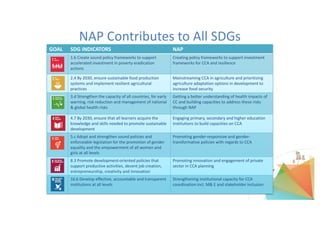
NAP	Contributes	to	All	SDGs
GOAL SDG	INDICATORS NAP
1.b	Create	sound	policy	frameworks	to	support	
accelerated	investment	in	poverty	eradication	
actions
Creating policy	frameworks	to	support	investment	
frameworks	for	CCA	and	resilience
2.4	By	2030,	ensure	sustainable	food	production
systems	and	implement	resilient	agricultural	
practices
Mainstreaming	CCA	in agriculture	and	prioritizing	
agriculture	adaptation	options	in	development	to	
increase	food	security
3.d	Strengthen	the	capacity	of	all	countries,	for	early	
warning,	risk reduction	and	management	of	national	
&	global	health risks
Getting a	better	understanding	of	health	impacts	of	
CC	and	building	capacities	to	address	these	risks	
through	NAP
4.7	By	2030,	ensure	that	all	learners	acquire	the
knowledge	and	skills	needed	to	promote	sustainable
development
Engaging	primary,	secondary	and	higher	education	
institutions	to	build	capacities	on	CCA
5.c	Adopt	and	strengthen	sound	policies	and
enforceable	legislation	for	the	promotion	of	gender
equality	and	the	empowerment	of	all	women	and	
girls	at	all	levels
Promoting gender-responsive	and	gender-
transformative	policies	with	regards	to	CCA
8.3	Promote	development-oriented	policies	that
support	productive	activities,	decent	job	creation,
entrepreneurship,	creativity	and	innovation
Promoting innovation	and	engagement	of	private
sector in	CCA	planning
16.6	Develop	effective,	accountable	and	transparent	
institutions	at	all	levels
Strengthening institutional capacity for	CCA	
coordination	incl.	M&	E	and	stakeholder inclusion
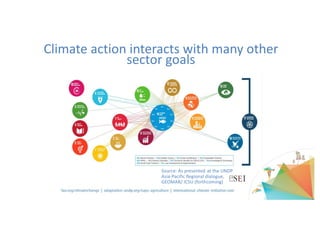
Climate	action	interacts	with	many	other	
sector	goals
Source:	As	presented at	the	UNDP	
Asia-Pacific	Regional	dialogue,	
GEOMAR/	ICSU (forthcoming)
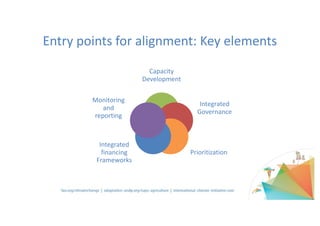
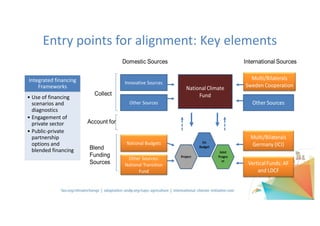
Entry	points	for	alignment:	Key	elements
Capacity	
Development
Integrated	
Governance
Prioritization
Integrated	
financing	
Frameworks
Monitoring	
and	
reporting
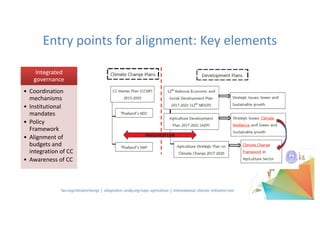
Integrated	
governance
• Coordination	
mechanisms
• Institutional	
mandates
• Policy	
Framework
• Alignment	of	
budgets	and	
integration	of	CC
• Awareness	of	CC
Capacities
• Joint	Skills	
assessment
• Comprehensive	
long-term	
capacity	
development	
• ToT approach
Financing	
Frameworks
• Use	of	financing	
scenarios	and	
diagnostics
• Engagement	of	
private	sector
• Alignment	of	
budgets	and	
integration	of	CC
Monitoring	and	
reporting
• M&E	systems	in	
place
• Common	
indicators
• What	vehicles	to	
report	to	
UNFCCC
• Sharing	of	
experience	with	
other	countries
Entry	points	for	alignment:	Key	elements
Capacity	
Development
• Joint	Skills	
assessment
• Comprehensive	
long-term	
capacity	
development	
• ToT approach
Governance
• Coordination	
mechanisms
• Institutional	
mandates
• Policy	
Framework
• Awareness	of	
CC
Financing	
Frameworks
• Use	of	financing	
scenarios	and	
diagnostics
• Engagement	of	
private	sector
• Alignment	of	
budgets	and	
integration	of	
CC
Monitoring	and	
reporting
• M&E	systems	in	
place
• Common	
indicators
• What	vehicles	
to	report	to	
UNFCCC
• Sharing	of	
experience	with	
other	countries
Source:
UNITAR,
forthcoming
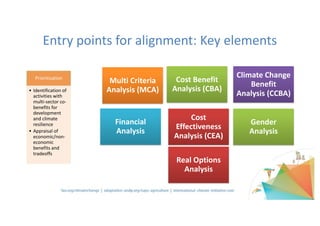
Entry	points	for	alignment:	Key	elements
Prioritisation
• Identification	of	
activities	with	
multi-sector	co-
benefits	for	
development	
and	climate	
resilience
• Appraisal	of	
economic/non-
economic	
benefits	and	
tradeoffs
Governance
• Coordination	
mechanisms
• Institutional	
mandates
• Policy	
Framework
• Alignment	of	
budgets	and	
integration	of	
CC
• Awareness	of	
CC
Capacities
• Joint	Skills	
assessment
• Comprehensive	
long-term	
capacity	
development	
• ToT approach
Financing	
Frameworks
• Use	of	financing	
scenarios	and	
diagnostics
• Engagement	of	
private	sector
• Public-private	
partnership	
options	and	
blended	
financing
Monitoring	and	
reporting
• M&E	systems	in	
place
• Common	
indicators
• What	vehicles	
to	report	to	
UNFCCC
• Sharing	of	
experience	with	
other	countries
Cost	
Effectiveness	
Analysis	(CEA)
Cost	Benefit	
Analysis	(CBA)
Climate	Change	
Benefit	
Analysis	(CCBA)
Financial	
Analysis
Multi	Criteria	
Analysis	(MCA)
Real	Options	
Analysis
Gender	
Analysis
Entry	points	for	alignment:	Key	elements
Integrated	financing	
Frameworks
• Use	of	financing	
scenarios	and	
diagnostics
• Engagement	of	
private	sector
• Public-private	
partnership	
options	and	
blended	financing
Capacities
• Joint	Skills	
assessment
• Comprehensive	
long-term	capacity	
development	
• ToT approach
Monitoring	and	
reporting
• M&E	systems	in	
place
• Common	
indicators
• What	vehicles	to	
report	to	UNFCCC
• Sharing	of	
experience	with	
other	countries
Governance
• Coordination	
mechanisms
• Institutional	
mandates
• Policy	Framework
• Awareness	of	CC
Entry	points	for	alignment:	Key	elements
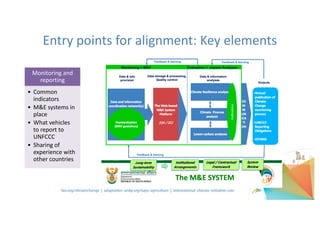
Monitoring	and	
reporting
• Common	
indicators
• M&E	systems	in	
place
• What	vehicles	
to	report	to	
UNFCCC
• Sharing	of	
experience	with	
other	countries
Governance
• Coordination	
mechanisms
• Institutional	
mandates
• Policy	
Framework
• Awareness	of	
CC
Capacities
• Joint	Skills	
assessment
• Comprehensive	
long-term	
capacity	
development	
• ToT approach
Financing	
Frameworks
• Use	of	financing	
scenarios	and	
diagnostics
• Engagement	of	
private	sector
• Alignment	of	
budgets	and	
integration	of	
CC
Entry	points	for	alignment:	Key	elements
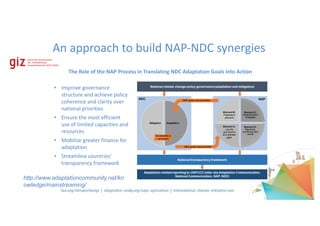
An	approach	to	build	NAP-NDC	synergies
The	Role	of	the	NAP	Process	in	Translating	NDC	Adaptation	Goals	into	Action
• Improve	governance	
structure	and	achieve	policy	
coherence	and	clarity	over	
national	priorities
• Ensure	the	most	efficient	
use	of	limited	capacities	and	
resources
• Mobilize	greater	finance	for	
adaptation
• Streamline	countries’	
transparency	framework
http://www.adaptationcommunity.net/kn
owledge/mainstreaming/
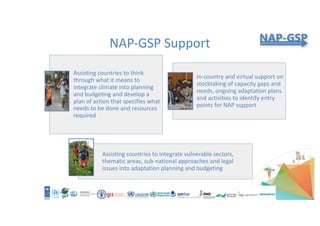
Assisting	countries	to	think	
through	what	it	means	to	
integrate	climate	into	planning	
and	budgeting	and	develop	a	
plan	of	action	that	specifies	what	
needs	to	be	done	and	resources	
required
In-country	and	virtual	support	on	
stocktaking	of	capacity	gaps	and	
needs,	ongoing adaptation	plans	
and	activities	to	identify	entry	
points	for	NAP	support
Assisting	countries	to	integrate	vulnerable	sectors,	
thematic	areas,	sub-national	approaches	and	legal	
issues	into	adaptation	planning	and	budgeting
NAP-GSP	Support
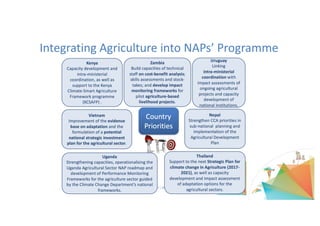
Integrating Agriculture	into NAPs’	Programme
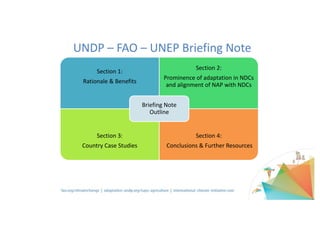
Section	1:	
Rationale	&	Benefits
Section	2:
Prominence	of	adaptation	in	NDCs	
and	alignment	of	NAP	with	NDCs
Section	3:
Country	Case	Studies
Section	4:
Conclusions	&	Further	Resources
Briefing	Note	
Outline	
UNDP	– FAO	– UNEP	Briefing	Note
Thank	you	for	your	attention
For more information:
Glenn.hodes@undp.org adaptation-undp.org/naps-agriculture
Julie.teng@fao.org fao.org/climatechange
Rohini.kohli@undp.org globalsupportprogramme.org
Julia.wolf@fao.org
Gelila.terrefe@undp.org

Towards an integrated approach to NAPs, NDCs and SDGs