Go	Purple!	
Augmenting	Application	Security	Program	by	
Adapting Purple	Team	Strategy
Trupti	Shiralkar
Disclaimer
This disclaimer informs readers that the views, thoughts, and
opinions expressed in the presentation belong solely to the
author, and not necessarily to the author’s employer,
organization, committee or other group or individual.
About Me
Application	Security	Life	
Cycle	Management	Software	Security
Practical	
Cryptography Sr Security	Technical	Security	Manager
Certified	Yoga	
Alliance	Instructor
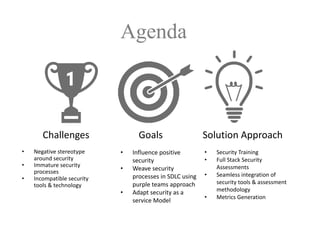
Agenda
Challenges Goals Solution	Approach	
• Negative	stereotype	
around	security
• Immature	security	
processes
• Incompatible	security	
tools	&	technology
• Influence	positive	
security	
• Weave	security	
processes	in	SDLC	using	
purple	teams	approach
• Adapt	security	as	a	
service	Model
• Security	Training
• Full	Stack	Security	
Assessments
• Seamless	integration	of	
security	tools	&	assessment	
methodology
• Metrics	Generation
“Perception is the co-pilot to Reality” ~ Carla Harris
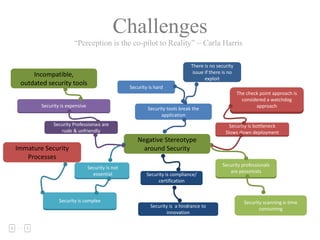
Challenges
Negative	Stereotype	
around	Security
Security	tools	break	the	
application
Security	is	hard
There	is	no	security	
issue	if	there	is	no	
exploit	
Security	Professionals	are	
rude	&	unfriendly
Security	is	expensive
Security	is	bottleneck
Slows	down	deployment
The	check	point	approach	is	
considered	a	watchdog	
approach
Security	is	compliance/	
certification
Security	professionals	
are	pessimists
Security	scanning	is	time	
consuming
Security	is	 a	hindrance	to	
innovation
Security	is	complex
Security	is	not	
essential	
Incompatible,	
outdated	security	tools
Immature	Security	
Processes
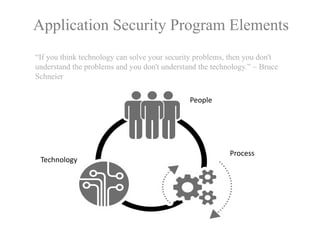
Application Security Program Elements
“If you think technology can solve your security problems, then you don't
understand the problems and you don't understand the technology.” ~ Bruce
Schneier
People
Process
Technology
People
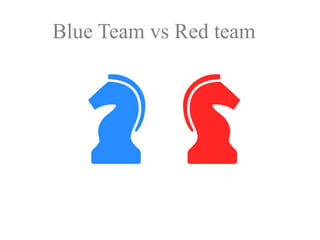
Blue Team vs Red team
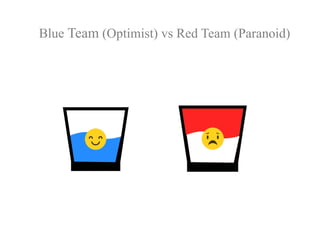
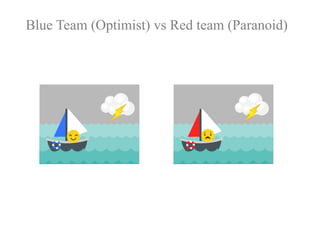
Blue Team (Optimist) vs Red Team (Paranoid)
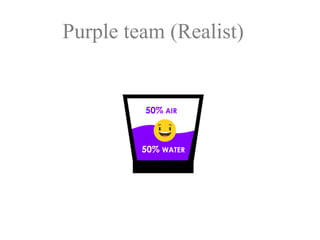
Purple team (Realist)
Blue Team (Optimist) vs Red team (Paranoid)
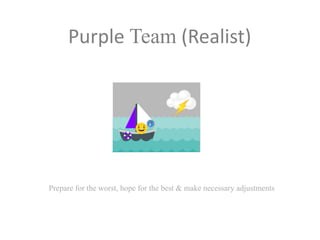
Purple	Team (Realist)
Prepare for the worst, hope for the best & make necessary adjustments
Process
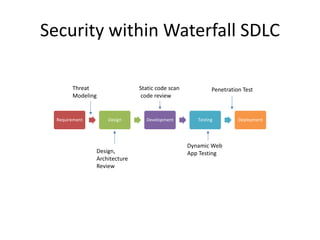
Security	within	Waterfall	SDLC
Requirement Design Development Testing Deployment
Threat	
Modeling
Design,	
Architecture	
Review
Static	code	scan
code	review	
Dynamic	Web	
App	Testing
Penetration	Test
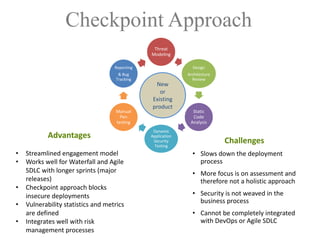
Checkpoint Approach
Threat	
Modeling
Design
Architecture	
Review
Static	
Code	
Analysis
Dynamic	
Application	
Security	
Testing
Manual	
Pen	
testing
Reporting
&	Bug	
Tracking
New
or		
Existing	
product
Advantages
• Streamlined	engagement	model
• Works	well	for	Waterfall	and	Agile	
SDLC	with	longer	sprints	(major	
releases)
• Checkpoint	approach	blocks	
insecure	deployments
• Vulnerability	statistics	and	metrics	
are	defined
• Integrates	well	with	risk	
management	processes
Challenges
• Slows	down	the	deployment	
process
• More	focus	is	on	assessment	and	
therefore	not	a	holistic	approach	
• Security	is	not	weaved	in	the	
business	process	
• Cannot	be	completely	integrated	
with	DevOps	or	Agile	SDLC
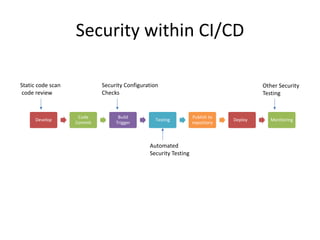
Security	within	CI/CD
Develop
Code	
Commit	
Build	
Trigger
Testing
Publish	to	
repository
Deploy Monitoring
Static	code	scan
code	review	
Automated	
Security	Testing
Other	Security	
Testing
Security	Configuration	
Checks
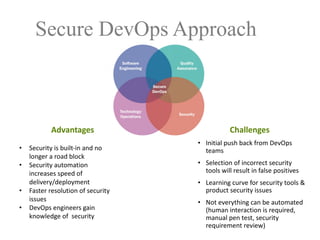
Advantages
• Security	is	built-in	and	no	
longer	a	road	block
• Security	automation	
increases	speed	of	
delivery/deployment
• Faster	resolution	of	security	
issues
• DevOps engineers	gain	
knowledge	of		security
Challenges
• Initial	push	back	from	DevOps	
teams
• Selection	of	incorrect	security	
tools	will	result	in	false	positives
• Learning	curve	for	security	tools	&	
product	security	issues
• Not	everything	can	be	automated	
(human	interaction	is	required,	
manual	pen	test,	security	
requirement	review)
Secure DevOps Approach
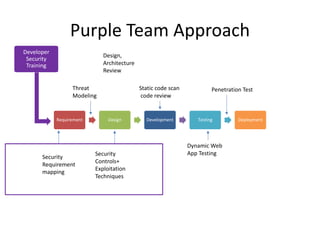
Purple	Team	Approach
Requirement Design Development Testing Deployment
Threat	
Modeling
Design,	
Architecture	
Review
Static	code	scan
code	review	
Dynamic	Web	
App	Testing
Penetration	Test
Security
Requirement	
mapping
Security	
Controls+
Exploitation	
Techniques
Developer	
Security	
Training
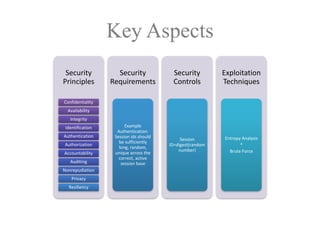
Key Aspects
Security	
Principles
Confidentiality
Availability
Integrity
Identification
Authentication
Authorization
Accountability
Auditing
Nonrepudiation
Privacy
Resiliency
Security	
Requirements
Example	
Authentication:	
Session	ids	should	
be	sufficiently	
long,	random,	
unique	across	the	
correct,	active	
session	base	
Security	
Controls
Session	
ID=digest(random	
number)
Exploitation	
Techniques
Entropy	Analysis	
+	
Brute	Force
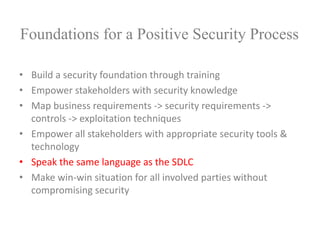
Foundations for a Positive Security Process
• Build	a	security	foundation	through	training
• Empower	stakeholders	with	security	knowledge	
• Map	business	requirements	->	security	requirements	->	
controls	->	exploitation	techniques
• Empower	all	stakeholders	with	appropriate	security	tools	&	
technology	
• Speak	the	same	language	as	the	SDLC
• Make	win-win	situation	for	all	involved	parties	without	
compromising	security
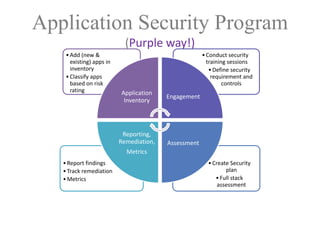
Application Security Program
(Purple	way!)
•Create	Security		
plan
•Full	stack	
assessment
•Report	findings
•Track	remediation
•Metrics	
•Conduct	security	
training	sessions
•Define	security										
requirement	and	
controls	
•Add	(new	&	
existing)	apps	in	
inventory
•Classify	apps	
based	on	risk	
rating Application	
Inventory
Engagement
Assessment
Reporting,	
Remediation,
Metrics
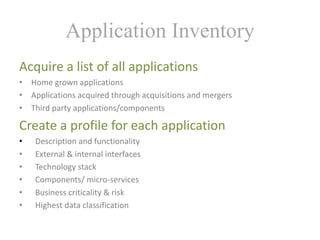
Application Inventory
Acquire	a	list	of	all	applications
• Home	grown	applications
• Applications	acquired	through	acquisitions	and	mergers
• Third	party	applications/components
Create	a	profile	for	each	application
• Description	and	functionality
• External	&	internal	interfaces
• Technology	stack
• Components/	micro-services
• Business	criticality	&	risk
• Highest	data	classification
Engagement
Training	
• Conduct	Security	training	sessions
• Internal	training	vs	external	training
• Teach	attacker’s	mindset	and	
exploitation	techniques
Product	Onboarding
• Map	business	requirements	with	
security	requirements
• Tie	security	requirements	with	
controls	and	respective	exploitation	
techniques
• Implement	controls/security	services
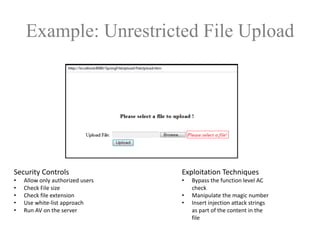
Security	Controls
• Allow	only	authorized	users
• Check	File	size
• Check	file	extension	
• Use	white-list	approach
• Run	AV	on	the	server
Exploitation	Techniques
• Bypass	the	function	level	AC	
check
• Manipulate	the	magic	number
• Insert	injection	attack	strings	
as	part	of	the	content	in	the	
file	
Example: Unrestricted File Upload
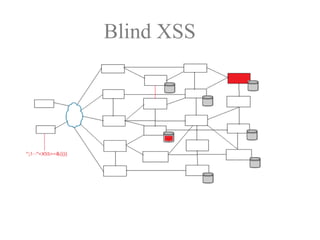
Blind XSS
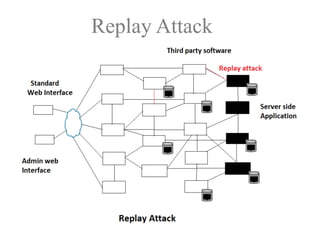
Replay Attack
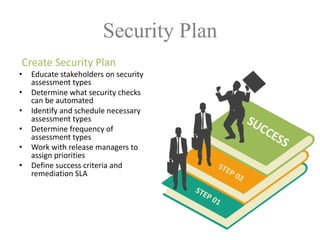
Security Plan
Create	Security	Plan
• Educate	stakeholders	on	security	
assessment	types
• Determine	what	security	checks	
can	be	automated	
• Identify	and	schedule	necessary	
assessment	types	
• Determine	frequency	of	
assessment	types
• Work	with	release	managers	to	
assign	priorities
• Define	success	criteria	and	
remediation	SLA
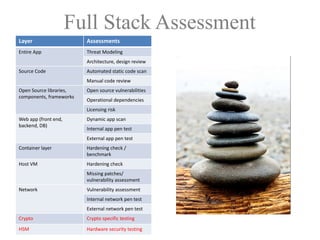
Full Stack Assessment
Layer Assessments
Entire	App Threat	Modeling
Architecture,	design review
Source	Code Automated static	code	scan
Manual	code	review
Open	Source	libraries,	
components,	frameworks
Open	source	vulnerabilities
Operational	dependencies
Licensing	risk
Web	app	(front	end,	
backend,	DB)
Dynamic	app	scan
Internal	app	pen	test
External	app	pen	test
Container	layer Hardening	check	/	
benchmark
Host	VM Hardening	check
Missing	patches/	
vulnerability	assessment
Network Vulnerability	assessment
Internal	network	pen	test
External	network	pen test
Crypto Crypto	specific	testing
HSM Hardware	security	testing
Reporting
• Use	same	bug	tracking	
mechanism	or	tool	for	recording	
security	issues	or	integrate	
security	bug	tracking	tool	with	
the	one	used	by	the	product	
teams
• Educate	stakeholders	on	
subjective	nature	of	risk
• Risk	=	Likelihood	*	Impact	*	
Threat	Agent
• Automate	vulnerability	statistics	
(critical,	high,	medium,	low,	
vulnerability	age)
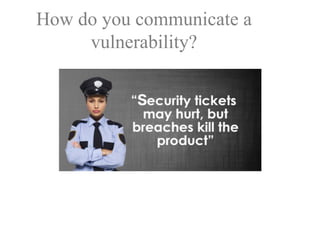
How do you communicate a
vulnerability?
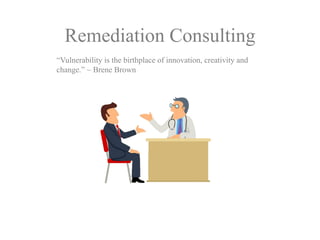
Remediation Consulting
“Vulnerability is the birthplace of innovation, creativity and
change.” ~ Brene Brown
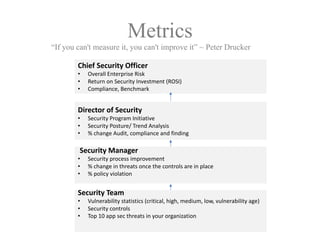
Metrics
Security	Team
• Vulnerability	statistics	(critical,	high,	medium,	low,	vulnerability	age)
• Security	controls
• Top	10	app	sec	threats	in	your	organization
Security	Manager
• Security	process	improvement
• %	change	in	threats	once	the	controls	are	in	place
• %	policy	violation
Director	of	Security
• Security	Program	Initiative
• Security	Posture/	Trend	Analysis
• %	change	Audit,	compliance	and	finding
Chief	Security	Officer
• Overall Enterprise Risk
• Return on Security Investment (ROSI)
• Compliance, Benchmark
“If you can't measure it, you can't improve it” ~ Peter Drucker
Conclusion
• A	holistic	approach	to	security	minimizes	gaps
• Security	is	effective	and	efficient	when	weaved	in	the	
business	and	not	just	SDLC
• Adapt	security	as	a	service	model
• Security	community	needs	to	work	towards	changing	
the	negative	stereotype	against	security
Question?

Purple team strategy_lascon_2016