Building Secure Web Applications In a Cloud Services Environment  Misha Logvinov Alex Bello IronKey, Inc. July 1, 2010
Who are we? Misha Logvinov VP of Online Operations at IronKey Director of Operations at Yodlee Alex Bello Director of Technical Operations at IronKey Product Threat Team Lead at IronKey Technical Operations at Anti-Phishing Working Group (APWG)
Reality check The Internet is full of web application hacking tools and tutorials Botnets are used to scan for recent web app exploits 75% of attacks happen at the app layer Majority of web app vulnerabilities remain undetected App security is an after-thought for most of the Internet-enabled businesses Security holes in web apps result in large business losses Bad guys are getting smarter and are not sitting still
Who gets attacked Brick and Mortar Retail Healthcare Government Small businesses Web 2.0
Who attacks Kids playing war Researchers looking for fame Organized crime Competition Governments
Consequences Customers defect Brand damaged and stock price plummets Large fines Company out of business You may get fired
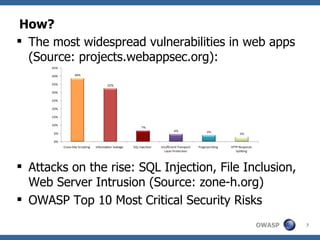
How? Attacks on the rise: SQL Injection, File Inclusion, Web Server Intrusion (Source: zone-h.org) OWASP Top 10 Most Critical Security Risks The most widespread vulnerabilities in web apps (Source: projects.webappsec.org):
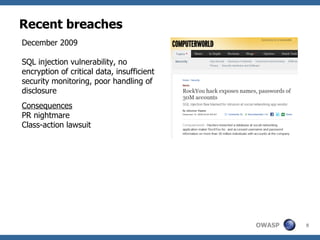
Recent breaches December 2009 SQL injection vulnerability, no encryption of critical data, insufficient security monitoring, poor handling of disclosure Consequences PR nightmare Class-action lawsuit
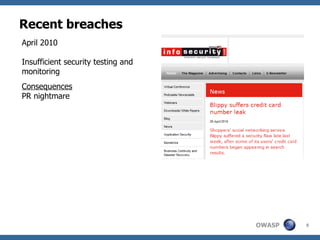
Recent breaches April 2010 Insufficient security testing and monitoring Consequences PR nightmare
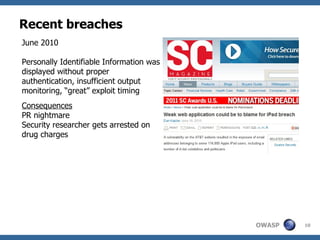
Recent breaches June 2010 Personally Identifiable Information was displayed without proper authentication, insufficient output monitoring, “great” exploit timing Consequences PR nightmare Security researcher gets arrested on drug charges
Why Insufficient Security in: SDLC Web Operations
How to get started? Understand business, security and privacy requirements Assess important security controls Create security awareness and facilitate training Get release management under control Scan applications prior to new releases Benchmark against industry best-practices Create and communicate meaningful metrics Conduct independent security assessments
Doing things right in the long run Implement a formal security program Integrate security into Software Development Life Cycle (SDLC) Make security a competitive advantage for your business
Implement a formal security program Security framework Policies and procedures Training Coding standards Risk assessments Security testing and evaluation Reporting Incident response Change management
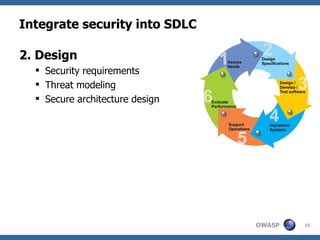
Integrate security into SDLC 2. Design Security requirements Threat modeling Secure architecture design
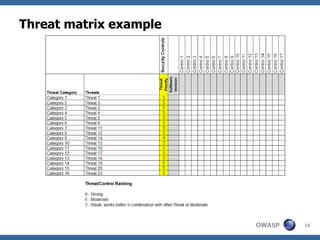
Threat matrix example
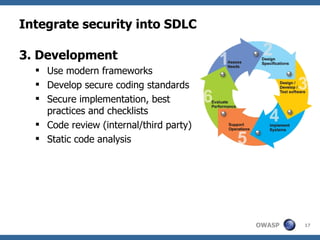
Integrate security into SDLC 3. Development Use modern frameworks Develop secure coding standards Secure implementation, best practices and checklists Code review (internal/third party) Static code analysis
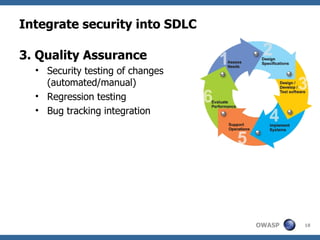
Integrate security into SDLC 3. Quality Assurance Security testing of changes (automated/manual) Regression testing Bug tracking integration
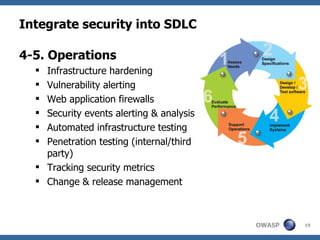
Integrate security into SDLC 4-5. Operations Infrastructure hardening Vulnerability alerting  Web application firewalls Security events alerting & analysis Automated infrastructure testing Penetration testing (internal/third party) Tracking security metrics Change & release management
Hardening CIS and NSA hardening guidelines http://cisecurity.org/en-us/?route=downloads.multiform http://www.nsa.gov/ia/guidance/security_configuration_guides/current_guides.shtml   OWASP Backend Security Project http://www.owasp.org/index.php/Category:OWASP_Backend_Security_Project Automated open-source and commercial tools
Standards & checklists OWASP Application Security Verification Standard Project http://www.owasp.org/index.php/Category:OWASP_Application_Security_Verification_Standard_Project The OWASP Code Review Top 9 http://www.owasp.org/index.php/The_Owasp_Code_Review_Top_9
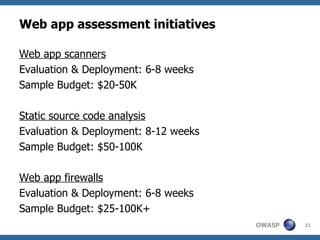
Web app assessment initiatives Web app scanners Evaluation & Deployment: 6-8 weeks Sample Budget: $20-50K Static source code analysis Evaluation & Deployment: 8-12 weeks Sample Budget: $50-100K Web app firewalls Evaluation & Deployment: 6-8 weeks Sample Budget: $25-100K+
Rules of thumb Invest in security training and certification of core personnel Encrypt all sensitive data and pay attention to key management Never trust input, validate all input/output Harden your systems Tightly control who has access to your environment Stay on top of vulnerabilities and keep your networks, servers and applications up-to-date
Conclusions Integrating security into SDLC from the beginning is worth it! Shortcuts will cost more time and $$ later Rome wasn’t built in a day – take a phased approach Mold a security framework around your business, not the other way around Don’t underestimate the power of marketing security within your organization
Q & A

OWASP: Building Secure Web Apps

  • 1.
    Building Secure WebApplications In a Cloud Services Environment Misha Logvinov Alex Bello IronKey, Inc. July 1, 2010
  • 2.
    Who are we?Misha Logvinov VP of Online Operations at IronKey Director of Operations at Yodlee Alex Bello Director of Technical Operations at IronKey Product Threat Team Lead at IronKey Technical Operations at Anti-Phishing Working Group (APWG)
  • 3.
    Reality check TheInternet is full of web application hacking tools and tutorials Botnets are used to scan for recent web app exploits 75% of attacks happen at the app layer Majority of web app vulnerabilities remain undetected App security is an after-thought for most of the Internet-enabled businesses Security holes in web apps result in large business losses Bad guys are getting smarter and are not sitting still
  • 4.
    Who gets attackedBrick and Mortar Retail Healthcare Government Small businesses Web 2.0
  • 5.
    Who attacks Kidsplaying war Researchers looking for fame Organized crime Competition Governments
  • 6.
    Consequences Customers defectBrand damaged and stock price plummets Large fines Company out of business You may get fired
  • 7.
    How? Attacks onthe rise: SQL Injection, File Inclusion, Web Server Intrusion (Source: zone-h.org) OWASP Top 10 Most Critical Security Risks The most widespread vulnerabilities in web apps (Source: projects.webappsec.org):
  • 8.
    Recent breaches December2009 SQL injection vulnerability, no encryption of critical data, insufficient security monitoring, poor handling of disclosure Consequences PR nightmare Class-action lawsuit
  • 9.
    Recent breaches April2010 Insufficient security testing and monitoring Consequences PR nightmare
  • 10.
    Recent breaches June2010 Personally Identifiable Information was displayed without proper authentication, insufficient output monitoring, “great” exploit timing Consequences PR nightmare Security researcher gets arrested on drug charges
  • 11.
    Why Insufficient Securityin: SDLC Web Operations
  • 12.
    How to getstarted? Understand business, security and privacy requirements Assess important security controls Create security awareness and facilitate training Get release management under control Scan applications prior to new releases Benchmark against industry best-practices Create and communicate meaningful metrics Conduct independent security assessments
  • 13.
    Doing things rightin the long run Implement a formal security program Integrate security into Software Development Life Cycle (SDLC) Make security a competitive advantage for your business
  • 14.
    Implement a formalsecurity program Security framework Policies and procedures Training Coding standards Risk assessments Security testing and evaluation Reporting Incident response Change management
  • 15.
    Integrate security intoSDLC 2. Design Security requirements Threat modeling Secure architecture design
  • 16.
  • 17.
    Integrate security intoSDLC 3. Development Use modern frameworks Develop secure coding standards Secure implementation, best practices and checklists Code review (internal/third party) Static code analysis
  • 18.
    Integrate security intoSDLC 3. Quality Assurance Security testing of changes (automated/manual) Regression testing Bug tracking integration
  • 19.
    Integrate security intoSDLC 4-5. Operations Infrastructure hardening Vulnerability alerting Web application firewalls Security events alerting & analysis Automated infrastructure testing Penetration testing (internal/third party) Tracking security metrics Change & release management
  • 20.
    Hardening CIS andNSA hardening guidelines http://cisecurity.org/en-us/?route=downloads.multiform http://www.nsa.gov/ia/guidance/security_configuration_guides/current_guides.shtml OWASP Backend Security Project http://www.owasp.org/index.php/Category:OWASP_Backend_Security_Project Automated open-source and commercial tools
  • 21.
    Standards & checklistsOWASP Application Security Verification Standard Project http://www.owasp.org/index.php/Category:OWASP_Application_Security_Verification_Standard_Project The OWASP Code Review Top 9 http://www.owasp.org/index.php/The_Owasp_Code_Review_Top_9
  • 22.
    Web app assessmentinitiatives Web app scanners Evaluation & Deployment: 6-8 weeks Sample Budget: $20-50K Static source code analysis Evaluation & Deployment: 8-12 weeks Sample Budget: $50-100K Web app firewalls Evaluation & Deployment: 6-8 weeks Sample Budget: $25-100K+
  • 23.
    Rules of thumbInvest in security training and certification of core personnel Encrypt all sensitive data and pay attention to key management Never trust input, validate all input/output Harden your systems Tightly control who has access to your environment Stay on top of vulnerabilities and keep your networks, servers and applications up-to-date
  • 24.
    Conclusions Integrating securityinto SDLC from the beginning is worth it! Shortcuts will cost more time and $$ later Rome wasn’t built in a day – take a phased approach Mold a security framework around your business, not the other way around Don’t underestimate the power of marketing security within your organization
  • 25.

Editor's Notes

  • #4 There are fewer attacks on the network layer. Based on our experience from talking with various IDS/IPS vendors, there is a growing need for hybrid web app security solutions that cover both network and app layers According to a recent VeriSign research, average price for renting a botnet is only $9 per hour
  • #6 Who knows how many successful attacks will never be known
  • #15 Security framework: Most of the existing framework methodologies are still getting worked on and improved, good examples to follow would be BSIMM and OWASP SAMM Incident response: Create a cross-functional body for reporting and managing security events (e.g. SIRT)
  • #16 Threat model: entry & exit points of the app, threat scenarios, dataflow
  • #19 Manual testing compliments automated testing. Detect logic flaws through manual testing since they are not easily detected by automated testing. Choose automated tools that work best with your application technology
  • #24 Validating input/output: Do not trust your own requests (CSRF and click jacking)
  • #25 From Alex’s SANS preso: Invest in security training and certification Integrate security into SDLC in phases Never trust input, validate all input/output Strong encryption of sensitive data and key management Strong access controls and hardening Stay on top of vulnerabilities and keep your networks, servers, applications up to date