Tips and Techniques for High-
Pressure Calibration
Agenda
• Basic vocabulary and the physics of pressure
• Special considerations when working with high pressure
• Equipment determination for high-pressure calibration
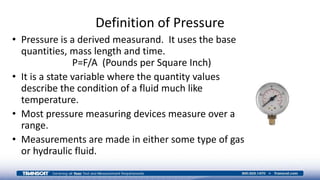
Definition of Pressure
• Pressure is a derived measurand. It uses the base
quantities, mass length and time.
P=F/A (Pounds per Square Inch)
• It is a state variable where the quantity values
describe the condition of a fluid much like
temperature.
• Most pressure measuring devices measure over a
range.
• Measurements are made in either some type of gas
or hydraulic fluid.
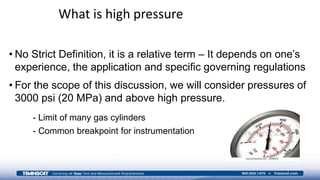
• No Strict Definition, it is a relative term – It depends on one’s
experience, the application and specific governing regulations
• For the scope of this discussion, we will consider pressures of
3000 psi (20 MPa) and above high pressure.
- Limit of many gas cylinders
- Common breakpoint for instrumentation
What is high pressure
Reference Mode
• Pressure values are sometimes followed by the words “gauge” or
“absolute” (or possibly “psig” or “psia”)
• What do these words mean and how do they affect the calibration
process?
• Measurements are relative
– You don’t say, “I live 5 miles.” You say, “I live 5 miles from here” or “I live
“5 miles from my work.” Everything has a starting point.
– Pressure is no different. Saying “The pressure is 5 psi” doesn’t say the
whole story. More proper to say “The pressure is 5 psi above
atmosphere.”
– Gauge, absolute, and differential are simply shorthand for this.
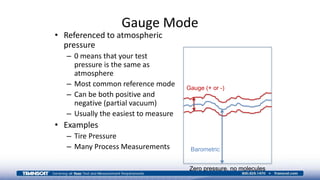
Gauge Mode
• Referenced to atmospheric
pressure
– 0 means that your test
pressure is the same as
atmosphere
– Most common reference mode
– Can be both positive and
negative (partial vacuum)
– Usually the easiest to measure
• Examples
– Tire Pressure
– Many Process Measurements
Gauge (+ or -)
Barometric
Zero pressure, no molecules
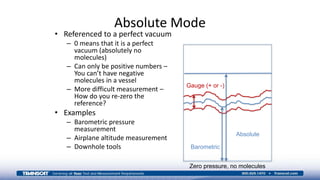
Absolute Mode
• Referenced to a perfect vacuum
– 0 means that it is a perfect
vacuum (absolutely no
molecules)
– Can only be positive numbers –
You can’t have negative
molecules in a vessel
– More difficult measurement –
How do you re-zero the
reference?
• Examples
– Barometric pressure
measurement
– Airplane altitude measurement
– Downhole tools
Gauge (+ or -)
Absolute
Barometric
Zero pressure, no molecules
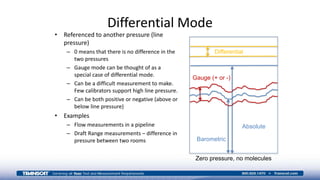
Differential Mode
• Referenced to another pressure (line
pressure)
– 0 means that there is no difference in the
two pressures
– Gauge mode can be thought of as a
special case of differential mode.
– Can be a difficult measurement to make.
Few calibrators support high line pressure.
– Can be both positive or negative (above or
below line pressure)
• Examples
– Flow measurements in a pipeline
– Draft Range measurements – difference in
pressure between two rooms
Gauge (+ or -)
Absolute
Differential
Barometric
Zero pressure, no molecules
Head Pressure
• The weight of a column of fluid will generate a pressure
P = height X density X acceleration of gravity
• If the reference device and the device under test (DUT) are at different
vertical positions, the pressure at each of them will be different.
• With liquid, the density is constant with pressure, resulting in a constant
offset at all pressures
• With gas,
– the density increases with pressure (gas compresses). The error is a function of
the pressure.
– Gas is less dense than liquid, resulting in a smaller head height error
• Some calibrators will make the correction for you
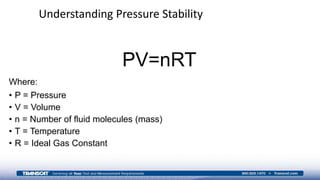
PV=nRT
Where:
• P = Pressure
• V = Volume
• n = Number of fluid molecules (mass)
• T = Temperature
• R = Ideal Gas Constant
Understanding Pressure Stability
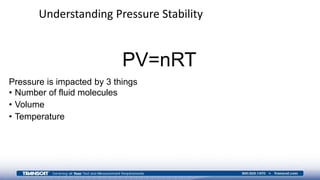
PV=nRT
Pressure is impacted by 3 things
• Number of fluid molecules
• Volume
• Temperature
Understanding Pressure Stability
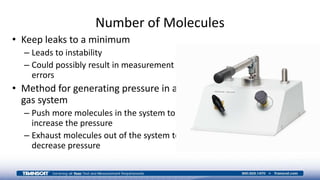
Number of Molecules
• Keep leaks to a minimum
– Leads to instability
– Could possibly result in measurement
errors
• Method for generating pressure in a
gas system
– Push more molecules in the system to
increase the pressure
– Exhaust molecules out of the system to
decrease pressure
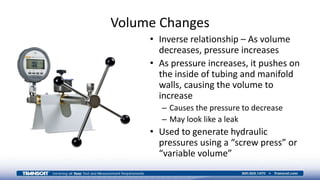
Volume Changes
• Inverse relationship – As volume
decreases, pressure increases
• As pressure increases, it pushes on
the inside of tubing and manifold
walls, causing the volume to
increase
– Causes the pressure to decrease
– May look like a leak
• Used to generate hydraulic
pressures using a “screw press” or
“variable volume”
Temperature
• In an enclosed system, temperature has the biggest impact on
pressure stability
• As pressure is increased, the temperature of the fluid also
increases.
• When the pressure set point is reached, the temperature
decreases, returning to ambient.
• This causes the pressure to decrease with it.
• Appearance of a leak, but the pressure drop will eventually
stabilize out
Considerations with High Pressure
• Safety
• Contamination
• Pressure Stability
Safety
• There are inherent danger with high pressure, but the risks can
be mitigated.
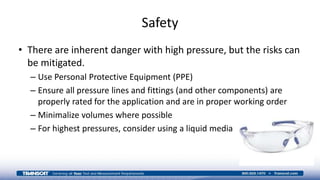
– Use Personal Protective Equipment (PPE)
– Ensure all pressure lines and fittings (and other components) are
properly rated for the application and are in proper working order
– Minimalize volumes where possible
– For highest pressures, consider using a liquid media
Contamination
• But there are drawbacks to using liquid as the media
• Leads to contamination of the DUT
• Liquid in the DUT can be different than the liquid in the
calibration system, contaminating the calibration system
• If contamination is a concern, a gas system might be preferable
Pressure Stability
• Pressure stability can be a bigger issue at higher pressures
• Temperature is more of an influence with liquids than gasses
• More expansion and contraction of pressure lines
• Can be minimized by using the appropriate equipment
– Gas devices will provide a more stable pressure
– Deadweight Testers provide stable pressures (the sinking piston acts
as a natural pressure regulator)
Equipment Determination
• Benchtop versus Portable
• Hydraulic versus Pneumatic
– Contamination Prevention
• Ease-of-use
– Physical effort
– Stability of pressure
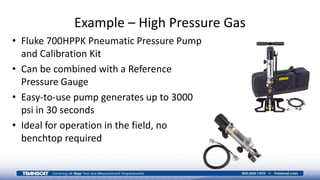
Example – High Pressure Gas
• Fluke 700HPPK Pneumatic Pressure Pump
and Calibration Kit
• Can be combined with a Reference
Pressure Gauge
• Easy-to-use pump generates up to 3000
psi in 30 seconds
• Ideal for operation in the field, no
benchtop required
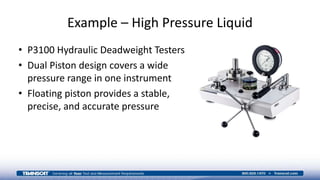
Example – High Pressure Liquid
• P3100 Hydraulic Deadweight Testers
• Dual Piston design covers a wide
pressure range in one instrument
• Floating piston provides a stable,
precise, and accurate pressure
Questions or Comments?
Email Nicole VanWert-Quinzi
nvanwert@Transcat.com
Transcat: 800-800-5001
www.Transcat.com
For related product information, go to:
www.Transcat.com/Fluke©2016 Fluke Calibration

Fluke Calibration Tips for High Pressure Calibration

  • 1.
    Tips and Techniquesfor High- Pressure Calibration
  • 2.
    Agenda • Basic vocabularyand the physics of pressure • Special considerations when working with high pressure • Equipment determination for high-pressure calibration
  • 3.
    Definition of Pressure •Pressure is a derived measurand. It uses the base quantities, mass length and time. P=F/A (Pounds per Square Inch) • It is a state variable where the quantity values describe the condition of a fluid much like temperature. • Most pressure measuring devices measure over a range. • Measurements are made in either some type of gas or hydraulic fluid.
  • 4.
    • No StrictDefinition, it is a relative term – It depends on one’s experience, the application and specific governing regulations • For the scope of this discussion, we will consider pressures of 3000 psi (20 MPa) and above high pressure. - Limit of many gas cylinders - Common breakpoint for instrumentation What is high pressure
  • 5.
    Reference Mode • Pressurevalues are sometimes followed by the words “gauge” or “absolute” (or possibly “psig” or “psia”) • What do these words mean and how do they affect the calibration process? • Measurements are relative – You don’t say, “I live 5 miles.” You say, “I live 5 miles from here” or “I live “5 miles from my work.” Everything has a starting point. – Pressure is no different. Saying “The pressure is 5 psi” doesn’t say the whole story. More proper to say “The pressure is 5 psi above atmosphere.” – Gauge, absolute, and differential are simply shorthand for this.
  • 6.
    Gauge Mode • Referencedto atmospheric pressure – 0 means that your test pressure is the same as atmosphere – Most common reference mode – Can be both positive and negative (partial vacuum) – Usually the easiest to measure • Examples – Tire Pressure – Many Process Measurements Gauge (+ or -) Barometric Zero pressure, no molecules
  • 7.
    Absolute Mode • Referencedto a perfect vacuum – 0 means that it is a perfect vacuum (absolutely no molecules) – Can only be positive numbers – You can’t have negative molecules in a vessel – More difficult measurement – How do you re-zero the reference? • Examples – Barometric pressure measurement – Airplane altitude measurement – Downhole tools Gauge (+ or -) Absolute Barometric Zero pressure, no molecules
  • 8.
    Differential Mode • Referencedto another pressure (line pressure) – 0 means that there is no difference in the two pressures – Gauge mode can be thought of as a special case of differential mode. – Can be a difficult measurement to make. Few calibrators support high line pressure. – Can be both positive or negative (above or below line pressure) • Examples – Flow measurements in a pipeline – Draft Range measurements – difference in pressure between two rooms Gauge (+ or -) Absolute Differential Barometric Zero pressure, no molecules
  • 9.
    Head Pressure • Theweight of a column of fluid will generate a pressure P = height X density X acceleration of gravity • If the reference device and the device under test (DUT) are at different vertical positions, the pressure at each of them will be different. • With liquid, the density is constant with pressure, resulting in a constant offset at all pressures • With gas, – the density increases with pressure (gas compresses). The error is a function of the pressure. – Gas is less dense than liquid, resulting in a smaller head height error • Some calibrators will make the correction for you
  • 10.
    PV=nRT Where: • P =Pressure • V = Volume • n = Number of fluid molecules (mass) • T = Temperature • R = Ideal Gas Constant Understanding Pressure Stability
  • 11.
    PV=nRT Pressure is impactedby 3 things • Number of fluid molecules • Volume • Temperature Understanding Pressure Stability
  • 12.
    Number of Molecules •Keep leaks to a minimum – Leads to instability – Could possibly result in measurement errors • Method for generating pressure in a gas system – Push more molecules in the system to increase the pressure – Exhaust molecules out of the system to decrease pressure
  • 13.
    Volume Changes • Inverserelationship – As volume decreases, pressure increases • As pressure increases, it pushes on the inside of tubing and manifold walls, causing the volume to increase – Causes the pressure to decrease – May look like a leak • Used to generate hydraulic pressures using a “screw press” or “variable volume”
  • 14.
    Temperature • In anenclosed system, temperature has the biggest impact on pressure stability • As pressure is increased, the temperature of the fluid also increases. • When the pressure set point is reached, the temperature decreases, returning to ambient. • This causes the pressure to decrease with it. • Appearance of a leak, but the pressure drop will eventually stabilize out
  • 15.
    Considerations with HighPressure • Safety • Contamination • Pressure Stability
  • 16.
    Safety • There areinherent danger with high pressure, but the risks can be mitigated. – Use Personal Protective Equipment (PPE) – Ensure all pressure lines and fittings (and other components) are properly rated for the application and are in proper working order – Minimalize volumes where possible – For highest pressures, consider using a liquid media
  • 17.
    Contamination • But thereare drawbacks to using liquid as the media • Leads to contamination of the DUT • Liquid in the DUT can be different than the liquid in the calibration system, contaminating the calibration system • If contamination is a concern, a gas system might be preferable
  • 18.
    Pressure Stability • Pressurestability can be a bigger issue at higher pressures • Temperature is more of an influence with liquids than gasses • More expansion and contraction of pressure lines • Can be minimized by using the appropriate equipment – Gas devices will provide a more stable pressure – Deadweight Testers provide stable pressures (the sinking piston acts as a natural pressure regulator)
  • 19.
    Equipment Determination • Benchtopversus Portable • Hydraulic versus Pneumatic – Contamination Prevention • Ease-of-use – Physical effort – Stability of pressure
  • 20.
    Example – HighPressure Gas • Fluke 700HPPK Pneumatic Pressure Pump and Calibration Kit • Can be combined with a Reference Pressure Gauge • Easy-to-use pump generates up to 3000 psi in 30 seconds • Ideal for operation in the field, no benchtop required
  • 21.
    Example – HighPressure Liquid • P3100 Hydraulic Deadweight Testers • Dual Piston design covers a wide pressure range in one instrument • Floating piston provides a stable, precise, and accurate pressure
  • 22.
    Questions or Comments? EmailNicole VanWert-Quinzi nvanwert@Transcat.com Transcat: 800-800-5001 www.Transcat.com For related product information, go to: www.Transcat.com/Fluke©2016 Fluke Calibration