Population Health Data Science, Complexity, and
Health Equity: Reflections from a Local Health Official
Tom´as J. Arag´on, MD, DrPH
Health Officer, City and County of San Francisco
Director, Population Health Division (PHD)
San Francisco Department of Public Health
Adjunct Faculty, UC Berkeley School of Public Health
Keynote Address: Stanford Center for Population Health Sciences
Annual PHS Colloquium an October 26, 2015
Tom´as J. Arag´on, MD, DrPH (SFDPH) PHDS, Complexity, & Health Equity October 26, 2015 1 / 30
Overview
1 Introduction and background
2 Population health data science
3 Transforming complex social systems
4 Tackling population health inequities
Tom´as J. Arag´on, MD, DrPH (SFDPH) PHDS, Complexity, & Health Equity October 26, 2015 2 / 30
Introduction and background
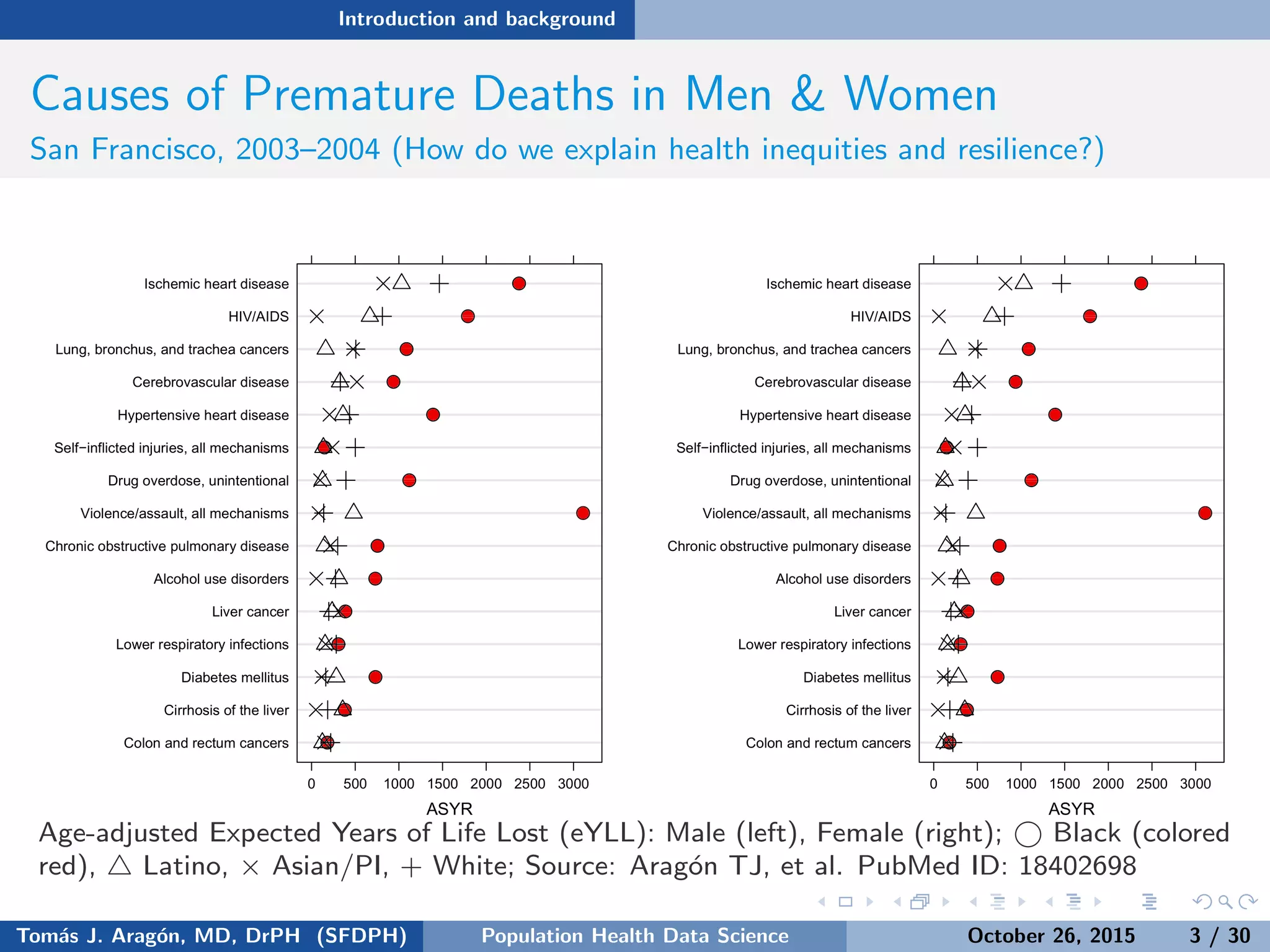
Causes of Premature Deaths in Men & Women
San Francisco, 2003–2004 (How do we explain health inequities and resilience?)
Age-adjusted Expected Years of Life Lost (eYLL): Male (left), Female (right); Black (colored
red), Latino, × Asian/PI, + White; Source: Arag´on TJ, et al. PubMed ID: 18402698
Tom´as J. Arag´on, MD, DrPH (SFDPH) PHDS, Complexity, & Health Equity October 26, 2015 3 / 30
Introduction and background
Some definitions
Health (WHO 1946)
Health is a state of complete physical, mental and social well-being and
not merely the absence of disease or infirmity.
Public Health (IOM 1988)
Public health is what we, as a society, do collectively to assure the
conditions in which people can be healthy.
Population Health (TJA 2015)
A systemsa framework for studying and improving the health of
populations through collective action and learning.
a
Complexity or complex adaptive systems
Tom´as J. Arag´on, MD, DrPH (SFDPH) PHDS, Complexity, & Health Equity October 26, 2015 4 / 30
Introduction and background
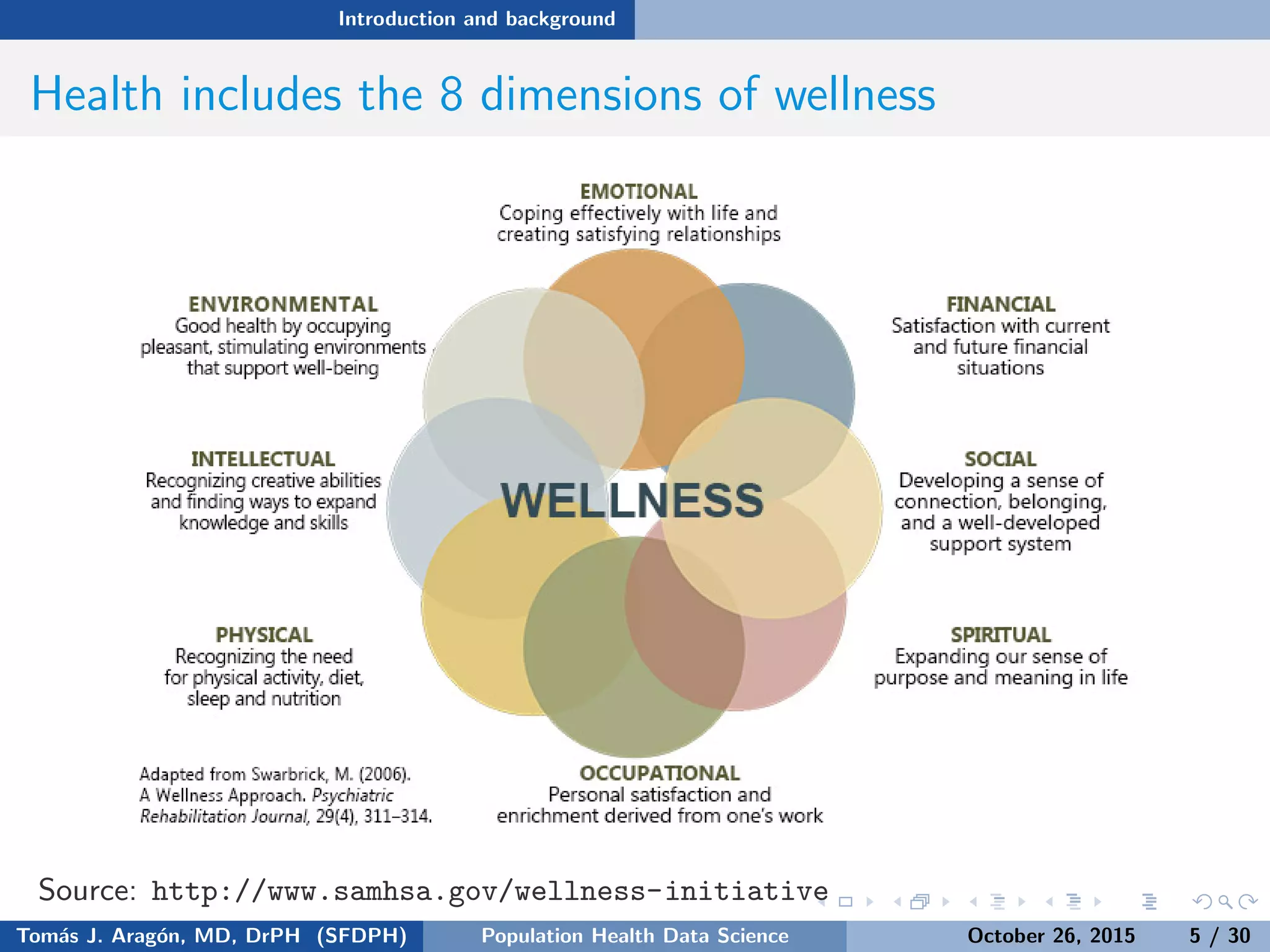
Health includes the 8 dimensions of wellness
Source: http://www.samhsa.gov/wellness-initiative
Tom´as J. Arag´on, MD, DrPH (SFDPH) PHDS, Complexity, & Health Equity October 26, 2015 5 / 30
Population health data science
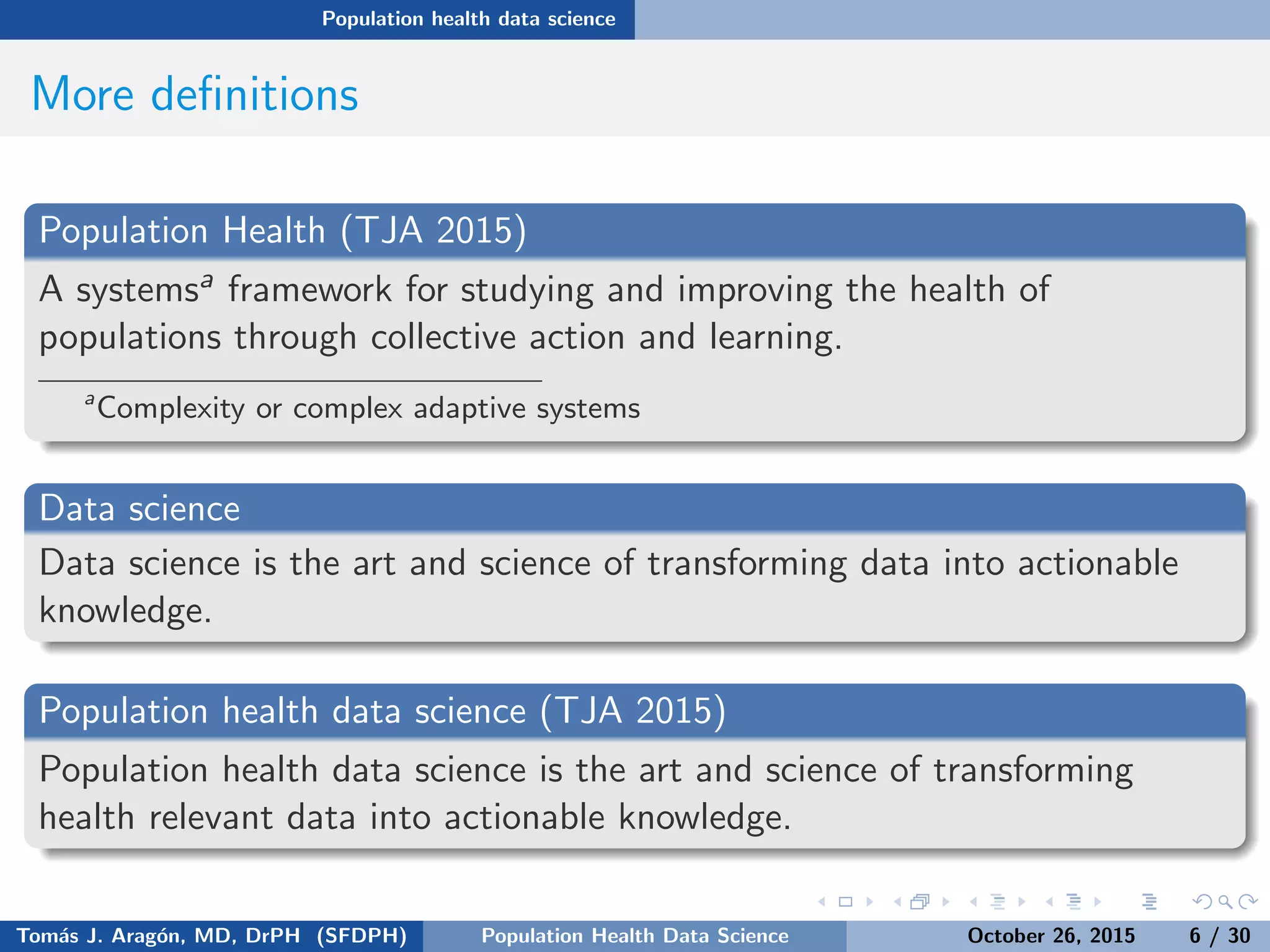
More definitions
Population Health (TJA 2015)
A systemsa framework for studying and improving the health of
populations through collective action and learning.
a
Complexity or complex adaptive systems
Data science
Data science is the art and science of transforming data into actionable
knowledge.
Population health data science (TJA 2015)
Population health data science is the art and science of transforming
health relevant data into actionable knowledge.
Tom´as J. Arag´on, MD, DrPH (SFDPH) PHDS, Complexity, & Health Equity October 26, 2015 6 / 30
Population health data science
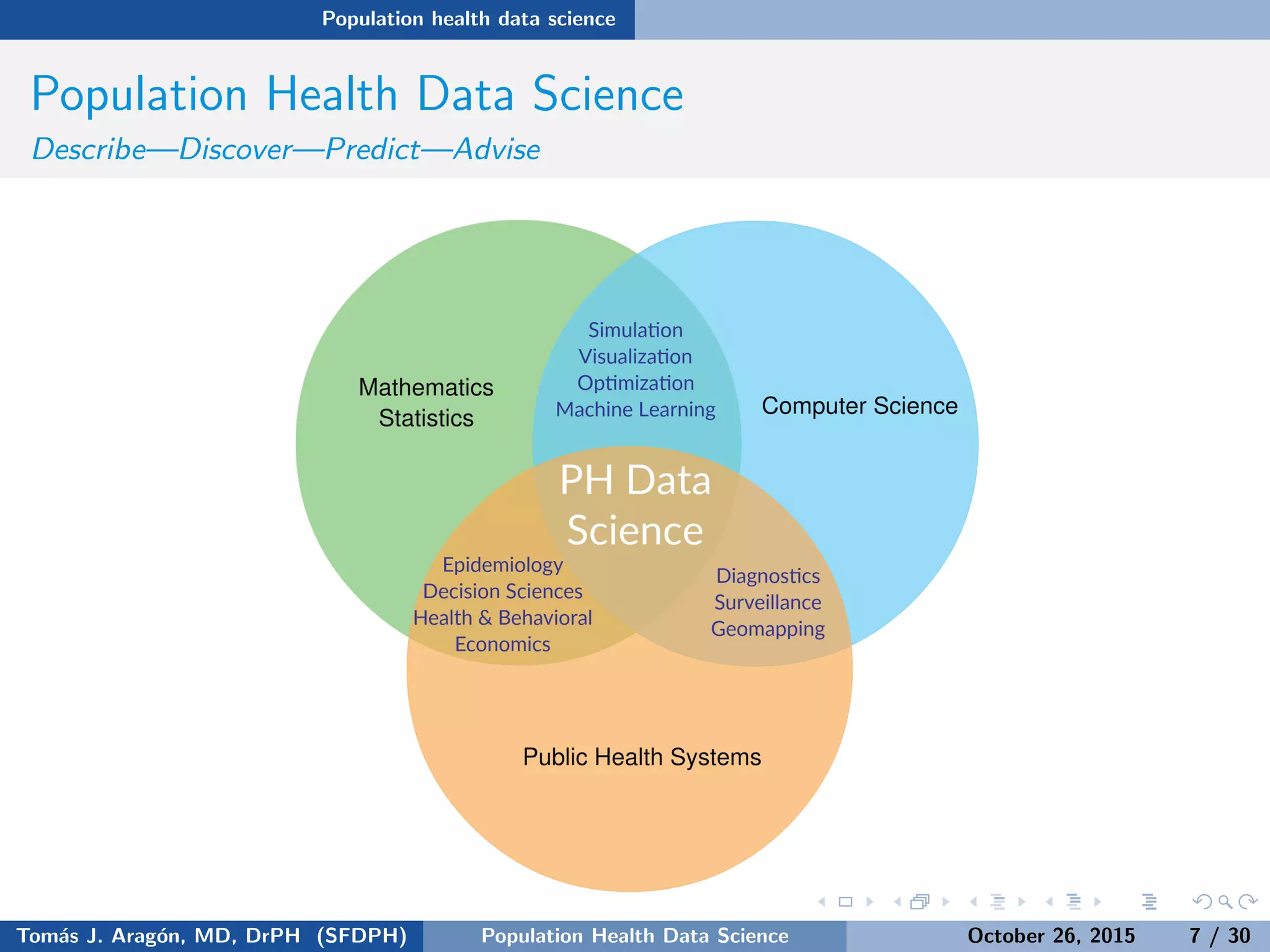
Population Health Data Science
Describe—Discover—Predict—Advise
Tom´as J. Arag´on, MD, DrPH (SFDPH) PHDS, Complexity, & Health Equity October 26, 2015 7 / 30
Transforming complex social systems
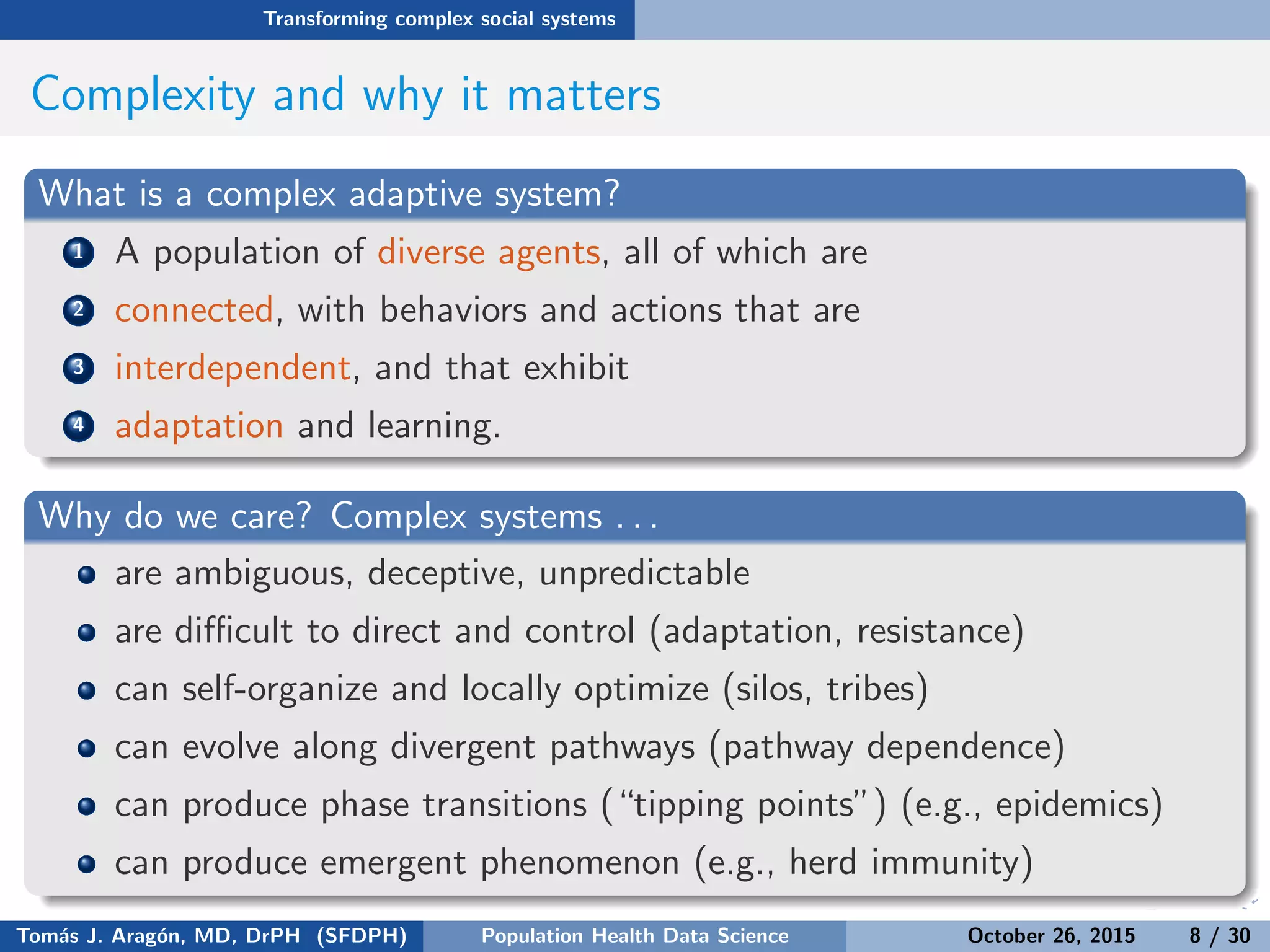
Complexity and why it matters
What is a complex adaptive system?
1 A population of diverse agents, all of which are
2 connected, with behaviors and actions that are
3 interdependent, and that exhibit
4 adaptation and learning.
Why do we care? Complex systems . . .
are ambiguous, deceptive, unpredictable
are difficult to direct and control (adaptation, resistance)
can self-organize and locally optimize (silos, tribes)
can evolve along divergent pathways (pathway dependence)
can produce phase transitions (“tipping points”) (e.g., epidemics)
can produce emergent phenomenon (e.g., herd immunity)
Tom´as J. Arag´on, MD, DrPH (SFDPH) PHDS, Complexity, & Health Equity October 26, 2015 8 / 30
Transforming complex social systems
Conceptualizing systems (selected approaches)
Causal loop diagrams
Agent-based models
Social network models
Tom´as J. Arag´on, MD, DrPH (SFDPH) PHDS, Complexity, & Health Equity October 26, 2015 9 / 30
Transforming complex social systems
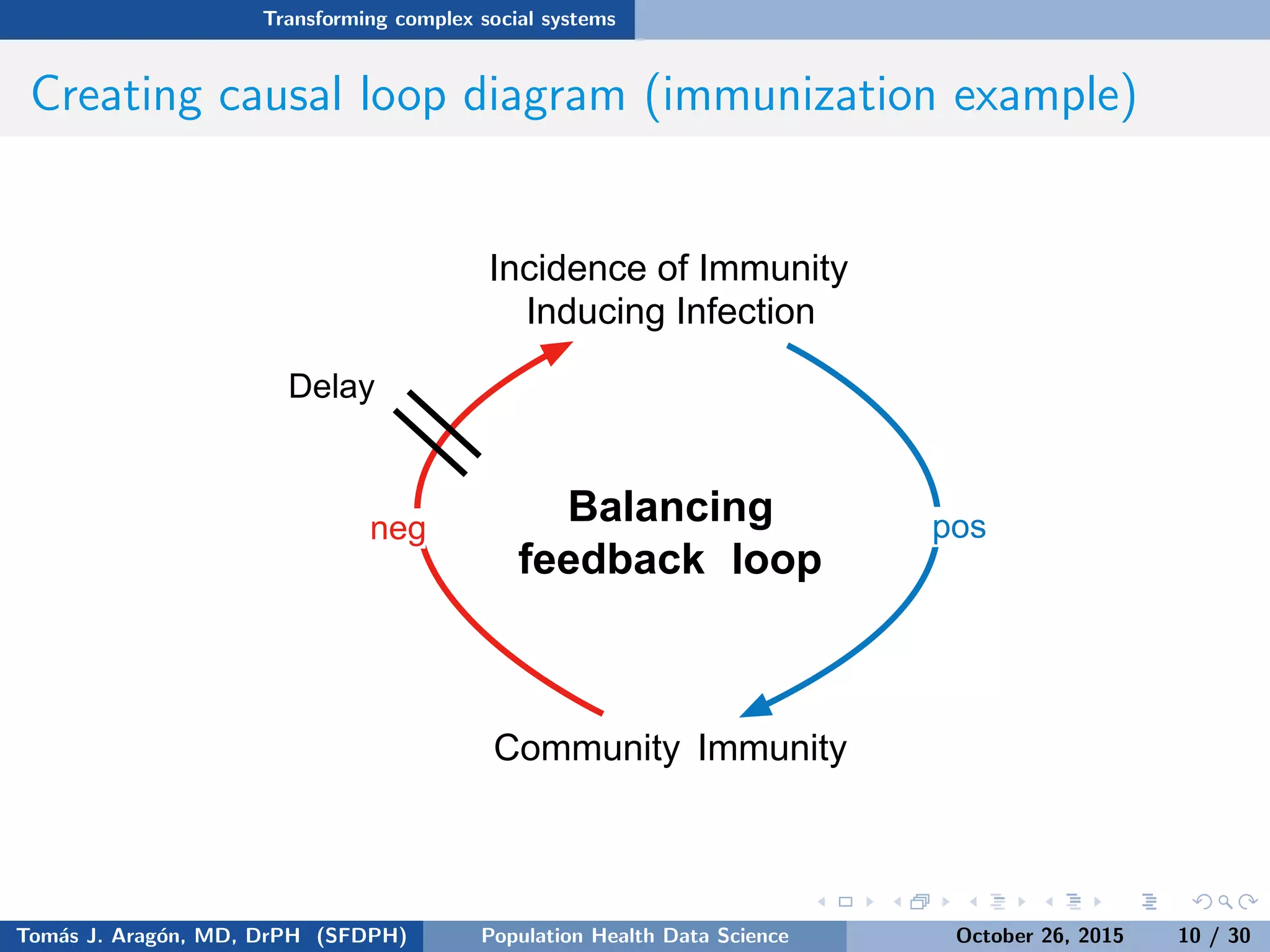
Creating causal loop diagram (immunization example)
Incidence of Immunity
Inducing Infection
neg
Community Immunity
posBalancing
feedback loop
Delay
Tom´as J. Arag´on, MD, DrPH (SFDPH) PHDS, Complexity, & Health Equity October 26, 2015 10 / 30
Transforming complex social systems
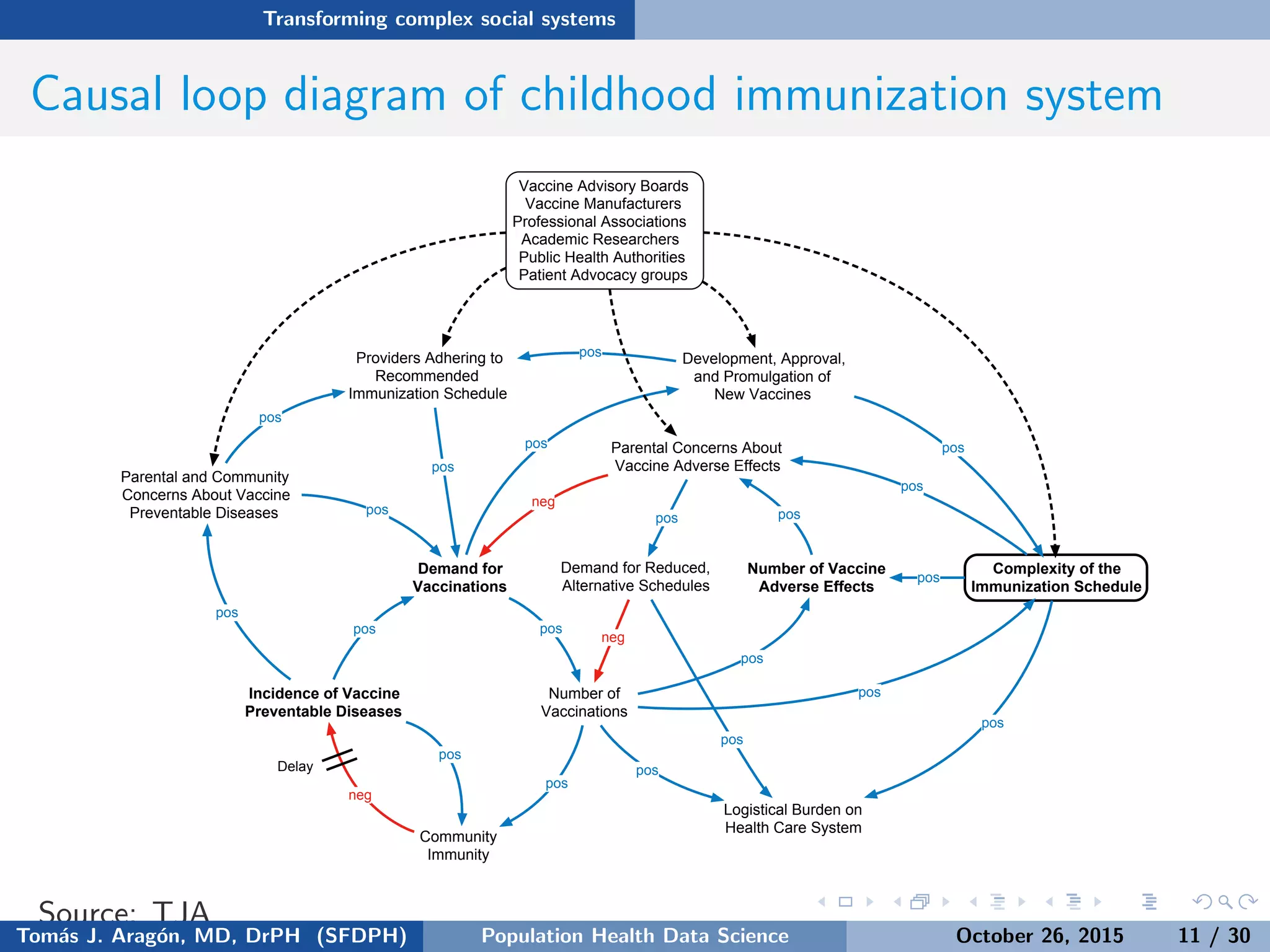
Causal loop diagram of childhood immunization system
Number of
Vaccinations
Incidence of Vaccine
Preventable Diseases
neg
pos
Number of Vaccine
Adverse Effects
pos
Complexity of the
Immunization Schedule
pos
Demand for
Vaccinations
pos
Parental Concerns About
Vaccine Adverse Effects
pos
pos
neg
Community
Immunity
pos
pos
Parental and Community
Concerns About Vaccine
Preventable Diseases
pos
pos
Providers Adhering to
Recommended
Immunization Schedule
Delay
Development, Approval,
and Promulgation of
New Vaccines
pos
pos
pos
pos
pos
pos
Logistical Burden on
Health Care System
pos
pos
Demand for Reduced,
Alternative Schedules
pos
neg
pos
Vaccine Advisory Boards
Vaccine Manufacturers
Professional Associations
Academic Researchers
Public Health Authorities
Patient Advocacy groups
Source: TJA
Tom´as J. Arag´on, MD, DrPH (SFDPH) PHDS, Complexity, & Health Equity October 26, 2015 11 / 30
Transforming complex social systems
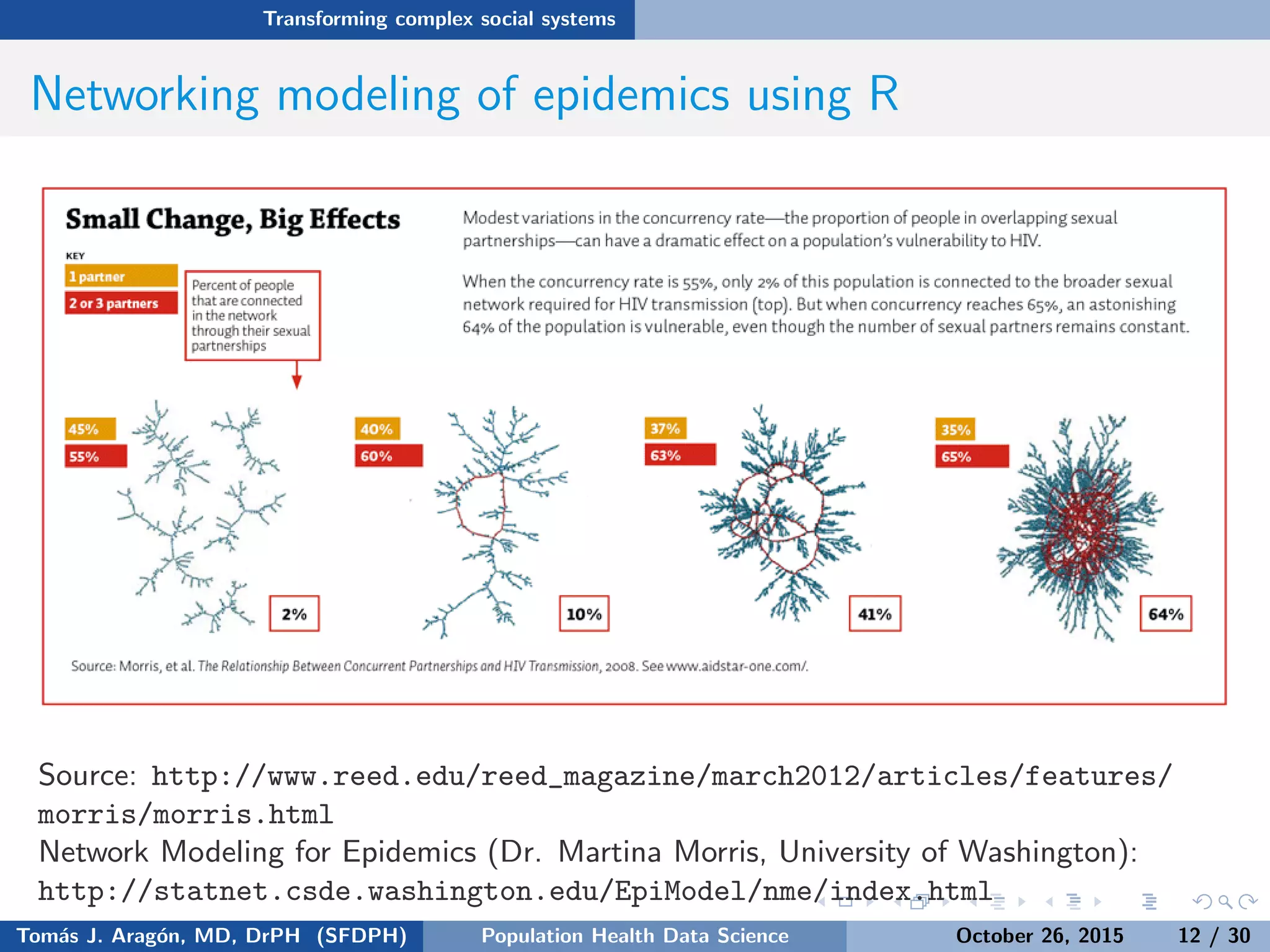
Networking modeling of epidemics using R
Source: http://www.reed.edu/reed_magazine/march2012/articles/features/
morris/morris.html
Network Modeling for Epidemics (Dr. Martina Morris, University of Washington):
http://statnet.csde.washington.edu/EpiModel/nme/index.html
Tom´as J. Arag´on, MD, DrPH (SFDPH) PHDS, Complexity, & Health Equity October 26, 2015 12 / 30
Transforming complex social systems
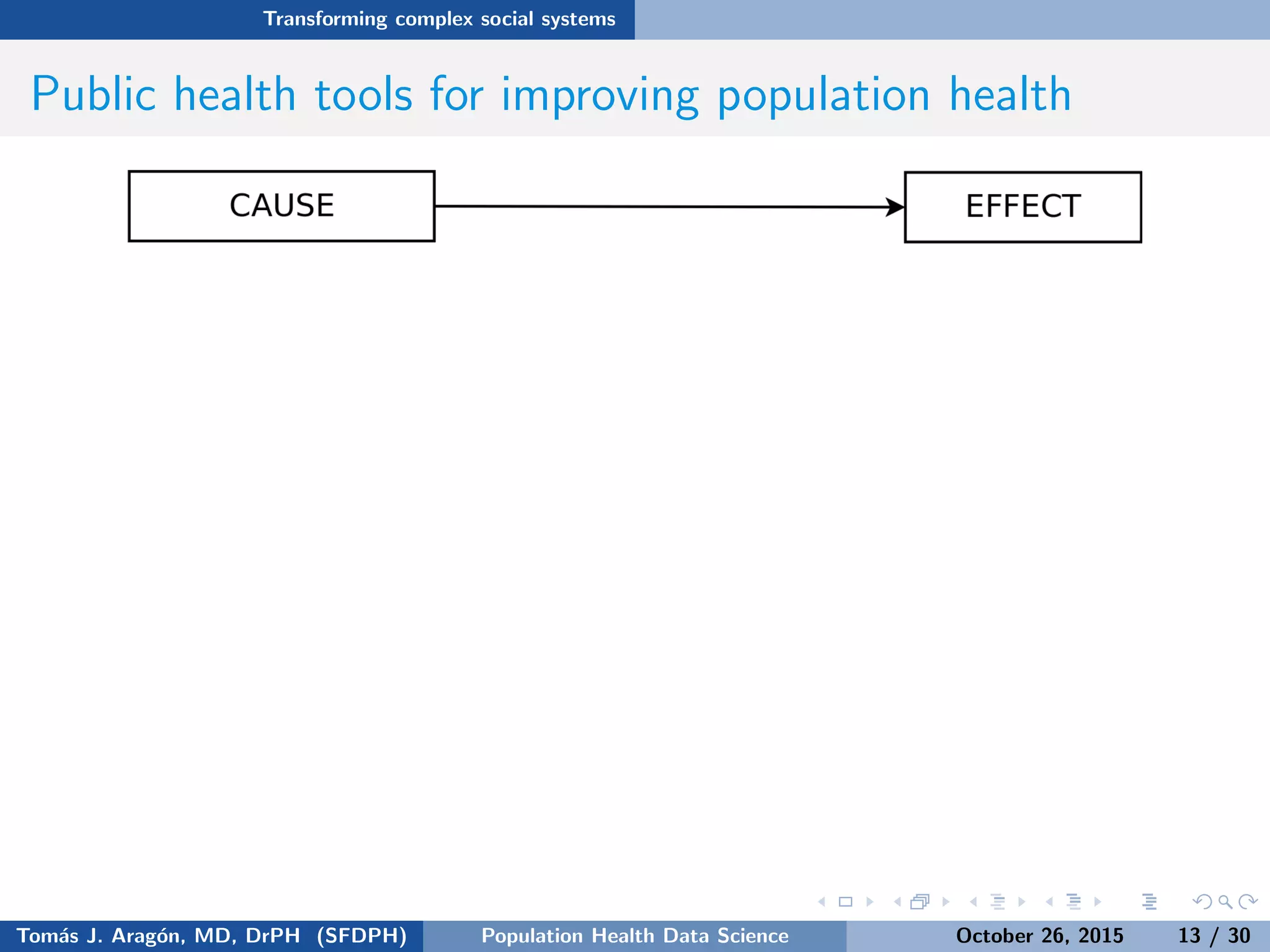
Public health tools for improving population health
Source:Tom´as J. Arag´on, MD, DrPH (SFDPH) PHDS, Complexity, & Health Equity October 26, 2015 13 / 30
Transforming complex social systems
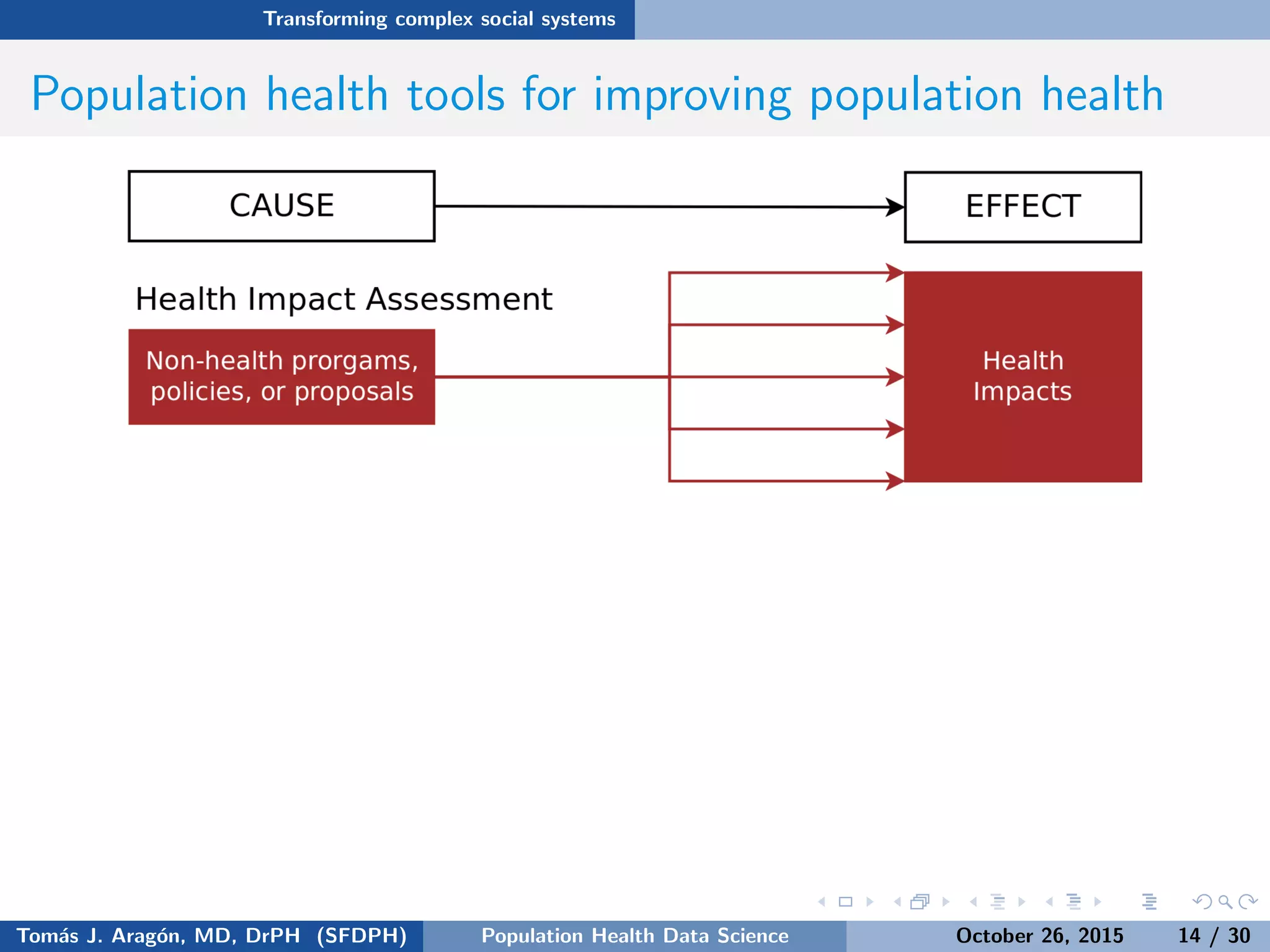
Population health tools for improving population health
Source:Tom´as J. Arag´on, MD, DrPH (SFDPH) PHDS, Complexity, & Health Equity October 26, 2015 14 / 30
Transforming complex social systems
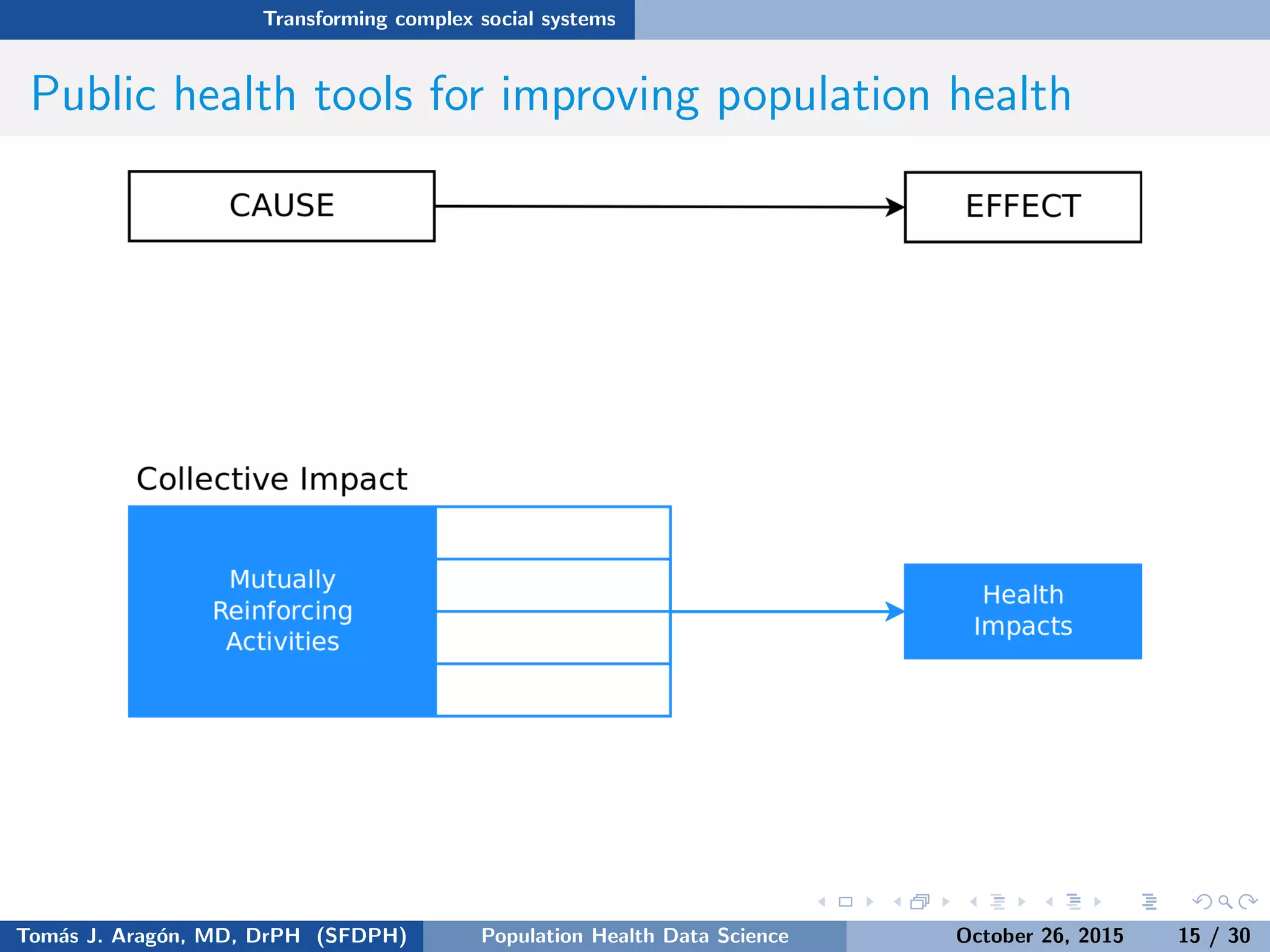
Public health tools for improving population health
Source:Tom´as J. Arag´on, MD, DrPH (SFDPH) PHDS, Complexity, & Health Equity October 26, 2015 15 / 30
Transforming complex social systems
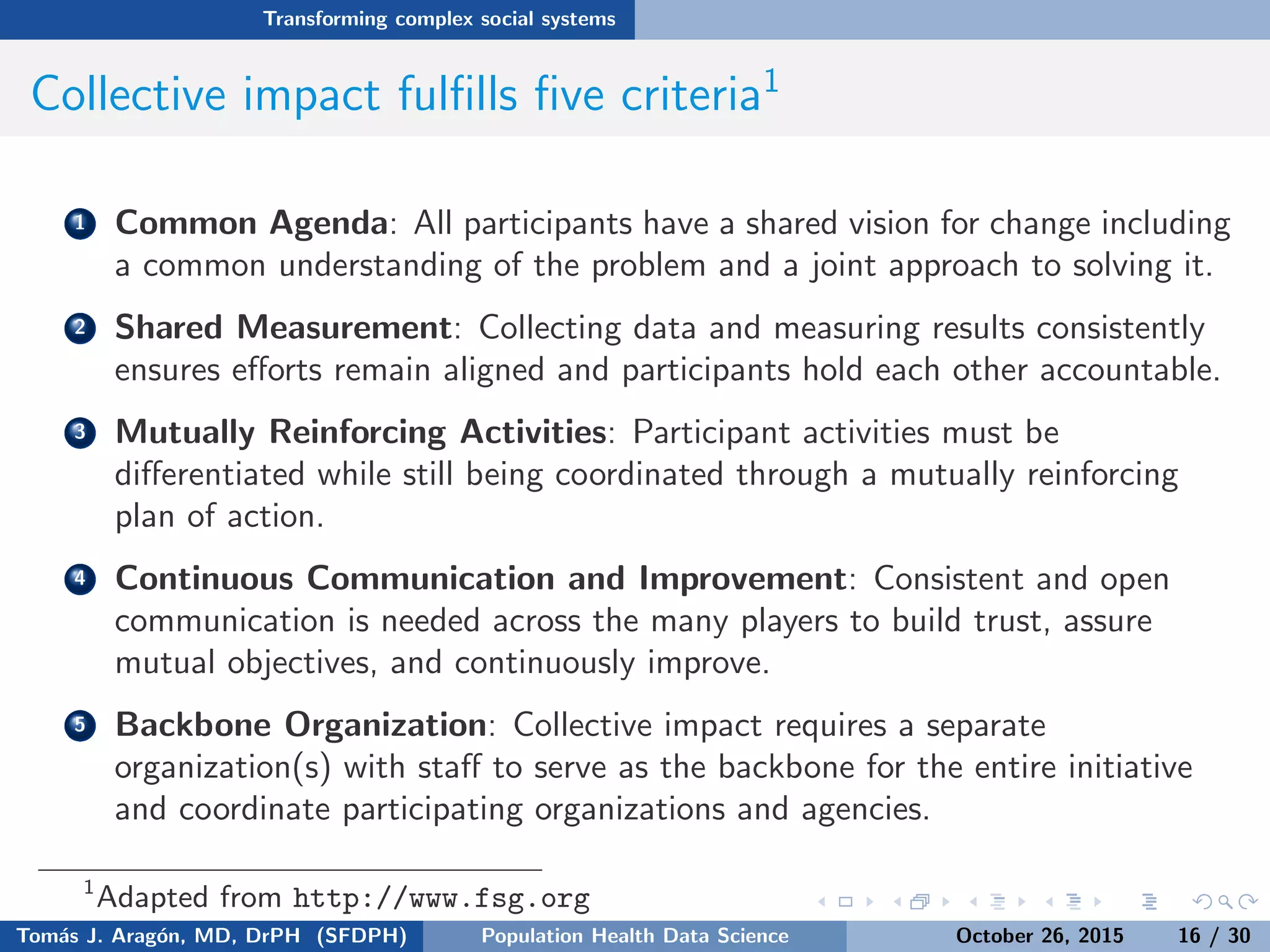
Collective impact fulfills five criteria1
1 Common Agenda: All participants have a shared vision for change including
a common understanding of the problem and a joint approach to solving it.
2 Shared Measurement: Collecting data and measuring results consistently
ensures efforts remain aligned and participants hold each other accountable.
3 Mutually Reinforcing Activities: Participant activities must be
differentiated while still being coordinated through a mutually reinforcing
plan of action.
4 Continuous Communication and Improvement: Consistent and open
communication is needed across the many players to build trust, assure
mutual objectives, and continuously improve.
5 Backbone Organization: Collective impact requires a separate
organization(s) with staff to serve as the backbone for the entire initiative
and coordinate participating organizations and agencies.
1
Adapted from http://www.fsg.org
Tom´as J. Arag´on, MD, DrPH (SFDPH) PHDS, Complexity, & Health Equity October 26, 2015 16 / 30
Transforming complex social systems
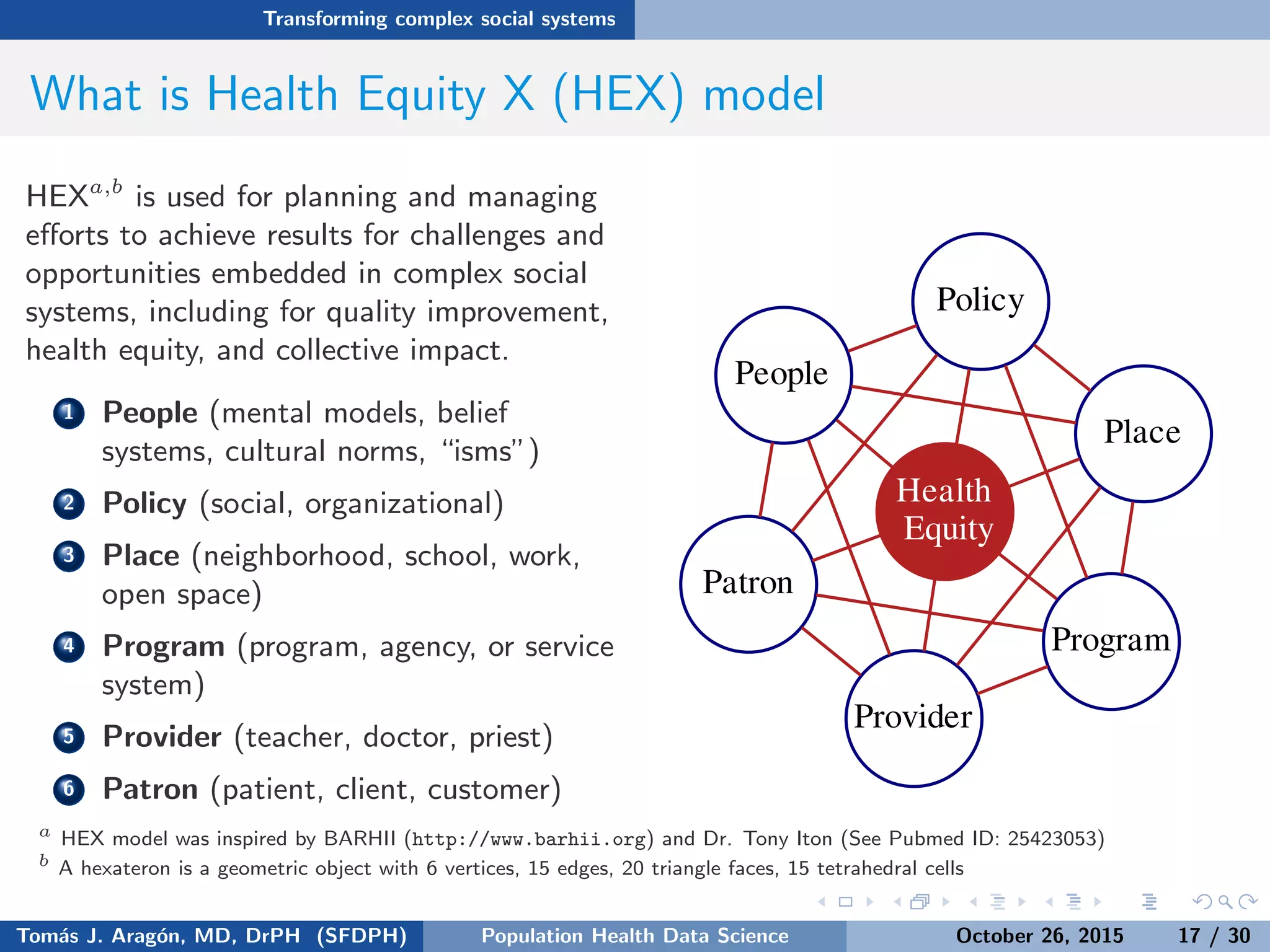
What is Health Equity X (HEX) model
HEXa,b
is used for planning and managing
efforts to achieve results for challenges and
opportunities embedded in complex social
systems, including for quality improvement,
health equity, and collective impact.
1 People (mental models, belief
systems, cultural norms, “isms”)
2 Policy (social, organizational)
3 Place (neighborhood, school, work,
open space)
4 Program (program, agency, or service
system)
5 Provider (teacher, doctor, priest)
6 Patron (patient, client, customer)
Patron
Program
People
Provider
Place
Policy
Health
Equity
a
HEX model was inspired by BARHII (http://www.barhii.org) and Dr. Tony Iton (See Pubmed ID: 25423053)
b
A hexateron is a geometric object with 6 vertices, 15 edges, 20 triangle faces, 15 tetrahedral cells
Tom´as J. Arag´on, MD, DrPH (SFDPH) PHDS, Complexity, & Health Equity October 26, 2015 17 / 30
Transforming complex social systems
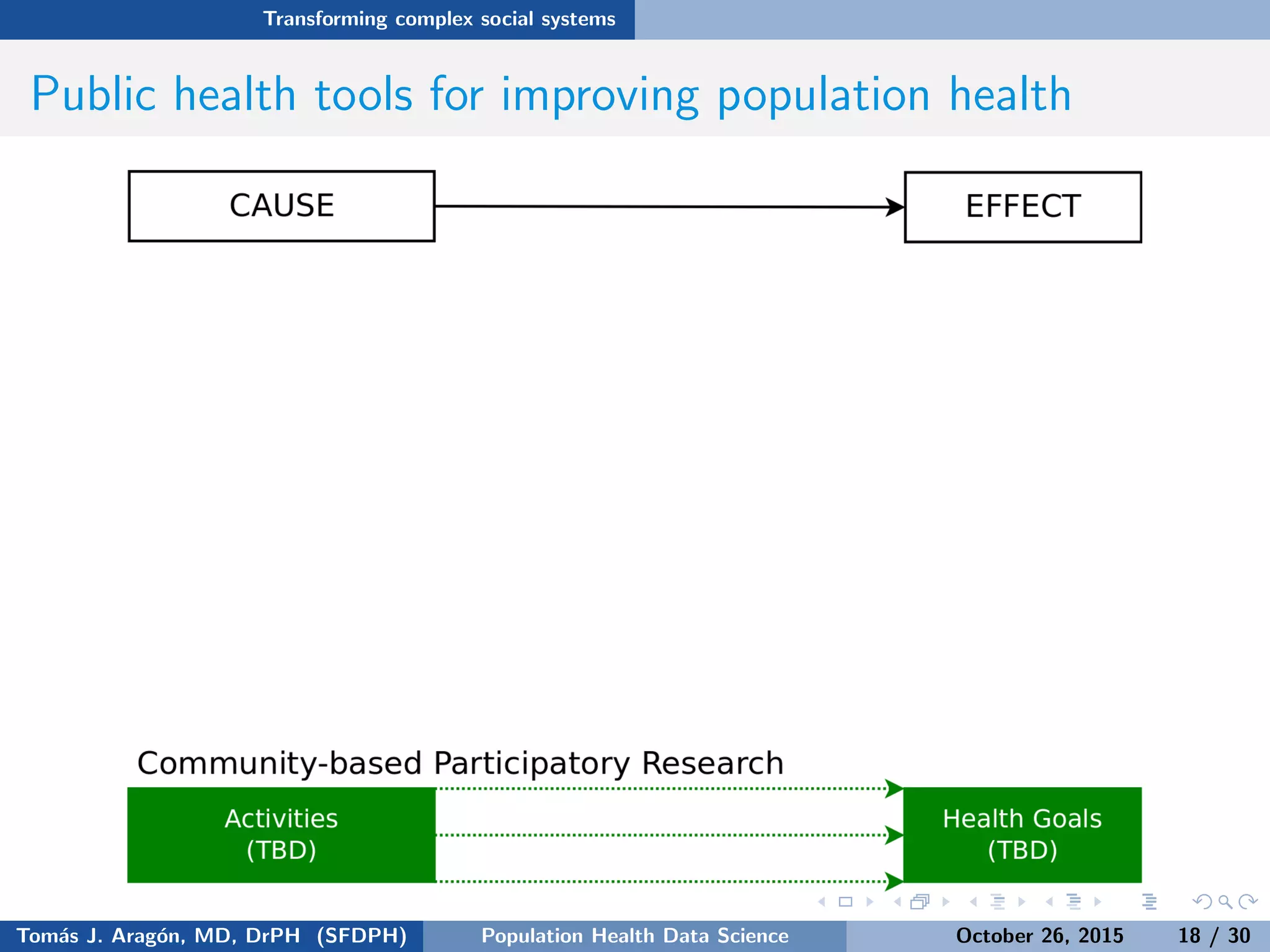
Public health tools for improving population health
Source:Tom´as J. Arag´on, MD, DrPH (SFDPH) PHDS, Complexity, & Health Equity October 26, 2015 18 / 30
Transforming complex social systems
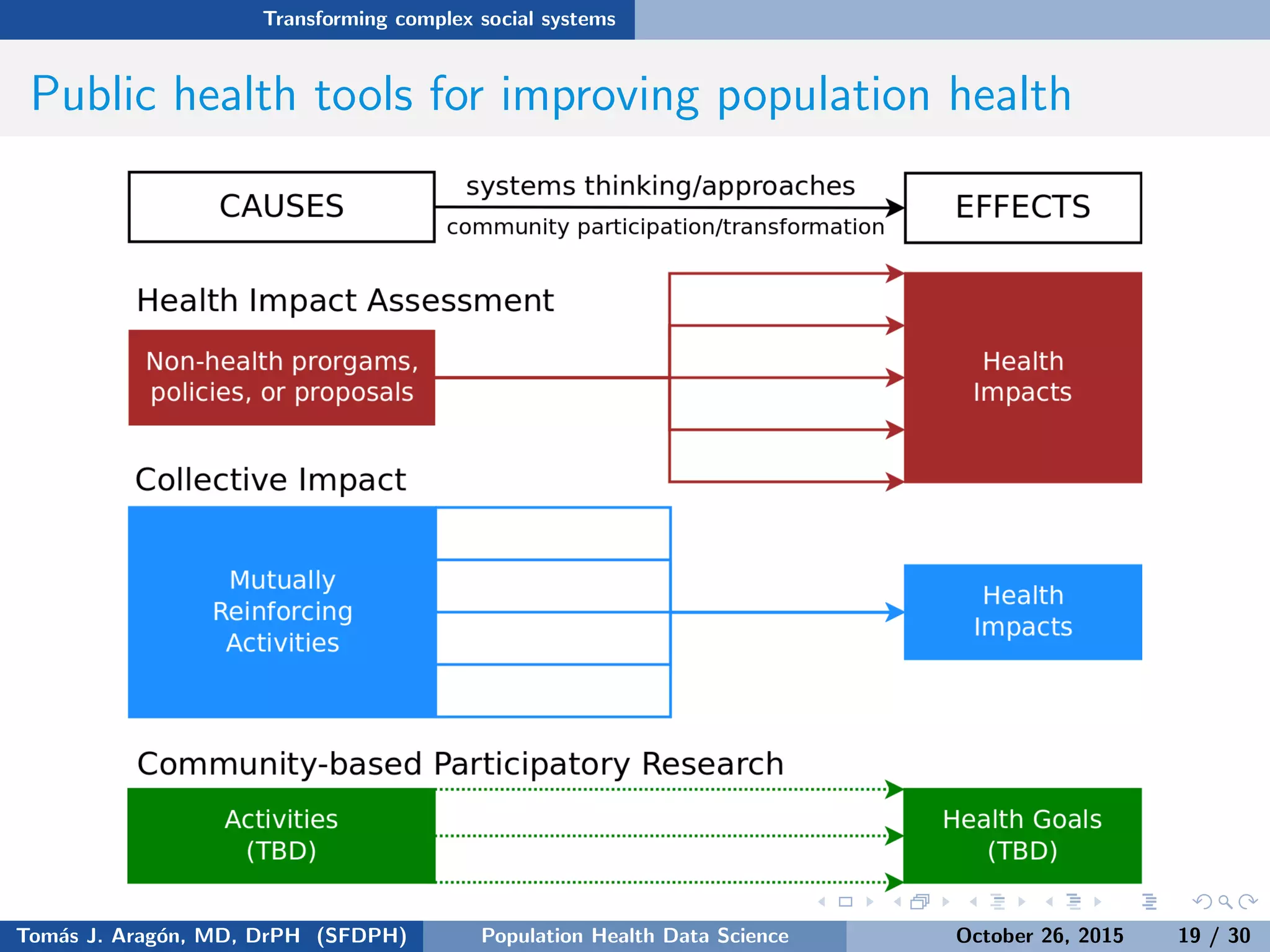
Public health tools for improving population health
Source:Tom´as J. Arag´on, MD, DrPH (SFDPH) PHDS, Complexity, & Health Equity October 26, 2015 19 / 30
Tackling population health inequities
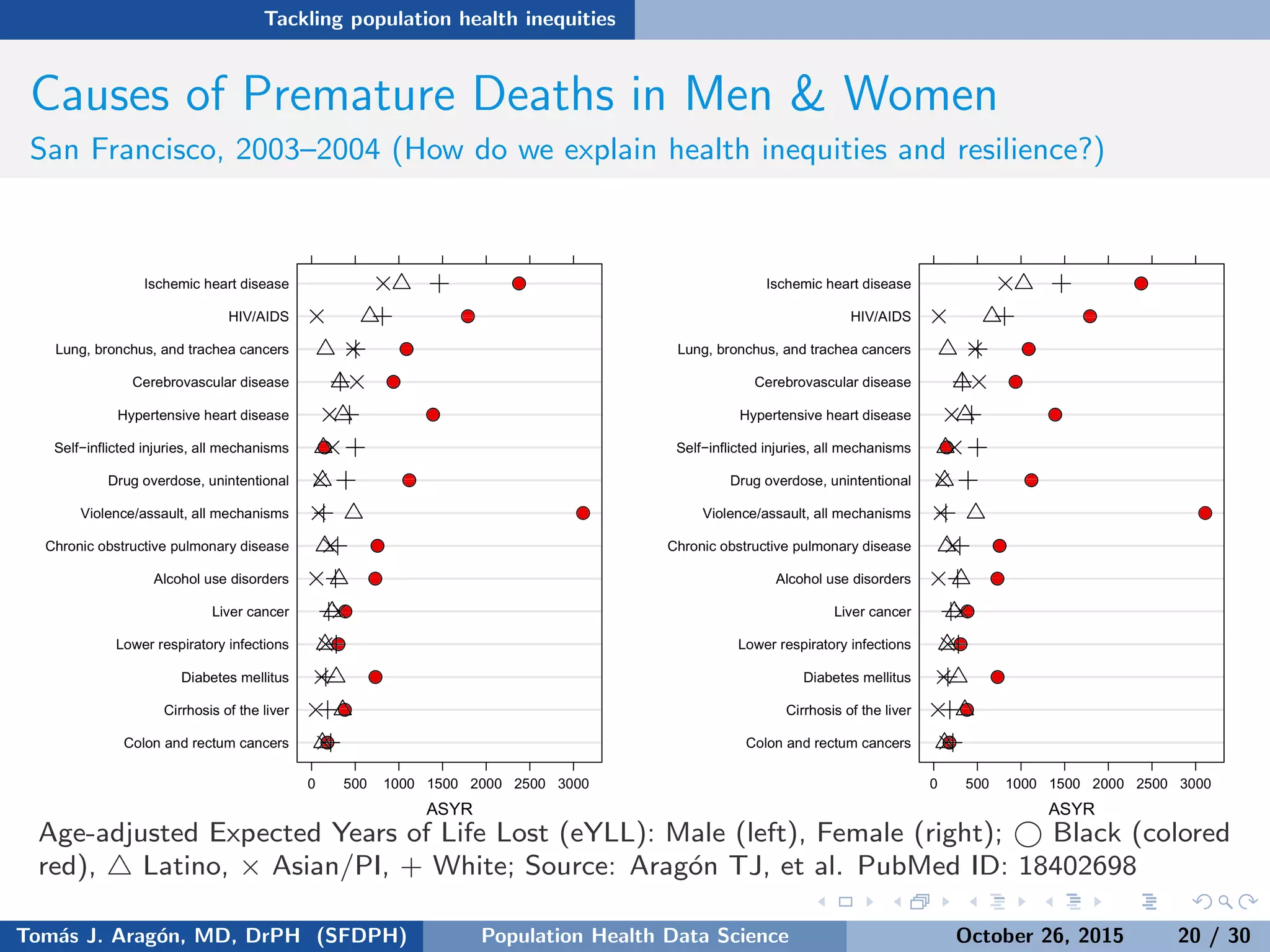
Causes of Premature Deaths in Men & Women
San Francisco, 2003–2004 (How do we explain health inequities and resilience?)
Age-adjusted Expected Years of Life Lost (eYLL): Male (left), Female (right); Black (colored
red), Latino, × Asian/PI, + White; Source: Arag´on TJ, et al. PubMed ID: 18402698
Tom´as J. Arag´on, MD, DrPH (SFDPH) PHDS, Complexity, & Health Equity October 26, 2015 20 / 30
Tackling population health inequities
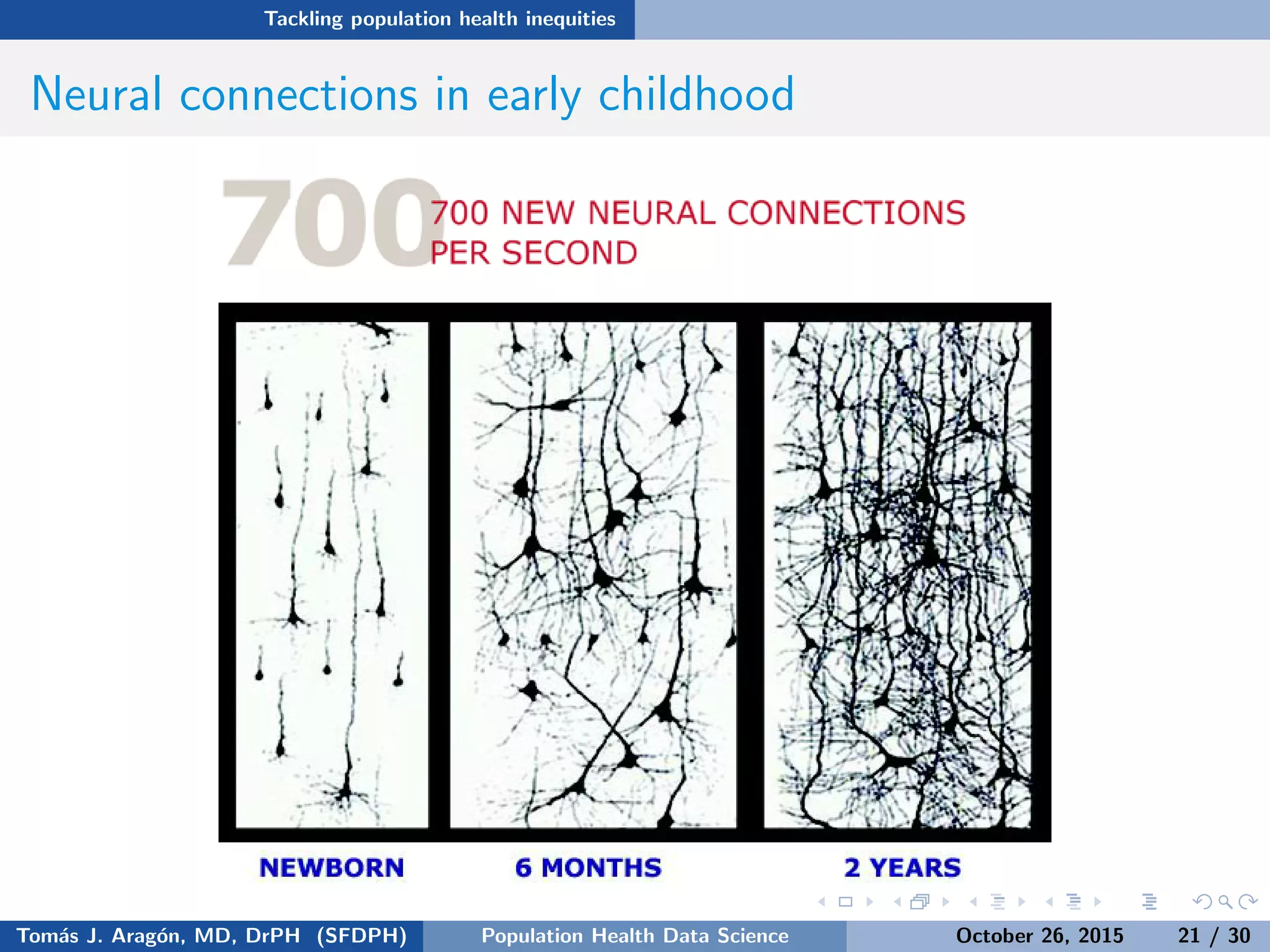
Neural connections in early childhood
Tom´as J. Arag´on, MD, DrPH (SFDPH) PHDS, Complexity, & Health Equity October 26, 2015 21 / 30
Tackling population health inequities
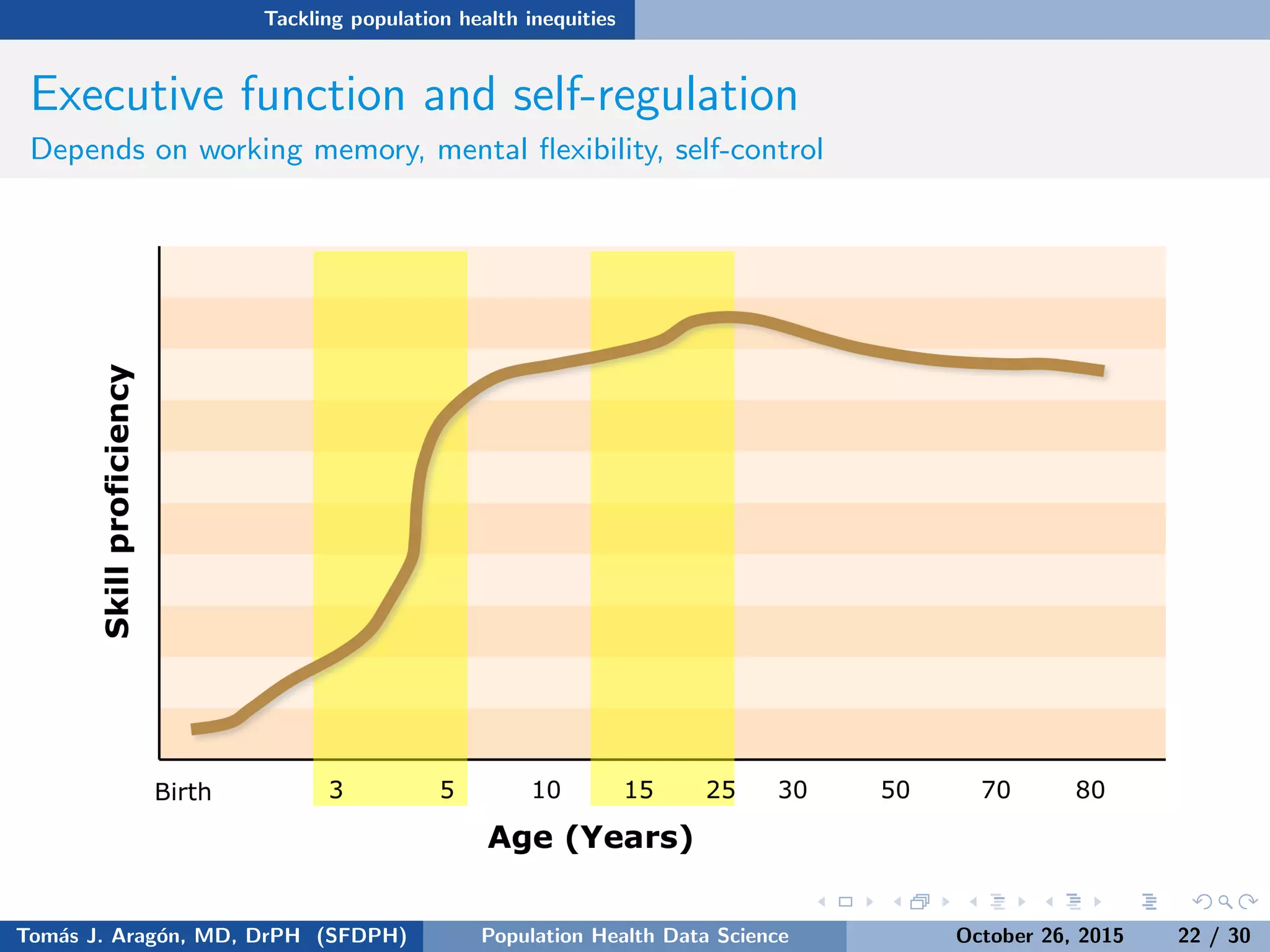
Executive function and self-regulation
Depends on working memory, mental flexibility, self-control
Tom´as J. Arag´on, MD, DrPH (SFDPH) PHDS, Complexity, & Health Equity October 26, 2015 22 / 30
Tackling population health inequities
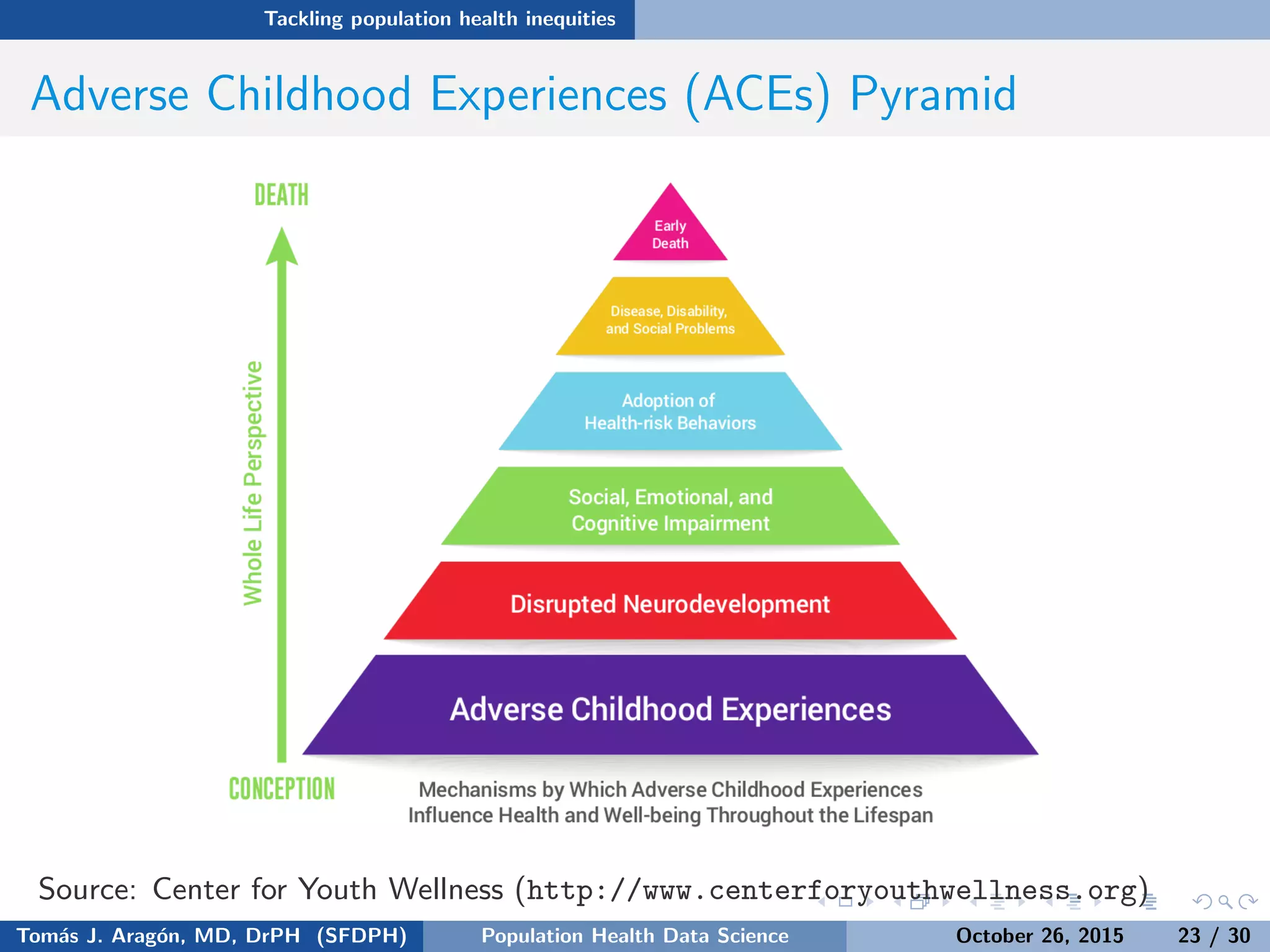
Adverse Childhood Experiences (ACEs) Pyramid
Source: Center for Youth Wellness (http://www.centerforyouthwellness.org)
Tom´as J. Arag´on, MD, DrPH (SFDPH) PHDS, Complexity, & Health Equity October 26, 2015 23 / 30
Tackling population health inequities
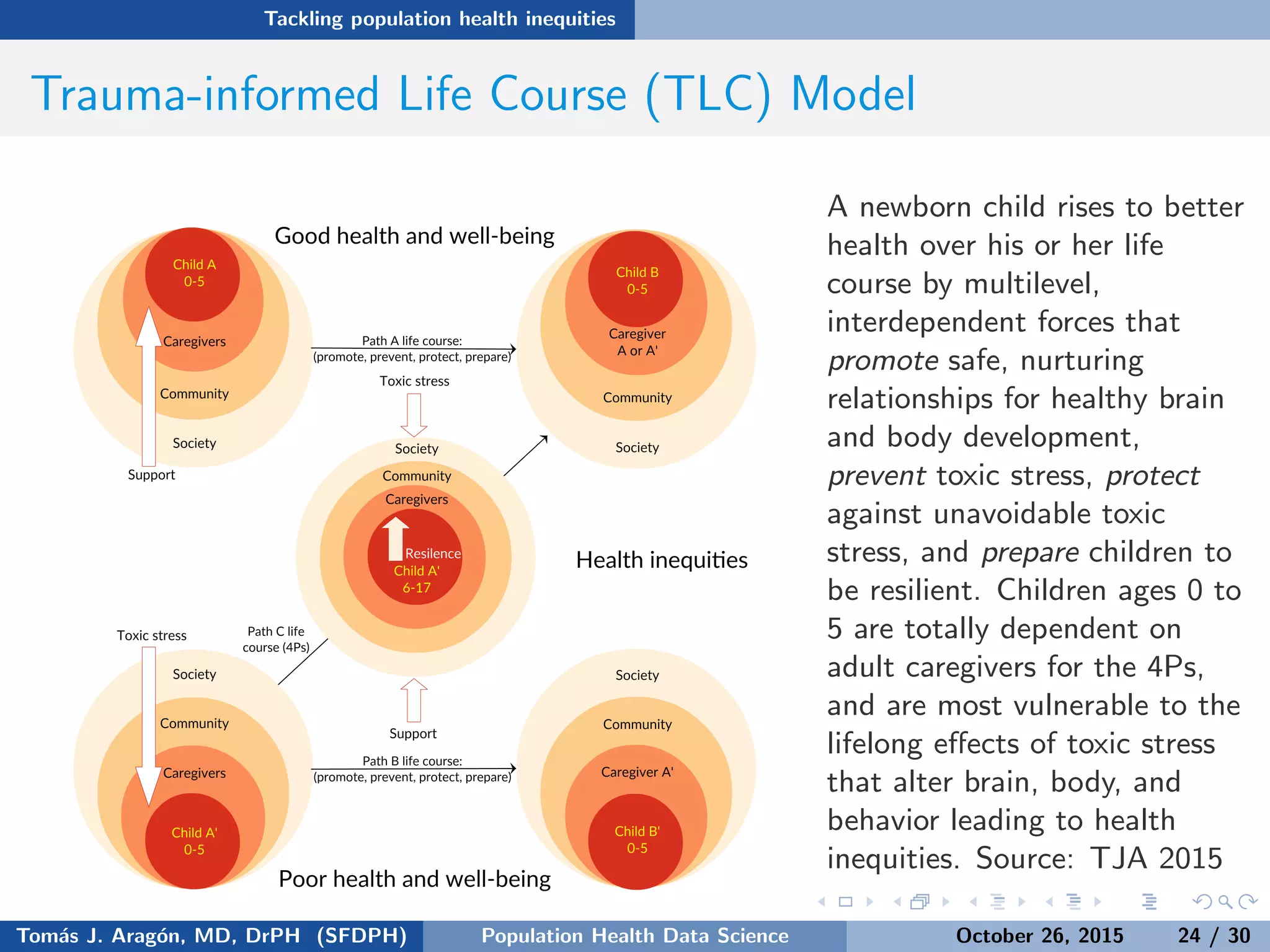
Trauma-informed, Intergenerational Life Course Model
The effects of trauma (toxic stress) are transmitted from one generation to the next
A newborn child rises to better
health over his or her life
course by multilevel,
interdependent forces that
promote safe, nurturing
relationships for healthy
neurodevelopment, prevent
toxic stress, protect against
unavoidable toxic stress, and
prepare children to be resilient.
Children ages 0 to 5 are totally
dependent on adult caregivers
for the 4Ps, and are most
vulnerable to the lifelong
effects of toxic stress that alter
brain, body, and behavior
leading to health inequities.
Source: TJA 2015
Tom´as J. Arag´on, MD, DrPH (SFDPH) PHDS, Complexity, & Health Equity October 26, 2015 24 / 30
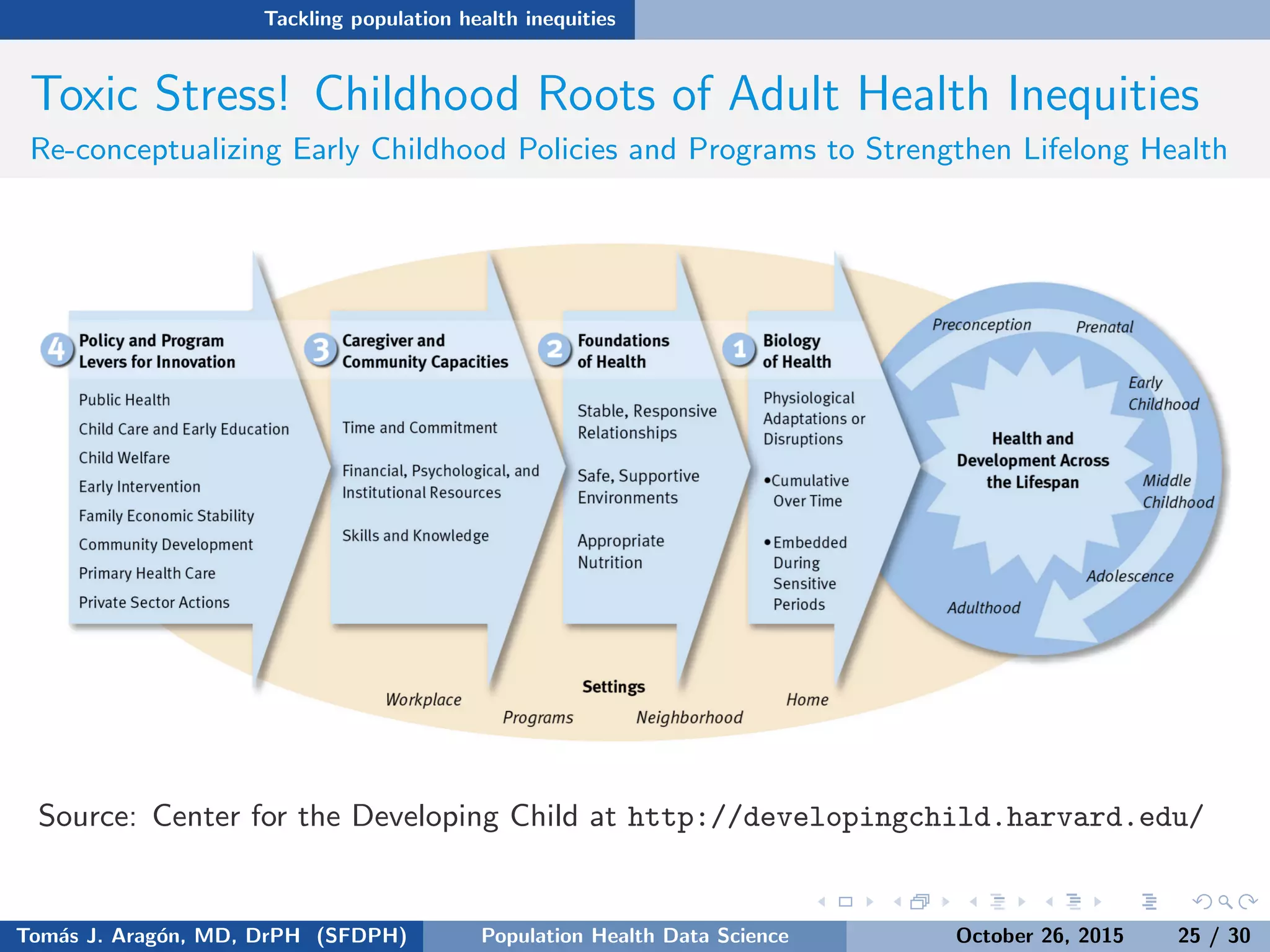
Tackling population health inequities
Toxic Stress! Childhood Roots of Adult Health Inequities
Re-conceptualizing Early Childhood Policies and Programs to Strengthen Lifelong Health
Source: Center for the Developing Child at http://developingchild.harvard.edu/
Tom´as J. Arag´on, MD, DrPH (SFDPH) PHDS, Complexity, & Health Equity October 26, 2015 25 / 30
Tackling population health inequities
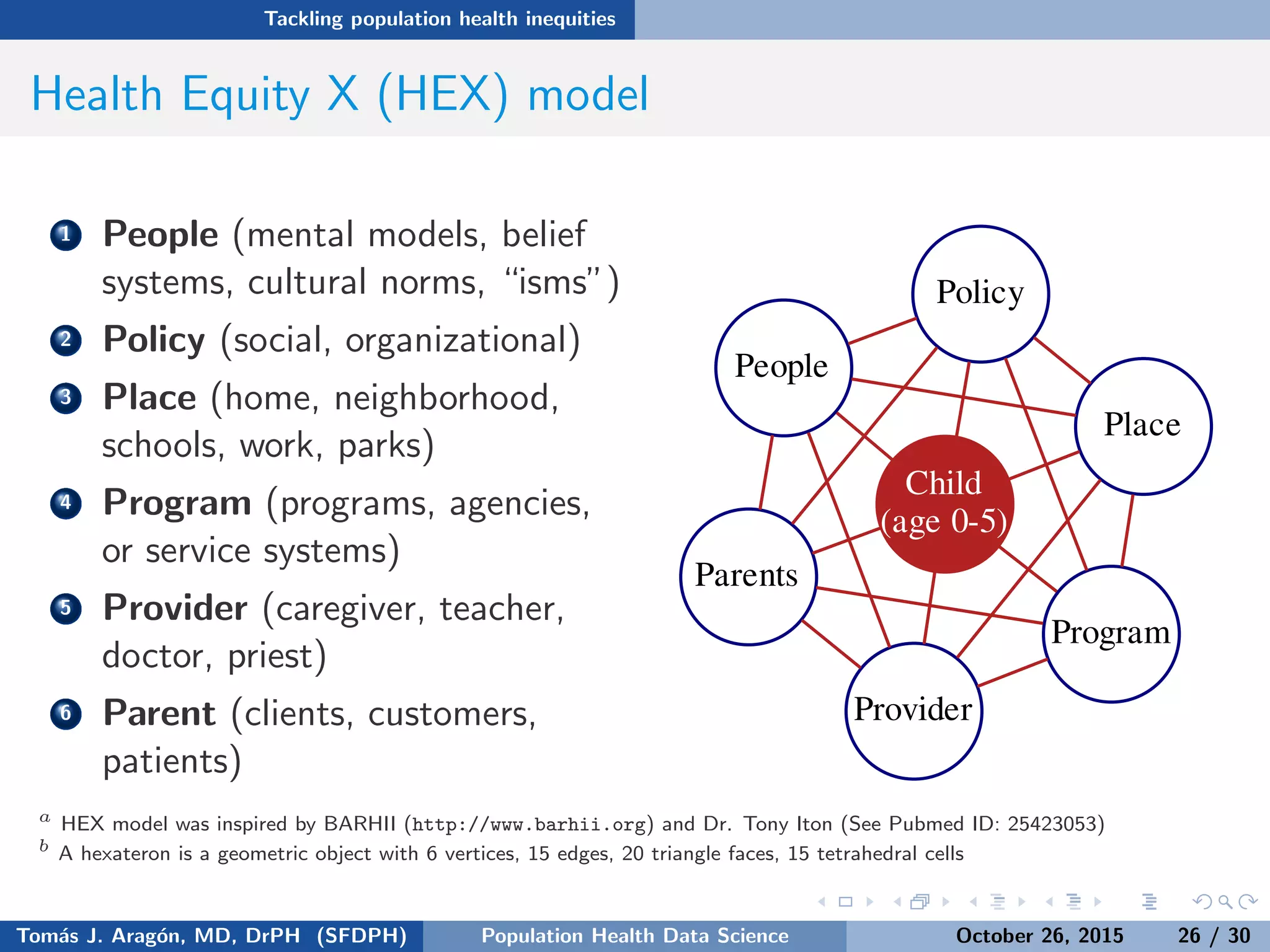
Health Equity X (HEX) model
1 People (mental models, belief
systems, cultural norms, “isms”)
2 Policy (social, organizational)
3 Place (home, neighborhood,
schools, work, parks)
4 Program (programs, agencies,
or service systems)
5 Provider (caregiver, teacher,
doctor, priest)
6 Parents (clients, customers,
patients)
Parents
Program
People
Provider
Place
Policy
Child
(age 0-5)
a
HEX model was inspired by BARHII (http://www.barhii.org) and Dr. Tony Iton (See Pubmed ID: 25423053)
b
A hexateron is a geometric object with 6 vertices, 15 edges, 20 triangle faces, 15 tetrahedral cells
Tom´as J. Arag´on, MD, DrPH (SFDPH) PHDS, Complexity, & Health Equity October 26, 2015 26 / 30
Tackling population health inequities
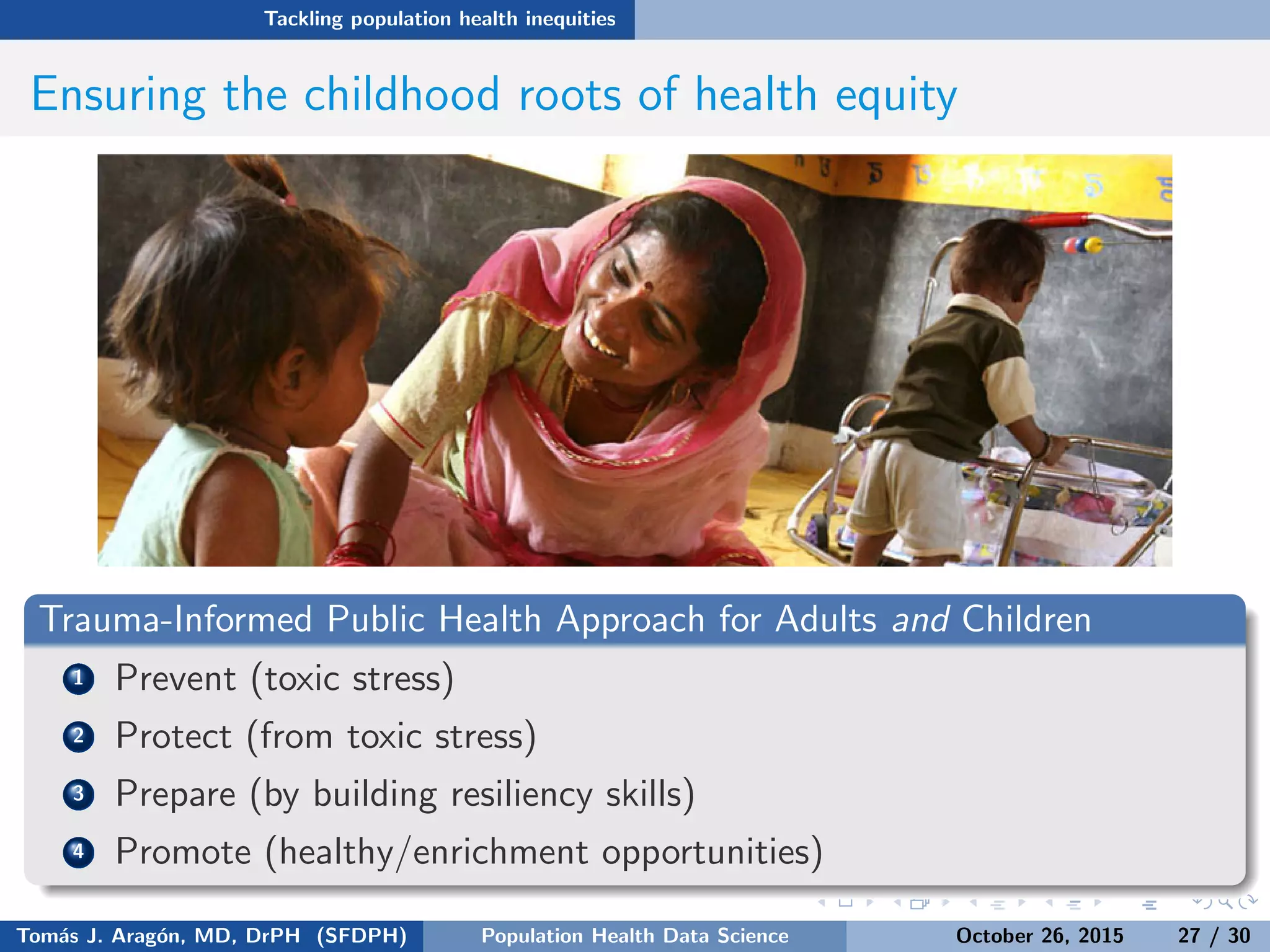
Ensuring the childhood roots of health equity
Trauma-Informed Public Health Approach for Adults and Children
1 Prevent (toxic stress)
2 Protect (from toxic stress)
3 Prepare (by building resiliency skills)
4 Promote (healthy/enrichment opportunities)
Tom´as J. Arag´on, MD, DrPH (SFDPH) PHDS, Complexity, & Health Equity October 26, 2015 27 / 30
Tackling population health inequities
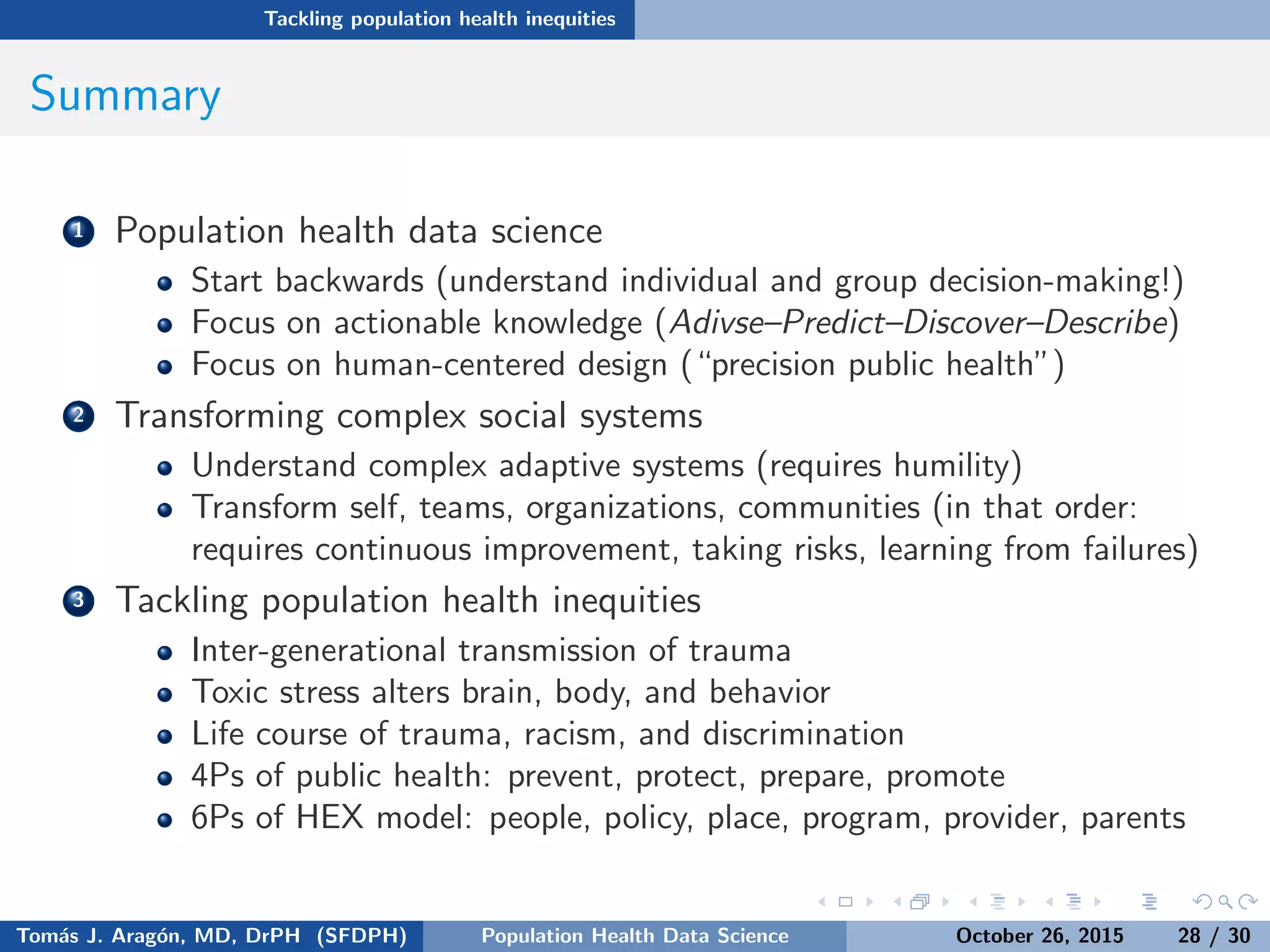
Summary
1 Population health data science
Start backwards (understand individual and group decision-making!)
Focus on actionable knowledge (Adivse–Predict–Discover–Describe)
Focus on human-centered design (“precision public health”)
2 Transforming complex social systems
Understand complex adaptive systems (requires humility)
Transform self, teams, organizations, communities (in that order:
requires continuous improvement, taking risks, learning from failures)
3 Tackling population health inequities
Inter-generational transmission of trauma
Toxic stress alters brain, body, and behavior
Life course of trauma, racism, and discrimination
4Ps of public health: prevent, protect, prepare, promote
6Ps of HEX model: people, policy, place, program, provider, parents
Tom´as J. Arag´on, MD, DrPH (SFDPH) PHDS, Complexity, & Health Equity October 26, 2015 28 / 30
Tackling population health inequities
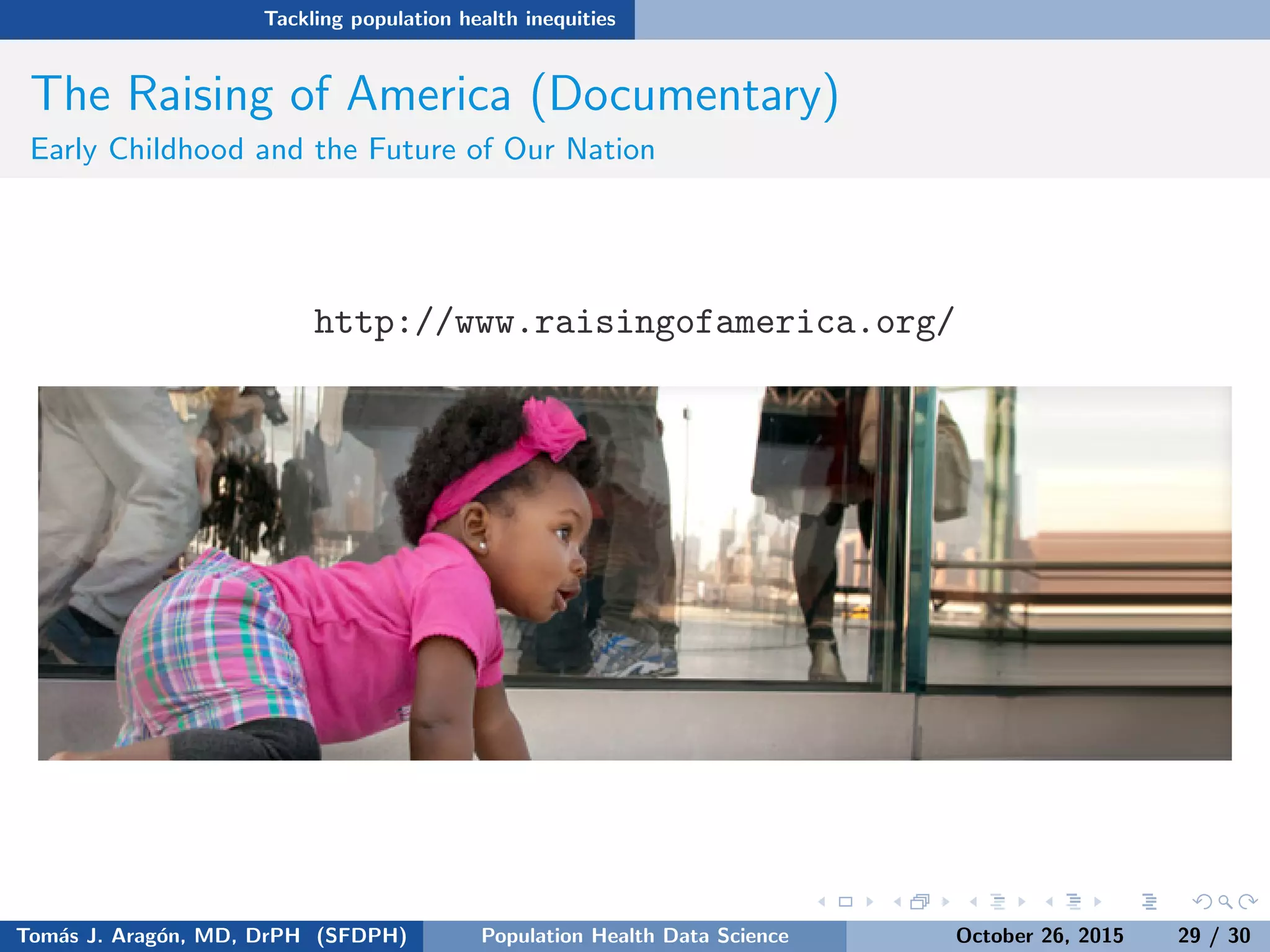
The Raising of America (Documentary)
Early Childhood and the Future of Our Nation
http://www.raisingofamerica.org/
Tom´as J. Arag´on, MD, DrPH (SFDPH) PHDS, Complexity, & Health Equity October 26, 2015 29 / 30
Tackling population health inequities
Selected Bibliography
1 Trying Hard Is Not Good Enough: How to Produce Measurable Improvement of
Customers and Communities (2009), by Mark Friedman
(http://amzn.com/1439237867). Covers practical and tested framework for
implementing and improving collective impact projects.
2 The Practice of Adaptive Leadership: Tools and Tactics for Changing Your
Organization and the World (2009), by Ronald A. Heifetz et al.
(http://amzn.com/1422105768). Covers practical, powerful, and inspiring
approach to leading change in complex environments.
3 Complex Adaptive Systems: An Introduction to Computational Models of Social
Life (2007), by John H. Miller, et al. (http://amzn.com/0691127026).
4 Network Modeling for Epidemics (2015), by Martina Morris, et al.
(http://statnet.csde.washington.edu/EpiModel/nme/index.html). Online
resource for learning how to use R for modeling social networks and epidemics.
5 Population Health Data Science with R (2015, manuscript in progress), by Tom´as
J. Arag´on. (https://leanpub.com/u/medepi). Covers how to use R for
population health analyses. Also visit http://medepi.com.
Tom´as J. Arag´on, MD, DrPH (SFDPH) PHDS, Complexity, & Health Equity October 26, 2015 30 / 30

Population Health Data Science, Complexity, and Health Equity: Reflections from a Local Health Official

  • 1.
    Population Health DataScience, Complexity, and Health Equity: Reflections from a Local Health Official Tom´as J. Arag´on, MD, DrPH Health Officer, City and County of San Francisco Director, Population Health Division (PHD) San Francisco Department of Public Health Adjunct Faculty, UC Berkeley School of Public Health Keynote Address: Stanford Center for Population Health Sciences Annual PHS Colloquium an October 26, 2015 Tom´as J. Arag´on, MD, DrPH (SFDPH) PHDS, Complexity, & Health Equity October 26, 2015 1 / 30
  • 2.
    Overview 1 Introduction andbackground 2 Population health data science 3 Transforming complex social systems 4 Tackling population health inequities Tom´as J. Arag´on, MD, DrPH (SFDPH) PHDS, Complexity, & Health Equity October 26, 2015 2 / 30
  • 3.
    Introduction and background Causesof Premature Deaths in Men & Women San Francisco, 2003–2004 (How do we explain health inequities and resilience?) Age-adjusted Expected Years of Life Lost (eYLL): Male (left), Female (right); Black (colored red), Latino, × Asian/PI, + White; Source: Arag´on TJ, et al. PubMed ID: 18402698 Tom´as J. Arag´on, MD, DrPH (SFDPH) PHDS, Complexity, & Health Equity October 26, 2015 3 / 30
  • 4.
    Introduction and background Somedefinitions Health (WHO 1946) Health is a state of complete physical, mental and social well-being and not merely the absence of disease or infirmity. Public Health (IOM 1988) Public health is what we, as a society, do collectively to assure the conditions in which people can be healthy. Population Health (TJA 2015) A systemsa framework for studying and improving the health of populations through collective action and learning. a Complexity or complex adaptive systems Tom´as J. Arag´on, MD, DrPH (SFDPH) PHDS, Complexity, & Health Equity October 26, 2015 4 / 30
  • 5.
    Introduction and background Healthincludes the 8 dimensions of wellness Source: http://www.samhsa.gov/wellness-initiative Tom´as J. Arag´on, MD, DrPH (SFDPH) PHDS, Complexity, & Health Equity October 26, 2015 5 / 30
  • 6.
    Population health datascience More definitions Population Health (TJA 2015) A systemsa framework for studying and improving the health of populations through collective action and learning. a Complexity or complex adaptive systems Data science Data science is the art and science of transforming data into actionable knowledge. Population health data science (TJA 2015) Population health data science is the art and science of transforming health relevant data into actionable knowledge. Tom´as J. Arag´on, MD, DrPH (SFDPH) PHDS, Complexity, & Health Equity October 26, 2015 6 / 30
  • 7.
    Population health datascience Population Health Data Science Describe—Discover—Predict—Advise Tom´as J. Arag´on, MD, DrPH (SFDPH) PHDS, Complexity, & Health Equity October 26, 2015 7 / 30
  • 8.
    Transforming complex socialsystems Complexity and why it matters What is a complex adaptive system? 1 A population of diverse agents, all of which are 2 connected, with behaviors and actions that are 3 interdependent, and that exhibit 4 adaptation and learning. Why do we care? Complex systems . . . are ambiguous, deceptive, unpredictable are difficult to direct and control (adaptation, resistance) can self-organize and locally optimize (silos, tribes) can evolve along divergent pathways (pathway dependence) can produce phase transitions (“tipping points”) (e.g., epidemics) can produce emergent phenomenon (e.g., herd immunity) Tom´as J. Arag´on, MD, DrPH (SFDPH) PHDS, Complexity, & Health Equity October 26, 2015 8 / 30
  • 9.
    Transforming complex socialsystems Conceptualizing systems (selected approaches) Causal loop diagrams Agent-based models Social network models Tom´as J. Arag´on, MD, DrPH (SFDPH) PHDS, Complexity, & Health Equity October 26, 2015 9 / 30
  • 10.
    Transforming complex socialsystems Creating causal loop diagram (immunization example) Incidence of Immunity Inducing Infection neg Community Immunity posBalancing feedback loop Delay Tom´as J. Arag´on, MD, DrPH (SFDPH) PHDS, Complexity, & Health Equity October 26, 2015 10 / 30
  • 11.
    Transforming complex socialsystems Causal loop diagram of childhood immunization system Number of Vaccinations Incidence of Vaccine Preventable Diseases neg pos Number of Vaccine Adverse Effects pos Complexity of the Immunization Schedule pos Demand for Vaccinations pos Parental Concerns About Vaccine Adverse Effects pos pos neg Community Immunity pos pos Parental and Community Concerns About Vaccine Preventable Diseases pos pos Providers Adhering to Recommended Immunization Schedule Delay Development, Approval, and Promulgation of New Vaccines pos pos pos pos pos pos Logistical Burden on Health Care System pos pos Demand for Reduced, Alternative Schedules pos neg pos Vaccine Advisory Boards Vaccine Manufacturers Professional Associations Academic Researchers Public Health Authorities Patient Advocacy groups Source: TJA Tom´as J. Arag´on, MD, DrPH (SFDPH) PHDS, Complexity, & Health Equity October 26, 2015 11 / 30
  • 12.
    Transforming complex socialsystems Networking modeling of epidemics using R Source: http://www.reed.edu/reed_magazine/march2012/articles/features/ morris/morris.html Network Modeling for Epidemics (Dr. Martina Morris, University of Washington): http://statnet.csde.washington.edu/EpiModel/nme/index.html Tom´as J. Arag´on, MD, DrPH (SFDPH) PHDS, Complexity, & Health Equity October 26, 2015 12 / 30
  • 13.
    Transforming complex socialsystems Public health tools for improving population health Source:Tom´as J. Arag´on, MD, DrPH (SFDPH) PHDS, Complexity, & Health Equity October 26, 2015 13 / 30
  • 14.
    Transforming complex socialsystems Population health tools for improving population health Source:Tom´as J. Arag´on, MD, DrPH (SFDPH) PHDS, Complexity, & Health Equity October 26, 2015 14 / 30
  • 15.
    Transforming complex socialsystems Public health tools for improving population health Source:Tom´as J. Arag´on, MD, DrPH (SFDPH) PHDS, Complexity, & Health Equity October 26, 2015 15 / 30
  • 16.
    Transforming complex socialsystems Collective impact fulfills five criteria1 1 Common Agenda: All participants have a shared vision for change including a common understanding of the problem and a joint approach to solving it. 2 Shared Measurement: Collecting data and measuring results consistently ensures efforts remain aligned and participants hold each other accountable. 3 Mutually Reinforcing Activities: Participant activities must be differentiated while still being coordinated through a mutually reinforcing plan of action. 4 Continuous Communication and Improvement: Consistent and open communication is needed across the many players to build trust, assure mutual objectives, and continuously improve. 5 Backbone Organization: Collective impact requires a separate organization(s) with staff to serve as the backbone for the entire initiative and coordinate participating organizations and agencies. 1 Adapted from http://www.fsg.org Tom´as J. Arag´on, MD, DrPH (SFDPH) PHDS, Complexity, & Health Equity October 26, 2015 16 / 30
  • 17.
    Transforming complex socialsystems What is Health Equity X (HEX) model HEXa,b is used for planning and managing efforts to achieve results for challenges and opportunities embedded in complex social systems, including for quality improvement, health equity, and collective impact. 1 People (mental models, belief systems, cultural norms, “isms”) 2 Policy (social, organizational) 3 Place (neighborhood, school, work, open space) 4 Program (program, agency, or service system) 5 Provider (teacher, doctor, priest) 6 Patron (patient, client, customer) Patron Program People Provider Place Policy Health Equity a HEX model was inspired by BARHII (http://www.barhii.org) and Dr. Tony Iton (See Pubmed ID: 25423053) b A hexateron is a geometric object with 6 vertices, 15 edges, 20 triangle faces, 15 tetrahedral cells Tom´as J. Arag´on, MD, DrPH (SFDPH) PHDS, Complexity, & Health Equity October 26, 2015 17 / 30
  • 18.
    Transforming complex socialsystems Public health tools for improving population health Source:Tom´as J. Arag´on, MD, DrPH (SFDPH) PHDS, Complexity, & Health Equity October 26, 2015 18 / 30
  • 19.
    Transforming complex socialsystems Public health tools for improving population health Source:Tom´as J. Arag´on, MD, DrPH (SFDPH) PHDS, Complexity, & Health Equity October 26, 2015 19 / 30
  • 20.
    Tackling population healthinequities Causes of Premature Deaths in Men & Women San Francisco, 2003–2004 (How do we explain health inequities and resilience?) Age-adjusted Expected Years of Life Lost (eYLL): Male (left), Female (right); Black (colored red), Latino, × Asian/PI, + White; Source: Arag´on TJ, et al. PubMed ID: 18402698 Tom´as J. Arag´on, MD, DrPH (SFDPH) PHDS, Complexity, & Health Equity October 26, 2015 20 / 30
  • 21.
    Tackling population healthinequities Neural connections in early childhood Tom´as J. Arag´on, MD, DrPH (SFDPH) PHDS, Complexity, & Health Equity October 26, 2015 21 / 30
  • 22.
    Tackling population healthinequities Executive function and self-regulation Depends on working memory, mental flexibility, self-control Tom´as J. Arag´on, MD, DrPH (SFDPH) PHDS, Complexity, & Health Equity October 26, 2015 22 / 30
  • 23.
    Tackling population healthinequities Adverse Childhood Experiences (ACEs) Pyramid Source: Center for Youth Wellness (http://www.centerforyouthwellness.org) Tom´as J. Arag´on, MD, DrPH (SFDPH) PHDS, Complexity, & Health Equity October 26, 2015 23 / 30
  • 24.
    Tackling population healthinequities Trauma-informed, Intergenerational Life Course Model The effects of trauma (toxic stress) are transmitted from one generation to the next A newborn child rises to better health over his or her life course by multilevel, interdependent forces that promote safe, nurturing relationships for healthy neurodevelopment, prevent toxic stress, protect against unavoidable toxic stress, and prepare children to be resilient. Children ages 0 to 5 are totally dependent on adult caregivers for the 4Ps, and are most vulnerable to the lifelong effects of toxic stress that alter brain, body, and behavior leading to health inequities. Source: TJA 2015 Tom´as J. Arag´on, MD, DrPH (SFDPH) PHDS, Complexity, & Health Equity October 26, 2015 24 / 30
  • 25.
    Tackling population healthinequities Toxic Stress! Childhood Roots of Adult Health Inequities Re-conceptualizing Early Childhood Policies and Programs to Strengthen Lifelong Health Source: Center for the Developing Child at http://developingchild.harvard.edu/ Tom´as J. Arag´on, MD, DrPH (SFDPH) PHDS, Complexity, & Health Equity October 26, 2015 25 / 30
  • 26.
    Tackling population healthinequities Health Equity X (HEX) model 1 People (mental models, belief systems, cultural norms, “isms”) 2 Policy (social, organizational) 3 Place (home, neighborhood, schools, work, parks) 4 Program (programs, agencies, or service systems) 5 Provider (caregiver, teacher, doctor, priest) 6 Parents (clients, customers, patients) Parents Program People Provider Place Policy Child (age 0-5) a HEX model was inspired by BARHII (http://www.barhii.org) and Dr. Tony Iton (See Pubmed ID: 25423053) b A hexateron is a geometric object with 6 vertices, 15 edges, 20 triangle faces, 15 tetrahedral cells Tom´as J. Arag´on, MD, DrPH (SFDPH) PHDS, Complexity, & Health Equity October 26, 2015 26 / 30
  • 27.
    Tackling population healthinequities Ensuring the childhood roots of health equity Trauma-Informed Public Health Approach for Adults and Children 1 Prevent (toxic stress) 2 Protect (from toxic stress) 3 Prepare (by building resiliency skills) 4 Promote (healthy/enrichment opportunities) Tom´as J. Arag´on, MD, DrPH (SFDPH) PHDS, Complexity, & Health Equity October 26, 2015 27 / 30
  • 28.
    Tackling population healthinequities Summary 1 Population health data science Start backwards (understand individual and group decision-making!) Focus on actionable knowledge (Adivse–Predict–Discover–Describe) Focus on human-centered design (“precision public health”) 2 Transforming complex social systems Understand complex adaptive systems (requires humility) Transform self, teams, organizations, communities (in that order: requires continuous improvement, taking risks, learning from failures) 3 Tackling population health inequities Inter-generational transmission of trauma Toxic stress alters brain, body, and behavior Life course of trauma, racism, and discrimination 4Ps of public health: prevent, protect, prepare, promote 6Ps of HEX model: people, policy, place, program, provider, parents Tom´as J. Arag´on, MD, DrPH (SFDPH) PHDS, Complexity, & Health Equity October 26, 2015 28 / 30
  • 29.
    Tackling population healthinequities The Raising of America (Documentary) Early Childhood and the Future of Our Nation http://www.raisingofamerica.org/ Tom´as J. Arag´on, MD, DrPH (SFDPH) PHDS, Complexity, & Health Equity October 26, 2015 29 / 30
  • 30.
    Tackling population healthinequities Selected Bibliography 1 Trying Hard Is Not Good Enough: How to Produce Measurable Improvement of Customers and Communities (2009), by Mark Friedman (http://amzn.com/1439237867). Covers practical and tested framework for implementing and improving collective impact projects. 2 The Practice of Adaptive Leadership: Tools and Tactics for Changing Your Organization and the World (2009), by Ronald A. Heifetz et al. (http://amzn.com/1422105768). Covers practical, powerful, and inspiring approach to leading change in complex environments. 3 Complex Adaptive Systems: An Introduction to Computational Models of Social Life (2007), by John H. Miller, et al. (http://amzn.com/0691127026). 4 Network Modeling for Epidemics (2015), by Martina Morris, et al. (http://statnet.csde.washington.edu/EpiModel/nme/index.html). Online resource for learning how to use R for modeling social networks and epidemics. 5 Population Health Data Science with R (2015, manuscript in progress), by Tom´as J. Arag´on. (https://leanpub.com/u/medepi). Covers how to use R for population health analyses. Also visit http://medepi.com. Tom´as J. Arag´on, MD, DrPH (SFDPH) PHDS, Complexity, & Health Equity October 26, 2015 30 / 30