Population Health Lean
"We will be the best at getting better!"
Tomás J. Aragón, MD, DrPH
PHD Staff Engagement 2017!, Wednesday, April 5, 2017
Health Officer, City & County of San Francisco
Director, Population Health Division (PHD)
San Francisco Department of Public Health
http://phlean.org (quality improvement)
http://phdata.science (data science)
tomas.aragon@sfdph.org (email)
1
What is population health lean?
What is lean thinking? (2017 theme!)
2
What is population health lean?
3
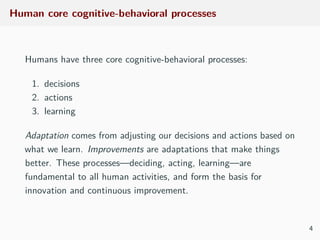
Human core cognitive-behavioral processes
Humans have three core cognitive-behavioral processes:
1. decisions
2. actions
3. learning
Adaptation comes from adjusting our decisions and actions based on
what we learn. Improvements are adaptations that make things
better. These processes—deciding, acting, learning—are
fundamental to all human activities, and form the basis for
innovation and continuous improvement.
4
Organizational core cognitive-behavioral processes
To fulfill its potential as a learning organization, we must ensure the
following:
1. decision quality (decisions: good decisions and data science)
2. project management (actions: execution with agile methods)
3. performance improvement (learning: innovation and results)
5
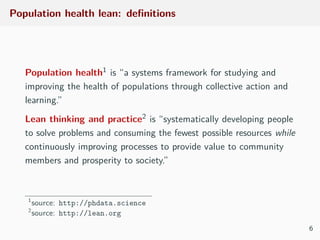
Population health lean: definitions
Population health1 is “a systems framework for studying and
improving the health of populations through collective action and
learning.”
Lean thinking and practice2 is “systematically developing people
to solve problems and consuming the fewest possible resources while
continuously improving processes to provide value to community
members and prosperity to society.”
1
source: http://phdata.science
2
source: http://lean.org
6
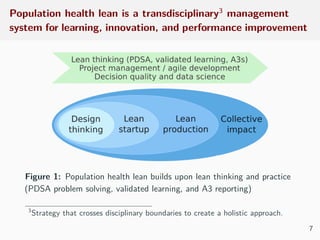
Population health lean is a transdisciplinary3
management
system for learning, innovation, and performance improvement
Figure 1: Population health lean builds upon lean thinking and practice
(PDSA problem solving, validated learning, and A3 reporting)
3
Strategy that crosses disciplinary boundaries to create a holistic approach.
7
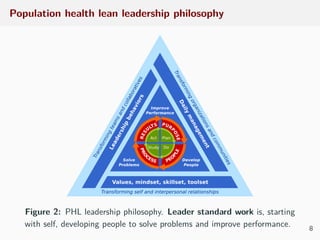
Population health lean leadership philosophy
Figure 2: PHL leadership philosophy. Leader standard work is, starting
with self, developing people to solve problems and improve performance. 8
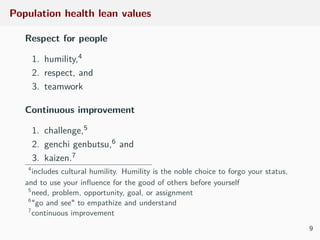
Population health lean values
Respect for people
1. humility,4
2. respect, and
3. teamwork
Continuous improvement
1. challenge,5
2. genchi genbutsu,6 and
3. kaizen.7
4
includes cultural humility. Humility is the noble choice to forgo your status,
and to use your influence for the good of others before yourself
5
need, problem, opportunity, goal, or assignment
6
"go and see" to empathize and understand
7
continuous improvement
9
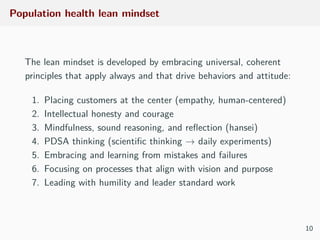
Population health lean mindset
The lean mindset is developed by embracing universal, coherent
principles that apply always and that drive behaviors and attitude:
1. Placing customers at the center (empathy, human-centered)
2. Intellectual honesty and courage
3. Mindfulness, sound reasoning, and reflection (hansei)
4. PDSA thinking (scientific thinking → daily experiments)
5. Embracing and learning from mistakes and failures
6. Focusing on processes that align with vision and purpose
7. Leading with humility and leader standard work
10
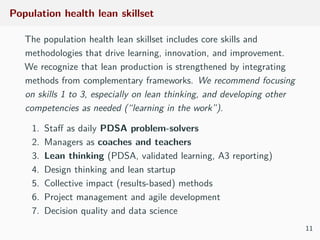
Population health lean skillset
The population health lean skillset includes core skills and
methodologies that drive learning, innovation, and improvement.
We recognize that lean production is strengthened by integrating
methods from complementary frameworks. We recommend focusing
on skills 1 to 3, especially on lean thinking, and developing other
competencies as needed (“learning in the work”).
1. Staff as daily PDSA problem-solvers
2. Managers as coaches and teachers
3. Lean thinking (PDSA, validated learning, A3 reporting)
4. Design thinking and lean startup
5. Collective impact (results-based) methods
6. Project management and agile development
7. Decision quality and data science
11
What is lean thinking? (2017
theme!)
12
Lean thinking and practice (“learning in the work”)
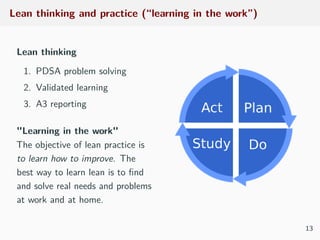
Lean thinking
1. PDSA problem solving
2. Validated learning
3. A3 reporting
"Learning in the work"
The objective of lean practice is
to learn how to improve. The
best way to learn lean is to find
and solve real needs and problems
at work and at home.
13
PDSA = PDCA
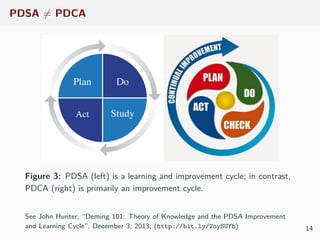
Figure 3: PDSA (left) is a learning and improvement cycle; in contrast,
PDCA (right) is primarily an improvement cycle.
See John Hunter, “Deming 101: Theory of Knowledge and the PDSA Improvement
and Learning Cycle”, December 3, 2013, (http://bit.ly/2oySUYb) 14
PDSA problem solving
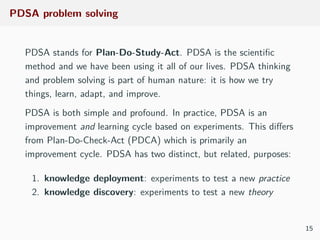
PDSA stands for Plan-Do-Study-Act. PDSA is the scientific
method and we have been using it all of our lives. PDSA thinking
and problem solving is part of human nature: it is how we try
things, learn, adapt, and improve.
PDSA is both simple and profound. In practice, PDSA is an
improvement and learning cycle based on experiments. This differs
from Plan-Do-Check-Act (PDCA) which is primarily an
improvement cycle. PDSA has two distinct, but related, purposes:
1. knowledge deployment: experiments to test a new practice
2. knowledge discovery: experiments to test a new theory
15
PDSA problem solving: single and double-loop learning
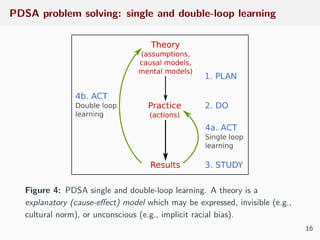
Figure 4: PDSA single and double-loop learning. A theory is a
explanatory (cause-effect) model which may be expressed, invisible (e.g.,
cultural norm), or unconscious (e.g., implicit racial bias).
16
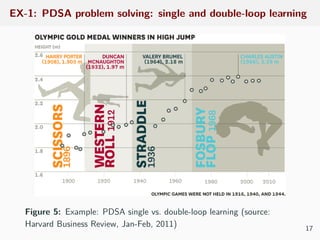
EX-1: PDSA problem solving: single and double-loop learning
Figure 5: Example: PDSA single vs. double-loop learning (source:
Harvard Business Review, Jan-Feb, 2011) 17
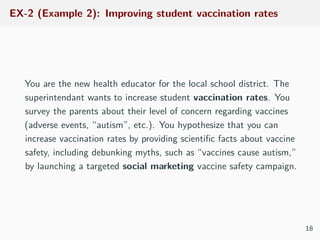
EX-2 (Example 2): Improving student vaccination rates
You are the new health educator for the local school district. The
superintendant wants to increase student vaccination rates. You
survey the parents about their level of concern regarding vaccines
(adverse events, “autism”, etc.). You hypothesize that you can
increase vaccination rates by providing scientific facts about vaccine
safety, including debunking myths, such as “vaccines cause autism,”
by launching a targeted social marketing vaccine safety campaign.
18
EX-2: Epidemiologic perspective: Dr. Jon Snowden
A medical epidemiologist, Dr. Jon Snowden,8 was assigned to assist
you. His working hypothesis is that parents who are exposed to the
vaccine safety campaign (yes vs. no) are more likely to vaccinate
their children (yes vs. no). He proposes to conduct multivariate
regression analysis in SAS, but needs for you to pay to renew his
expired license.
8
Dr. JS is a fictitious character; any resemblance to anyone you know is purely
coincidental.
19
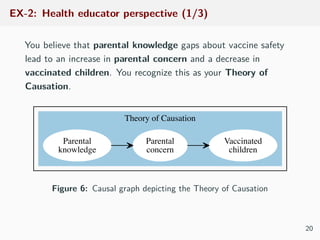
EX-2: Health educator perspective (1/3)
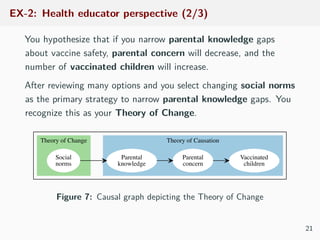
You believe that parental knowledge gaps about vaccine safety
lead to an increase in parental concern and a decrease in
vaccinated children. You recognize this as your Theory of
Causation.
Theory of Causation
Parental
knowledge
Parental
concern
Vaccinated
children
Figure 6: Causal graph depicting the Theory of Causation
20
EX-2: Health educator perspective (2/3)
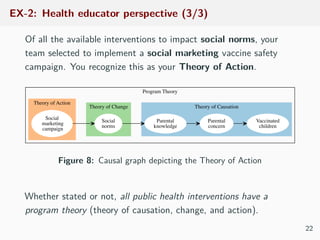
You hypothesize that if you narrow parental knowledge gaps
about vaccine safety, parental concern will decrease, and the
number of vaccinated children will increase.
After reviewing many options and you select changing social norms
as the primary strategy to narrow parental knowledge gaps. You
recognize this as your Theory of Change.
Theory of CausationTheory of Change
Parental
knowledge
Parental
concern
Vaccinated
children
Social
norms
Figure 7: Causal graph depicting the Theory of Change
21
EX-2: Health educator perspective (3/3)
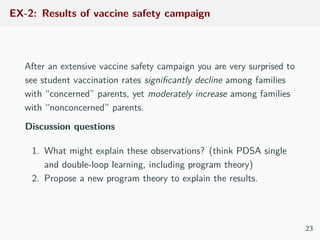
Of all the available interventions to impact social norms, your
team selected to implement a social marketing vaccine safety
campaign. You recognize this as your Theory of Action.
Program Theory
Theory of CausationTheory of Change
Theory of Action
Parental
knowledge
Parental
concern
Vaccinated
children
Social
norms
Social
marketing
campaign
Figure 8: Causal graph depicting the Theory of Action
Whether stated or not, all public health interventions have a
program theory (theory of causation, change, and action).
22
EX-2: Results of vaccine safety campaign
After an extensive vaccine safety campaign you are very surprised to
see student vaccination rates significantly decline among families
with “concerned” parents, yet moderately increase among families
with “nonconcerned” parents.
Discussion questions
1. What might explain these observations? (think PDSA single
and double-loop learning, including program theory)
2. Propose a new program theory to explain the results.
23
EX-2: Conceptual model of vaccine hesitancy
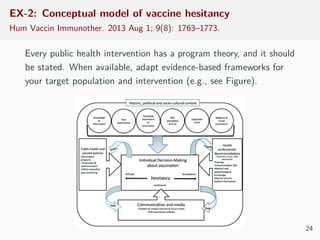
Hum Vaccin Immunother. 2013 Aug 1; 9(8): 1763–1773.
Every public health intervention has a program theory, and it should
be stated. When available, adapt evidence-based frameworks for
your target population and intervention (e.g., see Figure).
24
PDSA problem solving and PDSA variants
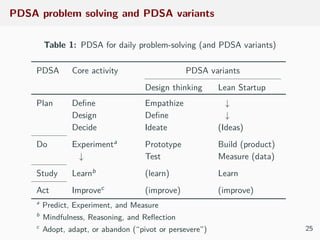
Table 1: PDSA for daily problem-solving (and PDSA variants)
PDSA Core activity PDSA variants
Design thinking Lean Startup
Plan Define Empathize ↓
Design Define ↓
Decide Ideate (Ideas)
Do Experimenta
Prototype Build (product)
↓ Test Measure (data)
Study Learnb
(learn) Learn
Act Improvec
(improve) (improve)
a
Predict, Experiment, and Measure
b
Mindfulness, Reasoning, and Reflection
c
Adopt, adapt, or abandon (“pivot or persevere”) 25
Validated learning is PDSA with a purposeful goal (1/3)
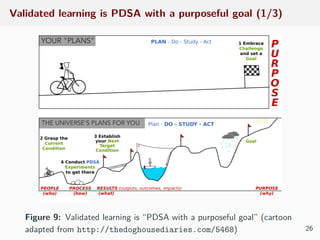
Figure 9: Validated learning is “PDSA with a purposeful goal” (cartoon
adapted from http://thedoghousediaries.com/5468) 26
Validated learning is also called “improvement kata” (2/3)
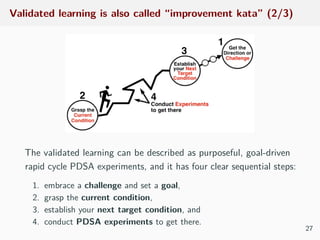
The validated learning can be described as purposeful, goal-driven
rapid cycle PDSA experiments, and it has four clear sequential steps:
1. embrace a challenge and set a goal,
2. grasp the current condition,
3. establish your next target condition, and
4. conduct PDSA experiments to get there.
27
Validated learning supports coaching (3/3)
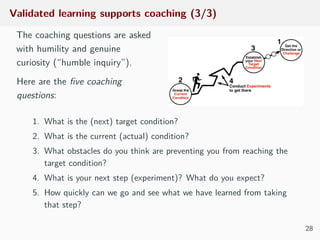
The coaching questions are asked
with humility and genuine
curiosity (“humble inquiry”).
Here are the five coaching
questions:
1. What is the (next) target condition?
2. What is the current (actual) condition?
3. What obstacles do you think are preventing you from reaching the
target condition?
4. What is your next step (experiment)? What do you expect?
5. How quickly can we go and see what we have learned from taking
that step?
28
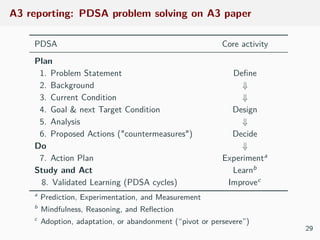
A3 reporting: PDSA problem solving on A3 paper
PDSA Core activity
Plan
1. Problem Statement Define
2. Background ⇓
3. Current Condition ⇓
4. Goal & next Target Condition Design
5. Analysis ⇓
6. Proposed Actions ("countermeasures") Decide
Do ⇓
7. Action Plan Experimenta
Study and Act Learnb
8. Validated Learning (PDSA cycles) Improvec
a
Prediction, Experimentation, and Measurement
b
Mindfulness, Reasoning, and Reflection
c
Adoption, adaptation, or abandonment (“pivot or persevere”)
29
Questions? Preguntas? Mga katanungan? Des questions?
30

Population Health Lean (SLIDES)

  • 1.
    Population Health Lean "Wewill be the best at getting better!" Tomás J. Aragón, MD, DrPH PHD Staff Engagement 2017!, Wednesday, April 5, 2017 Health Officer, City & County of San Francisco Director, Population Health Division (PHD) San Francisco Department of Public Health http://phlean.org (quality improvement) http://phdata.science (data science) tomas.aragon@sfdph.org (email) 1
  • 2.
    What is populationhealth lean? What is lean thinking? (2017 theme!) 2
  • 3.
    What is populationhealth lean? 3
  • 4.
    Human core cognitive-behavioralprocesses Humans have three core cognitive-behavioral processes: 1. decisions 2. actions 3. learning Adaptation comes from adjusting our decisions and actions based on what we learn. Improvements are adaptations that make things better. These processes—deciding, acting, learning—are fundamental to all human activities, and form the basis for innovation and continuous improvement. 4
  • 5.
    Organizational core cognitive-behavioralprocesses To fulfill its potential as a learning organization, we must ensure the following: 1. decision quality (decisions: good decisions and data science) 2. project management (actions: execution with agile methods) 3. performance improvement (learning: innovation and results) 5
  • 6.
    Population health lean:definitions Population health1 is “a systems framework for studying and improving the health of populations through collective action and learning.” Lean thinking and practice2 is “systematically developing people to solve problems and consuming the fewest possible resources while continuously improving processes to provide value to community members and prosperity to society.” 1 source: http://phdata.science 2 source: http://lean.org 6
  • 7.
    Population health leanis a transdisciplinary3 management system for learning, innovation, and performance improvement Figure 1: Population health lean builds upon lean thinking and practice (PDSA problem solving, validated learning, and A3 reporting) 3 Strategy that crosses disciplinary boundaries to create a holistic approach. 7
  • 8.
    Population health leanleadership philosophy Figure 2: PHL leadership philosophy. Leader standard work is, starting with self, developing people to solve problems and improve performance. 8
  • 9.
    Population health leanvalues Respect for people 1. humility,4 2. respect, and 3. teamwork Continuous improvement 1. challenge,5 2. genchi genbutsu,6 and 3. kaizen.7 4 includes cultural humility. Humility is the noble choice to forgo your status, and to use your influence for the good of others before yourself 5 need, problem, opportunity, goal, or assignment 6 "go and see" to empathize and understand 7 continuous improvement 9
  • 10.
    Population health leanmindset The lean mindset is developed by embracing universal, coherent principles that apply always and that drive behaviors and attitude: 1. Placing customers at the center (empathy, human-centered) 2. Intellectual honesty and courage 3. Mindfulness, sound reasoning, and reflection (hansei) 4. PDSA thinking (scientific thinking → daily experiments) 5. Embracing and learning from mistakes and failures 6. Focusing on processes that align with vision and purpose 7. Leading with humility and leader standard work 10
  • 11.
    Population health leanskillset The population health lean skillset includes core skills and methodologies that drive learning, innovation, and improvement. We recognize that lean production is strengthened by integrating methods from complementary frameworks. We recommend focusing on skills 1 to 3, especially on lean thinking, and developing other competencies as needed (“learning in the work”). 1. Staff as daily PDSA problem-solvers 2. Managers as coaches and teachers 3. Lean thinking (PDSA, validated learning, A3 reporting) 4. Design thinking and lean startup 5. Collective impact (results-based) methods 6. Project management and agile development 7. Decision quality and data science 11
  • 12.
    What is leanthinking? (2017 theme!) 12
  • 13.
    Lean thinking andpractice (“learning in the work”) Lean thinking 1. PDSA problem solving 2. Validated learning 3. A3 reporting "Learning in the work" The objective of lean practice is to learn how to improve. The best way to learn lean is to find and solve real needs and problems at work and at home. 13
  • 14.
    PDSA = PDCA Figure3: PDSA (left) is a learning and improvement cycle; in contrast, PDCA (right) is primarily an improvement cycle. See John Hunter, “Deming 101: Theory of Knowledge and the PDSA Improvement and Learning Cycle”, December 3, 2013, (http://bit.ly/2oySUYb) 14
  • 15.
    PDSA problem solving PDSAstands for Plan-Do-Study-Act. PDSA is the scientific method and we have been using it all of our lives. PDSA thinking and problem solving is part of human nature: it is how we try things, learn, adapt, and improve. PDSA is both simple and profound. In practice, PDSA is an improvement and learning cycle based on experiments. This differs from Plan-Do-Check-Act (PDCA) which is primarily an improvement cycle. PDSA has two distinct, but related, purposes: 1. knowledge deployment: experiments to test a new practice 2. knowledge discovery: experiments to test a new theory 15
  • 16.
    PDSA problem solving:single and double-loop learning Figure 4: PDSA single and double-loop learning. A theory is a explanatory (cause-effect) model which may be expressed, invisible (e.g., cultural norm), or unconscious (e.g., implicit racial bias). 16
  • 17.
    EX-1: PDSA problemsolving: single and double-loop learning Figure 5: Example: PDSA single vs. double-loop learning (source: Harvard Business Review, Jan-Feb, 2011) 17
  • 18.
    EX-2 (Example 2):Improving student vaccination rates You are the new health educator for the local school district. The superintendant wants to increase student vaccination rates. You survey the parents about their level of concern regarding vaccines (adverse events, “autism”, etc.). You hypothesize that you can increase vaccination rates by providing scientific facts about vaccine safety, including debunking myths, such as “vaccines cause autism,” by launching a targeted social marketing vaccine safety campaign. 18
  • 19.
    EX-2: Epidemiologic perspective:Dr. Jon Snowden A medical epidemiologist, Dr. Jon Snowden,8 was assigned to assist you. His working hypothesis is that parents who are exposed to the vaccine safety campaign (yes vs. no) are more likely to vaccinate their children (yes vs. no). He proposes to conduct multivariate regression analysis in SAS, but needs for you to pay to renew his expired license. 8 Dr. JS is a fictitious character; any resemblance to anyone you know is purely coincidental. 19
  • 20.
    EX-2: Health educatorperspective (1/3) You believe that parental knowledge gaps about vaccine safety lead to an increase in parental concern and a decrease in vaccinated children. You recognize this as your Theory of Causation. Theory of Causation Parental knowledge Parental concern Vaccinated children Figure 6: Causal graph depicting the Theory of Causation 20
  • 21.
    EX-2: Health educatorperspective (2/3) You hypothesize that if you narrow parental knowledge gaps about vaccine safety, parental concern will decrease, and the number of vaccinated children will increase. After reviewing many options and you select changing social norms as the primary strategy to narrow parental knowledge gaps. You recognize this as your Theory of Change. Theory of CausationTheory of Change Parental knowledge Parental concern Vaccinated children Social norms Figure 7: Causal graph depicting the Theory of Change 21
  • 22.
    EX-2: Health educatorperspective (3/3) Of all the available interventions to impact social norms, your team selected to implement a social marketing vaccine safety campaign. You recognize this as your Theory of Action. Program Theory Theory of CausationTheory of Change Theory of Action Parental knowledge Parental concern Vaccinated children Social norms Social marketing campaign Figure 8: Causal graph depicting the Theory of Action Whether stated or not, all public health interventions have a program theory (theory of causation, change, and action). 22
  • 23.
    EX-2: Results ofvaccine safety campaign After an extensive vaccine safety campaign you are very surprised to see student vaccination rates significantly decline among families with “concerned” parents, yet moderately increase among families with “nonconcerned” parents. Discussion questions 1. What might explain these observations? (think PDSA single and double-loop learning, including program theory) 2. Propose a new program theory to explain the results. 23
  • 24.
    EX-2: Conceptual modelof vaccine hesitancy Hum Vaccin Immunother. 2013 Aug 1; 9(8): 1763–1773. Every public health intervention has a program theory, and it should be stated. When available, adapt evidence-based frameworks for your target population and intervention (e.g., see Figure). 24
  • 25.
    PDSA problem solvingand PDSA variants Table 1: PDSA for daily problem-solving (and PDSA variants) PDSA Core activity PDSA variants Design thinking Lean Startup Plan Define Empathize ↓ Design Define ↓ Decide Ideate (Ideas) Do Experimenta Prototype Build (product) ↓ Test Measure (data) Study Learnb (learn) Learn Act Improvec (improve) (improve) a Predict, Experiment, and Measure b Mindfulness, Reasoning, and Reflection c Adopt, adapt, or abandon (“pivot or persevere”) 25
  • 26.
    Validated learning isPDSA with a purposeful goal (1/3) Figure 9: Validated learning is “PDSA with a purposeful goal” (cartoon adapted from http://thedoghousediaries.com/5468) 26
  • 27.
    Validated learning isalso called “improvement kata” (2/3) The validated learning can be described as purposeful, goal-driven rapid cycle PDSA experiments, and it has four clear sequential steps: 1. embrace a challenge and set a goal, 2. grasp the current condition, 3. establish your next target condition, and 4. conduct PDSA experiments to get there. 27
  • 28.
    Validated learning supportscoaching (3/3) The coaching questions are asked with humility and genuine curiosity (“humble inquiry”). Here are the five coaching questions: 1. What is the (next) target condition? 2. What is the current (actual) condition? 3. What obstacles do you think are preventing you from reaching the target condition? 4. What is your next step (experiment)? What do you expect? 5. How quickly can we go and see what we have learned from taking that step? 28
  • 29.
    A3 reporting: PDSAproblem solving on A3 paper PDSA Core activity Plan 1. Problem Statement Define 2. Background ⇓ 3. Current Condition ⇓ 4. Goal & next Target Condition Design 5. Analysis ⇓ 6. Proposed Actions ("countermeasures") Decide Do ⇓ 7. Action Plan Experimenta Study and Act Learnb 8. Validated Learning (PDSA cycles) Improvec a Prediction, Experimentation, and Measurement b Mindfulness, Reasoning, and Reflection c Adoption, adaptation, or abandonment (“pivot or persevere”) 29
  • 30.
    Questions? Preguntas? Mgakatanungan? Des questions? 30