Risk of Toxic Stress
for Children
Using Census Data to Target Services
The Institute for Urban Policy Research
At The University of Texas at Dallas
Timothy M. Bray, PhD
P a g e | 3
Risk of Toxic Stress for Children
Using Census Data to Target Services
Stress, and the body’s response to it, play an important part in shaping the current and future well-
being of children. When the body’s response is conditioned by constant stressors, such as living in
extreme poverty, lacking caring adults in life, and other correlates of poverty and socioeconomic
disadvantage, the body’s response to stress becomes toxic, and it can have a profound impact on child
development. In this paper, we use publicly available data from the American Community Survey’s
(ACS) Public Use Micro Sample (PUMS) dataset to estimate the number and percentage of children at
risk for experiencing toxic stress. Figure 1 depicts the eight risk factors that we selected. We further
explore the racial and ethnic distribution of toxic stress and the geographic distribution in Dallas
County, Texas. We find that 438,000 Dallas County children (64%) have at least one of eight risk factors
for toxic stress. Prevalence of toxic stress for children of color tends to be nearly double that for non-
Hispanic White children.
Figure 1. Overview of Census Demographics Tapped as Risk Factors for Toxic Stress
Housing
Distress
Over-crowding Deep Poverty Parental
Unemployment
Lack of
Transportation
Lack of Health
Insurance
Single-Parent
Households
Falling Behind
in School
4 | P a g e
What Is Toxic Stress?
The concept of toxic stress emerged in 2005, when the National Scientific Council on the Developing
Child (2014) published a report describing the effects of stress on brain development in children. Dr.
Jack Shonkoff (2010), a physician and member of the Council, later reported that the Council was
attempting to build a taxonomy to communicate the effects of prolonged exposure to stress to policy
makers and the medical community. The term toxic stress is primarily used to set it apart from other,
more common types of childhood stress.
Figure 2. Shonkoff's (2010) Definitions for a Taxonomy of Childhood Stress Responses
Shonkoff (2010) provides a simple set of definitions for the three types of stressors identified by the
Council, illustrated in Figure 2. As seen from the taxonomy proposed, toxic stress is not just about the
stressor but also the availability of caring, responsive adults to help the child cope with the stress. Toxic
stress, then, refers to the deleterious effects of prolonged exposure to serious stressors without
recourse to a caring, responsive adult.
Why Toxic Stress Matters
At its core, the toxic stress responses are most detrimental to children, whose brains are developing at
a rapid pace. Shonkoff et al. (2012) reported that “the essential characteristic of this phenomenon is the
postulated disruption of brain circuitry and other organ and metabolic systems during sensitive
developmental periods” (p. 236). They further suggested that toxic stress responses from adverse
childhood experiences may account, to some degree, for the racial and ethnic disparities in health
observed later in life. Shonkoff et al. framed the effects of exposure to toxic stress in two mediating
•A stress response to normative developmental events
•"Characterized by moderate, short-lived increases in heart rate, blood pressure
. . . stress hormones . . . an important aspect of healthy development is
experienced in the context of stable and supportive relationships that facilitate
adaptive responses that restore the stress response system to baseline."
•Example Precipitates: playground injury, shots at the doctor's office
Positive Stress
•A stress response to non-normative developmental events
•"A physiological state that could potentially disrupt brain architecture but is
buffered by supportive relationships that facilitate adaptive coping."
•Example Precipitates: A serious injury, death of a loved one, natural disaster
Tolerable Stress
•"Strong, frequent, or prolonged activation of the body's stress response
systems in the absense of the buffering protection of stable adult support."
•Example Precipitates: Extreme poverty, family violence, abuse, and neglect
Toxic Stress
P a g e | 5
forces: (a) altered architecture of the brain during key developmental phases and (b) prolonged
exposure to stress hormones that accompany toxic stress. A summary of the short- and long-term
consequences outlined by Shonkoff et al. is provided in Figure 3.
Figure 3. A Summary of Effects of Toxic Stress Reported by Shonkoff et al., 2012
Methodology
The US Census Bureau conducts the ACS monthly; results are tabulated annually and every 5 years,
producing what are known as the 1-Year and 5-Year estimates. From the individual survey responses,
the Census Bureau pulls a representative subset and publishes them as the PUMS dataset. Each survey
response is geographically coded according to the Public Use Micro Sample Area (PUMA) in which the
respondent lived. PUMAs are drawn to be sufficiently large so as to ensure the anonymity of census
respondents. Areas of larger population are more precisely subdivided than areas with fewer people. In
North Texas, for instance, Dallas County is subdivided into more than 20 PUMAs, while Rockwall and
Hunt counties are combined into a single PUMA. Here, we estimate the risk for toxic stress by
aggregating the PUMAs that compose Dallas County.
Short-Term Effects
• Functional differences in learning,
memory, and aspects of executive
functioning during stress responses.
• More anxiety during stress
responses, with less top-down
control of the stress response and
impaired memory and mood
control.
Long-Term Effects
• A chronically activated stress
response, with increased potential
for fear and anxiety.
• Impairments in memory and mood-
related functions.
• Decreased ability for the
hippocampus to promote contextual
learning and disrupted memory
encoding systems.
• Stunted development in executive
functions, such as decision-making,
working memory, behavioral self-
regulation, and mood and impulse
control.
6 | P a g e
A number of questions the ACS asks may indicate risk for toxic stress
responses. Figure 4 presents a brief outline of the eight risk factors that we
have selected, and their nominal definitions. Following Figure 4, we provide
a more technical definition for each risk factor.
Figure 4. ACS-Based Toxic Stress Risk Factor Definitions
We defined children as those whose age, at the time of data collection, was under 18. We coded each
child record with a 1 or 0 for each risk factor they possessed. Specifically, we defined the risk factors as
follows.
 Children were defined at risk if their household’s housing costs exceeded 30% of the household
income and household income was below 200% of the federal poverty threshold: POVPIP < 200
AND [GRPIP ≥ 0.30 OR OCPIP ≥ 0.30] (see Kingsley & Austin Turner, 2008; Nepal, Tanton, &
Harding, 2010; Quigley & Raphael, 2004).
 Parental unemployment was defined as living in a family with one or both spouses unemployed
and looking for work (WORKSTAT = 2, 4, 6, 8, 11, or 14).
 Children were defined at risk by living in deep poverty: a household income below 50% of the
poverty line, or POVPIP < 50 (see Ratcliffe & McKernan, 2012).
 No access to transportation was defined as living in a house with no access to an automobile
(VEH = 0).
 Single-parent households were defined as living with one parent with no spouse, unmarried
partner, or grandparent present (FES ≥ 5 AND PARTNER = 0 AND MULTGEN = 0).
 Risk due to overcrowding was defined as more than two people per bedroom and household
income below 200% of the federal poverty threshold: POVPIP < 200 AND NP/BDSP > 2 (Blake,
Kellerson, & Simic, 2007).
Housing Distress
• Living in a household where 30% or more of income is
spent on housing.
Parental
Unemployment
• Living in a household where one or both parents are
unemployed and looking for work.
Deep Poverty • Living in a household below 50% of the poverty line.
NoTransportation • Living in a house with no access to an automobile.
Single-Parent
Household
• Living in a household with one parent and no other
adult caregiver.
Overcrowded
• Living in a household with more than two occupants per
bedroom.
No Insurance • Not being covered by a health insurance policy.
Behind in School • Being one or more grade levels behind in school.
P a g e | 7
 Lack of health insurance was defined as indicating no health insurance coverage (HINS1 = 0
AND HINS2 = 0 AND HINS3 = 0 AND HINS4 = 0 AND HINS5 = 0 AND HINS6 = 0 AND HINS7 = 0).
 Risk from falling behind in school was defined as repeating a grade one or more times
(SCHG ≥ 3 AND SCHG ≤ 14 AND SCHG < SCHL).
We computed confidence intervals for counts and proportions using the Census-provided replicate
weights. This successive difference replication methodology allowed us to provide population-level
estimates from the PUMS data, which is essentially a sample from a sample, while also providing
confidence intervals and margins of error that respect this sampling design.
Findings
Table 1 presents the number of children estimated to be at risk for experiencing toxic stress in Dallas
County by risk factor. Three factors each affect more than 100,000 children: housing distress,
overcrowding, and behind grade level. The number of children with at least one risk factor is 438,525, or
more than 2 in 3 Dallas County children.
Table 1. Number of Children by Risk Factor
Risk Factor Number at Risk 95% Confidence Interval
Housing Distressed 255,888
38%
(±15,519)
(±2.3%)
Parental Unemployment 36,252
5%
(±7,382)
(±1.1%)
Deep Poverty 56,513
8%
(±8,750)
(±1.3%)
No Transportation 29,306
4%
(±5,817)
(±0.9%)
Single-Parent Household 41,928
6%
(±7,117)
(±1.0%)
Overcrowded Housing 132,012
19%
(±12,467)
(±1.8%)
No Insurance 72,577
11%
(±9,236)
(±1.4%)
Behind Grade Level 111,543
16%
(±10,196)
(±1.5%)
One or More Risk Factors 438,525
64%
(±13,236)
(±1.9%)
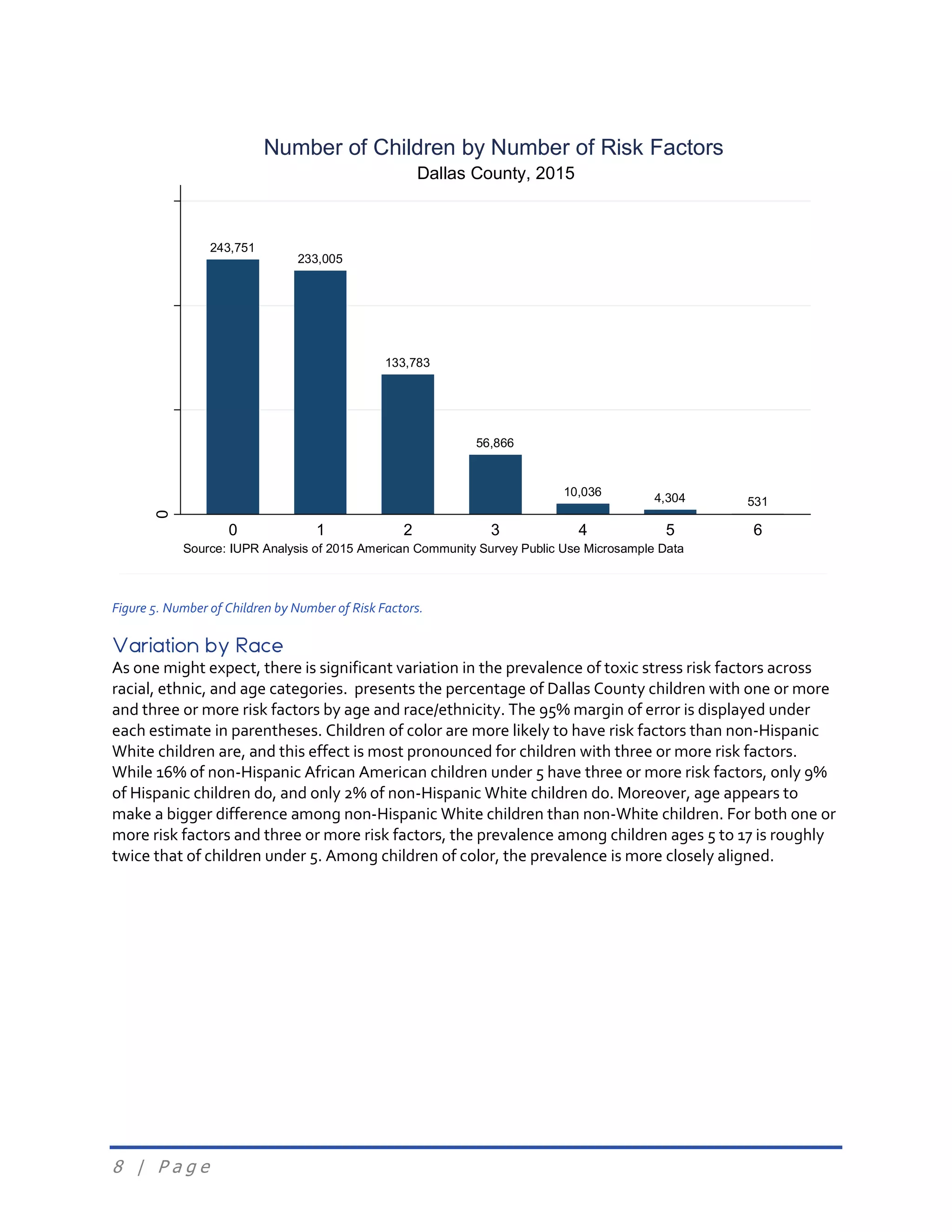
Of the 682,000 children in Dallas County, only 36% (some 244,000) had no risk factors for toxic stress,
which was also the modal category. The average child had 1.08 risk factors (±0.05). One-half of the
children (54%) had one or two risk factors. The highest number of risk factors that any child had was six.
Less than 1% of children had this high a risk. Figure 5 presents the number of children by their total
number of risk factors. As seen in the graphic, nearly as many children had one risk factor as had no risk
factors.
8 | P a g e
Figure 5. Number of Children by Number of Risk Factors.
Variation by Race
As one might expect, there is significant variation in the prevalence of toxic stress risk factors across
racial, ethnic, and age categories. presents the percentage of Dallas County children with one or more
and three or more risk factors by age and race/ethnicity. The 95% margin of error is displayed under
each estimate in parentheses. Children of color are more likely to have risk factors than non-Hispanic
White children are, and this effect is most pronounced for children with three or more risk factors.
While 16% of non-Hispanic African American children under 5 have three or more risk factors, only 9%
of Hispanic children do, and only 2% of non-Hispanic White children do. Moreover, age appears to
make a bigger difference among non-Hispanic White children than non-White children. For both one or
more risk factors and three or more risk factors, the prevalence among children ages 5 to 17 is roughly
twice that of children under 5. Among children of color, the prevalence is more closely aligned.
243,751
233,005
133,783
56,866
10,036 4,304 531
0
100,000200,000300,000
0 1 2 3 4 5 6
Source: IUPR Analysis of 2015 American Community Survey Public Use Microsample Data
Dallas County, 2015
Number of Children by Number of Risk Factors
P a g e | 9
Table 2. Percentage of Childhood Population by Number of Risk Factors, Age, and Race/Ethnicity.
At Lease 1 Risk Factor 3 or More Risk Factors
Under 5 5 to 17 Under 5 5 to 17
Non-Hispanic White 29%
(±6.7%)
50%
(±4.8%)
2%
(±1.6%)
5%
(±2.6%)
Non-Hispanic Black 65%
(±8.6%)
68%
(±4.5%)
16%
(±6.4%)
14%
(±4.0%)
Non-Hispanic Asian 39%
(±14.6%)
53%
(±10.6%)
1%
(±2.7%)
9%
(±5.7%)
Non-Hispanic Other 52%
(±14.6%)
60%
(±12.7%)
11%
(±7.8%)
13%
(±9.3%)
Hispanic 63%
(±4.2%)
75%
(±2.8%)
9%
(±3.0%)
12%
(±2.4%)
Table 3 belowpresents a more complete picture of the distribution of toxic stress risk by race and
ethnicity, while Figure 6 provides a graphic illustration. As both the table and graphic attest, housing
distress is the most prominent risk factor for all five racial and ethnic groups. For non-Hispanic White
children, however, it is tied with falling behind in school, each with 18% of children at risk. Comparing
risk among the groups reveals that, while all five groups lead with housing distress, it is far more
prominent among non-Hispanic African American children (41% of children at risk) and Hispanic
children (44% of children at risk).
For non-Hispanic African American children, the second and third leading risk factors were deep
poverty (13% of children) and falling behind in school (14% of children). The story was markedly
different for Hispanic children, however, with the second most prevalent risk factor being overcrowded
housing, with 27% of children at risk. This was followed by risk of falling behind in school (16%) and
having no health insurance (14% of Hispanic children—double that of non-Hispanic African American
children, and more than double that of non-Hispanic Whites).
1 0 | P a g e
Table 3. Number and Percentage of Children at Risk of Toxic Stress by Risk Factor, Race, and Ethnicity, Dallas County 2015 (95%
Confidence Intervals in Parentheses)
Non-Hispanic
White
Non-Hispanic
Black
Non-Hispanic
Asian
Non-Hispanic
Other
Hispanic
Housing
Distressed
22,111
18%
60,100
41%
6,605
20%
7,876
36%
159,196
44%
(±4,502)
(±3.6%)
(±7,200)
(±4.9%)
(±2,635)
(±8.0%)
(±3,200)
(±11.4%)
(±11,909)
(±3.3%)
Parental
Unemployment
4,668
4%
13,044
9%
3,358
10%
1,053
5%
14,129
4%
(±2,219)
(±1.8%)
(±4,795)
(±3.3%)
(±1,678)
(±5.1%)
(±890)
(±3.9%)
(±4,503)
(±1.3%)
Deep Poverty 4,370
4%
19,467
13%
512
2%
1,992
9%
30,172
8%
(±1,885)
(±1.5%)
(±5,541)
(±3.8%)
(±597)
(±1.8%)
(±1,389)
(±6.2%)
(±6,576)
(±1.8%)
No
Transportation
1,533
1%
16,996
12%
1,557
5%
1,225
6%
7,995
2%
(±848)
(±0.7%)
(±5,014)
(±3.5%)
(±1,196)
(±3.6%)
(±935)
(±4.2%)
(±3,108)
(±0.9%)
Single-Parent
Household
4,682
4%
14,915
10%
205
1%
1,078
5%
21,048
6%
(±2,067)
(±1.7%)
(±4,277)
(±3.0%)
(±353)
(±1.1%)
(±905)
(±4.1%)
(±5,751)
(±1.6%)
Overcrowded
Housing
11,172
9%
16,157
11%
4,166
13%
3,663
17%
96,854
27%
(±3,457)
(±2.8%)
(±4,962)
(±3.5%)
(±2,266)
(±6.6%)
(±2,274)
(±9.0%)
(±10,872)
(±3.0%)
No Insurance 7,784
6%
10,673
7%
2,469
8%
1,159
5%
50,492
14%
(±2,393)
(±1.9%)
(±3,628)
(±2.5%)
(±1,483)
(±4.4%)
(±1,028)
(±4.7%)
(±7,912)
(±2.2%)
Behind Grade
Level
22,648
18%
20,100
14%
6,262
19%
3,713
17%
58,820
16%
(±3,157)
(±2.5%)
(±4,267)
(±3.0%)
(±1,667)
(±5.1%)
(±1,576)
(±6.3%)
(±8,058)
(±2.2%)
P a g e | 1 1
Figure 6. Percentage of Children at Risk of Toxic Stress by Risk Factor, Race, and Ethnicity, Dallas County 2015
Variation by Geography
Figure 7 presents the geographic distribution of children with at least one risk factor in Dallas County.
Both northeast and south central sections of the county, including Rowlett and parts of Garland,
Sachse, Desoto, and Glenn Heights, had the lowest risk, with less than 50% of children with one or
more risk factors. Areas with the highest prevalence included northeast city of Dallas, as well as eastern
Dallas, western Mesquite, and parts of Balch Springs, with 74% to 80% of children with one or more risk
factors.
0
10203040
NH White NH Black NH Asian NH Other Hispanic
Source: IUPR Analysis of 2015 American Community Survey Public Use Microsample Data
Dallas County, 2015
Percentage of Children by Risk Factor, Race, and Ethnicity
Housing Distressed Parental Unemployment
Deep Poverty No Transportation
Single Parent Overcrowded
No Insurance Behind in School
1 2 | P a g e
Figure 7. Distribution of Percentage of Children With One or More Risk Factors by PUMA, Dallas County 2015
Figure 8. Distribution of Percentage of Children With Three or More Risk Factors by PUMA, Dallas County 2015
Figure 8 presents a map of the distribution of children with three or more of the eight risk factors.
Similar patterns hold, with northeast and south central Dallas County with the lowest risk. However,
664
5
148
276
548
356
66
78
205
741
289
2578
183
114
77
75
80
67
175
635
45
30
20
EllisEllis
DallasDallas
RockwallRockwall
KaufmanKaufman
DentonDenton
CollinCollin
I-30 E
I-635 E
I-30 W
US-80 W
I-30
AngusGWynneJrFwy
TX-183 ETX-183 W
U
S-67
S
US-67N
I-20 W
I-20 E
Pr
esident Geo rge Bush Tpke
I -35E S
I-35EN
I-45
N
I-45S
I
-3
5E
I-635N
TX-360N
TX-12-LOOPN
W N orthw est Hwy
TX-34
SBeltLin
e
R
d
EN
or thwest Hwy
NBeltLineRd
US-175E
US-175 W
SSH360
LancasterLancaster
RowlettRowlett
FarmersFarmers
BranchBranch
SachseSachse
AddisonAddison
IrvingIrving
DesotoDesoto
RichardsonRichardson
Balch SpringsBalch Springs
CoppellCoppell
SeagovilleSeagoville
GarlandGarland
ForneyForney
MesquiteMesquite
CarrolltonCarrollton
Cedar HillCedar Hill
UniversityUniversity
ParkPark
DuncanvilleDuncanville
Las ColinasLas Colinas
Grand PrairieGrand Prairie
GrapevineGrapevine
RockwallRockwall
Glenn HeightsGlenn Heights
WylieWylie
MurphyMurphy
PlanoPlano
DallasDallas
Legend
Dallas County PUMAs
At Least 1 Factor
41% - 50%
51% - 59%
60% - 68%
69% - 73%
74% - 80%
1 inch = 9.46 miles
664
5
148
276
548
356
66
78
205
741
289
2578
183
114
77
75
80
67
175
635
45
30
20
EllisEllis
DallasDallas
RockwallRockwall
KaufmanKaufman
DentonDenton
CollinCollin
I-30 E
I-635 E
I-30 W
US-80 W
I-30
AngusGWynneJrFwy
TX-183 ETX-183 W
U
S-67
S
US-67N
I-20 W
I-20 E
Pr
esident Geo rge Bush Tpke
I -35E S
I-35EN
I-45
N
I-45S
I
-3
5E
I-635N
TX-360N
TX-12-LOOPN
W N orthw est Hwy
TX-34
SBeltLin
e
R
d
EN
or thwest Hwy
NBeltLineRd
US-175E
US-175 W
SSH360
LancasterLancaster
RowlettRowlett
FarmersFarmers
BranchBranch
SachseSachse
AddisonAddison
IrvingIrving
DesotoDesoto
RichardsonRichardson
Balch SpringsBalch Springs
CoppellCoppell
SeagovilleSeagoville
GarlandGarland
ForneyForney
MesquiteMesquite
CarrolltonCarrollton
Cedar HillCedar Hill
UniversityUniversity
ParkPark
DuncanvilleDuncanville
Las ColinasLas Colinas
Grand PrairieGrand Prairie
GrapevineGrapevine
RockwallRockwall
Glenn HeightsGlenn Heights
WylieWylie
MurphyMurphy
PlanoPlano
DallasDallas
Legend
Dallas County PUMAs
At Least 3 Factors
0%
1% - 8%
9% - 11%
12% - 14%
15% - 16%
1 inch = 9.46 miles
P a g e | 1 3
this map sees northwestern Dallas County and eastern Dallas County join those with the lowest risk.
Old East Dallas remains a significant area of need, as does most of Oak Cliff. Southern Garland,
however, drops in classification, as does eastern Dallas County (Mesquite, Balch Springs, and
Sunnyvale), though less so.
Figure 9 presents the information using a different tact, presenting for each geography the median
number of risk factors for children in the area—one half of children fall above this number and one half
fall below. Again, northeast and south central Dallas County show the lowest risk rates, with the
median having no risk factors. Most of the remainder of the county shows the median of one risk factor:
one half of children have one or more risk factors, one half have one or none. Only one PUMA,
representing South Dallas and parts of Oak Cliff, indicates the highest level of need, where the median
was two risk factors. One half of children had two or more risk factors.
Figure 9. Distribution of Median Number of Risk Factors by PUMA, Dallas County 2015
Finally, Figure 10 represents the severity of need in the neighborhood by mapping the number of risk
factors at the 90th percentile: 90% of children have the indicated number of risk factors or fewer. Now,
only south central Dallas County (Desoto, Lancaster, parts of Glenn Heights) shows having the least
relative need, with 90% of children having one or fewer risk factors. Western Dallas County, northwest
city of Dallas, and northeast Dallas County (Garland, Sachse, and Rowlett) show moderate levels of
need, with 90% of children having two or fewer risk factors. The PUMA representing South Dallas and
parts of Oak Cliff continues to show the most severe need, with 90% of children having two or fewer
risk factors.
664
5
148
276
548
356
66
78
205
741
289
2578
183
114
77
75
80
67
175
635
45
30
20
EllisEllis
DallasDallas
RockwallRockwall
KaufmanKaufman
DentonDenton
CollinCollin
I-30 E
I-635 E
I-30 W
US-80 W
I-30
AngusGWynneJrFwy
TX-183 ETX-183 W
U
S-67
S
US-67N
I-20 W
I-20 E
Pr
esident Geo rge Bush Tpke
I -35E S
I-35EN
I-45
N
I-45S
I
-3
5E
I-635N
TX-360N
TX-12-LOOPN
W N orthw est Hwy
TX-34
SBeltLin
e
R
d
EN
or thwest Hwy
NBeltLineRd
US-175E
US-175 W
SSH360
LancasterLancaster
RowlettRowlett
FarmersFarmers
BranchBranch
SachseSachse
AddisonAddison
IrvingIrving
DesotoDesoto
RichardsonRichardson
Balch SpringsBalch Springs
CoppellCoppell
SeagovilleSeagoville
GarlandGarland
ForneyForney
MesquiteMesquite
CarrolltonCarrollton
Cedar HillCedar Hill
UniversityUniversity
ParkPark
DuncanvilleDuncanville
Las ColinasLas Colinas
Grand PrairieGrand Prairie
GrapevineGrapevine
RockwallRockwall
Glenn HeightsGlenn Heights
WylieWylie
MurphyMurphy
PlanoPlano
DallasDallas
Legend
Dallas County PUMAs
Mdn. Risk Factors
No Risk Factors
1 Risk Factor
2 Risk Factors
1 inch = 9.46 miles
1 4 | P a g e
Figure 10. Distribution of 90th Percentile Risk Factors by PUMA, Dallas County 2015
Summary
Our work demonstrates that, at a minimum, there is utility in turning to the PUMS data to estimate the
number of children at risk of toxic stress responses. Moreover, by using these tools to produce
estimates of risk, more careful analysis can then explore variations in estimated risk by age, gender,
race/ethnicity, and other demographic characteristics. Because of Dallas County’s population, the
county is divided into sufficiently small PUMAs, allowing the exploration of geographic variation in risk
of toxic stress.
Care should be taken to refine this method of estimation. Chief among its weaknesses is that it is an
estimate of risk rather than a prevalence of risk. Future clinical research should establish a more
definitive relationship between these, and potentially other, indicators available via the ACS. By turning
to advanced estimation techniques using publicly available data, we should be able to more precisely
target specific resources to the communities and children most in need, mitigating the near- and long-
term damage done by toxic stress.
664
5
148
276
548
356
66
78
205
741
289
2578
183
114
77
75
80
67
175
635
45
30
20
EllisEllis
DallasDallas
RockwallRockwall
KaufmanKaufman
DentonDenton
CollinCollin
I-30 E
I-635 E
I-30 W
US-80 W
I-30
AngusGWynneJrFwy
TX-183 ETX-183 W
U
S-67
S
US-67N
I-20 W
I-20 E
Pr
esident Geo rge Bush Tpke
I -35E S
I-35EN
I-45
N
I-45S
I
-3
5E
I-635N
TX-360N
TX-12-LOOPN
W N orthw est Hwy
TX-34
SBeltLin
e
R
d
EN
or thwest Hwy
NBeltLineRd
US-175E
US-175 W
SSH360
LancasterLancaster
RowlettRowlett
FarmersFarmers
BranchBranch
SachseSachse
AddisonAddison
IrvingIrving
DesotoDesoto
RichardsonRichardson
Balch SpringsBalch Springs
CoppellCoppell
SeagovilleSeagoville
GarlandGarland
ForneyForney
MesquiteMesquite
CarrolltonCarrollton
Cedar HillCedar Hill
UniversityUniversity
ParkPark
DuncanvilleDuncanville
Las ColinasLas Colinas
Grand PrairieGrand Prairie
GrapevineGrapevine
RockwallRockwall
Glenn HeightsGlenn Heights
WylieWylie
MurphyMurphy
PlanoPlano
DallasDallas
Legend
Dallas County PUMAs
90th Percentile
1 Risk Factor
2 Risk Factors
3 Risk Factors
1 inch = 9.46 miles
P a g e | 1 5
References
Blake, K. S., Kellerson, R. L., & Simic, A. (2007). Measuring overcrowding in housing. Washington, DC:
U.S. Department of Housing and Urban Development.
Kingsley, G. T., & Austin Turner, M. (2008). Federal programs for addressing low-income housing needs.
Washington, DC: The Urban Institute.
National Scientific Council on the Developing Child. (2014). Excessive stress disrupts the architecture of
the developing brain. Cambridge, MA: National Scientific Council on the Developing Child.
Nepal, B., Tanton, R., & Harding, A. (2010). Measuring housing stress: How much do definitions matter?
Urban Policy and Research, 28(2), 211–224.
Quigley, J. M., & Raphael, S. (2004). Is housing unaffordable? Why isn't it more affordable? The Journal
of Economic Perspectives, 18(1), 191–214.
Ratcliffe, C. E., & McKernan, S. (2012). Child poverty and its lasting consequence. Washington, DC: The
Urban Institute.
Shonkoff, J. P. (2010). Building a new biodevelopmental framework to guide the future of early
childhood policy. Child Development, 81(1), 357–367.
Shonkoff, J. P., Garner, A. S., Siegel, B. S., Dobbins, M. I., Earls, M. F., McGuinn, L., . . . Wood, D. L.
(2012). The lifelong effects of early childhood adversity and toxic stress. Pediatrics, 129(1), 232–
246.
800 West Campbell Road, WT20
Richardson, Texas 75080-3021
(972)883-5430 voice (972)883-5431 facsimile
Visit us on the Web! http://iupr.utdallas.edu

Risk of Toxic Stress for Children

  • 1.
    Risk of ToxicStress for Children Using Census Data to Target Services The Institute for Urban Policy Research At The University of Texas at Dallas Timothy M. Bray, PhD
  • 3.
    P a ge | 3 Risk of Toxic Stress for Children Using Census Data to Target Services Stress, and the body’s response to it, play an important part in shaping the current and future well- being of children. When the body’s response is conditioned by constant stressors, such as living in extreme poverty, lacking caring adults in life, and other correlates of poverty and socioeconomic disadvantage, the body’s response to stress becomes toxic, and it can have a profound impact on child development. In this paper, we use publicly available data from the American Community Survey’s (ACS) Public Use Micro Sample (PUMS) dataset to estimate the number and percentage of children at risk for experiencing toxic stress. Figure 1 depicts the eight risk factors that we selected. We further explore the racial and ethnic distribution of toxic stress and the geographic distribution in Dallas County, Texas. We find that 438,000 Dallas County children (64%) have at least one of eight risk factors for toxic stress. Prevalence of toxic stress for children of color tends to be nearly double that for non- Hispanic White children. Figure 1. Overview of Census Demographics Tapped as Risk Factors for Toxic Stress Housing Distress Over-crowding Deep Poverty Parental Unemployment Lack of Transportation Lack of Health Insurance Single-Parent Households Falling Behind in School
  • 4.
    4 | Pa g e What Is Toxic Stress? The concept of toxic stress emerged in 2005, when the National Scientific Council on the Developing Child (2014) published a report describing the effects of stress on brain development in children. Dr. Jack Shonkoff (2010), a physician and member of the Council, later reported that the Council was attempting to build a taxonomy to communicate the effects of prolonged exposure to stress to policy makers and the medical community. The term toxic stress is primarily used to set it apart from other, more common types of childhood stress. Figure 2. Shonkoff's (2010) Definitions for a Taxonomy of Childhood Stress Responses Shonkoff (2010) provides a simple set of definitions for the three types of stressors identified by the Council, illustrated in Figure 2. As seen from the taxonomy proposed, toxic stress is not just about the stressor but also the availability of caring, responsive adults to help the child cope with the stress. Toxic stress, then, refers to the deleterious effects of prolonged exposure to serious stressors without recourse to a caring, responsive adult. Why Toxic Stress Matters At its core, the toxic stress responses are most detrimental to children, whose brains are developing at a rapid pace. Shonkoff et al. (2012) reported that “the essential characteristic of this phenomenon is the postulated disruption of brain circuitry and other organ and metabolic systems during sensitive developmental periods” (p. 236). They further suggested that toxic stress responses from adverse childhood experiences may account, to some degree, for the racial and ethnic disparities in health observed later in life. Shonkoff et al. framed the effects of exposure to toxic stress in two mediating •A stress response to normative developmental events •"Characterized by moderate, short-lived increases in heart rate, blood pressure . . . stress hormones . . . an important aspect of healthy development is experienced in the context of stable and supportive relationships that facilitate adaptive responses that restore the stress response system to baseline." •Example Precipitates: playground injury, shots at the doctor's office Positive Stress •A stress response to non-normative developmental events •"A physiological state that could potentially disrupt brain architecture but is buffered by supportive relationships that facilitate adaptive coping." •Example Precipitates: A serious injury, death of a loved one, natural disaster Tolerable Stress •"Strong, frequent, or prolonged activation of the body's stress response systems in the absense of the buffering protection of stable adult support." •Example Precipitates: Extreme poverty, family violence, abuse, and neglect Toxic Stress
  • 5.
    P a ge | 5 forces: (a) altered architecture of the brain during key developmental phases and (b) prolonged exposure to stress hormones that accompany toxic stress. A summary of the short- and long-term consequences outlined by Shonkoff et al. is provided in Figure 3. Figure 3. A Summary of Effects of Toxic Stress Reported by Shonkoff et al., 2012 Methodology The US Census Bureau conducts the ACS monthly; results are tabulated annually and every 5 years, producing what are known as the 1-Year and 5-Year estimates. From the individual survey responses, the Census Bureau pulls a representative subset and publishes them as the PUMS dataset. Each survey response is geographically coded according to the Public Use Micro Sample Area (PUMA) in which the respondent lived. PUMAs are drawn to be sufficiently large so as to ensure the anonymity of census respondents. Areas of larger population are more precisely subdivided than areas with fewer people. In North Texas, for instance, Dallas County is subdivided into more than 20 PUMAs, while Rockwall and Hunt counties are combined into a single PUMA. Here, we estimate the risk for toxic stress by aggregating the PUMAs that compose Dallas County. Short-Term Effects • Functional differences in learning, memory, and aspects of executive functioning during stress responses. • More anxiety during stress responses, with less top-down control of the stress response and impaired memory and mood control. Long-Term Effects • A chronically activated stress response, with increased potential for fear and anxiety. • Impairments in memory and mood- related functions. • Decreased ability for the hippocampus to promote contextual learning and disrupted memory encoding systems. • Stunted development in executive functions, such as decision-making, working memory, behavioral self- regulation, and mood and impulse control.
  • 6.
    6 | Pa g e A number of questions the ACS asks may indicate risk for toxic stress responses. Figure 4 presents a brief outline of the eight risk factors that we have selected, and their nominal definitions. Following Figure 4, we provide a more technical definition for each risk factor. Figure 4. ACS-Based Toxic Stress Risk Factor Definitions We defined children as those whose age, at the time of data collection, was under 18. We coded each child record with a 1 or 0 for each risk factor they possessed. Specifically, we defined the risk factors as follows.  Children were defined at risk if their household’s housing costs exceeded 30% of the household income and household income was below 200% of the federal poverty threshold: POVPIP < 200 AND [GRPIP ≥ 0.30 OR OCPIP ≥ 0.30] (see Kingsley & Austin Turner, 2008; Nepal, Tanton, & Harding, 2010; Quigley & Raphael, 2004).  Parental unemployment was defined as living in a family with one or both spouses unemployed and looking for work (WORKSTAT = 2, 4, 6, 8, 11, or 14).  Children were defined at risk by living in deep poverty: a household income below 50% of the poverty line, or POVPIP < 50 (see Ratcliffe & McKernan, 2012).  No access to transportation was defined as living in a house with no access to an automobile (VEH = 0).  Single-parent households were defined as living with one parent with no spouse, unmarried partner, or grandparent present (FES ≥ 5 AND PARTNER = 0 AND MULTGEN = 0).  Risk due to overcrowding was defined as more than two people per bedroom and household income below 200% of the federal poverty threshold: POVPIP < 200 AND NP/BDSP > 2 (Blake, Kellerson, & Simic, 2007). Housing Distress • Living in a household where 30% or more of income is spent on housing. Parental Unemployment • Living in a household where one or both parents are unemployed and looking for work. Deep Poverty • Living in a household below 50% of the poverty line. NoTransportation • Living in a house with no access to an automobile. Single-Parent Household • Living in a household with one parent and no other adult caregiver. Overcrowded • Living in a household with more than two occupants per bedroom. No Insurance • Not being covered by a health insurance policy. Behind in School • Being one or more grade levels behind in school.
  • 7.
    P a ge | 7  Lack of health insurance was defined as indicating no health insurance coverage (HINS1 = 0 AND HINS2 = 0 AND HINS3 = 0 AND HINS4 = 0 AND HINS5 = 0 AND HINS6 = 0 AND HINS7 = 0).  Risk from falling behind in school was defined as repeating a grade one or more times (SCHG ≥ 3 AND SCHG ≤ 14 AND SCHG < SCHL). We computed confidence intervals for counts and proportions using the Census-provided replicate weights. This successive difference replication methodology allowed us to provide population-level estimates from the PUMS data, which is essentially a sample from a sample, while also providing confidence intervals and margins of error that respect this sampling design. Findings Table 1 presents the number of children estimated to be at risk for experiencing toxic stress in Dallas County by risk factor. Three factors each affect more than 100,000 children: housing distress, overcrowding, and behind grade level. The number of children with at least one risk factor is 438,525, or more than 2 in 3 Dallas County children. Table 1. Number of Children by Risk Factor Risk Factor Number at Risk 95% Confidence Interval Housing Distressed 255,888 38% (±15,519) (±2.3%) Parental Unemployment 36,252 5% (±7,382) (±1.1%) Deep Poverty 56,513 8% (±8,750) (±1.3%) No Transportation 29,306 4% (±5,817) (±0.9%) Single-Parent Household 41,928 6% (±7,117) (±1.0%) Overcrowded Housing 132,012 19% (±12,467) (±1.8%) No Insurance 72,577 11% (±9,236) (±1.4%) Behind Grade Level 111,543 16% (±10,196) (±1.5%) One or More Risk Factors 438,525 64% (±13,236) (±1.9%) Of the 682,000 children in Dallas County, only 36% (some 244,000) had no risk factors for toxic stress, which was also the modal category. The average child had 1.08 risk factors (±0.05). One-half of the children (54%) had one or two risk factors. The highest number of risk factors that any child had was six. Less than 1% of children had this high a risk. Figure 5 presents the number of children by their total number of risk factors. As seen in the graphic, nearly as many children had one risk factor as had no risk factors.
  • 8.
    8 | Pa g e Figure 5. Number of Children by Number of Risk Factors. Variation by Race As one might expect, there is significant variation in the prevalence of toxic stress risk factors across racial, ethnic, and age categories. presents the percentage of Dallas County children with one or more and three or more risk factors by age and race/ethnicity. The 95% margin of error is displayed under each estimate in parentheses. Children of color are more likely to have risk factors than non-Hispanic White children are, and this effect is most pronounced for children with three or more risk factors. While 16% of non-Hispanic African American children under 5 have three or more risk factors, only 9% of Hispanic children do, and only 2% of non-Hispanic White children do. Moreover, age appears to make a bigger difference among non-Hispanic White children than non-White children. For both one or more risk factors and three or more risk factors, the prevalence among children ages 5 to 17 is roughly twice that of children under 5. Among children of color, the prevalence is more closely aligned. 243,751 233,005 133,783 56,866 10,036 4,304 531 0 100,000200,000300,000 0 1 2 3 4 5 6 Source: IUPR Analysis of 2015 American Community Survey Public Use Microsample Data Dallas County, 2015 Number of Children by Number of Risk Factors
  • 9.
    P a ge | 9 Table 2. Percentage of Childhood Population by Number of Risk Factors, Age, and Race/Ethnicity. At Lease 1 Risk Factor 3 or More Risk Factors Under 5 5 to 17 Under 5 5 to 17 Non-Hispanic White 29% (±6.7%) 50% (±4.8%) 2% (±1.6%) 5% (±2.6%) Non-Hispanic Black 65% (±8.6%) 68% (±4.5%) 16% (±6.4%) 14% (±4.0%) Non-Hispanic Asian 39% (±14.6%) 53% (±10.6%) 1% (±2.7%) 9% (±5.7%) Non-Hispanic Other 52% (±14.6%) 60% (±12.7%) 11% (±7.8%) 13% (±9.3%) Hispanic 63% (±4.2%) 75% (±2.8%) 9% (±3.0%) 12% (±2.4%) Table 3 belowpresents a more complete picture of the distribution of toxic stress risk by race and ethnicity, while Figure 6 provides a graphic illustration. As both the table and graphic attest, housing distress is the most prominent risk factor for all five racial and ethnic groups. For non-Hispanic White children, however, it is tied with falling behind in school, each with 18% of children at risk. Comparing risk among the groups reveals that, while all five groups lead with housing distress, it is far more prominent among non-Hispanic African American children (41% of children at risk) and Hispanic children (44% of children at risk). For non-Hispanic African American children, the second and third leading risk factors were deep poverty (13% of children) and falling behind in school (14% of children). The story was markedly different for Hispanic children, however, with the second most prevalent risk factor being overcrowded housing, with 27% of children at risk. This was followed by risk of falling behind in school (16%) and having no health insurance (14% of Hispanic children—double that of non-Hispanic African American children, and more than double that of non-Hispanic Whites).
  • 10.
    1 0 |P a g e Table 3. Number and Percentage of Children at Risk of Toxic Stress by Risk Factor, Race, and Ethnicity, Dallas County 2015 (95% Confidence Intervals in Parentheses) Non-Hispanic White Non-Hispanic Black Non-Hispanic Asian Non-Hispanic Other Hispanic Housing Distressed 22,111 18% 60,100 41% 6,605 20% 7,876 36% 159,196 44% (±4,502) (±3.6%) (±7,200) (±4.9%) (±2,635) (±8.0%) (±3,200) (±11.4%) (±11,909) (±3.3%) Parental Unemployment 4,668 4% 13,044 9% 3,358 10% 1,053 5% 14,129 4% (±2,219) (±1.8%) (±4,795) (±3.3%) (±1,678) (±5.1%) (±890) (±3.9%) (±4,503) (±1.3%) Deep Poverty 4,370 4% 19,467 13% 512 2% 1,992 9% 30,172 8% (±1,885) (±1.5%) (±5,541) (±3.8%) (±597) (±1.8%) (±1,389) (±6.2%) (±6,576) (±1.8%) No Transportation 1,533 1% 16,996 12% 1,557 5% 1,225 6% 7,995 2% (±848) (±0.7%) (±5,014) (±3.5%) (±1,196) (±3.6%) (±935) (±4.2%) (±3,108) (±0.9%) Single-Parent Household 4,682 4% 14,915 10% 205 1% 1,078 5% 21,048 6% (±2,067) (±1.7%) (±4,277) (±3.0%) (±353) (±1.1%) (±905) (±4.1%) (±5,751) (±1.6%) Overcrowded Housing 11,172 9% 16,157 11% 4,166 13% 3,663 17% 96,854 27% (±3,457) (±2.8%) (±4,962) (±3.5%) (±2,266) (±6.6%) (±2,274) (±9.0%) (±10,872) (±3.0%) No Insurance 7,784 6% 10,673 7% 2,469 8% 1,159 5% 50,492 14% (±2,393) (±1.9%) (±3,628) (±2.5%) (±1,483) (±4.4%) (±1,028) (±4.7%) (±7,912) (±2.2%) Behind Grade Level 22,648 18% 20,100 14% 6,262 19% 3,713 17% 58,820 16% (±3,157) (±2.5%) (±4,267) (±3.0%) (±1,667) (±5.1%) (±1,576) (±6.3%) (±8,058) (±2.2%)
  • 11.
    P a ge | 1 1 Figure 6. Percentage of Children at Risk of Toxic Stress by Risk Factor, Race, and Ethnicity, Dallas County 2015 Variation by Geography Figure 7 presents the geographic distribution of children with at least one risk factor in Dallas County. Both northeast and south central sections of the county, including Rowlett and parts of Garland, Sachse, Desoto, and Glenn Heights, had the lowest risk, with less than 50% of children with one or more risk factors. Areas with the highest prevalence included northeast city of Dallas, as well as eastern Dallas, western Mesquite, and parts of Balch Springs, with 74% to 80% of children with one or more risk factors. 0 10203040 NH White NH Black NH Asian NH Other Hispanic Source: IUPR Analysis of 2015 American Community Survey Public Use Microsample Data Dallas County, 2015 Percentage of Children by Risk Factor, Race, and Ethnicity Housing Distressed Parental Unemployment Deep Poverty No Transportation Single Parent Overcrowded No Insurance Behind in School
  • 12.
    1 2 |P a g e Figure 7. Distribution of Percentage of Children With One or More Risk Factors by PUMA, Dallas County 2015 Figure 8. Distribution of Percentage of Children With Three or More Risk Factors by PUMA, Dallas County 2015 Figure 8 presents a map of the distribution of children with three or more of the eight risk factors. Similar patterns hold, with northeast and south central Dallas County with the lowest risk. However, 664 5 148 276 548 356 66 78 205 741 289 2578 183 114 77 75 80 67 175 635 45 30 20 EllisEllis DallasDallas RockwallRockwall KaufmanKaufman DentonDenton CollinCollin I-30 E I-635 E I-30 W US-80 W I-30 AngusGWynneJrFwy TX-183 ETX-183 W U S-67 S US-67N I-20 W I-20 E Pr esident Geo rge Bush Tpke I -35E S I-35EN I-45 N I-45S I -3 5E I-635N TX-360N TX-12-LOOPN W N orthw est Hwy TX-34 SBeltLin e R d EN or thwest Hwy NBeltLineRd US-175E US-175 W SSH360 LancasterLancaster RowlettRowlett FarmersFarmers BranchBranch SachseSachse AddisonAddison IrvingIrving DesotoDesoto RichardsonRichardson Balch SpringsBalch Springs CoppellCoppell SeagovilleSeagoville GarlandGarland ForneyForney MesquiteMesquite CarrolltonCarrollton Cedar HillCedar Hill UniversityUniversity ParkPark DuncanvilleDuncanville Las ColinasLas Colinas Grand PrairieGrand Prairie GrapevineGrapevine RockwallRockwall Glenn HeightsGlenn Heights WylieWylie MurphyMurphy PlanoPlano DallasDallas Legend Dallas County PUMAs At Least 1 Factor 41% - 50% 51% - 59% 60% - 68% 69% - 73% 74% - 80% 1 inch = 9.46 miles 664 5 148 276 548 356 66 78 205 741 289 2578 183 114 77 75 80 67 175 635 45 30 20 EllisEllis DallasDallas RockwallRockwall KaufmanKaufman DentonDenton CollinCollin I-30 E I-635 E I-30 W US-80 W I-30 AngusGWynneJrFwy TX-183 ETX-183 W U S-67 S US-67N I-20 W I-20 E Pr esident Geo rge Bush Tpke I -35E S I-35EN I-45 N I-45S I -3 5E I-635N TX-360N TX-12-LOOPN W N orthw est Hwy TX-34 SBeltLin e R d EN or thwest Hwy NBeltLineRd US-175E US-175 W SSH360 LancasterLancaster RowlettRowlett FarmersFarmers BranchBranch SachseSachse AddisonAddison IrvingIrving DesotoDesoto RichardsonRichardson Balch SpringsBalch Springs CoppellCoppell SeagovilleSeagoville GarlandGarland ForneyForney MesquiteMesquite CarrolltonCarrollton Cedar HillCedar Hill UniversityUniversity ParkPark DuncanvilleDuncanville Las ColinasLas Colinas Grand PrairieGrand Prairie GrapevineGrapevine RockwallRockwall Glenn HeightsGlenn Heights WylieWylie MurphyMurphy PlanoPlano DallasDallas Legend Dallas County PUMAs At Least 3 Factors 0% 1% - 8% 9% - 11% 12% - 14% 15% - 16% 1 inch = 9.46 miles
  • 13.
    P a ge | 1 3 this map sees northwestern Dallas County and eastern Dallas County join those with the lowest risk. Old East Dallas remains a significant area of need, as does most of Oak Cliff. Southern Garland, however, drops in classification, as does eastern Dallas County (Mesquite, Balch Springs, and Sunnyvale), though less so. Figure 9 presents the information using a different tact, presenting for each geography the median number of risk factors for children in the area—one half of children fall above this number and one half fall below. Again, northeast and south central Dallas County show the lowest risk rates, with the median having no risk factors. Most of the remainder of the county shows the median of one risk factor: one half of children have one or more risk factors, one half have one or none. Only one PUMA, representing South Dallas and parts of Oak Cliff, indicates the highest level of need, where the median was two risk factors. One half of children had two or more risk factors. Figure 9. Distribution of Median Number of Risk Factors by PUMA, Dallas County 2015 Finally, Figure 10 represents the severity of need in the neighborhood by mapping the number of risk factors at the 90th percentile: 90% of children have the indicated number of risk factors or fewer. Now, only south central Dallas County (Desoto, Lancaster, parts of Glenn Heights) shows having the least relative need, with 90% of children having one or fewer risk factors. Western Dallas County, northwest city of Dallas, and northeast Dallas County (Garland, Sachse, and Rowlett) show moderate levels of need, with 90% of children having two or fewer risk factors. The PUMA representing South Dallas and parts of Oak Cliff continues to show the most severe need, with 90% of children having two or fewer risk factors. 664 5 148 276 548 356 66 78 205 741 289 2578 183 114 77 75 80 67 175 635 45 30 20 EllisEllis DallasDallas RockwallRockwall KaufmanKaufman DentonDenton CollinCollin I-30 E I-635 E I-30 W US-80 W I-30 AngusGWynneJrFwy TX-183 ETX-183 W U S-67 S US-67N I-20 W I-20 E Pr esident Geo rge Bush Tpke I -35E S I-35EN I-45 N I-45S I -3 5E I-635N TX-360N TX-12-LOOPN W N orthw est Hwy TX-34 SBeltLin e R d EN or thwest Hwy NBeltLineRd US-175E US-175 W SSH360 LancasterLancaster RowlettRowlett FarmersFarmers BranchBranch SachseSachse AddisonAddison IrvingIrving DesotoDesoto RichardsonRichardson Balch SpringsBalch Springs CoppellCoppell SeagovilleSeagoville GarlandGarland ForneyForney MesquiteMesquite CarrolltonCarrollton Cedar HillCedar Hill UniversityUniversity ParkPark DuncanvilleDuncanville Las ColinasLas Colinas Grand PrairieGrand Prairie GrapevineGrapevine RockwallRockwall Glenn HeightsGlenn Heights WylieWylie MurphyMurphy PlanoPlano DallasDallas Legend Dallas County PUMAs Mdn. Risk Factors No Risk Factors 1 Risk Factor 2 Risk Factors 1 inch = 9.46 miles
  • 14.
    1 4 |P a g e Figure 10. Distribution of 90th Percentile Risk Factors by PUMA, Dallas County 2015 Summary Our work demonstrates that, at a minimum, there is utility in turning to the PUMS data to estimate the number of children at risk of toxic stress responses. Moreover, by using these tools to produce estimates of risk, more careful analysis can then explore variations in estimated risk by age, gender, race/ethnicity, and other demographic characteristics. Because of Dallas County’s population, the county is divided into sufficiently small PUMAs, allowing the exploration of geographic variation in risk of toxic stress. Care should be taken to refine this method of estimation. Chief among its weaknesses is that it is an estimate of risk rather than a prevalence of risk. Future clinical research should establish a more definitive relationship between these, and potentially other, indicators available via the ACS. By turning to advanced estimation techniques using publicly available data, we should be able to more precisely target specific resources to the communities and children most in need, mitigating the near- and long- term damage done by toxic stress. 664 5 148 276 548 356 66 78 205 741 289 2578 183 114 77 75 80 67 175 635 45 30 20 EllisEllis DallasDallas RockwallRockwall KaufmanKaufman DentonDenton CollinCollin I-30 E I-635 E I-30 W US-80 W I-30 AngusGWynneJrFwy TX-183 ETX-183 W U S-67 S US-67N I-20 W I-20 E Pr esident Geo rge Bush Tpke I -35E S I-35EN I-45 N I-45S I -3 5E I-635N TX-360N TX-12-LOOPN W N orthw est Hwy TX-34 SBeltLin e R d EN or thwest Hwy NBeltLineRd US-175E US-175 W SSH360 LancasterLancaster RowlettRowlett FarmersFarmers BranchBranch SachseSachse AddisonAddison IrvingIrving DesotoDesoto RichardsonRichardson Balch SpringsBalch Springs CoppellCoppell SeagovilleSeagoville GarlandGarland ForneyForney MesquiteMesquite CarrolltonCarrollton Cedar HillCedar Hill UniversityUniversity ParkPark DuncanvilleDuncanville Las ColinasLas Colinas Grand PrairieGrand Prairie GrapevineGrapevine RockwallRockwall Glenn HeightsGlenn Heights WylieWylie MurphyMurphy PlanoPlano DallasDallas Legend Dallas County PUMAs 90th Percentile 1 Risk Factor 2 Risk Factors 3 Risk Factors 1 inch = 9.46 miles
  • 15.
    P a ge | 1 5 References Blake, K. S., Kellerson, R. L., & Simic, A. (2007). Measuring overcrowding in housing. Washington, DC: U.S. Department of Housing and Urban Development. Kingsley, G. T., & Austin Turner, M. (2008). Federal programs for addressing low-income housing needs. Washington, DC: The Urban Institute. National Scientific Council on the Developing Child. (2014). Excessive stress disrupts the architecture of the developing brain. Cambridge, MA: National Scientific Council on the Developing Child. Nepal, B., Tanton, R., & Harding, A. (2010). Measuring housing stress: How much do definitions matter? Urban Policy and Research, 28(2), 211–224. Quigley, J. M., & Raphael, S. (2004). Is housing unaffordable? Why isn't it more affordable? The Journal of Economic Perspectives, 18(1), 191–214. Ratcliffe, C. E., & McKernan, S. (2012). Child poverty and its lasting consequence. Washington, DC: The Urban Institute. Shonkoff, J. P. (2010). Building a new biodevelopmental framework to guide the future of early childhood policy. Child Development, 81(1), 357–367. Shonkoff, J. P., Garner, A. S., Siegel, B. S., Dobbins, M. I., Earls, M. F., McGuinn, L., . . . Wood, D. L. (2012). The lifelong effects of early childhood adversity and toxic stress. Pediatrics, 129(1), 232– 246.
  • 16.
    800 West CampbellRoad, WT20 Richardson, Texas 75080-3021 (972)883-5430 voice (972)883-5431 facsimile Visit us on the Web! http://iupr.utdallas.edu