Tanzania Social Action Fund (TASAF)
Tanzania’s Productive Social Safety Net
programme
Presented to the Transfer Project workshop
Arusha, April 3rd 2019
S. Masala, T. Mwaruka and P. Kijazi
TASAF Management Unit
Presentation outline
1. PSSN intervention and graduation logic and
impact on households, adolescents and
women
– Discussion
2. PSSN Livelihoods Enhancement component
and the Adolescent Cash Plus model
– Discussion
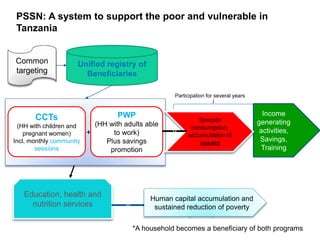
+
CCTs
(HH with children and
pregnant women)
Incl. monthly community
sessions
PWP
(HH with adults able
to work)
Plus savings
promotion
PSSN: A system to support the poor and vulnerable in
Tanzania
Income
generating
activities,
Savings,
Training
Education, health and
nutrition services
Human capital accumulation and
sustained reduction of poverty
v
Smooth
consumption,
accumulation of
assets
v
Participation for several years
*A household becomes a beneficiary of both programs
Unified registry of
Beneficiaries
Common
targeting
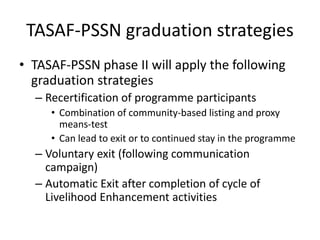
TASAF-PSSN graduation strategies
• TASAF-PSSN phase II will apply the following
graduation strategies
– Recertification of programme participants
• Combination of community-based listing and proxy
means-test
• Can lead to exit or to continued stay in the programme
– Voluntary exit (following communication
campaign)
– Automatic Exit after completion of cycle of
Livelihood Enhancement activities
MAIN IMPACT FINDINGS
4/10/2019 9
ThePSSNfurther reduced theshareof
householdsliving under theabsolute poverty line
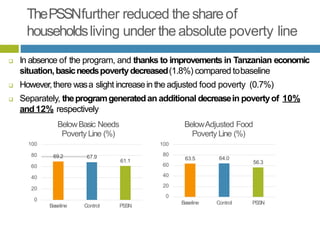
 In absence of the program, and thanks to improvements in Tanzanian economic
situation,basicneedspovertydecreased(1.8%) compared tobaseline
 However,there wasa slight increasein the adjusted food poverty (0.7%)
 Separately, theprogramgeneratedan additional decreasein povertyof 10%
and12% respectively
69.2 67.9
61.1
0
20
40
60
80
100
Baseline Control PSSN
BelowBasic Needs
Poverty Line (%)
63.5 64.0
56.3
100
80
60
40
20
0
Baseline Control PSSN
BelowAdjusted Food
Poverty Line (%)
Fooddiversity increased, related to better
performance of children & adults at school/work
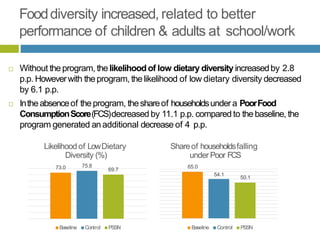
 Without the program, the likelihoodof low dietary diversity increasedby 2.8
p.p. Howeverwith theprogram, the likelihood of low dietary diversity decreased
by 6.1 p.p.
 Intheabsenceof theprogram, theshareof householdsundera PoorFood
ConsumptionScore(FCS)decreased by 11.1 p.p. compared to the baseline, the
program generated anadditional decrease of 4 p.p.
54.1
50.1
Shareof householdsfalling
under Poor FCS
65.0
Baseline Control PSSN
73.0 75.8
69.7
Likelihood of LowDietary
Diversity (%)
Baseline Control PSSN
Theprogram intensified farming activities, and
increased investmentin productive assets
61.0
78.7
100
90
80 72.2
70
60
50
40
30
20
10
0
Baseline Control PSSN
35.9
42.1
60.7
100
90
80
70
60
50
40
30
20
10
0
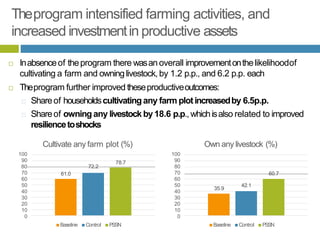
 Inabsenceof theprogram there wasan overall improvementonthelikelihoodof
cultivating a farm and owninglivestock,by 1.2 p.p., and 6.2 p.p. each
 Theprogram further improved theseproductiveoutcomes:
Shareof householdscultivatingany farm plotincreasedby 6.5p.p.
Shareof owningany livestock by18.6 p.p.,whichisalso related to improved
resiliencetoshocks
Cultivate any farm plot (%) Own any livestock (%)
Baseline Control PSSN
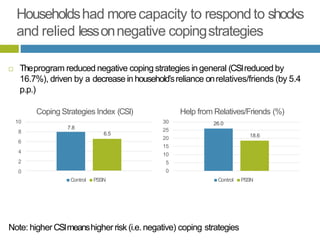
Householdshad morecapacity to respond to shocks
and relied lessonnegative copingstrategies
 Theprogram reduced negative coping strategies in general (CSIreduced by
16.7%), driven by a decrease in household’sreliance onrelatives/friends (by 5.4
p.p.)
Note: higher CSImeanshigher risk (i.e. negative) coping strategies
7.8
6.5
10
8
6
4
2
0
Coping Strategies Index (CSI)
Control PSSN
18.6
30
25
20
15
10
5
0
Help from Relatives/Friends (%)
26.0
Control PSSN
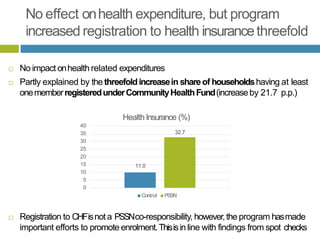
No effect onhealth expenditure, but program
increased registration to health insurancethreefold
 Registration to CHFisnota PSSNco-responsibility, however,the program hasmade
important efforts to promote enrolment.Thisisin line with findings from spot checks
11.0
32.7
40
35
30
25
20
15
10
5
0
 No impact onhealth related expenditures
 Partly explained by the threefoldincreasein shareof householdshaving at least
onememberregisteredunderCommunityHealthFund(increaseby 21.7 p.p.)
Health Insurance (%)
Control PSSN
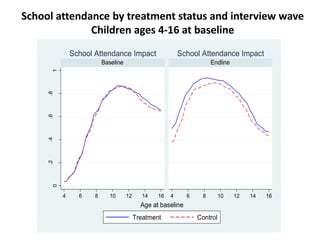
School attendance by treatment status and interview wave
Children ages 4-16 at baseline
0
.2.4.6.8
1
4 6 8 10 12 14 16 4 6 8 10 12 14 16
Baseline Endline
School Attendance Impact School Attendance Impact
Treatment Control
Age at baseline
Education
[Qualitative findings]
“My young brothers were having problems to attend
school because they had no uniforms and exercise books,
but now they attend school without any problems.”
[19-year old male, Mbogwe]
“I have seen big improvements in my life and family as a
whole. I have school uniforms, food and exercise books. I
see myself as having someone to hold my hand and assist
me, and for now I am hoping to study up to form six if
TASAF will continue to release funds. As a family we own
chicken and goats and we are planning to have more as
assets. I am working hard in my class and I am sure I will
perform well in my exams”.
[17-year old male, Itilima]
LIVELIHOODS ENHANCEMENT
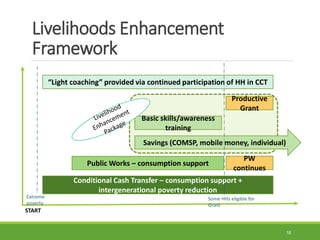
Livelihoods Enhancement
Framework
18
Conditional Cash Transfer – consumption support +
intergenerational poverty reduction
Public Works – consumption support
Basic skills/awareness
training
Productive
Grant
“Light coaching” provided via continued participation of HH in CCT
Savings (COMSP, mobile money, individual)
START
Extreme
poverty
PW
continues
Some HHs eligible for
Grant
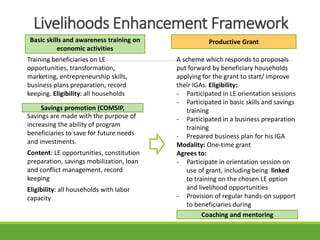
Livelihoods Enhancement Framework
Productive GrantBasic skills and awareness training on
economic activities
Savings promotion (COMSIP,
A scheme which responds to proposals
put forward by beneficiary households
applying for the grant to start/ improve
their IGAs. Eligibility:
- Participated in LE orientation sessions
- Participated in basic skills and savings
training
- Participated in a business preparation
training
- Prepared business plan for his IGA
Modality: One-time grant
Agrees to:
- Participate in orientation session on
use of grant, including being linked
to training on the chosen LE option
and livelihood opportunities
- Provision of regular hands-on support
to beneficiaries during
implementation
Training beneficiaries on LE
opportunities, transformation,
marketing, entrepreneurship skills,
business plans preparation, record
keeping. Eligibility: all households
Savings are made with the purpose of
increasing the ability of program
beneficiaries to save for future needs
and investments.
Content: LE opportunities, constitution
preparation, savings mobilization, loan
and conflict management, record
keeping
Eligibility: all households with labor
capacity
Coaching and mentoring
Livelihood Enhancement:
Implementation status
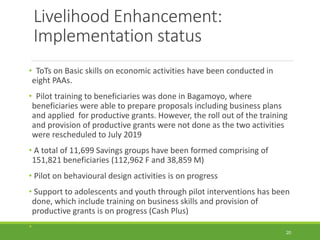
• ToTs on Basic skills on economic activities have been conducted in
eight PAAs.
• Pilot training to beneficiaries was done in Bagamoyo, where
beneficiaries were able to prepare proposals including business plans
and applied for productive grants. However, the roll out of the training
and provision of productive grants were not done as the two activities
were rescheduled to July 2019
• A total of 11,699 Savings groups have been formed comprising of
151,821 beneficiaries (112,962 F and 38,859 M)
• Pilot on behavioural design activities is on progress
• Support to adolescents and youth through pilot interventions has been
done, which include training on business skills and provision of
productive grants is on progress (Cash Plus)
•
20
LIVELIHOODS ENHANCEMENT –
CASH PLUS
• Adolescents: a key population to break the intergenerational cycle of poverty
• PSSN has a positive impact on safe transitions to adulthood
• The youth well-being impact evaluation highlighted positive changes for
young people in PSSN families in fields of education, basic needs, and
social support
• Yet, cash is important but not sufficient to address all barriers to safe and
productive transitions to adulthood
• Addressing early marriage and pregnancy, improving health, and
providing livelihood opportunities requires more
• Powerful synergies can be created when linking adolescents in PSSN
households to other services and interventions
• Hence, TASAF and partners developed the Cash Plus model and agreed to
have it accompanied by a rigorous impact evaluation
Cash Plus rationale
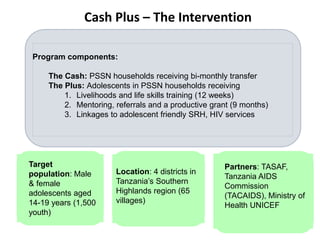
Target
population: Male
& female
adolescents aged
14-19 years (1,500
youth)
Location: 4 districts in
Tanzania’s Southern
Highlands region (65
villages)
Partners: TASAF,
Tanzania AIDS
Commission
(TACAIDS), Ministry of
Health UNICEF
Program components:
The Cash: PSSN households receiving bi-monthly transfer
The Plus: Adolescents in PSSN households receiving
1. Livelihoods and life skills training (12 weeks)
2. Mentoring, referrals and a productive grant (9 months)
3. Linkages to adolescent friendly SRH, HIV services
Cash Plus – The Intervention
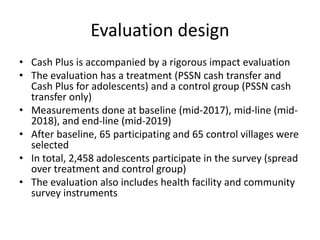
Evaluation design
• Cash Plus is accompanied by a rigorous impact evaluation
• The evaluation has a treatment (PSSN cash transfer and
Cash Plus for adolescents) and a control group (PSSN cash
transfer only)
• Measurements done at baseline (mid-2017), mid-line (mid-
2018), and end-line (mid-2019)
• After baseline, 65 participating and 65 control villages were
selected
• In total, 2,458 adolescents participate in the survey (spread
over treatment and control group)
• The evaluation also includes health facility and community
survey instruments
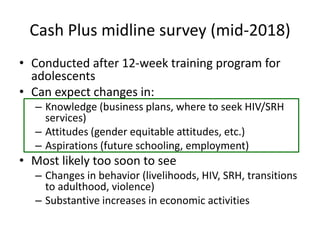
Cash Plus midline survey (mid-2018)
• Conducted after 12-week training program for
adolescents
• Can expect changes in:
– Knowledge (business plans, where to seek HIV/SRH
services)
– Attitudes (gender equitable attitudes, etc.)
– Aspirations (future schooling, employment)
• Most likely too soon to see
– Changes in behavior (livelihoods, HIV, SRH, transitions
to adulthood, violence)
– Substantive increases in economic activities
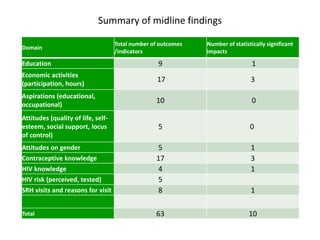
Summary of midline findings
Domain
Total number of outcomes
/indicators
Number of statistically significant
impacts
Education 9 1
Economic activities
(participation, hours)
17 3
Aspirations (educational,
occupational)
10 0
Attitudes (quality of life, self-
esteem, social support, locus
of control)
5 0
Attitudes on gender 5 1
Contraceptive knowledge 17 3
HIV knowledge 4 1
HIV risk (perceived, tested) 5
SRH visits and reasons for visit 8 1
Total 63 10
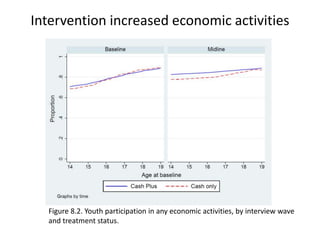
Intervention increased economic activities
Figure 8.2. Youth participation in any economic activities, by interview wave
and treatment status.
Economic activities
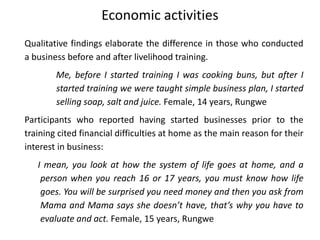
Qualitative findings elaborate the difference in those who conducted
a business before and after livelihood training.
Me, before I started training I was cooking buns, but after I
started training we were taught simple business plan, I started
selling soap, salt and juice. Female, 14 years, Rungwe
Participants who reported having started businesses prior to the
training cited financial difficulties at home as the main reason for their
interest in business:
I mean, you look at how the system of life goes at home, and a
person when you reach 16 or 17 years, you must know how life
goes. You will be surprised you need money and then you ask from
Mama and Mama says she doesn’t have, that’s why you have to
evaluate and act. Female, 15 years, Rungwe
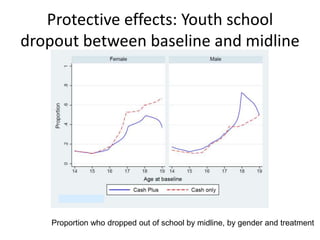
Protective effects: Youth school
dropout between baseline and midline
Proportion who dropped out of school by midline, by gender and treatment
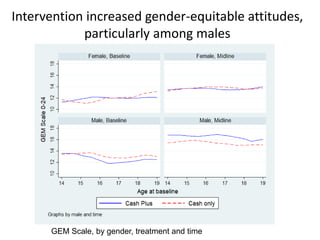
Intervention increased gender-equitable attitudes,
particularly among males
GEM Scale, by gender, treatment and time
Conclusion
• Adolescent Cash Plus intervention is:
– Addressing multiple vulnerabilities of adolescents in
Tanzania
– Running on a government platform
– Providing evidence on a pilot within extremely poor,
marginalized youth
• After 12 weeks of training, positive impacts on
knowledge and attitudes:
– Participation in economic activities
– More gender equitable attitudes
– More knowledge of modern contraceptives
– Increased knowledge of HIV prevention
• Changes in behavior take more time, and we will
measure at end-line (June – July 2019)

Tanzania's Productive Social Safety Net Programme

  • 1.
    Tanzania Social ActionFund (TASAF) Tanzania’s Productive Social Safety Net programme Presented to the Transfer Project workshop Arusha, April 3rd 2019 S. Masala, T. Mwaruka and P. Kijazi TASAF Management Unit
  • 2.
    Presentation outline 1. PSSNintervention and graduation logic and impact on households, adolescents and women – Discussion 2. PSSN Livelihoods Enhancement component and the Adolescent Cash Plus model – Discussion
  • 3.
    + CCTs (HH with childrenand pregnant women) Incl. monthly community sessions PWP (HH with adults able to work) Plus savings promotion PSSN: A system to support the poor and vulnerable in Tanzania Income generating activities, Savings, Training Education, health and nutrition services Human capital accumulation and sustained reduction of poverty v Smooth consumption, accumulation of assets v Participation for several years *A household becomes a beneficiary of both programs Unified registry of Beneficiaries Common targeting
  • 4.
    TASAF-PSSN graduation strategies •TASAF-PSSN phase II will apply the following graduation strategies – Recertification of programme participants • Combination of community-based listing and proxy means-test • Can lead to exit or to continued stay in the programme – Voluntary exit (following communication campaign) – Automatic Exit after completion of cycle of Livelihood Enhancement activities
  • 5.
  • 6.
    ThePSSNfurther reduced theshareof householdslivingunder theabsolute poverty line  In absence of the program, and thanks to improvements in Tanzanian economic situation,basicneedspovertydecreased(1.8%) compared tobaseline  However,there wasa slight increasein the adjusted food poverty (0.7%)  Separately, theprogramgeneratedan additional decreasein povertyof 10% and12% respectively 69.2 67.9 61.1 0 20 40 60 80 100 Baseline Control PSSN BelowBasic Needs Poverty Line (%) 63.5 64.0 56.3 100 80 60 40 20 0 Baseline Control PSSN BelowAdjusted Food Poverty Line (%)
  • 7.
    Fooddiversity increased, relatedto better performance of children & adults at school/work  Without the program, the likelihoodof low dietary diversity increasedby 2.8 p.p. Howeverwith theprogram, the likelihood of low dietary diversity decreased by 6.1 p.p.  Intheabsenceof theprogram, theshareof householdsundera PoorFood ConsumptionScore(FCS)decreased by 11.1 p.p. compared to the baseline, the program generated anadditional decrease of 4 p.p. 54.1 50.1 Shareof householdsfalling under Poor FCS 65.0 Baseline Control PSSN 73.0 75.8 69.7 Likelihood of LowDietary Diversity (%) Baseline Control PSSN
  • 8.
    Theprogram intensified farmingactivities, and increased investmentin productive assets 61.0 78.7 100 90 80 72.2 70 60 50 40 30 20 10 0 Baseline Control PSSN 35.9 42.1 60.7 100 90 80 70 60 50 40 30 20 10 0  Inabsenceof theprogram there wasan overall improvementonthelikelihoodof cultivating a farm and owninglivestock,by 1.2 p.p., and 6.2 p.p. each  Theprogram further improved theseproductiveoutcomes: Shareof householdscultivatingany farm plotincreasedby 6.5p.p. Shareof owningany livestock by18.6 p.p.,whichisalso related to improved resiliencetoshocks Cultivate any farm plot (%) Own any livestock (%) Baseline Control PSSN
  • 9.
    Householdshad morecapacity torespond to shocks and relied lessonnegative copingstrategies  Theprogram reduced negative coping strategies in general (CSIreduced by 16.7%), driven by a decrease in household’sreliance onrelatives/friends (by 5.4 p.p.) Note: higher CSImeanshigher risk (i.e. negative) coping strategies 7.8 6.5 10 8 6 4 2 0 Coping Strategies Index (CSI) Control PSSN 18.6 30 25 20 15 10 5 0 Help from Relatives/Friends (%) 26.0 Control PSSN
  • 10.
    No effect onhealthexpenditure, but program increased registration to health insurancethreefold  Registration to CHFisnota PSSNco-responsibility, however,the program hasmade important efforts to promote enrolment.Thisisin line with findings from spot checks 11.0 32.7 40 35 30 25 20 15 10 5 0  No impact onhealth related expenditures  Partly explained by the threefoldincreasein shareof householdshaving at least onememberregisteredunderCommunityHealthFund(increaseby 21.7 p.p.) Health Insurance (%) Control PSSN
  • 11.
    School attendance bytreatment status and interview wave Children ages 4-16 at baseline 0 .2.4.6.8 1 4 6 8 10 12 14 16 4 6 8 10 12 14 16 Baseline Endline School Attendance Impact School Attendance Impact Treatment Control Age at baseline
  • 12.
    Education [Qualitative findings] “My youngbrothers were having problems to attend school because they had no uniforms and exercise books, but now they attend school without any problems.” [19-year old male, Mbogwe] “I have seen big improvements in my life and family as a whole. I have school uniforms, food and exercise books. I see myself as having someone to hold my hand and assist me, and for now I am hoping to study up to form six if TASAF will continue to release funds. As a family we own chicken and goats and we are planning to have more as assets. I am working hard in my class and I am sure I will perform well in my exams”. [17-year old male, Itilima]
  • 13.
  • 14.
    Livelihoods Enhancement Framework 18 Conditional CashTransfer – consumption support + intergenerational poverty reduction Public Works – consumption support Basic skills/awareness training Productive Grant “Light coaching” provided via continued participation of HH in CCT Savings (COMSP, mobile money, individual) START Extreme poverty PW continues Some HHs eligible for Grant
  • 15.
    Livelihoods Enhancement Framework ProductiveGrantBasic skills and awareness training on economic activities Savings promotion (COMSIP, A scheme which responds to proposals put forward by beneficiary households applying for the grant to start/ improve their IGAs. Eligibility: - Participated in LE orientation sessions - Participated in basic skills and savings training - Participated in a business preparation training - Prepared business plan for his IGA Modality: One-time grant Agrees to: - Participate in orientation session on use of grant, including being linked to training on the chosen LE option and livelihood opportunities - Provision of regular hands-on support to beneficiaries during implementation Training beneficiaries on LE opportunities, transformation, marketing, entrepreneurship skills, business plans preparation, record keeping. Eligibility: all households Savings are made with the purpose of increasing the ability of program beneficiaries to save for future needs and investments. Content: LE opportunities, constitution preparation, savings mobilization, loan and conflict management, record keeping Eligibility: all households with labor capacity Coaching and mentoring
  • 16.
    Livelihood Enhancement: Implementation status •ToTs on Basic skills on economic activities have been conducted in eight PAAs. • Pilot training to beneficiaries was done in Bagamoyo, where beneficiaries were able to prepare proposals including business plans and applied for productive grants. However, the roll out of the training and provision of productive grants were not done as the two activities were rescheduled to July 2019 • A total of 11,699 Savings groups have been formed comprising of 151,821 beneficiaries (112,962 F and 38,859 M) • Pilot on behavioural design activities is on progress • Support to adolescents and youth through pilot interventions has been done, which include training on business skills and provision of productive grants is on progress (Cash Plus) • 20
  • 17.
  • 18.
    • Adolescents: akey population to break the intergenerational cycle of poverty • PSSN has a positive impact on safe transitions to adulthood • The youth well-being impact evaluation highlighted positive changes for young people in PSSN families in fields of education, basic needs, and social support • Yet, cash is important but not sufficient to address all barriers to safe and productive transitions to adulthood • Addressing early marriage and pregnancy, improving health, and providing livelihood opportunities requires more • Powerful synergies can be created when linking adolescents in PSSN households to other services and interventions • Hence, TASAF and partners developed the Cash Plus model and agreed to have it accompanied by a rigorous impact evaluation Cash Plus rationale
  • 20.
    Target population: Male & female adolescentsaged 14-19 years (1,500 youth) Location: 4 districts in Tanzania’s Southern Highlands region (65 villages) Partners: TASAF, Tanzania AIDS Commission (TACAIDS), Ministry of Health UNICEF Program components: The Cash: PSSN households receiving bi-monthly transfer The Plus: Adolescents in PSSN households receiving 1. Livelihoods and life skills training (12 weeks) 2. Mentoring, referrals and a productive grant (9 months) 3. Linkages to adolescent friendly SRH, HIV services Cash Plus – The Intervention
  • 21.
    Evaluation design • CashPlus is accompanied by a rigorous impact evaluation • The evaluation has a treatment (PSSN cash transfer and Cash Plus for adolescents) and a control group (PSSN cash transfer only) • Measurements done at baseline (mid-2017), mid-line (mid- 2018), and end-line (mid-2019) • After baseline, 65 participating and 65 control villages were selected • In total, 2,458 adolescents participate in the survey (spread over treatment and control group) • The evaluation also includes health facility and community survey instruments
  • 22.
    Cash Plus midlinesurvey (mid-2018) • Conducted after 12-week training program for adolescents • Can expect changes in: – Knowledge (business plans, where to seek HIV/SRH services) – Attitudes (gender equitable attitudes, etc.) – Aspirations (future schooling, employment) • Most likely too soon to see – Changes in behavior (livelihoods, HIV, SRH, transitions to adulthood, violence) – Substantive increases in economic activities
  • 23.
    Summary of midlinefindings Domain Total number of outcomes /indicators Number of statistically significant impacts Education 9 1 Economic activities (participation, hours) 17 3 Aspirations (educational, occupational) 10 0 Attitudes (quality of life, self- esteem, social support, locus of control) 5 0 Attitudes on gender 5 1 Contraceptive knowledge 17 3 HIV knowledge 4 1 HIV risk (perceived, tested) 5 SRH visits and reasons for visit 8 1 Total 63 10
  • 24.
    Intervention increased economicactivities Figure 8.2. Youth participation in any economic activities, by interview wave and treatment status.
  • 25.
    Economic activities Qualitative findingselaborate the difference in those who conducted a business before and after livelihood training. Me, before I started training I was cooking buns, but after I started training we were taught simple business plan, I started selling soap, salt and juice. Female, 14 years, Rungwe Participants who reported having started businesses prior to the training cited financial difficulties at home as the main reason for their interest in business: I mean, you look at how the system of life goes at home, and a person when you reach 16 or 17 years, you must know how life goes. You will be surprised you need money and then you ask from Mama and Mama says she doesn’t have, that’s why you have to evaluate and act. Female, 15 years, Rungwe
  • 26.
    Protective effects: Youthschool dropout between baseline and midline Proportion who dropped out of school by midline, by gender and treatment
  • 27.
    Intervention increased gender-equitableattitudes, particularly among males GEM Scale, by gender, treatment and time
  • 28.
    Conclusion • Adolescent CashPlus intervention is: – Addressing multiple vulnerabilities of adolescents in Tanzania – Running on a government platform – Providing evidence on a pilot within extremely poor, marginalized youth • After 12 weeks of training, positive impacts on knowledge and attitudes: – Participation in economic activities – More gender equitable attitudes – More knowledge of modern contraceptives – Increased knowledge of HIV prevention • Changes in behavior take more time, and we will measure at end-line (June – July 2019)

Editor's Notes

  • #16 This figure represents child school attendance by treatment status at baseline (left panel) and endline (right panel). School attendance has an inverted U-shaped relationship with age and peaks around age 11, when it reaches about 90 per cent. At baseline, school attendance of children in the treatment and control groups mostly overlaps. At endline, children in the treatment group have higher school attendance than children in the control group across all ages, indicating that the PSSN had a beneficial effect on school participation. This graph could follow after the group picture, just before the first results table.
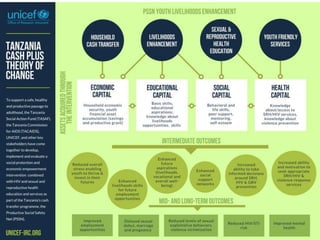
  • #24 This slide shows the conceptual framework for the Cash Plus model. A hand-out will be made available for detailed reading. I would like to just highlight the following main points: It shows that the intervention aims at combining cash transfers to the household, skills training for adolescents in those households, and strengthening youth-friendly services to respond to demand It is important to note that the training covers livelihood skills and sexual and reproductive health skills. Cash Plus for adolescents believes that the combination of livelihood and sexual and reproductive health skills is essential for adolescents. In short: no economic empowerment when adolescents are not healthy and no health when not economically strong This is also revealed by the type of outcomes that Cash Plus tries to influence. These range from employment opportunities, to reduced exposure to violence, and improved mental health, to delayed sexual debut, marriage, and early pregnancy.
  • #28 This slide show a summary of the mid-line findings. It presents to the left all the domains where we expect Cash Plus to have an impact. For each of the domains, it shows the number of indicators for which we measured the change between baseline and mid-line. Finally, to the right we present for how many indicators we found a significant impact. This shows that for only 10 out of 63 indicators we found impact. This was largely in line with what we expected to see because at mid-line only the training component was completed. The mentoring and productive grant components had not yet started.
  • #29 This slide show that at mid-line, the adolescents participated more in economic activities than at baseline.
  • #30 This is what young people themselves said about participation in economic activities.
  • #31 This slide shows that there was a different impact on school drop out between female and male participants in Cash Plus. Among female participants, Cash Plus reduced school drop out – notably for those 16 to 19 years of age Among male participants, Cash Plus participants actually revealed higher levels of school drop out – notably the 18 and 19 year old. We are still looking into finding explanations for these findings.
  • #32 This slide shows that the Cash Plus program increased gender equitable attitudes among male participants. Among males, the intervention had a positive impact on gender-equitable attitudes. It means that at mid-line, the attitudes of male participants in relation to violence, domestic chores, and other issues reflected a better gender balance than at baseline and that the improvements were significant in relation to the control group. We didn’t see this change among the group of female participants.
  • #33 The training increased knowledge among participants that sex with one uninfected partner can reduce HIV risk