MATHEMATICS – SPHERE AND PRISM
MUHAMMAD NAZMI
YEE JYH LIN
ERIK ONG
ISYRAQ NASIR
CHANG MAYCHEN
RIFAI NUSAIR
SPHERE
WHAT IS A SPHERE?
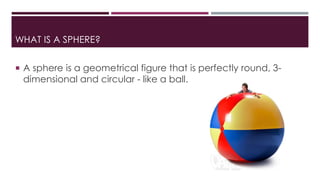
 A sphere is a geometrical figure that is perfectly round, 3-
dimensional and circular - like a ball.
WHAT IS A SPHERE?
 Geometrically, a sphere is defined as the set of all points
equidistant from a single point in space.
 It is a shape of biggest volume with the smallest surface
area.
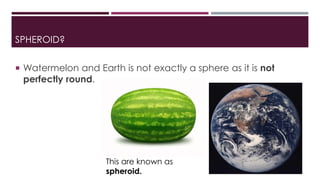
SPHEROID?
 Watermelon and Earth is not exactly a sphere as it is not
perfectly round.
This are known as
spheroid.
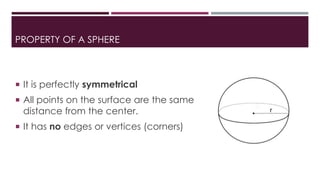
PROPERTY OF A SPHERE
 It is perfectly symmetrical
 All points on the surface are the same
distance from the center.
 It has no edges or vertices (corners)
SPHERE
VOLUME AND SURFACE AREA
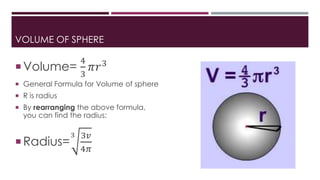
VOLUME OF SPHERE
 Volume=
4
3
𝜋𝑟3
 General Formula for Volume of sphere
 R is radius
 By rearranging the above formula,
you can find the radius:
 Radius=
3 3𝑣
4𝜋
EXAMPLE
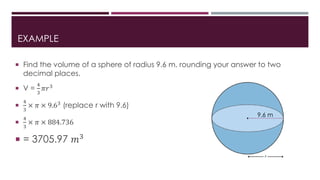
 Find the volume of a sphere of radius 9.6 m, rounding your answer to two
decimal places.
 V =
4
3
𝜋𝑟3

4
3
× 𝜋 × 9.63 (replace r with 9.6)

4
3
× 𝜋 × 884.736
 = 3705.97 𝑚3
9.6 m
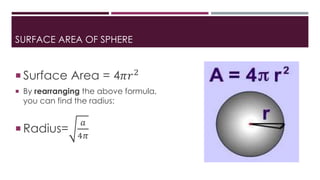
SURFACE AREA OF SPHERE
 Surface Area = 4𝜋𝑟2
 By rearranging the above formula,
you can find the radius:
 Radius=
𝑎
4𝜋
EXAMPLE
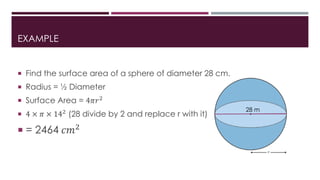
 Find the surface area of a sphere of diameter 28 cm.
 Radius = ½ Diameter
 Surface Area = 4𝜋𝑟2
 4 × 𝜋 × 142 (28 divide by 2 and replace r with it)
 = 2464 𝑐𝑚2
28 m
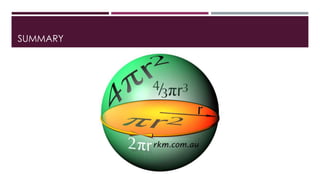
SUMMARY
HEMISPHERE
VOLUME AND SURFACE AREA
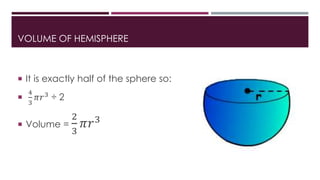
VOLUME OF HEMISPHERE
 It is exactly half of the sphere so:

4
3
𝜋𝑟3
÷ 2
 Volume =
2
3
𝜋𝑟3
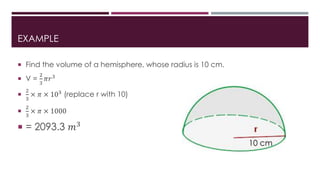
EXAMPLE
 Find the volume of a hemisphere, whose radius is 10 cm.
 V =
2
3
𝜋𝑟3

2
3
× 𝜋 × 103 (replace r with 10)

2
3
× 𝜋 × 1000
 = 2093.3 𝑚3
10 cm
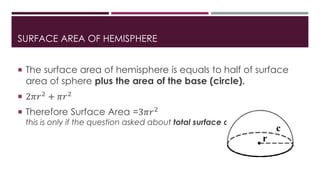
SURFACE AREA OF HEMISPHERE
 The surface area of hemisphere is equals to half of surface
area of sphere plus the area of the base (circle).
 2𝜋𝑟2 + 𝜋𝑟2
 Therefore Surface Area =3𝜋𝑟2
this is only if the question asked about total surface area.
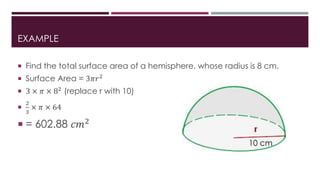
EXAMPLE
 Find the total surface area of a hemisphere, whose radius is 8 cm.
 Surface Area = 3𝜋𝑟2
 3 × 𝜋 × 82 (replace r with 10)

2
3
× 𝜋 × 64
 = 602.88 𝑐𝑚2
10 cm
PRISM
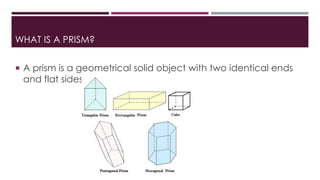
WHAT IS A PRISM?
 A prism is a geometrical solid object with two identical ends
and flat sides.
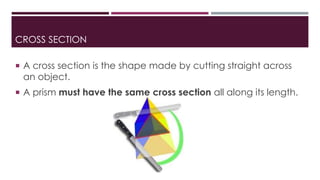
CROSS SECTION
 A cross section is the shape made by cutting straight across
an object.
 A prism must have the same cross section all along its length.
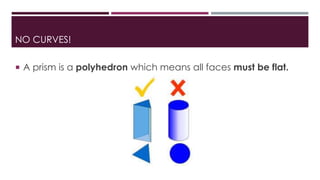
NO CURVES!
 A prism is a polyhedron which means all faces must be flat.
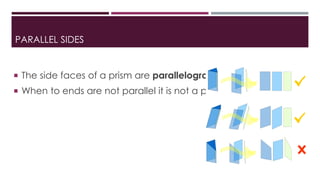
PARALLEL SIDES
 The side faces of a prism are parallelograms.
 When to ends are not parallel it is not a prism.
PRISM
VOLUME AND SURFACE AREA
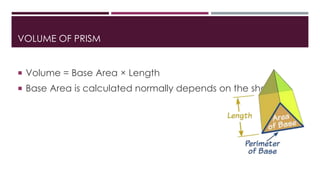
VOLUME OF PRISM
 Volume = Base Area × Length
 Base Area is calculated normally depends on the shape.
EXAMPLE
 What is the volume of a prism where the base area is 25 m2 and which
is 12 m long:
 Volume = Base Area × Length
 𝑉𝑜𝑙𝑢𝑚𝑒 = 25 𝑥 12
 = 300 𝑚3
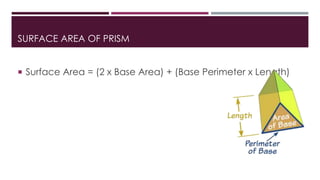
SURFACE AREA OF PRISM
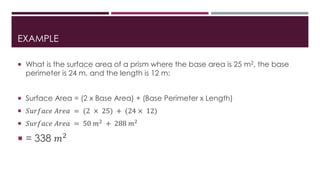
 Surface Area = (2 x Base Area) + (Base Perimeter x Length)
EXAMPLE
 What is the surface area of a prism where the base area is 25 m2, the base
perimeter is 24 m, and the length is 12 m:
 Surface Area = (2 x Base Area) + (Base Perimeter x Length)
 𝑆𝑢𝑟𝑓𝑎𝑐𝑒 𝐴𝑟𝑒𝑎 = (2 × 25) + (24 × 12)
 𝑆𝑢𝑟𝑓𝑎𝑐𝑒 𝐴𝑟𝑒𝑎 = 50 𝑚2 + 288 𝑚2
 = 338 𝑚2
QUESTION!!
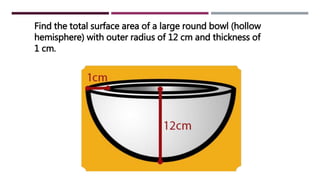
Find the total surface area of a large round bowl (hollow
hemisphere) with outer radius of 12 cm and thickness of
1 cm.
ANSWER
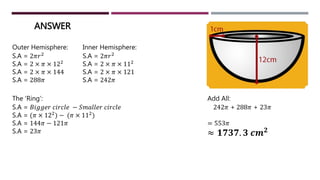
Outer Hemisphere:
S.A = 2𝜋𝑟2
S.A = 2 × 𝜋 × 122
S.A = 2 × 𝜋 × 144
S.A = 288𝜋
Inner Hemisphere:
S.A = 2𝜋𝑟2
S.A = 2 × 𝜋 × 112
S.A = 2 × 𝜋 × 121
S.A = 242𝜋
The ‘Ring’:
S.A = 𝐵𝑖𝑔𝑔𝑒𝑟 𝑐𝑖𝑟𝑐𝑙𝑒 − 𝑆𝑚𝑎𝑙𝑙𝑒𝑟 𝑐𝑖𝑟𝑐𝑙𝑒
S.A = (𝜋 × 122) − (𝜋 × 112)
S.A = 144𝜋 − 121𝜋
S.A = 23𝜋
Add All:
242𝜋 + 288𝜋 + 23𝜋
= 553𝜋
≈ 𝟏𝟕𝟑𝟕. 𝟑 𝒄𝒎 𝟐
Thank You
REFERENCE
http://www.calculatorsoup.com/calculators/geometry-solids/hemisphere.php
http://www.rkm.com.au/CALCULATORS/calculator-images/MATHS-SPHERE-CIRCLE-equations-
white-500.png
http://www.ditutor.com/solid_gometry/volume_hemisphere.html
http://mathcentral.uregina.ca/QQ/database/QQ.09.07/h/nicholas4.html
https://www.mathsisfun.com/geometry/prisms.html

Mathematics – Sphere and Prism

  • 1.
    MATHEMATICS – SPHEREAND PRISM MUHAMMAD NAZMI YEE JYH LIN ERIK ONG ISYRAQ NASIR CHANG MAYCHEN RIFAI NUSAIR
  • 2.
  • 3.
    WHAT IS ASPHERE?  A sphere is a geometrical figure that is perfectly round, 3- dimensional and circular - like a ball.
  • 4.
    WHAT IS ASPHERE?  Geometrically, a sphere is defined as the set of all points equidistant from a single point in space.  It is a shape of biggest volume with the smallest surface area.
  • 5.
    SPHEROID?  Watermelon andEarth is not exactly a sphere as it is not perfectly round. This are known as spheroid.
  • 6.
    PROPERTY OF ASPHERE  It is perfectly symmetrical  All points on the surface are the same distance from the center.  It has no edges or vertices (corners)
  • 7.
  • 8.
    VOLUME OF SPHERE Volume= 4 3 𝜋𝑟3  General Formula for Volume of sphere  R is radius  By rearranging the above formula, you can find the radius:  Radius= 3 3𝑣 4𝜋
  • 9.
    EXAMPLE  Find thevolume of a sphere of radius 9.6 m, rounding your answer to two decimal places.  V = 4 3 𝜋𝑟3  4 3 × 𝜋 × 9.63 (replace r with 9.6)  4 3 × 𝜋 × 884.736  = 3705.97 𝑚3 9.6 m
  • 10.
    SURFACE AREA OFSPHERE  Surface Area = 4𝜋𝑟2  By rearranging the above formula, you can find the radius:  Radius= 𝑎 4𝜋
  • 11.
    EXAMPLE  Find thesurface area of a sphere of diameter 28 cm.  Radius = ½ Diameter  Surface Area = 4𝜋𝑟2  4 × 𝜋 × 142 (28 divide by 2 and replace r with it)  = 2464 𝑐𝑚2 28 m
  • 12.
  • 13.
  • 14.
    VOLUME OF HEMISPHERE It is exactly half of the sphere so:  4 3 𝜋𝑟3 ÷ 2  Volume = 2 3 𝜋𝑟3
  • 15.
    EXAMPLE  Find thevolume of a hemisphere, whose radius is 10 cm.  V = 2 3 𝜋𝑟3  2 3 × 𝜋 × 103 (replace r with 10)  2 3 × 𝜋 × 1000  = 2093.3 𝑚3 10 cm
  • 16.
    SURFACE AREA OFHEMISPHERE  The surface area of hemisphere is equals to half of surface area of sphere plus the area of the base (circle).  2𝜋𝑟2 + 𝜋𝑟2  Therefore Surface Area =3𝜋𝑟2 this is only if the question asked about total surface area.
  • 17.
    EXAMPLE  Find thetotal surface area of a hemisphere, whose radius is 8 cm.  Surface Area = 3𝜋𝑟2  3 × 𝜋 × 82 (replace r with 10)  2 3 × 𝜋 × 64  = 602.88 𝑐𝑚2 10 cm
  • 18.
  • 19.
    WHAT IS APRISM?  A prism is a geometrical solid object with two identical ends and flat sides.
  • 20.
    CROSS SECTION  Across section is the shape made by cutting straight across an object.  A prism must have the same cross section all along its length.
  • 21.
    NO CURVES!  Aprism is a polyhedron which means all faces must be flat.
  • 22.
    PARALLEL SIDES  Theside faces of a prism are parallelograms.  When to ends are not parallel it is not a prism.
  • 23.
  • 24.
    VOLUME OF PRISM Volume = Base Area × Length  Base Area is calculated normally depends on the shape.
  • 25.
    EXAMPLE  What isthe volume of a prism where the base area is 25 m2 and which is 12 m long:  Volume = Base Area × Length  𝑉𝑜𝑙𝑢𝑚𝑒 = 25 𝑥 12  = 300 𝑚3
  • 26.
    SURFACE AREA OFPRISM  Surface Area = (2 x Base Area) + (Base Perimeter x Length)
  • 27.
    EXAMPLE  What isthe surface area of a prism where the base area is 25 m2, the base perimeter is 24 m, and the length is 12 m:  Surface Area = (2 x Base Area) + (Base Perimeter x Length)  𝑆𝑢𝑟𝑓𝑎𝑐𝑒 𝐴𝑟𝑒𝑎 = (2 × 25) + (24 × 12)  𝑆𝑢𝑟𝑓𝑎𝑐𝑒 𝐴𝑟𝑒𝑎 = 50 𝑚2 + 288 𝑚2  = 338 𝑚2
  • 28.
  • 29.
    Find the totalsurface area of a large round bowl (hollow hemisphere) with outer radius of 12 cm and thickness of 1 cm.
  • 30.
    ANSWER Outer Hemisphere: S.A =2𝜋𝑟2 S.A = 2 × 𝜋 × 122 S.A = 2 × 𝜋 × 144 S.A = 288𝜋 Inner Hemisphere: S.A = 2𝜋𝑟2 S.A = 2 × 𝜋 × 112 S.A = 2 × 𝜋 × 121 S.A = 242𝜋 The ‘Ring’: S.A = 𝐵𝑖𝑔𝑔𝑒𝑟 𝑐𝑖𝑟𝑐𝑙𝑒 − 𝑆𝑚𝑎𝑙𝑙𝑒𝑟 𝑐𝑖𝑟𝑐𝑙𝑒 S.A = (𝜋 × 122) − (𝜋 × 112) S.A = 144𝜋 − 121𝜋 S.A = 23𝜋 Add All: 242𝜋 + 288𝜋 + 23𝜋 = 553𝜋 ≈ 𝟏𝟕𝟑𝟕. 𝟑 𝒄𝒎 𝟐
  • 31.
  • 32.