SUSTAINABLE ENERGY
SOLUTIONS
Module 4, part 3 by Turku University of Applied Sciences
2
Part 3
The reliability and future of new energies
Learning objectives and outcomes of the module:
• ability to understand about the reliability of technology
• ability to understand about the possible futures of energy solutions
3
4
• As we have already found out,
renewable energy is now
capturing market share from
fossil fuels and nuclear energy
at an unprecedented rate.
• When it comes to climate
change and renewable energy
solutions, we must be guided by
science and facts, coupled with
a sense of urgency argues
IRENA (2015), International
Renewable Energy Agency
Reliability of energy
Three facts that speak for themselves by IRENA
Renewable systems are reliable, even at night and on windless
days
• Reliability is not a function of individual generation technologies, but a
function of the electricity system as a whole.
• It is important to remember that “renewable energy” is not a single
energy source, but roughly speaking six: solar, wind, biomass,
geothermal, hydro, and ocean. Of these, only wind and solar are
“variable;” the rest are capable of being dialled up or down when
needed – “dispatchable” in industry parlance.
5
Second fact
"Baseload" is not essential
• Nuclear and coal-fired power plants by definition provide baseload
electricity because that is what they are designed to do. These types of
plants are designed to supply a lot of electricity, all the time.
• Energy consumers do not need this massive baseload to be sure the
lights will come on when we hit the switch. What we do need are power
systems that can match supply and demand in a more concerted and
flexible way. Flexibility is the key.
6
Third fact
The future will look different than the past
• Renewables-based models allow individual households, communities
and global companies to produce and manage their own electricity
supply and demand, with the grid serving solely as back-up.
• "Smart" meters and appliances make this task all the easier. In future,
having the ability to flexibly manage both supply and demand will
create a system that utilizes the free resources provided by the sun and
wind in the most effective way.
7
How reliable are the different forms of renewable
energy?
• When you stop thinking about renewable energy as individual
modes of electricity generation working independently of each
other, and instead you see them as a holistic force, then you
can determine that renewable energy is indeed reliable (IRENA)
• The availability or more specifically the supply and location is
what makes an energy source reliable (YaleEnvironment)
• There is only a finite amount of coal and oil, where there is
essentially an unlimited amount of renewable resources that
can sustain the globe for generations to come.
8
The future
“The need for plentiful, sustainable energy that doesn’t disrupt
the delicate balance of the Earth’s atmosphere may be the single
most important issue facing this generation. The decisions we
make and the technologies we develop over the next few
decades will have profound implications for geopolitics, wildlife,
food production, and almost every sphere of human endeavour.”
(Source: John Hopkins University)
9
10
Is totally renewable energy
even possible?
Key targets in the European Union
• In December 2019, the European Commission published the
European Green Deal, which sets out the means for achieving
climate neutrality.
• EU has set Key Targets for 2030:
• At least 40% cuts in greenhouse gas emissions (from 1990 levels)
• At least 32% share for renewable energy
• At least 32.5% improvement in energy efficiency (European Commission)
11
Examples, estimates…
• According to a report from the Global Financial Institution ING,
renewables could account for nearly 70% of the world's energy
mix by 2040
• 90% of U.S. could be powered by renewables by 2035
(YaleEnvironment)
• In Finland the objective of the present government is to be
carbon-neutral and the first fossil-free welfare society by
2035. (Ministry of the Environment)
12
About the challenges in various regions
• Climate change poses major challenges to environmental stability,
economic growth and human development in the East Asia and
Pacific region according to World Bank.
• There are 4.7 billion people living in countries ranging from the
world’s largest energy consumer to small island economies that
are among the most vulnerable to the impacts of climate change.
• The region accounts for more than half of global energy
consumption, with 85% of that regional consumption sourced from
fossil fuels. Read more about the future challenges at IRENE
13
African continent
• Africa has contributed negligibly to the changing climate
according to UNEP
• However, Africa’s rapid economic expansion creates a daunting
energy challenge combined with rising expectations of improved
resilience and sustainability. Luckily Africa is rich in renewable
energy sources, including hydro, sun, wind and others (IRENA)
14
Latin-America and the Caribbean
• The Renewable Energy for Latin America and the Caribbean Initiative
(RELAC) was launched in December 2019 under the framework of the
United Nations Secretary General's Climate Action Summit, with the
objective of accelerating the carbon neutrality of electricity systems in the
Latin American and Caribbean (LAC) region, while improving the
resilience, competitiveness and sustainability of the sector.
• RELAC initiative aims to achieve at least 70% of renewable energy
participation in the region’s electricity matrix by 2030 (IRENE)
15
16
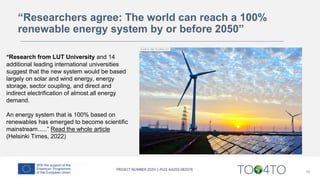
“Research from LUT University and 14
additional leading international universities
suggest that the new system would be based
largely on solar and wind energy, energy
storage, sector coupling, and direct and
indirect electrification of almost all energy
demand.
An energy system that is 100% based on
renewables has emerged to become scientific
mainstream…..” Read the whole article
(Helsinki Times, 2022)
“Researchers agree: The world can reach a 100%
renewable energy system by or before 2050”
Self-study questions
1.What is meant with reliability of technology and is that achievable?
1.What challenges are there in with the future energy solutions in different
areas of the globe?
17
This is the end of part 3. Thank you
18

TOO4TO Module 4 / Sustainable Energy Solutions: Part 3

  • 2.
    SUSTAINABLE ENERGY SOLUTIONS Module 4,part 3 by Turku University of Applied Sciences 2
  • 3.
    Part 3 The reliabilityand future of new energies Learning objectives and outcomes of the module: • ability to understand about the reliability of technology • ability to understand about the possible futures of energy solutions 3
  • 4.
    4 • As wehave already found out, renewable energy is now capturing market share from fossil fuels and nuclear energy at an unprecedented rate. • When it comes to climate change and renewable energy solutions, we must be guided by science and facts, coupled with a sense of urgency argues IRENA (2015), International Renewable Energy Agency Reliability of energy
  • 5.
    Three facts thatspeak for themselves by IRENA Renewable systems are reliable, even at night and on windless days • Reliability is not a function of individual generation technologies, but a function of the electricity system as a whole. • It is important to remember that “renewable energy” is not a single energy source, but roughly speaking six: solar, wind, biomass, geothermal, hydro, and ocean. Of these, only wind and solar are “variable;” the rest are capable of being dialled up or down when needed – “dispatchable” in industry parlance. 5
  • 6.
    Second fact "Baseload" isnot essential • Nuclear and coal-fired power plants by definition provide baseload electricity because that is what they are designed to do. These types of plants are designed to supply a lot of electricity, all the time. • Energy consumers do not need this massive baseload to be sure the lights will come on when we hit the switch. What we do need are power systems that can match supply and demand in a more concerted and flexible way. Flexibility is the key. 6
  • 7.
    Third fact The futurewill look different than the past • Renewables-based models allow individual households, communities and global companies to produce and manage their own electricity supply and demand, with the grid serving solely as back-up. • "Smart" meters and appliances make this task all the easier. In future, having the ability to flexibly manage both supply and demand will create a system that utilizes the free resources provided by the sun and wind in the most effective way. 7
  • 8.
    How reliable arethe different forms of renewable energy? • When you stop thinking about renewable energy as individual modes of electricity generation working independently of each other, and instead you see them as a holistic force, then you can determine that renewable energy is indeed reliable (IRENA) • The availability or more specifically the supply and location is what makes an energy source reliable (YaleEnvironment) • There is only a finite amount of coal and oil, where there is essentially an unlimited amount of renewable resources that can sustain the globe for generations to come. 8
  • 9.
    The future “The needfor plentiful, sustainable energy that doesn’t disrupt the delicate balance of the Earth’s atmosphere may be the single most important issue facing this generation. The decisions we make and the technologies we develop over the next few decades will have profound implications for geopolitics, wildlife, food production, and almost every sphere of human endeavour.” (Source: John Hopkins University) 9
  • 10.
    10 Is totally renewableenergy even possible?
  • 11.
    Key targets inthe European Union • In December 2019, the European Commission published the European Green Deal, which sets out the means for achieving climate neutrality. • EU has set Key Targets for 2030: • At least 40% cuts in greenhouse gas emissions (from 1990 levels) • At least 32% share for renewable energy • At least 32.5% improvement in energy efficiency (European Commission) 11
  • 12.
    Examples, estimates… • Accordingto a report from the Global Financial Institution ING, renewables could account for nearly 70% of the world's energy mix by 2040 • 90% of U.S. could be powered by renewables by 2035 (YaleEnvironment) • In Finland the objective of the present government is to be carbon-neutral and the first fossil-free welfare society by 2035. (Ministry of the Environment) 12
  • 13.
    About the challengesin various regions • Climate change poses major challenges to environmental stability, economic growth and human development in the East Asia and Pacific region according to World Bank. • There are 4.7 billion people living in countries ranging from the world’s largest energy consumer to small island economies that are among the most vulnerable to the impacts of climate change. • The region accounts for more than half of global energy consumption, with 85% of that regional consumption sourced from fossil fuels. Read more about the future challenges at IRENE 13
  • 14.
    African continent • Africahas contributed negligibly to the changing climate according to UNEP • However, Africa’s rapid economic expansion creates a daunting energy challenge combined with rising expectations of improved resilience and sustainability. Luckily Africa is rich in renewable energy sources, including hydro, sun, wind and others (IRENA) 14
  • 15.
    Latin-America and theCaribbean • The Renewable Energy for Latin America and the Caribbean Initiative (RELAC) was launched in December 2019 under the framework of the United Nations Secretary General's Climate Action Summit, with the objective of accelerating the carbon neutrality of electricity systems in the Latin American and Caribbean (LAC) region, while improving the resilience, competitiveness and sustainability of the sector. • RELAC initiative aims to achieve at least 70% of renewable energy participation in the region’s electricity matrix by 2030 (IRENE) 15
  • 16.
    16 “Research from LUTUniversity and 14 additional leading international universities suggest that the new system would be based largely on solar and wind energy, energy storage, sector coupling, and direct and indirect electrification of almost all energy demand. An energy system that is 100% based on renewables has emerged to become scientific mainstream…..” Read the whole article (Helsinki Times, 2022) “Researchers agree: The world can reach a 100% renewable energy system by or before 2050”
  • 17.
    Self-study questions 1.What ismeant with reliability of technology and is that achievable? 1.What challenges are there in with the future energy solutions in different areas of the globe? 17
  • 18.
    This is theend of part 3. Thank you 18