Efficiency Imp
based Solar cell
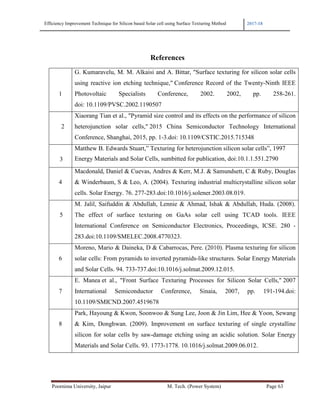
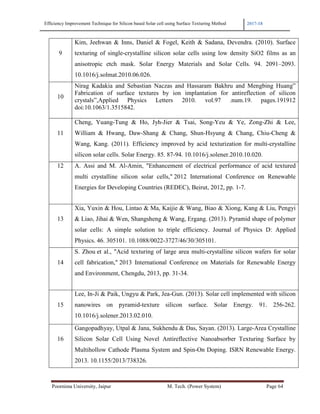
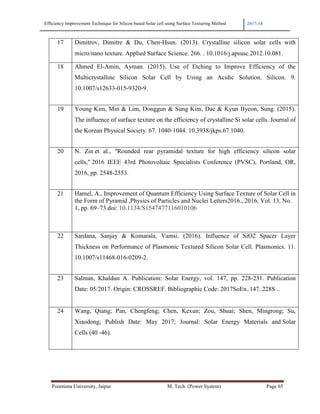
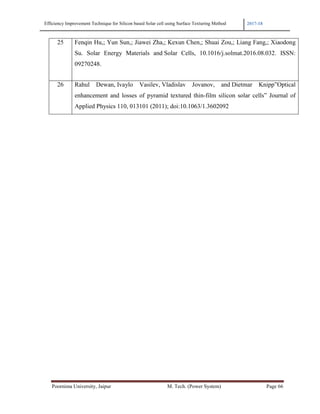
Dissertation submitt
Department of
With S
Pr
Assista
School
Ranchandrapura, P.O. V
y Improvement Technique for S
r cell using Surface Texturing M
ubmitted in partial fulfillment of the requiremen
the award of the Degree of
Master of Technology
ent of Electrical and Electronics Engineerin
With Specialization in Power System
Submitted by
Divya Shikha
2016PUSETMPSX04942
Supervised by
Dr. Manoj Gupta
Professor, Department of EEE
Poornima University
Co-guided by
Mr.Ashish Raj
ssistant Professor, Department of EEE
Poornima University
(Session 2017-18)
chool of Engineering and Technology
Poornima University
P.O. VidhaniVatika, Sitapura Extension, Jaipur
for Silicon
ing Method
irements for
eering
Jaipur – 303905
Efficiency Improvement Technique for Silicon based Solar cell using Surface Texturing Method 2017-18
Poornima University, Jaipur M. Tech. (Power System) Page ii
CERTIFICATE
This is to certify that Ms. Divya Shikha, Registration No. 2016PUSETMPSX04942,
student of M. Tech., Power System, Department of Electrical and Electronics
Engineering, School of Engineering & Technology has submitted this dissertation
entitled “Efficiency Improvement Technique for Silicon based Solar cell using
Surface Texturing Method” under the supervision of Dr. Manoj Gupta Professor,
Department of EEE, Poornima University, and Mr. Ashish Raj Assistant Professor,
Department of EEE, Poornima University toward partial fulfillment of the requirements
for the Degree of M.Tech. from the Poornima University.
Dr. B.K Sharma
Dean, SET
Efficiency Improvement Technique for Silicon based Solar cell using Surface Texturing Method 2017-18
Poornima University, Jaipur M. Tech. (Power System) Page iii
CANDIDATE’S DECLARATION
I hereby declare that the work which is being presented in this dissertation entitled
“Efficiency Improvement Technique for Silicon based Solar cell using Surface
Texturing Method” in the partial fulfillment for the award of the Degree of master of
technology in Power System, submitted to the Department of Electrical and Electronics
Engineering.
Electrical Engineering Poornima University, Jaipur, is an authentic record of original
work done by me during the period from January, 2018 to July, 2018 under the
supervision and guidance of Dr. Manoj Gupta Professor, Department of EEE,
Poornima University, and Mr. Ashish Raj Assistant Professor, Department of EEE,
Poornima University, Jaipur.
I have not submitted the matter embodied in this dissertation for the award of any other
degree.
Dated: 31.07.18 Divya Shikha
Place: Jaipur 2016PUSETMPSX04942
SUPERVISOR’S CERTIFICATE
This is certifying that this dissertation is based on original work done by the candidate
under my supervision and to the best of my knowledge; this work has not been
submitted elsewhere for the award of any degree.
Dated: 31.07.18 Dr. Manoj Gupta
Place: Jaipur (Professor, Department of EEE, Poornima University)
Mr. Ashish Raj
(Assistant Professor, Department of EEE, Poornima University)
Efficiency Improvement Technique for Silicon based Solar cell using Surface Texturing Method 2017-18
Poornima University, Jaipur M. Tech. (Power System) Page iv
ACKNOWLEDGEMENT
I would like to express my deep gratitude and thanks to Dr. Manoj Gupta, Pro-
President and Mr. Ashish Raj, HOD in the department of Electrical and Electronics
Engineering, Poornima University for giving me an opportunity to work under his
guidance for preparing the report of my dissertation work.
I extend my deep sense of gratitude and respect towards honorable Dr. S. M. Seth,
Chairman Emeritus, Poornima Foundation, former Director, National Institute of
Hydrology, Roorkee for his continuous inspiration and motivation for the research. My
sincere thanks are due to Mr. Shashikant Singhi, Chairman, Poornima Foundation
and Chairperson, Poornima University, who has established Poornima University.
I would also like to express my deep gratitude to Dr. K.K.S. Bhatia, President,
Poornima University & Ar. Rahul Singhi, Director of Poornima Foundation &
Poornima University for their kind support and guidance from time to time.
I extend my sincere thanks to Dr. Chandani Kirplani, Registrar, Poornima University
for her continuous support and encouragements.
I extend my sincere thanks to Dr. B.K. Sharma, Dean, SET, Poornima University for
his continuous support and encouragements throughout the course work of my Master
program.
My thanks are due to Mr. Simranjeet Singh Sudan, M. Tech. Coordinator, Poornima
University and all those who have inspired and motivated me time to time, and all those
who have directly or indirectly helped me to complete my report of the dissertation.
Special thanks to my family and friends for their continuous motivation and support.
Divya Shikha
(M. Tech Power System)
2016PUSETMPSX04942
Efficiency Improvement Technique for Silicon based Solar cell using Surface Texturing Method 2017-18
Poornima University, Jaipur M. Tech. (Power System) Page v
ABSTRACT
In this research work, the efficiency of silicon solar cells will be improved by surface
texturing technique. The surface Texturing method on semiconductor materials, such as
monocrystalline and multicrystalline silicon (Si), consist of an array of geometrical
structures. The main advantage of geometrical structures is the that they are capable to
significantly increase the amount of transmitted light on the cell surface without the use
of other antireflection and light trapping techniques, such as antireflection coatings.
Texturing a Si wafer includes three benefits: decrease in external reflection, increase in
internal reflection preventing the rays from escaping the solar cell, and increase in
effective absorption length due to tilted rays.
The dissertation report deals with literature review of 26 research papers and their
analysis leading to gaps in the published research and consequently to selection of
problem statement and objectives. From the literature review it could be seen that
almost researchers attempted to use surface texturization processes for Solar Cells and
analyze its effect on incident light on the surface of silicon solar cell.
In this work, we are model solar cells simulated in Silvaco ATLAS. After simulation
performance, parameters were extracted and tabulated. Open Circuit voltage, Short
circuit current, Fill factor, efficiency and max. Power will have been extracted from I-V
characteristics of the device. From the simulation we will be able to say that
performance of the device will be improved.
Efficiency Improvement Technique for Silicon based Solar cell using Surface Texturing Method 2017-18
Poornima University, Jaipur M. Tech. (Power System) Page vi
TABLE OF CONTENTS
Content Page No.
Front page i
Certificate ii
Candidate Declaration & Supervisor Certificate iii
Acknowledgement iv
Abstract v
Table of Contents vi
List of Tables viii
List of Figures ix
List of Symbols and Abbreviations x
Chapter 1 Introduction 1-3
1.1 Motivation: Solving the Energy Crisis with Photovoltaic 1
1.2 Thesis Summary 2
Chapter 2 Literature Review 4-31
2.1 Categorical Review on Research Work Reviewed 4
2.1.1 Issue 1: Design and Modeling of Solar Cell 5
2.1.2 Issue 2: Efficiency and Parametric Variation on Solar Cells 10
2.1.3 Issue 3: Manufacturing Cost Consumption and Time Saving 20
2.2 Common Findings under the Issues 24
2.3 Comparative Analysis of Research Work Reviewed 26
2.4 Strengths and Weaknesses of Research Works Reviewed 28
2.4.1 Strengths 28
2.5 Gaps in the Published Research 29
2.6 Problem Statement and Objectives 30
2.6.1 Problem Statement 30
2.6.2 Objectives 30
Chapter 3 Design and Fabrication of Solar Cell 31-45
3. 1 Solar Cell 31
3. 1.1 Types Solar Cell Based on Silicon 31
3.2 P-N Junction Solar Cell 33
3.2.1 Working Principle 33
3.3 Power Generation from Light Absorption 34
Efficiency Improvement Technique for Silicon based Solar cell using Surface Texturing Method 2017-18
Poornima University, Jaipur M. Tech. (Power System) Page vii
3.3.1 Light Absorption 34
3.3.2 Spectral Response 36
3.3.3 Power Generation 37
3.4. Parameters 37
3.4.1 Short Circuit Current 37
3.4.2 Open-Circuit Voltage 38
3.4.3 Fill Factor 38
3.5 Factors Influencing the Efficiency of Solar Cells 38
3.6 Details of Software used for Simulation 40
3.6.1 SILVACO Basic 40
3.6.1.1 Structure Specification 42
3.6.1.2 Material Model Specification 43
3.6.1.3 Method Selection 43
3.6.1.4 Solution Specification 43
3.6.1.5 Result Analysis 45
Chapter 4 Surface Texturing 46-51
4.1 Principle of the Surface Texture 46
4.1.1 Surface Textured for Monocrystalline Silicon 47
4.1.2 Surface Textured for Polycrystalline Silicon 48
4.2 Optical Benefits of Textured Silicon 49
4.2.1Front Reflectance Reduction 49
4.3 Light Trapping 50
4.4 Influence of Textured Surface in Solar Cell Parameters 50
Chapter 5 Proposed Methodology and Techniques 52-54
5.1 Process Flow Diagram 52
5.2 Steps Followed for Device Implementation 53
5.3 Device Structure of Proposed Work 53
5.4 Details of Input Parameters 54
Chapter 6 Simulation and Results 55-60
6.1 Simulation Procedure 55
6.2 Results and Discussion 57
6.2.1 Efficiency Variation with Respect to Dimension of Pyramid (µm) 60
Chapter 7 Conclusions 62
Efficiency Improvement Technique for Silicon based Solar cell using Surface Texturing Method 2017-18
Poornima University, Jaipur M. Tech. (Power System) Page viii
References 63-66
Efficiency Improvement Technique for Silicon based Solar cell using Surface Texturing Method 2017-18
Poornima University, Jaipur M. Tech. (Power System) Page ix
LIST OF TABLES
Table
No.
Table Name Page No.
2.1 Issue of Efficiency Improvement Technique for Silicon
based Solar cell using Surface Texturing Method
5
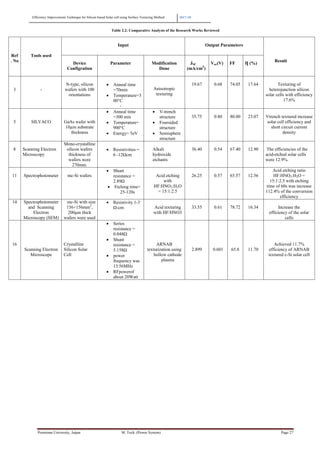
2.2 Comparative Analysis of the Research Works Reviewed 27
5.1
Parameter Used During Simulation
54
6.1 Efficiency Variation with Respect to Dimension of Pyramid
(µm)
60
6.2 Efficiency of Pyramids Texture Solar Cell Compared with
Flat Surface Silicon Solar
61
Efficiency Improvement Technique for Silicon based Solar cell using Surface Texturing Method 2017-18
Poornima University, Jaipur M. Tech. (Power System) Page x
LIST OF FIGURES
Figure
No.
Name of Figure Page
No.
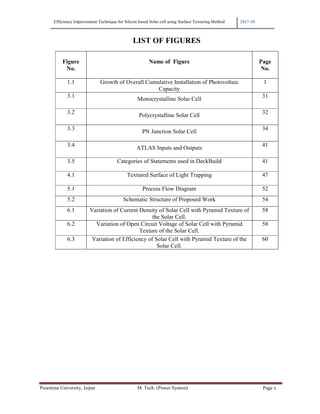
1.1 Growth of Overall Cumulative Installation of Photovoltaic
Capacity
1
3.1
Monocrystalline Solar Cell
31
3.2
Polycrystalline Solar Cell
32
3.3
PN Junction Solar Cell
34
3.4
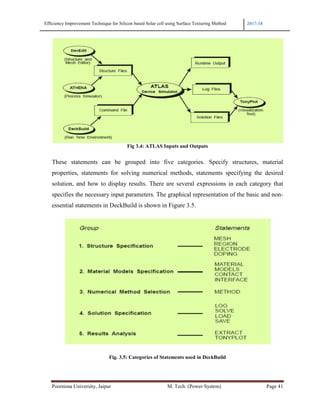
ATLAS Inputs and Outputs
41
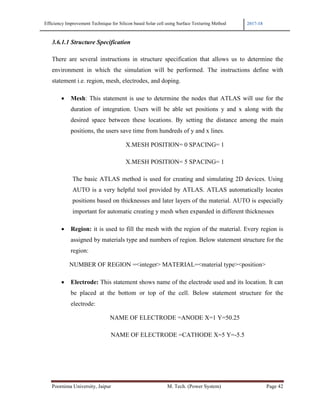
3.5 Categories of Statements used in DeckBuild 41
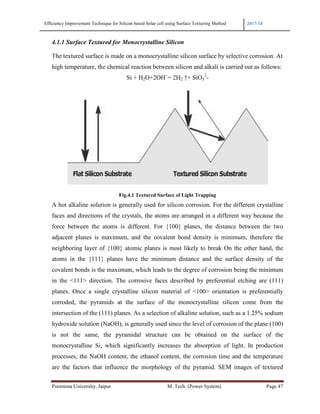
4.1 Textured Surface of Light Trapping 47
5.1 Process Flow Diagram 52
5.2 Schematic Structure of Proposed Work 54
6.1 Variation of Current Density of Solar Cell with Pyramid Texture of
the Solar Cell.
58
6.2 Variation of Open Circuit Voltage of Solar Cell with Pyramid
Texture of the Solar Cell.
58
6.3 Variation of Efficiency of Solar Cell with Pyramid Texture of the
Solar Cell.
60
Efficiency Improvement Technique for Silicon based Solar cell using Surface Texturing Method 2017-18
Poornima University, Jaipur M. Tech. (Power System) Page xi
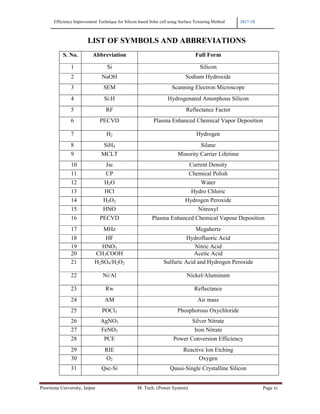
LIST OF SYMBOLS AND ABBREVIATIONS
S. No. Abbreviation Full Form
1 Si Silicon
2 NaOH Sodium Hydroxide
3 SEM Scanning Electron Microscope
4 Si:H Hydrogenated Amorphous Silicon
5 RF Reflectance Factor
6 PECVD Plasma Enhanced Chemical Vapor Deposition
7 H2 Hydrogen
8 SiH4 Silane
9 MCLT Minority Carrier Lifetime
10 Jsc Current Density
11 CP Chemical Polish
12 H2O Water
13 HCl Hydro Chloric
14 H2O2 Hydrogen Peroxide
15 HNO Nitroxyl
16 PECVD Plasma Enhanced Chemical Vapour Deposition
17 MHz Megahertz
18 HF Hydrofluoric Acid
19 HNO3 Nitric Acid
20 CH3COOH Acetic Acid
21 H2SO4/H2O2 Sulfuric Acid and Hydrogen Peroxide
22 Ni/Al Nickel/Aluminum
23 Rw Reflectance
24 AM Air mass
25 POCl3 Phosphorous Oxychloride
26 AgNO3 Silver Nitrate
27 FeNO3 Iron Nitrate
28 PCE Power Conversion Efficiency
29 RIE Reactive Ion Etching
30 O2 Oxygen
31 Qsc-Si Quasi-Single Crystalline Silicon
Efficiency Improvement Technique for Silicon based Solar cell using Surface Texturing Method 2017-18
Poornima University, Jaipur M. Tech. (Power System) Page xii
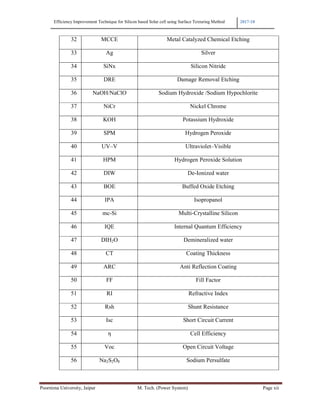
32 MCCE Metal Catalyzed Chemical Etching
33 Ag Silver
34 SiNx Silicon Nitride
35 DRE Damage Removal Etching
36 NaOH/NaClO Sodium Hydroxide /Sodium Hypochlorite
37 NiCr Nickel Chrome
38 KOH Potassium Hydroxide
39 SPM Hydrogen Peroxide
40 UV–V Ultraviolet–Visible
41 HPM Hydrogen Peroxide Solution
42 DIW De-Ionized water
43 BOE Buffed Oxide Etching
44 IPA Isopropanol
45 mc-Si Multi-Crystalline Silicon
46 IQE Internal Quantum Efficiency
47 DIH2O Demineralized water
48 CT Coating Thickness
49 ARC Anti Reflection Coating
50 FF Fill Factor
51 RI Refractive Index
52 Rsh Shunt Resistance
53 Isc Short Circuit Current
54 η Cell Efficiency
55 Voc Open Circuit Voltage
56 Na2S2O8 Sodium Persulfate
Efficiency Improvement Technique for Silicon based Solar cell using Surface Texturing Method 2017-18
Poornima University, Jaipur M. Tech. (Power System) Page xiii
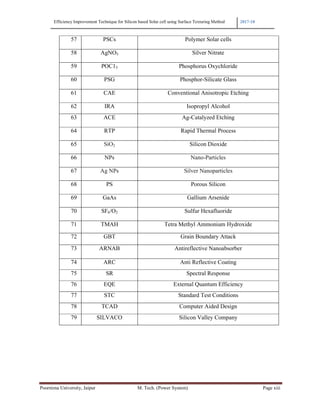
57 PSCs Polymer Solar cells
58 AgNO3 Silver Nitrate
59 POC13 Phosphorus Oxychloride
60 PSG Phosphor-Silicate Glass
61 CAE Conventional Anisotropic Etching
62 IRA Isopropyl Alcohol
63 ACE Ag-Catalyzed Etching
64 RTP Rapid Thermal Process
65 SiO2 Silicon Dioxide
66 NPs Nano-Particles
67 Ag NPs Silver Nanoparticles
68 PS Porous Silicon
69 GaAs Gallium Arsenide
70 SF6/O2 Sulfur Hexafluoride
71 TMAH Tetra Methyl Ammonium Hydroxide
72 GBT Grain Boundary Attack
73 ARNAB Antireflective Nanoabsorber
74 ARC Anti Reflective Coating
75 SR Spectral Response
76 EQE External Quantum Efficiency
77 STC Standard Test Conditions
78 TCAD Computer Aided Design
79 SILVACO Silicon Valley Company
Efficiency Improvement Technique for Silicon based Solar cell using Surface Texturing Method 2017-18
Poornima University, Jaipur M. Tech. (Power System) Page 1
Chapter 1: Introduction
1.1 Motivation: Solving the Energy Crisis with Photovoltaic
Now a day the world has depended on fossil fuels for energy supply. The worldwide
consumption of fossil fuels (coal, gas and oil) is still increasing in spite of the growing
global awareness of the environmental impact of fossil fuel consumption and of limited
fossil fuel reserves. Presently increase in the price of oil has been a most important source
of economical problem in the world. The production of oil level in the world will dissipate
in less than 50 years. So we have strong motivation on our technologies to develop and
harvest the abundant solar energy into clean renewable energy for the ultimate replacement
of fossil fuels. The primary obstacle in the growth of photovoltaic is the high total cost of
photovoltaic installations. In contrast, coal is cheap and abundant in key consuming
countries such as India and China, making coal the world’s rapidly growing fuel.
Consequently, the main aim of this research is making photovoltaic cells more efficient for
converting solar energy into electricity and by reducing production cost. In recent years, the
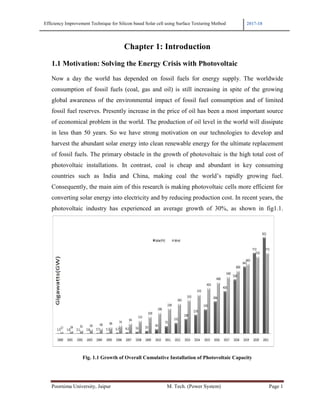
photovoltaic industry has experienced an average growth of 30%, as shown in fig1.1.
Fig. 1.1 Growth of Overall Cumulative Installation of Photovoltaic Capacity
Efficiency Improvement Technique for Silicon based Solar cell using Surface Texturing Method 2017-18
Poornima University, Jaipur M. Tech. (Power System) Page 2
This growth has been supported by the increasing efficiency and associated cost
competitiveness of photovoltaic cells as well as enabling renewable energy policies. To
maintain the high growth rate of the photovoltaic industry, it is essential to continue
improving the conversion efficiency while decreasing production cost of photovoltaic cells.
To increase the solar cells efficiency, we have different solar cell texture technique that
aims to maximize the incident photons absorption and the gathering of photo-generated
carriers. Solar cell design in such a way that the specification of the parameters in order to
maximize efficiency. Historically, higher efficiencies have been achieved by minimization
of optical and electrical losses of silicon (si) solar cells. Combining low cost material with
high light trapping features, the price of solar cells could be reduced. This surface texturing
technique utilizes the reduction of reflections from silicon wafer surfaces and maintains the
long life of minority carriers by diminish process-induced defects.
Texturing is a very effective technique for reducing reflections and is important mainly for
thin films, multicrystalline materials and for capturing light with a high wavelength.
Surface texture technology improves the absorption of silicon by creating arbitrarily
distributed pyramids using anisotropic etching.
1.2 Thesis Summary
The report is structured in the form of chapters, as under:
Chapter 1: Introduction
This chapter briefly focuses on the motivation of this thesis
Chapter 2: Literature Review
This chapter deals with the literature review in different surface texturing
technologies and their performance analysis of solar cell. It also includes the
problem statement and objective of thesis work.
Chapter 3: Design and Fabrication of Solar Cell
This chapter briefly introduces the principles of silicon solar cell, main parameters
that affect the cell performance.
Chapter 4: Surface Texturing
This chapter briefly introduces the principles of surface texture, Optical benefits of
textured silicon, light trapping, Influence of textured surface in solar cell parameters
Efficiency Improvement Technique for Silicon based Solar cell using Surface Texturing Method 2017-18
Poornima University, Jaipur M. Tech. (Power System) Page 3
Chapter 5: Proposed Methodology and Techniques
This chapter includes the details of purposed work along with overall system design
flow and details of simulation.
Chapter 6: Simulation and Result
This chapter includes the simulation results analysis.
Chapter 7 : Conclusions and Recommended Future Work
The conclusion and recommended of future work is discussed in this chapter.
Efficiency Improvement Technique for Silicon based Solar cell using Surface Texturing Method 2017-18
Poornima University, Jaipur M. Tech. (Power System) Page 4
Chapter 2: Literature Review
A literature review is necessary to review the literature on the field of research and what
problem in this area is solved and needs to be solved in the future .An appropriate review of
the literature provides a solid foundation for noble research. To initiate the research, the
first step is to find the research problem and to choose specific objectives of the need. There
are many procedures and processes established by researchers to move on and achieve a
definitive end to the research objectives. In order to select specific objectives of the study
the need to follow a typical process leading to uniqueness, novelty and the significance of
the problem in a specific area/sub-area. It should begin with a wider area/sub-area, and
while studying the literature, magazines, books, research papers, research published in
various conferences, magazines and transactions. The study and understanding of literature,
apart from scientific research, is a bit simple because it explains the concepts in simple and
explanatory techniques. At the same time, these contents cannot be considered as a basis for
concluding that the framework for research objectives is not possible through appropriate
examination by different researchers working in the field. Review of a scientific research
paper is a tedious job. It needs the prior knowledge of the area of research. The scientific
research papers are highly structured, compact and precise in explanation. One may take
few days to few weeks to understand a research paper published in standard peer reviewed
journals. The researchers need to adopt certain path for doing literature review of such
literature.
2.1 Categorical Review on Research Work Reviewed
A detailed review of 26 research papers, on Efficiency Improvement Technique for Silicon
based Solar cell using Surface Texturing Method from year 2002 to 2017 has been
undertaken. The review process based on the five stage analysis, as discussed in previous
section was adopted. All research papers under the following section, would describe the
particular issues found in the area along with the summaries of the papers reviewed under
each issue, followed by common findings. Paper categorization is presented in Table 2.1.
Efficiency Improvement Technique for Silicon based Solar cell using Surface Texturing Method 2017-18
Poornima University, Jaipur M. Tech. (Power System) Page 5
Table 2.1: Issue of Efficiency Improvement Technique for Silicon based Solar cell using Surface
Texturing Method
S. No Name of Issues
Number of Paper Reviewed
Total paper
Conference Journal
1 Design and Modeling of Solar
Cell 3 4 7
2 Efficiency and Parametric
Variation on Solar Cells 4 9 13
3 Manufacturing Cost Consumption
and Time Saving 1 4 5
2.1.1 Issue 1: Design and Modeling of Solar Cell
[Xiaorang Tian et-al, 2015] studied morphological pyramids and etching quantities during
texturing formation processes. They found that the pyramid had a linear association with
the amount of shaping at the transition points of the (100) to (111) planes. 200µm thickness
of phosphor-doped n-type Si wafers 5inch with 3Ωcm resistivity was used. Initially, a
solution of NaOH was used to remove the saw blades. The platelets are formed using
alkaline solutions of chemical etching and after that analyzed for pyramidal morphology
and the quantities of samples forming at certain significant points in the texturing process,
by scanning electron microscopy (SEM), light microscopy and an electronic scale. Cleaning
the wafer by using RCA cleaning procedures, followed by the deposition of a-Si:H film,
using a parallel plate RF PECVD reactor operating at a frequency (13.56MHz). They
observed a surface passivation inherent to a-Si:H layers with a thickness of about 40nm,
which were deposited using precursors SiH4 and H2 to symmetrically form a-Si:H/c-Si/a-
Si:H MCLT test structure. Solar cells were made using texture wafer of different sizes of
pyramids. They indicate that the size of the pyramids can be controlled by observing and
varying the amount of shaping at the point of transition. Mean dimensions of pyramidal
were 0.5µm to 12µm. When the size of the pyramid was less than 1µm or greater than
12µm, it affects the light reflection, life expectancy and productivity of heterojunction
Efficiency Improvement Technique for Silicon based Solar cell using Surface Texturing Method 2017-18
Poornima University, Jaipur M. Tech. (Power System) Page 6
silicon solar cells. The result showed that the impact directly affects the density of photo
generated charge carriers, reversing the tendency of JSC to increase first and decrease
considerably increasing the size of the pyramid [2].
[Matthew B.Edwards et-al, 1997] had demonstrated the property of anisotropic
structuring on the existence and cell performance of the structures of the hetero-junction
layer of i-Si layer. Isotropic etching processes are included for remove metal contamination
preceding to deposition of Si and annealing of deposited i-layer. They showed the
preparation of embossed surfaces with sodium hydroxide before the deposition of an
amorphous silica inner layer. N-type wafer having the (100) orientation was subjected to a
random pyramid form using a 2 percent NaOH solution with 2-propanol, put in as wetting
agent NaOH, were submitted to RCA2 own, engraving, or together. The RCA2 solution
consists of 1:6:1 HCL: H2O:H2O2, the mixture was heated to near 80°C for 5 minutes. CP
etching consisted of random pyramidal shaping using a 2% NaOH solution with 2 percent
propanol mixed as a wetting agent. The CP columns are composed of 300mL of HNO3,
10mL of CH3COOH and 40mL of HF and range from 0 to 60s. The surface of the wafer
was cleaned in H2O2/ H2SO4, followed by a decrease in HF. The samples were instantly
transferred to the deposition system and Si deposited on both sides of the plate to a
thickness of 10nm. The deposition was conceded by a plasma enhanced chemical vapour
deposition (PECVD) method and a ratio of dissolved hydrogen to silane. The application of
the layer I is annealed at ~ 300 ° C. in the air for a time ranging from 0 to 70 minutes. Then,
again the wafer was transferred into the PECVD system for the deposition of a layer of a-
Si, deposited by a p-type, face and n-type dosed a-Si back layer. Finally, the contacts were
added, consisting of Al/Ni grids and transparent conductive oxide at the front and an
aluminum back cover. They suggested that a chemical polishing engraving of NaOH
texturing or at low temperatures, which were annealed after texturing with the accurate
deposition parameters, can achieved effective wafer existence which exhibits excellent
passivation of the area. They also suggest that correct wafer surface preparation can lead to
excellent solar cell performance [3].
Efficiency Improvement Technique for Silicon based Solar cell using Surface Texturing Method 2017-18
Poornima University, Jaipur M. Tech. (Power System) Page 7
[Su Zhou et al, 2013] proposed acid texturing multi crystalline silicon slices, to improve
trapping incident light and enhance the efficiency of solar cells. Acid texturizing solution
had been considered to reduce grain boundaries and imperfections that can occur in the
texturizing method. For texturing a mc-Si p type, as a base 156 x156mm2
wafer thickness of
200µm using with a resistivity 1 to 3Ω-cm. This process takes place on RENA through the
texture. Firstly, the wafer was formed using acid mixtures including various ratios of HF,
H2O and HNO3 to optimize the solution that was formed. Wafer of different depths of
etching were then obtained by controlling the formation time. Then, the emitter was
dissipated by phosphorus with a POC13 at 835° C in an open furnace. After removing glass
phosphor film, Si3N4 films and the edges deposited by PECVD in a conservative plasma
reactor operating at 13.56MHz, by a mixture of ammonia and SiH4 and the temperature
was put at 450°C. Finally, the diffuse wafer of mc-Si was carried out using the paste of A1
and Ar standard protective metallization, by baking in a furnace at a temperature of 930°C.
The reflective surface was passivated at 300-1200nm range and surface morphologies of the
textured samples were measured using spectrophotometer and SEM. Weighted reflection
(Rw) was calculated by integrating the AM1.5 reflection losses at 300-1200nm. Finally,
they concluded that the solar cells efficiency was improved by optimizing the
multicrystalline silicon texturing process [14].
[In-Ji Lee, et al., 2013] proposed a pyramidal texture surface device for solar cells, which
had been filled with silicon nanowires. P-type silicon wafer with a resistivity of 1 to 3Ωcm
and the thickness of 200µm was etched using 2% by weight a solution of KOH, to generate
square pyramids dispersed randomly on the surface of silicon. Pyramid-shaped silicon
wafers were immersed in a mixed solution of AgNO3 (0.068g), deionized water (160ml)
and HF (46ml) for 30s, in order to place nanoparticle Ag masks on the silicon texture of the
pyramid. Then, the pyramid-shaped silicon wafer masks Ag etched nanoparticles with a
solution of FeNO3 (8.16 g), HF(46ml) and deionized water (160ml) for 0, 1, 2, 3, 4, 5, 7, 10
and 15 min, electro-less etching, to produce silicon nanowires on the wafer surface.
Photovoltaic efficiency was evaluated by a solar simulator under the spectrum of solar light
(AM) 1.5. Finally, they came to the conclusion that n-type silicon photovoltaic cell with
nano-silicon coating on the silicon texture pyramid is increased by 10% in PCE compared
Efficiency Improvement Technique for Silicon based Solar cell using Surface Texturing Method 2017-18
Poornima University, Jaipur M. Tech. (Power System) Page 8
to a conventional p-type silicon photo-voltaic cell that skipped anti-reflective coating
process.[15]
[K. A. Kavadias, et al, 2013] provided nanocrystalline surface textured with
nanocrystalline columnar structures of 50 to 100nm diameters and 500nm depth, formed by
RIE in multi hollow cathode system. The light that shines on the etched silicon surface RIE
was reflected in both directions between the spikes so that most of them never came back.
The release of the radio frequency from the hollow cathode allowed the amplitude density
of the plasma to be improved relative to the standard parallel RF scattering parameters. The
process of plasma etched had been developed using O2/SF6 mixture to produce a random
silicon textured surface that appears black to the bare eye. The result of texturing was
obtained while using the RF power of 20W of a cathode reactor with their multi hollow
cathode glow. The frequency of RF was 13.56MHz. The partial pressure coefficient of
O2/SF6 was 2.5 and the etching pressure was 50mTorr for the plasma glowing conditions.
The texturing time is 20 minutes. After textured etching using a plasma system with multi
hollow cathodes, the textured surface resembles a black surface. They had effectively
achieved 11.7% efficiency of textured crystalline silicon solar cell using low-cost spin-on
coating doping [16].
[Qiang Wang, et al, 2017] proposed work in which a crystalline silicon quasi-single-cell
solar cell with a combination of mc-Si grains and sc-MCCE nano-texture process. Initially,
all QSC-Si wafers of p-type with resistivity 1-3Ωcm were treated with an etching of
hydrofluoric acid/nitric acid from the texture of the surface. Then the QSC-Si pre-textured
wafers were applied to the MCCE. Then micron-textured wafers were put down with Ag
nanoparticles and etched with a solution of HF/H2O2/H2O, to form the surface of some
nano-pores. The wafers were etched in HF/HNO3 solution to render the nano-pores in the
final nano-texture which was immediately immersed in a 69% HNO3 solution to remove the
remaining Ag nanoparticles. Finally, all QSC-Si nano-texture wafers were accumulated into
cells using a conventional method involving diffusion of phosphorus removal from the back
edge and p-n junction, chemical evaporation delayed plasma SiNx anti reflection layer and
metallization front and back contacts. The efficiency of the nano-textured cells increases
from 18.4 to 18.9%, due to the different qualities of the wafers from the bottom to the top
Efficiency Improvement Technique for Silicon based Solar cell using Surface Texturing Method 2017-18
Poornima University, Jaipur M. Tech. (Power System) Page 9
of a Qsc-Si, and the color difference in the Qsc-Si cells was depressed. Parallel model used
subcell, which explains the characteristics of the QSC-Si cell, which is mainly limited by
the worst subcell. The results show that the efficiency of QSC-Si solar cells is 18 % more
than that of mc-Si solar cells [24].
[Fenqin Hu, et al., 2017] had been developed alkaline etching two-step process for
forming a flat surface on the wafer, which can be rapidly and almost isotropically etched by
immersion in a hydroxide solution. This etching process leads to the formation of a uniform
nanostructure. In order to use the basic process of forming a combination of isotropic
production process and MCCE mc-Si solar cells, the characteristics of these photovoltaic
devices have been studied in detail. There is a p-type mc-Si wafer with a resistivity of 1 to 3
Ωcm, a size of 156 × 156 mm 2 and a thickness of 180 mm. Any raw mc-Si wafers before
etching in the same production batch was immersed in a 4% HF solution for 5 minutes to
remove the native oxides and then rinsed in deionized water. In step 1, the two types of mc-
Si platelets are Damage Elimination Engraving (DRE). The etching solution in an HNO3/
HF wafers mixture labeled H-DRE, and the first etching in a NaOH solution, then etched in
the slice of a NaOH/NaCl solution is identified as the N- DRE. In step 2, the same MCCE
process is performed on both layers of H-ERD and N-ERD. In this process, first, with the
coating layer of Ag nanoparticles, then etching in a solution of mixing HF/H2O/ H2O to
form a nano-porous surface. After the NaOH/H2O etching solution in the nanopores of the
pretend pyramid, and finally all the platelets were immersed in 69% HNO3 to remove the
remaining Ag nanoparticle. The manufacturing process, the wafer is designated as H-DRE
mc-Si, H-DRE Bmc-Si, and N-DRE Bmc-Si. In step 3, the plates are assembled in the cells
(20 samples each) and the formation of a phosphor diffusion n + emitter, the removal of the
edge and back p+
junctions, chemical vapour phase antireflection activated by SiNx plasma
and the passivation layer having a thickness of 80 nm, and screen printing, to form the
sample Ag and Al+ contact in the back surface. The etching process results in the formation
of a homogenous nanostructure improve repeatability and performance of the cell, while
increasing the short circuit current and the open circuit voltage. [25]
Efficiency Improvement Technique for Silicon based Solar cell using Surface Texturing Method 2017-18
Poornima University, Jaipur M. Tech. (Power System) Page 10
[Rahul Dewan, et al., 2011] investigated the propagation of optical waves in
microcrystalline thin-film silicon solar cells with pyramidal surface structures and
compared to the theoretical limitations of light capture. The effect of texture duration,
texture height and microcrystalline silicon diode thickness on short-circuit current and
quantum efficiency was also studied. The short-circuit current was maximized for
pyramidal periods of 700 to 1200nm and a height of 400 to 500nm. A comparison of the
simulated quantum efficiency and the short-circuit current with the theoretical limits of
light capture shows that as the thickness of the solar cell increases, the structure reaches its
limit. The comparison of simulated quantum efficiency and short-circuit currents with the
theoretical limit of light capture showed that the structures reached the limits with
increasing solar cell thickness. In order to improve the absorption in the silicon layer i, the
parasitic losses in the solar cell must be minimized. Optically improved short-circuit current
the thinner solar cells have the highest relative gain. For a solar cell with an absorber
thickness of 500nm, the simulated solar cell has a gain of 106%. At an absorber thickness
of 3500nm, the relative gain is reduced to 27%. The main mechanism of cell loss is
reflection, not loss of absorption. As solar cells become thinner, effective light harvesting
techniques can guide the absorption of light into the cell to become more important.
2.1.2 Issue 2: Efficiency and Parametric Variation on Solar Cells
[G.Kumaravelu et al., 2002] had developed a reactive ion etching process for surface
texturing. The monocrystalline silicon had a thickness of 500µm, was cut into a p-type of
20x20mm and a resistivity of 1Ωcm was used as a substrate. Photolithography was
performed using a conventional mercury beam alignment mask characterized by broadband
illumination with a dominant wavelength between 313 and 600nm to define the pattern. In
all experiments, the exposure time was 35seconds. In the lithographic substrate, a
chromium mask on the glass was used. A commercially available g-line photoresist is used
to define the template. All samples were developed with Shipley MF320 developer in
deionized water at a 3:1 dilution for 10seconds.The etching technique is used to create hole-
type structures and the pickup technique to create column type models. NiCr 40nm was
evaporated on the substrate.For the surface texture, three structures were compared: the
structure of the column. It can be seen that on three types of textured surfaces, the reflection
decreases at a wavelength of 250 to 2500nanometers. In particular, at a wavelength of 250
Efficiency Improvement Technique for Silicon based Solar cell using Surface Texturing Method 2017-18
Poornima University, Jaipur M. Tech. (Power System) Page 11
nm to 1000nm including the visible region, as expected, the reflection greatly decreases
relative to the polished silicon surface. Conical surface of the reflective structure at a
wavelength less than 400nm at 1000nm is 0.4%, with a minimum of 0.29% at 1000nm,
which is much smaller than the reflection factor obtained in the opening. The untreated
silicon wafer had a reflectance of about 40% at a wavelength of 400nm to 1000nm and at
least 32% at 1000nm. By way of comparison, the reflection of the pore structure was about
8.8% at a wavelength of 400nm to 1000nm, and the minimum value at 1000nm was 4.8%.
The pore structure has a higher reflectance than the column structure at a wavelength of 400
nm to 1000nm. At wavelengths greater than 1000nm, it shows about 8% less reflection than
the column structure, but this may be due to the support layer used in the measurement. The
reflectance of the surface without the etched surface is less than 1.4% at a wavelength of
400 nm to 1000 nm and a minimum of 0.8% at 1000nm.column, pore and black silicon of
Different texturing structures were examined and compared in wavelength and it was found
that the reflection of the textured columnar structures was less than 0.4% at wavelengths of
500nm at 1000nm and shows a minimum of 0.29% 1000nm, while the reflection of black
silicon was about 1% and the hole structure is about 6.8% in the same wavelength range
[1].
[E. Manea, et al., 2007] had proposed an experimental study on increasing the efficiency
of silicon solar cells using texture techniques on the front surface. The texturing processes
of the surface of the high efficiency solar cells were used monocrystalline silicon wafers
doping with boron having resistivity 1-2Ωcm and thickness 380um. They were considered
three types of surface texture these are regular pyramids structure, honeycomb structure and
electrochemical porosification of the silica. First two textures are prepared by the processes
of the integrated circuit technology planar i) increase the surface of the silicon wafer the
with silicon dioxide layer of 800nm thickness as mask of etching (ii) the process of
photolithography on the basis of positive photo resist, which are carried out the windows
scratched in silicon dioxide. In the case of a honeycomb, the windows are 4µm,
respectively 6µm in diameter and were also spaced above an equilateral triangle with 20µm
side on entire surface of silicon wafer. Silicon was isotropically etched with two types of
acid solution HNO3:NH4F:HF:H2O-(280:6:3:140) and CH3COOH:HNO3:HF-(10:25:1). The
shaping deepness was 7µm and 5µm respectively. For the solution of HNO3:
Efficiency Improvement Technique for Silicon based Solar cell using Surface Texturing Method 2017-18
Poornima University, Jaipur M. Tech. (Power System) Page 12
NH4F:HF:H20-(280:6:3:140) during etching was 10 times smaller compared to
CH3COOH:HNO3: HF- (10:1:25) uniform on the entire surface of silicon wafers and good
etching time management. The application of texture processes with small masks leads to
reflections of less than 10%. Photolithography was used to produce samples through the
SO2 layer first developed on silicon wafers. The holes were equally spread all over the
surface and the find the distance between the centers of holes was defined as 20µm. The
Semispherical walls were placed in holes with isotropic etching until the walls of the
adjacent walls meet. For the pyramidal walls formation a photolithographic technique and
etching were used in a 40% KOH solution. The texture of an antireflection layer obtained
by oxidation of silicon leads to a reflection reduction of less than 5%. The antireflection
technique applied to the solar cells leads to a significant increase in the trapping of light in
the structure, which make it possible to achieve conversion efficiency greater than 20% [7].
[Hayoung Park, et al., 2009] used mixture of aqueous acidic acid for the saw-damage
etching process. The etching of silicon is isotropic in nature. The aim of the author is to
improve the final texture of the surface by using an acid etching of the saws to produce
small pyramids of regular shape. SEM and spectrophotometer was used to estimate the
surface of textured. Mono-crystalline silicon wafers with resistivity’s 6–12Ωcm and
thickness of 270m. Wafers surfaces were first cleaned to remove all organic and metallic
impurities. For this cleaning process, sulphuric acid mixed with a solution of hydrogen
peroxide (SPM) and hydrochloric acid mixed with a solution of hydrogen peroxide (HPM)
was used on the basis of a standard RCA cleaning. After soaking thoroughly with de-
ionized water (DIW) between every cleaning stage, the wafers were soaked in a buffed
oxide etching (BOE) to remove the natural oxide layer. In comparison, the wafers were
prepared with three different surface morphologies. Section 1 was not saw-damage-etched
wafer and section 2 was saw-damage etched with KOH solution. At last Sample 3 wafers
were saw damage etched with an aqueous acid mixture. All wafers were then
anisotropically formed etched using solution mixture of KOH and IPA. It showed that acid
etching saw damage had the potential to get better cell efficiency. Compared to the alkali
saw-damage-etched solar cell, JSC for acidic saw-damage-etched solar cell increases almost
10% indicating effective capture of photons due to the textured surface [8].
Efficiency Improvement Technique for Silicon based Solar cell using Surface Texturing Method 2017-18
Poornima University, Jaipur M. Tech. (Power System) Page 13
[yuang-tung cheng, et al, 2011] proposed an acid texturizing method for multicrystalline
silicon solar cells (mc-Si) to improve their efficiency. The acidic texture is cheap, fast, very
simple, inexpensive and suitable for mass production. P-type Mc-Si wafer was used with
resistivity of 0.1-0.5Ωcm and a thickness of 300µm with 125mm×125mm. The isotropic
acid test for the mc-Si wafers was carried out with a mixture solution HNO3 and HF.
surface texturing and removal of the saw damage layer can be accomplished in one step for
an acidic etching solution. The substrate of the mc-Si solar cell was initially etched with the
HNO3, HF and H2O acid mixture in a 1:2.5:2.5mixture for 20s, 15s, and 25s. The etching
time for the four different set was taken as 120s, 60s, 30s and 25s. All etching was
performed at room temperature. All the samples of textured were measured with a
spectrophotometer and the surface of the samples was examined under a SEM. In order to
compute the PV effect, the I-V curves were represented on a curve tracer. The IQE curve
with an acidic solution (HNO3:HF:H2O =1:15:2.5) is higher than that of the alkaline texture
and non-etching on mc-Si [11].
[Ali Assi et al., 2012] presented the fabrication, characterization, and analysis of mc-Si
solar cells. Authors used an acidic texture method that increases parasitic resistance losses,
provides a grain boundary defect, and degrades electrical characteristics. By varying the
composition of the solution of texture, the defective etching was minimized, but leads to a
polished texture and thus lowers the absorption of incident. In order to improve the incident
light absorption isotropic texture was extensively used with nitric acid (HNO3),
hydrofluoric acid (HF) and demineralized water (DI H2O). The diffusion of phosphorus
temperature, phosphorus concentration, refractive index (RI) of anti reflection coating
(ARC), coating thickness (CT), and the sintering rate of metal electrodes were studied. A
batch of 156mm2
was produced with 16.54% average cell efficiency, which was 0.42%
absolute and the shunt resistance (Rsh) was increased twice compared to the standard
method. They can be analyzed and compared to surface morphology of open circuit voltage
(Voc), short-circuit current (Isc), fill factor (FF), efficiency the cell (η) reflection factor
(RF) [12].
[Yuxin Xia, et-al, 2013] proposed pyramid-shaped PSCs with trapping of light in the entire
360◦ directions as well as complete space utilization when assembled into device. The
Efficiency Improvement Technique for Silicon based Solar cell using Surface Texturing Method 2017-18
Poornima University, Jaipur M. Tech. (Power System) Page 14
advantage of a pyramidal PSC was that it can fully utilize the limited space. The pyramidal
device consists of four independent triangular solar cells with a fixed area of 1cm2
for each
of them. These triangular solar cells are placed on a certain pyramid-shaped support which
serves as four lateral sides of the pyramid so that the lateral surface of the pyramidal device
was a total of 4cm2
. Eight copper contact probes used to mount on the support, two for
each cell which could establish close contact with the electrodes of the solar cells. Probes
can be connected with the cells in series, parallel and in series parallel to obtain an
appropriate Voc and a suitable JSC. The absorption of light depended on the angle of two
opposite sides of the pyramids (β). The absorption throughout the entire visible range
became stronger when β decreases from 180° to 30°. Decrease in β due to the irradiated
light on the active layer per unit area may be weaker and thus the light can be absorbed
more efficiently. When β decreases, the lighting will probably be reflected more times,
which means more light absorption time in the device and it also helped the light trapping.
Thus, when β decreases, the effect of lighting of the light is more efficient which leads to an
increase in the collection of photons and Jsc [13].
[Dimitre Z., et-al, 2013] proposed random upright pyramids microtexture on
nanostructured silicon surfaces, obtained by electroless processing in Na2S2O8 solution,
followed by etching in H2O2/HF/H2O. In the KOH-IPA solution at 80°C for 45 minutes was
performed texturization with micron sized random pyramids. Textured wafers were cleaned
in a mixture of H2O2:HCl:H2O at 80°C for 10minutes and then wafer surfaces H-terminated
in diluted HF. Random nano pyramid texture was produced by a two-step method
consisting of electroless treatment in an acid aqueous solution of AgNO3 (pH <3) and
Na2S2O8 for 6minutes followed by etching in aqueous solution of H2O2 and HF and for
2min. Both treatments were performing at room temperature on a wafer of pseudo-square
with length 125cmx125cm. The details of the preparation of the electroless solution were
described in the. The normal sheet resistance after diffusion of phosphorus oxychloride
(POC13) and the removal of phosphorus-silicate glass (PSG) in dilute HF was calculated at
about 80Ω/square. After PECVD deposition of antireflection and SiNx passivation layer on
the front surface of the wafer, the contact with the silver pattern and the aluminum surface
of the back surface were formed by screen printing and co-firing in an infrared belt furnace.
The overall reflectance of texturized wafers and solar cells was measured with a Hitachi U-
Efficiency Improvement Technique for Silicon based Solar cell using Surface Texturing Method 2017-18
Poornima University, Jaipur M. Tech. (Power System) Page 15
3010 spectrophotometer equipped with an integrating sphere in the wavelength range of
300-900nm. The wafer surface morphology was examined by a SEM technique. For SEM
measurements were drawn square pieces of 20mmx20mm, using laser cutting. Finishing
performance of solar cells was analyzed by reflection, quantum efficiency and I-V
measurements. Determination of the current-voltage (I-V) parameters of the solar cell was
carried out at 25°C under AM1.5G solar spectrum using a Wacom solar simulator an output
power of 1000 W/m2
. Nanoporous structure with relatively shallow pore depth and reduced
contact emitter leads to improved blue response and increased Voc and JSC in two-
dimensional textured cells [17].
[Ayman Ahmed, et-al, 2015] proposed surface texturing techniques with an alkaline
solution for monocrystalline Si (c-Si) solar cells were usually accepted to enhance cell
performance. Multicrystalline cells (mc-Si) were complicated to form by alkaline etching
due to the grains of the substrate are randomly oriented. They considered the HF/HNO3
/H2O acid solution to texturize the mc-Si cells. The isotropic textureing of the mc-Si wafer
was performed using a mixture of HNO3 and HF. For an acidic removal of saw damage,
etching solution and surface shaping can be accomplished in one step. The rate of etching
was about 5m/min. A sequence of experiments based on acid etching was performed by
various processes. In the first part of the mc-Si solar cell prototype experiment, the
substrate was etched with the sequence of an acid solution of H2O, HF and HNO3 and in a
mixing ratio of 2.5:2.5:1 at 25s, 15s and 20s. When optimizing the shape, the HF ratios are
changed in three different recipes of 5, 15 and 30. The duration of the etching of the four
different sets is taken as 120s, 60s, 30s and 25s. Every etching was performed at room
temperature. Conversion efficiency of the mc-Si solar cells, textured with the HNO3/HF
/H2O=1:30:2.5 solution had comparatively high values. The optimal ratio of HNO3:HF:H2O
= 1:30:2.5 bind with etching time of 60s and a reduction of 41.9% compared to the R value
can increase 111.8 % of the conversion efficiency (η) of the solar cells. The acid texturing
approach is a tool for achieving high efficiency in mass production, using a comparatively
low cost mc-Si as an initial material with the appropriate optimization of the fabrication
stages [18].
Efficiency Improvement Technique for Silicon based Solar cell using Surface Texturing Method 2017-18
Poornima University, Jaipur M. Tech. (Power System) Page 16
[Min Young Kim, et-al, 2015] proposed the effect of surface texture on the efficiency of c-
Si solar cells. To examine the effect of the texture, the solar cells were produced with
different surfaces textured using conventional anisotropic etching of a combination of
isopropyl alcohol and KOH, RIE and Ag-catalyzed etching. They used p-type
monocrystalline Si wafer of a thickness of about 200µm and a resistivity of about 1.5 Ω-cm.
The abrasive wafers were etched using KOH to eliminate surface damage caused by the
saw wires. After elimination of the damage had many different texturing techniques,
including conventional anisotropic etching (CAE) with a combination of KOH, isopropyl
alcohol (IRA), Ag-catalyzed etching (ACE) and reactive ion etching (RIE). They also
realized a macro-micro textured mixing method in two steps. They used the following
procedure: The first etching was done using CAE. The textured Si plate was then etched
again using RIE or ACE. After the surface treatment, the m-Si solar cells were prepared
with a 60Ω/square n-type emitter by performing a conventional diffusion of POCL3. The
Phosphosilicate glass (PSG) glass layers on wafer surfaces were removed by immersing
them in a solution with a buffered oxide etch (BOE) for one minute. To deposit a layer of
silicon nitride (SiNx) with a thickness of about 76nm using PECVD as a passivation layer
and an antireflection layer on the front surface at 400°C. The refractive index of the SiNx
film was maintained at 1.95. The front and rear metallizations were carried away by a
screen printing technique with a standard Ag paste for the front surface and an Al paste for
the rear surface. The metal contacts were produced by rapid thermal process (RTP), which
has a maximum temperature of about 620°C. Surface morphologies of Si were analyzed
using SEM with working voltage of 10kV. Reflections of textured Si wafers were measured
using spectrophotometer in the visible range of wavelengths of 400-1000nm. The Si wafers
resistances were measured using a 4-point probe. Current voltage characteristics were
measured using a McScience Lab 50 solar simulator with AM1.5G illumination at an output
power of 100mW/cm2
. The reflection of the textured surfaces ranges from 9.11% to 1.47%
at wavelengths between 400 and 1000nm. In the case of CAE samples, the surface
reflection was 9.11%. The RIE and ACE samples respectively had a reflection of 5.41%
and 5.44% respectively. In the case of two-step etching, the surface reflections were 2.65%
(CAE + RIE) and 1.47% (CAE + ACE). The reflection of the textured Si surface at two
stages was lower, especially at shorter wavelengths. Among the five different solar cell
Efficiency Improvement Technique for Silicon based Solar cell using Surface Texturing Method 2017-18
Poornima University, Jaipur M. Tech. (Power System) Page 17
structures, the solar cell with a two-step textured CAE / RIE combined structure showed the
highest efficiency at 17.78%. It also had a JSC of 37.46mA /cm2
, a Voc of 0.614 V and a FF
of 77.34% [19].
[Ngwe Zin1, et-al, 2016] proposed pyramid rounding textured to improve the conservation
of light. Samples with round and round flat pyramidal form were used. In rounding form a
burning time of 60seconds was accepted for this evaluation. The cells consist of high-
strength FZ plates <100>. The cells with flat and rounded pyramidal structures had a final
thickness of 230µm and 170µm. The current-voltage, measured in the sun, using an internal
solar simulator. Double-sided texture including rounded rare texture, while keep a relatively
low surface recombination. Increasing the rounding time when etching makes the pyramids
with a smaller and smoother texture; resulting in enhanced passivation of the surface. The
rounded textured pyramids reduce Jo up to 65% and Jo fully textured pyramids. Ray tracing
proposed that optimum trapping of light would came from the partially rounded rear
pyramids. Jsc of rounded cells textured compared to that planar rear cell was increased by
0.25mA/cm2
[20].
[A. Hamel, 2016] presented detailed study of light transmission through the textured
surfaces of pyramids, and analyzes the optimal texture of the surface to provide the best
trapping of light to solar cells at the total internal reflection occurring in the medium with a
high index and the nominal critical angle value. The author also analyzed the impact of the
opening between the heads of the two pyramids closest to the textured surface of the solar
cells and its application on photovoltaic parameters such as quantum efficiency. The
material may have five or more consecutive absorptions of incident rays instead of three, as
they change the direction of the reflected beam by changing the angle between the two
adjacent pyramids, the angle of inclination, the incidence angle, the opening between the
heads of the two nearest pyramids and their height. Thus, the angle between the two
adjacent pyramids varies between 20° and 12° and the angle of the incidence was between
80° and 84°. For these values of the angle between the two adjacent pyramids and the angle
of inclination, the opening between the heads of the two nearest pyramids varies
respectively from 3.53 to 2.10µm in a pyramid having a height of 10µm. This led to a
significant increase in quantum efficiency, hence photovoltaic efficiency. The variation of
Efficiency Improvement Technique for Silicon based Solar cell using Surface Texturing Method 2017-18
Poornima University, Jaipur M. Tech. (Power System) Page 18
the absorption coefficient as a function of the reflectance shows different curves
representing the internal quantum efficiency as a function of the reflection coefficient of the
textured photovoltaic cell with cell thickness d = 100µm and L diffusion length =100m.
This difference was compared to the ideal case, in the case of a plane normal to that of the
texture plane was a link for different values of the internal quantum efficiency, which
showed that they were closer to the ideal values if they wanted to take advantage of ray
incidence five times, then the fourth, then three, twice as much as that. The result obtained a
good result, especially for the processed surface of the plane, where the reflection
coefficient r was close to zero and thus the internal quantum efficiency increased almost to
the ideal value [21].
[Sanjay K. Sardana, et-al, 2016] Investigated the effect of SiO2 spacer layer thickness
between the textured silicon surface and silver nanoparticles (Ag NPs) on solar cell solar
cells having a thickness of 200 ± 10 µm without antireflection layer were used. POCL3
diffusion was used for the fabrication of cell. The front and rear contacts were prepared
from Ag and Ag/Al metals, respectively, using a screen printing process. Areas of Small
cells 2.5 to 4 cm2
were used for experimental purposes after cutting large size cells of
standard size. The different thicknesses of SiO2 100, 70, 50, 40 and 300nm layers were
deposited on these cells by RF magnetron sputtering. The refractive indices of the
powdered SiO2 films were evaluated using an ellipsometry of 1.45. SiO2 was applied at an
operating pressure of 4x10⁻²
mbar in an argon gas atmosphere at a flow rate of 20sccm with
an RF power of 200W. Thin solid films having a thickness of 10nm, was also deposited on
the solar cell with and without the SiO2 layer using the same RF sputtering system, but with
a power of 20W. Finally the cells were annealed at 300°C in nitrogen gas environment for
1h to convert Ag ultra-thin film into NPs. A SEM was used to study the surface
morphology of Ag NPs. spectra quantum efficiency measurement system, equipped with a
solution integration sphere RERA, The Netherlands, was used to record the spectra of
external quantum efficiency (EQE) and total reflection. These measurements were
performed under AM1.5G lighting conditions with an incident light power of 100mW/cm2
.
The EQE and Total Reflection spectra were used to calculate the internal quantum
efficiency (IQE) of the cells. AAA class solar simulator by Oriel Newport Corporation,
USA, and the Keithley 2440 output meter was used to measure current density and voltage
Efficiency Improvement Technique for Silicon based Solar cell using Surface Texturing Method 2017-18
Poornima University, Jaipur M. Tech. (Power System) Page 19
(J-V) by illuminating the front of the cell. In order to calibrate the xenon light source, a
certified solar cell from NREL, USA had been certified. The EQE and J-V measurements
were performed on the same cells before and after the deposition of Ag NPs on layers of
SiO2 of different thickness to avoid variations in the electronic properties of the cell. All
these measurements were performed at room temperature. Photovoltaic parameters such as
current density (Jsc), series resistance (Rs), fill factor (FF) and efficiency (η) were affected
due to the cell configuration modified with Ag NP on the layer Optimized SiO2 spacing.
Due to the increased light scattering of NPs Ag in silicon, Jsc increases from 22.23 to
23.81mA/cm2
, increasing efficiency of cell efficiency from 8.7 to 10.0%. They found that
the optimized spacing SiO2 layer was between 30 and 40nm for for enhancing the
photocurrent in the off-resonance (longer) wavelength region and maintenance nearly same
in the SPR region of the Ag NPs. A high thickness of SiO2(≥ 70 nm) has reduced quantum
efficiency clearly demonstrated that to maximize cell efficiency, the spacer dielectric layer
must provide electronic isolation without self-absorption and the optimal coupling
generated close to Ag NPs fields in the silicon base material after the interaction of light
[22].
[Khaldun A. Salman, 2017] had been proposed two texturing methods using porous
silicon (PS) and pyramids to study the improvement of the efficiency of crystalline silicon
solar cells (c-Si). He also showed the representation of c-Si solar cells with different
texturing processes. N-type c-Si substrate orientation (100), 283µm thickness and resistance
0.75Ωcm were used as a substrate for surface texturing using PS and pyramid processes.
Before the texturization process, the c-Si plates were cleaned in H2SO4:H2O2 (2:1) solution.
To perform PS, place the plate in an electrolytic solution (HF: ethanol, 1: 5) with a current
density of 40mA/cm2
and 25min. etching time using a photo-electrochemical cell (PECE)
that was made of teflon and has a circular aperture at the bottom that was sealed by the c-Si
sample. The cell has a two-electrode system connected to the c-Si sample as anode and
platinum (Pt) as the cathode. The morphology of the topography of the surface was
characterized by SEM and AFM, with a high density of nano-pores with high porosity were
produced in the PS layer compared to the lower density nano-pyramids with low porosity
were apparently distributed randomly on the surface of N-type c-Si (100). The high degree
of roughness was confirmed by the higher mean square, which was 330.64 nm for the PS
Efficiency Improvement Technique for Silicon based Solar cell using Surface Texturing Method 2017-18
Poornima University, Jaipur M. Tech. (Power System) Page 20
layers compared to 110.30nm and 2.65nm of Si grown and the texturing of the pyramids.
The light characteristic traps in the PS layer was no longer possible because of the increase,
it significantly reduces the reflection of light with a wavelength in the range of 350-1050nm
compared to the texturing of the pyramids and growing Si. Results showed that the high
conversion efficiency of 13.23% for the PS layer compared to 11.36% and 37% efficiency
for solar cell devices with a pyramidal and Si-grown texture, respectively. The PS texture
showed an excellent reduction of the reflection of the incident light with respect to the
pyramidal process, with a good light-trapping of wide wavelength spectrum which could
produce high efficiency solar cells. [23]
2.1.3 Issue 3: Manufacturing Cost Consumption and Time Saving
[D.H. Macdonald, et-al, 2004] proposed three texturizing methods: wet acidic texturing,
masked and maskless Reactive Ion Etching (RIE) for commercial multicrystalline silicon
solar cells, based on the measurement of reflectance. They found that the three texturing
methods significantly reduced reflection losses in solar cells. They also studied as as-cut
wafers that remain in a damaged state after cutting the wafer. An acidic textured wafer was
made with a HF / HNO3 solution. A wetting agent is added to obtain a more even structure.
Approximately 5-10µm of silicon was removed from each surface. Surface damage was
removed, but its initial presence was critical because it acts as a seeding layer for texturing.
The wafers were placed at random, but the deep features with steep walls that offer very
little reflection. The RIE light plates were much smaller than those of the acid textured
sample. The RIEs were very regular and steep, with a distance of 7µm between the
pyramids. The pyramids were about the same as those of the wet acid texture wafer.
Textured RIE slices create an even greater increase in current compared to the predicted
controls, from 28.25 to 30.63mAcm2
. So, finally, they suggested that the reduction of
impact was most noticeable for masked RIE pyramids, attracted by masked RIE, and then
acid texturing. As a result, the relative distinction between strategies was greatly reduced
after antireflection coverage and encapsulation. In addition, they mentioned that the
implementation costs were much less acidic texturing than RIE processes, especially the
masked RIE. [4]
Efficiency Improvement Technique for Silicon based Solar cell using Surface Texturing Method 2017-18
Poornima University, Jaipur M. Tech. (Power System) Page 21
[Saifuddin M. lalil, et al.2008] had investigated various models of GaAs solar cells with
different texturizing surfaces to improve the spectral sensitivity of photovoltaics by
reducing light reflection and improving light trapping. Four surface texture models were
used: simple structure, four-sided structure, semisphere structure and V-shaped structure of
photovoltaic device. An <100> orientation of a GaAs buffer was selected with a 10
substrate thickness and a concentration of boron was 1×10¹⁷
cm. The p-n branch was
developed by phosphorus doping implantation with 1x10¹⁷
cm-3
and 5eV energy. The anneal
time 300minutes and the anneal temperature 900°C were constant. By changing four
variables of the surface texture, the solar cell with the single p-n can be simulated. By
plotting the characteristic I-V graph, a single-surface solar cell with a three-patterned
textured surface was compared. For the surface treatment technique of solar cells, the
ATHENA software was used as a method of shaping the surface structure. The lowest
efficiency was 20.95%, derived from the normal structure of the solar cell. The V trench
structure was the optimal textured surface for GaAs solar cells compared to the others and
Jsc was 3.5752mA, Voc was 0.800V and efficiency of 23.07% was obtained. They suggest
that the V-trench structure was the best surface texture that has optimal efficiency and
short-circuit current density for the GaAs solar cell than others [5].
[M. Moreno, et-al, 2010] presented a study of the texture of c-Si plates using SF6/O2
plasma in a reactive ion etching (RIE) system. They also determine the combined effect of
RF plasma power and SF6/O2 ratio. They found that by changing the RF power with an
optimized SF6/O2 ratio, it was possible to produce normal or inverted pyramidal structures
with very low reflection values of only 6%. The c-Si texture was realized in a 13.56MHz
RF projection system. Substrates of the p-Si type (100) were used and the resistance was
between 14 and 22Ωcm. Different texturing processes had been systematically studied and
optimized by changing the SF6/O2 ratio from 2 to 10 combined with a wide range of RF
powers (from 25to150 W). For a reliable texture of c-Si, it was found that the ratio of gas
should fall to 3(SF6/O2=99sccm/33sccm). All processes were performed for 15min at a
fixed pressure of 100mTorr. Before each texturing process, they applied oxygen plasma for
5 minutes. A SEM was used to analyze textured c-Si surfaces. The reflection of the textured
samples in the wavelength range of 300 to 1000nm was measured. They used an atomic
force microscope to analyze the roughness of the surface and the profile of the structures
Efficiency Improvement Technique for Silicon based Solar cell using Surface Texturing Method 2017-18
Poornima University, Jaipur M. Tech. (Power System) Page 22
produced on the surface of the c-Si plasma. Finally, Raman measurements were made to
analyze the effect of the plasma process on the surface crystallinity of c-Si. They can
observe the formation of SiOx micro-masks. At 50W, at the same time as the plasma
formation, there was an increase in the structure and a decrease in SiOx micro-masks
thickness, the size of which also decreases due to SF6/O2 plasma etching. It was possible
that at low RF power the texture was controlled by an anisotropic chemical process, more
than an isotropic ion assisted etching process. At 100 and 150W there were no more micro-
masks. These results represented a potential alternative for the production of low cost c-Si
solar cells because the process was completely dry, no DI water, wet chemicals or
photolithography was needed. Pyramid-like normal structures in the c-Si surface resulted in
an average reflection of about 18%, whereas pyramid-reversed structures resulted in
average reflection up to 6% without anti-reflective coating [6].
[Jeehwan Kim, et-al, 2010] proposed surface texturing method to reduce the loss of
surface reflection. The author used a layer of low density SiO2 to allow etching in localized
areas such as the etch mask, forming inverted pyramids. The oxide can be deferred by
plasma enhanced chemical vapour deposition using low deposition temperatures. Density of
PECVD oxide films can be controlled by changing the PECVD deposition conditions, as
deposition temperature, plasma power and gas pressure. The deposition temperature was
one of the strong factors that determine the density of the film. They varied the deposition
temperature to deposit SiO2 with different densities. SiO2 film 25nm thick was deposited on
single crystalline. The thermal oxide was also grown at 800°C with the same comparison
thickness. Silicon substrates with various oxides were dipped in a TMAH solution at 90°C
for 5 minutes. This process can be categorized in four steps; Step 1: Formation of inverted
pyramids, step 2: coalescence of inverted pyramids, step 3: removal of masks and
extinction of inverted pyramids, and Step 4: Formation of upright pyramids. Semi-
dimensional reflection of the samples at each step, measured using an integrating and
monochromatic sphere. About 40% of the impact reduction had to form step 1 which had
partially coated the surface of the inverted pyramid. 14% hemispheric reflectivity was
observed for the sample from step 2, which was as good as the effect obtained by the
classical upright pyramidal patterns [9].
Efficiency Improvement Technique for Silicon based Solar cell using Surface Texturing Method 2017-18
Poornima University, Jaipur M. Tech. (Power System) Page 23
[Nirag Kadakia, et-al, 2010] proposed a method based on ion implantation and thermal
annealing to produce silicon surface textures for antireflection purposes. The crystalline Si
surface modification by implantation of hydrogen ions was a well-known phenomenon, but
the surface structures generated by the implantation of H, usually low density packing, and
a small proportional amount, were not effective in the suppression of the light reflection of
Si. A critical step towards increasing the efficiency of sunlight to transform electricity
through photovoltaic action was to minimize the impact of sunlight on the surface of solar
devices. Implantation of ionic hydrogen was useful for surface texturing due to the
exfoliation phenomena of Si crystals. Evolution of surface morphologies with quenching of
n-type crystal temperature Si (100), 10-20Ω cm, implanted with 20 kV H ions at the flow of
8.7x10¹⁶
/cm2
. Samples implanted with H, micron sized blisters appeared on the Si surface,
followed by annealing above 500°C for 75minutes, and many of them even inside the
craters. At 1100°C, a noticeable exfoliation of Si, leading to the formation of micron-sized
hillock-shaped structures, poorly distributed on the surface of the sample implanted with H.
Atomic force microscopy indicates that the height of these structures was near 200nm,
suggests that Si delamination occurs at a depth deeper than the maximum concentration of
H at 270nm below the surface. H implantation samples were implanted with 90kV Ar ions,
designed in the 100nm range at room temperature to a fluence of 5.5 x 10¹⁵
/cm2
. Surface
blisters appear at 400°C and they did not evaporate until the annealing temperature does not
exceed 800°C. At 1100°C quite different surface morphology was characterized by
interconnected structures, such as that the depth of 1µm and 1 to 2µm the width, density and
aspect ratio was much higher than those surface textures generated from a single implant H.
The concentration of Ar peaks implanted around 100nm from the surface, Ar implantation
gives amorphous layer starting from the surface at the 300nm depth, close to the maximum
ionic ion implanted distribution, determined by diffusion analysis Rutherford reaction,
respectively. A-Si layer in the formation of surface textures with high density and high-
aspect-ratio of appearance necessary to effectively suppress the reflection of light. The
effect of the interference becomes more pronounced than the thickness of the a-Si layer
greatly decreased after heat treatment at 900°C. They also found that the diffuse reflection
loss of this sample remained below 5%, only slightly higher than that of the polished virgin
1% Si. By changing the energy and the fluence for the Ar ions, they produced different
Efficiency Improvement Technique for Silicon based Solar cell using Surface Texturing Method 2017-18
Poornima University, Jaipur M. Tech. (Power System) Page 24
layers of a-Si with a thickness much smaller or greater than 300nm, but these Ar implants
did not give the desired surface texture. In conclusion, the construction of surface texture
based on co-implantation of H and Ar combined with thermal annealing and oxidation was
suitable for Si antireflection. The lowest reflection obtained with respect to the AM1.5 solar
spectrum is 1% for a wide range of the incident [10].
2.2 Common findings under the issues “Efficiency Improvement
Technique for Silicon based Solar cell using Surface Texturing
Method”
I have reviewed 25 research papers which are related to Efficiency Improvement Technique
for Silicon based Solar cell using Surface Texturing Method. To enhance the efficiency of
solar cell authors proposed difference structure modification, different materials and
techniques. Some common findings that are used by the researchers are listed below along
with their brief introduction:
• CP etching or low temperature anneal after texturing with the correct deposition
parameters, can achieve the effective lifetimes of the wafers greater than 1ms, which
exhibits excellent surface passivation[3].
• Alkaline etching to eliminate saw damage and do not create texture produces high
reflectivity. In fact, for samples with this thickness (about 275 mm) perfectly
polished surface will also lead to a reflection of about 34% [14].
• The optimal ratio of etching acid HF: HNO3:H2O=15:1:2.5 with the etching time of
60seconds and the lowering of 42.7% of the reflection improves 112.4% of the
conversion efficiency of the solar cell developed [11].
• The solution HNO3/HF/DI H2O was used for mc-Si solar cells, which considerably
reduces the reflection factor, but also creates a significant number of dark lines in
the grain boundaries known under grain boundary attack GBT. To reduce GBT, they
studied the use of sulphuric acid (H2SO4), acetic acid (CH3COOH) phosphoric acid
(H3PO4) [12].
• Recipe solution for Group A texturing is HF: HNO3: H2O=1: 2: 1.5, and the depth
of shaping is 3.6µm, and that of group B is HF: HNO3: H2O=1: 4: 2 and 4.1µm. The
parameters of the cell, such as open circuit voltage, short circuit current and
Efficiency Improvement Technique for Silicon based Solar cell using Surface Texturing Method 2017-18
Poornima University, Jaipur M. Tech. (Power System) Page 25
efficiency, have been improved. This showed that the ratio HF: HNO3: H2O changes
from 1: 2: 1.5 to 1: 4: 2. It was possible to observe the deep grain boundaries and
openings, which can lead to the shunt [14].
• Production process of silicon nanowire using the Ag nanoparticle mask and
electroless etching, should be a key engineering technique that maximizes the
photovoltaic efficiency of silicon solar cells [15].
• P-type silicon photovoltaic cell with nano-silicon coating on a silicon surface with
textured pyramid increased by 10% at PCE, in comparison with the conventional
photovoltaic cell of p-type silicon, where the coating of anti-reflective process
skipped [15].
• Antireflection textured surface property ARNAB was examined and compared with
silicon samples coated with a wet texture and PECVD. A solar cell was used using
low-cost spin-on coating technology. Solar cell using low-cost spin-on coating
technique has been verified. They have successfully achieved 11.7% efficient large
area (98cm2
) ARNAB textured crystalline silicon solar cell using low-cost spin-on
coating doping [16].
• Na2S2O8 treatment, activated by AgNO3 electroless solution and etching in
HF/H2O2/H2O, gave the nanostructure directly onto the pyramids covered silicon
surface was achieved [17].
• Reflectivity values for acid etching and alkali etching were improved by 39.21%
and 2.21% of the value of non-etching [18].
• Textured surface reflections ranged from 9.11 percent to 1.47 percent wavelengths
between 400 and 1000nm, and cell efficiency ranged from 15.83 percent to 17.78
percent [19].
• Samples with a double-sided texture with rounded rare pyramids have a higher light
capture to sample with a flat back surface. Highly potential rounded pyramids in
silicon solar cells results in efficient solar cell production of 24% of the back-
contact [20].
• Evaporation of Silver (Ag) was used on the front (n-type) side of the sample to
structure a metallisation grid pattern and aluminum (Al) evaporation was used on
the rear (p-type) side to form a reflector contact [23].
Efficiency Improvement Technique for Silicon based Solar cell using Surface Texturing Method 2017-18
Poornima University, Jaipur M. Tech. (Power System) Page 26
• QSC-Si solar cells with a mixture of SC- and mc-Si grains showed 18.4% efficiency
to 18.9% using their well established nanotexture process and showed that QSC-Si
can be competitive with both CZ sc-Si and cast mc-Si [24].
2.3 Comparative Analysis of Research Work Reviewed
The conceptual explanation of various experiment and algorithms used has been already
covered in previous sections. Here simulation parameters are material, size, doping
concentration and work function. The performance evaluation parameters taken by different
authors are short circuit current, open circuit voltage, and power conversion efficiency and
fill factor. This section includes the various methodology used by research along with result
obtained. Advantages and limitation of a particular method also has been discussed in
following given comparison table:
Efficiency Improvement Technique for Silicon based Solar cell using Surface Texturing Method 2017-18
Poornima University, Jaipur M. Tech. (Power System) Page 27
Table 2.2: Comparative Analysis of the Research Works Reviewed
Ref
. No
Tools used
Input Output Parameters
Result
Device
Configration
Parameter Modification
Done
JSC
(mA/cm2
)
Voc(V) FF Ƞ (%)
3 -
N-type, silicon
wafers with 100
orientations
• Anneal time
=70min
• Temperature=3
00°C
-
Anisotropic
texturing
19.67 0.68 74.05 17.64 Texturing of
heterojunction silicon
solar cells with efficiency
17.6%
5 SILVACO GaAs wafer with
10µm substrate
thickness
• Anneal time
=300 min
• Temperature=
900°C
• Energy= 5eV
• V-trench
structure
• Foursided
structure
• Semisphere
structure
35.75 0.80 80.00 23.07 Vtrench textured increase
solar cell efficiency and
short circuit current
density
8 Scanning Electron
Microscopy
Mono-crystalline
silicon wafers
thickness of
wafers were
270mm.
• Resistivities =
6 -12Ωcm
Alkali
hydroxide
etchants
36.40 0.54 67.40 12.90 The efficiencies of the
acid-etched solar cells
were 12.9%.
11 Spectrophotometer mc-Si wafers
• Shunt
resistance =
2.89Ω
• Etching time=
25-120s
Acid etching
with
HF:HNO3:H2O
= 15:1:2.5
26.25 0.57 65.57 12.56
Acid etching ratio
HF:HNO3:H2O =
15:1:2.5 with etching
time of 60s was increase
112.4% of the conversion
efficiency
14 Spectrophotometer
and Scanning
Electron
Microscopy (SEM)
mc-Si with size
156×156mm2
,
200µm thick
wafers were used
• Resistivity 1-3
Ω-cm Acid texturing
with HF/HNO3
33.55 0.61 78.72 16.34 Increase the
efficiency of the solar
cells
16
Scanning Electron
Microscope
Crystalline
Silicon Solar
Cell
• Series
resistance =
0.048Ω
• Shunt
resistance =
5.158Ω
• power
frequency was
13.56MHz
• RFpowerof
about 20Watt
ARNAB
texturization using
hollow cathode
plasma
2.899 0.601 65.8 11.70
Achieved 11.7%
efficiency of ARNAB
textured c-Si solar cell
Efficiency Improvement Technique for Silicon based Solar cell using Surface Texturing Method 2017-18
Poornima University, Jaipur M. Tech. (Power System) Page 28
2.4 Strengths and Weaknesses of Research Works Reviewed
After, the review of 26 research papers in the field of Efficiency Improvement Technique
for Silicon based Solar cell using Surface Texturing Method. Then there were a strengths
and weaknesses of different approaches to solve the issues discussed in previous chapters.
This chapter will enlist the strengths and weaknesses of the different methods used.
2.4.1 Strengths
Reactive ion etching process for three structures of the surface texture, i.e. structures
with column, hole structures and without mask texturing, having a measured
reflection of less than 0.4, 6.8% and 1.4% at wavelengths of 400 nm to 1000 nm [1].
Surface texture structure of GaAs photovoltaic V-trench has improved the
efficiency of 2.12%, and the quality of the device performance is about 9% [5].
Front surface texturing anti-reflective layer obtained by oxidation of silicon, which
leads to the reduction of reflection less than 5% [7].
The acidic etched surface of the plane (111) which has a higher density relative to
that of the plane (100) was exposed and leads to an increase in the number of small
pyramids per unit area of the surface of the wafer. The pyramids of alkaline and
acid surfaces have dimensions of 7-10 and 3-4 mm. As a result, pyramids in the acid
etch surface are larger than 50% smaller [8].
Acid etched surface capable of absorbing 0.87% of incident light from the surface
etched with an alkali, the average incident light of 300 to 1100 nm [8].
Optimum HF acid etching ratio: HNO3: H2O = 15: 1: 2.5 with etching time of 60
seconds and lowering 42.7% of reflectance value improves 112.4% of conversion
efficiency of the solar cell developed [11].
HF/HNO3/H2O acid solution for texturing mc-Si cells. The conversion efficiency of
the mc-Si solar cells, textured with the solution (HF/HNO3/H2O=30:1:2.5) has a
relatively high [18].
The solar cell with a CAE/RIE combined two-step textured structure showed the
highest efficiency at 17.78%. It also had a Jsc of 37.46mA/cm2
, Voc of 0.614 V, and
FF of 77.34% [19].
Efficiency Improvement Technique for Silicon based Solar cell using Surface Texturing Method 2017-18
Poornima University, Jaipur M. Tech. (Power System) Page 29
The forward light scattering enhanced scattering light in a forward direction was
enhanced by the AgNPs in the silicon and also improves the Jsc from 22.23 to
23.81mA/cm2
, which leads to the improvement of the cells efficiency from 8.7 to
10. 0% of [22].
The efficiency of the nano-textured cells improves in the range of 18.4 to 18.9%
because of the different wafers qualities from the bottom to the top of the Qsc-Si bar
and the difference between the colors of the Qsc-Si cells were depressed [24].
2.4.2 Weaknesses
The size of the surface texture pyramid decreases by less than 1µm or greater than
12µm, adversely affecting the light reflection, operating time and productivity of
heterojunction solar cells [2].
Implantation of hydrogen ions to produce only the textures of the silicon surface,
generally low density packaging, and a small proportional amount, are not effective
in suppressing the reflection of light Si [10].
Si has a high refractive index that reflects more than 35% of the infrared to
ultraviolet light of a polished Si surface [10].
Alkaline etchant cannot produce a uniform textured surface to generate sufficient
open circuit voltage (VOC) and high efficiency of mc-Si due to the unavoidable grain
randomly oriented with higher steps formed during the etching process [11].
In order to improve the absorption of incident light, is extensively used isotropic
texture, using nitric acid (HNO3), hydrofluoric acid (HF) and demineralized water
(DI H2O), but leads to an engraving of the pit of the grain boundary, [12]
Multicrystalline silicon solar cells can hardly be formed by alkaline etching because
the grains of the substrates are oriented randomly [18].
The solar cell with a CAE/ACE combined two-step textured structure showed
lowest surface reflectance, it also had the lowest efficiency at 15.83% [19].
2.5 Gaps in the Published Research
After reading 26 research papers some gaps have been identified in this research work are
listed below:
Efficiency Improvement Technique for Silicon based Solar cell using Surface Texturing Method 2017-18
Poornima University, Jaipur M. Tech. (Power System) Page 30
• Researchers had focused on the types of textures available for other solar cell
materials.
• Researchers mostly focused on the dimensions of surface texturing which are also
cost-effective textures.
2.6 Problem Statement and Objectives
2.6.1 Problem Statement
In the previous section, the review of different papers had been understood efficiently. The
strengths of the different approaches used in the papers and weakness of their researches
were evaluated. This detailed study of the literature has shown that Optical loss is one of
the important inhibitions for the development of solar cells. Low reflectance surfaces on
optically dense materials such as silicon can be obtained using surface texture technique.
The surface texturing technique for Si solar cells is used to reduce reflection of the front
surface. This is achieve by texturing the front surface that forces light to bounce more than
once on the front surface and thus giving multiple chances to light rays to enter the Si
wafer. To solve this problem many techniques had been proposed by different researchers
which has increased the performance of the solar cell. So the main thesis is selected as
“Efficiency Improvement Technique for Silicon based Solar cell using Surface
Texturing Method”
2.6.2 Objectives
The main aim of the dissertation is to Efficiency Improvement Technique for Silicon based
Solar cell using Surface Texturing Method. To achieve the goal following steps of work as
objectives has to be considered:
• To design and simulate silicon solar cell by using front-surface pyramidal texture
technique using Silvaco.
• To analysis the performance of solar cell using the surface texturing technique.
• To simulate electrical characteristics i.e. Voc, Isc, Jsc, FF, Pmax and efficiency and
optical characteristics of solar cell.
• To improve efficiency by Surface Texturing Process for Silicon Solar Cells
So this chapter presents, summaries, common findings, approaches used by researchers,
strength and weaknesses, gaps, comparison table and objectives.
Efficiency Improvement Technique for Si
Poornima University, Jaipur
Chapter 3: D
This chapter first discusses
principle of p-n solar cell ope
3. 1 Solar Cell
A solar cell, or photovoltaic
directly into electricity throu
defined as a device whose el
vary with exposed to light. S
otherwise known as solar pan
3. 1.1 Types solar Cell Base
Different types Solar cells ar
a) Monocrystalline Sol
Monocrystalline is the olde
silicon wafers. Monocrystal
semi-round or square bars, w
expensive than semi-round o
They are rarely used becau
monocrystalline solar cell.
for Silicon based Solar cell using Surface Texturing Method
r M. Tech. (Power System)
er 3: Design and Fabrication of Solar C
usses the different types of solar cells, and then ex
ell operation, highlighting key parameters and mechan
oltaic cell, is an electrical device that converts the ene
through the photovoltaic effect. It is a form of photoe
ose electrical characteristics, such as current, voltage,
ight. Solar cells are the building blocks of photovoltai
lar panels.
ased on Silicon
are discussed below:
ne Solar Cell
oldest, most efficient solar cells technology whic
crystalline solar cells are designed in many shapes
bars, with a thickness between 0.2mm to 0.3mm. Rou
ound or square cells since because material is lost in
because they do not use the module space. Figure
Fig.3.1 Monocrystalline Solar Cell
2017-18
Page 31
lar Cell
en explains the basic
echanisms of loss.
he energy of light
photoelectric cell,
ltage, or resistance,
voltaic modules,
which is made from
hapes: round shapes,
. Round cells are less
in the production.
Figure 3.1 shows the
Efficiency Improvement Technique for Si
Poornima University, Jaipur
The main properties of mo
Efficiency: 15% to 18
Form: round, semi ro
Thickness: 0.2mm to
Color: dark blue to bl
b) Polycrystalline Sola
Polycrystalline solar cell
is similar to the monoc
square cells should be
because less number of c
The main properties of
Efficiency: 13% t
Form: Square.
Thickness: 0.24m
Color: blue (with
c) Amorphous Solar
In this case, silicon is d
glass or even plastic. Thi
to its low efficiency per
crystalline silicon. An
for Silicon based Solar cell using Surface Texturing Method
r M. Tech. (Power System)
of monocrystalline solar cell are:
to 18% (Czochralski silicon).
emi round or square shape.
mm to 0.3mm.
e to black (with ARC), grey (Without ARC).
e Solar Cell
cell is cheaper per unit area than monocrystalline; t
monocrystalline. To increase the overall module ef
ld be used. By using larger cells the module cost
er of cells is used. Figure 3.2 shows a polycrystalline c
Fig. 3.2 Polycrystalline Solar Cell
ies of polycrystalline solar cell are:
13% to 16 %.
0.24mm to 0.3mm.
(with ARC), silver, grey, brown, gold and green (with
Cell (a-Si)
n is deposited in a very thin layer on the substrate
ic. This technology is not preferred to utilize for roof
cy per unit area which leads to consume a larger are
Another disadvantage amorphous solar cell
2017-18
Page 32
lline; the cell structure
ule efficiency, larger
cost will be lower,
alline cell.
n (without ARC).
strate such as; metal,
r roof installation due
er area than utilizing
is light-induced
Efficiency Improvement Technique for Silicon based Solar cell using Surface Texturing Method 2017-18
Poornima University, Jaipur M. Tech. (Power System) Page 33
degradation which reduces the module efficiency during the first 6-12 months of
operation before levelling off at a stable value of the nominal output power.
The main properties for amorphous solar cell are:
Efficiency: 5% to 7% module efficiency (stabilized condition).
Thickness: 1mm to 3mm substrate material, with approximately 0.001mm (1µm)
coating, of which approximately 0.3µm amorphous silicon.
Color: reddish brown to blue or blue-violet.
3.2 P-N Junction Solar Cell
A solar cell made of a p-n junction is called a p-n solar cell. It is able to absorb photons and
convert them into electricity.
3.2.1 Working Principle
Solar cells generate energy by using energy stored in photons of light to create pairs of
electron holes in junction of p-n. The solar cell can be same as a p-n junction with a
resistive load. Even without bias, there is an electric field in the depletion zone. Photons of
relatively high energy produce pairs of electron holes in the depletion zone, which then
move, creating the photon current IL in the opposite deflection direction. This current
creates a voltage drop in the load that deflects the junction of p-n. The forward-bias voltage,
in turn, creates a forward-bias current IF which opposes the photocurrent. The total p-n
junction current I is
I=I − I (3.1)
When the junction in forward-biased the electric field decreases, but not disappear
completely or do not reverse the polarity. The photocurrent is always in the opposite
direction, which also causes the net flow of the solar cells current to the opposite side. The
block diagram of p-n junction solar cell is shown in Fig.3.3.
Efficiency Improvement Technique for Si
Poornima University, Jaipur
3.3 Power Generation f
The efficiency of a solar cell
																																	
where,
Pin = incident power
FF = fill factor
Jsc = short-circuit current de
Voc=open circuit voltage.
All three parameters (FF, Jsc
solar cell. These parameters
production of electricity.
3.3.1 Light Absorption
Incoming light photons, who
gap created by the p-n bond
incident light energy
																																																	
for Silicon based Solar cell using Surface Texturing Method
r M. Tech. (Power System)
Fig. 3.3: PN Junction Solar Cell
tion from Light Absorption
ar cell is given by
															ɳ
rent density
F, Jsc and Voc) must be maximized to improve the ef
eters determine the efficiency of the photovoltaic pan
s, whose energy content is equal to or greater than tho
bond excite the electron and produce e-h pairs. The ph
															E
2017-18
Page 34
(3.2)
the efficiency of the
ic panel and the
those of the band
The photons of
(3.3)
Efficiency Improvement Technique for Silicon based Solar cell using Surface Texturing Method 2017-18
Poornima University, Jaipur M. Tech. (Power System) Page 35
Where:
Eph = photon energy of light (J),
h = Planck’s constant=6.626*10-34
(Js).
c = speed of light in a vacuum= 2.998*108
(m/s).
λ = wavelength (m).
The silicon band gap is 1.1ev, which corresponds to a photon with a wavelength of 1.13µm.
The incoming photons of light with more energy than that of the band gap will dissipate
this excess energy in the form of heat. Photons with a wavelength greater than 1.13µm will
not contribute to the production of electricity.
The silicon absorption coefficient describes the dependence of the absorption of light on the
wavelength. The absorption coefficient is related to the extinction coefficient and the
wavelength given by
α (λ)= (3.4)
Where: α = absorption coefficient (m-1
).
ke = extinction coefficient.
As the light propagates through the material the light intensity (I), at any point or depth in
the material is given
I=I 	 !"#
						 3.5
Where: Io = light intensity.
x = path length of light.
Thus, when light is absorbed and generated electron hole pairs then Ge-h generation rate at
any depth of the material can be given by a differentiation equation.
Ge-h=αNo
!"#
																																																														 3.6
Where:
N0= photon flux of the top surface (photons/unit-area/sec).
Surface texturing of the photovoltaic cell, not only reduces the impact, but also contributes
to the effect of a trapping of light, so that the advance of light is reflected by the inclined
surfaces in a much wider range angles and thus increases the length of the path of light in
Efficiency Improvement Technique for Silicon based Solar cell using Surface Texturing Method 2017-18
Poornima University, Jaipur M. Tech. (Power System) Page 36
the material absorbent. In fact, the internal reflection power in the silicon is higher because
of the increase in light angles. This increase in the length of the path of light inside the solar
cell significantly increases the probability of absorption. Such texturing can be performed
on the front surface, rear reflector or both
3.3.2 Spectral Response
Spectral response of silicon solar cells associated with external and internal quantum
efficiency. It provides the currents generated under non-load or ISC for incident solar cell
energy. This parameter is essential because it describes the limits of solar cell efficiency as
well as an indication of effectiveness.
The spectral characteristic SR (λ) in (A/W) of the solar cell is related to the external
quantum efficiency by:
SR(λ)=
( )*+
*,
)
-
EQE λ (3.7)
Where: ISC = short circuit current (A).
Pin(λ) = power of spectral incident light (W).
q = electron elementary charge = 1.602*10-19
C.
ne = flux of electrons per unit time.
nph = incident flux of photons wavelength
λ =per unit time.
EQE = external quantum efficiency.
External quantum efficiency includes reflection losses while internal quantum efficiency
excludes reflection losses. The reflection as a function of the wavelength, R (λ), is given
by:
R (λ) =
0 !1 2
0 31 2
(3.8)
Where n is the silicon refractive index and the medium from which light is transmitted is air
with a refractive index equivalent to 1. The light transmitted in the solar cell will then be
the amount of light that does not affect the upper surface, by subtracting the light
transmitted by the T to the back of the cell the EQE is given as follows:
Efficiency Improvement Technique for Silicon based Solar cell using Surface Texturing Method 2017-18
Poornima University, Jaipur M. Tech. (Power System) Page 37
																																																					EQE IQE	 1-R-T (3.9)
IQE = number of e-h pairs generated for photon of incident that are not reflected or
transmitted through the cell.
3.3.3 Power Generation
The standard way to find out the maximum output power Pmp of PV modules is given by:
Pmp=FFISCVOC 																																																										(3.10)
Where: FF = fill factor of the.
VOC = open circuit voltage.
These parameters, needed to find the output power of the solar cell under standard test
conditions (STC) that are:
Solar solar spectrum AM1.5, standardized at 1000 W/m2
operating temperature of 25°C
Normal irradiance
VOC, ISC and FF are usually defined under normal radiation and these are valid for a very
short period during the day time.
3.4. Parameters
3.4.1 Short Circuit Current
Short-circuit current ISC is considered as the most critical parameter in the optical modeling
of photovoltaic panels because it is directly related to the number of pairs e-h produced and
therefore to the number of incoming photons and thus to the optical transmission of the
panel. Isc is the current flowing through the solar cell when a short circuit and the cell
voltage is zero. This is the maximum current that tested solar cells can produce at specific
lighting. The active area of the short circuit current per unit area or the density of the short-
circuit current JSC (A/m2
) can be expressed by
																																									J9: ; SR λ F λ T>
1
?
λ @1 − R> λ A TB C λ dλ (3.11)
and
																																																																	I9: 	J9:A:FGG (3.12)
Where:
Efficiency Improvement Technique for Silicon based Solar cell using Surface Texturing Method 2017-18
Poornima University, Jaipur M. Tech. (Power System) Page 38
λ1-2 = spectral range of wavelengths (nm).
F(λ) = spectral irradiance per unit area (W/m2
/nm).
Tg(λ) = transmission of the covered glass, or portion of light not absorbed.
Rg(λ) = reflectivity of the covered glass.
TEVA(λ) = transmission of the encapsulated EVA.
Acell = area of the solar cell (m2
).
3.4.2 Open-Circuit Voltage
Open-Circuit Voltage, VOC = maximum voltage, i.e. when no load is attached to the cell or
zero current, and increases logarithmically with increasing daylight.
																																																								0 I9: − II,K @
)L
FMN OPP Q+RS!1
A (3.13)
and
																																																									VU:
VW OPP
)
ln Z
(
([,
+ 1^ (3.14)
Where:
nideal= ideality factor =1.
k = Boltzmann’s constant = 1.381*10-23
(m2
kg s-2
).
TCELL = absolute temperature (K).
ID, 0 = dark saturation current.
3.4.3 Fill Factor
Fill factor, FF is the ratio of the product of maximum current and maximum voltage to the
product of the ISC and the VOC.
3.5 Factors Influencing the Efficiency of Solar Cells
Several factors influence the efficiency of solar cells. The most significant ones are
mentioned below.
a) Reflection of photons from the solar cell surface: Efficiency is the objective of all
solar cell design. There are several factors that decrease the efficiency of the solar cell.
Thus, even the best solar cells produce only 30% of the input power emitted. The light
which shines on the solar cell surface has the potential to simply reflect the surface before
Efficiency Improvement Technique for Silicon based Solar cell using Surface Texturing Method 2017-18
Poornima University, Jaipur M. Tech. (Power System) Page 39
transmitting its energy to the electrons in the material. If the angle of propagation is far
away from at a 90° angle and the material has a strong reflective surface, the solar cell
surface can lose up to 36% of the energy. To solve this problem antireflection coatings are
designed and apply on the surface of solar cells.
b) Photons with insufficient energy: The photons have different amounts of energy. The
energy required to overcome the difference in the group is specific to each material. The
Photon can bombard the electron, but it does not have enough energy to move from the
valence band to the conduction band and other problem related to this is that the collision of
an insufficiently conducted photon with electrons reasons only a heating because it cannot
cross the band. This is not rare incidence and this leads to an increase in the resistance due
to the heating of the entire solar cell. Losses due to thermal effects also considerably reduce
production.
c) Photons with too much energy: On the contrary, photons can carry a lot of power.
When the photon collide the overloaded electron, it allows the electrons to cross the space
of the band. The excess energy that is not cross the band dissipates like heat and causes the
same thermal effects as bombardment with weak photons. Another reason for the high
temperature of the cell is the phenomenon that allows solar cells produce electricity. The
electrostatic field of the depleted region passes the charge on the opposite side of the cell
and the heat produced as a result of internal recombination. The temperature of the cell is
essential for efficient operation. When the cell is above or below its operating temperature,
crystal lattice structure prevents movement of the charge carriers through the cell, thereby
reducing the power output.
d) Manufacturing defects: The semiconductor materials used for the production of solar
cells, the inevitable defects and the impurities are introduced into the final product. These
impurities and defects in the crystalline arrangement cause a degradation of productivity.
The metal contacts of the solar cell have intrinsic resistance, resulting in a loss of power
output and an increasing cell temperature. These same connections above the solar cells
and the conductive grid do not allow the illumination of light through them and result in a
shadow effect. Shadow effects reduce the input light to 8% in the cell.
Efficiency Improvement Technique for Silicon based Solar cell using Surface Texturing Method 2017-18
Poornima University, Jaipur M. Tech. (Power System) Page 40
3.6 Details of Software used for Simulation
The solar cell structures were simulated on the ATLAS TCAD tool. Silicon Valley
Company (Silvaco) is a leading manufacturer in the field of computer-aided design
(TCAD) technology. Established in 1984 and located in Santa Clara, California, Silvaco has
created unique TCAD simulation tools to support the process and simulation of
semiconductor devices. Some basic features and process sequences used in ATLAS are
discussed below:
3.6.1 SILVACO Basic:
Silvaco is used to obtain the results discussed in the thesis. ATLAS offers common
opportunities for 2D physical basis and 3D simulation of semiconductor devices. It has
predicted the electrical behavior of some semiconductor structures and allows a better
understanding of the internal physical mechanisms associated with the operation of the
device. ATLAS includes a comprehensive set of digital integration models and techniques
for accurate modeling of semiconductor devices. The different inputs and outputs of
ATLAS are shown in Figure 3.3
The main format of ATLAS is to design a device using a network of nodes. Some device
parameters can be entered using different expressions. ATLAS solves partial differential
equations of the second order at every node to find out several features of the device at
equilibrium. These characteristics may include current, voltage, charge density, carrier
mobility, etc. ATLAS explains these equations using an iterative method to try to process a
solution. To create a device the user must use a program called DeckBuild. It requires a
specific set of instructions to perfectly design the device we.
Efficiency Improvement Technique for Si
Poornima University, Jaipur
These statements can be
properties, statements for s
solution, and how to displa
specifies the necessary input
essential statements in DeckB
Fig. 3
for Silicon based Solar cell using Surface Texturing Method
r M. Tech. (Power System)
Fig 3.4: ATLAS Inputs and Outputs
n be grouped into five categories. Specify struc
for solving numerical methods, statements specify
display results. There are several expressions in eac
input parameters. The graphical representation of the
DeckBuild is shown in Figure 3.5.
ig. 3.5: Categories of Statements used in DeckBuild
2017-18
Page 41
structures, material
pecifying the desired
in each category that
of the basic and non-
Efficiency Improvement Technique for Silicon based Solar cell using Surface Texturing Method 2017-18
Poornima University, Jaipur M. Tech. (Power System) Page 42
3.6.1.1 Structure Specification
There are several instructions in structure specification that allows us to determine the
environment in which the simulation will be performed. The instructions define with
statement i.e. region, mesh, electrodes, and doping.
• Mesh: This statement is use to determine the nodes that ATLAS will use for the
duration of integration. Users will be able set positions y and x along with the
desired space between these locations. By setting the distance among the main
positions, the users save time from hundreds of y and x lines.
X.MESH POSITION= 0 SPACING= 1
X.MESH POSITION= 5 SPACING= 1
The basic ATLAS method is used for creating and simulating 2D devices. Using
AUTO is a very helpful tool provided by ATLAS. ATLAS automatically locates
positions based on thicknesses and later layers of the material. AUTO is especially
important for automatic creating y mesh when expanded in different thicknesses
• Region: it is used to fill the mesh with the region of the material. Every region is
assigned by materials type and numbers of region. Below statement structure for the
region:
NUMBER OF REGION =<integer> MATERIAL=<material type><position>
• Electrode: This statement shows name of the electrode used and its location. It can
be placed at the bottom or top of the cell. Below statement structure for the
electrode:
NAME OF ELECTRODE =ANODE X=1 Y=50.25
NAME OF ELECTRODE =CATHODE X=5 Y=-5.5
Efficiency Improvement Technique for Silicon based Solar cell using Surface Texturing Method 2017-18
Poornima University, Jaipur M. Tech. (Power System) Page 43
• Doping: A DOPPING statement is used to add dopants to different region. This
statement may specify the type of distribution, type of additive, concentration and
location. Below statement structure for the Doping:
DOPING uniform region= p.type concentration=1e20
3.6.1.2 Material Model Specification
This statement must follow the structure specification statements. In this statement users
can change many default parameters and select physical models that user ATLAS during
the device simulation.
• Material: Declaration of MATERIAL distributes three types of class, such as
conductor, insulators and semiconductors. Each type has its own parameter
specifications. For semiconductors materials these parameters include holes
mobility, band gap, permittivity, electrons density of states and affinity.
• Models: The physical model that the user wants to show in the simulation is
inserted using the MODELS statements. ATLAS break physical model to five
types: carrier statistics, impact ionization, mobility, recombination and tunneling.
ATLAS provides additional several statement found in their manuals
3.6.1.3 Method Selection
Method selection is used when ATLAS solves the equilibrium of the device. ATLAS
defines three options for a numerical process: GUMMEL, NEWTON and BLOCK. When
the system equation is incorrectly connected then GUMMEL method is used. This gives the
shortest calculation time, but it can become unstable if applied to the wrong system. The
NEWTON method is used for systems that have a strongly associated system of equations.
This method always gives the best convergence, but it can take time and requires a good
initial evaluation The BLOCK method is a combination of the GUMMEL and NEWTON
for solving some equations in pairs, while others are not in pair.
Efficiency Improvement Technique for Silicon based Solar cell using Surface Texturing Method 2017-18
Poornima University, Jaipur M. Tech. (Power System) Page 44
3.6.1.4 Solution Specification
When device parameters are set and specified the numerical method, the user can enter a
specific resolution of the solution. Specification solution allows users to download
necessary data of the device. Atlas initializes device i.e. zero bias in all respects to the
electrodes. The measure operation for this step is for the user to determine the
corresponding voltage of the node currently in use. Then ATLAS calculates electrode
current as well as an internal electric field.
• Log: Log files are only used at the device's characteristics. The log files will save
each voltage and current of the electrode in the DC simulation. Users define
commands:
LOG OUTFILE=<NAME OF FILE>.log
A log file Open with the name of file as define by the user.
• Solve: SOLVE statement is a statement that the user defines what voltage to sweep
the device. The Atlas starts the device electrode at zero bias. Use statements to solve
users can set the last voltage.
SOLVE VANODE=0 VSTEP=0.02 VFINAL=0.76 ANODE NAME
SOLVE statement tracks the anode voltage from 0V to 0.76V in a 0.02V step.
• Load: statement loads the saved file in DeckBuild. ATLAS should apply the device
or allow comparing the pre simulation results with the current simulation. Upload a
file to DeckBuild using:
LOAD INFILE=<NAME OF FILE>
• Save: It allows the user to store all node point information in the output file. Unlike
a LOG statement that records only the characteristics of the electronic device, the
SAVE statement records all the device parameters such as the mesh, material and
Efficiency Improvement Technique for Silicon based Solar cell using Surface Texturing Method 2017-18
Poornima University, Jaipur M. Tech. (Power System) Page 45
doping. Also the SAVE statement records all the details of the device. they have
taken large memory than the LOG statement. The SAVE command statement given
by:
SAVE OUTFILE=<NAME OF FILE>.str
3.6.1.5 Result Analysis
This instruction allows to analysis the details of the device. There are two commands that
allow doing this, the EXTRACT command and the TONYPLOT command. The
EXTRACT statement permits the user to determine the device settings we want and how to
calculate them. Extract EXTRACT Example
NAME OF EXTRACT ="JSC" Y.VAL FROM CURVE (V."ANODE", I."ANODE")
WHERE X.VAL=0.0
NAME OF EXTRACT ="VOC" X.VAL FROM CURVE(V."ANODE", I."ANODE")
WHERE Y.VAL=0.0
This instruction finds the maximum current and maximum voltage in the anode and stores
the value as "short circuit" and "open circuit voltage". TONYPLOT command is used to
view the data of each saved file. The TONYPLOT command is given by:
TONYPLOT <NAME OF FILE>.log
Efficiency Improvement Technique for Silicon based Solar cell using Surface Texturing Method 2017-18
Poornima University, Jaipur M. Tech. (Power System) Page 46
Chapter 4: Surface Texturing
When sunlight illuminates on the front surface of the solar cell, some part of the incident
energy is reflected by the surface and some part of the incident energy transmitted inside
the solar cell and is converted into electrical energy. Normally, the reflective surface of the
bare silicon is much higher; more than 30% of the sunlight can reflect. To reduce the loss of
reflection on the surface of the solar cell, the following methods are generally adopted. One
is to corrode and texture the front surface so that the reflected light is reflected back and
forth between the sloped surfaces, which will increase the interaction between the light and
the advancement of the surface of the semiconductor. The second is coated with a
monolayer or multilayer anti-reflective film. These coatings are very thin and the optical
thickness is almost a quarter or half the wavelength of wavelength. A single anti-reflective
layer has a good antireflection effect at a single wavelength, so a multilayer anti-reflective
coating is commonly used in high efficiency solar cells as it anti-reflection good effect in
the spectrum of solar radiation. Thirdly, surface plasmons offer a new way of preserving
light by using metal nanoparticles to improve the absorption or extraction of light in thin-
film photovoltaic structures. By manipulating their size, the particles can be used as an
effective diffusion layer. An advantage of this approach for light trapping is that the surface
area of the silicon layer and passivation of the surface remains the same for the planar cell
so that surface recombination losses are not expected to increase.
4.1 Principle of the Surface Texture
Textured solar cells can not only increase the absorption of sunlight, but also have many
other benefits. For solar cells, superior efficiency and reduced costs are always a major
topic in the research. Since crystalline silicon is a semiconductor material without a direct
band, the absorption of sunlight is relatively weak, the thickness of the solar cell must
exceed a few millimeters to absorb 99% of the solar spectrum, which increases the weight
of the materials and production costs, mass recombination, leading to a reduction in anti-
radiation efficiency. The textured surface can be made in many ways. These methods are
different for monocrystalline silicon and multicrystalline silicon.
Efficiency Improvement Technique for Si
Poornima University, Jaipur
4.1.1 Surface Textured for M
The textured surface is made
high temperature, the chemic
Fi
A hot alkaline solution is ge
faces and directions of the c
force between the atoms is
adjacent planes is maximum
neighboring layer of {100}
atoms in the {111} planes
covalent bonds is the maxim
in the <111> direction. The
planes. Once a single cryst
corroded, the pyramids at
intersection of the (111) plan
hydroxide solution (NaOH),
is not the same, the pyr
monocrystalline Si, which
processes, the NaOH conten
are the factors that influenc
for Silicon based Solar cell using Surface Texturing Method
r M. Tech. (Power System)
for Monocrystalline Silicon
made on a monocrystalline silicon surface by selectiv
hemical reaction between silicon and alkali is carried
Si + H2O+2OH-
= 2H2 ↑+ SiO3
2
-
Fig.4.1 Textured Surface of Light Trapping
generally used for silicon corrosion. For the diffe
f the crystals, the atoms are arranged in a different w
ms is different. For {100} planes, the distance be
ximum, and the covalent bond density is minimum
{100} atomic planes is most likely to break On the
lanes have the minimum distance and the surface
aximum, which leads to the degree of corrosion bein
The corrosive faces described by preferential etc
crystalline silicon material of <100> orientation i
ds at the surface of the monocrystalline silicon c
1) planes. As a selection of alkaline solution, such as a
aOH), is generally used since the level of corrosion of
e pyramidal structure can be obtained on the
hich significantly increases the absorption of light
content, the ethanol content, the corrosion time and
fluence the morphology of the pyramid. SEM ima
2017-18
Page 47
elective corrosion. At
arried out as follows:
e different crystalline
rent way because the
between the two
nimum, therefore the
n the other hand, the
urface density of the
n being the minimum
tial etching are (111)
ation is preferentially
icon come from the
ch as a 1.25% sodium
ion of the plane (100)
the surface of the
f light. In production
and the temperature
images of textured
Efficiency Improvement Technique for Silicon based Solar cell using Surface Texturing Method 2017-18
Poornima University, Jaipur M. Tech. (Power System) Page 48
surfaces with changes in corrosion time. It can be seen that pyramids formation with time
of corrosion. For example, after 5 minutes, the pyramid began to show; after 15 minutes,
the surface of silicon is covered with small pyramids, and several have begun to grow; after
30 minutes, the silicon surface covered with pyramids. The reflectivity of mono-crystalline
silicon wafer after different corrosion time in the visible (450-1000nm), the reflection
decreases with rising corrosion time and the lowest reflectivity is 11%. For the corrosion
time, it is of the order of 25-45minutes, the corresponding reflectance is 11-15%. If the
etching time increases again, there is no large change in reflectivity.
4.1.2 Surface Textured for Polycrystalline Silicon
For monocrystalline silicon with a <100> orientation, the ideal pyramidal structure can be
etched with NaOH solution. However, for polysilicon, only a very small portion of the
surface is covered with an orientation (100), so that the use of anisotropic etching for a
textured surface is not feasible. Since the orientations of the polysilicon grains are arbitrary
and the alkaline solutions such as KOH or NaOH are anisotropic etchings, these can easily
lead to uneven texture, this alkaline etching method is not suitable for polysilicon texturing.
In terms of optics, the acid solution (the mixture of HF, H2O and HNO3) and the RIE
(reactive ion etching) method are isotropic surface texture methods for a textured
polysilicon surface. The acid etch solution for polysilicon is a mixture of HNO3,HF and
deionized water mixed by certain percentages, where HNO3 is used as a strong oxidizer, so
that the silicon becomes SiO2 after oxidation. The entire silicon surface is covered with a
dense SiO2 film after oxidation and this SiO2 film will protect the silicon from further
reaction. The HF solution is used as a complexing agent and this solution can dissolve the
SiO2 sheet, the resulting H2 [SiF6] complexes are soluble in water. H2 [SiF6] is a strong acid
stronger than sulfuric acid and easily dissociable in solution.
This reaction is therefore a positive feedback reaction, with the generation of H2 [SiF6] and
the dissociation of the increasing H+
concentration, then the rate of corrosion is also
increased. If the rate of corrosion is too fast, the reaction process is difficult to control,
resulting in poor corrosion. In order to reduce the corrosion reaction, by the law of mass
activity, the decrease in the HF concentration can slow down the reaction rate. The reaction
mechanism is as follows:
Efficiency Improvement Technique for Silicon based Solar cell using Surface Texturing Method 2017-18
Poornima University, Jaipur M. Tech. (Power System) Page 49
4HNO3+3Si =3SiO2+4NO ↑+2H2O+
6HF +SiO2= 2H2O+ H2[SiF6]
[SiF6]H2↔	[SiF6]2-
+2H+
Isotropic corrosion method of etching has nothing to do with the orientation of the grains,
because it will form a uniform textured surface on the surface of the polysilicon. The acid
etching process of polysilicon has several benefits: firstly, it can reduce the surface damage
layer and the surface of the texture for a very small period of time, which will save time for
manufacture; Second, after etching the surface is relatively flat and thin, which facilitates
the manufacture of a thin battery; Third, no NaOH solution is used to prevent
contamination by the Na ion; and the wafer after the acidic corrosion is flat, which
facilitates the formation of a relatively flat pn bond, thus contributing to improving the solar
cells stability; Finally, the flat surface is appropriate for the screen printing process and the
contact of the electrode is unlikely to break.
4.2 Optical Benefits of Textured Silicon
4.2.1 Front Reflectance Reduction
As a function of the wavelength, the reflection of normal light on the silicon surface is
determined by the complex refractive index nc = (n - ik) silicon and air:
																																																											R
n-a − n-1
?
n-a + n-1
?
																																																																	 4.1
In this case the subscript 0 and 1 for silicon and air respectively, where n is the real and k
is an imaginary part of the refractive index, depending on the wavelength. For air, as
convention n and k take the fix values of 1 and 0 respectively, thus:
																																																									R
na − 1 ?
+ ka
?
na + 1 ? + ka
?
																																																														 4.2
There are two main solutions to reduce these front reflection losses in the solar cell: by an
anti-reflective coating (ARC) or by texturing the silicon surface, which will in most cases
be covered with ARC to further reduce the reflection on the front. In case of texture,
Efficiency Improvement Technique for Silicon based Solar cell using Surface Texturing Method 2017-18
Poornima University, Jaipur M. Tech. (Power System) Page 50
silicone microstructures are formed on the silicone surface. The structures of the pyramids
are able to redirect the reflected light rays to the right angle by re-pressing on the silicon
surface. The angle and height of the structures will affect the number of recesses on the
front surface. The angle of the walls of the pyramid at the surface α is 54.7 ° for the case of
arbitrary pyramids obtained by anisotropic alkaline etching determined by the angle of the
Si and {111} planes. That's 30% of normal lightning strikes three times the front silicon
surface formed by straight forward pyramids. The process of weaving and anti-reflective
coating significantly reduces the reflection on the front, which increases the short-circuit
current and therefore the efficiency.
4.3 Light Trapping
Some awareness should be also paid to the light that escapes by the back surface of the
wafer of solar cell due to transmission. With the purpose of redirecting it again to the
silicon bulk, back reflectors are used. This can be achieved by coating the back surface with
a metal that acts also as back contact, which reflects the light back towards the front
surface, improving the so called light trapping effect. The path length of the poorly
absorbed light inside the silicon will be increased, which will give the photons more chance
of being absorbed. From snell law of refraction the angle of the light refracted in the silicon
has a higher angle for the textured surface and this effect increases the path length through
the silicon substrate. Because of the same reason, in textured wafers the light has more
probabilities of striking the back surface with an angle higher than the critical angle for Si-
air (fact that produces total internal reflection) than in flat wafers. These effects improve the
light trapping of normally incident rays in textured wafers compared to flat ones.
4.4 Influence of Textured Surface in Solar Cell Parameters
The main parameters affected in the solar cell by a textured surface are the short circuit
current and the open circuit voltage. the change in these parameters depending on the
decrease of reflectance for the short circuit current increase, and on the increase of the
surface area (and subsequent increase of the dark current) for the open circuit voltage
decrease, as shown below. The short circuit current density Jsc increases with reflection
reduction:
Efficiency Improvement Technique for Silicon based Solar cell using Surface Texturing Method 2017-18
Poornima University, Jaipur M. Tech. (Power System) Page 51
The main parameters affected in the solar cell from a textured surface are open voltage and
the short circuit current. The variation of these parameters as a function of the decrease of
the reflective power to increase the short-circuit current and the increase of the surface (and
the subsequent increase of the dark current) to reduce the open-circuit voltage, as indicated
below. The short circuit current density Jsc increases with the decreasing reflection:
																																																					
	e 1!fN ! 1!f
1!f
	=	
1!fN
	1!f
− 1																																											(4.3)
Where
RT = reflectance of the texturing surface
and R0 = reflectance of the plane surface.
On the other hand, the darkness current density JO increases due to a larger surface area on
the textured surface
																																																																						
		∆ CN!C
C
(4.4)
where AT = surface area of the texturing surface
and A0 = surface area of the plane surface.
Therefore, the open circuit voltage Voc decreases as:
																											ΔVU: ≈
VW
)
iln @
3e
3e
A − ln @ Aj
VW
)
ln i
1!fN / 1!f
CN/C
j																					 4.5
The increase in JSC has more weight than the VOC decrease, leading finally to a gain in the
efficiency.
Efficiency Improvement Technique for Silicon based Solar cell using Surface Texturing Method 2017-18
Poornima University, Jaipur M. Tech. (Power System) Page 52
Chapter 5: Proposed Methodology and Techniques
This chapter discusses the process flow diagram of proposed work, device design
parameters and details of simulation software used for experimentation.
5.1 Process Flow Diagram
Fig. 5.1 Process Flow Diagram
Efficiency Improvement Technique for Silicon based Solar cell using Surface Texturing Method 2017-18
Poornima University, Jaipur M. Tech. (Power System) Page 53
5.2 Steps followed for Device Implementation
Step 1: semiconductor material is used to design silicon solar cells.
Step 2: Mesh is defined in order to specify the x and y co-ordinates of device structure.
Step 3: Regions are define including region number and materials of the region.
Step 4: Electrodes are defined along its position and materials of the electrodes.
Step 5: Material properties are defined.
Step 6: Doping type (n or p- type) and doping concentration in each region is specified.
Step 7: Models are added for simulation process.
Step 8: contact and interface provided and using SOLVE statement conditions for
obtaining solution is defined.
Step 9: LOG file is created and saved I-V features of the device.
Step 10: Electrical and optical properties are simulated.
Step 11: Output is plotted in Tonyplot and extracted for analysis.
5.3 Device Structure of Proposed Work
The silicon solar cell is designed with a pyramidal texture technique on the front surface
used to reduce reflection losses. The pyramidal texture is made on silicone substrates. The
length of the half-pyramid is 5µm and the height of the pyramid is varied from 4µm to 7µm
to get the maximum efficiency. A silicon wafer having a substrate thickness of 50µm and a
concentration of 7e16cm boron and n-type doped impurity concentration of 1e20 was used.
The electrodes are aluminum metal, which is placed in the bottom and top part of the solar
cell. The electrode at the top of the surface of the solar cell is known as a cathode, and the
electrode at bottom surface of the solar cell is known as the anode. The p-n junction was
developed by phosphorus doping implantation with 5x10¹⁵
cm-3
and energy of 10eV. The
anneal time of 30minutes and the anneal temperature of 1000°C are constant. For the
surface treatment technique of solar cells, the ATHENA software was used as a method of
shaping the surface structure. The front surface is textured with a layer of SiO2, which has
Efficiency Improvement Technique for Si
Poornima University, Jaipur
good light-catching propertie
layer of silicon oxide covers
Fig
5.4 Details of Input Par
Table
Paramet
p-Si layer Th
Si Band
Affinity
Tempera
Boltzmann's C
Permittivity in
Thermal V
Elementary
for Silicon based Solar cell using Surface Texturing Method
r M. Tech. (Power System)
operties to allow light to enter the cell. On the back su
overs the entire back, except the anode sections.
Fig.5.2 Schematic Structure of Proposed Work
ut Parameters
Table 5.1: Parameter Used During the Simulation
rameters Value
Thickness 50micron
i Bandgap 1.12ev
ffinity Si 4.05ev
mperature 300K
ann's Constant 1.38e-023 J
vity in Vacuum 8.85e-014 F
mal Voltage 0.026 V
ntary Charge 1.6e-19
2017-18
Page 54
ack surface, the thick
alue
micron
ev
ev
00K
023 J/K
014 F/cm
026 V
19C
Efficiency Improvement Technique for Silicon based Solar cell using Surface Texturing Method 2017-18
Poornima University, Jaipur M. Tech. (Power System) Page 55
Chapter 6: Simulation and Results
The previous chapter dealt with work flow diagram, device design parameters and details of
simulation software used for experimentation. This chapter covers the basic experiments
carried out so far which includes Installation of ATLAS SILVACO with necessary
packages and some basic experiments done with results.
6.1 Simulation Procedure
The modeling and simulation of the structure is a commercially available ATLAS device
simulator, which is a physical-based numerical simulator. SILVACO's ATLAS is based on
physics, 2D and 3D simulation devices that predict the electrical behavior of the device and
allows the design of microelectronic devices. It also provides a two-dimensional profile of
power lines, carrier concentration, current density profiles and electrical potential profiles.
The entire ATLAS documentation can be found in the available Silvaco manual. The set of
basic equations developed by ATLAS is the continuity equations, the transport equations
and the Poisson equation. The solution of the continuity equation and the Poisson
continuity equation which are a set of related. Partial differential equations that are solved
numerically using the ATLAS software to give a final performance of microelectronic
devices below
Poisson’s Equation provides a relation between the evolution of electrostatic potential and
local charge density of holes and electrons. Mathematically expression of the poisons given
by the following relation
∇. (ε∇ψ) = -ρ (6.1)
∇. (ε∇ψ) = (- q) (p-n+Nm
3
-Nn
!
) (6.2)
where ρ = local space charge density
ψ = electrostatic potential
ε = local permittivity of the semiconductor (F/cm),
Nm
3
= ionized donor density (cm3
)
p = density of hole (cm-3
)
Efficiency Improvement Technique for Silicon based Solar cell using Surface Texturing Method 2017-18
Poornima University, Jaipur M. Tech. (Power System) Page 56
n = density of electron (cm-3
) and
Nn
!
= ionized acceptor density (cm-3
).
The charge density of the local space is the sum of all the contributions of all mobile and
fixed charges, including electrons, holes, and ionized impurities.
Semiconductor materials have crystalline defects that can be caused by dangling bonds
interfaces or the presence of impurities in the substrate. The presence of these defective
centres or traps in semiconductor substrates can significantly affect the electrical
characteristics of the device. The trap centres, whose associated energy is located in a
forbidden gap, exchange charges with conduction and valence bands by emission and
capture of electrons. The trap centres have an impact on the density of the space charge in
the semiconductor bulk and on the recombination statistics. The physics of the device has
identified three different mechanisms that add to the term space charge in the poison
equation in addition to ionized donors and acceptor impurities. These are fixed interface
charge, interface trap states, and bulk states. The fixed interface charge is modeled as an
interface charge sheet and is therefore controlled by the interface boundary state. Interface
traps and bulk traps will add a space charge directly to the right side of the Poisson
equation. To account the trapped charge, the Poisson equations are modified by adding an
additional QT term representing the trapped charge given in (6.3). The trapped charge can
consist of both a donor state and an acceptor state in the forbidden energy range where the
acceptor states act as electronic traps and where the donor act like traps of hole.
∇(ε∇ψ) = - q (p-n+Nm
3
-Nn
!
) - QT (6.3)
Where QT = q (NoI
3
+NoC
!
).Here NoI
3
= ionized density of the donor traps and NoC
!
= ionized
density of the accepter traps respectively.
The continuity equations for holes and electrons are defined as follows
																																																							
	dn
dt
1
q
∇. J* + G* − R*																																																						 6.4 			
																																																					
	dn
dt
1
q
∇. J + G − R 																																																									 6.5
Efficiency Improvement Technique for Silicon based Solar cell using Surface Texturing Method 2017-18
Poornima University, Jaipur M. Tech. (Power System) Page 57
where n = electron concentration , p = hole concentrations, Jn= electron densities , Jp =
hole current densities, Gn(Rn) = recombination rates for electrons ,Gp(Rp) = recombination
rates for holes, and q = fundamental electronic charge. ATLAS includes both eqns. in the
simulations, but also provides the ability to exclude one of the two equations for solving the
electron continuity equation.
Equations (6.1) to (6.3) give the general simulation framework for devices. These
equations must specify certain physical models for electron current density and holes and
also recombination rates. The equations of current density are obtained using the diffusion
charge transfer model. The reason for this choice lies in the inherent simplicity and
limitation of the number of independent variables of only three, ψ n and p. The accuracy of
this model is excellent for all technologically achievable sizes. The diffusion model is
described below
			J* qnu*E* + qD*∇* 																																											 6.6 		
																																																																J 	 qnu E + qD ∇ 6.7
Where µn = electron motilities ,µp = hole motilities, Dn = electron diffusion constant Dp =
hole diffusion constant, En = local electric fields for electrons local , Ep electric fields for
holes, and ∇* , ∇ are the three dimensional spatial gradient of n and p.
6.2 Results and Discussion
We created a physical structure of the proposed structure using ATLAS commercial
simulation software. After having simulated the solar cell described in the previous chapter
result obtained Fig.6.1 shows the current density of the solar cell with pyramid textures of
solar cells. Fig.6.2 shows the open-cell voltage of the solar cell pyramid texture solar cell
structures.
Efficiency Improvement Technique for Silicon based Solar cell using Surface Texturing Method 2017-18
Poornima University, Jaipur M. Tech. (Power System) Page 58
Fig.6.1: Variation of Current Density of Solar Cell with Pyramid Texture of the Solar Cell.
Fig.6.2: Variation of Open Circuit Voltage of Solar Cell with Pyramid Texture of the Solar Cell.
6.00E-09
6.50E-09
7.00E-09
7.50E-09
8.00E-09
8.50E-09
0 1 2 3 4 5 6 7 8
Current
Density(A)
Height of pyramid (µm)
0.675
0.68
0.685
0.69
0.695
0.7
0.705
0.71
0.715
0 2 4 6 8
Open
Circuit
Voltage(V)
Height of pyramid(µm)
Pyramids
Texturing
Efficiency Improvement Technique for Silicon based Solar cell using Surface Texturing Method 2017-18
Poornima University, Jaipur M. Tech. (Power System) Page 59
It shows that the topography of the n-type Si (100) pyramidal texture has many pyramids
that are apparently randomly distributed over the n-type Si surface. The distribution is
geometric for the heights and length of the pyramids. The texture of the surface reduces the
reflection of light and improves the optical transition, which results in a reflection of light
on the solar cell surface, then increases the conversion of photo efficiency. The reduction of
light reflection results in an increase in light capture and then an increase in conversion of
photo efficiency. The short-circuit current (Isc), open-circuit voltage (Voc), maximum
voltage (Vm) and the maximum current (Im) are the basic parameters that use the
established I-V characteristics and examine the solar cells efficiency. The solar cell
efficiency (η) is the ratio between the maximum power (Pm) and incident power (Pin)
η =	 w
	=	
(w w
(6.8)
The degree to which Vm coincides with Voc and the extent to which Im corresponds to Isc
can be described by the FF (Eq (6.9))
																																																																										FF	 	
(w w
(x y
(6. 9)
When Pm=ImVm
Then:																																																									FF =	
Pm
IscVoc
(6.10)
Thus, Equation (10) can also rewrite as:
	η =		
FFIscVoc
Pin
(6.11)
The calculation of the efficiency from the above equation (6.11) it shows that the
efficiency increases with respect to pyramid texture of the solar cell.
Efficiency Improvement Technique for Silicon based Solar cell using Surface Texturing Method 2017-18
Poornima University, Jaipur M. Tech. (Power System) Page 60
6.2.1 Efficiency Variation with Respect to Dimension of pyramid (µm)
Table 6.1: Efficiency Variation with Respect to Dimension of Pyramid (µm)
Fig.6.3: Variation of Efficiency of Solar Cell with Pyramid Texture of the Solar Cell.
8
9
10
11
12
13
0 2 4 6 8
Efficiency(%)
Height of pyramid(µm)
Pyramids
Texturing
Height
of
pyramid
(µm)
Length of
pyramid
(µm)
Isc (A) Voc(V) Pmax(W) Im(A) Vm (V) FF Ƞ (%)
4 5 7.14×10⁻⁹
0.69 4.19×10
-9
6.77×10⁻⁹
0.61 84.21 10.57
5 5 7.36×10⁻⁹
0.70 4.35×10⁻⁹
7.03×10⁻⁹
0.61 84.31 10.97
6 5 7.41×10⁻⁹
0.70 4.40×10-
9
7.10×10⁻⁹
0.62 84.37 11.08
7 5 8.04×10⁻⁹
0.71 4.82×10-
9
7.78×10⁻⁹
0.62 84.22 12.14
Efficiency Improvement Technique for Silicon based Solar cell using Surface Texturing Method 2017-18
Poornima University, Jaipur M. Tech. (Power System) Page 61
From the table above, we can see that the maximum efficiency is obtained for a 50 micron
silicon layer thickness with a pyramidal texture and is compared to a flat surface. Compare
the output parameters of the pyramid surface texture silicon solar cell, such as short-circuit
current, open-loop voltage, maximum power, maximum voltage, and maximum current
with a silicon solar cell flat surface shown in Table 6.2.
Table 6.2: Efficiency of Pyramids Texture Solar Cell Compared with Flat Surface Silicon Solar
Solar cell Vm (V) Im(A) Voc(V) Isc (A) Ƞ (%)
With flat surface 0.60 6.35×10⁻⁹
0.68 6.60×10⁻⁹
9.60
With the pyramids
texturing
0.62 7.78×10⁻⁹
0.71 8.04×10⁻⁹
12.14
The value of Voc increase without significant losses of the Isc for Pyramid solar texture
resulted increase in efficiency of 26.45% compared to the efficiency of the solar of flat-
surface silicon. The efficiency of solar cell devices has improved and, as a result, the
efficiency has been increased by capturing the incident energy, which has led to an increase
in (Isc) and (Voc). The value of Isc is also increases the value (Im) to calculate FF using
Eq. (6.9). The efficiency is calculated by Eq. (6.11). It shows a solar cell with pyramids that
are better structured than flat silicon solar cells. Therefore, the light retention characteristics
in the pyramidal structure are more likely due to increased roughness, apparently reducing
light scattering at wavelengths of 300-1200nm compared to flat surface.
Efficiency Improvement Technique for Silicon based Solar cell using Surface Texturing Method 2017-18
Poornima University, Jaipur M. Tech. (Power System) Page 62
Chapter 7 Conclusions
The review of 26 research papers has been carried out in the area of efficiency
improvement technique for silicon based solar cell using surface texturing method. The
review could fetch three issues such as efficiency and parametric variation on Solar Cells.
The main purpose of the thesis is to decrease the loss of reflection of the solar cell surface
to increase the efficiency. To achieve this general objective, we have set the following
objectives:
• To Design and simulation of silicon solar cells using front-surface pyramidal texture
on the using Silvaco software.
• To Analysis the efficiency of the solar cell using the surface texturing technique.
• To simulate electrical characteristics i.e. VOC, ISC, JSC, FF, PMAX and efficiency and
optical characteristics of solar cell.
• To Increase efficiency through surface texture of silicon solar cells
Future scope
• Texture analysis and its influence on the performance of solar devices can be
extended to other solar cells rather than silicon solar cells.
• Influences of reduced frontal reflectance on solar cell performance can be studied in
organic solar cells and thin-film cells.
Efficiency Improvement Technique for Silicon based Solar cell using Surface Texturing Method 2017-18
Poornima University, Jaipur M. Tech. (Power System) Page 63
References
1
G. Kumaravelu, M. M. Alkaisi and A. Bittar, "Surface texturing for silicon solar cells
using reactive ion etching technique," Conference Record of the Twenty-Ninth IEEE
Photovoltaic Specialists Conference, 2002. 2002, pp. 258-261.
doi: 10.1109/PVSC.2002.1190507
2
Xiaorang Tian et al., "Pyramid size control and its effects on the performance of silicon
heterojunction solar cells," 2015 China Semiconductor Technology International
Conference, Shanghai, 2015, pp. 1-3.doi: 10.1109/CSTIC.2015.715348
3
Matthew B. Edwards Stuart,” Texturing for heterojunction silicon solar cells”, 1997
Energy Materials and Solar Cells, sumbitted for publication, doi:10.1.1.551.2790
4
Macdonald, Daniel & Cuevas, Andres & Kerr, M.J. & Samundsett, C & Ruby, Douglas
& Winderbaum, S & Leo, A. (2004). Texturing industrial multicrystalline silicon solar
cells. Solar Energy. 76. 277-283.doi:10.1016/j.solener.2003.08.019.
5
M. Jalil, Saifuddin & Abdullah, Lennie & Ahmad, Ishak & Abdullah, Huda. (2008).
The effect of surface texturing on GaAs solar cell using TCAD tools. IEEE
International Conference on Semiconductor Electronics, Proceedings, ICSE. 280 -
283.doi:10.1109/SMELEC.2008.4770323.
6
Moreno, Mario & Daineka, D & Cabarrocas, Pere. (2010). Plasma texturing for silicon
solar cells: From pyramids to inverted pyramids-like structures. Solar Energy Materials
and Solar Cells. 94. 733-737.doi:10.1016/j.solmat.2009.12.015.
7
E. Manea et al., "Front Surface Texturing Processes for Silicon Solar Cells," 2007
International Semiconductor Conference, Sinaia, 2007, pp. 191-194.doi:
10.1109/SMICND.2007.4519678
8
Park, Hayoung & Kwon, Soonwoo & Sung Lee, Joon & Jin Lim, Hee & Yoon, Sewang
& Kim, Donghwan. (2009). Improvement on surface texturing of single crystalline
silicon for solar cells by saw-damage etching using an acidic solution. Solar Energy
Materials and Solar Cells. 93. 1773-1778. 10.1016/j.solmat.2009.06.012.
Efficiency Improvement Technique for Silicon based Solar cell using Surface Texturing Method 2017-18
Poornima University, Jaipur M. Tech. (Power System) Page 64
9
Kim, Jeehwan & Inns, Daniel & Fogel, Keith & Sadana, Devendra. (2010). Surface
texturing of single-crystalline silicon solar cells using low density SiO2 films as an
anisotropic etch mask. Solar Energy Materials and Solar Cells. 94. 2091–2093.
10.1016/j.solmat.2010.06.026.
10
Nirag Kadakia and Sebastian Naczas and Hassaram Bakhru and Mengbing Huang”
Fabrication of surface textures by ion implantation for antireflection of silicon
crystals”,Applied Physics Letters 2010. vol.97 .num.19. pages.191912
doi:10.1063/1.3515842.
11
Cheng, Yuang-Tung & Ho, Jyh-Jier & Tsai, Song-Yeu & Ye, Zong-Zhi & Lee,
William & Hwang, Daw-Shang & Chang, Shun-Hsyung & Chang, Chiu-Cheng &
Wang, Kang. (2011). Efficiency improved by acid texturization for multi-crystalline
silicon solar cells. Solar Energy. 85. 87-94. 10.1016/j.solener.2010.10.020.
12 A. Assi and M. Al-Amin, "Enhancement of electrical performance of acid textured
multi crystalline silicon solar cells," 2012 International Conference on Renewable
Energies for Developing Countries (REDEC), Beirut, 2012, pp. 1-7.
13
Xia, Yuxin & Hou, Lintao & Ma, Kaijie & Wang, Biao & Xiong, Kang & Liu, Pengyi
& Liao, Jihai & Wen, Shangsheng & Wang, Ergang. (2013). Pyramid shape of polymer
solar cells: A simple solution to triple efficiency. Journal of Physics D: Applied
Physics. 46. 305101. 10.1088/0022-3727/46/30/305101.
14
S. Zhou et al., "Acid texturing of large area multi-crystalline silicon wafers for solar
cell fabrication," 2013 International Conference on Materials for Renewable Energy
and Environment, Chengdu, 2013, pp. 31-34.
15
Lee, In-Ji & Paik, Ungyu & Park, Jea-Gun. (2013). Solar cell implemented with silicon
nanowires on pyramid-texture silicon surface. Solar Energy. 91. 256-262.
10.1016/j.solener.2013.02.010.
16
Gangopadhyay, Utpal & Jana, Sukhendu & Das, Sayan. (2013). Large-Area Crystalline
Silicon Solar Cell Using Novel Antireflective Nanoabsorber Texturing Surface by
Multihollow Cathode Plasma System and Spin-On Doping. ISRN Renewable Energy.
2013. 10.1155/2013/738326.
Efficiency Improvement Technique for Silicon based Solar cell using Surface Texturing Method 2017-18
Poornima University, Jaipur M. Tech. (Power System) Page 65
17 Dimitrov, Dimitre & Du, Chen-Hsun. (2013). Crystalline silicon solar cells with
micro/nano texture. Applied Surface Science. 266. . 10.1016/j.apsusc.2012.10.081.
18 Ahmed El-Amin, Ayman. (2015). Use of Etching to Improve Efficiency of the
Multicrystalline Silicon Solar Cell by Using an Acidic Solution. Silicon. 9.
10.1007/s12633-015-9320-9.
19 Young Kim, Min & Lim, Donggun & Sung Kim, Dae & Kyun Byeon, Sung. (2015).
The influence of surface texture on the efficiency of crystalline Si solar cells. Journal of
the Korean Physical Society. 67. 1040-1044. 10.3938/jkps.67.1040.
20 N. Zin et al., "Rounded rear pyramidal texture for high efficiency silicon solar
cells," 2016 IEEE 43rd Photovoltaic Specialists Conference (PVSC), Portland, OR,
2016, pp. 2548-2553.
21 Hamel, A., Improvement of Quantum Efficiency Using Surface Texture of Solar Cell in
the Form of Pyramid ,Physics of Particles and Nuclei Letters2016., 2016, Vol. 13, No.
1, pp. 69–73.doi: 10.1134/S1547477116010106
22 Sardana, Sanjay & Komarala, Vamsi. (2016). Influence of SiO2 Spacer Layer
Thickness on Performance of Plasmonic Textured Silicon Solar Cell. Plasmonics. 11.
10.1007/s11468-016-0209-2.
23 Salman, Khaldun A. Publication: Solar Energy, vol. 147, pp. 228-231. Publication
Date: 05/2017. Origin: CROSSREF. Bibliographic Code: 2017SoEn..147..228S ..
24 Wang, Qiang; Pan, Chengfeng; Chen, Kexun; Zou, Shuai; Shen, Mingrong; Su,
Xiaodong; Publish Date: May 2017; Journal: Solar Energy Materials and Solar
Cells (40 -46).
Efficiency Improvement Technique for Silicon based Solar cell using Surface Texturing Method 2017-18
Poornima University, Jaipur M. Tech. (Power System) Page 66
25 Fenqin Hu,; Yun Sun,; Jiawei Zha,; Kexun Chen,; Shuai Zou,; Liang Fang,; Xiaodong
Su. Solar Energy Materials and Solar Cells, 10.1016/j.solmat.2016.08.032. ISSN:
09270248.
26 Rahul Dewan, Ivaylo Vasilev, Vladislav Jovanov, and Dietmar Knipp”Optical
enhancement and losses of pyramid textured thin-film silicon solar cells” Journal of
Applied Physics 110, 013101 (2011); doi:10.1063/1.3602092

Efficiency Improvement Technique for silicon based Solar cell using Surface texturing Method

  • 1.
    Efficiency Imp based Solarcell Dissertation submitt Department of With S Pr Assista School Ranchandrapura, P.O. V y Improvement Technique for S r cell using Surface Texturing M ubmitted in partial fulfillment of the requiremen the award of the Degree of Master of Technology ent of Electrical and Electronics Engineerin With Specialization in Power System Submitted by Divya Shikha 2016PUSETMPSX04942 Supervised by Dr. Manoj Gupta Professor, Department of EEE Poornima University Co-guided by Mr.Ashish Raj ssistant Professor, Department of EEE Poornima University (Session 2017-18) chool of Engineering and Technology Poornima University P.O. VidhaniVatika, Sitapura Extension, Jaipur for Silicon ing Method irements for eering Jaipur – 303905
  • 2.
    Efficiency Improvement Techniquefor Silicon based Solar cell using Surface Texturing Method 2017-18 Poornima University, Jaipur M. Tech. (Power System) Page ii CERTIFICATE This is to certify that Ms. Divya Shikha, Registration No. 2016PUSETMPSX04942, student of M. Tech., Power System, Department of Electrical and Electronics Engineering, School of Engineering & Technology has submitted this dissertation entitled “Efficiency Improvement Technique for Silicon based Solar cell using Surface Texturing Method” under the supervision of Dr. Manoj Gupta Professor, Department of EEE, Poornima University, and Mr. Ashish Raj Assistant Professor, Department of EEE, Poornima University toward partial fulfillment of the requirements for the Degree of M.Tech. from the Poornima University. Dr. B.K Sharma Dean, SET
  • 3.
    Efficiency Improvement Techniquefor Silicon based Solar cell using Surface Texturing Method 2017-18 Poornima University, Jaipur M. Tech. (Power System) Page iii CANDIDATE’S DECLARATION I hereby declare that the work which is being presented in this dissertation entitled “Efficiency Improvement Technique for Silicon based Solar cell using Surface Texturing Method” in the partial fulfillment for the award of the Degree of master of technology in Power System, submitted to the Department of Electrical and Electronics Engineering. Electrical Engineering Poornima University, Jaipur, is an authentic record of original work done by me during the period from January, 2018 to July, 2018 under the supervision and guidance of Dr. Manoj Gupta Professor, Department of EEE, Poornima University, and Mr. Ashish Raj Assistant Professor, Department of EEE, Poornima University, Jaipur. I have not submitted the matter embodied in this dissertation for the award of any other degree. Dated: 31.07.18 Divya Shikha Place: Jaipur 2016PUSETMPSX04942 SUPERVISOR’S CERTIFICATE This is certifying that this dissertation is based on original work done by the candidate under my supervision and to the best of my knowledge; this work has not been submitted elsewhere for the award of any degree. Dated: 31.07.18 Dr. Manoj Gupta Place: Jaipur (Professor, Department of EEE, Poornima University) Mr. Ashish Raj (Assistant Professor, Department of EEE, Poornima University)
  • 4.
    Efficiency Improvement Techniquefor Silicon based Solar cell using Surface Texturing Method 2017-18 Poornima University, Jaipur M. Tech. (Power System) Page iv ACKNOWLEDGEMENT I would like to express my deep gratitude and thanks to Dr. Manoj Gupta, Pro- President and Mr. Ashish Raj, HOD in the department of Electrical and Electronics Engineering, Poornima University for giving me an opportunity to work under his guidance for preparing the report of my dissertation work. I extend my deep sense of gratitude and respect towards honorable Dr. S. M. Seth, Chairman Emeritus, Poornima Foundation, former Director, National Institute of Hydrology, Roorkee for his continuous inspiration and motivation for the research. My sincere thanks are due to Mr. Shashikant Singhi, Chairman, Poornima Foundation and Chairperson, Poornima University, who has established Poornima University. I would also like to express my deep gratitude to Dr. K.K.S. Bhatia, President, Poornima University & Ar. Rahul Singhi, Director of Poornima Foundation & Poornima University for their kind support and guidance from time to time. I extend my sincere thanks to Dr. Chandani Kirplani, Registrar, Poornima University for her continuous support and encouragements. I extend my sincere thanks to Dr. B.K. Sharma, Dean, SET, Poornima University for his continuous support and encouragements throughout the course work of my Master program. My thanks are due to Mr. Simranjeet Singh Sudan, M. Tech. Coordinator, Poornima University and all those who have inspired and motivated me time to time, and all those who have directly or indirectly helped me to complete my report of the dissertation. Special thanks to my family and friends for their continuous motivation and support. Divya Shikha (M. Tech Power System) 2016PUSETMPSX04942
  • 5.
    Efficiency Improvement Techniquefor Silicon based Solar cell using Surface Texturing Method 2017-18 Poornima University, Jaipur M. Tech. (Power System) Page v ABSTRACT In this research work, the efficiency of silicon solar cells will be improved by surface texturing technique. The surface Texturing method on semiconductor materials, such as monocrystalline and multicrystalline silicon (Si), consist of an array of geometrical structures. The main advantage of geometrical structures is the that they are capable to significantly increase the amount of transmitted light on the cell surface without the use of other antireflection and light trapping techniques, such as antireflection coatings. Texturing a Si wafer includes three benefits: decrease in external reflection, increase in internal reflection preventing the rays from escaping the solar cell, and increase in effective absorption length due to tilted rays. The dissertation report deals with literature review of 26 research papers and their analysis leading to gaps in the published research and consequently to selection of problem statement and objectives. From the literature review it could be seen that almost researchers attempted to use surface texturization processes for Solar Cells and analyze its effect on incident light on the surface of silicon solar cell. In this work, we are model solar cells simulated in Silvaco ATLAS. After simulation performance, parameters were extracted and tabulated. Open Circuit voltage, Short circuit current, Fill factor, efficiency and max. Power will have been extracted from I-V characteristics of the device. From the simulation we will be able to say that performance of the device will be improved.
  • 6.
    Efficiency Improvement Techniquefor Silicon based Solar cell using Surface Texturing Method 2017-18 Poornima University, Jaipur M. Tech. (Power System) Page vi TABLE OF CONTENTS Content Page No. Front page i Certificate ii Candidate Declaration & Supervisor Certificate iii Acknowledgement iv Abstract v Table of Contents vi List of Tables viii List of Figures ix List of Symbols and Abbreviations x Chapter 1 Introduction 1-3 1.1 Motivation: Solving the Energy Crisis with Photovoltaic 1 1.2 Thesis Summary 2 Chapter 2 Literature Review 4-31 2.1 Categorical Review on Research Work Reviewed 4 2.1.1 Issue 1: Design and Modeling of Solar Cell 5 2.1.2 Issue 2: Efficiency and Parametric Variation on Solar Cells 10 2.1.3 Issue 3: Manufacturing Cost Consumption and Time Saving 20 2.2 Common Findings under the Issues 24 2.3 Comparative Analysis of Research Work Reviewed 26 2.4 Strengths and Weaknesses of Research Works Reviewed 28 2.4.1 Strengths 28 2.5 Gaps in the Published Research 29 2.6 Problem Statement and Objectives 30 2.6.1 Problem Statement 30 2.6.2 Objectives 30 Chapter 3 Design and Fabrication of Solar Cell 31-45 3. 1 Solar Cell 31 3. 1.1 Types Solar Cell Based on Silicon 31 3.2 P-N Junction Solar Cell 33 3.2.1 Working Principle 33 3.3 Power Generation from Light Absorption 34
  • 7.
    Efficiency Improvement Techniquefor Silicon based Solar cell using Surface Texturing Method 2017-18 Poornima University, Jaipur M. Tech. (Power System) Page vii 3.3.1 Light Absorption 34 3.3.2 Spectral Response 36 3.3.3 Power Generation 37 3.4. Parameters 37 3.4.1 Short Circuit Current 37 3.4.2 Open-Circuit Voltage 38 3.4.3 Fill Factor 38 3.5 Factors Influencing the Efficiency of Solar Cells 38 3.6 Details of Software used for Simulation 40 3.6.1 SILVACO Basic 40 3.6.1.1 Structure Specification 42 3.6.1.2 Material Model Specification 43 3.6.1.3 Method Selection 43 3.6.1.4 Solution Specification 43 3.6.1.5 Result Analysis 45 Chapter 4 Surface Texturing 46-51 4.1 Principle of the Surface Texture 46 4.1.1 Surface Textured for Monocrystalline Silicon 47 4.1.2 Surface Textured for Polycrystalline Silicon 48 4.2 Optical Benefits of Textured Silicon 49 4.2.1Front Reflectance Reduction 49 4.3 Light Trapping 50 4.4 Influence of Textured Surface in Solar Cell Parameters 50 Chapter 5 Proposed Methodology and Techniques 52-54 5.1 Process Flow Diagram 52 5.2 Steps Followed for Device Implementation 53 5.3 Device Structure of Proposed Work 53 5.4 Details of Input Parameters 54 Chapter 6 Simulation and Results 55-60 6.1 Simulation Procedure 55 6.2 Results and Discussion 57 6.2.1 Efficiency Variation with Respect to Dimension of Pyramid (µm) 60 Chapter 7 Conclusions 62
  • 8.
    Efficiency Improvement Techniquefor Silicon based Solar cell using Surface Texturing Method 2017-18 Poornima University, Jaipur M. Tech. (Power System) Page viii References 63-66
  • 9.
    Efficiency Improvement Techniquefor Silicon based Solar cell using Surface Texturing Method 2017-18 Poornima University, Jaipur M. Tech. (Power System) Page ix LIST OF TABLES Table No. Table Name Page No. 2.1 Issue of Efficiency Improvement Technique for Silicon based Solar cell using Surface Texturing Method 5 2.2 Comparative Analysis of the Research Works Reviewed 27 5.1 Parameter Used During Simulation 54 6.1 Efficiency Variation with Respect to Dimension of Pyramid (µm) 60 6.2 Efficiency of Pyramids Texture Solar Cell Compared with Flat Surface Silicon Solar 61
  • 10.
    Efficiency Improvement Techniquefor Silicon based Solar cell using Surface Texturing Method 2017-18 Poornima University, Jaipur M. Tech. (Power System) Page x LIST OF FIGURES Figure No. Name of Figure Page No. 1.1 Growth of Overall Cumulative Installation of Photovoltaic Capacity 1 3.1 Monocrystalline Solar Cell 31 3.2 Polycrystalline Solar Cell 32 3.3 PN Junction Solar Cell 34 3.4 ATLAS Inputs and Outputs 41 3.5 Categories of Statements used in DeckBuild 41 4.1 Textured Surface of Light Trapping 47 5.1 Process Flow Diagram 52 5.2 Schematic Structure of Proposed Work 54 6.1 Variation of Current Density of Solar Cell with Pyramid Texture of the Solar Cell. 58 6.2 Variation of Open Circuit Voltage of Solar Cell with Pyramid Texture of the Solar Cell. 58 6.3 Variation of Efficiency of Solar Cell with Pyramid Texture of the Solar Cell. 60
  • 11.
    Efficiency Improvement Techniquefor Silicon based Solar cell using Surface Texturing Method 2017-18 Poornima University, Jaipur M. Tech. (Power System) Page xi LIST OF SYMBOLS AND ABBREVIATIONS S. No. Abbreviation Full Form 1 Si Silicon 2 NaOH Sodium Hydroxide 3 SEM Scanning Electron Microscope 4 Si:H Hydrogenated Amorphous Silicon 5 RF Reflectance Factor 6 PECVD Plasma Enhanced Chemical Vapor Deposition 7 H2 Hydrogen 8 SiH4 Silane 9 MCLT Minority Carrier Lifetime 10 Jsc Current Density 11 CP Chemical Polish 12 H2O Water 13 HCl Hydro Chloric 14 H2O2 Hydrogen Peroxide 15 HNO Nitroxyl 16 PECVD Plasma Enhanced Chemical Vapour Deposition 17 MHz Megahertz 18 HF Hydrofluoric Acid 19 HNO3 Nitric Acid 20 CH3COOH Acetic Acid 21 H2SO4/H2O2 Sulfuric Acid and Hydrogen Peroxide 22 Ni/Al Nickel/Aluminum 23 Rw Reflectance 24 AM Air mass 25 POCl3 Phosphorous Oxychloride 26 AgNO3 Silver Nitrate 27 FeNO3 Iron Nitrate 28 PCE Power Conversion Efficiency 29 RIE Reactive Ion Etching 30 O2 Oxygen 31 Qsc-Si Quasi-Single Crystalline Silicon
  • 12.
    Efficiency Improvement Techniquefor Silicon based Solar cell using Surface Texturing Method 2017-18 Poornima University, Jaipur M. Tech. (Power System) Page xii 32 MCCE Metal Catalyzed Chemical Etching 33 Ag Silver 34 SiNx Silicon Nitride 35 DRE Damage Removal Etching 36 NaOH/NaClO Sodium Hydroxide /Sodium Hypochlorite 37 NiCr Nickel Chrome 38 KOH Potassium Hydroxide 39 SPM Hydrogen Peroxide 40 UV–V Ultraviolet–Visible 41 HPM Hydrogen Peroxide Solution 42 DIW De-Ionized water 43 BOE Buffed Oxide Etching 44 IPA Isopropanol 45 mc-Si Multi-Crystalline Silicon 46 IQE Internal Quantum Efficiency 47 DIH2O Demineralized water 48 CT Coating Thickness 49 ARC Anti Reflection Coating 50 FF Fill Factor 51 RI Refractive Index 52 Rsh Shunt Resistance 53 Isc Short Circuit Current 54 η Cell Efficiency 55 Voc Open Circuit Voltage 56 Na2S2O8 Sodium Persulfate
  • 13.
    Efficiency Improvement Techniquefor Silicon based Solar cell using Surface Texturing Method 2017-18 Poornima University, Jaipur M. Tech. (Power System) Page xiii 57 PSCs Polymer Solar cells 58 AgNO3 Silver Nitrate 59 POC13 Phosphorus Oxychloride 60 PSG Phosphor-Silicate Glass 61 CAE Conventional Anisotropic Etching 62 IRA Isopropyl Alcohol 63 ACE Ag-Catalyzed Etching 64 RTP Rapid Thermal Process 65 SiO2 Silicon Dioxide 66 NPs Nano-Particles 67 Ag NPs Silver Nanoparticles 68 PS Porous Silicon 69 GaAs Gallium Arsenide 70 SF6/O2 Sulfur Hexafluoride 71 TMAH Tetra Methyl Ammonium Hydroxide 72 GBT Grain Boundary Attack 73 ARNAB Antireflective Nanoabsorber 74 ARC Anti Reflective Coating 75 SR Spectral Response 76 EQE External Quantum Efficiency 77 STC Standard Test Conditions 78 TCAD Computer Aided Design 79 SILVACO Silicon Valley Company
  • 14.
    Efficiency Improvement Techniquefor Silicon based Solar cell using Surface Texturing Method 2017-18 Poornima University, Jaipur M. Tech. (Power System) Page 1 Chapter 1: Introduction 1.1 Motivation: Solving the Energy Crisis with Photovoltaic Now a day the world has depended on fossil fuels for energy supply. The worldwide consumption of fossil fuels (coal, gas and oil) is still increasing in spite of the growing global awareness of the environmental impact of fossil fuel consumption and of limited fossil fuel reserves. Presently increase in the price of oil has been a most important source of economical problem in the world. The production of oil level in the world will dissipate in less than 50 years. So we have strong motivation on our technologies to develop and harvest the abundant solar energy into clean renewable energy for the ultimate replacement of fossil fuels. The primary obstacle in the growth of photovoltaic is the high total cost of photovoltaic installations. In contrast, coal is cheap and abundant in key consuming countries such as India and China, making coal the world’s rapidly growing fuel. Consequently, the main aim of this research is making photovoltaic cells more efficient for converting solar energy into electricity and by reducing production cost. In recent years, the photovoltaic industry has experienced an average growth of 30%, as shown in fig1.1. Fig. 1.1 Growth of Overall Cumulative Installation of Photovoltaic Capacity
  • 15.
    Efficiency Improvement Techniquefor Silicon based Solar cell using Surface Texturing Method 2017-18 Poornima University, Jaipur M. Tech. (Power System) Page 2 This growth has been supported by the increasing efficiency and associated cost competitiveness of photovoltaic cells as well as enabling renewable energy policies. To maintain the high growth rate of the photovoltaic industry, it is essential to continue improving the conversion efficiency while decreasing production cost of photovoltaic cells. To increase the solar cells efficiency, we have different solar cell texture technique that aims to maximize the incident photons absorption and the gathering of photo-generated carriers. Solar cell design in such a way that the specification of the parameters in order to maximize efficiency. Historically, higher efficiencies have been achieved by minimization of optical and electrical losses of silicon (si) solar cells. Combining low cost material with high light trapping features, the price of solar cells could be reduced. This surface texturing technique utilizes the reduction of reflections from silicon wafer surfaces and maintains the long life of minority carriers by diminish process-induced defects. Texturing is a very effective technique for reducing reflections and is important mainly for thin films, multicrystalline materials and for capturing light with a high wavelength. Surface texture technology improves the absorption of silicon by creating arbitrarily distributed pyramids using anisotropic etching. 1.2 Thesis Summary The report is structured in the form of chapters, as under: Chapter 1: Introduction This chapter briefly focuses on the motivation of this thesis Chapter 2: Literature Review This chapter deals with the literature review in different surface texturing technologies and their performance analysis of solar cell. It also includes the problem statement and objective of thesis work. Chapter 3: Design and Fabrication of Solar Cell This chapter briefly introduces the principles of silicon solar cell, main parameters that affect the cell performance. Chapter 4: Surface Texturing This chapter briefly introduces the principles of surface texture, Optical benefits of textured silicon, light trapping, Influence of textured surface in solar cell parameters
  • 16.
    Efficiency Improvement Techniquefor Silicon based Solar cell using Surface Texturing Method 2017-18 Poornima University, Jaipur M. Tech. (Power System) Page 3 Chapter 5: Proposed Methodology and Techniques This chapter includes the details of purposed work along with overall system design flow and details of simulation. Chapter 6: Simulation and Result This chapter includes the simulation results analysis. Chapter 7 : Conclusions and Recommended Future Work The conclusion and recommended of future work is discussed in this chapter.
  • 17.
    Efficiency Improvement Techniquefor Silicon based Solar cell using Surface Texturing Method 2017-18 Poornima University, Jaipur M. Tech. (Power System) Page 4 Chapter 2: Literature Review A literature review is necessary to review the literature on the field of research and what problem in this area is solved and needs to be solved in the future .An appropriate review of the literature provides a solid foundation for noble research. To initiate the research, the first step is to find the research problem and to choose specific objectives of the need. There are many procedures and processes established by researchers to move on and achieve a definitive end to the research objectives. In order to select specific objectives of the study the need to follow a typical process leading to uniqueness, novelty and the significance of the problem in a specific area/sub-area. It should begin with a wider area/sub-area, and while studying the literature, magazines, books, research papers, research published in various conferences, magazines and transactions. The study and understanding of literature, apart from scientific research, is a bit simple because it explains the concepts in simple and explanatory techniques. At the same time, these contents cannot be considered as a basis for concluding that the framework for research objectives is not possible through appropriate examination by different researchers working in the field. Review of a scientific research paper is a tedious job. It needs the prior knowledge of the area of research. The scientific research papers are highly structured, compact and precise in explanation. One may take few days to few weeks to understand a research paper published in standard peer reviewed journals. The researchers need to adopt certain path for doing literature review of such literature. 2.1 Categorical Review on Research Work Reviewed A detailed review of 26 research papers, on Efficiency Improvement Technique for Silicon based Solar cell using Surface Texturing Method from year 2002 to 2017 has been undertaken. The review process based on the five stage analysis, as discussed in previous section was adopted. All research papers under the following section, would describe the particular issues found in the area along with the summaries of the papers reviewed under each issue, followed by common findings. Paper categorization is presented in Table 2.1.
  • 18.
    Efficiency Improvement Techniquefor Silicon based Solar cell using Surface Texturing Method 2017-18 Poornima University, Jaipur M. Tech. (Power System) Page 5 Table 2.1: Issue of Efficiency Improvement Technique for Silicon based Solar cell using Surface Texturing Method S. No Name of Issues Number of Paper Reviewed Total paper Conference Journal 1 Design and Modeling of Solar Cell 3 4 7 2 Efficiency and Parametric Variation on Solar Cells 4 9 13 3 Manufacturing Cost Consumption and Time Saving 1 4 5 2.1.1 Issue 1: Design and Modeling of Solar Cell [Xiaorang Tian et-al, 2015] studied morphological pyramids and etching quantities during texturing formation processes. They found that the pyramid had a linear association with the amount of shaping at the transition points of the (100) to (111) planes. 200µm thickness of phosphor-doped n-type Si wafers 5inch with 3Ωcm resistivity was used. Initially, a solution of NaOH was used to remove the saw blades. The platelets are formed using alkaline solutions of chemical etching and after that analyzed for pyramidal morphology and the quantities of samples forming at certain significant points in the texturing process, by scanning electron microscopy (SEM), light microscopy and an electronic scale. Cleaning the wafer by using RCA cleaning procedures, followed by the deposition of a-Si:H film, using a parallel plate RF PECVD reactor operating at a frequency (13.56MHz). They observed a surface passivation inherent to a-Si:H layers with a thickness of about 40nm, which were deposited using precursors SiH4 and H2 to symmetrically form a-Si:H/c-Si/a- Si:H MCLT test structure. Solar cells were made using texture wafer of different sizes of pyramids. They indicate that the size of the pyramids can be controlled by observing and varying the amount of shaping at the point of transition. Mean dimensions of pyramidal were 0.5µm to 12µm. When the size of the pyramid was less than 1µm or greater than 12µm, it affects the light reflection, life expectancy and productivity of heterojunction
  • 19.
    Efficiency Improvement Techniquefor Silicon based Solar cell using Surface Texturing Method 2017-18 Poornima University, Jaipur M. Tech. (Power System) Page 6 silicon solar cells. The result showed that the impact directly affects the density of photo generated charge carriers, reversing the tendency of JSC to increase first and decrease considerably increasing the size of the pyramid [2]. [Matthew B.Edwards et-al, 1997] had demonstrated the property of anisotropic structuring on the existence and cell performance of the structures of the hetero-junction layer of i-Si layer. Isotropic etching processes are included for remove metal contamination preceding to deposition of Si and annealing of deposited i-layer. They showed the preparation of embossed surfaces with sodium hydroxide before the deposition of an amorphous silica inner layer. N-type wafer having the (100) orientation was subjected to a random pyramid form using a 2 percent NaOH solution with 2-propanol, put in as wetting agent NaOH, were submitted to RCA2 own, engraving, or together. The RCA2 solution consists of 1:6:1 HCL: H2O:H2O2, the mixture was heated to near 80°C for 5 minutes. CP etching consisted of random pyramidal shaping using a 2% NaOH solution with 2 percent propanol mixed as a wetting agent. The CP columns are composed of 300mL of HNO3, 10mL of CH3COOH and 40mL of HF and range from 0 to 60s. The surface of the wafer was cleaned in H2O2/ H2SO4, followed by a decrease in HF. The samples were instantly transferred to the deposition system and Si deposited on both sides of the plate to a thickness of 10nm. The deposition was conceded by a plasma enhanced chemical vapour deposition (PECVD) method and a ratio of dissolved hydrogen to silane. The application of the layer I is annealed at ~ 300 ° C. in the air for a time ranging from 0 to 70 minutes. Then, again the wafer was transferred into the PECVD system for the deposition of a layer of a- Si, deposited by a p-type, face and n-type dosed a-Si back layer. Finally, the contacts were added, consisting of Al/Ni grids and transparent conductive oxide at the front and an aluminum back cover. They suggested that a chemical polishing engraving of NaOH texturing or at low temperatures, which were annealed after texturing with the accurate deposition parameters, can achieved effective wafer existence which exhibits excellent passivation of the area. They also suggest that correct wafer surface preparation can lead to excellent solar cell performance [3].
  • 20.
    Efficiency Improvement Techniquefor Silicon based Solar cell using Surface Texturing Method 2017-18 Poornima University, Jaipur M. Tech. (Power System) Page 7 [Su Zhou et al, 2013] proposed acid texturing multi crystalline silicon slices, to improve trapping incident light and enhance the efficiency of solar cells. Acid texturizing solution had been considered to reduce grain boundaries and imperfections that can occur in the texturizing method. For texturing a mc-Si p type, as a base 156 x156mm2 wafer thickness of 200µm using with a resistivity 1 to 3Ω-cm. This process takes place on RENA through the texture. Firstly, the wafer was formed using acid mixtures including various ratios of HF, H2O and HNO3 to optimize the solution that was formed. Wafer of different depths of etching were then obtained by controlling the formation time. Then, the emitter was dissipated by phosphorus with a POC13 at 835° C in an open furnace. After removing glass phosphor film, Si3N4 films and the edges deposited by PECVD in a conservative plasma reactor operating at 13.56MHz, by a mixture of ammonia and SiH4 and the temperature was put at 450°C. Finally, the diffuse wafer of mc-Si was carried out using the paste of A1 and Ar standard protective metallization, by baking in a furnace at a temperature of 930°C. The reflective surface was passivated at 300-1200nm range and surface morphologies of the textured samples were measured using spectrophotometer and SEM. Weighted reflection (Rw) was calculated by integrating the AM1.5 reflection losses at 300-1200nm. Finally, they concluded that the solar cells efficiency was improved by optimizing the multicrystalline silicon texturing process [14]. [In-Ji Lee, et al., 2013] proposed a pyramidal texture surface device for solar cells, which had been filled with silicon nanowires. P-type silicon wafer with a resistivity of 1 to 3Ωcm and the thickness of 200µm was etched using 2% by weight a solution of KOH, to generate square pyramids dispersed randomly on the surface of silicon. Pyramid-shaped silicon wafers were immersed in a mixed solution of AgNO3 (0.068g), deionized water (160ml) and HF (46ml) for 30s, in order to place nanoparticle Ag masks on the silicon texture of the pyramid. Then, the pyramid-shaped silicon wafer masks Ag etched nanoparticles with a solution of FeNO3 (8.16 g), HF(46ml) and deionized water (160ml) for 0, 1, 2, 3, 4, 5, 7, 10 and 15 min, electro-less etching, to produce silicon nanowires on the wafer surface. Photovoltaic efficiency was evaluated by a solar simulator under the spectrum of solar light (AM) 1.5. Finally, they came to the conclusion that n-type silicon photovoltaic cell with nano-silicon coating on the silicon texture pyramid is increased by 10% in PCE compared
  • 21.
    Efficiency Improvement Techniquefor Silicon based Solar cell using Surface Texturing Method 2017-18 Poornima University, Jaipur M. Tech. (Power System) Page 8 to a conventional p-type silicon photo-voltaic cell that skipped anti-reflective coating process.[15] [K. A. Kavadias, et al, 2013] provided nanocrystalline surface textured with nanocrystalline columnar structures of 50 to 100nm diameters and 500nm depth, formed by RIE in multi hollow cathode system. The light that shines on the etched silicon surface RIE was reflected in both directions between the spikes so that most of them never came back. The release of the radio frequency from the hollow cathode allowed the amplitude density of the plasma to be improved relative to the standard parallel RF scattering parameters. The process of plasma etched had been developed using O2/SF6 mixture to produce a random silicon textured surface that appears black to the bare eye. The result of texturing was obtained while using the RF power of 20W of a cathode reactor with their multi hollow cathode glow. The frequency of RF was 13.56MHz. The partial pressure coefficient of O2/SF6 was 2.5 and the etching pressure was 50mTorr for the plasma glowing conditions. The texturing time is 20 minutes. After textured etching using a plasma system with multi hollow cathodes, the textured surface resembles a black surface. They had effectively achieved 11.7% efficiency of textured crystalline silicon solar cell using low-cost spin-on coating doping [16]. [Qiang Wang, et al, 2017] proposed work in which a crystalline silicon quasi-single-cell solar cell with a combination of mc-Si grains and sc-MCCE nano-texture process. Initially, all QSC-Si wafers of p-type with resistivity 1-3Ωcm were treated with an etching of hydrofluoric acid/nitric acid from the texture of the surface. Then the QSC-Si pre-textured wafers were applied to the MCCE. Then micron-textured wafers were put down with Ag nanoparticles and etched with a solution of HF/H2O2/H2O, to form the surface of some nano-pores. The wafers were etched in HF/HNO3 solution to render the nano-pores in the final nano-texture which was immediately immersed in a 69% HNO3 solution to remove the remaining Ag nanoparticles. Finally, all QSC-Si nano-texture wafers were accumulated into cells using a conventional method involving diffusion of phosphorus removal from the back edge and p-n junction, chemical evaporation delayed plasma SiNx anti reflection layer and metallization front and back contacts. The efficiency of the nano-textured cells increases from 18.4 to 18.9%, due to the different qualities of the wafers from the bottom to the top
  • 22.
    Efficiency Improvement Techniquefor Silicon based Solar cell using Surface Texturing Method 2017-18 Poornima University, Jaipur M. Tech. (Power System) Page 9 of a Qsc-Si, and the color difference in the Qsc-Si cells was depressed. Parallel model used subcell, which explains the characteristics of the QSC-Si cell, which is mainly limited by the worst subcell. The results show that the efficiency of QSC-Si solar cells is 18 % more than that of mc-Si solar cells [24]. [Fenqin Hu, et al., 2017] had been developed alkaline etching two-step process for forming a flat surface on the wafer, which can be rapidly and almost isotropically etched by immersion in a hydroxide solution. This etching process leads to the formation of a uniform nanostructure. In order to use the basic process of forming a combination of isotropic production process and MCCE mc-Si solar cells, the characteristics of these photovoltaic devices have been studied in detail. There is a p-type mc-Si wafer with a resistivity of 1 to 3 Ωcm, a size of 156 × 156 mm 2 and a thickness of 180 mm. Any raw mc-Si wafers before etching in the same production batch was immersed in a 4% HF solution for 5 minutes to remove the native oxides and then rinsed in deionized water. In step 1, the two types of mc- Si platelets are Damage Elimination Engraving (DRE). The etching solution in an HNO3/ HF wafers mixture labeled H-DRE, and the first etching in a NaOH solution, then etched in the slice of a NaOH/NaCl solution is identified as the N- DRE. In step 2, the same MCCE process is performed on both layers of H-ERD and N-ERD. In this process, first, with the coating layer of Ag nanoparticles, then etching in a solution of mixing HF/H2O/ H2O to form a nano-porous surface. After the NaOH/H2O etching solution in the nanopores of the pretend pyramid, and finally all the platelets were immersed in 69% HNO3 to remove the remaining Ag nanoparticle. The manufacturing process, the wafer is designated as H-DRE mc-Si, H-DRE Bmc-Si, and N-DRE Bmc-Si. In step 3, the plates are assembled in the cells (20 samples each) and the formation of a phosphor diffusion n + emitter, the removal of the edge and back p+ junctions, chemical vapour phase antireflection activated by SiNx plasma and the passivation layer having a thickness of 80 nm, and screen printing, to form the sample Ag and Al+ contact in the back surface. The etching process results in the formation of a homogenous nanostructure improve repeatability and performance of the cell, while increasing the short circuit current and the open circuit voltage. [25]
  • 23.
    Efficiency Improvement Techniquefor Silicon based Solar cell using Surface Texturing Method 2017-18 Poornima University, Jaipur M. Tech. (Power System) Page 10 [Rahul Dewan, et al., 2011] investigated the propagation of optical waves in microcrystalline thin-film silicon solar cells with pyramidal surface structures and compared to the theoretical limitations of light capture. The effect of texture duration, texture height and microcrystalline silicon diode thickness on short-circuit current and quantum efficiency was also studied. The short-circuit current was maximized for pyramidal periods of 700 to 1200nm and a height of 400 to 500nm. A comparison of the simulated quantum efficiency and the short-circuit current with the theoretical limits of light capture shows that as the thickness of the solar cell increases, the structure reaches its limit. The comparison of simulated quantum efficiency and short-circuit currents with the theoretical limit of light capture showed that the structures reached the limits with increasing solar cell thickness. In order to improve the absorption in the silicon layer i, the parasitic losses in the solar cell must be minimized. Optically improved short-circuit current the thinner solar cells have the highest relative gain. For a solar cell with an absorber thickness of 500nm, the simulated solar cell has a gain of 106%. At an absorber thickness of 3500nm, the relative gain is reduced to 27%. The main mechanism of cell loss is reflection, not loss of absorption. As solar cells become thinner, effective light harvesting techniques can guide the absorption of light into the cell to become more important. 2.1.2 Issue 2: Efficiency and Parametric Variation on Solar Cells [G.Kumaravelu et al., 2002] had developed a reactive ion etching process for surface texturing. The monocrystalline silicon had a thickness of 500µm, was cut into a p-type of 20x20mm and a resistivity of 1Ωcm was used as a substrate. Photolithography was performed using a conventional mercury beam alignment mask characterized by broadband illumination with a dominant wavelength between 313 and 600nm to define the pattern. In all experiments, the exposure time was 35seconds. In the lithographic substrate, a chromium mask on the glass was used. A commercially available g-line photoresist is used to define the template. All samples were developed with Shipley MF320 developer in deionized water at a 3:1 dilution for 10seconds.The etching technique is used to create hole- type structures and the pickup technique to create column type models. NiCr 40nm was evaporated on the substrate.For the surface texture, three structures were compared: the structure of the column. It can be seen that on three types of textured surfaces, the reflection decreases at a wavelength of 250 to 2500nanometers. In particular, at a wavelength of 250
  • 24.
    Efficiency Improvement Techniquefor Silicon based Solar cell using Surface Texturing Method 2017-18 Poornima University, Jaipur M. Tech. (Power System) Page 11 nm to 1000nm including the visible region, as expected, the reflection greatly decreases relative to the polished silicon surface. Conical surface of the reflective structure at a wavelength less than 400nm at 1000nm is 0.4%, with a minimum of 0.29% at 1000nm, which is much smaller than the reflection factor obtained in the opening. The untreated silicon wafer had a reflectance of about 40% at a wavelength of 400nm to 1000nm and at least 32% at 1000nm. By way of comparison, the reflection of the pore structure was about 8.8% at a wavelength of 400nm to 1000nm, and the minimum value at 1000nm was 4.8%. The pore structure has a higher reflectance than the column structure at a wavelength of 400 nm to 1000nm. At wavelengths greater than 1000nm, it shows about 8% less reflection than the column structure, but this may be due to the support layer used in the measurement. The reflectance of the surface without the etched surface is less than 1.4% at a wavelength of 400 nm to 1000 nm and a minimum of 0.8% at 1000nm.column, pore and black silicon of Different texturing structures were examined and compared in wavelength and it was found that the reflection of the textured columnar structures was less than 0.4% at wavelengths of 500nm at 1000nm and shows a minimum of 0.29% 1000nm, while the reflection of black silicon was about 1% and the hole structure is about 6.8% in the same wavelength range [1]. [E. Manea, et al., 2007] had proposed an experimental study on increasing the efficiency of silicon solar cells using texture techniques on the front surface. The texturing processes of the surface of the high efficiency solar cells were used monocrystalline silicon wafers doping with boron having resistivity 1-2Ωcm and thickness 380um. They were considered three types of surface texture these are regular pyramids structure, honeycomb structure and electrochemical porosification of the silica. First two textures are prepared by the processes of the integrated circuit technology planar i) increase the surface of the silicon wafer the with silicon dioxide layer of 800nm thickness as mask of etching (ii) the process of photolithography on the basis of positive photo resist, which are carried out the windows scratched in silicon dioxide. In the case of a honeycomb, the windows are 4µm, respectively 6µm in diameter and were also spaced above an equilateral triangle with 20µm side on entire surface of silicon wafer. Silicon was isotropically etched with two types of acid solution HNO3:NH4F:HF:H2O-(280:6:3:140) and CH3COOH:HNO3:HF-(10:25:1). The shaping deepness was 7µm and 5µm respectively. For the solution of HNO3:
  • 25.
    Efficiency Improvement Techniquefor Silicon based Solar cell using Surface Texturing Method 2017-18 Poornima University, Jaipur M. Tech. (Power System) Page 12 NH4F:HF:H20-(280:6:3:140) during etching was 10 times smaller compared to CH3COOH:HNO3: HF- (10:1:25) uniform on the entire surface of silicon wafers and good etching time management. The application of texture processes with small masks leads to reflections of less than 10%. Photolithography was used to produce samples through the SO2 layer first developed on silicon wafers. The holes were equally spread all over the surface and the find the distance between the centers of holes was defined as 20µm. The Semispherical walls were placed in holes with isotropic etching until the walls of the adjacent walls meet. For the pyramidal walls formation a photolithographic technique and etching were used in a 40% KOH solution. The texture of an antireflection layer obtained by oxidation of silicon leads to a reflection reduction of less than 5%. The antireflection technique applied to the solar cells leads to a significant increase in the trapping of light in the structure, which make it possible to achieve conversion efficiency greater than 20% [7]. [Hayoung Park, et al., 2009] used mixture of aqueous acidic acid for the saw-damage etching process. The etching of silicon is isotropic in nature. The aim of the author is to improve the final texture of the surface by using an acid etching of the saws to produce small pyramids of regular shape. SEM and spectrophotometer was used to estimate the surface of textured. Mono-crystalline silicon wafers with resistivity’s 6–12Ωcm and thickness of 270m. Wafers surfaces were first cleaned to remove all organic and metallic impurities. For this cleaning process, sulphuric acid mixed with a solution of hydrogen peroxide (SPM) and hydrochloric acid mixed with a solution of hydrogen peroxide (HPM) was used on the basis of a standard RCA cleaning. After soaking thoroughly with de- ionized water (DIW) between every cleaning stage, the wafers were soaked in a buffed oxide etching (BOE) to remove the natural oxide layer. In comparison, the wafers were prepared with three different surface morphologies. Section 1 was not saw-damage-etched wafer and section 2 was saw-damage etched with KOH solution. At last Sample 3 wafers were saw damage etched with an aqueous acid mixture. All wafers were then anisotropically formed etched using solution mixture of KOH and IPA. It showed that acid etching saw damage had the potential to get better cell efficiency. Compared to the alkali saw-damage-etched solar cell, JSC for acidic saw-damage-etched solar cell increases almost 10% indicating effective capture of photons due to the textured surface [8].
  • 26.
    Efficiency Improvement Techniquefor Silicon based Solar cell using Surface Texturing Method 2017-18 Poornima University, Jaipur M. Tech. (Power System) Page 13 [yuang-tung cheng, et al, 2011] proposed an acid texturizing method for multicrystalline silicon solar cells (mc-Si) to improve their efficiency. The acidic texture is cheap, fast, very simple, inexpensive and suitable for mass production. P-type Mc-Si wafer was used with resistivity of 0.1-0.5Ωcm and a thickness of 300µm with 125mm×125mm. The isotropic acid test for the mc-Si wafers was carried out with a mixture solution HNO3 and HF. surface texturing and removal of the saw damage layer can be accomplished in one step for an acidic etching solution. The substrate of the mc-Si solar cell was initially etched with the HNO3, HF and H2O acid mixture in a 1:2.5:2.5mixture for 20s, 15s, and 25s. The etching time for the four different set was taken as 120s, 60s, 30s and 25s. All etching was performed at room temperature. All the samples of textured were measured with a spectrophotometer and the surface of the samples was examined under a SEM. In order to compute the PV effect, the I-V curves were represented on a curve tracer. The IQE curve with an acidic solution (HNO3:HF:H2O =1:15:2.5) is higher than that of the alkaline texture and non-etching on mc-Si [11]. [Ali Assi et al., 2012] presented the fabrication, characterization, and analysis of mc-Si solar cells. Authors used an acidic texture method that increases parasitic resistance losses, provides a grain boundary defect, and degrades electrical characteristics. By varying the composition of the solution of texture, the defective etching was minimized, but leads to a polished texture and thus lowers the absorption of incident. In order to improve the incident light absorption isotropic texture was extensively used with nitric acid (HNO3), hydrofluoric acid (HF) and demineralized water (DI H2O). The diffusion of phosphorus temperature, phosphorus concentration, refractive index (RI) of anti reflection coating (ARC), coating thickness (CT), and the sintering rate of metal electrodes were studied. A batch of 156mm2 was produced with 16.54% average cell efficiency, which was 0.42% absolute and the shunt resistance (Rsh) was increased twice compared to the standard method. They can be analyzed and compared to surface morphology of open circuit voltage (Voc), short-circuit current (Isc), fill factor (FF), efficiency the cell (η) reflection factor (RF) [12]. [Yuxin Xia, et-al, 2013] proposed pyramid-shaped PSCs with trapping of light in the entire 360◦ directions as well as complete space utilization when assembled into device. The
  • 27.
    Efficiency Improvement Techniquefor Silicon based Solar cell using Surface Texturing Method 2017-18 Poornima University, Jaipur M. Tech. (Power System) Page 14 advantage of a pyramidal PSC was that it can fully utilize the limited space. The pyramidal device consists of four independent triangular solar cells with a fixed area of 1cm2 for each of them. These triangular solar cells are placed on a certain pyramid-shaped support which serves as four lateral sides of the pyramid so that the lateral surface of the pyramidal device was a total of 4cm2 . Eight copper contact probes used to mount on the support, two for each cell which could establish close contact with the electrodes of the solar cells. Probes can be connected with the cells in series, parallel and in series parallel to obtain an appropriate Voc and a suitable JSC. The absorption of light depended on the angle of two opposite sides of the pyramids (β). The absorption throughout the entire visible range became stronger when β decreases from 180° to 30°. Decrease in β due to the irradiated light on the active layer per unit area may be weaker and thus the light can be absorbed more efficiently. When β decreases, the lighting will probably be reflected more times, which means more light absorption time in the device and it also helped the light trapping. Thus, when β decreases, the effect of lighting of the light is more efficient which leads to an increase in the collection of photons and Jsc [13]. [Dimitre Z., et-al, 2013] proposed random upright pyramids microtexture on nanostructured silicon surfaces, obtained by electroless processing in Na2S2O8 solution, followed by etching in H2O2/HF/H2O. In the KOH-IPA solution at 80°C for 45 minutes was performed texturization with micron sized random pyramids. Textured wafers were cleaned in a mixture of H2O2:HCl:H2O at 80°C for 10minutes and then wafer surfaces H-terminated in diluted HF. Random nano pyramid texture was produced by a two-step method consisting of electroless treatment in an acid aqueous solution of AgNO3 (pH <3) and Na2S2O8 for 6minutes followed by etching in aqueous solution of H2O2 and HF and for 2min. Both treatments were performing at room temperature on a wafer of pseudo-square with length 125cmx125cm. The details of the preparation of the electroless solution were described in the. The normal sheet resistance after diffusion of phosphorus oxychloride (POC13) and the removal of phosphorus-silicate glass (PSG) in dilute HF was calculated at about 80Ω/square. After PECVD deposition of antireflection and SiNx passivation layer on the front surface of the wafer, the contact with the silver pattern and the aluminum surface of the back surface were formed by screen printing and co-firing in an infrared belt furnace. The overall reflectance of texturized wafers and solar cells was measured with a Hitachi U-
  • 28.
    Efficiency Improvement Techniquefor Silicon based Solar cell using Surface Texturing Method 2017-18 Poornima University, Jaipur M. Tech. (Power System) Page 15 3010 spectrophotometer equipped with an integrating sphere in the wavelength range of 300-900nm. The wafer surface morphology was examined by a SEM technique. For SEM measurements were drawn square pieces of 20mmx20mm, using laser cutting. Finishing performance of solar cells was analyzed by reflection, quantum efficiency and I-V measurements. Determination of the current-voltage (I-V) parameters of the solar cell was carried out at 25°C under AM1.5G solar spectrum using a Wacom solar simulator an output power of 1000 W/m2 . Nanoporous structure with relatively shallow pore depth and reduced contact emitter leads to improved blue response and increased Voc and JSC in two- dimensional textured cells [17]. [Ayman Ahmed, et-al, 2015] proposed surface texturing techniques with an alkaline solution for monocrystalline Si (c-Si) solar cells were usually accepted to enhance cell performance. Multicrystalline cells (mc-Si) were complicated to form by alkaline etching due to the grains of the substrate are randomly oriented. They considered the HF/HNO3 /H2O acid solution to texturize the mc-Si cells. The isotropic textureing of the mc-Si wafer was performed using a mixture of HNO3 and HF. For an acidic removal of saw damage, etching solution and surface shaping can be accomplished in one step. The rate of etching was about 5m/min. A sequence of experiments based on acid etching was performed by various processes. In the first part of the mc-Si solar cell prototype experiment, the substrate was etched with the sequence of an acid solution of H2O, HF and HNO3 and in a mixing ratio of 2.5:2.5:1 at 25s, 15s and 20s. When optimizing the shape, the HF ratios are changed in three different recipes of 5, 15 and 30. The duration of the etching of the four different sets is taken as 120s, 60s, 30s and 25s. Every etching was performed at room temperature. Conversion efficiency of the mc-Si solar cells, textured with the HNO3/HF /H2O=1:30:2.5 solution had comparatively high values. The optimal ratio of HNO3:HF:H2O = 1:30:2.5 bind with etching time of 60s and a reduction of 41.9% compared to the R value can increase 111.8 % of the conversion efficiency (η) of the solar cells. The acid texturing approach is a tool for achieving high efficiency in mass production, using a comparatively low cost mc-Si as an initial material with the appropriate optimization of the fabrication stages [18].
  • 29.
    Efficiency Improvement Techniquefor Silicon based Solar cell using Surface Texturing Method 2017-18 Poornima University, Jaipur M. Tech. (Power System) Page 16 [Min Young Kim, et-al, 2015] proposed the effect of surface texture on the efficiency of c- Si solar cells. To examine the effect of the texture, the solar cells were produced with different surfaces textured using conventional anisotropic etching of a combination of isopropyl alcohol and KOH, RIE and Ag-catalyzed etching. They used p-type monocrystalline Si wafer of a thickness of about 200µm and a resistivity of about 1.5 Ω-cm. The abrasive wafers were etched using KOH to eliminate surface damage caused by the saw wires. After elimination of the damage had many different texturing techniques, including conventional anisotropic etching (CAE) with a combination of KOH, isopropyl alcohol (IRA), Ag-catalyzed etching (ACE) and reactive ion etching (RIE). They also realized a macro-micro textured mixing method in two steps. They used the following procedure: The first etching was done using CAE. The textured Si plate was then etched again using RIE or ACE. After the surface treatment, the m-Si solar cells were prepared with a 60Ω/square n-type emitter by performing a conventional diffusion of POCL3. The Phosphosilicate glass (PSG) glass layers on wafer surfaces were removed by immersing them in a solution with a buffered oxide etch (BOE) for one minute. To deposit a layer of silicon nitride (SiNx) with a thickness of about 76nm using PECVD as a passivation layer and an antireflection layer on the front surface at 400°C. The refractive index of the SiNx film was maintained at 1.95. The front and rear metallizations were carried away by a screen printing technique with a standard Ag paste for the front surface and an Al paste for the rear surface. The metal contacts were produced by rapid thermal process (RTP), which has a maximum temperature of about 620°C. Surface morphologies of Si were analyzed using SEM with working voltage of 10kV. Reflections of textured Si wafers were measured using spectrophotometer in the visible range of wavelengths of 400-1000nm. The Si wafers resistances were measured using a 4-point probe. Current voltage characteristics were measured using a McScience Lab 50 solar simulator with AM1.5G illumination at an output power of 100mW/cm2 . The reflection of the textured surfaces ranges from 9.11% to 1.47% at wavelengths between 400 and 1000nm. In the case of CAE samples, the surface reflection was 9.11%. The RIE and ACE samples respectively had a reflection of 5.41% and 5.44% respectively. In the case of two-step etching, the surface reflections were 2.65% (CAE + RIE) and 1.47% (CAE + ACE). The reflection of the textured Si surface at two stages was lower, especially at shorter wavelengths. Among the five different solar cell
  • 30.
    Efficiency Improvement Techniquefor Silicon based Solar cell using Surface Texturing Method 2017-18 Poornima University, Jaipur M. Tech. (Power System) Page 17 structures, the solar cell with a two-step textured CAE / RIE combined structure showed the highest efficiency at 17.78%. It also had a JSC of 37.46mA /cm2 , a Voc of 0.614 V and a FF of 77.34% [19]. [Ngwe Zin1, et-al, 2016] proposed pyramid rounding textured to improve the conservation of light. Samples with round and round flat pyramidal form were used. In rounding form a burning time of 60seconds was accepted for this evaluation. The cells consist of high- strength FZ plates <100>. The cells with flat and rounded pyramidal structures had a final thickness of 230µm and 170µm. The current-voltage, measured in the sun, using an internal solar simulator. Double-sided texture including rounded rare texture, while keep a relatively low surface recombination. Increasing the rounding time when etching makes the pyramids with a smaller and smoother texture; resulting in enhanced passivation of the surface. The rounded textured pyramids reduce Jo up to 65% and Jo fully textured pyramids. Ray tracing proposed that optimum trapping of light would came from the partially rounded rear pyramids. Jsc of rounded cells textured compared to that planar rear cell was increased by 0.25mA/cm2 [20]. [A. Hamel, 2016] presented detailed study of light transmission through the textured surfaces of pyramids, and analyzes the optimal texture of the surface to provide the best trapping of light to solar cells at the total internal reflection occurring in the medium with a high index and the nominal critical angle value. The author also analyzed the impact of the opening between the heads of the two pyramids closest to the textured surface of the solar cells and its application on photovoltaic parameters such as quantum efficiency. The material may have five or more consecutive absorptions of incident rays instead of three, as they change the direction of the reflected beam by changing the angle between the two adjacent pyramids, the angle of inclination, the incidence angle, the opening between the heads of the two nearest pyramids and their height. Thus, the angle between the two adjacent pyramids varies between 20° and 12° and the angle of the incidence was between 80° and 84°. For these values of the angle between the two adjacent pyramids and the angle of inclination, the opening between the heads of the two nearest pyramids varies respectively from 3.53 to 2.10µm in a pyramid having a height of 10µm. This led to a significant increase in quantum efficiency, hence photovoltaic efficiency. The variation of
  • 31.
    Efficiency Improvement Techniquefor Silicon based Solar cell using Surface Texturing Method 2017-18 Poornima University, Jaipur M. Tech. (Power System) Page 18 the absorption coefficient as a function of the reflectance shows different curves representing the internal quantum efficiency as a function of the reflection coefficient of the textured photovoltaic cell with cell thickness d = 100µm and L diffusion length =100m. This difference was compared to the ideal case, in the case of a plane normal to that of the texture plane was a link for different values of the internal quantum efficiency, which showed that they were closer to the ideal values if they wanted to take advantage of ray incidence five times, then the fourth, then three, twice as much as that. The result obtained a good result, especially for the processed surface of the plane, where the reflection coefficient r was close to zero and thus the internal quantum efficiency increased almost to the ideal value [21]. [Sanjay K. Sardana, et-al, 2016] Investigated the effect of SiO2 spacer layer thickness between the textured silicon surface and silver nanoparticles (Ag NPs) on solar cell solar cells having a thickness of 200 ± 10 µm without antireflection layer were used. POCL3 diffusion was used for the fabrication of cell. The front and rear contacts were prepared from Ag and Ag/Al metals, respectively, using a screen printing process. Areas of Small cells 2.5 to 4 cm2 were used for experimental purposes after cutting large size cells of standard size. The different thicknesses of SiO2 100, 70, 50, 40 and 300nm layers were deposited on these cells by RF magnetron sputtering. The refractive indices of the powdered SiO2 films were evaluated using an ellipsometry of 1.45. SiO2 was applied at an operating pressure of 4x10⁻² mbar in an argon gas atmosphere at a flow rate of 20sccm with an RF power of 200W. Thin solid films having a thickness of 10nm, was also deposited on the solar cell with and without the SiO2 layer using the same RF sputtering system, but with a power of 20W. Finally the cells were annealed at 300°C in nitrogen gas environment for 1h to convert Ag ultra-thin film into NPs. A SEM was used to study the surface morphology of Ag NPs. spectra quantum efficiency measurement system, equipped with a solution integration sphere RERA, The Netherlands, was used to record the spectra of external quantum efficiency (EQE) and total reflection. These measurements were performed under AM1.5G lighting conditions with an incident light power of 100mW/cm2 . The EQE and Total Reflection spectra were used to calculate the internal quantum efficiency (IQE) of the cells. AAA class solar simulator by Oriel Newport Corporation, USA, and the Keithley 2440 output meter was used to measure current density and voltage
  • 32.
    Efficiency Improvement Techniquefor Silicon based Solar cell using Surface Texturing Method 2017-18 Poornima University, Jaipur M. Tech. (Power System) Page 19 (J-V) by illuminating the front of the cell. In order to calibrate the xenon light source, a certified solar cell from NREL, USA had been certified. The EQE and J-V measurements were performed on the same cells before and after the deposition of Ag NPs on layers of SiO2 of different thickness to avoid variations in the electronic properties of the cell. All these measurements were performed at room temperature. Photovoltaic parameters such as current density (Jsc), series resistance (Rs), fill factor (FF) and efficiency (η) were affected due to the cell configuration modified with Ag NP on the layer Optimized SiO2 spacing. Due to the increased light scattering of NPs Ag in silicon, Jsc increases from 22.23 to 23.81mA/cm2 , increasing efficiency of cell efficiency from 8.7 to 10.0%. They found that the optimized spacing SiO2 layer was between 30 and 40nm for for enhancing the photocurrent in the off-resonance (longer) wavelength region and maintenance nearly same in the SPR region of the Ag NPs. A high thickness of SiO2(≥ 70 nm) has reduced quantum efficiency clearly demonstrated that to maximize cell efficiency, the spacer dielectric layer must provide electronic isolation without self-absorption and the optimal coupling generated close to Ag NPs fields in the silicon base material after the interaction of light [22]. [Khaldun A. Salman, 2017] had been proposed two texturing methods using porous silicon (PS) and pyramids to study the improvement of the efficiency of crystalline silicon solar cells (c-Si). He also showed the representation of c-Si solar cells with different texturing processes. N-type c-Si substrate orientation (100), 283µm thickness and resistance 0.75Ωcm were used as a substrate for surface texturing using PS and pyramid processes. Before the texturization process, the c-Si plates were cleaned in H2SO4:H2O2 (2:1) solution. To perform PS, place the plate in an electrolytic solution (HF: ethanol, 1: 5) with a current density of 40mA/cm2 and 25min. etching time using a photo-electrochemical cell (PECE) that was made of teflon and has a circular aperture at the bottom that was sealed by the c-Si sample. The cell has a two-electrode system connected to the c-Si sample as anode and platinum (Pt) as the cathode. The morphology of the topography of the surface was characterized by SEM and AFM, with a high density of nano-pores with high porosity were produced in the PS layer compared to the lower density nano-pyramids with low porosity were apparently distributed randomly on the surface of N-type c-Si (100). The high degree of roughness was confirmed by the higher mean square, which was 330.64 nm for the PS
  • 33.
    Efficiency Improvement Techniquefor Silicon based Solar cell using Surface Texturing Method 2017-18 Poornima University, Jaipur M. Tech. (Power System) Page 20 layers compared to 110.30nm and 2.65nm of Si grown and the texturing of the pyramids. The light characteristic traps in the PS layer was no longer possible because of the increase, it significantly reduces the reflection of light with a wavelength in the range of 350-1050nm compared to the texturing of the pyramids and growing Si. Results showed that the high conversion efficiency of 13.23% for the PS layer compared to 11.36% and 37% efficiency for solar cell devices with a pyramidal and Si-grown texture, respectively. The PS texture showed an excellent reduction of the reflection of the incident light with respect to the pyramidal process, with a good light-trapping of wide wavelength spectrum which could produce high efficiency solar cells. [23] 2.1.3 Issue 3: Manufacturing Cost Consumption and Time Saving [D.H. Macdonald, et-al, 2004] proposed three texturizing methods: wet acidic texturing, masked and maskless Reactive Ion Etching (RIE) for commercial multicrystalline silicon solar cells, based on the measurement of reflectance. They found that the three texturing methods significantly reduced reflection losses in solar cells. They also studied as as-cut wafers that remain in a damaged state after cutting the wafer. An acidic textured wafer was made with a HF / HNO3 solution. A wetting agent is added to obtain a more even structure. Approximately 5-10µm of silicon was removed from each surface. Surface damage was removed, but its initial presence was critical because it acts as a seeding layer for texturing. The wafers were placed at random, but the deep features with steep walls that offer very little reflection. The RIE light plates were much smaller than those of the acid textured sample. The RIEs were very regular and steep, with a distance of 7µm between the pyramids. The pyramids were about the same as those of the wet acid texture wafer. Textured RIE slices create an even greater increase in current compared to the predicted controls, from 28.25 to 30.63mAcm2 . So, finally, they suggested that the reduction of impact was most noticeable for masked RIE pyramids, attracted by masked RIE, and then acid texturing. As a result, the relative distinction between strategies was greatly reduced after antireflection coverage and encapsulation. In addition, they mentioned that the implementation costs were much less acidic texturing than RIE processes, especially the masked RIE. [4]
  • 34.
    Efficiency Improvement Techniquefor Silicon based Solar cell using Surface Texturing Method 2017-18 Poornima University, Jaipur M. Tech. (Power System) Page 21 [Saifuddin M. lalil, et al.2008] had investigated various models of GaAs solar cells with different texturizing surfaces to improve the spectral sensitivity of photovoltaics by reducing light reflection and improving light trapping. Four surface texture models were used: simple structure, four-sided structure, semisphere structure and V-shaped structure of photovoltaic device. An <100> orientation of a GaAs buffer was selected with a 10 substrate thickness and a concentration of boron was 1×1017 cm. The p-n branch was developed by phosphorus doping implantation with 1x1017 cm-3 and 5eV energy. The anneal time 300minutes and the anneal temperature 900°C were constant. By changing four variables of the surface texture, the solar cell with the single p-n can be simulated. By plotting the characteristic I-V graph, a single-surface solar cell with a three-patterned textured surface was compared. For the surface treatment technique of solar cells, the ATHENA software was used as a method of shaping the surface structure. The lowest efficiency was 20.95%, derived from the normal structure of the solar cell. The V trench structure was the optimal textured surface for GaAs solar cells compared to the others and Jsc was 3.5752mA, Voc was 0.800V and efficiency of 23.07% was obtained. They suggest that the V-trench structure was the best surface texture that has optimal efficiency and short-circuit current density for the GaAs solar cell than others [5]. [M. Moreno, et-al, 2010] presented a study of the texture of c-Si plates using SF6/O2 plasma in a reactive ion etching (RIE) system. They also determine the combined effect of RF plasma power and SF6/O2 ratio. They found that by changing the RF power with an optimized SF6/O2 ratio, it was possible to produce normal or inverted pyramidal structures with very low reflection values of only 6%. The c-Si texture was realized in a 13.56MHz RF projection system. Substrates of the p-Si type (100) were used and the resistance was between 14 and 22Ωcm. Different texturing processes had been systematically studied and optimized by changing the SF6/O2 ratio from 2 to 10 combined with a wide range of RF powers (from 25to150 W). For a reliable texture of c-Si, it was found that the ratio of gas should fall to 3(SF6/O2=99sccm/33sccm). All processes were performed for 15min at a fixed pressure of 100mTorr. Before each texturing process, they applied oxygen plasma for 5 minutes. A SEM was used to analyze textured c-Si surfaces. The reflection of the textured samples in the wavelength range of 300 to 1000nm was measured. They used an atomic force microscope to analyze the roughness of the surface and the profile of the structures
  • 35.
    Efficiency Improvement Techniquefor Silicon based Solar cell using Surface Texturing Method 2017-18 Poornima University, Jaipur M. Tech. (Power System) Page 22 produced on the surface of the c-Si plasma. Finally, Raman measurements were made to analyze the effect of the plasma process on the surface crystallinity of c-Si. They can observe the formation of SiOx micro-masks. At 50W, at the same time as the plasma formation, there was an increase in the structure and a decrease in SiOx micro-masks thickness, the size of which also decreases due to SF6/O2 plasma etching. It was possible that at low RF power the texture was controlled by an anisotropic chemical process, more than an isotropic ion assisted etching process. At 100 and 150W there were no more micro- masks. These results represented a potential alternative for the production of low cost c-Si solar cells because the process was completely dry, no DI water, wet chemicals or photolithography was needed. Pyramid-like normal structures in the c-Si surface resulted in an average reflection of about 18%, whereas pyramid-reversed structures resulted in average reflection up to 6% without anti-reflective coating [6]. [Jeehwan Kim, et-al, 2010] proposed surface texturing method to reduce the loss of surface reflection. The author used a layer of low density SiO2 to allow etching in localized areas such as the etch mask, forming inverted pyramids. The oxide can be deferred by plasma enhanced chemical vapour deposition using low deposition temperatures. Density of PECVD oxide films can be controlled by changing the PECVD deposition conditions, as deposition temperature, plasma power and gas pressure. The deposition temperature was one of the strong factors that determine the density of the film. They varied the deposition temperature to deposit SiO2 with different densities. SiO2 film 25nm thick was deposited on single crystalline. The thermal oxide was also grown at 800°C with the same comparison thickness. Silicon substrates with various oxides were dipped in a TMAH solution at 90°C for 5 minutes. This process can be categorized in four steps; Step 1: Formation of inverted pyramids, step 2: coalescence of inverted pyramids, step 3: removal of masks and extinction of inverted pyramids, and Step 4: Formation of upright pyramids. Semi- dimensional reflection of the samples at each step, measured using an integrating and monochromatic sphere. About 40% of the impact reduction had to form step 1 which had partially coated the surface of the inverted pyramid. 14% hemispheric reflectivity was observed for the sample from step 2, which was as good as the effect obtained by the classical upright pyramidal patterns [9].
  • 36.
    Efficiency Improvement Techniquefor Silicon based Solar cell using Surface Texturing Method 2017-18 Poornima University, Jaipur M. Tech. (Power System) Page 23 [Nirag Kadakia, et-al, 2010] proposed a method based on ion implantation and thermal annealing to produce silicon surface textures for antireflection purposes. The crystalline Si surface modification by implantation of hydrogen ions was a well-known phenomenon, but the surface structures generated by the implantation of H, usually low density packing, and a small proportional amount, were not effective in the suppression of the light reflection of Si. A critical step towards increasing the efficiency of sunlight to transform electricity through photovoltaic action was to minimize the impact of sunlight on the surface of solar devices. Implantation of ionic hydrogen was useful for surface texturing due to the exfoliation phenomena of Si crystals. Evolution of surface morphologies with quenching of n-type crystal temperature Si (100), 10-20Ω cm, implanted with 20 kV H ions at the flow of 8.7x10¹⁶ /cm2 . Samples implanted with H, micron sized blisters appeared on the Si surface, followed by annealing above 500°C for 75minutes, and many of them even inside the craters. At 1100°C, a noticeable exfoliation of Si, leading to the formation of micron-sized hillock-shaped structures, poorly distributed on the surface of the sample implanted with H. Atomic force microscopy indicates that the height of these structures was near 200nm, suggests that Si delamination occurs at a depth deeper than the maximum concentration of H at 270nm below the surface. H implantation samples were implanted with 90kV Ar ions, designed in the 100nm range at room temperature to a fluence of 5.5 x 10¹⁵ /cm2 . Surface blisters appear at 400°C and they did not evaporate until the annealing temperature does not exceed 800°C. At 1100°C quite different surface morphology was characterized by interconnected structures, such as that the depth of 1µm and 1 to 2µm the width, density and aspect ratio was much higher than those surface textures generated from a single implant H. The concentration of Ar peaks implanted around 100nm from the surface, Ar implantation gives amorphous layer starting from the surface at the 300nm depth, close to the maximum ionic ion implanted distribution, determined by diffusion analysis Rutherford reaction, respectively. A-Si layer in the formation of surface textures with high density and high- aspect-ratio of appearance necessary to effectively suppress the reflection of light. The effect of the interference becomes more pronounced than the thickness of the a-Si layer greatly decreased after heat treatment at 900°C. They also found that the diffuse reflection loss of this sample remained below 5%, only slightly higher than that of the polished virgin 1% Si. By changing the energy and the fluence for the Ar ions, they produced different
  • 37.
    Efficiency Improvement Techniquefor Silicon based Solar cell using Surface Texturing Method 2017-18 Poornima University, Jaipur M. Tech. (Power System) Page 24 layers of a-Si with a thickness much smaller or greater than 300nm, but these Ar implants did not give the desired surface texture. In conclusion, the construction of surface texture based on co-implantation of H and Ar combined with thermal annealing and oxidation was suitable for Si antireflection. The lowest reflection obtained with respect to the AM1.5 solar spectrum is 1% for a wide range of the incident [10]. 2.2 Common findings under the issues “Efficiency Improvement Technique for Silicon based Solar cell using Surface Texturing Method” I have reviewed 25 research papers which are related to Efficiency Improvement Technique for Silicon based Solar cell using Surface Texturing Method. To enhance the efficiency of solar cell authors proposed difference structure modification, different materials and techniques. Some common findings that are used by the researchers are listed below along with their brief introduction: • CP etching or low temperature anneal after texturing with the correct deposition parameters, can achieve the effective lifetimes of the wafers greater than 1ms, which exhibits excellent surface passivation[3]. • Alkaline etching to eliminate saw damage and do not create texture produces high reflectivity. In fact, for samples with this thickness (about 275 mm) perfectly polished surface will also lead to a reflection of about 34% [14]. • The optimal ratio of etching acid HF: HNO3:H2O=15:1:2.5 with the etching time of 60seconds and the lowering of 42.7% of the reflection improves 112.4% of the conversion efficiency of the solar cell developed [11]. • The solution HNO3/HF/DI H2O was used for mc-Si solar cells, which considerably reduces the reflection factor, but also creates a significant number of dark lines in the grain boundaries known under grain boundary attack GBT. To reduce GBT, they studied the use of sulphuric acid (H2SO4), acetic acid (CH3COOH) phosphoric acid (H3PO4) [12]. • Recipe solution for Group A texturing is HF: HNO3: H2O=1: 2: 1.5, and the depth of shaping is 3.6µm, and that of group B is HF: HNO3: H2O=1: 4: 2 and 4.1µm. The parameters of the cell, such as open circuit voltage, short circuit current and
  • 38.
    Efficiency Improvement Techniquefor Silicon based Solar cell using Surface Texturing Method 2017-18 Poornima University, Jaipur M. Tech. (Power System) Page 25 efficiency, have been improved. This showed that the ratio HF: HNO3: H2O changes from 1: 2: 1.5 to 1: 4: 2. It was possible to observe the deep grain boundaries and openings, which can lead to the shunt [14]. • Production process of silicon nanowire using the Ag nanoparticle mask and electroless etching, should be a key engineering technique that maximizes the photovoltaic efficiency of silicon solar cells [15]. • P-type silicon photovoltaic cell with nano-silicon coating on a silicon surface with textured pyramid increased by 10% at PCE, in comparison with the conventional photovoltaic cell of p-type silicon, where the coating of anti-reflective process skipped [15]. • Antireflection textured surface property ARNAB was examined and compared with silicon samples coated with a wet texture and PECVD. A solar cell was used using low-cost spin-on coating technology. Solar cell using low-cost spin-on coating technique has been verified. They have successfully achieved 11.7% efficient large area (98cm2 ) ARNAB textured crystalline silicon solar cell using low-cost spin-on coating doping [16]. • Na2S2O8 treatment, activated by AgNO3 electroless solution and etching in HF/H2O2/H2O, gave the nanostructure directly onto the pyramids covered silicon surface was achieved [17]. • Reflectivity values for acid etching and alkali etching were improved by 39.21% and 2.21% of the value of non-etching [18]. • Textured surface reflections ranged from 9.11 percent to 1.47 percent wavelengths between 400 and 1000nm, and cell efficiency ranged from 15.83 percent to 17.78 percent [19]. • Samples with a double-sided texture with rounded rare pyramids have a higher light capture to sample with a flat back surface. Highly potential rounded pyramids in silicon solar cells results in efficient solar cell production of 24% of the back- contact [20]. • Evaporation of Silver (Ag) was used on the front (n-type) side of the sample to structure a metallisation grid pattern and aluminum (Al) evaporation was used on the rear (p-type) side to form a reflector contact [23].
  • 39.
    Efficiency Improvement Techniquefor Silicon based Solar cell using Surface Texturing Method 2017-18 Poornima University, Jaipur M. Tech. (Power System) Page 26 • QSC-Si solar cells with a mixture of SC- and mc-Si grains showed 18.4% efficiency to 18.9% using their well established nanotexture process and showed that QSC-Si can be competitive with both CZ sc-Si and cast mc-Si [24]. 2.3 Comparative Analysis of Research Work Reviewed The conceptual explanation of various experiment and algorithms used has been already covered in previous sections. Here simulation parameters are material, size, doping concentration and work function. The performance evaluation parameters taken by different authors are short circuit current, open circuit voltage, and power conversion efficiency and fill factor. This section includes the various methodology used by research along with result obtained. Advantages and limitation of a particular method also has been discussed in following given comparison table:
  • 40.
    Efficiency Improvement Techniquefor Silicon based Solar cell using Surface Texturing Method 2017-18 Poornima University, Jaipur M. Tech. (Power System) Page 27 Table 2.2: Comparative Analysis of the Research Works Reviewed Ref . No Tools used Input Output Parameters Result Device Configration Parameter Modification Done JSC (mA/cm2 ) Voc(V) FF Ƞ (%) 3 - N-type, silicon wafers with 100 orientations • Anneal time =70min • Temperature=3 00°C - Anisotropic texturing 19.67 0.68 74.05 17.64 Texturing of heterojunction silicon solar cells with efficiency 17.6% 5 SILVACO GaAs wafer with 10µm substrate thickness • Anneal time =300 min • Temperature= 900°C • Energy= 5eV • V-trench structure • Foursided structure • Semisphere structure 35.75 0.80 80.00 23.07 Vtrench textured increase solar cell efficiency and short circuit current density 8 Scanning Electron Microscopy Mono-crystalline silicon wafers thickness of wafers were 270mm. • Resistivities = 6 -12Ωcm Alkali hydroxide etchants 36.40 0.54 67.40 12.90 The efficiencies of the acid-etched solar cells were 12.9%. 11 Spectrophotometer mc-Si wafers • Shunt resistance = 2.89Ω • Etching time= 25-120s Acid etching with HF:HNO3:H2O = 15:1:2.5 26.25 0.57 65.57 12.56 Acid etching ratio HF:HNO3:H2O = 15:1:2.5 with etching time of 60s was increase 112.4% of the conversion efficiency 14 Spectrophotometer and Scanning Electron Microscopy (SEM) mc-Si with size 156×156mm2 , 200µm thick wafers were used • Resistivity 1-3 Ω-cm Acid texturing with HF/HNO3 33.55 0.61 78.72 16.34 Increase the efficiency of the solar cells 16 Scanning Electron Microscope Crystalline Silicon Solar Cell • Series resistance = 0.048Ω • Shunt resistance = 5.158Ω • power frequency was 13.56MHz • RFpowerof about 20Watt ARNAB texturization using hollow cathode plasma 2.899 0.601 65.8 11.70 Achieved 11.7% efficiency of ARNAB textured c-Si solar cell
  • 41.
    Efficiency Improvement Techniquefor Silicon based Solar cell using Surface Texturing Method 2017-18 Poornima University, Jaipur M. Tech. (Power System) Page 28 2.4 Strengths and Weaknesses of Research Works Reviewed After, the review of 26 research papers in the field of Efficiency Improvement Technique for Silicon based Solar cell using Surface Texturing Method. Then there were a strengths and weaknesses of different approaches to solve the issues discussed in previous chapters. This chapter will enlist the strengths and weaknesses of the different methods used. 2.4.1 Strengths Reactive ion etching process for three structures of the surface texture, i.e. structures with column, hole structures and without mask texturing, having a measured reflection of less than 0.4, 6.8% and 1.4% at wavelengths of 400 nm to 1000 nm [1]. Surface texture structure of GaAs photovoltaic V-trench has improved the efficiency of 2.12%, and the quality of the device performance is about 9% [5]. Front surface texturing anti-reflective layer obtained by oxidation of silicon, which leads to the reduction of reflection less than 5% [7]. The acidic etched surface of the plane (111) which has a higher density relative to that of the plane (100) was exposed and leads to an increase in the number of small pyramids per unit area of the surface of the wafer. The pyramids of alkaline and acid surfaces have dimensions of 7-10 and 3-4 mm. As a result, pyramids in the acid etch surface are larger than 50% smaller [8]. Acid etched surface capable of absorbing 0.87% of incident light from the surface etched with an alkali, the average incident light of 300 to 1100 nm [8]. Optimum HF acid etching ratio: HNO3: H2O = 15: 1: 2.5 with etching time of 60 seconds and lowering 42.7% of reflectance value improves 112.4% of conversion efficiency of the solar cell developed [11]. HF/HNO3/H2O acid solution for texturing mc-Si cells. The conversion efficiency of the mc-Si solar cells, textured with the solution (HF/HNO3/H2O=30:1:2.5) has a relatively high [18]. The solar cell with a CAE/RIE combined two-step textured structure showed the highest efficiency at 17.78%. It also had a Jsc of 37.46mA/cm2 , Voc of 0.614 V, and FF of 77.34% [19].
  • 42.
    Efficiency Improvement Techniquefor Silicon based Solar cell using Surface Texturing Method 2017-18 Poornima University, Jaipur M. Tech. (Power System) Page 29 The forward light scattering enhanced scattering light in a forward direction was enhanced by the AgNPs in the silicon and also improves the Jsc from 22.23 to 23.81mA/cm2 , which leads to the improvement of the cells efficiency from 8.7 to 10. 0% of [22]. The efficiency of the nano-textured cells improves in the range of 18.4 to 18.9% because of the different wafers qualities from the bottom to the top of the Qsc-Si bar and the difference between the colors of the Qsc-Si cells were depressed [24]. 2.4.2 Weaknesses The size of the surface texture pyramid decreases by less than 1µm or greater than 12µm, adversely affecting the light reflection, operating time and productivity of heterojunction solar cells [2]. Implantation of hydrogen ions to produce only the textures of the silicon surface, generally low density packaging, and a small proportional amount, are not effective in suppressing the reflection of light Si [10]. Si has a high refractive index that reflects more than 35% of the infrared to ultraviolet light of a polished Si surface [10]. Alkaline etchant cannot produce a uniform textured surface to generate sufficient open circuit voltage (VOC) and high efficiency of mc-Si due to the unavoidable grain randomly oriented with higher steps formed during the etching process [11]. In order to improve the absorption of incident light, is extensively used isotropic texture, using nitric acid (HNO3), hydrofluoric acid (HF) and demineralized water (DI H2O), but leads to an engraving of the pit of the grain boundary, [12] Multicrystalline silicon solar cells can hardly be formed by alkaline etching because the grains of the substrates are oriented randomly [18]. The solar cell with a CAE/ACE combined two-step textured structure showed lowest surface reflectance, it also had the lowest efficiency at 15.83% [19]. 2.5 Gaps in the Published Research After reading 26 research papers some gaps have been identified in this research work are listed below:
  • 43.
    Efficiency Improvement Techniquefor Silicon based Solar cell using Surface Texturing Method 2017-18 Poornima University, Jaipur M. Tech. (Power System) Page 30 • Researchers had focused on the types of textures available for other solar cell materials. • Researchers mostly focused on the dimensions of surface texturing which are also cost-effective textures. 2.6 Problem Statement and Objectives 2.6.1 Problem Statement In the previous section, the review of different papers had been understood efficiently. The strengths of the different approaches used in the papers and weakness of their researches were evaluated. This detailed study of the literature has shown that Optical loss is one of the important inhibitions for the development of solar cells. Low reflectance surfaces on optically dense materials such as silicon can be obtained using surface texture technique. The surface texturing technique for Si solar cells is used to reduce reflection of the front surface. This is achieve by texturing the front surface that forces light to bounce more than once on the front surface and thus giving multiple chances to light rays to enter the Si wafer. To solve this problem many techniques had been proposed by different researchers which has increased the performance of the solar cell. So the main thesis is selected as “Efficiency Improvement Technique for Silicon based Solar cell using Surface Texturing Method” 2.6.2 Objectives The main aim of the dissertation is to Efficiency Improvement Technique for Silicon based Solar cell using Surface Texturing Method. To achieve the goal following steps of work as objectives has to be considered: • To design and simulate silicon solar cell by using front-surface pyramidal texture technique using Silvaco. • To analysis the performance of solar cell using the surface texturing technique. • To simulate electrical characteristics i.e. Voc, Isc, Jsc, FF, Pmax and efficiency and optical characteristics of solar cell. • To improve efficiency by Surface Texturing Process for Silicon Solar Cells So this chapter presents, summaries, common findings, approaches used by researchers, strength and weaknesses, gaps, comparison table and objectives.
  • 44.
    Efficiency Improvement Techniquefor Si Poornima University, Jaipur Chapter 3: D This chapter first discusses principle of p-n solar cell ope 3. 1 Solar Cell A solar cell, or photovoltaic directly into electricity throu defined as a device whose el vary with exposed to light. S otherwise known as solar pan 3. 1.1 Types solar Cell Base Different types Solar cells ar a) Monocrystalline Sol Monocrystalline is the olde silicon wafers. Monocrystal semi-round or square bars, w expensive than semi-round o They are rarely used becau monocrystalline solar cell. for Silicon based Solar cell using Surface Texturing Method r M. Tech. (Power System) er 3: Design and Fabrication of Solar C usses the different types of solar cells, and then ex ell operation, highlighting key parameters and mechan oltaic cell, is an electrical device that converts the ene through the photovoltaic effect. It is a form of photoe ose electrical characteristics, such as current, voltage, ight. Solar cells are the building blocks of photovoltai lar panels. ased on Silicon are discussed below: ne Solar Cell oldest, most efficient solar cells technology whic crystalline solar cells are designed in many shapes bars, with a thickness between 0.2mm to 0.3mm. Rou ound or square cells since because material is lost in because they do not use the module space. Figure Fig.3.1 Monocrystalline Solar Cell 2017-18 Page 31 lar Cell en explains the basic echanisms of loss. he energy of light photoelectric cell, ltage, or resistance, voltaic modules, which is made from hapes: round shapes, . Round cells are less in the production. Figure 3.1 shows the
  • 45.
    Efficiency Improvement Techniquefor Si Poornima University, Jaipur The main properties of mo Efficiency: 15% to 18 Form: round, semi ro Thickness: 0.2mm to Color: dark blue to bl b) Polycrystalline Sola Polycrystalline solar cell is similar to the monoc square cells should be because less number of c The main properties of Efficiency: 13% t Form: Square. Thickness: 0.24m Color: blue (with c) Amorphous Solar In this case, silicon is d glass or even plastic. Thi to its low efficiency per crystalline silicon. An for Silicon based Solar cell using Surface Texturing Method r M. Tech. (Power System) of monocrystalline solar cell are: to 18% (Czochralski silicon). emi round or square shape. mm to 0.3mm. e to black (with ARC), grey (Without ARC). e Solar Cell cell is cheaper per unit area than monocrystalline; t monocrystalline. To increase the overall module ef ld be used. By using larger cells the module cost er of cells is used. Figure 3.2 shows a polycrystalline c Fig. 3.2 Polycrystalline Solar Cell ies of polycrystalline solar cell are: 13% to 16 %. 0.24mm to 0.3mm. (with ARC), silver, grey, brown, gold and green (with Cell (a-Si) n is deposited in a very thin layer on the substrate ic. This technology is not preferred to utilize for roof cy per unit area which leads to consume a larger are Another disadvantage amorphous solar cell 2017-18 Page 32 lline; the cell structure ule efficiency, larger cost will be lower, alline cell. n (without ARC). strate such as; metal, r roof installation due er area than utilizing is light-induced
  • 46.
    Efficiency Improvement Techniquefor Silicon based Solar cell using Surface Texturing Method 2017-18 Poornima University, Jaipur M. Tech. (Power System) Page 33 degradation which reduces the module efficiency during the first 6-12 months of operation before levelling off at a stable value of the nominal output power. The main properties for amorphous solar cell are: Efficiency: 5% to 7% module efficiency (stabilized condition). Thickness: 1mm to 3mm substrate material, with approximately 0.001mm (1µm) coating, of which approximately 0.3µm amorphous silicon. Color: reddish brown to blue or blue-violet. 3.2 P-N Junction Solar Cell A solar cell made of a p-n junction is called a p-n solar cell. It is able to absorb photons and convert them into electricity. 3.2.1 Working Principle Solar cells generate energy by using energy stored in photons of light to create pairs of electron holes in junction of p-n. The solar cell can be same as a p-n junction with a resistive load. Even without bias, there is an electric field in the depletion zone. Photons of relatively high energy produce pairs of electron holes in the depletion zone, which then move, creating the photon current IL in the opposite deflection direction. This current creates a voltage drop in the load that deflects the junction of p-n. The forward-bias voltage, in turn, creates a forward-bias current IF which opposes the photocurrent. The total p-n junction current I is I=I − I (3.1) When the junction in forward-biased the electric field decreases, but not disappear completely or do not reverse the polarity. The photocurrent is always in the opposite direction, which also causes the net flow of the solar cells current to the opposite side. The block diagram of p-n junction solar cell is shown in Fig.3.3.
  • 47.
    Efficiency Improvement Techniquefor Si Poornima University, Jaipur 3.3 Power Generation f The efficiency of a solar cell where, Pin = incident power FF = fill factor Jsc = short-circuit current de Voc=open circuit voltage. All three parameters (FF, Jsc solar cell. These parameters production of electricity. 3.3.1 Light Absorption Incoming light photons, who gap created by the p-n bond incident light energy for Silicon based Solar cell using Surface Texturing Method r M. Tech. (Power System) Fig. 3.3: PN Junction Solar Cell tion from Light Absorption ar cell is given by ɳ rent density F, Jsc and Voc) must be maximized to improve the ef eters determine the efficiency of the photovoltaic pan s, whose energy content is equal to or greater than tho bond excite the electron and produce e-h pairs. The ph E 2017-18 Page 34 (3.2) the efficiency of the ic panel and the those of the band The photons of (3.3)
  • 48.
    Efficiency Improvement Techniquefor Silicon based Solar cell using Surface Texturing Method 2017-18 Poornima University, Jaipur M. Tech. (Power System) Page 35 Where: Eph = photon energy of light (J), h = Planck’s constant=6.626*10-34 (Js). c = speed of light in a vacuum= 2.998*108 (m/s). λ = wavelength (m). The silicon band gap is 1.1ev, which corresponds to a photon with a wavelength of 1.13µm. The incoming photons of light with more energy than that of the band gap will dissipate this excess energy in the form of heat. Photons with a wavelength greater than 1.13µm will not contribute to the production of electricity. The silicon absorption coefficient describes the dependence of the absorption of light on the wavelength. The absorption coefficient is related to the extinction coefficient and the wavelength given by α (λ)= (3.4) Where: α = absorption coefficient (m-1 ). ke = extinction coefficient. As the light propagates through the material the light intensity (I), at any point or depth in the material is given I=I !"# 3.5 Where: Io = light intensity. x = path length of light. Thus, when light is absorbed and generated electron hole pairs then Ge-h generation rate at any depth of the material can be given by a differentiation equation. Ge-h=αNo !"# 3.6 Where: N0= photon flux of the top surface (photons/unit-area/sec). Surface texturing of the photovoltaic cell, not only reduces the impact, but also contributes to the effect of a trapping of light, so that the advance of light is reflected by the inclined surfaces in a much wider range angles and thus increases the length of the path of light in
  • 49.
    Efficiency Improvement Techniquefor Silicon based Solar cell using Surface Texturing Method 2017-18 Poornima University, Jaipur M. Tech. (Power System) Page 36 the material absorbent. In fact, the internal reflection power in the silicon is higher because of the increase in light angles. This increase in the length of the path of light inside the solar cell significantly increases the probability of absorption. Such texturing can be performed on the front surface, rear reflector or both 3.3.2 Spectral Response Spectral response of silicon solar cells associated with external and internal quantum efficiency. It provides the currents generated under non-load or ISC for incident solar cell energy. This parameter is essential because it describes the limits of solar cell efficiency as well as an indication of effectiveness. The spectral characteristic SR (λ) in (A/W) of the solar cell is related to the external quantum efficiency by: SR(λ)= ( )*+ *, ) - EQE λ (3.7) Where: ISC = short circuit current (A). Pin(λ) = power of spectral incident light (W). q = electron elementary charge = 1.602*10-19 C. ne = flux of electrons per unit time. nph = incident flux of photons wavelength λ =per unit time. EQE = external quantum efficiency. External quantum efficiency includes reflection losses while internal quantum efficiency excludes reflection losses. The reflection as a function of the wavelength, R (λ), is given by: R (λ) = 0 !1 2 0 31 2 (3.8) Where n is the silicon refractive index and the medium from which light is transmitted is air with a refractive index equivalent to 1. The light transmitted in the solar cell will then be the amount of light that does not affect the upper surface, by subtracting the light transmitted by the T to the back of the cell the EQE is given as follows:
  • 50.
    Efficiency Improvement Techniquefor Silicon based Solar cell using Surface Texturing Method 2017-18 Poornima University, Jaipur M. Tech. (Power System) Page 37 EQE IQE 1-R-T (3.9) IQE = number of e-h pairs generated for photon of incident that are not reflected or transmitted through the cell. 3.3.3 Power Generation The standard way to find out the maximum output power Pmp of PV modules is given by: Pmp=FFISCVOC (3.10) Where: FF = fill factor of the. VOC = open circuit voltage. These parameters, needed to find the output power of the solar cell under standard test conditions (STC) that are: Solar solar spectrum AM1.5, standardized at 1000 W/m2 operating temperature of 25°C Normal irradiance VOC, ISC and FF are usually defined under normal radiation and these are valid for a very short period during the day time. 3.4. Parameters 3.4.1 Short Circuit Current Short-circuit current ISC is considered as the most critical parameter in the optical modeling of photovoltaic panels because it is directly related to the number of pairs e-h produced and therefore to the number of incoming photons and thus to the optical transmission of the panel. Isc is the current flowing through the solar cell when a short circuit and the cell voltage is zero. This is the maximum current that tested solar cells can produce at specific lighting. The active area of the short circuit current per unit area or the density of the short- circuit current JSC (A/m2 ) can be expressed by J9: ; SR λ F λ T> 1 ? λ @1 − R> λ A TB C λ dλ (3.11) and I9: J9:A:FGG (3.12) Where:
  • 51.
    Efficiency Improvement Techniquefor Silicon based Solar cell using Surface Texturing Method 2017-18 Poornima University, Jaipur M. Tech. (Power System) Page 38 λ1-2 = spectral range of wavelengths (nm). F(λ) = spectral irradiance per unit area (W/m2 /nm). Tg(λ) = transmission of the covered glass, or portion of light not absorbed. Rg(λ) = reflectivity of the covered glass. TEVA(λ) = transmission of the encapsulated EVA. Acell = area of the solar cell (m2 ). 3.4.2 Open-Circuit Voltage Open-Circuit Voltage, VOC = maximum voltage, i.e. when no load is attached to the cell or zero current, and increases logarithmically with increasing daylight. 0 I9: − II,K @ )L FMN OPP Q+RS!1 A (3.13) and VU: VW OPP ) ln Z ( ([, + 1^ (3.14) Where: nideal= ideality factor =1. k = Boltzmann’s constant = 1.381*10-23 (m2 kg s-2 ). TCELL = absolute temperature (K). ID, 0 = dark saturation current. 3.4.3 Fill Factor Fill factor, FF is the ratio of the product of maximum current and maximum voltage to the product of the ISC and the VOC. 3.5 Factors Influencing the Efficiency of Solar Cells Several factors influence the efficiency of solar cells. The most significant ones are mentioned below. a) Reflection of photons from the solar cell surface: Efficiency is the objective of all solar cell design. There are several factors that decrease the efficiency of the solar cell. Thus, even the best solar cells produce only 30% of the input power emitted. The light which shines on the solar cell surface has the potential to simply reflect the surface before
  • 52.
    Efficiency Improvement Techniquefor Silicon based Solar cell using Surface Texturing Method 2017-18 Poornima University, Jaipur M. Tech. (Power System) Page 39 transmitting its energy to the electrons in the material. If the angle of propagation is far away from at a 90° angle and the material has a strong reflective surface, the solar cell surface can lose up to 36% of the energy. To solve this problem antireflection coatings are designed and apply on the surface of solar cells. b) Photons with insufficient energy: The photons have different amounts of energy. The energy required to overcome the difference in the group is specific to each material. The Photon can bombard the electron, but it does not have enough energy to move from the valence band to the conduction band and other problem related to this is that the collision of an insufficiently conducted photon with electrons reasons only a heating because it cannot cross the band. This is not rare incidence and this leads to an increase in the resistance due to the heating of the entire solar cell. Losses due to thermal effects also considerably reduce production. c) Photons with too much energy: On the contrary, photons can carry a lot of power. When the photon collide the overloaded electron, it allows the electrons to cross the space of the band. The excess energy that is not cross the band dissipates like heat and causes the same thermal effects as bombardment with weak photons. Another reason for the high temperature of the cell is the phenomenon that allows solar cells produce electricity. The electrostatic field of the depleted region passes the charge on the opposite side of the cell and the heat produced as a result of internal recombination. The temperature of the cell is essential for efficient operation. When the cell is above or below its operating temperature, crystal lattice structure prevents movement of the charge carriers through the cell, thereby reducing the power output. d) Manufacturing defects: The semiconductor materials used for the production of solar cells, the inevitable defects and the impurities are introduced into the final product. These impurities and defects in the crystalline arrangement cause a degradation of productivity. The metal contacts of the solar cell have intrinsic resistance, resulting in a loss of power output and an increasing cell temperature. These same connections above the solar cells and the conductive grid do not allow the illumination of light through them and result in a shadow effect. Shadow effects reduce the input light to 8% in the cell.
  • 53.
    Efficiency Improvement Techniquefor Silicon based Solar cell using Surface Texturing Method 2017-18 Poornima University, Jaipur M. Tech. (Power System) Page 40 3.6 Details of Software used for Simulation The solar cell structures were simulated on the ATLAS TCAD tool. Silicon Valley Company (Silvaco) is a leading manufacturer in the field of computer-aided design (TCAD) technology. Established in 1984 and located in Santa Clara, California, Silvaco has created unique TCAD simulation tools to support the process and simulation of semiconductor devices. Some basic features and process sequences used in ATLAS are discussed below: 3.6.1 SILVACO Basic: Silvaco is used to obtain the results discussed in the thesis. ATLAS offers common opportunities for 2D physical basis and 3D simulation of semiconductor devices. It has predicted the electrical behavior of some semiconductor structures and allows a better understanding of the internal physical mechanisms associated with the operation of the device. ATLAS includes a comprehensive set of digital integration models and techniques for accurate modeling of semiconductor devices. The different inputs and outputs of ATLAS are shown in Figure 3.3 The main format of ATLAS is to design a device using a network of nodes. Some device parameters can be entered using different expressions. ATLAS solves partial differential equations of the second order at every node to find out several features of the device at equilibrium. These characteristics may include current, voltage, charge density, carrier mobility, etc. ATLAS explains these equations using an iterative method to try to process a solution. To create a device the user must use a program called DeckBuild. It requires a specific set of instructions to perfectly design the device we.
  • 54.
    Efficiency Improvement Techniquefor Si Poornima University, Jaipur These statements can be properties, statements for s solution, and how to displa specifies the necessary input essential statements in DeckB Fig. 3 for Silicon based Solar cell using Surface Texturing Method r M. Tech. (Power System) Fig 3.4: ATLAS Inputs and Outputs n be grouped into five categories. Specify struc for solving numerical methods, statements specify display results. There are several expressions in eac input parameters. The graphical representation of the DeckBuild is shown in Figure 3.5. ig. 3.5: Categories of Statements used in DeckBuild 2017-18 Page 41 structures, material pecifying the desired in each category that of the basic and non-
  • 55.
    Efficiency Improvement Techniquefor Silicon based Solar cell using Surface Texturing Method 2017-18 Poornima University, Jaipur M. Tech. (Power System) Page 42 3.6.1.1 Structure Specification There are several instructions in structure specification that allows us to determine the environment in which the simulation will be performed. The instructions define with statement i.e. region, mesh, electrodes, and doping. • Mesh: This statement is use to determine the nodes that ATLAS will use for the duration of integration. Users will be able set positions y and x along with the desired space between these locations. By setting the distance among the main positions, the users save time from hundreds of y and x lines. X.MESH POSITION= 0 SPACING= 1 X.MESH POSITION= 5 SPACING= 1 The basic ATLAS method is used for creating and simulating 2D devices. Using AUTO is a very helpful tool provided by ATLAS. ATLAS automatically locates positions based on thicknesses and later layers of the material. AUTO is especially important for automatic creating y mesh when expanded in different thicknesses • Region: it is used to fill the mesh with the region of the material. Every region is assigned by materials type and numbers of region. Below statement structure for the region: NUMBER OF REGION =<integer> MATERIAL=<material type><position> • Electrode: This statement shows name of the electrode used and its location. It can be placed at the bottom or top of the cell. Below statement structure for the electrode: NAME OF ELECTRODE =ANODE X=1 Y=50.25 NAME OF ELECTRODE =CATHODE X=5 Y=-5.5
  • 56.
    Efficiency Improvement Techniquefor Silicon based Solar cell using Surface Texturing Method 2017-18 Poornima University, Jaipur M. Tech. (Power System) Page 43 • Doping: A DOPPING statement is used to add dopants to different region. This statement may specify the type of distribution, type of additive, concentration and location. Below statement structure for the Doping: DOPING uniform region= p.type concentration=1e20 3.6.1.2 Material Model Specification This statement must follow the structure specification statements. In this statement users can change many default parameters and select physical models that user ATLAS during the device simulation. • Material: Declaration of MATERIAL distributes three types of class, such as conductor, insulators and semiconductors. Each type has its own parameter specifications. For semiconductors materials these parameters include holes mobility, band gap, permittivity, electrons density of states and affinity. • Models: The physical model that the user wants to show in the simulation is inserted using the MODELS statements. ATLAS break physical model to five types: carrier statistics, impact ionization, mobility, recombination and tunneling. ATLAS provides additional several statement found in their manuals 3.6.1.3 Method Selection Method selection is used when ATLAS solves the equilibrium of the device. ATLAS defines three options for a numerical process: GUMMEL, NEWTON and BLOCK. When the system equation is incorrectly connected then GUMMEL method is used. This gives the shortest calculation time, but it can become unstable if applied to the wrong system. The NEWTON method is used for systems that have a strongly associated system of equations. This method always gives the best convergence, but it can take time and requires a good initial evaluation The BLOCK method is a combination of the GUMMEL and NEWTON for solving some equations in pairs, while others are not in pair.
  • 57.
    Efficiency Improvement Techniquefor Silicon based Solar cell using Surface Texturing Method 2017-18 Poornima University, Jaipur M. Tech. (Power System) Page 44 3.6.1.4 Solution Specification When device parameters are set and specified the numerical method, the user can enter a specific resolution of the solution. Specification solution allows users to download necessary data of the device. Atlas initializes device i.e. zero bias in all respects to the electrodes. The measure operation for this step is for the user to determine the corresponding voltage of the node currently in use. Then ATLAS calculates electrode current as well as an internal electric field. • Log: Log files are only used at the device's characteristics. The log files will save each voltage and current of the electrode in the DC simulation. Users define commands: LOG OUTFILE=<NAME OF FILE>.log A log file Open with the name of file as define by the user. • Solve: SOLVE statement is a statement that the user defines what voltage to sweep the device. The Atlas starts the device electrode at zero bias. Use statements to solve users can set the last voltage. SOLVE VANODE=0 VSTEP=0.02 VFINAL=0.76 ANODE NAME SOLVE statement tracks the anode voltage from 0V to 0.76V in a 0.02V step. • Load: statement loads the saved file in DeckBuild. ATLAS should apply the device or allow comparing the pre simulation results with the current simulation. Upload a file to DeckBuild using: LOAD INFILE=<NAME OF FILE> • Save: It allows the user to store all node point information in the output file. Unlike a LOG statement that records only the characteristics of the electronic device, the SAVE statement records all the device parameters such as the mesh, material and
  • 58.
    Efficiency Improvement Techniquefor Silicon based Solar cell using Surface Texturing Method 2017-18 Poornima University, Jaipur M. Tech. (Power System) Page 45 doping. Also the SAVE statement records all the details of the device. they have taken large memory than the LOG statement. The SAVE command statement given by: SAVE OUTFILE=<NAME OF FILE>.str 3.6.1.5 Result Analysis This instruction allows to analysis the details of the device. There are two commands that allow doing this, the EXTRACT command and the TONYPLOT command. The EXTRACT statement permits the user to determine the device settings we want and how to calculate them. Extract EXTRACT Example NAME OF EXTRACT ="JSC" Y.VAL FROM CURVE (V."ANODE", I."ANODE") WHERE X.VAL=0.0 NAME OF EXTRACT ="VOC" X.VAL FROM CURVE(V."ANODE", I."ANODE") WHERE Y.VAL=0.0 This instruction finds the maximum current and maximum voltage in the anode and stores the value as "short circuit" and "open circuit voltage". TONYPLOT command is used to view the data of each saved file. The TONYPLOT command is given by: TONYPLOT <NAME OF FILE>.log
  • 59.
    Efficiency Improvement Techniquefor Silicon based Solar cell using Surface Texturing Method 2017-18 Poornima University, Jaipur M. Tech. (Power System) Page 46 Chapter 4: Surface Texturing When sunlight illuminates on the front surface of the solar cell, some part of the incident energy is reflected by the surface and some part of the incident energy transmitted inside the solar cell and is converted into electrical energy. Normally, the reflective surface of the bare silicon is much higher; more than 30% of the sunlight can reflect. To reduce the loss of reflection on the surface of the solar cell, the following methods are generally adopted. One is to corrode and texture the front surface so that the reflected light is reflected back and forth between the sloped surfaces, which will increase the interaction between the light and the advancement of the surface of the semiconductor. The second is coated with a monolayer or multilayer anti-reflective film. These coatings are very thin and the optical thickness is almost a quarter or half the wavelength of wavelength. A single anti-reflective layer has a good antireflection effect at a single wavelength, so a multilayer anti-reflective coating is commonly used in high efficiency solar cells as it anti-reflection good effect in the spectrum of solar radiation. Thirdly, surface plasmons offer a new way of preserving light by using metal nanoparticles to improve the absorption or extraction of light in thin- film photovoltaic structures. By manipulating their size, the particles can be used as an effective diffusion layer. An advantage of this approach for light trapping is that the surface area of the silicon layer and passivation of the surface remains the same for the planar cell so that surface recombination losses are not expected to increase. 4.1 Principle of the Surface Texture Textured solar cells can not only increase the absorption of sunlight, but also have many other benefits. For solar cells, superior efficiency and reduced costs are always a major topic in the research. Since crystalline silicon is a semiconductor material without a direct band, the absorption of sunlight is relatively weak, the thickness of the solar cell must exceed a few millimeters to absorb 99% of the solar spectrum, which increases the weight of the materials and production costs, mass recombination, leading to a reduction in anti- radiation efficiency. The textured surface can be made in many ways. These methods are different for monocrystalline silicon and multicrystalline silicon.
  • 60.
    Efficiency Improvement Techniquefor Si Poornima University, Jaipur 4.1.1 Surface Textured for M The textured surface is made high temperature, the chemic Fi A hot alkaline solution is ge faces and directions of the c force between the atoms is adjacent planes is maximum neighboring layer of {100} atoms in the {111} planes covalent bonds is the maxim in the <111> direction. The planes. Once a single cryst corroded, the pyramids at intersection of the (111) plan hydroxide solution (NaOH), is not the same, the pyr monocrystalline Si, which processes, the NaOH conten are the factors that influenc for Silicon based Solar cell using Surface Texturing Method r M. Tech. (Power System) for Monocrystalline Silicon made on a monocrystalline silicon surface by selectiv hemical reaction between silicon and alkali is carried Si + H2O+2OH- = 2H2 ↑+ SiO3 2 - Fig.4.1 Textured Surface of Light Trapping generally used for silicon corrosion. For the diffe f the crystals, the atoms are arranged in a different w ms is different. For {100} planes, the distance be ximum, and the covalent bond density is minimum {100} atomic planes is most likely to break On the lanes have the minimum distance and the surface aximum, which leads to the degree of corrosion bein The corrosive faces described by preferential etc crystalline silicon material of <100> orientation i ds at the surface of the monocrystalline silicon c 1) planes. As a selection of alkaline solution, such as a aOH), is generally used since the level of corrosion of e pyramidal structure can be obtained on the hich significantly increases the absorption of light content, the ethanol content, the corrosion time and fluence the morphology of the pyramid. SEM ima 2017-18 Page 47 elective corrosion. At arried out as follows: e different crystalline rent way because the between the two nimum, therefore the n the other hand, the urface density of the n being the minimum tial etching are (111) ation is preferentially icon come from the ch as a 1.25% sodium ion of the plane (100) the surface of the f light. In production and the temperature images of textured
  • 61.
    Efficiency Improvement Techniquefor Silicon based Solar cell using Surface Texturing Method 2017-18 Poornima University, Jaipur M. Tech. (Power System) Page 48 surfaces with changes in corrosion time. It can be seen that pyramids formation with time of corrosion. For example, after 5 minutes, the pyramid began to show; after 15 minutes, the surface of silicon is covered with small pyramids, and several have begun to grow; after 30 minutes, the silicon surface covered with pyramids. The reflectivity of mono-crystalline silicon wafer after different corrosion time in the visible (450-1000nm), the reflection decreases with rising corrosion time and the lowest reflectivity is 11%. For the corrosion time, it is of the order of 25-45minutes, the corresponding reflectance is 11-15%. If the etching time increases again, there is no large change in reflectivity. 4.1.2 Surface Textured for Polycrystalline Silicon For monocrystalline silicon with a <100> orientation, the ideal pyramidal structure can be etched with NaOH solution. However, for polysilicon, only a very small portion of the surface is covered with an orientation (100), so that the use of anisotropic etching for a textured surface is not feasible. Since the orientations of the polysilicon grains are arbitrary and the alkaline solutions such as KOH or NaOH are anisotropic etchings, these can easily lead to uneven texture, this alkaline etching method is not suitable for polysilicon texturing. In terms of optics, the acid solution (the mixture of HF, H2O and HNO3) and the RIE (reactive ion etching) method are isotropic surface texture methods for a textured polysilicon surface. The acid etch solution for polysilicon is a mixture of HNO3,HF and deionized water mixed by certain percentages, where HNO3 is used as a strong oxidizer, so that the silicon becomes SiO2 after oxidation. The entire silicon surface is covered with a dense SiO2 film after oxidation and this SiO2 film will protect the silicon from further reaction. The HF solution is used as a complexing agent and this solution can dissolve the SiO2 sheet, the resulting H2 [SiF6] complexes are soluble in water. H2 [SiF6] is a strong acid stronger than sulfuric acid and easily dissociable in solution. This reaction is therefore a positive feedback reaction, with the generation of H2 [SiF6] and the dissociation of the increasing H+ concentration, then the rate of corrosion is also increased. If the rate of corrosion is too fast, the reaction process is difficult to control, resulting in poor corrosion. In order to reduce the corrosion reaction, by the law of mass activity, the decrease in the HF concentration can slow down the reaction rate. The reaction mechanism is as follows:
  • 62.
    Efficiency Improvement Techniquefor Silicon based Solar cell using Surface Texturing Method 2017-18 Poornima University, Jaipur M. Tech. (Power System) Page 49 4HNO3+3Si =3SiO2+4NO ↑+2H2O+ 6HF +SiO2= 2H2O+ H2[SiF6] [SiF6]H2↔ [SiF6]2- +2H+ Isotropic corrosion method of etching has nothing to do with the orientation of the grains, because it will form a uniform textured surface on the surface of the polysilicon. The acid etching process of polysilicon has several benefits: firstly, it can reduce the surface damage layer and the surface of the texture for a very small period of time, which will save time for manufacture; Second, after etching the surface is relatively flat and thin, which facilitates the manufacture of a thin battery; Third, no NaOH solution is used to prevent contamination by the Na ion; and the wafer after the acidic corrosion is flat, which facilitates the formation of a relatively flat pn bond, thus contributing to improving the solar cells stability; Finally, the flat surface is appropriate for the screen printing process and the contact of the electrode is unlikely to break. 4.2 Optical Benefits of Textured Silicon 4.2.1 Front Reflectance Reduction As a function of the wavelength, the reflection of normal light on the silicon surface is determined by the complex refractive index nc = (n - ik) silicon and air: R n-a − n-1 ? n-a + n-1 ? 4.1 In this case the subscript 0 and 1 for silicon and air respectively, where n is the real and k is an imaginary part of the refractive index, depending on the wavelength. For air, as convention n and k take the fix values of 1 and 0 respectively, thus: R na − 1 ? + ka ? na + 1 ? + ka ? 4.2 There are two main solutions to reduce these front reflection losses in the solar cell: by an anti-reflective coating (ARC) or by texturing the silicon surface, which will in most cases be covered with ARC to further reduce the reflection on the front. In case of texture,
  • 63.
    Efficiency Improvement Techniquefor Silicon based Solar cell using Surface Texturing Method 2017-18 Poornima University, Jaipur M. Tech. (Power System) Page 50 silicone microstructures are formed on the silicone surface. The structures of the pyramids are able to redirect the reflected light rays to the right angle by re-pressing on the silicon surface. The angle and height of the structures will affect the number of recesses on the front surface. The angle of the walls of the pyramid at the surface α is 54.7 ° for the case of arbitrary pyramids obtained by anisotropic alkaline etching determined by the angle of the Si and {111} planes. That's 30% of normal lightning strikes three times the front silicon surface formed by straight forward pyramids. The process of weaving and anti-reflective coating significantly reduces the reflection on the front, which increases the short-circuit current and therefore the efficiency. 4.3 Light Trapping Some awareness should be also paid to the light that escapes by the back surface of the wafer of solar cell due to transmission. With the purpose of redirecting it again to the silicon bulk, back reflectors are used. This can be achieved by coating the back surface with a metal that acts also as back contact, which reflects the light back towards the front surface, improving the so called light trapping effect. The path length of the poorly absorbed light inside the silicon will be increased, which will give the photons more chance of being absorbed. From snell law of refraction the angle of the light refracted in the silicon has a higher angle for the textured surface and this effect increases the path length through the silicon substrate. Because of the same reason, in textured wafers the light has more probabilities of striking the back surface with an angle higher than the critical angle for Si- air (fact that produces total internal reflection) than in flat wafers. These effects improve the light trapping of normally incident rays in textured wafers compared to flat ones. 4.4 Influence of Textured Surface in Solar Cell Parameters The main parameters affected in the solar cell by a textured surface are the short circuit current and the open circuit voltage. the change in these parameters depending on the decrease of reflectance for the short circuit current increase, and on the increase of the surface area (and subsequent increase of the dark current) for the open circuit voltage decrease, as shown below. The short circuit current density Jsc increases with reflection reduction:
  • 64.
    Efficiency Improvement Techniquefor Silicon based Solar cell using Surface Texturing Method 2017-18 Poornima University, Jaipur M. Tech. (Power System) Page 51 The main parameters affected in the solar cell from a textured surface are open voltage and the short circuit current. The variation of these parameters as a function of the decrease of the reflective power to increase the short-circuit current and the increase of the surface (and the subsequent increase of the dark current) to reduce the open-circuit voltage, as indicated below. The short circuit current density Jsc increases with the decreasing reflection: e 1!fN ! 1!f 1!f = 1!fN 1!f − 1 (4.3) Where RT = reflectance of the texturing surface and R0 = reflectance of the plane surface. On the other hand, the darkness current density JO increases due to a larger surface area on the textured surface ∆ CN!C C (4.4) where AT = surface area of the texturing surface and A0 = surface area of the plane surface. Therefore, the open circuit voltage Voc decreases as: ΔVU: ≈ VW ) iln @ 3e 3e A − ln @ Aj VW ) ln i 1!fN / 1!f CN/C j 4.5 The increase in JSC has more weight than the VOC decrease, leading finally to a gain in the efficiency.
  • 65.
    Efficiency Improvement Techniquefor Silicon based Solar cell using Surface Texturing Method 2017-18 Poornima University, Jaipur M. Tech. (Power System) Page 52 Chapter 5: Proposed Methodology and Techniques This chapter discusses the process flow diagram of proposed work, device design parameters and details of simulation software used for experimentation. 5.1 Process Flow Diagram Fig. 5.1 Process Flow Diagram
  • 66.
    Efficiency Improvement Techniquefor Silicon based Solar cell using Surface Texturing Method 2017-18 Poornima University, Jaipur M. Tech. (Power System) Page 53 5.2 Steps followed for Device Implementation Step 1: semiconductor material is used to design silicon solar cells. Step 2: Mesh is defined in order to specify the x and y co-ordinates of device structure. Step 3: Regions are define including region number and materials of the region. Step 4: Electrodes are defined along its position and materials of the electrodes. Step 5: Material properties are defined. Step 6: Doping type (n or p- type) and doping concentration in each region is specified. Step 7: Models are added for simulation process. Step 8: contact and interface provided and using SOLVE statement conditions for obtaining solution is defined. Step 9: LOG file is created and saved I-V features of the device. Step 10: Electrical and optical properties are simulated. Step 11: Output is plotted in Tonyplot and extracted for analysis. 5.3 Device Structure of Proposed Work The silicon solar cell is designed with a pyramidal texture technique on the front surface used to reduce reflection losses. The pyramidal texture is made on silicone substrates. The length of the half-pyramid is 5µm and the height of the pyramid is varied from 4µm to 7µm to get the maximum efficiency. A silicon wafer having a substrate thickness of 50µm and a concentration of 7e16cm boron and n-type doped impurity concentration of 1e20 was used. The electrodes are aluminum metal, which is placed in the bottom and top part of the solar cell. The electrode at the top of the surface of the solar cell is known as a cathode, and the electrode at bottom surface of the solar cell is known as the anode. The p-n junction was developed by phosphorus doping implantation with 5x1015 cm-3 and energy of 10eV. The anneal time of 30minutes and the anneal temperature of 1000°C are constant. For the surface treatment technique of solar cells, the ATHENA software was used as a method of shaping the surface structure. The front surface is textured with a layer of SiO2, which has
  • 67.
    Efficiency Improvement Techniquefor Si Poornima University, Jaipur good light-catching propertie layer of silicon oxide covers Fig 5.4 Details of Input Par Table Paramet p-Si layer Th Si Band Affinity Tempera Boltzmann's C Permittivity in Thermal V Elementary for Silicon based Solar cell using Surface Texturing Method r M. Tech. (Power System) operties to allow light to enter the cell. On the back su overs the entire back, except the anode sections. Fig.5.2 Schematic Structure of Proposed Work ut Parameters Table 5.1: Parameter Used During the Simulation rameters Value Thickness 50micron i Bandgap 1.12ev ffinity Si 4.05ev mperature 300K ann's Constant 1.38e-023 J vity in Vacuum 8.85e-014 F mal Voltage 0.026 V ntary Charge 1.6e-19 2017-18 Page 54 ack surface, the thick alue micron ev ev 00K 023 J/K 014 F/cm 026 V 19C
  • 68.
    Efficiency Improvement Techniquefor Silicon based Solar cell using Surface Texturing Method 2017-18 Poornima University, Jaipur M. Tech. (Power System) Page 55 Chapter 6: Simulation and Results The previous chapter dealt with work flow diagram, device design parameters and details of simulation software used for experimentation. This chapter covers the basic experiments carried out so far which includes Installation of ATLAS SILVACO with necessary packages and some basic experiments done with results. 6.1 Simulation Procedure The modeling and simulation of the structure is a commercially available ATLAS device simulator, which is a physical-based numerical simulator. SILVACO's ATLAS is based on physics, 2D and 3D simulation devices that predict the electrical behavior of the device and allows the design of microelectronic devices. It also provides a two-dimensional profile of power lines, carrier concentration, current density profiles and electrical potential profiles. The entire ATLAS documentation can be found in the available Silvaco manual. The set of basic equations developed by ATLAS is the continuity equations, the transport equations and the Poisson equation. The solution of the continuity equation and the Poisson continuity equation which are a set of related. Partial differential equations that are solved numerically using the ATLAS software to give a final performance of microelectronic devices below Poisson’s Equation provides a relation between the evolution of electrostatic potential and local charge density of holes and electrons. Mathematically expression of the poisons given by the following relation ∇. (ε∇ψ) = -ρ (6.1) ∇. (ε∇ψ) = (- q) (p-n+Nm 3 -Nn ! ) (6.2) where ρ = local space charge density ψ = electrostatic potential ε = local permittivity of the semiconductor (F/cm), Nm 3 = ionized donor density (cm3 ) p = density of hole (cm-3 )
  • 69.
    Efficiency Improvement Techniquefor Silicon based Solar cell using Surface Texturing Method 2017-18 Poornima University, Jaipur M. Tech. (Power System) Page 56 n = density of electron (cm-3 ) and Nn ! = ionized acceptor density (cm-3 ). The charge density of the local space is the sum of all the contributions of all mobile and fixed charges, including electrons, holes, and ionized impurities. Semiconductor materials have crystalline defects that can be caused by dangling bonds interfaces or the presence of impurities in the substrate. The presence of these defective centres or traps in semiconductor substrates can significantly affect the electrical characteristics of the device. The trap centres, whose associated energy is located in a forbidden gap, exchange charges with conduction and valence bands by emission and capture of electrons. The trap centres have an impact on the density of the space charge in the semiconductor bulk and on the recombination statistics. The physics of the device has identified three different mechanisms that add to the term space charge in the poison equation in addition to ionized donors and acceptor impurities. These are fixed interface charge, interface trap states, and bulk states. The fixed interface charge is modeled as an interface charge sheet and is therefore controlled by the interface boundary state. Interface traps and bulk traps will add a space charge directly to the right side of the Poisson equation. To account the trapped charge, the Poisson equations are modified by adding an additional QT term representing the trapped charge given in (6.3). The trapped charge can consist of both a donor state and an acceptor state in the forbidden energy range where the acceptor states act as electronic traps and where the donor act like traps of hole. ∇(ε∇ψ) = - q (p-n+Nm 3 -Nn ! ) - QT (6.3) Where QT = q (NoI 3 +NoC ! ).Here NoI 3 = ionized density of the donor traps and NoC ! = ionized density of the accepter traps respectively. The continuity equations for holes and electrons are defined as follows dn dt 1 q ∇. J* + G* − R* 6.4 dn dt 1 q ∇. J + G − R 6.5
  • 70.
    Efficiency Improvement Techniquefor Silicon based Solar cell using Surface Texturing Method 2017-18 Poornima University, Jaipur M. Tech. (Power System) Page 57 where n = electron concentration , p = hole concentrations, Jn= electron densities , Jp = hole current densities, Gn(Rn) = recombination rates for electrons ,Gp(Rp) = recombination rates for holes, and q = fundamental electronic charge. ATLAS includes both eqns. in the simulations, but also provides the ability to exclude one of the two equations for solving the electron continuity equation. Equations (6.1) to (6.3) give the general simulation framework for devices. These equations must specify certain physical models for electron current density and holes and also recombination rates. The equations of current density are obtained using the diffusion charge transfer model. The reason for this choice lies in the inherent simplicity and limitation of the number of independent variables of only three, ψ n and p. The accuracy of this model is excellent for all technologically achievable sizes. The diffusion model is described below J* qnu*E* + qD*∇* 6.6 J qnu E + qD ∇ 6.7 Where µn = electron motilities ,µp = hole motilities, Dn = electron diffusion constant Dp = hole diffusion constant, En = local electric fields for electrons local , Ep electric fields for holes, and ∇* , ∇ are the three dimensional spatial gradient of n and p. 6.2 Results and Discussion We created a physical structure of the proposed structure using ATLAS commercial simulation software. After having simulated the solar cell described in the previous chapter result obtained Fig.6.1 shows the current density of the solar cell with pyramid textures of solar cells. Fig.6.2 shows the open-cell voltage of the solar cell pyramid texture solar cell structures.
  • 71.
    Efficiency Improvement Techniquefor Silicon based Solar cell using Surface Texturing Method 2017-18 Poornima University, Jaipur M. Tech. (Power System) Page 58 Fig.6.1: Variation of Current Density of Solar Cell with Pyramid Texture of the Solar Cell. Fig.6.2: Variation of Open Circuit Voltage of Solar Cell with Pyramid Texture of the Solar Cell. 6.00E-09 6.50E-09 7.00E-09 7.50E-09 8.00E-09 8.50E-09 0 1 2 3 4 5 6 7 8 Current Density(A) Height of pyramid (µm) 0.675 0.68 0.685 0.69 0.695 0.7 0.705 0.71 0.715 0 2 4 6 8 Open Circuit Voltage(V) Height of pyramid(µm) Pyramids Texturing
  • 72.
    Efficiency Improvement Techniquefor Silicon based Solar cell using Surface Texturing Method 2017-18 Poornima University, Jaipur M. Tech. (Power System) Page 59 It shows that the topography of the n-type Si (100) pyramidal texture has many pyramids that are apparently randomly distributed over the n-type Si surface. The distribution is geometric for the heights and length of the pyramids. The texture of the surface reduces the reflection of light and improves the optical transition, which results in a reflection of light on the solar cell surface, then increases the conversion of photo efficiency. The reduction of light reflection results in an increase in light capture and then an increase in conversion of photo efficiency. The short-circuit current (Isc), open-circuit voltage (Voc), maximum voltage (Vm) and the maximum current (Im) are the basic parameters that use the established I-V characteristics and examine the solar cells efficiency. The solar cell efficiency (η) is the ratio between the maximum power (Pm) and incident power (Pin) η = w = (w w (6.8) The degree to which Vm coincides with Voc and the extent to which Im corresponds to Isc can be described by the FF (Eq (6.9)) FF (w w (x y (6. 9) When Pm=ImVm Then: FF = Pm IscVoc (6.10) Thus, Equation (10) can also rewrite as: η = FFIscVoc Pin (6.11) The calculation of the efficiency from the above equation (6.11) it shows that the efficiency increases with respect to pyramid texture of the solar cell.
  • 73.
    Efficiency Improvement Techniquefor Silicon based Solar cell using Surface Texturing Method 2017-18 Poornima University, Jaipur M. Tech. (Power System) Page 60 6.2.1 Efficiency Variation with Respect to Dimension of pyramid (µm) Table 6.1: Efficiency Variation with Respect to Dimension of Pyramid (µm) Fig.6.3: Variation of Efficiency of Solar Cell with Pyramid Texture of the Solar Cell. 8 9 10 11 12 13 0 2 4 6 8 Efficiency(%) Height of pyramid(µm) Pyramids Texturing Height of pyramid (µm) Length of pyramid (µm) Isc (A) Voc(V) Pmax(W) Im(A) Vm (V) FF Ƞ (%) 4 5 7.14×10⁻⁹ 0.69 4.19×10 -9 6.77×10⁻⁹ 0.61 84.21 10.57 5 5 7.36×10⁻⁹ 0.70 4.35×10⁻⁹ 7.03×10⁻⁹ 0.61 84.31 10.97 6 5 7.41×10⁻⁹ 0.70 4.40×10- 9 7.10×10⁻⁹ 0.62 84.37 11.08 7 5 8.04×10⁻⁹ 0.71 4.82×10- 9 7.78×10⁻⁹ 0.62 84.22 12.14
  • 74.
    Efficiency Improvement Techniquefor Silicon based Solar cell using Surface Texturing Method 2017-18 Poornima University, Jaipur M. Tech. (Power System) Page 61 From the table above, we can see that the maximum efficiency is obtained for a 50 micron silicon layer thickness with a pyramidal texture and is compared to a flat surface. Compare the output parameters of the pyramid surface texture silicon solar cell, such as short-circuit current, open-loop voltage, maximum power, maximum voltage, and maximum current with a silicon solar cell flat surface shown in Table 6.2. Table 6.2: Efficiency of Pyramids Texture Solar Cell Compared with Flat Surface Silicon Solar Solar cell Vm (V) Im(A) Voc(V) Isc (A) Ƞ (%) With flat surface 0.60 6.35×10⁻⁹ 0.68 6.60×10⁻⁹ 9.60 With the pyramids texturing 0.62 7.78×10⁻⁹ 0.71 8.04×10⁻⁹ 12.14 The value of Voc increase without significant losses of the Isc for Pyramid solar texture resulted increase in efficiency of 26.45% compared to the efficiency of the solar of flat- surface silicon. The efficiency of solar cell devices has improved and, as a result, the efficiency has been increased by capturing the incident energy, which has led to an increase in (Isc) and (Voc). The value of Isc is also increases the value (Im) to calculate FF using Eq. (6.9). The efficiency is calculated by Eq. (6.11). It shows a solar cell with pyramids that are better structured than flat silicon solar cells. Therefore, the light retention characteristics in the pyramidal structure are more likely due to increased roughness, apparently reducing light scattering at wavelengths of 300-1200nm compared to flat surface.
  • 75.
    Efficiency Improvement Techniquefor Silicon based Solar cell using Surface Texturing Method 2017-18 Poornima University, Jaipur M. Tech. (Power System) Page 62 Chapter 7 Conclusions The review of 26 research papers has been carried out in the area of efficiency improvement technique for silicon based solar cell using surface texturing method. The review could fetch three issues such as efficiency and parametric variation on Solar Cells. The main purpose of the thesis is to decrease the loss of reflection of the solar cell surface to increase the efficiency. To achieve this general objective, we have set the following objectives: • To Design and simulation of silicon solar cells using front-surface pyramidal texture on the using Silvaco software. • To Analysis the efficiency of the solar cell using the surface texturing technique. • To simulate electrical characteristics i.e. VOC, ISC, JSC, FF, PMAX and efficiency and optical characteristics of solar cell. • To Increase efficiency through surface texture of silicon solar cells Future scope • Texture analysis and its influence on the performance of solar devices can be extended to other solar cells rather than silicon solar cells. • Influences of reduced frontal reflectance on solar cell performance can be studied in organic solar cells and thin-film cells.
  • 76.
    Efficiency Improvement Techniquefor Silicon based Solar cell using Surface Texturing Method 2017-18 Poornima University, Jaipur M. Tech. (Power System) Page 63 References 1 G. Kumaravelu, M. M. Alkaisi and A. Bittar, "Surface texturing for silicon solar cells using reactive ion etching technique," Conference Record of the Twenty-Ninth IEEE Photovoltaic Specialists Conference, 2002. 2002, pp. 258-261. doi: 10.1109/PVSC.2002.1190507 2 Xiaorang Tian et al., "Pyramid size control and its effects on the performance of silicon heterojunction solar cells," 2015 China Semiconductor Technology International Conference, Shanghai, 2015, pp. 1-3.doi: 10.1109/CSTIC.2015.715348 3 Matthew B. Edwards Stuart,” Texturing for heterojunction silicon solar cells”, 1997 Energy Materials and Solar Cells, sumbitted for publication, doi:10.1.1.551.2790 4 Macdonald, Daniel & Cuevas, Andres & Kerr, M.J. & Samundsett, C & Ruby, Douglas & Winderbaum, S & Leo, A. (2004). Texturing industrial multicrystalline silicon solar cells. Solar Energy. 76. 277-283.doi:10.1016/j.solener.2003.08.019. 5 M. Jalil, Saifuddin & Abdullah, Lennie & Ahmad, Ishak & Abdullah, Huda. (2008). The effect of surface texturing on GaAs solar cell using TCAD tools. IEEE International Conference on Semiconductor Electronics, Proceedings, ICSE. 280 - 283.doi:10.1109/SMELEC.2008.4770323. 6 Moreno, Mario & Daineka, D & Cabarrocas, Pere. (2010). Plasma texturing for silicon solar cells: From pyramids to inverted pyramids-like structures. Solar Energy Materials and Solar Cells. 94. 733-737.doi:10.1016/j.solmat.2009.12.015. 7 E. Manea et al., "Front Surface Texturing Processes for Silicon Solar Cells," 2007 International Semiconductor Conference, Sinaia, 2007, pp. 191-194.doi: 10.1109/SMICND.2007.4519678 8 Park, Hayoung & Kwon, Soonwoo & Sung Lee, Joon & Jin Lim, Hee & Yoon, Sewang & Kim, Donghwan. (2009). Improvement on surface texturing of single crystalline silicon for solar cells by saw-damage etching using an acidic solution. Solar Energy Materials and Solar Cells. 93. 1773-1778. 10.1016/j.solmat.2009.06.012.
  • 77.
    Efficiency Improvement Techniquefor Silicon based Solar cell using Surface Texturing Method 2017-18 Poornima University, Jaipur M. Tech. (Power System) Page 64 9 Kim, Jeehwan & Inns, Daniel & Fogel, Keith & Sadana, Devendra. (2010). Surface texturing of single-crystalline silicon solar cells using low density SiO2 films as an anisotropic etch mask. Solar Energy Materials and Solar Cells. 94. 2091–2093. 10.1016/j.solmat.2010.06.026. 10 Nirag Kadakia and Sebastian Naczas and Hassaram Bakhru and Mengbing Huang” Fabrication of surface textures by ion implantation for antireflection of silicon crystals”,Applied Physics Letters 2010. vol.97 .num.19. pages.191912 doi:10.1063/1.3515842. 11 Cheng, Yuang-Tung & Ho, Jyh-Jier & Tsai, Song-Yeu & Ye, Zong-Zhi & Lee, William & Hwang, Daw-Shang & Chang, Shun-Hsyung & Chang, Chiu-Cheng & Wang, Kang. (2011). Efficiency improved by acid texturization for multi-crystalline silicon solar cells. Solar Energy. 85. 87-94. 10.1016/j.solener.2010.10.020. 12 A. Assi and M. Al-Amin, "Enhancement of electrical performance of acid textured multi crystalline silicon solar cells," 2012 International Conference on Renewable Energies for Developing Countries (REDEC), Beirut, 2012, pp. 1-7. 13 Xia, Yuxin & Hou, Lintao & Ma, Kaijie & Wang, Biao & Xiong, Kang & Liu, Pengyi & Liao, Jihai & Wen, Shangsheng & Wang, Ergang. (2013). Pyramid shape of polymer solar cells: A simple solution to triple efficiency. Journal of Physics D: Applied Physics. 46. 305101. 10.1088/0022-3727/46/30/305101. 14 S. Zhou et al., "Acid texturing of large area multi-crystalline silicon wafers for solar cell fabrication," 2013 International Conference on Materials for Renewable Energy and Environment, Chengdu, 2013, pp. 31-34. 15 Lee, In-Ji & Paik, Ungyu & Park, Jea-Gun. (2013). Solar cell implemented with silicon nanowires on pyramid-texture silicon surface. Solar Energy. 91. 256-262. 10.1016/j.solener.2013.02.010. 16 Gangopadhyay, Utpal & Jana, Sukhendu & Das, Sayan. (2013). Large-Area Crystalline Silicon Solar Cell Using Novel Antireflective Nanoabsorber Texturing Surface by Multihollow Cathode Plasma System and Spin-On Doping. ISRN Renewable Energy. 2013. 10.1155/2013/738326.
  • 78.
    Efficiency Improvement Techniquefor Silicon based Solar cell using Surface Texturing Method 2017-18 Poornima University, Jaipur M. Tech. (Power System) Page 65 17 Dimitrov, Dimitre & Du, Chen-Hsun. (2013). Crystalline silicon solar cells with micro/nano texture. Applied Surface Science. 266. . 10.1016/j.apsusc.2012.10.081. 18 Ahmed El-Amin, Ayman. (2015). Use of Etching to Improve Efficiency of the Multicrystalline Silicon Solar Cell by Using an Acidic Solution. Silicon. 9. 10.1007/s12633-015-9320-9. 19 Young Kim, Min & Lim, Donggun & Sung Kim, Dae & Kyun Byeon, Sung. (2015). The influence of surface texture on the efficiency of crystalline Si solar cells. Journal of the Korean Physical Society. 67. 1040-1044. 10.3938/jkps.67.1040. 20 N. Zin et al., "Rounded rear pyramidal texture for high efficiency silicon solar cells," 2016 IEEE 43rd Photovoltaic Specialists Conference (PVSC), Portland, OR, 2016, pp. 2548-2553. 21 Hamel, A., Improvement of Quantum Efficiency Using Surface Texture of Solar Cell in the Form of Pyramid ,Physics of Particles and Nuclei Letters2016., 2016, Vol. 13, No. 1, pp. 69–73.doi: 10.1134/S1547477116010106 22 Sardana, Sanjay & Komarala, Vamsi. (2016). Influence of SiO2 Spacer Layer Thickness on Performance of Plasmonic Textured Silicon Solar Cell. Plasmonics. 11. 10.1007/s11468-016-0209-2. 23 Salman, Khaldun A. Publication: Solar Energy, vol. 147, pp. 228-231. Publication Date: 05/2017. Origin: CROSSREF. Bibliographic Code: 2017SoEn..147..228S .. 24 Wang, Qiang; Pan, Chengfeng; Chen, Kexun; Zou, Shuai; Shen, Mingrong; Su, Xiaodong; Publish Date: May 2017; Journal: Solar Energy Materials and Solar Cells (40 -46).
  • 79.
    Efficiency Improvement Techniquefor Silicon based Solar cell using Surface Texturing Method 2017-18 Poornima University, Jaipur M. Tech. (Power System) Page 66 25 Fenqin Hu,; Yun Sun,; Jiawei Zha,; Kexun Chen,; Shuai Zou,; Liang Fang,; Xiaodong Su. Solar Energy Materials and Solar Cells, 10.1016/j.solmat.2016.08.032. ISSN: 09270248. 26 Rahul Dewan, Ivaylo Vasilev, Vladislav Jovanov, and Dietmar Knipp”Optical enhancement and losses of pyramid textured thin-film silicon solar cells” Journal of Applied Physics 110, 013101 (2011); doi:10.1063/1.3602092