DEMAND
MANAGEMENT
- S U M A Y Y A
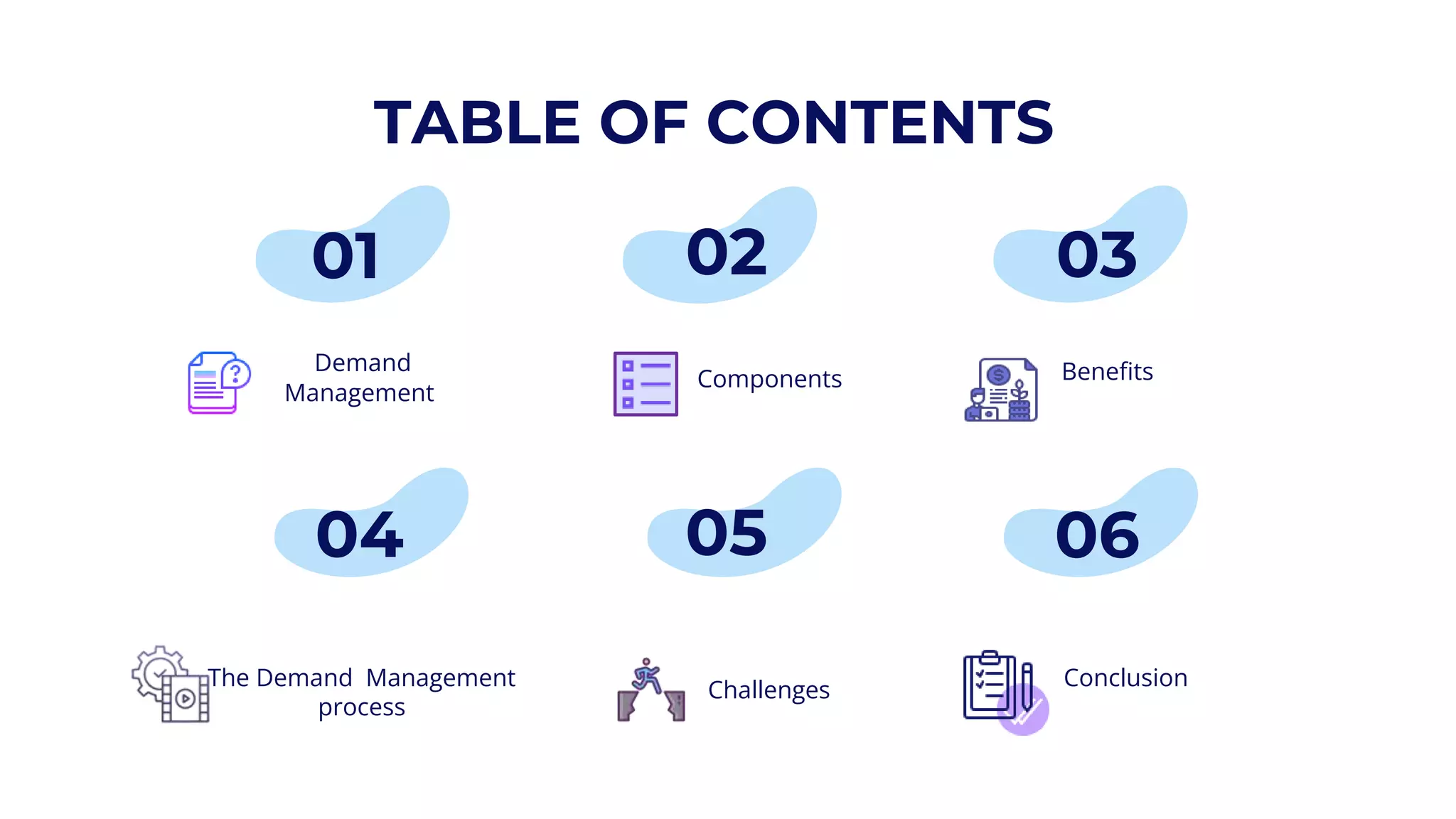
TABLE OF CONTENTS
Demand
Management
01
The Demand Management
process
04
Components
02
Challenges
05
Benefits
03
Conclusion
06
Demand management is a planning methodology used to forecast, plan for and manage the demand
for products and services. This can be at macro-levels as in economics and at micro-levels within
individual organizations. For example, at macro-levels, a government may influence interest rates to
regulate financial demand.
Demand management is a process within an organization which enables that organization to tailor
its capacity to meet variations in demand or to manage the level of demand using marketing or
supply chain management strategies.
Demand-chain management (DCM) is the management of relationships between suppliers and
customers to deliver the best value to the customer at the least cost to the demand chain as a whole.
What is Demand Management?
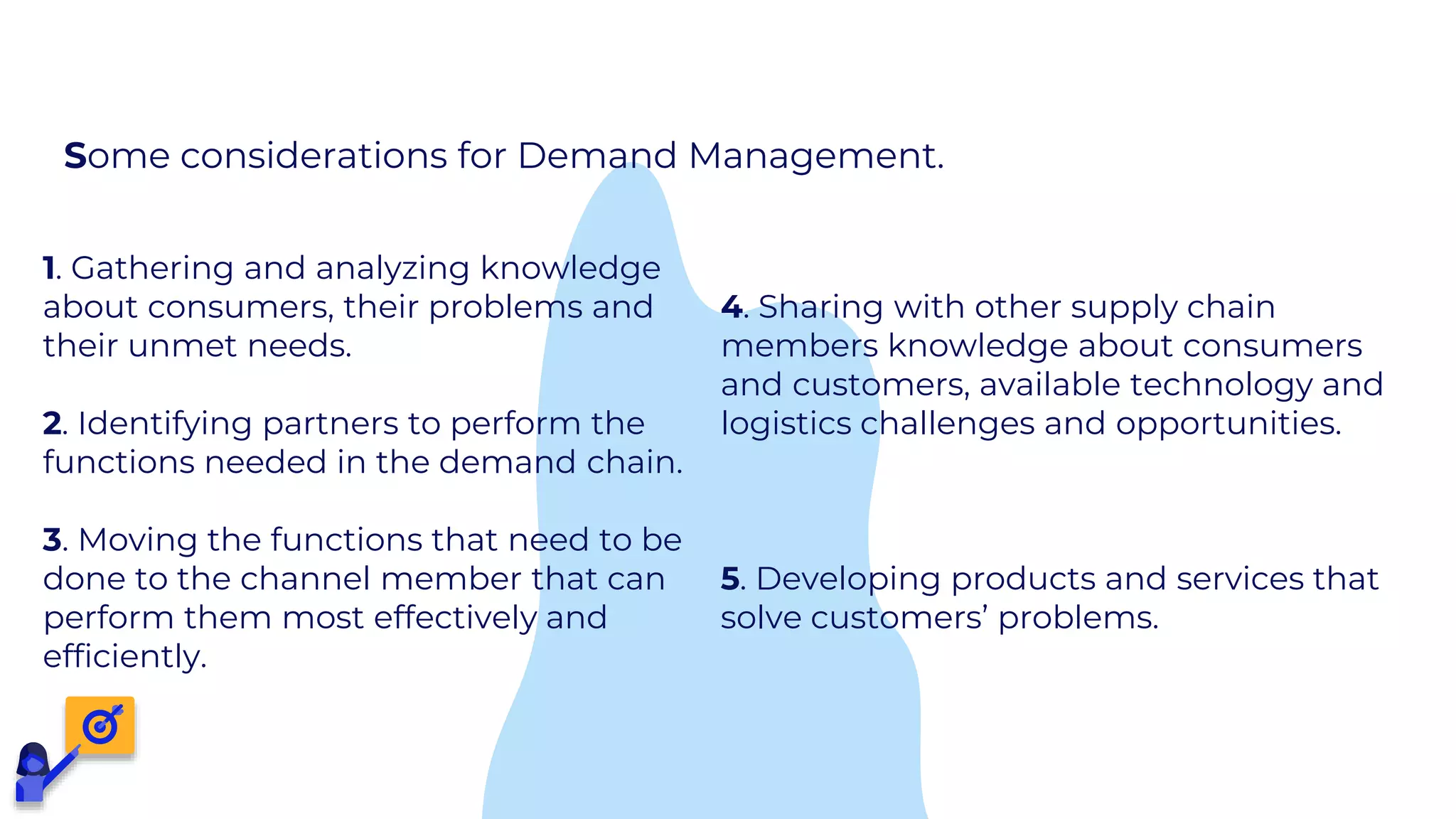
1. Gathering and analyzing knowledge
about consumers, their problems and
their unmet needs.
2. Identifying partners to perform the
functions needed in the demand chain.
3. Moving the functions that need to be
done to the channel member that can
perform them most effectively and
efficiently.
4. Sharing with other supply chain
members knowledge about consumers
and customers, available technology and
logistics challenges and opportunities.
5. Developing products and services that
solve customers’ problems.
Some considerations for Demand Management.
Components of Demand Management
There are four components of the Demand Management process-
1. Forecasting
2. Supply Planning
3.Demand Analysis
4. Sales and Operations planning
Benefits
 Improvement of Product Forecasting
 Increasing Supply Chain Scheduling
 Optimize The Labor Management
 Efficient Management Of Cash Flow
The Demand Management Process
The demand management process is concerned with balancing the
customers’ requirements with the capabilities of the supply chain.
This includes forecasting demand and synchronizing it with
production, procurement, and distribution capabilities. A good
demand management process can enable a company to be more
proactive to anticipated demand, and more reactive to unanticipated
demand. An important component of demand management is
finding ways to reduce demand variability and improve operational
flexibility.
Challenges
• Lead times are long and risky
There can be a high price to pay if your business works with both foreign labor and cheap
labor. The main cause is the amount of time it takes for a shipment to arrive. Also, it is kind of
hard to cancel an order as it sits in the middle of an ocean on a cargo ship.
• Increasing business complexity
With many companies needing to be complex this might become the only way to remain competitive. To
compete successfully many companies have relocated their manufacturing overseas. This way they have a
reduced amount of labor costs.
• Cutting costs
If your business plans to utilize a leaner model for distribution and manufacturing make sure that it does not
happen at the expense of quality or productivity. Also remember to not overemphasize your cost cutting
because it can be detrimental to a successful supply chain.
• No strategy for risk management
Every demand management company is familiar with taking risks. But, what some companies fail at is how to
manage that risk once something goes wrong. Risk is unavoidable but only if you have no strategy for risk
management.
Conclusion
Demand management is the supply chain
management process that balances the
customers' requirements with the capabilities of
the supply chain. With the right process in place,
management can match supply with demand
proactively and execute the plan with minimal
disruptions.
T H A N K Y O U …

Demand Management- Logistics and Supply Chain Management

  • 1.
  • 2.
    TABLE OF CONTENTS Demand Management 01 TheDemand Management process 04 Components 02 Challenges 05 Benefits 03 Conclusion 06
  • 3.
    Demand management isa planning methodology used to forecast, plan for and manage the demand for products and services. This can be at macro-levels as in economics and at micro-levels within individual organizations. For example, at macro-levels, a government may influence interest rates to regulate financial demand. Demand management is a process within an organization which enables that organization to tailor its capacity to meet variations in demand or to manage the level of demand using marketing or supply chain management strategies. Demand-chain management (DCM) is the management of relationships between suppliers and customers to deliver the best value to the customer at the least cost to the demand chain as a whole. What is Demand Management?
  • 4.
    1. Gathering andanalyzing knowledge about consumers, their problems and their unmet needs. 2. Identifying partners to perform the functions needed in the demand chain. 3. Moving the functions that need to be done to the channel member that can perform them most effectively and efficiently. 4. Sharing with other supply chain members knowledge about consumers and customers, available technology and logistics challenges and opportunities. 5. Developing products and services that solve customers’ problems. Some considerations for Demand Management.
  • 5.
    Components of DemandManagement There are four components of the Demand Management process- 1. Forecasting 2. Supply Planning 3.Demand Analysis 4. Sales and Operations planning
  • 6.
    Benefits  Improvement ofProduct Forecasting  Increasing Supply Chain Scheduling  Optimize The Labor Management  Efficient Management Of Cash Flow
  • 7.
    The Demand ManagementProcess The demand management process is concerned with balancing the customers’ requirements with the capabilities of the supply chain. This includes forecasting demand and synchronizing it with production, procurement, and distribution capabilities. A good demand management process can enable a company to be more proactive to anticipated demand, and more reactive to unanticipated demand. An important component of demand management is finding ways to reduce demand variability and improve operational flexibility.
  • 8.
    Challenges • Lead timesare long and risky There can be a high price to pay if your business works with both foreign labor and cheap labor. The main cause is the amount of time it takes for a shipment to arrive. Also, it is kind of hard to cancel an order as it sits in the middle of an ocean on a cargo ship. • Increasing business complexity With many companies needing to be complex this might become the only way to remain competitive. To compete successfully many companies have relocated their manufacturing overseas. This way they have a reduced amount of labor costs. • Cutting costs If your business plans to utilize a leaner model for distribution and manufacturing make sure that it does not happen at the expense of quality or productivity. Also remember to not overemphasize your cost cutting because it can be detrimental to a successful supply chain. • No strategy for risk management Every demand management company is familiar with taking risks. But, what some companies fail at is how to manage that risk once something goes wrong. Risk is unavoidable but only if you have no strategy for risk management.
  • 9.
    Conclusion Demand management isthe supply chain management process that balances the customers' requirements with the capabilities of the supply chain. With the right process in place, management can match supply with demand proactively and execute the plan with minimal disruptions.
  • 10.
    T H AN K Y O U …