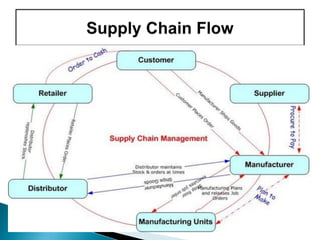
 A supply chain is the system of organizations,
people, activities, information and resources
involved in moving a product or service from
supplier to customer.
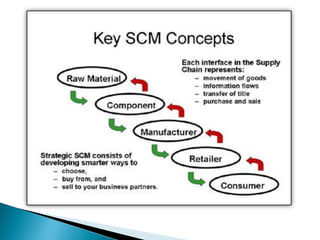
 An integrated group of processes to “source,”
“make,” and “deliver” products.
 Supply chain activities transform raw materials and
components into a finished product that is
delivered to the end customer.
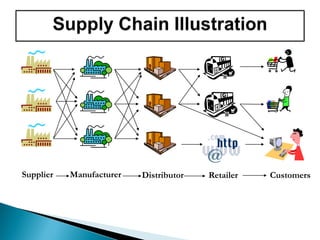
Supplier Manufacturer Distributor Retailer Customers
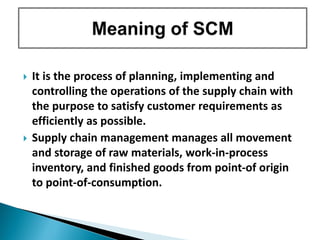
 It is the process of planning, implementing and
controlling the operations of the supply chain with
the purpose to satisfy customer requirements as
efficiently as possible.
 Supply chain management manages all movement
and storage of raw materials, work-in-process
inventory, and finished goods from point-of origin
to point-of-consumption.
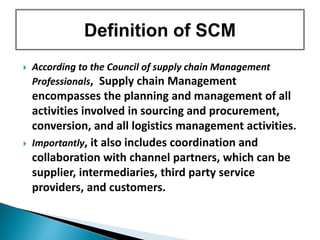
 According to the Council of supply chain Management
Professionals, Supply chain Management
encompasses the planning and management of all
activities involved in sourcing and procurement,
conversion, and all logistics management activities.
 Importantly, it also includes coordination and
collaboration with channel partners, which can be
supplier, intermediaries, third party service
providers, and customers.
Efficient supply chain management must
result in tangible business improvements.
It is characterized by a sharp focus on
– Revenue growth
– Better asset utilization
– Cost reduction.
 Some experts distinguish supply chain management and
logistics management, while others consider the terms to
be interchangeable.
 Logistic management can be termed as one of its part that
is related to planning , implementing , and controlling the
movement and storage of goods, services and related
information between the point of origin and the point of
consumption. But supply chain management includes
more aspects apart from the logistics function.
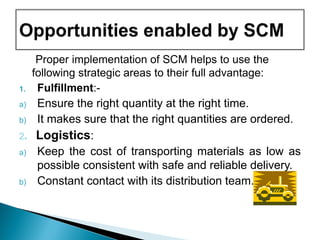
Proper implementation of SCM helps to use the
following strategic areas to their full advantage:
1. Fulfillment:-
a) Ensure the right quantity at the right time.
b) It makes sure that the right quantities are ordered.
2. Logistics:
a) Keep the cost of transporting materials as low as
possible consistent with safe and reliable delivery.
b) Constant contact with its distribution team.
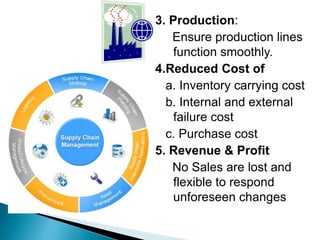
3. Production:
Ensure production lines
function smoothly.
4.Reduced Cost of
a. Inventory carrying cost
b. Internal and external
failure cost
c. Purchase cost
5. Revenue & Profit
No Sales are lost and
flexible to respond
unforeseen changes
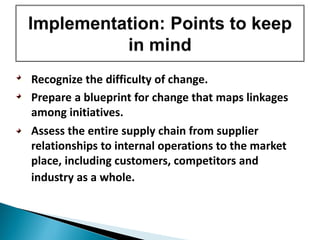
• Recognize the difficulty of change.
• Prepare a blueprint for change that maps linkages
among initiatives.
• Assess the entire supply chain from supplier
relationships to internal operations to the market
place, including customers, competitors and
industry as a whole.
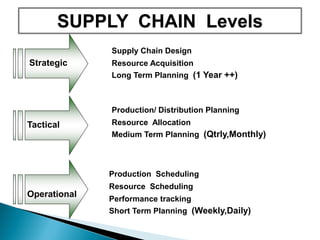
SUPPLY CHAIN Levels
• Supply Chain Design
• Resource Acquisition
• Long Term Planning (1 Year ++)
Strategic
• Production/ Distribution Planning
• Resource Allocation
• Medium Term Planning (Qtrly,Monthly)
Tactical
• Production Scheduling
• Resource Scheduling
• Performance tracking
• Short Term Planning (Weekly,Daily)
Operational
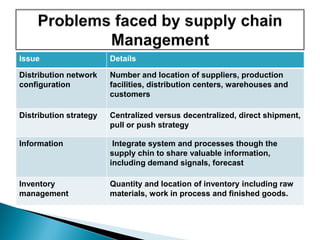
Issue Details
Distribution network
configuration
Number and location of suppliers, production
facilities, distribution centers, warehouses and
customers
Distribution strategy Centralized versus decentralized, direct shipment,
pull or push strategy
Information Integrate system and processes though the
supply chin to share valuable information,
including demand signals, forecast
Inventory
management
Quantity and location of inventory including raw
materials, work in process and finished goods.
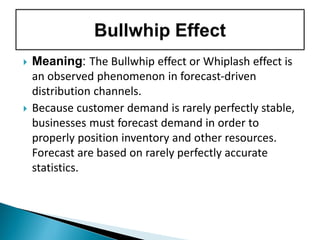
 Meaning: The Bullwhip effect or Whiplash effect is
an observed phenomenon in forecast-driven
distribution channels.
 Because customer demand is rarely perfectly stable,
businesses must forecast demand in order to
properly position inventory and other resources.
Forecast are based on rarely perfectly accurate
statistics.
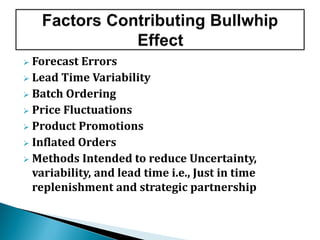
 Forecast Errors
 Lead Time Variability
 Batch Ordering
 Price Fluctuations
 Product Promotions
 Inflated Orders
 Methods Intended to reduce Uncertainty,
variability, and lead time i.e., Just in time
replenishment and strategic partnership
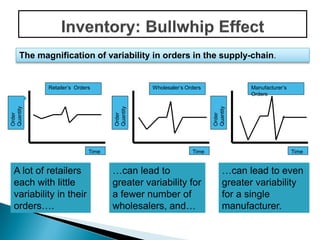
Time
Retailer’s Orders
Time
Wholesaler’s Orders
Time
Manufacturer’s
Orders
The magnification of variability in orders in the supply-chain.
A lot of retailers
each with little
variability in their
orders….
…can lead to
greater variability for
a fewer number of
wholesalers, and…
…can lead to even
greater variability
for a single
manufacturer.

intro to supply chain mgt.pdf

intro to supply chain mgt.pdf

  • 3.
     A supplychain is the system of organizations, people, activities, information and resources involved in moving a product or service from supplier to customer.  An integrated group of processes to “source,” “make,” and “deliver” products.  Supply chain activities transform raw materials and components into a finished product that is delivered to the end customer.
  • 4.
  • 6.
     It isthe process of planning, implementing and controlling the operations of the supply chain with the purpose to satisfy customer requirements as efficiently as possible.  Supply chain management manages all movement and storage of raw materials, work-in-process inventory, and finished goods from point-of origin to point-of-consumption.
  • 7.
     According tothe Council of supply chain Management Professionals, Supply chain Management encompasses the planning and management of all activities involved in sourcing and procurement, conversion, and all logistics management activities.  Importantly, it also includes coordination and collaboration with channel partners, which can be supplier, intermediaries, third party service providers, and customers.
  • 9.
    Efficient supply chainmanagement must result in tangible business improvements. It is characterized by a sharp focus on – Revenue growth – Better asset utilization – Cost reduction.
  • 10.
     Some expertsdistinguish supply chain management and logistics management, while others consider the terms to be interchangeable.  Logistic management can be termed as one of its part that is related to planning , implementing , and controlling the movement and storage of goods, services and related information between the point of origin and the point of consumption. But supply chain management includes more aspects apart from the logistics function.
  • 11.
    Proper implementation ofSCM helps to use the following strategic areas to their full advantage: 1. Fulfillment:- a) Ensure the right quantity at the right time. b) It makes sure that the right quantities are ordered. 2. Logistics: a) Keep the cost of transporting materials as low as possible consistent with safe and reliable delivery. b) Constant contact with its distribution team.
  • 12.
    3. Production: Ensure productionlines function smoothly. 4.Reduced Cost of a. Inventory carrying cost b. Internal and external failure cost c. Purchase cost 5. Revenue & Profit No Sales are lost and flexible to respond unforeseen changes
  • 13.
    • Recognize thedifficulty of change. • Prepare a blueprint for change that maps linkages among initiatives. • Assess the entire supply chain from supplier relationships to internal operations to the market place, including customers, competitors and industry as a whole.
  • 14.
    SUPPLY CHAIN Levels •Supply Chain Design • Resource Acquisition • Long Term Planning (1 Year ++) Strategic • Production/ Distribution Planning • Resource Allocation • Medium Term Planning (Qtrly,Monthly) Tactical • Production Scheduling • Resource Scheduling • Performance tracking • Short Term Planning (Weekly,Daily) Operational
  • 15.
    Issue Details Distribution network configuration Numberand location of suppliers, production facilities, distribution centers, warehouses and customers Distribution strategy Centralized versus decentralized, direct shipment, pull or push strategy Information Integrate system and processes though the supply chin to share valuable information, including demand signals, forecast Inventory management Quantity and location of inventory including raw materials, work in process and finished goods.
  • 16.
     Meaning: TheBullwhip effect or Whiplash effect is an observed phenomenon in forecast-driven distribution channels.  Because customer demand is rarely perfectly stable, businesses must forecast demand in order to properly position inventory and other resources. Forecast are based on rarely perfectly accurate statistics.
  • 17.
     Forecast Errors Lead Time Variability  Batch Ordering  Price Fluctuations  Product Promotions  Inflated Orders  Methods Intended to reduce Uncertainty, variability, and lead time i.e., Just in time replenishment and strategic partnership
  • 18.
    Time Retailer’s Orders Time Wholesaler’s Orders Time Manufacturer’s Orders Themagnification of variability in orders in the supply-chain. A lot of retailers each with little variability in their orders…. …can lead to greater variability for a fewer number of wholesalers, and… …can lead to even greater variability for a single manufacturer. 