MALTHUSIAN THEORY
INTRODUCTION
 In his 1798 work, An Essay on the Principle of Population, Malthus
examined the relationship between population growth and
resources and developed the Malthusian theory of population
growth.
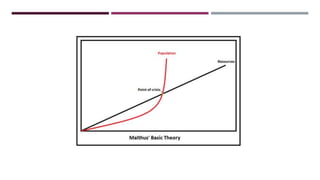
 He wrote that population growth occurs exponentially, so it
increases according to birth rate.
EXAMPLE
 If every member of a family tree reproduces, the tree will continue
to grow with each generation.
 On the other hand, food production increases arithmetically, so it
only increases at given points in time.
 Malthus wrote that, left unchecked, populations can outgrow their
resources.
CHECKS
 PREVENTIVE CHECKS
 POSITIVE CHECKS
PREVENTIVE CHECKS
 Preventive checks are voluntary actions people can take
to avoid contributing to the population.
 Because of his religious beliefs, he supported a concept he
called moral restraint, in which people resist the urge to
marry and reproduce until they are capable of supporting
a family.
 This often means waiting until a later age to marry. He also
wrote that there are 'immoral' ways to check a population,
such as vices, adultery, prostitution, and birth control.
 Due to his beliefs, he favored moral restraint and didn't
support the latter practices.
POSITIVE CHECKS
 Positive checks to population growth are things that may shorten
the average lifespan, such as disease, warfare, famine, and poor
living and working environments.
 According to Malthus, eventually these positive checks would
result in a Malthusian catastrophe (also sometimes called a
Malthusian crisis), which is a forced return of a population to basic
survival.
Malthusian Theory
Malthusian Theory

Malthusian Theory

  • 1.
  • 2.
    INTRODUCTION  In his1798 work, An Essay on the Principle of Population, Malthus examined the relationship between population growth and resources and developed the Malthusian theory of population growth.  He wrote that population growth occurs exponentially, so it increases according to birth rate.
  • 3.
    EXAMPLE  If everymember of a family tree reproduces, the tree will continue to grow with each generation.  On the other hand, food production increases arithmetically, so it only increases at given points in time.  Malthus wrote that, left unchecked, populations can outgrow their resources.
  • 4.
  • 5.
    PREVENTIVE CHECKS  Preventivechecks are voluntary actions people can take to avoid contributing to the population.  Because of his religious beliefs, he supported a concept he called moral restraint, in which people resist the urge to marry and reproduce until they are capable of supporting a family.
  • 6.
     This oftenmeans waiting until a later age to marry. He also wrote that there are 'immoral' ways to check a population, such as vices, adultery, prostitution, and birth control.  Due to his beliefs, he favored moral restraint and didn't support the latter practices.
  • 7.
    POSITIVE CHECKS  Positivechecks to population growth are things that may shorten the average lifespan, such as disease, warfare, famine, and poor living and working environments.  According to Malthus, eventually these positive checks would result in a Malthusian catastrophe (also sometimes called a Malthusian crisis), which is a forced return of a population to basic survival.