Media Law Presentation: 
Copyright Law
Copyright Law for 
High School Student Journalists 
An introduction to common copyright law 
issues and resources for high school student 
journalists 
and their advisers This presentation was made 
possible by a generous grant 
from:
3 
Student Press Law Center 
Provides free legal help and information on media law 
issues to student journalists and their advisers 
Web site: www.splc.org 
Phone: (703) 807-1904 
Monday - Friday 9 a.m. - 6 p.m. Eastern Time
Copyright Infringement 
Using someone else’s original 
work without obtaining the 
copyright owner’s permission
5 
What is copyright? 
©
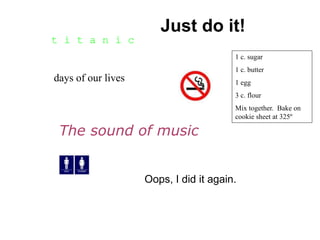
6 
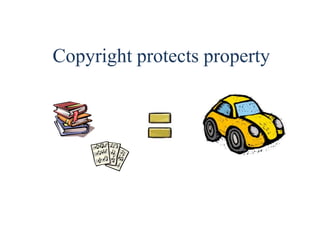
Copyright protects property
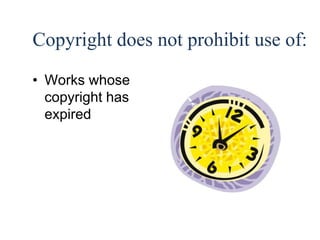
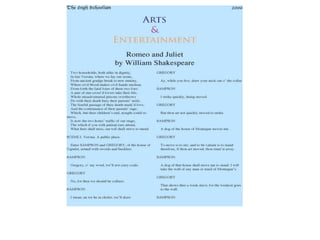
7 
Rights protected by a copyright 
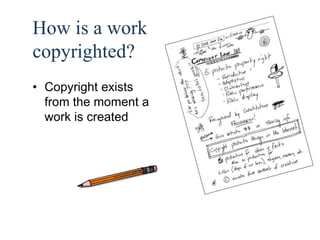
• Reproduction 
• Adaptation 
• Distribution 
• Public performance 
• Public display
8 
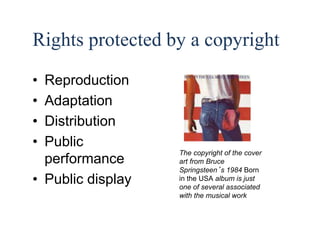
Rights protected by a copyright 
• Reproduction 
• Adaptation 
• Distribution 
• Public 
performance 
• Public display 
The copyright of the cover 
art from Bruce 
Springsteen’s 1984 Born 
in the USA album is just 
one of several associated 
with the musical work
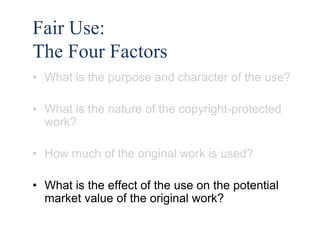
9 
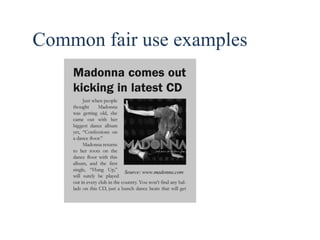
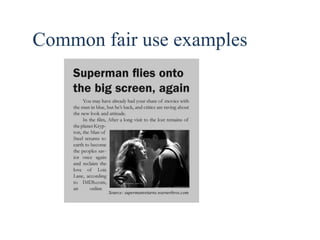
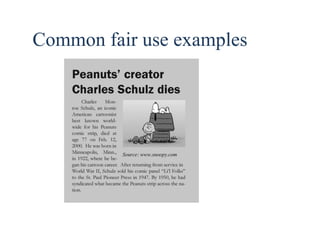
Purpose of copyright 
• Recognized in U.S. Constitution 
– Encourage progress through advancement 
of 
arts & sciences
10 
Purpose of copyright 
• Recognized in U.S. Constitution 
– Encourage progress through advancement 
of 
arts & sciences 
• Reward creative efforts
11 
Purpose of copyright 
• Recognized in U.S. Constitution 
– Encourage progress through advancement 
of 
arts & sciences 
• Reward creative efforts 
• Promote societal knowledge
12 
Intellectual Property 
• Copyright 
• Patent 
• Trademark 
• Plagiarism
13 
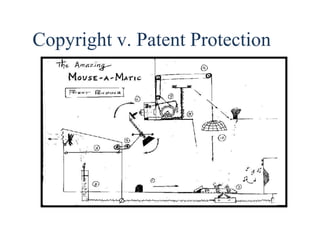
Copyright v. Patent Protection
14 
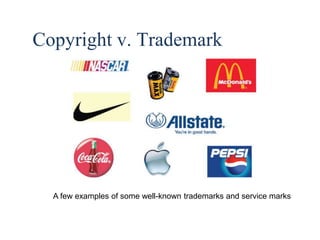
Copyright v. Trademark 
A few examples of some well-known trademarks and service marks
15 
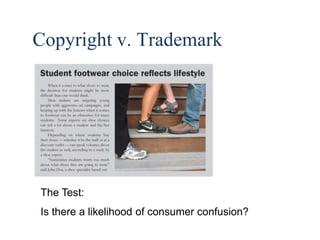
Copyright v. Trademark 
The Test: 
Is there a likelihood of consumer confusion?
16 
Copyright v. Plagiarism 
• Posing as the creator of a work that is 
not your own 
• Not a legal term 
• Academic crime with variable definitions
17 
What can be copyrighted? 
Requirement 1: Originality 
Requirement 2: Minimal Creativity 
Requirement 3: Fixation
18 
Copyright law protects 
material on the Internet!
19 
Copyright can protect: 
• Photos 
• Stories 
• Illustrations 
• Cartoons 
• Advertisements 
• …even Wallpaper
20 
Copyright does not prohibit use of: 
Ideas
21 
Copyright does not prohibit use of: 
Facts
22 
Copyright does not prohibit use of: 
• Most federal government records 
• Some state and local government 
records
23 
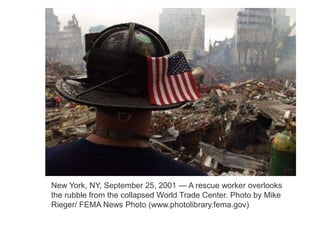
New York, NY, September 25, 2001 — A rescue worker overlooks 
the rubble from the collapsed World Trade Center. Photo by Mike 
Rieger/ FEMA News Photo (www.photolibrary.fema.gov)
24 
Copyright does not prohibit use of: 
• Odds and Ends 
– Titles 
– Slogans 
– Short phrases 
– Names 
– Familiar symbols 
– Lists of ingredients 
– Basic instructions 
– Simple blank forms
25 
days of our lives 
Just do it! 
The sound of music 
Oops, I did it again. 
t i t a n i c 
1 c. sugar 
1 c. butter 
1 egg 
3 c. flour 
Mix together. Bake on 
cookie sheet at 325º
26 
Copyright does not prohibit use of: 
• Works whose 
copyright has 
expired
27
28 
How is a work 
copyrighted? 
• Copyright exists 
from the moment a 
work is created
29 
Copyright MythBuster #1 
A work that does not have a copyright notice 
(e.g., © Copyright 2006 Student Press Law 
Center) is not protected by copyright and can 
be used freely. 
False: Since 1989, a copyright notice has 
been optional and its inclusion or omission on 
a work does not affect the validity of a 
copyright.
30 
Copyright MythBuster #2 
A work must be registered with the U.S. 
Copyright Office to receive copyright protection. 
False: Formal registration of a copyright is not 
required.
31 
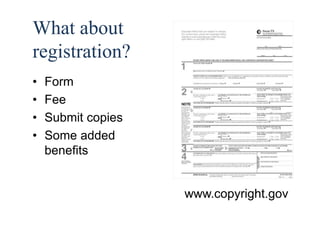
What about 
registration? 
• Form 
• Fee 
• Submit copies 
• Some added 
benefits 
www.copyright.gov
32 
Who owns a copyright? 
• “Work for hire” doctrine 
– Work owned by employer 
– Formal employer/employee relationship required 
• Most high school student journalists are likely 
“independent contractors” who own the works they 
create 
• Importance of a copyright agreement
33 
The General Rule 
If you didn’t create it and/or you 
don’t own the copyright to it, you 
must get permission to use it
34 
Copyright MythBuster #3 
Including a credit line on a copyrighted 
work is enough to avoid copyright 
problems. 
False: The law requires actual permission 
from the copyright owner, not just attribution.
35 
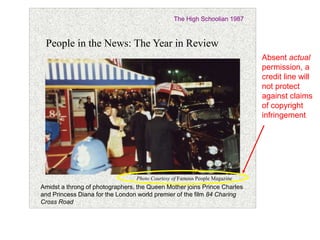
The High Schoolian 1987 
People in the News: The Year in Review 
Photo Courtesy of Famous People Magazine 
Amidst a throng of photographers, the Queen Mother joins Prince Charles 
and Princess Diana for the London world premier of the film 84 Charing 
Cross Road 
Absent actual 
permission, a 
credit line will 
not protect 
against claims 
of copyright 
infringement
36 
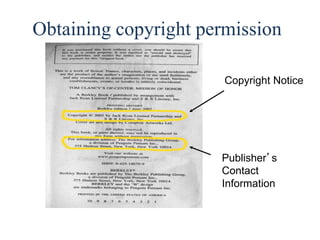
Obtaining copyright permission 
Copyright Notice 
Publisher’s 
Contact 
Information
37 
Obtaining copyright permission 
• Written copyright permission request 
usually required and should include: 
– Contact information 
– Expected publication date 
– Number of copies you intend to produce 
– Publication price (if any) 
– Non-profit statement (if applicable) 
– Clear description of intended use 
– Response deadline 
• Written permission response preferred
38 
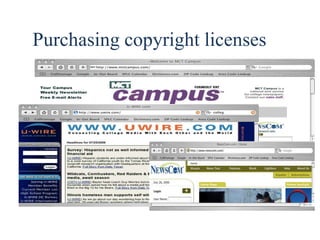
Purchasing copyright licenses
39 
The General Rule 
If you didn’t create it and/or you 
don’t own the copyright to it, you 
must get permission to use it 
Except…
40 
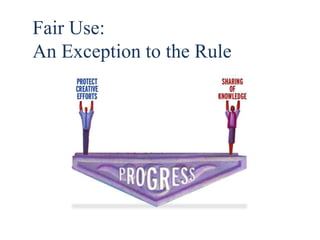
Fair Use: 
An Exception to the Rule
41 
Fair Use: 
An Exception to the Rule 
• Using a limited amount of a copyright-protected 
work for news, educational or 
informational purposes without consent 
may be permissible as a “fair use”
42 
Fair Use: 
An Exception to the Rule 
• Using a limited amount of a copyright-protected 
work for news, educational or 
informational purposes without consent 
may be permissible as a “fair use” 
• Not every use by a student media 
organization is a fair use
43 
Fair Use: 
The Four Factors 
• What is the purpose and character of the use?
44 
Fair Use: 
The Four Factors 
• What is the purpose and character of the use? 
• What is the nature of the copyright-protected 
work?
45 
Fair Use: 
The Four Factors 
• What is the purpose and character of the use? 
• What is the nature of the copyright-protected 
work? 
• How much of the original work is used?
46 
Copyright MythBuster #4 
You can safely use up to 250 words of text 
or up to 30 seconds of a song or movie 
without violating copyright law. 
False: Copyright law does not recognize any 
absolute word/time allowances or other 
“safe harbors” for use of copyright-protected 
works.
47 
Fair Use: 
The Four Factors 
• What is the purpose and character of the use? 
• What is the nature of the copyright-protected 
work? 
• How much of the original work is used? 
• What is the effect of the use on the potential 
market value of the original work?
48 
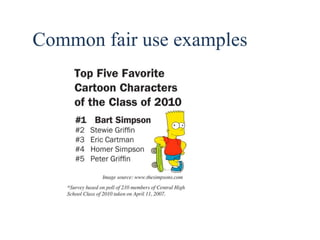
Common fair use examples
49 
Common fair use examples
50 
Common fair use examples
51 
Common fair use examples
52 
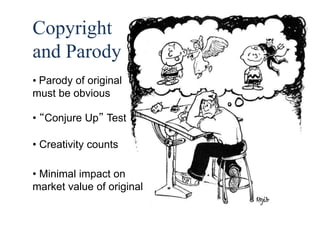
Copyright 
and Parody 
• Parody of original 
must be obvious 
• “Conjure Up” Test 
• Creativity counts 
• Minimal impact on 
market value of original
53 
Penalties for 
Copyright Infringement 
• Actual damages 
• Statutory damages 
• Injunctive relief
54 
U.S. Copyright Office Web site: 
www.copyright.gov
55 
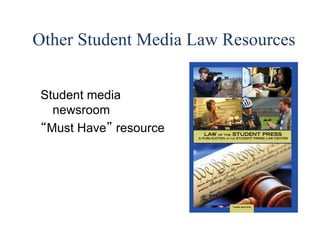
Other Student Media Law Resources 
Student media 
newsroom 
“Must Have” resource
56 
Other Student Media Law Resources 
• SPLC monthly podcast 
(splc.org/podcasts) 
• SPLC Report: thrice-yearly magazine 
• SPLC News Flashes: news stories about 
legal issues affecting student media 
• News Media and the Law: RCFP’s 
magazine
Seek help when you need it! 
Student Press Law Center 
www.splc.org 
(703) 807-1904 
Monday - Friday, 9 a.m. to 6 p.m. Eastern 
Time
58 
Copyright Law for High School Student Journalists was written and produced by the 
Student Press Law Center with the support of a generous grant from the Newspaper 
Association of America Foundation. 
You can help the Student Press Law Center create new generations of Americans who will 
understand and defend the First Amendment to the U.S. Constitution and the values it 
embodies through your tax-deductible contribution. Go to www.splc.org/give for details. 
Permission to use and display this classroom presentation for noncommercial, educational 
purposes is hereby granted. Any commercial use, reproduction or editing of this 
presentation is prohibited without the express written permission of the Student Press Law 
Center. 
While every effort is made to ensure the accuracy of the information contained in Copyright 
Law for High School Student Journalists it provides general guidance and information only. 
It is neither intended nor represented as a substitute for obtaining case-specific advice 
from a licensed and experienced media law attorney in your state. 
A special thanks to Dineen Pashoukos Wasylik for her contributions to this project. 
© 2006 Student Press Law Center. All rights reserved.

Copyright Law

  • 1.
  • 2.
    Copyright Law for High School Student Journalists An introduction to common copyright law issues and resources for high school student journalists and their advisers This presentation was made possible by a generous grant from:
  • 3.
    3 Student PressLaw Center Provides free legal help and information on media law issues to student journalists and their advisers Web site: www.splc.org Phone: (703) 807-1904 Monday - Friday 9 a.m. - 6 p.m. Eastern Time
  • 4.
    Copyright Infringement Usingsomeone else’s original work without obtaining the copyright owner’s permission
  • 5.
    5 What iscopyright? ©
  • 6.
  • 7.
    7 Rights protectedby a copyright • Reproduction • Adaptation • Distribution • Public performance • Public display
  • 8.
    8 Rights protectedby a copyright • Reproduction • Adaptation • Distribution • Public performance • Public display The copyright of the cover art from Bruce Springsteen’s 1984 Born in the USA album is just one of several associated with the musical work
  • 9.
    9 Purpose ofcopyright • Recognized in U.S. Constitution – Encourage progress through advancement of arts & sciences
  • 10.
    10 Purpose ofcopyright • Recognized in U.S. Constitution – Encourage progress through advancement of arts & sciences • Reward creative efforts
  • 11.
    11 Purpose ofcopyright • Recognized in U.S. Constitution – Encourage progress through advancement of arts & sciences • Reward creative efforts • Promote societal knowledge
  • 12.
    12 Intellectual Property • Copyright • Patent • Trademark • Plagiarism
  • 13.
    13 Copyright v.Patent Protection
  • 14.
    14 Copyright v.Trademark A few examples of some well-known trademarks and service marks
  • 15.
    15 Copyright v.Trademark The Test: Is there a likelihood of consumer confusion?
  • 16.
    16 Copyright v.Plagiarism • Posing as the creator of a work that is not your own • Not a legal term • Academic crime with variable definitions
  • 17.
    17 What canbe copyrighted? Requirement 1: Originality Requirement 2: Minimal Creativity Requirement 3: Fixation
  • 18.
    18 Copyright lawprotects material on the Internet!
  • 19.
    19 Copyright canprotect: • Photos • Stories • Illustrations • Cartoons • Advertisements • …even Wallpaper
  • 20.
    20 Copyright doesnot prohibit use of: Ideas
  • 21.
    21 Copyright doesnot prohibit use of: Facts
  • 22.
    22 Copyright doesnot prohibit use of: • Most federal government records • Some state and local government records
  • 23.
    23 New York,NY, September 25, 2001 — A rescue worker overlooks the rubble from the collapsed World Trade Center. Photo by Mike Rieger/ FEMA News Photo (www.photolibrary.fema.gov)
  • 24.
    24 Copyright doesnot prohibit use of: • Odds and Ends – Titles – Slogans – Short phrases – Names – Familiar symbols – Lists of ingredients – Basic instructions – Simple blank forms
  • 25.
    25 days ofour lives Just do it! The sound of music Oops, I did it again. t i t a n i c 1 c. sugar 1 c. butter 1 egg 3 c. flour Mix together. Bake on cookie sheet at 325º
  • 26.
    26 Copyright doesnot prohibit use of: • Works whose copyright has expired
  • 27.
  • 28.
    28 How isa work copyrighted? • Copyright exists from the moment a work is created
  • 29.
    29 Copyright MythBuster#1 A work that does not have a copyright notice (e.g., © Copyright 2006 Student Press Law Center) is not protected by copyright and can be used freely. False: Since 1989, a copyright notice has been optional and its inclusion or omission on a work does not affect the validity of a copyright.
  • 30.
    30 Copyright MythBuster#2 A work must be registered with the U.S. Copyright Office to receive copyright protection. False: Formal registration of a copyright is not required.
  • 31.
    31 What about registration? • Form • Fee • Submit copies • Some added benefits www.copyright.gov
  • 32.
    32 Who ownsa copyright? • “Work for hire” doctrine – Work owned by employer – Formal employer/employee relationship required • Most high school student journalists are likely “independent contractors” who own the works they create • Importance of a copyright agreement
  • 33.
    33 The GeneralRule If you didn’t create it and/or you don’t own the copyright to it, you must get permission to use it
  • 34.
    34 Copyright MythBuster#3 Including a credit line on a copyrighted work is enough to avoid copyright problems. False: The law requires actual permission from the copyright owner, not just attribution.
  • 35.
    35 The HighSchoolian 1987 People in the News: The Year in Review Photo Courtesy of Famous People Magazine Amidst a throng of photographers, the Queen Mother joins Prince Charles and Princess Diana for the London world premier of the film 84 Charing Cross Road Absent actual permission, a credit line will not protect against claims of copyright infringement
  • 36.
    36 Obtaining copyrightpermission Copyright Notice Publisher’s Contact Information
  • 37.
    37 Obtaining copyrightpermission • Written copyright permission request usually required and should include: – Contact information – Expected publication date – Number of copies you intend to produce – Publication price (if any) – Non-profit statement (if applicable) – Clear description of intended use – Response deadline • Written permission response preferred
  • 38.
  • 39.
    39 The GeneralRule If you didn’t create it and/or you don’t own the copyright to it, you must get permission to use it Except…
  • 40.
    40 Fair Use: An Exception to the Rule
  • 41.
    41 Fair Use: An Exception to the Rule • Using a limited amount of a copyright-protected work for news, educational or informational purposes without consent may be permissible as a “fair use”
  • 42.
    42 Fair Use: An Exception to the Rule • Using a limited amount of a copyright-protected work for news, educational or informational purposes without consent may be permissible as a “fair use” • Not every use by a student media organization is a fair use
  • 43.
    43 Fair Use: The Four Factors • What is the purpose and character of the use?
  • 44.
    44 Fair Use: The Four Factors • What is the purpose and character of the use? • What is the nature of the copyright-protected work?
  • 45.
    45 Fair Use: The Four Factors • What is the purpose and character of the use? • What is the nature of the copyright-protected work? • How much of the original work is used?
  • 46.
    46 Copyright MythBuster#4 You can safely use up to 250 words of text or up to 30 seconds of a song or movie without violating copyright law. False: Copyright law does not recognize any absolute word/time allowances or other “safe harbors” for use of copyright-protected works.
  • 47.
    47 Fair Use: The Four Factors • What is the purpose and character of the use? • What is the nature of the copyright-protected work? • How much of the original work is used? • What is the effect of the use on the potential market value of the original work?
  • 48.
    48 Common fairuse examples
  • 49.
    49 Common fairuse examples
  • 50.
    50 Common fairuse examples
  • 51.
    51 Common fairuse examples
  • 52.
    52 Copyright andParody • Parody of original must be obvious • “Conjure Up” Test • Creativity counts • Minimal impact on market value of original
  • 53.
    53 Penalties for Copyright Infringement • Actual damages • Statutory damages • Injunctive relief
  • 54.
    54 U.S. CopyrightOffice Web site: www.copyright.gov
  • 55.
    55 Other StudentMedia Law Resources Student media newsroom “Must Have” resource
  • 56.
    56 Other StudentMedia Law Resources • SPLC monthly podcast (splc.org/podcasts) • SPLC Report: thrice-yearly magazine • SPLC News Flashes: news stories about legal issues affecting student media • News Media and the Law: RCFP’s magazine
  • 57.
    Seek help whenyou need it! Student Press Law Center www.splc.org (703) 807-1904 Monday - Friday, 9 a.m. to 6 p.m. Eastern Time
  • 58.
    58 Copyright Lawfor High School Student Journalists was written and produced by the Student Press Law Center with the support of a generous grant from the Newspaper Association of America Foundation. You can help the Student Press Law Center create new generations of Americans who will understand and defend the First Amendment to the U.S. Constitution and the values it embodies through your tax-deductible contribution. Go to www.splc.org/give for details. Permission to use and display this classroom presentation for noncommercial, educational purposes is hereby granted. Any commercial use, reproduction or editing of this presentation is prohibited without the express written permission of the Student Press Law Center. While every effort is made to ensure the accuracy of the information contained in Copyright Law for High School Student Journalists it provides general guidance and information only. It is neither intended nor represented as a substitute for obtaining case-specific advice from a licensed and experienced media law attorney in your state. A special thanks to Dineen Pashoukos Wasylik for her contributions to this project. © 2006 Student Press Law Center. All rights reserved.