5G Core Network
and the Cloud
Sridhar Bhaskaran • 13.12.2017
A Standards Perspective
Agenda
5G Requirements
Standards - Who is Doing What?
3GPP Standards
● Flavors of 5G Deployment
● Use Cases Driving the Need For a New
5G Core Network
● 5G Core Network Overview
● 5G Core Network Features
● Enablers for Cloud Deployment
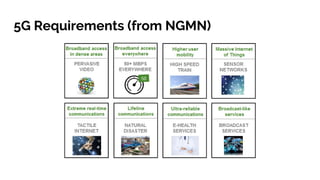
5G Requirements (from NGMN)
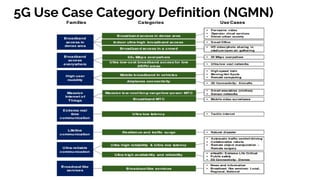
5G Use Case Category Definition (NGMN)
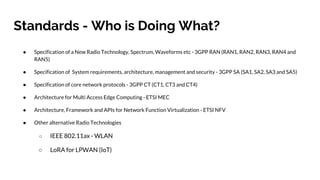
Standards - Who is Doing What?
● Specification of a New Radio Technology, Spectrum, Waveforms etc - 3GPP RAN (RAN1, RAN2, RAN3, RAN4 and
RAN5)
● Specification of System requirements, architecture, management and security - 3GPP SA (SA1, SA2, SA3 and SA5)
● Specification of core network protocols - 3GPP CT (CT1, CT3 and CT4)
● Architecture for Multi Access Edge Computing - ETSI MEC
● Architecture, Framework and APIs for Network Function Virtualization - ETSI NFV
● Other alternative Radio Technologies
○ IEEE 802.11ax - WLAN
○ LoRA for LPWAN (IoT)
3GPP Standards
(5G Core Network)
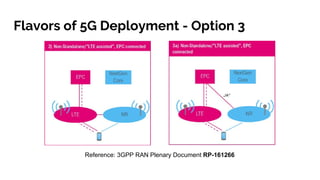
Flavors of 5G Deployment - Option 3
Reference: 3GPP RAN Plenary Document RP-161266
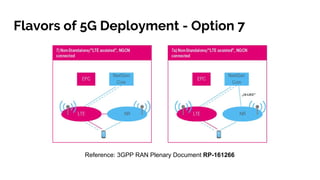
Flavors of 5G Deployment - Option 7
Reference: 3GPP RAN Plenary Document RP-161266
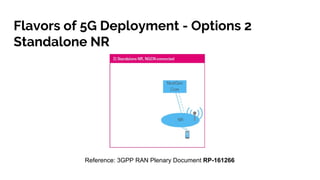
Flavors of 5G Deployment - Options 2
Standalone NR
Reference: 3GPP RAN Plenary Document RP-161266
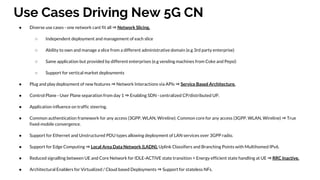
Use Cases Driving New 5G CN
● Diverse use cases - one network cant fit all ⇒ Network Slicing.
○ Independent deployment and management of each slice
○ Ability to own and manage a slice from a different administrative domain (e.g 3rd party enterprise)
○ Same application but provided by different enterprises (e.g vending machines from Coke and Pepsi)
○ Support for vertical market deployments
● Plug and play deployment of new features ⇒ Network Interactions via APIs ⇒ Service Based Architecture.
● Control Plane - User Plane separation from day 1 ⇒ Enabling SDN - centralized CP/distributed UP.
● Application influence on traffic steering.
● Common authentication framework for any access (3GPP, WLAN, Wireline). Common core for any access (3GPP, WLAN, Wireline) ⇒ True
fixed-mobile convergence.
● Support for Ethernet and Unstructured PDU types allowing deployment of LAN services over 3GPP radio.
● Support for Edge Computing ⇒ Local Area Data Network (LADN), Uplink Classifiers and Branching Points with Multihomed IPv6.
● Reduced signalling between UE and Core Network for IDLE-ACTIVE state transition + Energy efficient state handling at UE ⇒ RRC Inactive.
● Architectural Enablers for Virtualized / Cloud based Deployments ⇒ Support for stateless NFs.
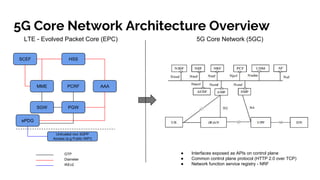
5G Core Network Architecture Overview
PGW
MME
SGW
HSS
PCRF AAA
ePDG
SCEF
Untrusted non 3GPP
Access (e.g Public WiFI)
GTP
Diameter
● Interfaces exposed as APIs on control plane
● Common control plane protocol (HTTP 2.0 over TCP)
● Network function service registry - NRF
LTE - Evolved Packet Core (EPC) 5G Core Network (5GC)
IKEv2
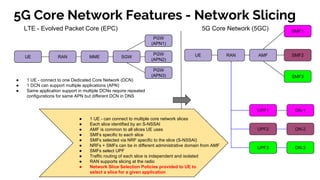
5G Core Network Features - Network Slicing
UE RAN MME SGW
PGW
(APN1)
PGW
(APN2)
PGW
(APN3)
● 1 UE - connect to one Dedicated Core Network (DCN)
● 1 DCN can support multiple applications (APN)
● Same application support in multiple DCNs require repeated
configurations for same APN but different DCN in DNS
UE RAN AMF
SMF1
SMF2
SMF3
UPF1 DN-1
UPF2 DN-2
UPF3 DN-3
● 1 UE - can connect to multiple core network slices
● Each slice identified by an S-NSSAI
● AMF is common to all slices UE uses
● SMFs specific to each slice
● SMFs selected via NRF specific to the slice (S-NSSAI)
● NRFs + SMFs can be in different administrative domain from AMF
● SMFs select UPF
● Traffic routing of each slice is independent and isolated
● RAN supports slicing at the radio
● Network Slice Selection Policies provided to UE to
select a slice for a given application
LTE - Evolved Packet Core (EPC) 5G Core Network (5GC)
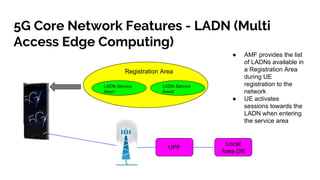
5G Core Network Features - LADN (Multi
Access Edge Computing)
Registration Area
LADN Service
Area1
LADN Service
Area2
UPF
Local
Area DN
● AMF provides the list
of LADNs available in
a Registration Area
during UE
registration to the
network
● UE activates
sessions towards the
LADN when entering
the service area
Architectural Enablers for Cloud Deployment
● Storage of Network Function and session state in a unstructured data storage function (UDSF).
○ Allows session state to be separated from signalling thus enabling stateless NFs
● From protocol based signalling ⇒ API based core network signaling interaction.
○ Allows new features to be developed by reusing APIs
○ Direct interaction with needed NF via API
○ API and service discovery via NRF
● Ability to change the TNL (Transport Network Layer) address to UE session state binding anytime.
Challenges in Cloud Deployment
● Network slicing involving parts of slices spanning across administrative boundaries may
require multi-domain orchestration and resource co-ordination.
● Multi-domain orchestration is an open research area.
● No standard APIs yet for cross cloud federation.
● Once resources are instantiated and VNFs are onboarded - communication between VNFs
spanning across administrative boundaries will be through standardized 3GPP service
based interfaces.
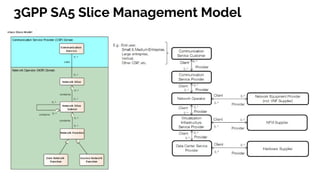
● 3GPP SA5 defining information model for network slicing - concept of Network Slice
Subnet (e.g Transport network could be a subnet).
○ 3GPP TR 28.801 and TS 28.530
● A standard resource model leading to standard API will be a step in the right direction
(atleast for cross domain orchestration for slicing)
3GPP SA5 Slice Management Model
3GPP 5G Core Network Specifications
● 5G System Requirements - TS 22.261
● 5G System Architecture - TS 23.501
● 5G System Procedures and Call Flows - TS 23.502
● 5G Security - TS 33.501
● 5G Network Slice Management - TS 28.530
● Latest specifications to be available after Dec 20-22, 2017 SA Plenary at Lisbon
● http://www.3gpp.org/ftp/Specs/archive/23_series/
● http://www.3gpp.org/ftp/Specs/archive/22_series/
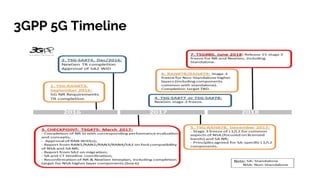
3GPP 5G Timeline
3GPP Release 16 and Beyond
● Support for massive IoT - core network enhancements to support cellular IoT features in 5G
● Support for Ultra Reliable and Low Latency Communication (URLLC) - new QoS characteristics,
enhanced UPF placement logic, Enablers for ultra reliability
● Wireless Wireline Convergence
● Support for Enhanced Network Automation using Analytics
● Multicast and Broadcast support over 5G
● 5G LAN
Summary
1. 5G Core Network is a Paradigm
Shift
2. First truly cloud native
architecture
3. API based - Easy 3rd party
application integration
4. First truly converged core for all
access
5. Diverse use case support
Thank You

5 g core network and the cloud - A standards perspective

  • 1.
    5G Core Network andthe Cloud Sridhar Bhaskaran • 13.12.2017 A Standards Perspective
  • 2.
    Agenda 5G Requirements Standards -Who is Doing What? 3GPP Standards ● Flavors of 5G Deployment ● Use Cases Driving the Need For a New 5G Core Network ● 5G Core Network Overview ● 5G Core Network Features ● Enablers for Cloud Deployment
  • 3.
  • 4.
    5G Use CaseCategory Definition (NGMN)
  • 5.
    Standards - Whois Doing What? ● Specification of a New Radio Technology, Spectrum, Waveforms etc - 3GPP RAN (RAN1, RAN2, RAN3, RAN4 and RAN5) ● Specification of System requirements, architecture, management and security - 3GPP SA (SA1, SA2, SA3 and SA5) ● Specification of core network protocols - 3GPP CT (CT1, CT3 and CT4) ● Architecture for Multi Access Edge Computing - ETSI MEC ● Architecture, Framework and APIs for Network Function Virtualization - ETSI NFV ● Other alternative Radio Technologies ○ IEEE 802.11ax - WLAN ○ LoRA for LPWAN (IoT)
  • 6.
  • 7.
    Flavors of 5GDeployment - Option 3 Reference: 3GPP RAN Plenary Document RP-161266
  • 8.
    Flavors of 5GDeployment - Option 7 Reference: 3GPP RAN Plenary Document RP-161266
  • 9.
    Flavors of 5GDeployment - Options 2 Standalone NR Reference: 3GPP RAN Plenary Document RP-161266
  • 10.
    Use Cases DrivingNew 5G CN ● Diverse use cases - one network cant fit all ⇒ Network Slicing. ○ Independent deployment and management of each slice ○ Ability to own and manage a slice from a different administrative domain (e.g 3rd party enterprise) ○ Same application but provided by different enterprises (e.g vending machines from Coke and Pepsi) ○ Support for vertical market deployments ● Plug and play deployment of new features ⇒ Network Interactions via APIs ⇒ Service Based Architecture. ● Control Plane - User Plane separation from day 1 ⇒ Enabling SDN - centralized CP/distributed UP. ● Application influence on traffic steering. ● Common authentication framework for any access (3GPP, WLAN, Wireline). Common core for any access (3GPP, WLAN, Wireline) ⇒ True fixed-mobile convergence. ● Support for Ethernet and Unstructured PDU types allowing deployment of LAN services over 3GPP radio. ● Support for Edge Computing ⇒ Local Area Data Network (LADN), Uplink Classifiers and Branching Points with Multihomed IPv6. ● Reduced signalling between UE and Core Network for IDLE-ACTIVE state transition + Energy efficient state handling at UE ⇒ RRC Inactive. ● Architectural Enablers for Virtualized / Cloud based Deployments ⇒ Support for stateless NFs.
  • 11.
    5G Core NetworkArchitecture Overview PGW MME SGW HSS PCRF AAA ePDG SCEF Untrusted non 3GPP Access (e.g Public WiFI) GTP Diameter ● Interfaces exposed as APIs on control plane ● Common control plane protocol (HTTP 2.0 over TCP) ● Network function service registry - NRF LTE - Evolved Packet Core (EPC) 5G Core Network (5GC) IKEv2
  • 12.
    5G Core NetworkFeatures - Network Slicing UE RAN MME SGW PGW (APN1) PGW (APN2) PGW (APN3) ● 1 UE - connect to one Dedicated Core Network (DCN) ● 1 DCN can support multiple applications (APN) ● Same application support in multiple DCNs require repeated configurations for same APN but different DCN in DNS UE RAN AMF SMF1 SMF2 SMF3 UPF1 DN-1 UPF2 DN-2 UPF3 DN-3 ● 1 UE - can connect to multiple core network slices ● Each slice identified by an S-NSSAI ● AMF is common to all slices UE uses ● SMFs specific to each slice ● SMFs selected via NRF specific to the slice (S-NSSAI) ● NRFs + SMFs can be in different administrative domain from AMF ● SMFs select UPF ● Traffic routing of each slice is independent and isolated ● RAN supports slicing at the radio ● Network Slice Selection Policies provided to UE to select a slice for a given application LTE - Evolved Packet Core (EPC) 5G Core Network (5GC)
  • 13.
    5G Core NetworkFeatures - LADN (Multi Access Edge Computing) Registration Area LADN Service Area1 LADN Service Area2 UPF Local Area DN ● AMF provides the list of LADNs available in a Registration Area during UE registration to the network ● UE activates sessions towards the LADN when entering the service area
  • 14.
    Architectural Enablers forCloud Deployment ● Storage of Network Function and session state in a unstructured data storage function (UDSF). ○ Allows session state to be separated from signalling thus enabling stateless NFs ● From protocol based signalling ⇒ API based core network signaling interaction. ○ Allows new features to be developed by reusing APIs ○ Direct interaction with needed NF via API ○ API and service discovery via NRF ● Ability to change the TNL (Transport Network Layer) address to UE session state binding anytime.
  • 15.
    Challenges in CloudDeployment ● Network slicing involving parts of slices spanning across administrative boundaries may require multi-domain orchestration and resource co-ordination. ● Multi-domain orchestration is an open research area. ● No standard APIs yet for cross cloud federation. ● Once resources are instantiated and VNFs are onboarded - communication between VNFs spanning across administrative boundaries will be through standardized 3GPP service based interfaces. ● 3GPP SA5 defining information model for network slicing - concept of Network Slice Subnet (e.g Transport network could be a subnet). ○ 3GPP TR 28.801 and TS 28.530 ● A standard resource model leading to standard API will be a step in the right direction (atleast for cross domain orchestration for slicing)
  • 16.
    3GPP SA5 SliceManagement Model
  • 17.
    3GPP 5G CoreNetwork Specifications ● 5G System Requirements - TS 22.261 ● 5G System Architecture - TS 23.501 ● 5G System Procedures and Call Flows - TS 23.502 ● 5G Security - TS 33.501 ● 5G Network Slice Management - TS 28.530 ● Latest specifications to be available after Dec 20-22, 2017 SA Plenary at Lisbon ● http://www.3gpp.org/ftp/Specs/archive/23_series/ ● http://www.3gpp.org/ftp/Specs/archive/22_series/
  • 18.
  • 19.
    3GPP Release 16and Beyond ● Support for massive IoT - core network enhancements to support cellular IoT features in 5G ● Support for Ultra Reliable and Low Latency Communication (URLLC) - new QoS characteristics, enhanced UPF placement logic, Enablers for ultra reliability ● Wireless Wireline Convergence ● Support for Enhanced Network Automation using Analytics ● Multicast and Broadcast support over 5G ● 5G LAN
  • 20.
    Summary 1. 5G CoreNetwork is a Paradigm Shift 2. First truly cloud native architecture 3. API based - Easy 3rd party application integration 4. First truly converged core for all access 5. Diverse use case support
  • 21.