‘Biosensors in Food Industry’
By-
Sonika Singh (FTM),
414014
Dated : May 7th 2015
A Status Paper Presentation
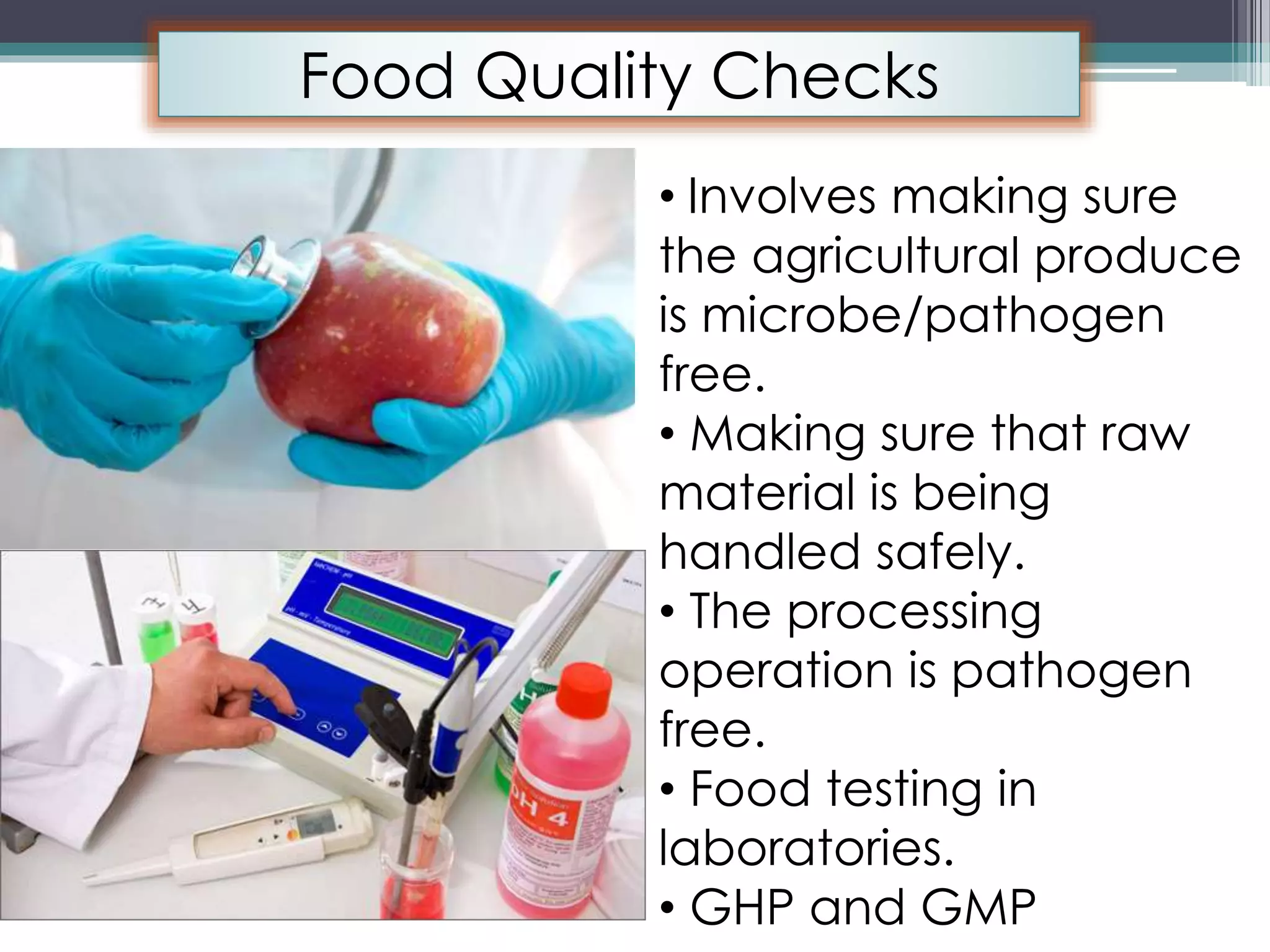
Food Quality Checks
• Involves making sure
the agricultural produce
is microbe/pathogen
free.
• Making sure that raw
material is being
handled safely.
• The processing
operation is pathogen
free.
• Food testing in
laboratories.
• GHP and GMP
Problems with Food Analysis
• Sample preparation is
tedious job.
• Results may not be
reproducible.
• Results may be inaccurate.
What are Biosensors?
Classification of Biosensors
• Enzymes
• Proteins
• Antibodies
• DNA
• Organelles
• Microbial
Cells
Biological Recognition Transducer and
Measured Property
•Electrochemical
• Electrical
•Optical
• Mass Sensitive
•Thermal
Conventional modes of food analysis
and their disadvantages-
• Expensive
• Time
Consuming
• Changes the
morphology of
the food
CASE STUDY- How sampling destroys the real analysis of a food
product.
Uses of Biosensors
Usage of Biosensors in Food Industry
• PH
• DNA Testing
• Alcohol Testing
• Sugar Content Testing
•Contamination in packed Food
A Typical Biosensor
Biosensors in Dairy Technology
•DNA testing of the cows
•Pathogen Testing in the milk
•Milk bacterial Load
• Micro-organism Identification in the
milk
• Test for preservation and
pasteurization
Biosensors in Agriculture
• Testing for pesticides in the
crop.
• Soil ph testing
• Crop deterioration test
• Crop respiration detectors
• Gases detectors
• Environmental pollutants
Trending Biosensors
E- nose
• Sensory Analysis Software (accuracy)
• Detection of odd volatile compounds
• Application in Tea, Wine, Coffee, Spices
Industry
Trending Biosensors
E- Tongue
• Used when a combination of
volatiles and their effect on sensory is
to be analyzed.
• Applications in Tea, Coffee,
Beverage (liquid food industry).
Indian scenario in usage of Biosensors
Research and Development is less;
companies depends more on usage
of conventional systems
Usage of Biosensors are limited to medical
field.
Not manufactured in India. Custom made
are expensive.
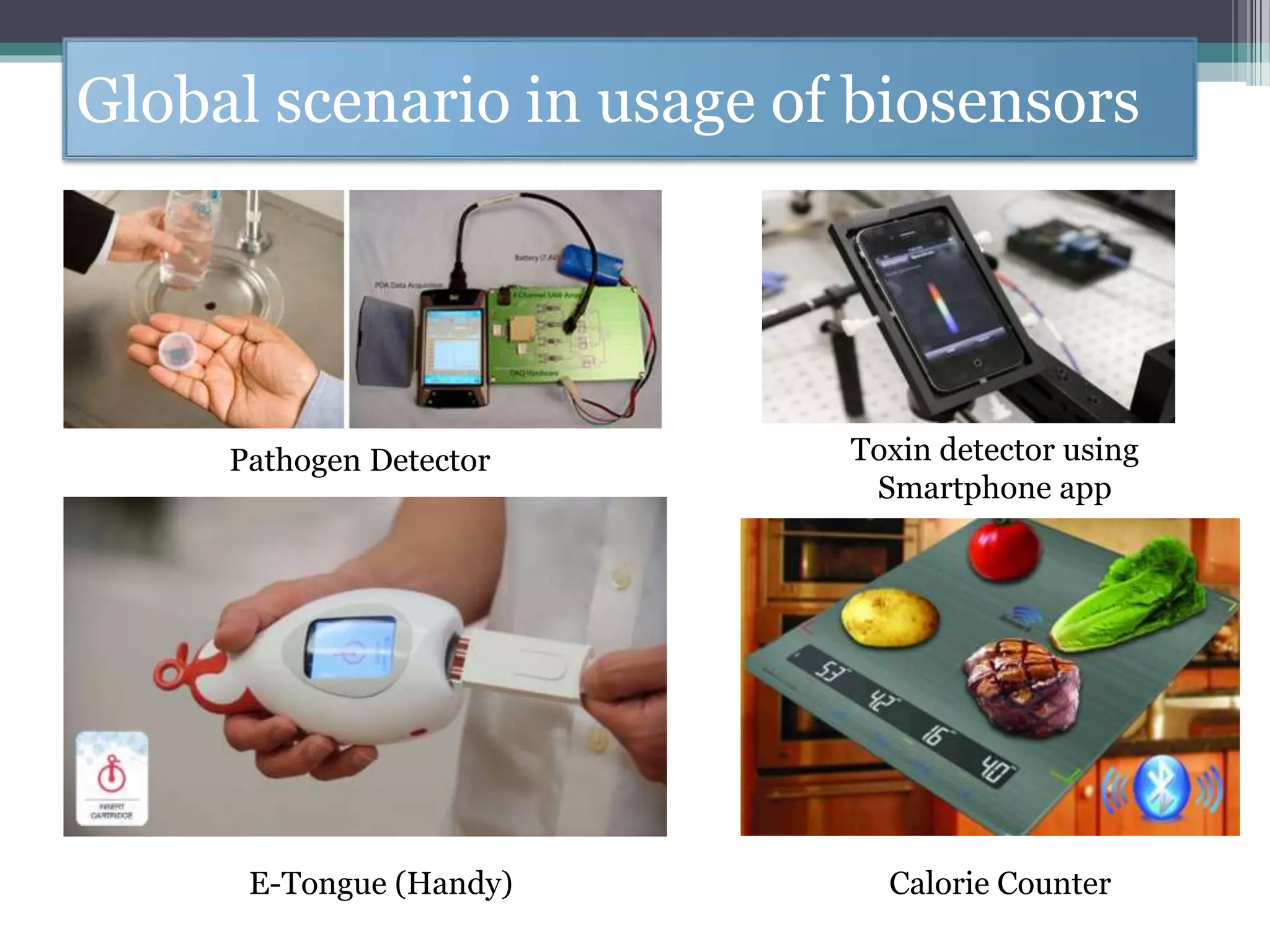
Global scenario in usage of biosensors
Pathogen Detector Toxin detector using
Smartphone app
E-Tongue (Handy) Calorie Counter
Nano-sensors in Food Packaging
Nanotechnology offers 3 distinct
advantages to food packaging-
•Barrier resistance
• Incorporation of active components to
provide functional performance
• Sensing of relevant information
Application in this area already support
development of improved-
• Taste, colour, flavour, texture and
consistency of foodstuffs, increased
absorption and bioavailability of nutrients
and health supplements.
• New food packaging materials with
improved mechanical, barrier and
antimicrobial properties
Nano-sensors for Food Safety
Companies manufacturing Food Biosensors
Conclusion
• The potential is infinite.
• Developmental stage; unorganized.
• India lags in food quality.
• Companies reluctant want to invest in R & D and
food quality.
• With stringent food regulations, the quality
assurance might increase and hence would
increasing the usage of biosensors.
• Handy food biosensors will eliminate the need of
conventional biosensors.
The last fraction…
• A handy biosensor that beats all the biosensors/food
testing equipments ever.
• How can Indian industries use biosensors for quality
assurance.
• From Field to table- Biosensor usage in fresh foods.
• Small, medium and large scale industry- how could
biosensors make a difference in terms of quality.
THANK
YOU

Biosensors in food industry’ presentation by Sonika Singh, NIFTEM, M.tech First year

  • 1.
    ‘Biosensors in FoodIndustry’ By- Sonika Singh (FTM), 414014 Dated : May 7th 2015 A Status Paper Presentation
  • 2.
    Food Quality Checks •Involves making sure the agricultural produce is microbe/pathogen free. • Making sure that raw material is being handled safely. • The processing operation is pathogen free. • Food testing in laboratories. • GHP and GMP
  • 3.
    Problems with FoodAnalysis • Sample preparation is tedious job. • Results may not be reproducible. • Results may be inaccurate.
  • 4.
  • 6.
    Classification of Biosensors •Enzymes • Proteins • Antibodies • DNA • Organelles • Microbial Cells Biological Recognition Transducer and Measured Property •Electrochemical • Electrical •Optical • Mass Sensitive •Thermal
  • 7.
    Conventional modes offood analysis and their disadvantages- • Expensive • Time Consuming • Changes the morphology of the food CASE STUDY- How sampling destroys the real analysis of a food product.
  • 8.
  • 9.
    Usage of Biosensorsin Food Industry • PH • DNA Testing • Alcohol Testing • Sugar Content Testing •Contamination in packed Food
  • 11.
  • 12.
    Biosensors in DairyTechnology •DNA testing of the cows •Pathogen Testing in the milk •Milk bacterial Load • Micro-organism Identification in the milk • Test for preservation and pasteurization
  • 13.
    Biosensors in Agriculture •Testing for pesticides in the crop. • Soil ph testing • Crop deterioration test • Crop respiration detectors • Gases detectors • Environmental pollutants
  • 14.
    Trending Biosensors E- nose •Sensory Analysis Software (accuracy) • Detection of odd volatile compounds • Application in Tea, Wine, Coffee, Spices Industry
  • 15.
    Trending Biosensors E- Tongue •Used when a combination of volatiles and their effect on sensory is to be analyzed. • Applications in Tea, Coffee, Beverage (liquid food industry).
  • 16.
    Indian scenario inusage of Biosensors Research and Development is less; companies depends more on usage of conventional systems Usage of Biosensors are limited to medical field. Not manufactured in India. Custom made are expensive.
  • 17.
    Global scenario inusage of biosensors Pathogen Detector Toxin detector using Smartphone app E-Tongue (Handy) Calorie Counter
  • 18.
    Nano-sensors in FoodPackaging Nanotechnology offers 3 distinct advantages to food packaging- •Barrier resistance • Incorporation of active components to provide functional performance • Sensing of relevant information Application in this area already support development of improved- • Taste, colour, flavour, texture and consistency of foodstuffs, increased absorption and bioavailability of nutrients and health supplements. • New food packaging materials with improved mechanical, barrier and antimicrobial properties
  • 19.
  • 20.
  • 21.
    Conclusion • The potentialis infinite. • Developmental stage; unorganized. • India lags in food quality. • Companies reluctant want to invest in R & D and food quality. • With stringent food regulations, the quality assurance might increase and hence would increasing the usage of biosensors. • Handy food biosensors will eliminate the need of conventional biosensors.
  • 22.
    The last fraction… •A handy biosensor that beats all the biosensors/food testing equipments ever. • How can Indian industries use biosensors for quality assurance. • From Field to table- Biosensor usage in fresh foods. • Small, medium and large scale industry- how could biosensors make a difference in terms of quality.
  • 23.

Editor's Notes

  • #4 Authenticity of the food is spoilt. Food may act differently in different environment. It also requires a lot of skill. Due to uncontrollable external factors like RH, Temperature and water activity. Results may be inaccurate because of inconsistency.
  • #5 History of biosensors usage in medical science recent usage in food science and food industry
  • #7 Enzymes and Proteins- Enzyme Electrode, Antobodies- Immunosensors, Dna- DNA Biosensors, Organelles and Microbial cells- Microbial Sensors Electrochemical: Potentiometric, amperometric and voltametric Electrical: Surface Conductivity and Electrolyte Conductivity Optical: Fluorescence, Adsorption, Reflection Mass Sensitive: Resonant Frequency of peziolytes Thermal: Heat of reaction and heat of adsorption
  • #10 Industry specifics
  • #17 Other reasons are lack of quality maintainence in food processing plants.