
Presented by-
Sneha Sarkar (104)
Soham Ray (105)
Stream: B.Pharm (3rdYear)
College Name: Guru Nanak Institute of Pharmaceutical Science
and Technology
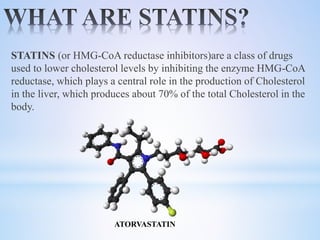
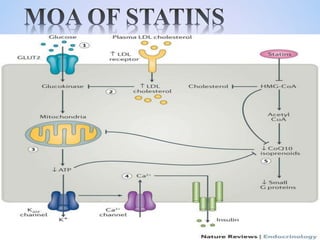
STATINS (or HMG-CoA reductase inhibitors)are a class of drugs
used to lower cholesterol levels by inhibiting the enzyme HMG-CoA
reductase, which plays a central role in the production of Cholesterol
in the liver, which produces about 70% of the total Cholesterol in the
body.
ATORVASTATIN
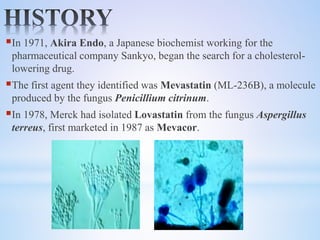
In 1971, Akira Endo, a Japanese biochemist working for the
pharmaceutical company Sankyo, began the search for a cholesterol-
lowering drug.
The first agent they identified was Mevastatin (ML-236B), a molecule
produced by the fungus Penicillium citrinum.
In 1978, Merck had isolated Lovastatin from the fungus Aspergillus
terreus, first marketed in 1987 as Mevacor.
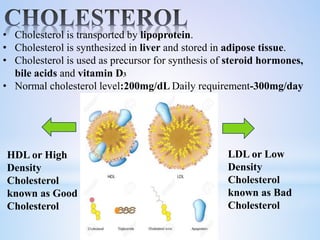
• Cholesterol is transported by lipoprotein.
• Cholesterol is synthesized in liver and stored in adipose tissue.
• Cholesterol is used as precursor for synthesis of steroid hormones,
bile acids and vitamin D3
• Normal cholesterol level:200mg/dL Daily requirement-300mg/day
HDL or High
Density
Cholesterol
known as Good
Cholesterol
LDL or Low
Density
Cholesterol
known as Bad
Cholesterol
Statins
(Brandname)
Dose
(mg/day)
LDL HDL Absorpt
ion
(%)
Bioa
vailab
ility
(%)
Lipophilicity t1/2
(hours)
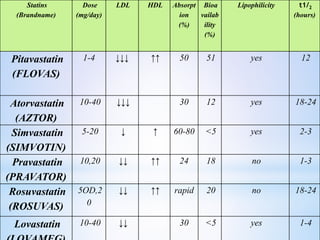
Pitavastatin
(FLOVAS)
1-4 ↓↓↓ ↑↑ 50 51 yes 12
Atorvastatin
(AZTOR)
10-40 ↓↓↓ 30 12 yes 18-24
Simvastatin
(SIMVOTIN)
5-20 ↓ ↑ 60-80 <5 yes 2-3
Pravastatin
(PRAVATOR)
10,20 ↓↓ ↑↑ 24 18 no 1-3
Rosuvastatin
(ROSUVAS)
5OD,2
0
↓↓ ↑↑ rapid 20 no 18-24
Lovastatin 10-40 ↓↓ 30 <5 yes 1-4
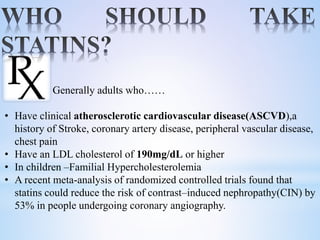
Generally adults who……
• Have clinical atherosclerotic cardiovascular disease(ASCVD),a
history of Stroke, coronary artery disease, peripheral vascular disease,
chest pain
• Have an LDL cholesterol of 190mg/dL or higher
• In children –Familial Hypercholesterolemia
• A recent meta-analysis of randomized controlled trials found that
statins could reduce the risk of contrast–induced nephropathy(CIN) by
53% in people undergoing coronary angiography.
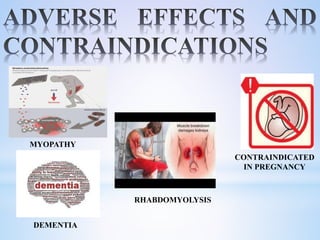
MYOPATHY
RHABDOMYOLYSIS
DEMENTIA
CONTRAINDICATED
IN PREGNANCY
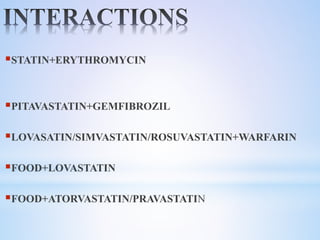
STATIN+ERYTHROMYCIN
PITAVASTATIN+GEMFIBROZIL
LOVASATIN/SIMVASTATIN/ROSUVASTATIN+WARFARIN
FOOD+LOVASTATIN
FOOD+ATORVASTATIN/PRAVASTATIN
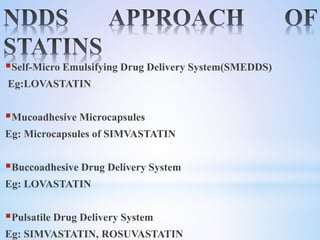
Self-Micro Emulsifying Drug Delivery System(SMEDDS)
Eg:LOVASTATIN
Mucoadhesive Microcapsules
Eg: Microcapsules of SIMVASTATIN
Buccoadhesive Drug Delivery System
Eg: LOVASTATIN
Pulsatile Drug Delivery System
Eg: SIMVASTATIN, ROSUVASTATIN
The discovery of HMG-CoA(3-hydroxy-3-methylglutaryl-
CoA)reductase inhibitors, called statins, was a breakthrough in the
prevention of hypercholesterolemia and related diseases.
Hypercholesterolemia is considered to be one of the major risk factors
for atherosclerosis which often leads
to cardiovascular, cerebrovascular and peripheral vascular diseases.
The statins inhibit cholesterol synthesis in the body and that leads to
reduction in blood cholesterol levels, which is thought to reduce the
risk of atherosclerosis and diseases caused by it.
Statins differ in several ways. The most obvious difference is
in their ability to reduce cholesterol. Currently, atorvastatin
(Lipitor) and rosuvastatin (Crestor) are the most potent, and
fluvastatin (Lescol) is the least potent.
 Cerivastatin (Baycol) was withdrawn from pharmacies
worldwide because it caused rhabdomyolysis 10 to 100
times more often than other statins.
Extensive pharmaceutical research in understanding the
causes of low oral bioavailability has led to the development
of novel technologies to address these challenges.
Shah Asma Farooq, Vipin Saini, Randhir Singh, Kamaldeep
Kaur. Application of novel drug delivery system in the
pharmacotherapy of hyperlipidemia.Haryana;2013.138p
KD Tripathy. Essentials of medical pharmacology. New
Delhi(India):Jaypee brothers medical publishers; 2013.634p.
Statins

Statins

  • 1.
    Presented by- Sneha Sarkar(104) Soham Ray (105) Stream: B.Pharm (3rdYear) College Name: Guru Nanak Institute of Pharmaceutical Science and Technology
  • 2.
    STATINS (or HMG-CoAreductase inhibitors)are a class of drugs used to lower cholesterol levels by inhibiting the enzyme HMG-CoA reductase, which plays a central role in the production of Cholesterol in the liver, which produces about 70% of the total Cholesterol in the body. ATORVASTATIN
  • 3.
    In 1971, AkiraEndo, a Japanese biochemist working for the pharmaceutical company Sankyo, began the search for a cholesterol- lowering drug. The first agent they identified was Mevastatin (ML-236B), a molecule produced by the fungus Penicillium citrinum. In 1978, Merck had isolated Lovastatin from the fungus Aspergillus terreus, first marketed in 1987 as Mevacor.
  • 4.
    • Cholesterol istransported by lipoprotein. • Cholesterol is synthesized in liver and stored in adipose tissue. • Cholesterol is used as precursor for synthesis of steroid hormones, bile acids and vitamin D3 • Normal cholesterol level:200mg/dL Daily requirement-300mg/day HDL or High Density Cholesterol known as Good Cholesterol LDL or Low Density Cholesterol known as Bad Cholesterol
  • 6.
    Statins (Brandname) Dose (mg/day) LDL HDL Absorpt ion (%) Bioa vailab ility (%) Lipophilicityt1/2 (hours) Pitavastatin (FLOVAS) 1-4 ↓↓↓ ↑↑ 50 51 yes 12 Atorvastatin (AZTOR) 10-40 ↓↓↓ 30 12 yes 18-24 Simvastatin (SIMVOTIN) 5-20 ↓ ↑ 60-80 <5 yes 2-3 Pravastatin (PRAVATOR) 10,20 ↓↓ ↑↑ 24 18 no 1-3 Rosuvastatin (ROSUVAS) 5OD,2 0 ↓↓ ↑↑ rapid 20 no 18-24 Lovastatin 10-40 ↓↓ 30 <5 yes 1-4
  • 8.
    Generally adults who…… •Have clinical atherosclerotic cardiovascular disease(ASCVD),a history of Stroke, coronary artery disease, peripheral vascular disease, chest pain • Have an LDL cholesterol of 190mg/dL or higher • In children –Familial Hypercholesterolemia • A recent meta-analysis of randomized controlled trials found that statins could reduce the risk of contrast–induced nephropathy(CIN) by 53% in people undergoing coronary angiography.
  • 9.
  • 10.
  • 11.
    Self-Micro Emulsifying DrugDelivery System(SMEDDS) Eg:LOVASTATIN Mucoadhesive Microcapsules Eg: Microcapsules of SIMVASTATIN Buccoadhesive Drug Delivery System Eg: LOVASTATIN Pulsatile Drug Delivery System Eg: SIMVASTATIN, ROSUVASTATIN
  • 12.
    The discovery ofHMG-CoA(3-hydroxy-3-methylglutaryl- CoA)reductase inhibitors, called statins, was a breakthrough in the prevention of hypercholesterolemia and related diseases. Hypercholesterolemia is considered to be one of the major risk factors for atherosclerosis which often leads to cardiovascular, cerebrovascular and peripheral vascular diseases. The statins inhibit cholesterol synthesis in the body and that leads to reduction in blood cholesterol levels, which is thought to reduce the risk of atherosclerosis and diseases caused by it.
  • 13.
    Statins differ inseveral ways. The most obvious difference is in their ability to reduce cholesterol. Currently, atorvastatin (Lipitor) and rosuvastatin (Crestor) are the most potent, and fluvastatin (Lescol) is the least potent.  Cerivastatin (Baycol) was withdrawn from pharmacies worldwide because it caused rhabdomyolysis 10 to 100 times more often than other statins. Extensive pharmaceutical research in understanding the causes of low oral bioavailability has led to the development of novel technologies to address these challenges.
  • 14.
    Shah Asma Farooq,Vipin Saini, Randhir Singh, Kamaldeep Kaur. Application of novel drug delivery system in the pharmacotherapy of hyperlipidemia.Haryana;2013.138p KD Tripathy. Essentials of medical pharmacology. New Delhi(India):Jaypee brothers medical publishers; 2013.634p.