TRIGGER
A batch of 100mg Sumatriptan (Imigran) tablets, produced by
IntelliPharma Ltd, failed a number of USP quality control
tests for tablets. An investigation revealed numerous issues
during tablet formulation. Due to ongoing production
problems, the company decides to switch to Sumatriptan
capsules. In addition, a decision is made to begin
production of a novel transdermal delivery system
containing sumatriptan.
As the new section head, you have been assigned
responsibly for these two new products, to ensure they
meet all standards of safety, quality and efficacy.
LEARNING OBJECTIVE
1. Description and component of Transdermal drug delivery
system (TDDS)
2. Formulation principle of TDDS
3. Advantage and disadvantage of TDDS
4. Comparison between old TDDS and other Novel
formulations
5. Type of penetration enhancer
6. Comparison TDDS and oral drug delivery system
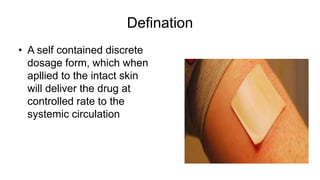
Defination
• A self contained discrete
dosage form, which when
apllied to the intact skin
will deliver the drug at
controlled rate to the
systemic circulation
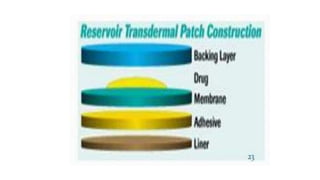
COMPONENTS OF TDDS
POLYMER MATRIX
DRUG
PERMEATION ENHANCER
OTHER EXCIPENTS
POLYMER MATRIX
• Release the drug from the device
• Ideal criteria :
– Molecular weight,physical characteristic of polymer can allow
diffusion of drug desired
– Non-reactive, inert, stable and easily manufactured
– The mechanical properties of the polymer should not-
deteriorate excessively when large amount of active ingredient
incorporated into it
DRUG
• Phsicochemical properties
– Criteria:
– Non-ionic
– Low molecular weight (<1000 Da)
– Low melting point
• Biological properties
– Criteria :
– Potent with daily dose of ew mg/day
– Non-irritant
– Short half life
– Drug prone to first pass metabolism and degrade in GIT
PERMEATION ENHANCER
• Agent that promote the skin permeability by altering the
skin as a barrier to the flux of desired penetrant
• Criteria :
– Inert
– Non- toxic
– Immediate action
– Compatible with drug and other excipients
OTHER EXCIPIENTS
• Adhesive
• non-irritate or sensive the skin
• Adhere to the skin during dose interval
• Easily removed
• Not leave unwashable residue
• Backing membrane
• Flexible and provide good bond to the drug reservoir
• Impermeable membrane that protect the product during the use
on the skin
• Contain formulation throughout shelf life and during wear period
• Printable
Selecting drug molecules
• Small in size large
• Relatively low molecular weight (<500 Da)
* Molecular mass of sumatriptan : 295.4 Da.
• Moderately lipophilic with ( log Pwater/octanol = 1–4)
* log P of sumatriptan = 1.06.
• Effective at low doses
* <10 mg/day for transdermal delivery.
Drug Release
• Rapid release = locally acting drug.
• sustained and slow release = (7-day patch).
• The formulation will contains :
* moderately lipophilic drug (Sumatriptan) in a lipophilic oily base.
• Thus, the drug is less likely to partition out of the formulation
and enter the lipophilic skin barrier.
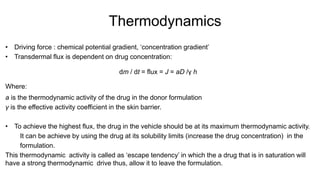
Thermodynamics
• Driving force : chemical potential gradient, ‘concentration gradient’
• Transdermal flux is dependent on drug concentration:
dm / dt = flux = J = aD /γ h
Where:
a is the thermodynamic activity of the drug in the donor formulation
γ is the effective activity coefficient in the skin barrier.
• To achieve the highest flux, the drug in the vehicle should be at its maximum thermodynamic activity.
It can be achieve by using the drug at its solubility limits (increase the drug concentration) in the
formulation.
This thermodynamic activity is called as ‘escape tendency’ in which the a drug that is in saturation will
have a strong thermodynamic drive thus, allow it to leave the formulation.
Alcohol
• Alcohols can partition into skin and can provide a transient ‘reservoir’ into which the drug can
partition.
• Improve the diffusion coefficient of the drug in the stratum corneum.
• ‘Good’ solvents , they evaporate from the skin surface.
Occlusion.
• Occlusion = (covering the skin with an impermeable barrier)
• Function: Hydrates the skin by blocking transepidermal water loss to the external
environment.
• Thus, the water content of the stratum corneum can rise up to 400% of the tissue's dry
weight
• increased hydration and porosity of the skin (improves transdermal delivery of
sumatriptan).
Advantages & disadvantages
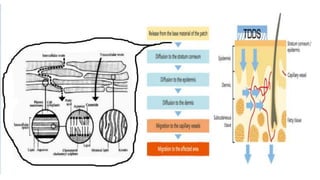
TRANSDERMAL DRUG DELIVERY SYSTEM
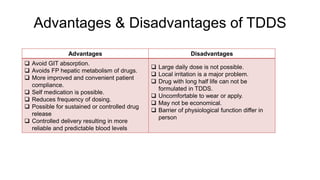
Advantages & Disadvantages of TDDS
Advantages Disadvantages
 Avoid GIT absorption.
 Avoids FP hepatic metabolism of drugs.
 More improved and convenient patient
compliance.
 Self medication is possible.
 Reduces frequency of dosing.
 Possible for sustained or controlled drug
release
 Controlled delivery resulting in more
reliable and predictable blood levels
 Large daily dose is not possible.
 Local irritation is a major problem.
 Drug with long half life can not be
formulated in TDDS.
 Uncomfortable to wear or apply.
 May not be economical.
 Barrier of physiological function differ in
person
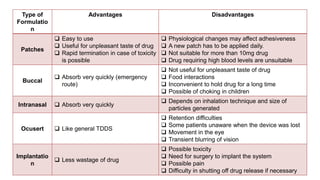
ComparisonS
BETWEEN OLD TDDS SYSTEM & OTHER NOVEL FORMULATIONS
Type of
Formulatio
n
Advantages Disadvantages
Patches
 Easy to use
 Useful for unpleasant taste of drug
 Rapid termination in case of toxicity
is possible
 Physiological changes may affect adhesiveness
 A new patch has to be applied daily.
 Not suitable for more than 10mg drug
 Drug requiring high blood levels are unsuitable
Buccal
 Absorb very quickly (emergency
route)
 Not useful for unpleasant taste of drug
 Food interactions
 Inconvenient to hold drug for a long time
 Possible of choking in children
Intranasal  Absorb very quickly
 Depends on inhalation technique and size of
particles generated
Ocusert  Like general TDDS
 Retention difficulties
 Some patients unaware when the device was lost
 Movement in the eye
 Transient blurring of vision
Implantatio
n
 Less wastage of drug
 Possible toxicity
 Need for surgery to implant the system
 Possible pain
 Difficulty in shutting off drug release if necessary
Penetration enhancer
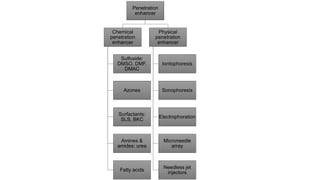
Penetration
enhancer
Chemical
penetration
enhancer
Sulfoxide:
DMSO, DMF,
DMAC
Azones
Surfactants:
SLS, BKC
Amines &
amides: urea
Fatty acids
Physical
penetration
enhancer
Iontophoresis
Sonophoresis
Electrophoration
Microneedle
array
Needless jet
injectors
Chemical penetration enhancer
1. Sulphoxides
MOA: -denature protein, change the keratin conformation
-interact with head groups of some bilayer lipids to distort the
packing geometry
2. Azones
MOA: -interact with the lipid domains of stratum corneum
-partition into lipid bilayer to disrupt their packing arrangement
3. Surfactants
MOA: -solubilise the lipophilic active ingredient and also solubilise lipids
within the stratum corneum
4. Urea
MOA: -hydrating agent
-produce significant stratum corneum hydration
-produce hydrophilic diffusion channels
5. Fatty acids
MOA: -interacts with and modifies the lipid domains of stratum corneum
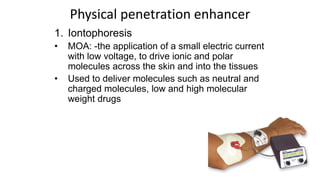
1. Iontophoresis
• MOA: -the application of a small electric current
with low voltage, to drive ionic and polar
molecules across the skin and into the tissues
• Used to deliver molecules such as neutral and
charged molecules, low and high molecular
weight drugs
Physical penetration enhancer
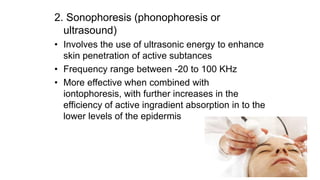
2. Sonophoresis (phonophoresis or
ultrasound)
• Involves the use of ultrasonic energy to enhance
skin penetration of active subtances
• Frequency range between -20 to 100 KHz
• More effective when combined with
iontophoresis, with further increases in the
efficiency of active ingradient absorption in to the
lower levels of the epidermis
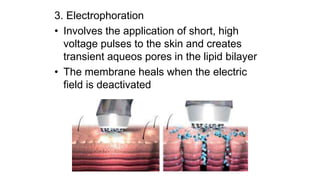
3. Electrophoration
• Involves the application of short, high
voltage pulses to the skin and creates
transient aqueos pores in the lipid bilayer
• The membrane heals when the electric
field is deactivated
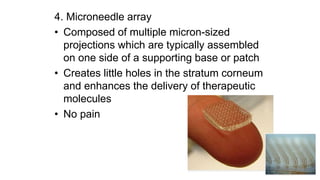
4. Microneedle array
• Composed of multiple micron-sized
projections which are typically assembled
on one side of a supporting base or patch
• Creates little holes in the stratum corneum
and enhances the delivery of therapeutic
molecules
• No pain
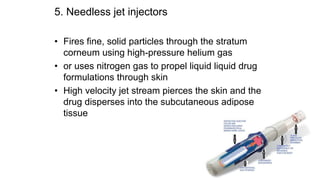
5. Needless jet injectors
• Fires fine, solid particles through the stratum
corneum using high-pressure helium gas
• or uses nitrogen gas to propel liquid liquid drug
formulations through skin
• High velocity jet stream pierces the skin and the
drug disperses into the subcutaneous adipose
tissue

TDDS

  • 1.
    TRIGGER A batch of100mg Sumatriptan (Imigran) tablets, produced by IntelliPharma Ltd, failed a number of USP quality control tests for tablets. An investigation revealed numerous issues during tablet formulation. Due to ongoing production problems, the company decides to switch to Sumatriptan capsules. In addition, a decision is made to begin production of a novel transdermal delivery system containing sumatriptan. As the new section head, you have been assigned responsibly for these two new products, to ensure they meet all standards of safety, quality and efficacy.
  • 2.
    LEARNING OBJECTIVE 1. Descriptionand component of Transdermal drug delivery system (TDDS) 2. Formulation principle of TDDS 3. Advantage and disadvantage of TDDS 4. Comparison between old TDDS and other Novel formulations 5. Type of penetration enhancer 6. Comparison TDDS and oral drug delivery system
  • 3.
    Defination • A selfcontained discrete dosage form, which when apllied to the intact skin will deliver the drug at controlled rate to the systemic circulation
  • 5.
    COMPONENTS OF TDDS POLYMERMATRIX DRUG PERMEATION ENHANCER OTHER EXCIPENTS
  • 6.
    POLYMER MATRIX • Releasethe drug from the device • Ideal criteria : – Molecular weight,physical characteristic of polymer can allow diffusion of drug desired – Non-reactive, inert, stable and easily manufactured – The mechanical properties of the polymer should not- deteriorate excessively when large amount of active ingredient incorporated into it
  • 7.
    DRUG • Phsicochemical properties –Criteria: – Non-ionic – Low molecular weight (<1000 Da) – Low melting point • Biological properties – Criteria : – Potent with daily dose of ew mg/day – Non-irritant – Short half life – Drug prone to first pass metabolism and degrade in GIT
  • 8.
    PERMEATION ENHANCER • Agentthat promote the skin permeability by altering the skin as a barrier to the flux of desired penetrant • Criteria : – Inert – Non- toxic – Immediate action – Compatible with drug and other excipients
  • 9.
    OTHER EXCIPIENTS • Adhesive •non-irritate or sensive the skin • Adhere to the skin during dose interval • Easily removed • Not leave unwashable residue • Backing membrane • Flexible and provide good bond to the drug reservoir • Impermeable membrane that protect the product during the use on the skin • Contain formulation throughout shelf life and during wear period • Printable
  • 12.
    Selecting drug molecules •Small in size large • Relatively low molecular weight (<500 Da) * Molecular mass of sumatriptan : 295.4 Da. • Moderately lipophilic with ( log Pwater/octanol = 1–4) * log P of sumatriptan = 1.06. • Effective at low doses * <10 mg/day for transdermal delivery.
  • 13.
    Drug Release • Rapidrelease = locally acting drug. • sustained and slow release = (7-day patch). • The formulation will contains : * moderately lipophilic drug (Sumatriptan) in a lipophilic oily base. • Thus, the drug is less likely to partition out of the formulation and enter the lipophilic skin barrier.
  • 14.
    Thermodynamics • Driving force: chemical potential gradient, ‘concentration gradient’ • Transdermal flux is dependent on drug concentration: dm / dt = flux = J = aD /γ h Where: a is the thermodynamic activity of the drug in the donor formulation γ is the effective activity coefficient in the skin barrier. • To achieve the highest flux, the drug in the vehicle should be at its maximum thermodynamic activity. It can be achieve by using the drug at its solubility limits (increase the drug concentration) in the formulation. This thermodynamic activity is called as ‘escape tendency’ in which the a drug that is in saturation will have a strong thermodynamic drive thus, allow it to leave the formulation.
  • 15.
    Alcohol • Alcohols canpartition into skin and can provide a transient ‘reservoir’ into which the drug can partition. • Improve the diffusion coefficient of the drug in the stratum corneum. • ‘Good’ solvents , they evaporate from the skin surface. Occlusion. • Occlusion = (covering the skin with an impermeable barrier) • Function: Hydrates the skin by blocking transepidermal water loss to the external environment. • Thus, the water content of the stratum corneum can rise up to 400% of the tissue's dry weight • increased hydration and porosity of the skin (improves transdermal delivery of sumatriptan).
  • 16.
  • 17.
    Advantages & Disadvantagesof TDDS Advantages Disadvantages  Avoid GIT absorption.  Avoids FP hepatic metabolism of drugs.  More improved and convenient patient compliance.  Self medication is possible.  Reduces frequency of dosing.  Possible for sustained or controlled drug release  Controlled delivery resulting in more reliable and predictable blood levels  Large daily dose is not possible.  Local irritation is a major problem.  Drug with long half life can not be formulated in TDDS.  Uncomfortable to wear or apply.  May not be economical.  Barrier of physiological function differ in person
  • 18.
    ComparisonS BETWEEN OLD TDDSSYSTEM & OTHER NOVEL FORMULATIONS
  • 19.
    Type of Formulatio n Advantages Disadvantages Patches Easy to use  Useful for unpleasant taste of drug  Rapid termination in case of toxicity is possible  Physiological changes may affect adhesiveness  A new patch has to be applied daily.  Not suitable for more than 10mg drug  Drug requiring high blood levels are unsuitable Buccal  Absorb very quickly (emergency route)  Not useful for unpleasant taste of drug  Food interactions  Inconvenient to hold drug for a long time  Possible of choking in children Intranasal  Absorb very quickly  Depends on inhalation technique and size of particles generated Ocusert  Like general TDDS  Retention difficulties  Some patients unaware when the device was lost  Movement in the eye  Transient blurring of vision Implantatio n  Less wastage of drug  Possible toxicity  Need for surgery to implant the system  Possible pain  Difficulty in shutting off drug release if necessary
  • 20.
  • 21.
    Penetration enhancer Chemical penetration enhancer Sulfoxide: DMSO, DMF, DMAC Azones Surfactants: SLS, BKC Amines& amides: urea Fatty acids Physical penetration enhancer Iontophoresis Sonophoresis Electrophoration Microneedle array Needless jet injectors
  • 22.
    Chemical penetration enhancer 1.Sulphoxides MOA: -denature protein, change the keratin conformation -interact with head groups of some bilayer lipids to distort the packing geometry 2. Azones MOA: -interact with the lipid domains of stratum corneum -partition into lipid bilayer to disrupt their packing arrangement 3. Surfactants MOA: -solubilise the lipophilic active ingredient and also solubilise lipids within the stratum corneum 4. Urea MOA: -hydrating agent -produce significant stratum corneum hydration -produce hydrophilic diffusion channels 5. Fatty acids MOA: -interacts with and modifies the lipid domains of stratum corneum
  • 23.
    1. Iontophoresis • MOA:-the application of a small electric current with low voltage, to drive ionic and polar molecules across the skin and into the tissues • Used to deliver molecules such as neutral and charged molecules, low and high molecular weight drugs Physical penetration enhancer
  • 24.
    2. Sonophoresis (phonophoresisor ultrasound) • Involves the use of ultrasonic energy to enhance skin penetration of active subtances • Frequency range between -20 to 100 KHz • More effective when combined with iontophoresis, with further increases in the efficiency of active ingradient absorption in to the lower levels of the epidermis
  • 25.
    3. Electrophoration • Involvesthe application of short, high voltage pulses to the skin and creates transient aqueos pores in the lipid bilayer • The membrane heals when the electric field is deactivated
  • 26.
    4. Microneedle array •Composed of multiple micron-sized projections which are typically assembled on one side of a supporting base or patch • Creates little holes in the stratum corneum and enhances the delivery of therapeutic molecules • No pain
  • 27.
    5. Needless jetinjectors • Fires fine, solid particles through the stratum corneum using high-pressure helium gas • or uses nitrogen gas to propel liquid liquid drug formulations through skin • High velocity jet stream pierces the skin and the drug disperses into the subcutaneous adipose tissue